What? You say. She’s seen them and photographed them. Surely she knows what they look like. Well, in a manner of speaking, I do, of course. I’ve got quite of bit of reference of them from previous sightings and have done a couple of small paintngs. But until this past trip I didn’t really have sharp, close-up reference of ibex in good light and also doing interesting things. Now I do.
I spent three out of my first four mornings at Ikh Nartiin Chuluu Nature Reserve in August taking around 1000 photos of 2-3 groups of nannies, kids and young billies. I’ve done an initial sorting and 5-star rated (in Aperture, my image management software) the ones that caught my eye for possible paintings.
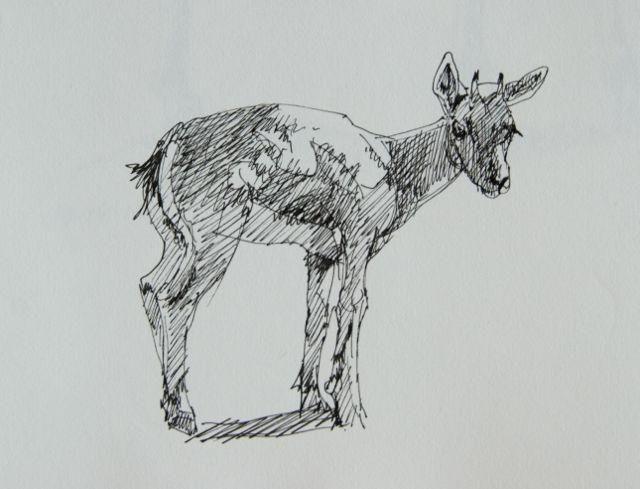
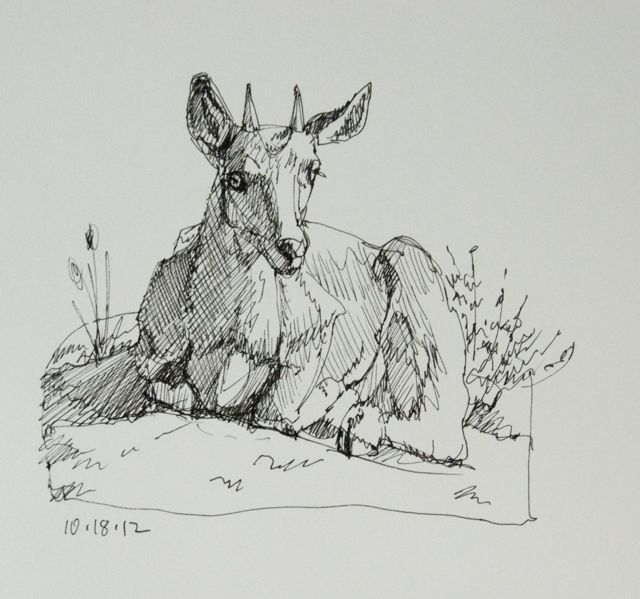
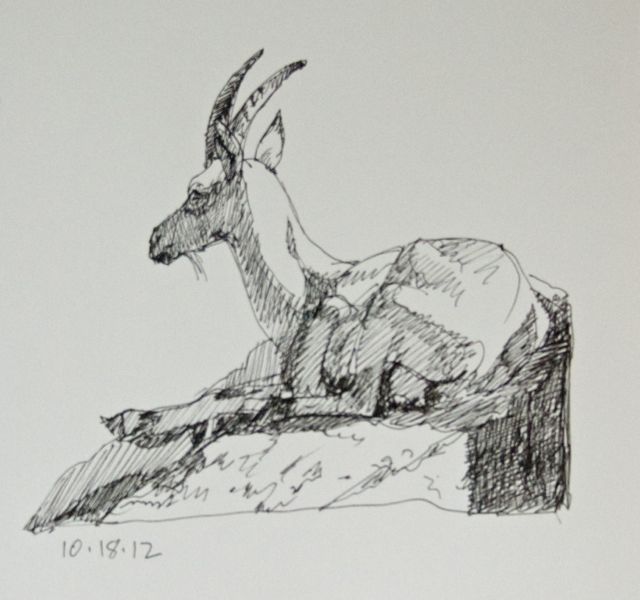
But…I’ve learned when I decide to paint a new species that I’ll be sorry if I just dive in and hit the easel. I first need to “learn what the animal looks like” and to do that I simplify things by doing a number of monochrome sketches and drawings to familiarize myself with their structure, proportions and anatomy, along with looking for interesting behaviors. I pick reference photos that have a strong light and shadow pattern or some kind of interesting, perhaps, challenging, pose. Sometimes I throw in a quick indication of the ground so I can start to think about that, too.
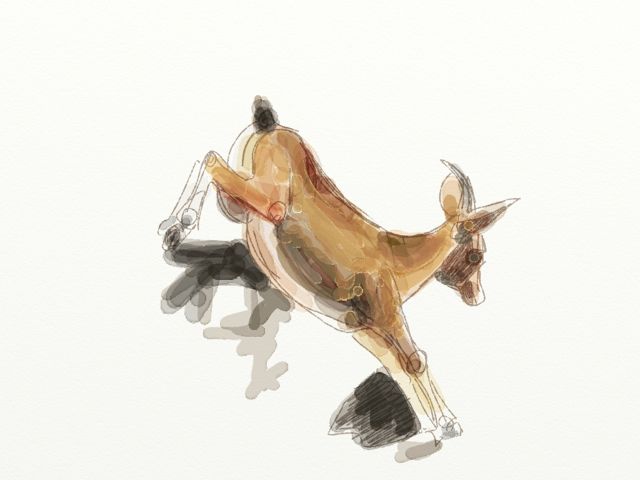
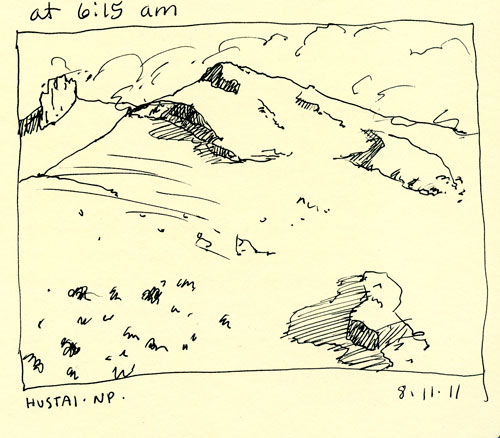
I like doing small, fairly quick pen sketches. For those I use Sakura Micron .01. and .02 pens on whatever sketchbook I have on hand. They give me a basic idea of what I need to know. Then I’ll often do some finished larger graphite drawings on vellum bristol. I also did a couple of iPad drawings using ArtRage, which makes it easy to lay in some color.
Pen and ink sketches- I do these directly with the pen and spend about 10-30 minutes max on them depending on sizePen and ink sketchPen and ink sketchPen and ink sketchPen and ink sketchGraphite on vellum bristolgraphite on vellum bristolgraphite on vellum bristoliPad using ArtRage appiPad using ArtRage app
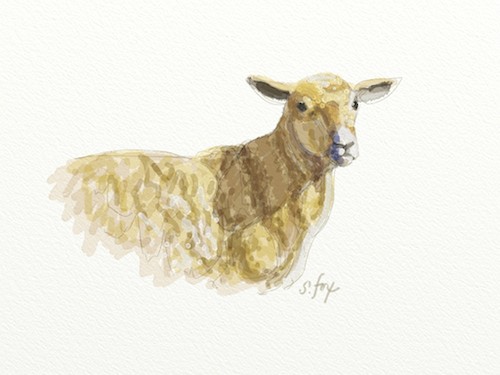
An artist friend and colleague, Guy Combes, just told me about a iPad art app called ArtRage. So of course I had to buy it and try it. Below are a few of my first pieces using it.
ArtRage provides tools that correspond to all the regular media and tools artists use…pencils, brushes, pastels, pens, palette knife, airbrush and also chalk and crayons. You can also pick your “paper”. The app is designed for the tools to make the same kind of marks on the different virtual papers that they would on real papers and canvas.
I think it’s a good complement to Autodesk’s Sketchbook Pro, which is more illustration oriented in terms of the tools it offers. ArtRage is definitely targeted towards fine artists. But both can be easily and productively used by either depending on what one wants to do. I like having both! Here’s what I’ve done using Sketchbook Pro.
So far, I’ve only messed with the watercolor brush on watercolor “paper”. I’m interested in being able to use my iPad for location painting in addition to sketching and I think this will work, once I get the hang of it.
Young horseNeighborhood sheepWhite-napped crane, Bronx Zoo
I got an email last year from one of the authors of a book called “Visual Notes”, first published in 1984. He and his co-author were updating it to include images created digitally. He found my blog post about my iPad sketching and asked permission to use some of them in the new edition. Of course, I said “Yes!”
The new book is out and is available on here on Amazon. I haven’t had a chance to read it yet, but have browsed through it and it looks really good. I’m very, very proud to have my iPad sketches included in a book that also includes “visual notes” by people such as choreographer Merce Cunningham and architect Michael Graves.
Here are a few of the seven sketches that are in the book:
"Pot-bellied Pig, Oakland Zoo"- I did this one in about 15 seconds and almost hit "Don't Save", but this was the one that caught the author's eye."Flamingos, Oakland Zoo"- My own favorite from that day at the zoo."Roosevelt Elk Bull, Redwood National Park"- I sat in the car and sketched this big guy who also had a large harem of cows.
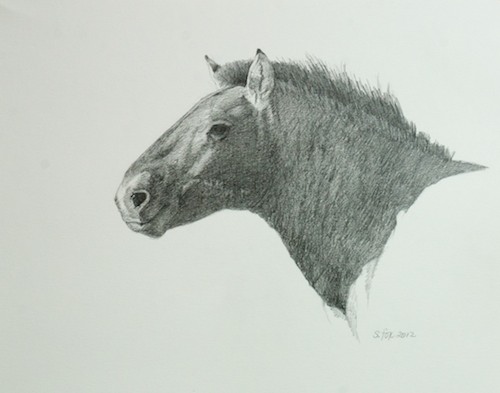
It’s been awhile since I’ve done some finished graphite drawings and that’s what I’ve been doing this week. I’ve always loved to draw, so it was fun to just sit with a pencil (a General’s Draughting Pencil) and paper (Strathmore 300 vellum bristol) and work from some of the takhi photos I’ve shot during my trips to Mongolia.
Tahki StallionTakhi foalTakhi Stallion Head StudyTakhi Stallion "Snaking"
A French equid researcher I know told me that this body position is known as “snaking”. It’s purpose is to get the stallion’s harem moving quickly. His low body position is suggestive of a stalking predator and triggers the response he wants from his mares. I’ll probably be doing a painting of the whole scene at some point, so this is a useful study.
All of these horses were photographed at Hustai National Park, which is an easy two-hour drive west of Ulaanbaatar.
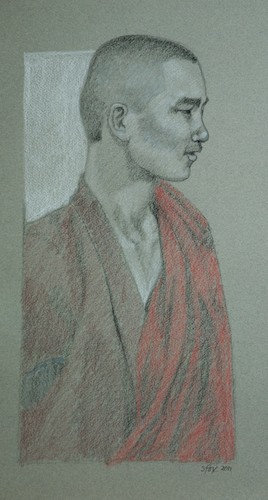
After looking through Drew Struzen’s wonderful book, “Oeuvre”, I got inspired to pull out some toned Canson paper and try some portraits of Mongol people I’ve photographed over the years. I’m not anywhere near his league, but I’m really having fun doing this kind of finished drawing again.
These are all on Canson Mi Tientes paper, drawn with a 6B General’s Charcoal Pencil and a white Prismacolor colored pencil. For the monks, I added a couple of other colors for their robes.
A herder from Ikh Nartiin Chuluu, 2005A young monk, Gandan Monastery, Ulaanbaatar, 2006An older monk, Gandan Monastery, Ulaanbaatar, 2006Camel herder's wife, Gobi, 2006
Little by little I’m getting caught up, but there are a couple of really interesting irons in the fire that I’ll be posting about in the weeks ahead that have taken a fair amount of email time.
In the meantime, there’s this trip I just took, during which I managed to find some sketching time, both in my journal and in my iPad.
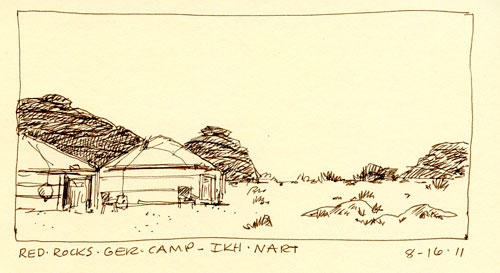
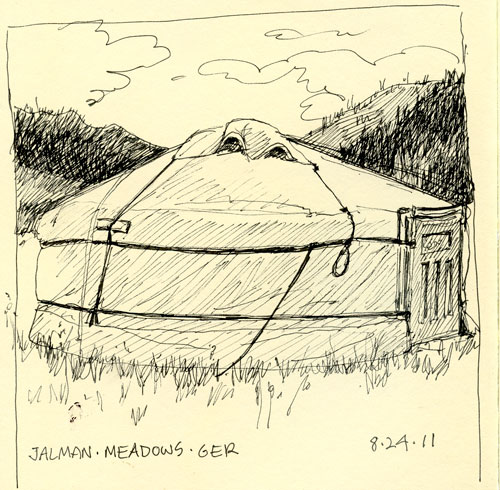
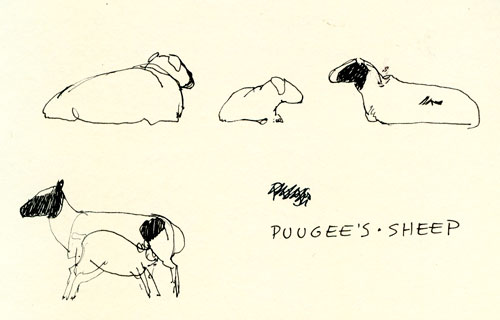
First are the ones I did in my Moleskin sketch journal. They were pretty much all done in five minutes or less for the small ones and maybe twenty for the one that crosses both pages. Some were done during lunch stops, some at camp between drives. The cows and sheep were done at the home ger of my driver, where I got to stay overnight. That wonderful experience will rate its own post:
...we're going and that's ok.
Since no one pestered me while I did the above sketch, I got out my iPad and did a couple more quick studies.
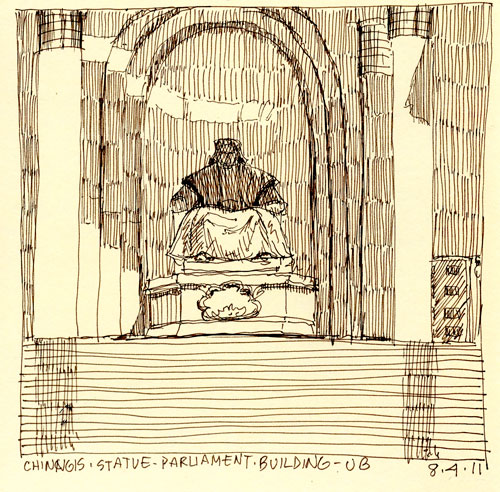
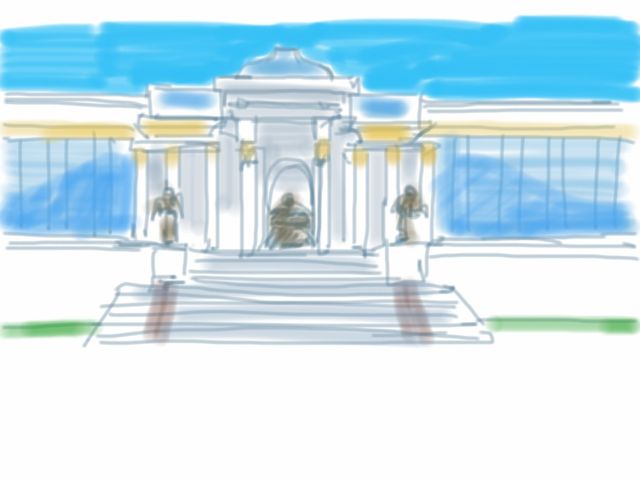
Parliament BuildingThree of a large group of women who were meeting on the square, some wearing beautiful del
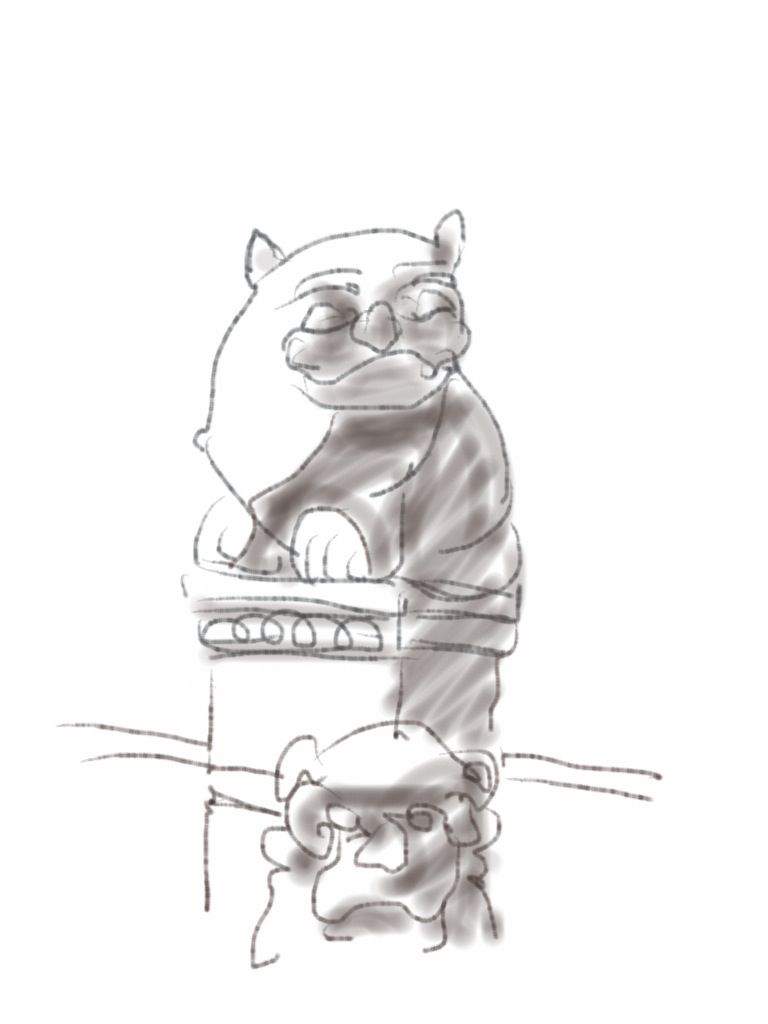
Before we left on our “wildlife tour”, Pokey and I had time to wander around UB. I took her to the Museum of the Chojin Lama. Since I had been in the temples before, I got out my iPad and did a little sketching of a few of the statues flanking the entry stairs of the main temple.
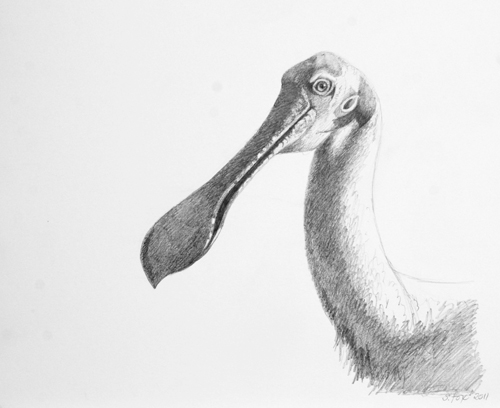
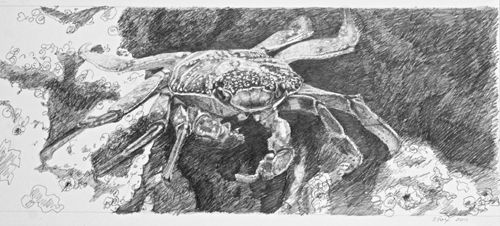
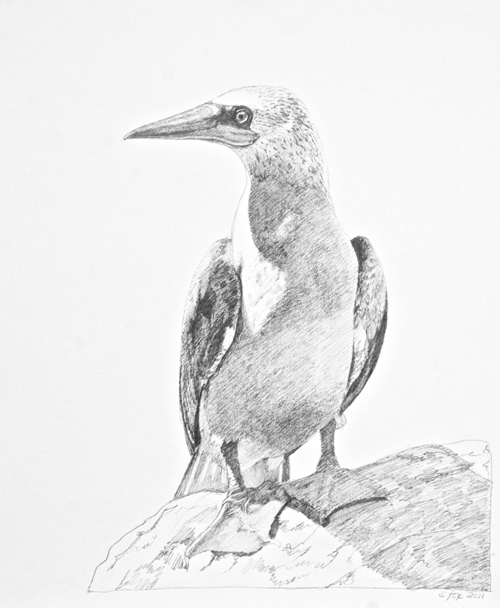
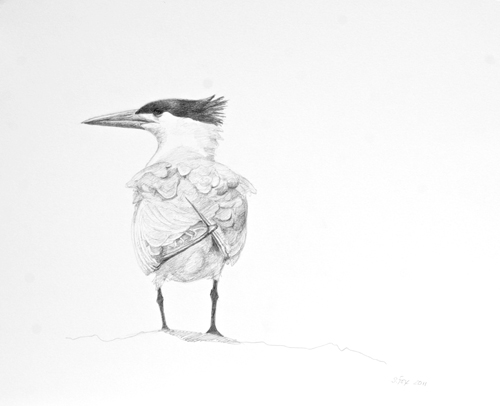
I’ve been having fun over the last month or so doing graphite drawings from reference I shot during the artist’s trip to the Sea of Cortez this past March. You can find out more about the trip here.
One of the reasons for doing them is to explore possible subjects for finished paintings that will be submitted for the 2013 exhibition, “The Sea of Cortez: Where the Desert Meets the Sea”, to be held at the Arizona-Sonora Desert Museum in Tucson, Arizona.
All the drawings are done with a General Draughting Pencil on 14×17″ Strathmore vellum bristol.
So, without further ado:
Roseate spoonbillSally Lightfoot crabBlue-footed boobyMagnificent frigatebirdElegant or Royal tern (the birders on the trip never could decide for sure which species)
Continuing on from last week, I knew that I was going to do a big painting (big for me, at this point) when the five rams walked across the stream bed in the beautiful morning light.
I also knew that it would be a complex piece that would take more planning than I’d done in the past. I’ve started a couple of big paintings, only to have them bog down and fail because, while I did do preliminary sketches and drawings, I found that I hadn’t really solved some critical problems and then was faced with figuring them out on the canvas. A recipe for frustration and failure.
Not this time. First, I thought about what it was that made me want to paint this scene. It was not only the argali, but the interesting alternating pattern of light and shadow, which started in the foreground and went all the way back. And it was important that it be about my emotional response to this very special experience.
Here’s one of the reference shots. I create Albums in Aperture where I can put all the images I’m using on a painting. In this case, thirteen. Here’s the lead ram.
Since I had a pretty clear image in my head of where I wanted to end up, I didn’t do thumbnails this time. And, having struggled with understanding how to work larger, I decided to start larger right away. This is the first layout, done on 19×24″ Canson Calque tracing paper.
As you can see, I adjusted the proportions as needed. I wanted the emphasis to be on the rams, but still show enough of the background to place them in a specific setting and show that alternating light and shadow pattern.
You will also notice that I have an even number of animals, which breaks a “rule”. But they are in an uneven number of “groups”. This doesn’t happen by accident. Or if it does, then there is a conscious decision to keep it.
I had also done a finished drawing of the two rams, which some of you saw a few months ago on Facebook (you can “Like” my public page here).
The next step was to do a small color rough to figure out how I would achieve the visual effect I was looking for. This is on a 6×8″ canvasboard. I blocked out the part that didn’t fit the proportion.
What was critical was to play up the golden light on the ram’s horns and to make sure the argali were the objects of highest contrast by placing them against the central shadow shape. Notice that I’m just painting blobs of color to get the relationships down.
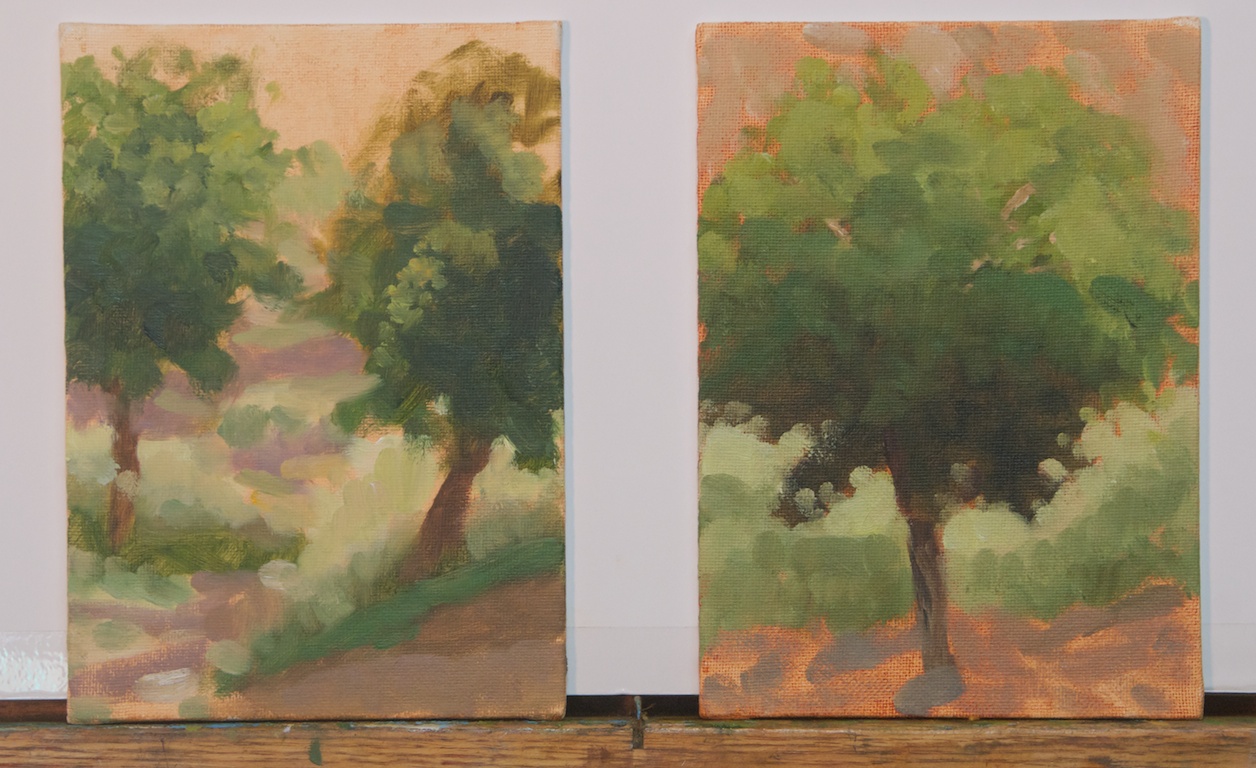
The central tree has a cast shadow. This is something that has given me trouble in the past. The shapes, edges and value relationships have to be just right. So I did a couple of studies of just that tree, along with another to figure out some of the same things where the stream bed goes back into space.
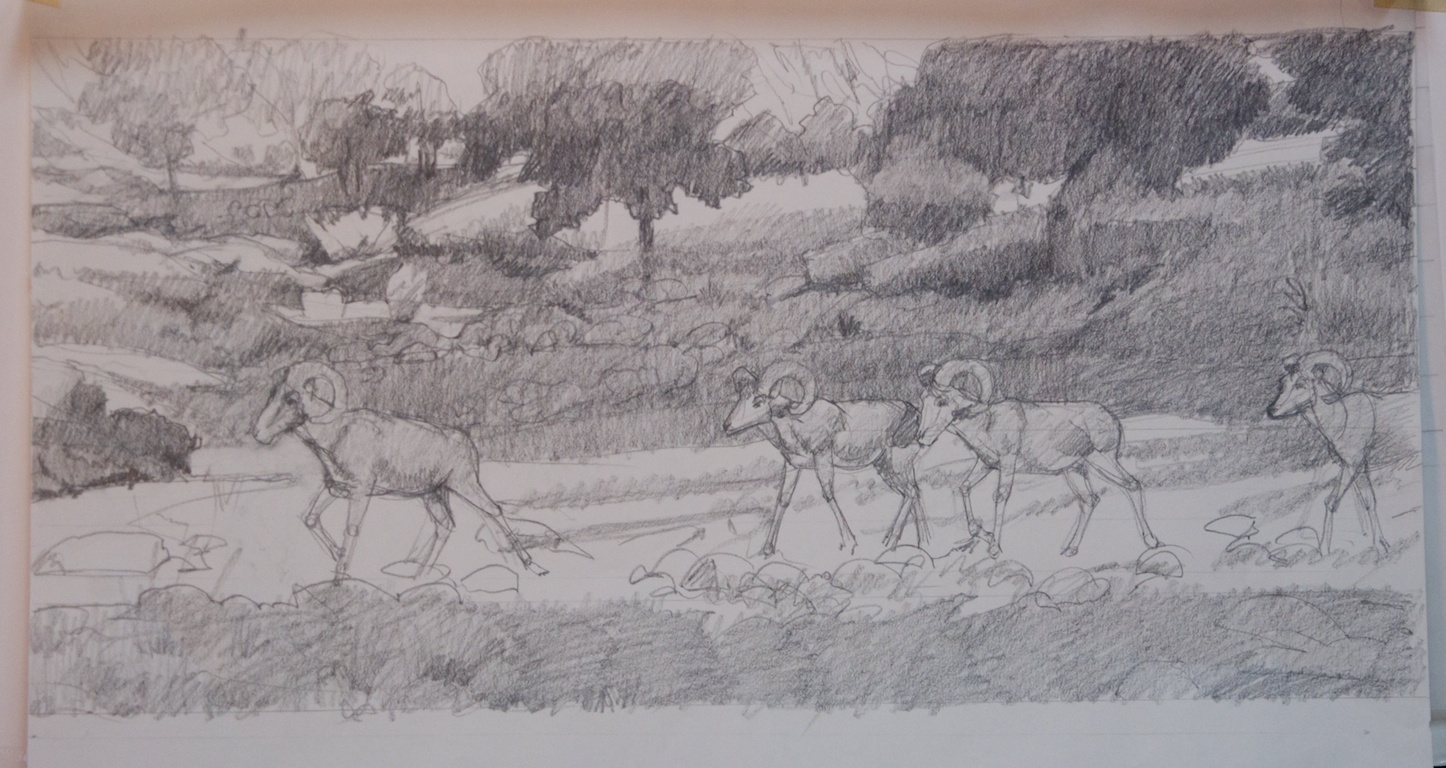
Now it was time to do a large value study, 12×24″. I adjusted the relative position of the rams, moving the pair forward a little.
I had to know if what I had come up with would work at the final size I had decided upon- 24×48″. This is where I’d gotten into trouble before. I asked an artist colleague for advice and he said to take my finished drawing to a copy place and have it blown up to the final size, which I think is a really good idea.
But I chose to try something else. I have found great value in the re-drawing process. It allows me to refine, correct, simplify and really learn to know my subjects in a way that would not be possible if I simply did a drawing, transferred it and started to paint, or worse, heaven forbid, projected them. The depth of understanding and flexibility I get is critical to the quality of my finished product.
First I put a sheet of tracing paper over the drawing above and drew a one inch grid on it.
Then I placed my untoned canvasboard on the easel and ruled a grid on it in pencil. I taped tracing paper to it. It took three sheets to cover it. I lightly sketched a transfer drawing so that every element was in the right spot.
Once the background was laid in, I taped on three more pieces of tracing paper and did the final pencil drawings of each argali. Now I had this:
Because the argali were all on their own pieces of paper, I could do a final check on position and easily move them if needed. I also now had the whole composition at the final size and could see that it did, in fact, work. Whew!
I removed the tracing paper, toned the canvas, re-attached it and, using a No. 7 pencil and a sheet of homemade graphite transfer paper, transferred the drawing.
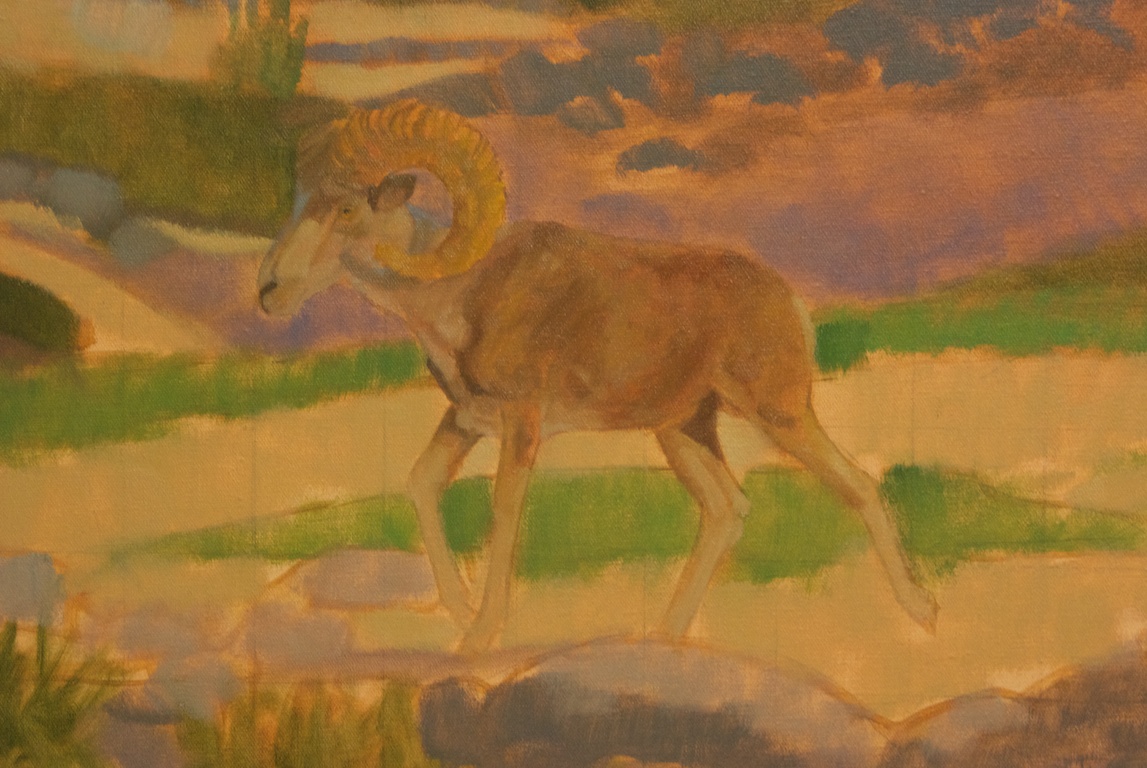
Using the tracing paper drawings as a guide and referring back to the photo reference if necessary, I carefully re-drew the argali with a brush, figuring I’d get the most important elements down first. Here’s a close-up which also shows the loose lay-on of the background. Notice that you can see three of the four hooves. They vanish later as I decide to add additional and larger rocks to create more of a visual separation between the sheep and the viewer.
Here’s the finished drawing, with basic values starting to be indicated. Notice that the rocks in the foreground and middle ground are just roughed in. No need to spend a lot of time on them at this point.
Finally it was time to start adding color! I work all over a canvas in a sitting, keeping the edges soft and letting colors “bleed” into each other. This lets me control where the harder edges will be later on. I’ll also “lose” the drawing, knowing that, having drawn the animals multiple times, I can “find them” again with no problem. First I established the shadow shapes, letting the undertone be the light.
Here’s a close-up of the lead ram in progress. Still keeping it loose, but working on light and shadow and correct structure.
I started to see a problem in the forequarters and it nagged at me for a couple of sittings until I realized that the leg closest to the viewer was too far forward. Moving it and the shoulder back about a quarter of an inch solved the problem. His head was also a little too small. That’s a big advantage of working this way. I can make changes at any point in the process, which turned out to be really important when I was trying to keep track of so many pictorial elements and their relationships to each other.
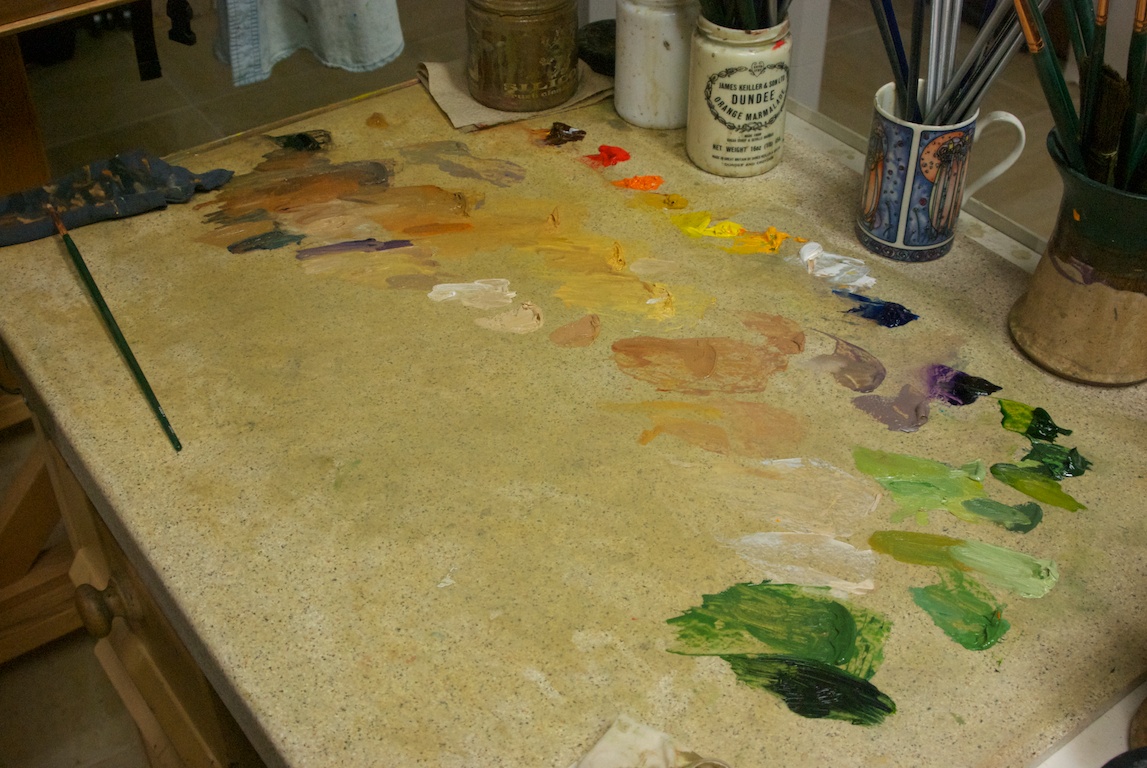
Let’s take a quick break. Here’s my palette. For this painting, I used my standard color range: transparent oxide red, cadmium red medium, cadmium orange, yellow ochre light, cadmium yellow pale, cadmium yellow, titanium white, ultramarine blue, Winsor violet (dioxine), sap green, terra verte, chromium oxide green.
Missing this time around is cobalt blue and magnesium blue hue. I mix my own earth colors and greys. My black is a mix of transparent oxide red and ultramarine blue. I can easily shift the color temperature by changing the proportions.
The palette itself is a scrap of Swanstone solid surface countertop. I got the idea from another art blog and I like it much better than the glass one I’d been using.
Ok, back to the painting. I’m probably about mid-way through at this point. All the value relationships are set (at least I thought so) and basic colors are on.
Oh, darn. I realized that having all the rams in the same light wasn’t very interesting. I went back to my reference images and found a nice shot of the very first one coming out of the shadows. Now I needed to put the fourth ram in that light. Aperture is great for this since it lets you show multiple images at once.
Much better. Having solved that final, somewhat major problem, it was now a matter of simply pushing on, solving all the problems, making decisions, tweaking and tweaking (what Scott Christensen more elegantly calls “orchestration”).
Until, finally, after far longer than I have ever spent on a single painting, it was done.
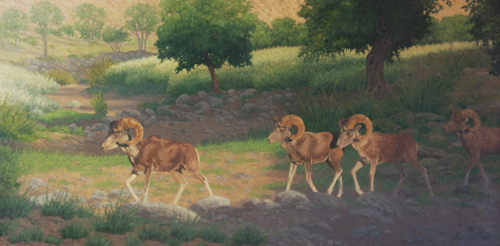
Then They Walked Out Into The Morning Light 24x48" oil
I have a small collection of old books about the practice and techniques of oil painting, watercolor, drawing and sketching. This morning, trying to figure out what to blog about today, I pulled “The Practice of Oil Painting-And of Drawing as Associated with it” by Solomon J. Solomon, R.A. (Royal Academy) off the shelf. I purchased it some years ago in England for the princely sum of six pounds, fifty pence. There is no copyright date, but a portrait of a young girl with short hair suggests that it was published in the 1920s to 1930s.
Opening the book randomly, I found some study advice that is as relevant now as it was then, so thought that I would share it.
It’s from Chapter XII, Hints on Arrangements-Solecisms in Composition:
“We do not get stronger by watching other men lift weights. Nor are weights lifted or pictures composed, either at the beginning or at any time, without effort. Good composition calls for a far higher mental capacity than mere painting (interesting observation), which is in itself difficult enough…
When in the course of your reading you come across a pictorial episode, visualize it and sketch the scene as it strikes you. There are, nowadays, so many beautiful illustrations to be seen (alas, those days are mostly gone); you may well learn, from some of them, how figures are grouped, and how accessories are placed to complete the pictorial arrangement. Such mental notes, added to your unceasing practice, will greatly increase the facility with which you will be enabled to arrange and compose artistically.
When visiting a picture or sculpture gallery, take a sketchbook with you. Your memory will not suffice to recall the results of your analysis of compositions. Study particularly the placing of heads, half and full length portraits and figures, and the main structural lines and colour massed of decorative designs. Mark the arrangement of light and shade (chiaroscuro) in Dutch and Spanish pictures, which have such fine technical qualities, and when anything strikes you as particularly beautiful, draw it, and in drawing it search for the secret of its beauty.”
My main takeaway from the studies above was a greater understanding of what it means to “work from lean to fat” and how many small, subtle touches of tone and color go into painting at the level of a Rembrandt or Hals. This is why it is so critical to see great original art. Reproductions just aren’t the same
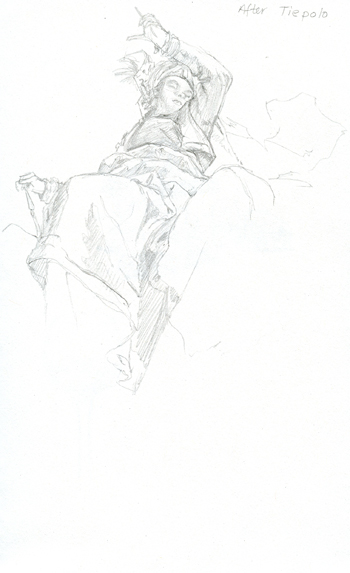
From Tiepolo
* The images are from studies that I’ve done myself. All but the first and last were from a show at the Metropolitan Museum of Art in 1995, “Rembrandt, Not Rembrandt”. The Tiepolo was from an incredible show of his preliminary drawings for one of his ceiling “jobs”. I’ve never been able to find a book with more than a couple of ok reproductions of them.





























 Susan Fox, American Artist
