Mongolia Monday- 20 Questions for Mongolphiles Quiz: Results!

Chinggis Khan statue east of Ulaanbaatar

Here are the answers:

Part 1:

1. Who demonstrated the strength in working together using arrows?- Hoelun, the mother of Chinggis Khan

2. What form does the tea used for milk tea traditionally come in?- Bricks or blocks

3. What side of a Mongol horse does one always mount from?- Left

4. Mongolia became independent in the early 20th century from what other country?- China

5. What two animals do the Mongols claim descent from?- Wolf and deer

6. What was the real name of the “mad monk of the Gobi”-  who wrote the famous poem “Perfect Qualities”?- Danzanravjaa

7. What is the traditional greeting when approaching a herder’s ger?- Hold the dogs!

8. From what people did the Mongols get their classical vertical script?- Uighers

9. Why did the Mongol army leave Europe and return to Mongolia?- To elect a new Khan

10. Who created and bestowed the title “Dalai Lama”? For bonus points, what does the world “Dalai” mean?- Altan Khan; “ocean”

Large ovoo along main road south out of Ulaanbaatar

Part 2:

1. What is a “morin khuur”?- Horse-head fiddle

2. From what people did the Mongols get their classical vertical script?- Uighers (my apologies for missing that I’d used this one in the first 10)

3. What are each of the four sides of a sheep’s anklebone called?- Sheep, goat, horse, camel

4. Name the Five Snouts.- Horse, cattle, sheep, goat, camel

5. Which ikh khan founded Kharkhorin?- Ogedei

6. Which direction do gers always face?- South

7. Who is the lead singer of Hurd? For bonus points, what does his name mean?- Chono: wolf

8. What is the name of the mountain where Temujin took refuge?- Burkhan Khaldun

9. What are The Three Manly Sports?- horse racing, wrestling, archery

10. Name the two main political parties in Mongolia.- Democratic party and Mongolian People’s Party (I was a little flexible on this one since there have been fairly recent name changes. The MPRP changed its name last year. The other party is referred to in the media as the Democrats. But I knew what you meant)

And the winner is…..Carole Hollrigel! But it was close. Only two points separated her from the next closest entrant.

Thank you to those who entered!
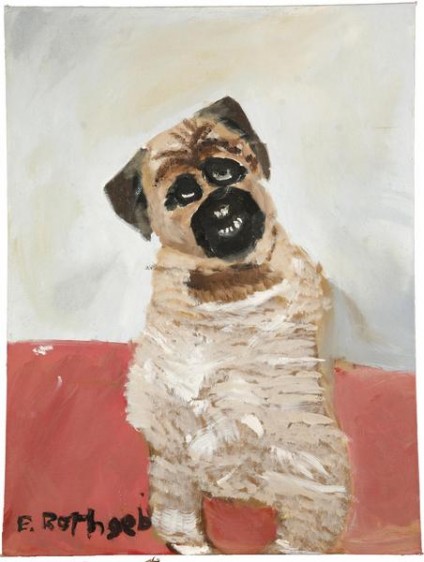
Amusing Art Quotes & Links To Bad Art

"Ronan the Pug"- One of the treasures in the collection of the Museum of Bad Art, which has, heaven help us, THREE locations in Sommerville, Massachusetts.

Artists can color the sky red because they know it’s blue. Those of us who aren’t artists must color things the way they really are or people might think we’re stupid.
Jules Pfeiffer

Look, it’s my misery that I have to paint this kind of painting, it’s your misery that you have to love it, and the price of the misery is thirteen hundred and fifty dollars.
Mark Rothdo

Seattle’s Official Bad Art Museum

Art is the only way to run away without leaving home.
Twyla Tharp

I don’t want to be interesting. I want to be good.
Ludwig Mies van der Rohe

Museum of Bad Art

Lying in bed would be an altogether perfect and supreme experience if only one had a colored pencil long enough to draw on the ceiling.
Gilbert K. Chesterton

Murals in restaurants are on a par with the food in museums.
Peter De Vries

Bert Christensen’s Weird, Strange and Just Plain Bad Art Collection

Finally,
Artist Leslie White had the guts to do a blog post called Bad Art and used one of her own pieces as an example. I personally don’t think it’s all THAT bad. Especially compared to Ronan the Pug.

Mongolia Monday- “From the Top of a Camel the Sun Seems so Near” by Zhanchvyn Shagdar

Today’s post is a poem about the Gobi and a “sandalwood brown camel”, but I also want to remind you that the deadline for the Mongolphile Quiz is this Friday at 5pm, Pacific time. Twenty questions here and here.

“From the Top of a Camel the Sun Seems so Near” by Zhanchyvn Shagdar

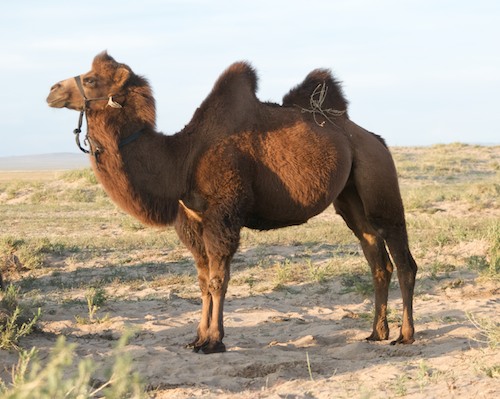
Bactrian camel, Arburd Sands, Sept. 2008

Gobi of exquisite mirage
Has the seven colors of the rainbow.
And my brown camel with graceful legs
Can travel for a month without rest.

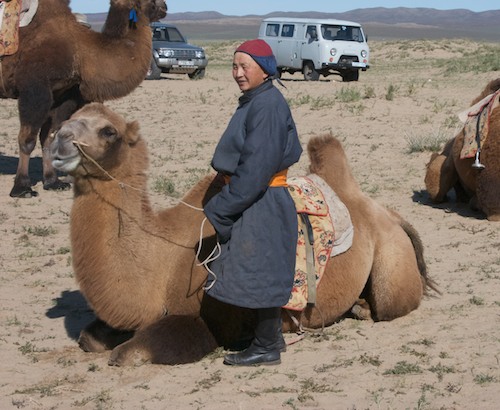
Gobi bactrian camels, July 2010

When I ride my sure-footed brown camel
The sun in the sky seems so near,
Oh, I’m on my way, my sweetheart,
And I’ll be with you at sunset.

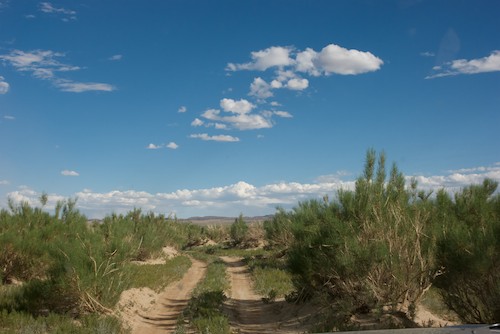
Saxaul forest with the Flaming Cliffs in the distance, Sept. 2006

Gobi, with its bushes of saksaul,
You are renowned in this wide world,
And my sandalwood brown camel
Can jog faster the longer the road.

Arburd Sands, Sept. 2008

When I ride my sandalwood brown camel
The moon in the sky seems so near,
Oh, my love, linked to me by fate,
I’ll be meeting you when the moon rises at night.

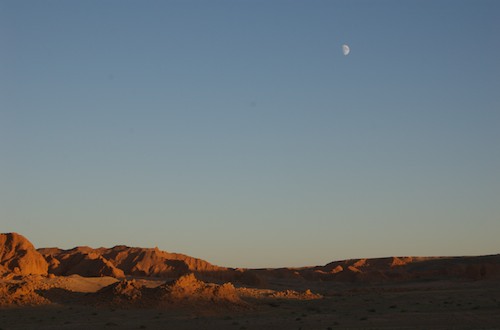
Moonrise over the Flaming Cliffs, Sept. 2006

Gobi in the radiance of pure gold
Is beautiful like a new family tent,
And the jogging of my straight humped brown camel
Can reach the distant horizon.

Saxaul forest near Orog Nuur, July 2010

My Gobi with its bushes of saxaul,
You are renowned in this wide world,
And my sandalwood brown camel
Can jog faster the longer the road.

Arburd Sands, Sept. 2008

My iPad Sketches Are In A New Book!

I got an email last year from one of the authors of a book called “Visual Notes”, first published in 1984. He and his co-author were updating it to include images created digitally. He found my blog post about my iPad sketching and asked permission to use some of them in the new edition. Of course, I said “Yes!”

The new book is out and is available on here on Amazon. I haven’t had a chance to read it yet, but have browsed through it and it looks really good. I’m very, very proud to have my iPad sketches included in a book that also includes “visual notes” by people such as choreographer Merce Cunningham and architect Michael Graves.

Here are a few of the seven sketches that are in the book:

"Pot-bellied Pig, Oakland Zoo"- I did this one in about 15 seconds and almost hit "Don't Save", but this was the one that caught the author's eye.
"Flamingos, Oakland Zoo"- My own favorite from that day at the zoo.
"Roosevelt Elk Bull, Redwood National Park"- I sat in the car and sketched this big guy who also had a large harem of cows.

Mongolia Monday- Twenty Questions For Mongolphiles, Part 2

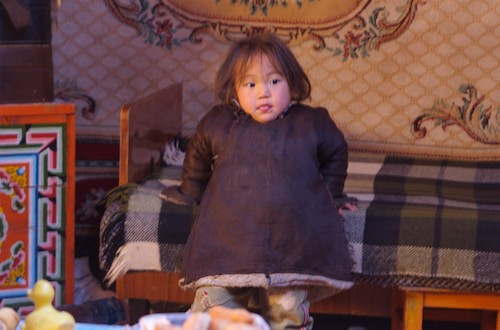
Mongol child, near Hustai National Park, Sept. 2006

You can find Part 1 of the quiz here.

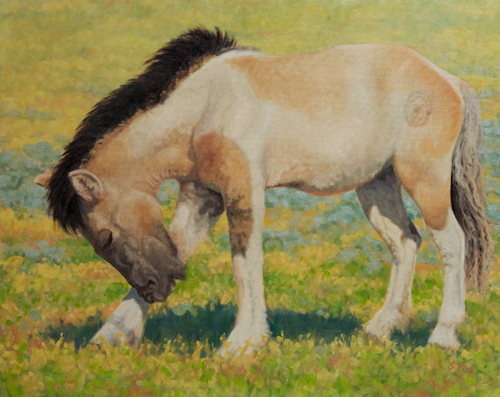
Take the quiz and find how much of a Mongolphile you REALLY are. Post your answers in the comments. Below are the second ten questions. Answers will be accepted until March 30, then I’ll do a tally. The person with the most right answers will receive an 8×10″ print of Mongol Horse #3-Young Stallion :

Good luck!

1. What is a “morin khuur”?

2. From what people did the Mongols get their classical vertical script?

3. What are each of the four sides of a sheep’s anklebone called?

4. Name the Five Snouts.

5. Which ikh khan founded Kharkhorin?

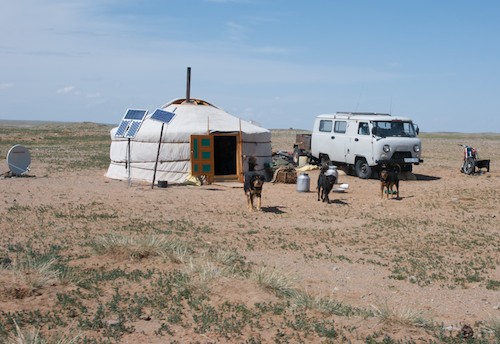
Herder's ger, Gobi, July 2010

6. Which direction do gers always face?

7. Who is the lead singer of Hurd? For bonus points, what does his name mean?

8. What is the name of the mountain where Temujin took refuge?

9. What are The Three Manly Sports?

10. Name the two main political parties in Mongolia.

Mongol script used on advertising banner, Ulaanbaatar, Sept. 2006

Come Paint En Plein Air In Northern California with James Coe!

I’m extremely pleased to announce that my friend and colleague James Coe will be coming to northern California to hold his first ever workshop out here in July! Below are all the details. We expect his workshop to fill up, so get your reservation in soon! As I’ve made the arrangements, please direct any questions to me.

Encroaching Shadows, Roadside Barns by James Coe

Nationally known landscape painter, bird artist and author James Coe will be giving his first-ever West Coast workshop, “Plein Air Landscape Painting in Oils”, July 9-14, 2012, to be hosted by Westhaven Center for the Arts.

This will be an intensive 5-day program which will explore the challenges of working en plein air directly from the landscape and also introduce the traditional methods and materials of alla prima (direct) painting in oil. There will be a presentation and orientation session Monday evening which will include topics ranging from the history of plein-air painting to the preparation of homemade painting panels for use in the field.  The session will also include a step-by-step presentation of the instructor painting outdoors and in the studio, using plein air studies as references for larger studio canvases.

The workshop will be based at Westhaven Center for the Arts, which is located in Humboldt County on the beautiful and scenic north coast of California, about six hours north by car from San Francisco. Painting locations will include coastal seascapes and beaches, redwood forests and the nearby fishing town of Trinidad.

James doing a demo at a previous workshop

PLEIN AIR LANDSCAPE PAINTING IN OIL- Workshop information:

Instructor: James Coe
Dates: July 9-14 (Monday evening orientation, Tuesday-Saturday plein air sessions)
Workshop fee: $600 ($100 deposit due upon sign-up)
Class size: maximum of 10
Location: Westhaven Center for the Arts
501 S. Westhaven Dr.
Westhaven, CA 95570

Supply list, travel information and lodging/meal options will be provided upon registration (fee is for workshop only)

For more information or to reserve a space, call Susan Fox at 707 496 1246 or email her at sfox at foxstudio dot biz (email address format is to foil web crawlers; use normal format for emailing me)

 
Source of the Saco by James Coe

About James Coe: Jim’s oil landscapes, which typically feature natural settings and rural scenes from New York’s Hudson River Valley and Northern Catskills, are recognized for their naturalistic palette and painterly handling.    

A signature member of the Oil Painters of America, and chosen in 2011 as a Leigh Yawkey Woodson Art Museum Master Wildlife Artist,  Jim has been featured recently in PleinAir magazine, Western Art Collector and Wildlife Art Journal.   

His art has appeared on the covers of Sanctuary, Bird Watcher’s Digest, Birding World and The Auk, the professional Journal of the American Ornithologists Union.  He is represented in the permanent collections of the New York State Museum, Hiram Blauvelt Art Museum, Leigh Yawkey Woodson Art Museum, Massachusetts Audubon Society and the Bennington Center for the Arts.   

Jim lives with his wife and two children in a farmhouse on the western rim of the Hudson River Valley, where he continues to seek a balance between plein air landscapes and larger studio canvases of birds in natural settings.

Mongolia Monday- Twenty Questions for Mongolphiles, Part 1

Rounding up yaks in the Hangai Mountains

You love Mongolia. You’ve traveled there. You’ve studied the history and have learned quite a bit about the culture. You love buuz and airag and mutton. You even own a del.

Take the quiz and find how much of a Mongolphile you REALLY are. Post your answers in the comments. There will be ten more questions next Monday. Answers will be accepted until March 30, then I’ll do a tally. The person with the most right answers will receive a print of Mongol Horse #3-Young Stallion :

Mongol Horse #3-Young Stallion 8x10" print on paper

Onward and good luck!

1. Who demonstrated the strength in working together using arrows?

2. What form does the tea used for milk tea traditionally come in?

3. What side of a Mongol horse does one always mount from?

4. Mongolia became independent in the early 20th century from what other country?

5. What two animals do the Mongols claim descent from?

6. What was the real name of the “mad monk of the Gobi” who wrote the famous poem “Perfect Qualities”?

Display of Mongol saddles at the Union of Mongolian Artists' gallery

7. What is the traditional greeting when approaching a herder’s ger?

8. From what people did the Mongols get their classical vertical script?

9. Why did the Mongol army leave Europe and return to Mongolia?

10. Who created and bestowed the title “Dalai Lama”? For bonus points, what does the world “Dalai” mean?

Ikh Bogd Uul near Orog Nuur in the Gobi

New Painting Debut! “Zun Odor (Summer Day)”

And here it is the "real" finish again for comparison.

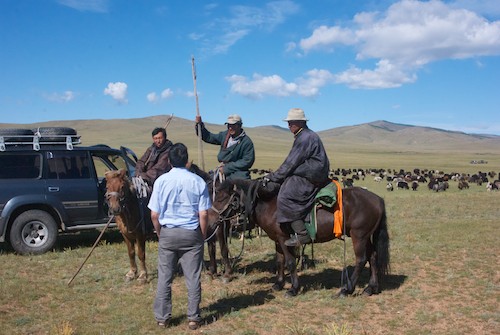
I was coming down out of the mountains north of Tsetserleg with my guide and driver while on a one week camping trip last August and off in the distance we saw a large herd of yaks. Of course we stopped so I could get some photos. The three herders who were with them spotted us and came riding over. I asked the guide to ask them if I could take their pictures and they said yes. I knew while I was snapping the shutter that I was going to get multiple paintings out of this chance encounter, typical of travel in Mongolia.

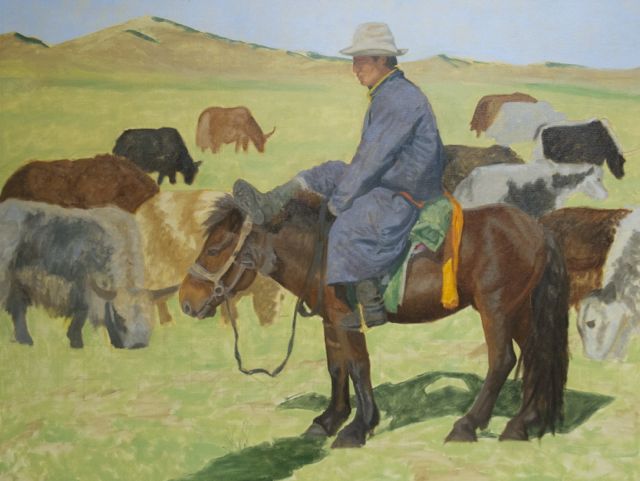
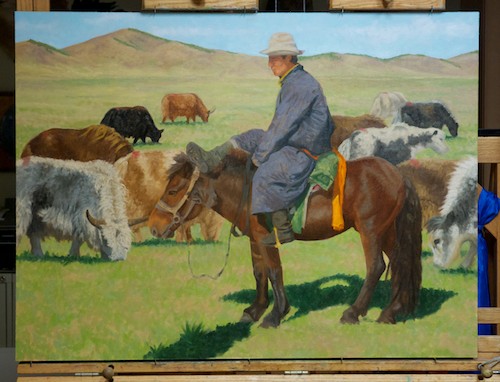
Here’s a step-by-step of my newest painting “Zun Odor (Summer Day)”:

The three yak herders, Arkhangai Aimag, chatting with Puugii, my driver
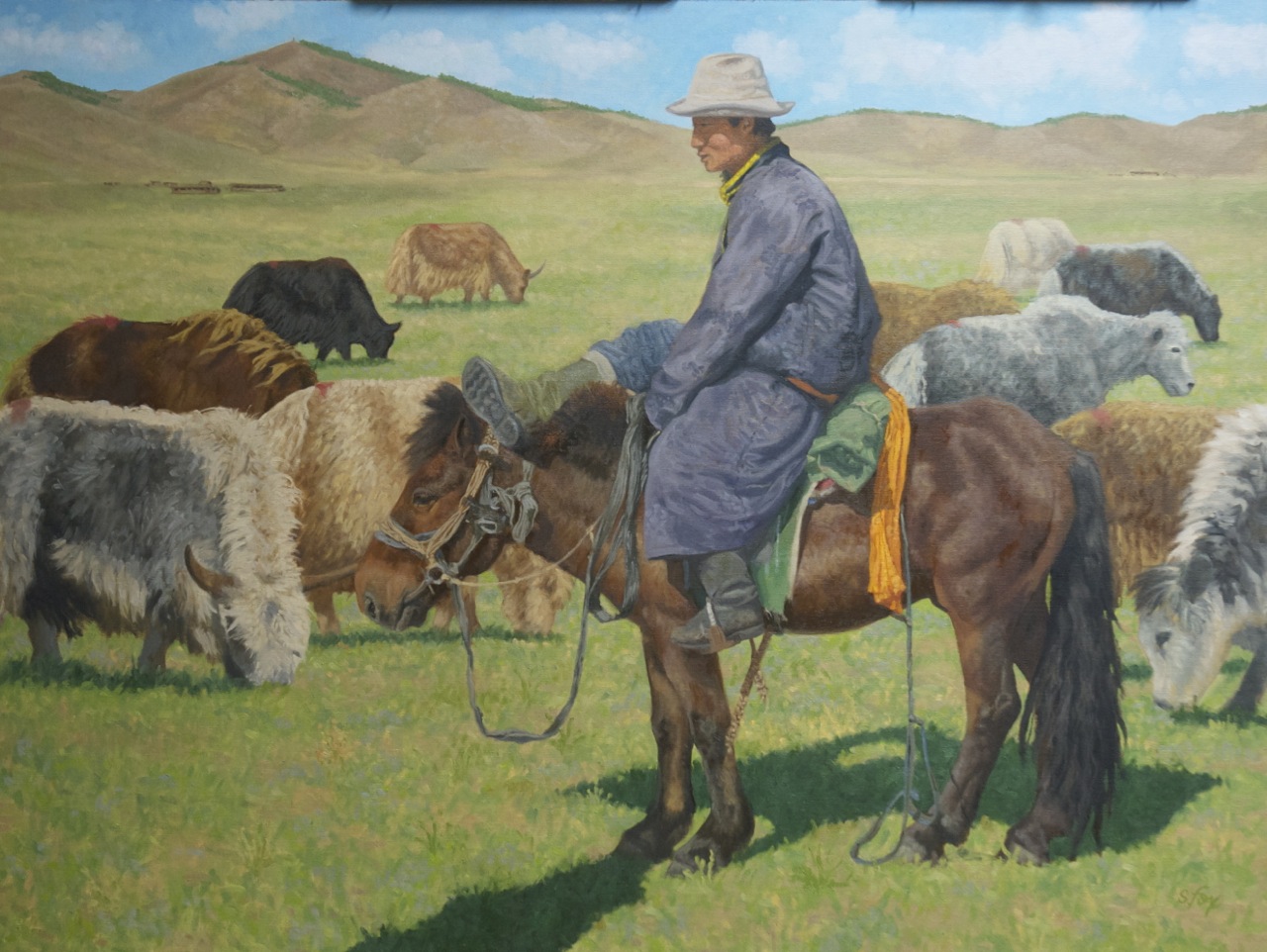
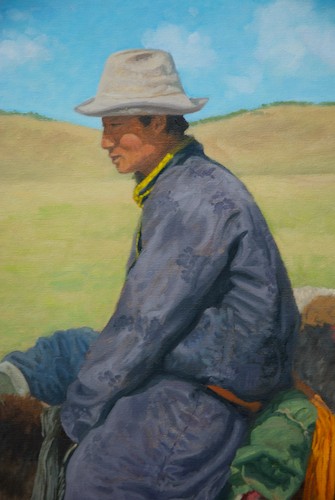
The idea of the painting (and a good painting has only one) was the casual way the herder had laid his leg across the neck of the horse, who seemed to be totally unconcerned. The Mongols' relationship with their horses is really something special, going back, as it does, over 1000 years. They know each other pretty well at this point. The composition was allowed to resemble some I've seen of American cowboys and cattle, only in this case it's malchin (herders) and sarlag (yaks).
This is after the first pass of laying in color on the herder, horse and landscape. It lets me see how the shapes of the yaks are working. This was the most animals, by far, that I've ever put in a painting, so it became a pretty intense juggling act, making sure that all the parts worked together.
One to two passes of color overall. I'm also using my reference to make decisions about what colors the yaks will be. I wanted the right amount of variety, but not to the point where it drew attention away from the herder and his horse.
Continuing on, working over the whole canvas.
The finished painting. I thought. But I decided that I needed some fresh, knowledgeable eyeballs on it, so I emailed a jpg to two colleagues who, among other things, pointed out that the yaks in the background were not in correct scale. And they were right. They also thought the grey yak's head on the right was odd and I found that, after going back to my reference, that I agreed with them about that too. Back to the easel. One of the reasons I have the working process that I do is to provide the flexibility to make whatever changes or corrections are necessary at any point, even when I think I'm done and have signed the piece. I have no compunctions whatsoever about wiping out or scraping down any part at any time if it's not right.
"Zun Odor" (Summer Day) 30x40" oil (price on request)- the "real" finish again. Notice how the yak on the right at the herder's waist changed color twice.

Here are some detail close-ups so you can get a better look at my brushwork:

The herder
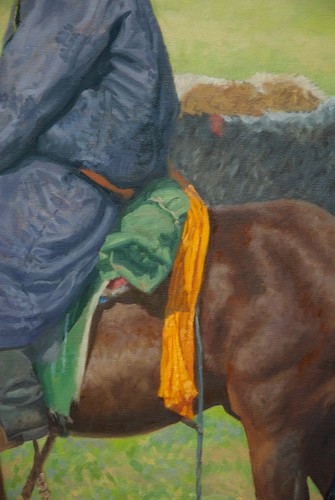
His rain slicker and sash
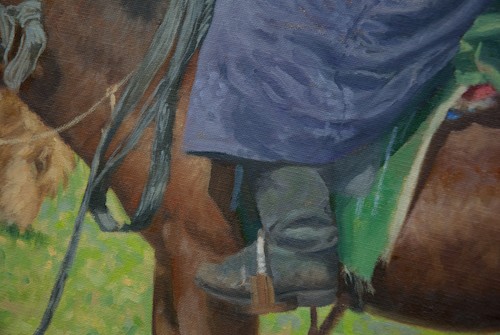
Boot, stirrup and tack
The horse's head
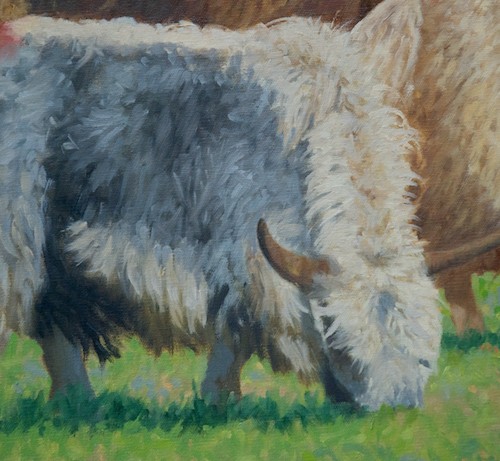
One of the yaks

Mongolia Monday: 5 Photos of Favorite Places- Baga Gazriin Chuluu Nature Reserve

This will be a occasional, on-going series of images of my favorite places in Mongolia. Baga Gazriin Chuluu means “Small Earth/Land Rocks”. There is also an Ikh Gazriin Chuluu (Great Earth Rocks), but I haven’t gotten there yet.

In July of 2009, my driver/guide and I pulled into the ger camp, which is located in the reserve and got settled in. I came out of my ger and was greeted with this amazing light and a woman riding down the valley. I had a feeling I was going to like this place.
It was my good luck to be there on the day of a local mountain blessing ceremony or local naadam. There was a horse race, wrestling, anklebone shooting and lots of people just riding around on their horses.
Seeing argali was my purpose for going there and within a couple of hours the first morning, my driver spotted this group of rams within sight of the car.
The following year, 2010, I got to go back as the first stop on a two-week camping trip. Here's the spot my driver/guide (same one as in 2009) picked.
Driving around, we came upon a short valley which had a number of cinereous vulture nests, including this one with a juvenile who was almost ready to fly. We climbed up on the rocks to get above him and I got some great photos.

There are more photos of Baga Gazriin Chuluu, including the story of my first trip there in 2009 here.