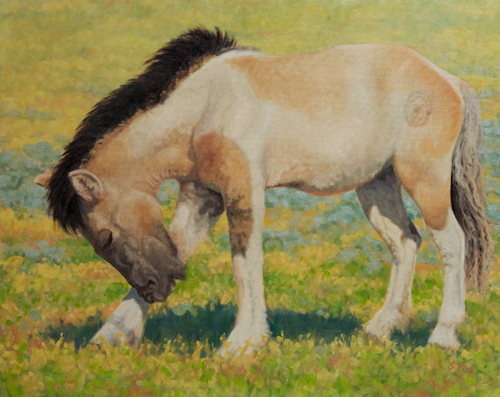
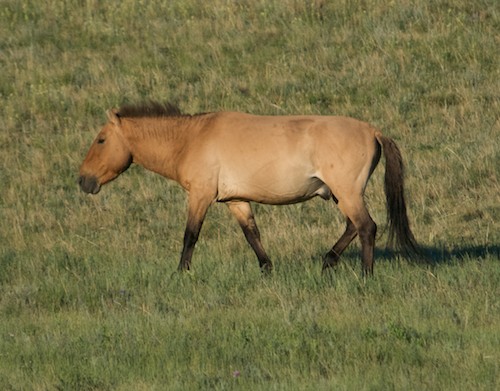
Take the quiz and find how much of a Mongolphile you REALLY are. Post your answers in the comments. Below are the second ten questions. Answers will be accepted until March 30, then I’ll do a tally. The person with the most right answers will receive an 8×10″ print of Mongol Horse #3-Young Stallion :
Good luck!
1. What is a “morin khuur”?
2. From what people did the Mongols get their classical vertical script?
3. What are each of the four sides of a sheep’s anklebone called?
4. Name the Five Snouts.
5. Which ikh khan founded Kharkhorin?
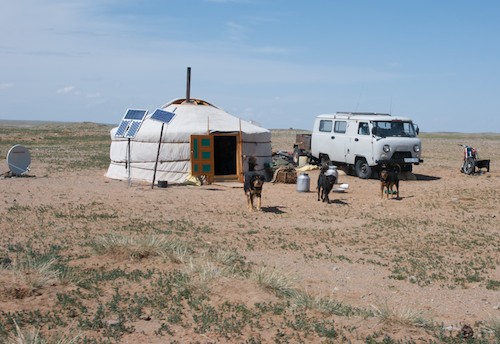
Herder's ger, Gobi, July 2010
6. Which direction do gers always face?
7. Who is the lead singer of Hurd? For bonus points, what does his name mean?
8. What is the name of the mountain where Temujin took refuge?
9. What are The Three Manly Sports?
10. Name the two main political parties in Mongolia.
Mongol script used on advertising banner, Ulaanbaatar, Sept. 2006
You love Mongolia. You’ve traveled there. You’ve studied the history and have learned quite a bit about the culture. You love buuz and airag and mutton. You even own a del.
Take the quiz and find how much of a Mongolphile you REALLY are. Post your answers in the comments. There will be ten more questions next Monday. Answers will be accepted until March 30, then I’ll do a tally. The person with the most right answers will receive a print of Mongol Horse #3-Young Stallion :
Mongol Horse #3-Young Stallion 8x10" print on paper
Onward and good luck!
1. Who demonstrated the strength in working together using arrows?
2. What form does the tea used for milk tea traditionally come in?
3. What side of a Mongol horse does one always mount from?
4. Mongolia became independent in the early 20th century from what other country?
5. What two animals do the Mongols claim descent from?
6. What was the real name of the “mad monk of the Gobi” who wrote the famous poem “Perfect Qualities”?
Display of Mongol saddles at the Union of Mongolian Artists' gallery
7. What is the traditional greeting when approaching a herder’s ger?
8. From what people did the Mongols get their classical vertical script?
9. Why did the Mongol army leave Europe and return to Mongolia?
10. Who created and bestowed the title “Dalai Lama”? For bonus points, what does the world “Dalai” mean?
This will be a occasional, on-going series of images of my favorite places in Mongolia. Baga Gazriin Chuluu means “Small Earth/Land Rocks”. There is also an Ikh Gazriin Chuluu (Great Earth Rocks), but I haven’t gotten there yet.
In July of 2009, my driver/guide and I pulled into the ger camp, which is located in the reserve and got settled in. I came out of my ger and was greeted with this amazing light and a woman riding down the valley. I had a feeling I was going to like this place.It was my good luck to be there on the day of a local mountain blessing ceremony or local naadam. There was a horse race, wrestling, anklebone shooting and lots of people just riding around on their horses.Seeing argali was my purpose for going there and within a couple of hours the first morning, my driver spotted this group of rams within sight of the car.The following year, 2010, I got to go back as the first stop on a two-week camping trip. Here's the spot my driver/guide (same one as in 2009) picked.Driving around, we came upon a short valley which had a number of cinereous vulture nests, including this one with a juvenile who was almost ready to fly. We climbed up on the rocks to get above him and I got some great photos.
There are more photos of Baga Gazriin Chuluu, including the story of my first trip there in 2009 here.
One of the best-kept secrets about Mongolia is how important art is to Mongol culture. It reminds me of what I’ve heard about Bali, where it seems that everyone does something creative. I’ve found that as soon as someone in Mongolia finds out that I’m an artist, I come into focus and more or less jump to the head of the cultural line.
Artistic expression in Mongolia ranges far and wide, from traditional painting and sculpture to singing, music, dance, calligraphy, leatherwork, feltwork, embroidery and more.
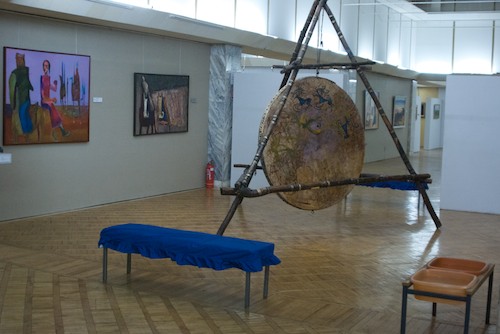
One of the gallery areas in the Modern Art Gallery, with a large shaman's drum
Mongol painters have been able, for the past seventy or so years, to travel to art schools in Eastern Europe, including Russia, where they have learned classical academic methods at a time when that instruction was impossible to find in the United States. The results can be seen today, especially in the Mongolian Modern Art Gallery. which is really a museum with a permanent collection.
Horses Hooves by P. Tsegmid, Modern Art Gallery; a personal favorite
There is also a national organization, the Arts Council of Mongolia, which runs a variety of programs to support young and emerging artists. I spent an hour with the director of the Council this past trip and came away very impressed by the quality of the programs and the staff.
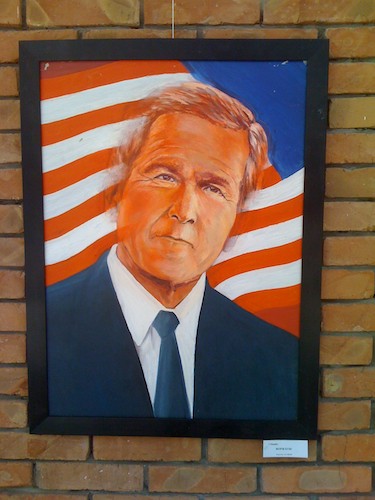
Political commentary from an artist who was part of a group show at the Union of Mongolian Artists' gallery last year
There are also at least a couple of artist-run organizations. One of them, the Union of Mongolian Artists, has excellent light-filled exhibition space in a building just south of Sukhbaatar Square. I go there every time I’m in UB and the current offering is always interesting and of good quality.
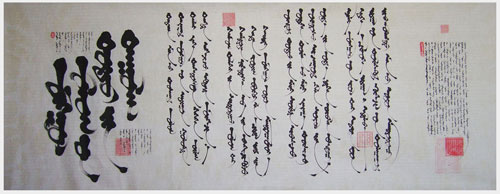
Mongol calligraphy by Sukhbaatar Lkhagvadorj
Some of the artists have their own websites. Here’s one from an incredible Mongol calligrapher, Sukhbaatar, who I have gotten to know on Facebook. He and his fellow calligraphic artists use the ancient Mongol vertical script which Chinggis Khan got from the Uigher people since the Mongols had no writing at the time he established the empire. The script also exists in type fonts and is taught in the schools.
Tsagaandarium Art Gallery and Museum
There are also a few commercial art galleries where you can see a very wide range of contemporary Mongolian painting, sculpture and other media. I’ve been to the Valiant Art Gallery a number of times. It has two locations: one in the same building as the famous expat restaurant, Millie’s, which is right across the street from the Museum of the Chojin Lama and the second near the State Department Store. Last, but certainly not least, is the Tsagaandarium Art Gallery and Museum, which is located on a corner in Zaisan, across the river from the main part of Ulaanbaatar. They not only have great art, but offer all kinds of community events and art classes.
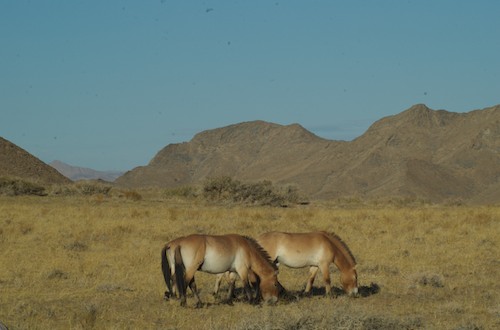
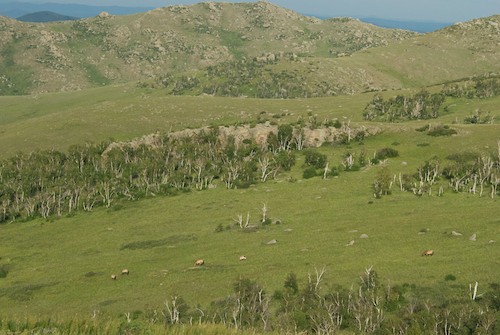
Habitat Preference: Steppe, semi-desert; now also mountain steppe (Hustai)
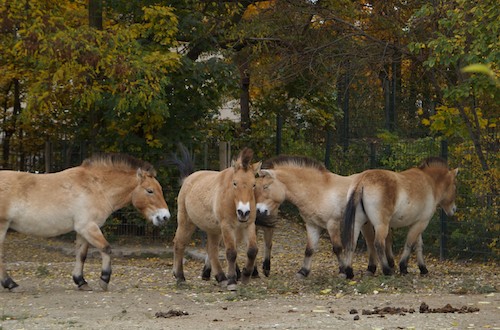
Takhi group, Berlin Zoo, 2004 (first time I ever saw the species)
Best places to see takhi: In the wild: Hustai National Park, Mongolia. Captive animals: Many zoos and some reserves, including: San Diego Zoo, Denver Zoo, the National Zoo, the Berlin Zoo, the Wilds (near Cincinnati, Ohio)
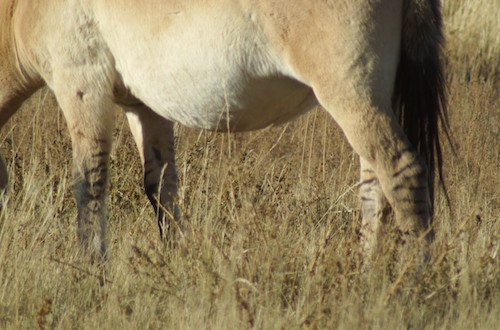
Takhi leg stripes, Hustai National Park, 2005Domestic Mongol horse with leg stripes, 2011
Interesting facts:
-Takhi are the only surviving species of true wild horse. What are called “wild horses” in the USA are feral domestic horses.
-The last wild takhi, a lone stallion, was spotted at a waterhole in the Dzungarian Gobi in 1969, and not long after the species was declared extinct in the wild. After WWII, only 55 survived in captivity, all descended from 13 founder animals. Today there are approximately 2000 takhi of which, as of 2011, 360 were at three release sites in Mongolia.
-Their range originally included, along with Mongolia: Belarus, China, Germany, Kazakhstan, Lithuania, Poland, Russian Federation, Ukraine.
– Takhi have 66 chromosomes. Domestic horses have 64. They can mate and produce fertile offspring. It is estimated that they diverged around 500,000 years ago, so the speciation process is not complete. Domestic Mongol horses with takhi characteristics like carpal and tarpal leg stripes are fairly common, indicating a cross at some point in the past. Modern horses are not descendents of takhi.
-Other than a few instances of intensively hand-raised foals who would tolerate a rider while young, no one has ever “tamed” a takhi.
-They became known in the west when Col. Nikolai Przewalski brought a skull and skin, which had been presented to him at a border crossing between far western China and Mongolia, back to Russia. The official description was published in 1881.
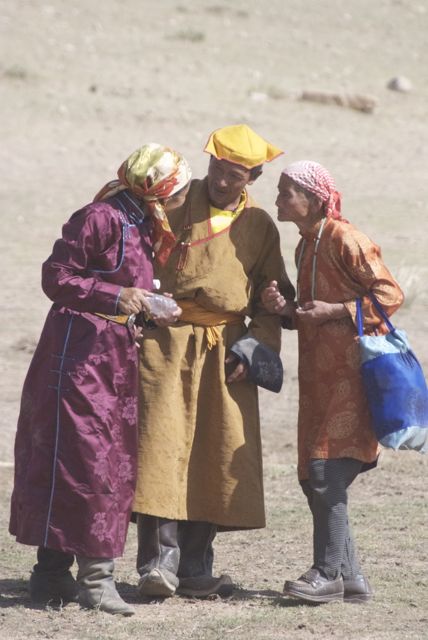
Buddhist priest chats with two women, Baga Gazriin Chuluu mountain blessing naadam, July 2009
There are many proverbs in Mongolia concerning good and bad character traits. Many are meant to teach children how they are expected to act. Others are intended as reminders about how to get along in life.
A good character and name is very important and is shown (or not shown) in one’s actions:
Take care of your deel when it is new Take care of your name when it is clean
Person who has bad character loses his name Person who works hard will tell his name
Being humble is considered a very good character trait:
A large sea is calm A knowledgeable person is humble
Many proverbs encourage people to work hard and finish what they start:
If you are bold, work will be finished If you are persistent, happiness will come
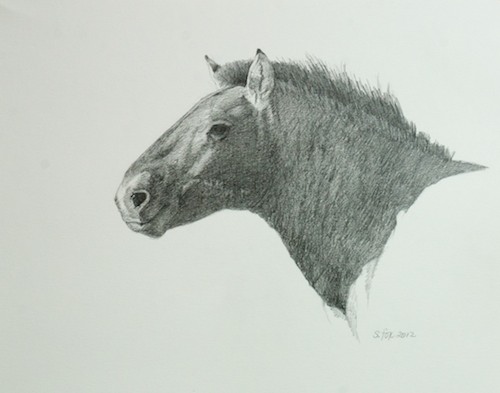
It’s been awhile since I’ve done some finished graphite drawings and that’s what I’ve been doing this week. I’ve always loved to draw, so it was fun to just sit with a pencil (a General’s Draughting Pencil) and paper (Strathmore 300 vellum bristol) and work from some of the takhi photos I’ve shot during my trips to Mongolia.
Tahki StallionTakhi foalTakhi Stallion Head StudyTakhi Stallion "Snaking"
A French equid researcher I know told me that this body position is known as “snaking”. It’s purpose is to get the stallion’s harem moving quickly. His low body position is suggestive of a stalking predator and triggers the response he wants from his mares. I’ll probably be doing a painting of the whole scene at some point, so this is a useful study.
All of these horses were photographed at Hustai National Park, which is an easy two-hour drive west of Ulaanbaatar.
Mongol ethnic folk group Altain Orgil is essentially the house band at the City Nomads restaurant in Ulaanbaatar. I had never heard of them until I bought one of the CDs on a whim at the HiFi shop on Seoul St. Wow. I will be at City Nomads at 7:30pm sharp next time I’m in UB.
There are a number of these groups around, young people who are not only preserving traditional singing forms and instruments like khoomii, long song and morin khuur, but adding their own individual vibes and twists. What makes Altain Orgil interesting to me, besides loving their music, is that they often wear authentic-looking Mongol shamanic clothing when they perform. Unfortunately, I could only find a couple images of the group, but there are a number of videos on YouTube and I’ve posted a few of them below.
In the distance, glittering with mirages,
Things come together and drift apart.
And, as the dark brown horses run,
a gentle flame brushes their stirrups.
In the eyes of one used to the steppe,
the edge of heaven appears nearby.
In the action of the horses, used to distance,
It seems their homeland stretches straight ahead.
Above, a kite is circling,
Taking the measure of the broad steppe.
And so. tired out below,
I rest upon a hill. I crane my neck back.












 Susan Fox, American Artist