Back home and in the studio

Got back from my trip last Thursday evening with no more than what is the usual nonsense when one flies these days. Plane was late getting to Denver, so we were late leaving Denver, which meant I missed my 4:12 connection in San Francisco. On the bright side, the airline automatically rebooked me on the next flight home at 6:30, which was good since the last flight out didn’t leave until, ouch, 11:30pm.

ANIMAL NEWS

We have a canine guest right now, a 3.5 year old male German Shepherd rescued from a seriously rotten situation. I’m doing the emergency foster while a ride is lined up to get him to his long-term foster. He’s spent the last four months with people who didn’t “like” him, so he was kept inside and forced to do his business in a room. He’s got what looks like flea allergy dermatitis. Very thin fur on his back end and tail. Also very scared at first, but totally unaggressive.

We have him on a long cable tie-down on the patio so he can have peace and quiet, but start to get used to a normal environment not filled with screaming and craziness. He’s unneutered, but very submissive. Ignores the cats. Associates collars and having his neck reached for with something negative, but isn’t head shy. Niki is modeling calm, balanced behavior and setting boundaries for their interactions, so he’s my partner in helping get the poor guy back on an even keel. He’ll be a fantastic family companion once he’s had time in a stable environment and gets his confidence back.

I guess the moral is, if you really don’t want an animal, don’t just ignore it and stop caring for it, do what it takes to get them to a place where they have a chance to get a new home where they will get the love they deserve. Sheeh, is that so hard?

ART TALK

I had a great time sketching and photographing at the Denver Zoo, along with getting to see the Robert Bateman show at The Wildlife Experience. There were so many of his iconic images- the snow leopard sitting on a cliff as snow swirls around, the orca amongst the kelp, the storks at dusk with the shimmering band of gold water, plus some of his early abstracts. He is the living master in wildlife art when it comes to design/composition and the sheer beauty of his painting. Very, very inspirational. If you are in the Denver area and you want to see the best in animal art, see his show.

There was also a small room with paintings of African subjects and I was tickled to quickly realize that I had at least met, if not studied, with all of the artists: John Seerey-Lester, John Banovich, Simon Combes and Daniel Smith. I think I feel a lion painting coming on!

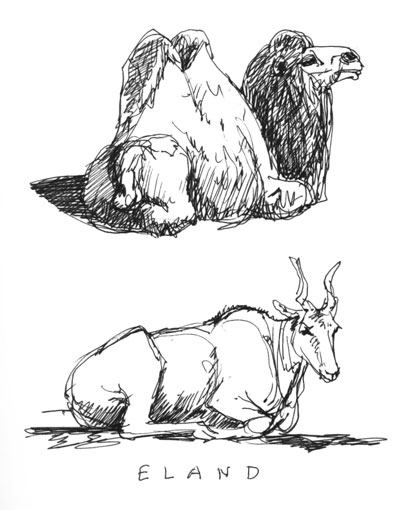
In the meantime, here are some of my sketches from the Denver Zoo. Most of them took less than three minutes, if that, so no time to doodle around. First I try to capture the gesture of their pose or movement, then add things like eyes and fur texture. Last is value, Sometimes I end up adding the modeling and “color” while I’m having lunch. The lions were very fit for zoo cats, but I’ll still “tighten” them up by referring to lions I photographed in Kenya.

The horses are my beloved takhi, of which three were out when I was there. I had seen domestic yaks, but these were the first wild yaks. They manage ok in The Mile High City, but in their native (shrinking) habitat, they thrive at 15,000 feet plus.


Great time in Missoula

Getting here got interesting, but the event has been terrific. Got caught on the ground in Denver yesterday when a May Day “blizzard” went right over the airport. Everything was closed down for about an hour and then I got to take pictures out the window of the plane being de-iced.

The OPA event is headquartered at the Holiday Inn Parkside. Great place! Big comfortable room, pleasant efficient staff. There was a small barking, whining dog in the room next door this morning and within a half hour of it starting, they had staff going around the restaurant trying to find the owners.

Yesterday’s activities included a talk by Peter Trippi on one of my all-time favorite artists, John William Waterhouse. I first saw his “Lady of Shalott” at the Tate Gallery in 1987. Then I got a personal critique of my work from William Schneider, OPAM, which was very positive. I’ll be taking a shot at getting into the national show next year. Finally, there was an information-packed presentation on ways that painters can use Photoshop. I’ll be blogging about that as I try what I learned for myself.

Then it was time to walk over to the Dana Gallery for the big opening of the Oil Painters of
America’s national show. Two hundred of the best contemporary paintings that I have ever seen in one place. Very inspiring and a little daunting. The weather was warm and beautiful and the gallery was packed. About a dozen red dots too. Very encouraging since the economy has essentially ground to a halt.

Time to go back to the Dana Gallery for morning demos, then marketing info this afternoon.

It’s Show Time!

Here I am at the Residence Inn in Pleasant Hill, which is about a half-hour east of San Francisco. Tomorrow, Saturday and Sunday I’ll be about ten minutes south in Walnut Creek doing their spring art festival. We used to live here in the late 1980’s and come back for occasional visits, so I more or less know the area, which is handy.

The Residence Inn is nice because it is in a quiet area and the room has a full-kitchen. So, I hit the Whole Foods store this afternoon. I won’t have to eat out unless I want to, which will save money.

I have no idea what to expect with the economy heading into the tank. Gas down here for the premium grade I need for the Eurovan is running around $4.10/gal. Home foreclosures are off the charts. A well-known wildlife artist once described himself in a workshop I took with him as “a luxury goods manufacturer”, which is probably about right. Serious buyers of art tend to have fairly recession proof incomes, but there is so much uncertainty in the world right now. Food riots, for heaven’s sake. So, we’ll see how it goes.

On the (much) brighter side, I got a “VIP” personal tour of Andrew Denman’s one-man show at Pacific Wildlife Galleries this morning from the artist himself. It’s fascinating to stand in front of one of his originals and hear him talk about how he did the work. Very inspirational. Made me want to run home and get in front of the easel, but since I get home on Monday and leave for Montana and Colorado on Thursday for a week, it will be close to the middle of May before that happens.

But, this weekend, I’ll get to meet lots of nice people and talk about one of the things I love most, painting!

On the Road again and Calf Update

It looks like all’s well that ends well this time. He is one lucky little calf.

image_7.jpg

Times-Standard 03/29/2008, Page A08
 Norman's owner comes forward

 Donna Tam

 THE
 TIMES- STANDARD

  The story of Norman the calf is on its way to a happy ending.
   Norman's owner came forward yesterday and was more than happy to
sign the calf over to the county, ensuring the calf 's eligibility
to be adopted, said Animal Control Officer Jim Norton.
   The little male dairy calf changed his fate when he got out of the
back of truck on its way to the auction, and was found on Highway 101
on Wednesday.
   "Usually when they have a dayold  bull calf, they ship him off to
meat factory,  said Norton, who
 has experience raising cattle. Male calves are not valuable to dairy
ranchers unless the rancher needs a replacement for a bull, because
they don't produce milk, Norton said.
   Since the owner's trailer was broken, Norman was being
transported  in a vehicle that wasn't set up for transporting
livestock.
   " It happens,  Norton said. " That doesn't always work, some
things like to jump.
   Norton said livestock officers will be visiting potential homes
this week to make sure Norman's new owners have the resources

The story continues on the back page, but this is the gist of it.

I’ll be driving down to San Francisco tomorrow for the Grand National Rodeo and Horse Show. I was invited to participate in the art show and shipped five paintings of Mongolian horse subjects down to the Cow Palace last week. Looking forward to seeing the show, meeting some of the other artists and carrying my conservati0n message to a new audience. I’m looking forward to American horse people’s reaction to images of Mongolian horses, both wild and domestic. I’ll also do some sketching at the zoo and hook up with nature art colleague, Andrew Denman for that on Saturday morning. Then Andrew will be my guest for the big opening reception and award ceremony at the art show. We can then wander around and check out the scene. There are supposed to be Tennessee Walking Horses, which I’ve never see live before.

Eggs and Elk

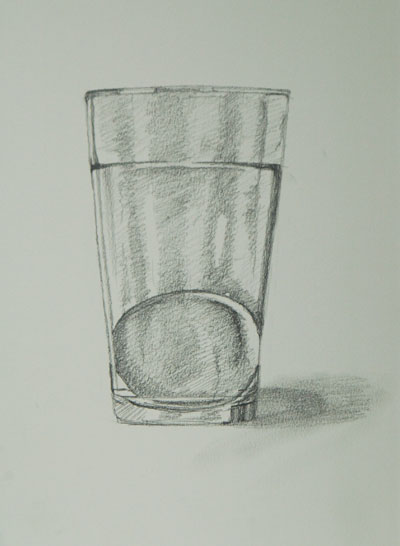
Ok, here it is, as promised. Sure to bring a million dollars at auction 1oo years after I’m dead and gone (which means it will probably go for about five bucks). Took about 30 minutes.

egg-in-water-glass.jpg

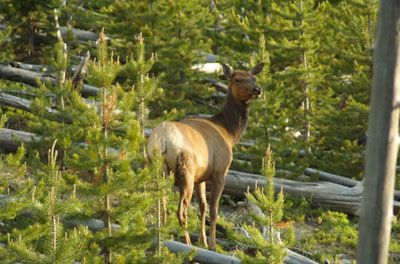
I thought that I might start to post works in progress which, one, always gives me something to blog on, and two, may provide one answer to “How do you artists do this stuff?” So, here we have a start of a cow elk that I photographed in Yellowstone in June of 2005, along with the reference photo. I was “game driving” between Mammoth and Norris and up on a hillside a group of elk were grazing. As you can see, they were in one of the burned areas. Lots of downed tree trunks and fresh new pines coming up.

yellowstone-elk2005-06-25.jpg

cow-elk-in-progress.jpg

The first questions I ask myself when I have an idea for a painting or am inspired by reference I shot are:

1. What makes me want to paint this? In this case, it’s a combination of the light, her graceful pose and I haven’t done an elk painting for awhile. A painting needs one strong idea and everything else is subordinated to it (Thanks, Scott Christensen). Every artist finds their own way to do that.

2. What is the best size and proportion of canvas to communicate the idea of this painting? (Thank you, John Banovich) As you can see, since my idea is the cow elk with the great light, most of the background was extraneous, so I chose a vertical format. This is a simple subject and, for me, didn’t really call for a big canvas, 16″x12″ seemed about right. But someone else might have decided that female animals don’t get the prominence in the art world they deserve and done her six feet high. Both are equally valid choices. I’ve had viewers of my paintings comment that they like seeing something besides bloated trophy males and enjoy my more off-beat subjects, which is encouraging. But ultimately I paint what I want, the way I want and then try to find a market.

3. As I lay in the drawing with a brush, I’m already thinking about the value (light/dark) pattern. I want the area of highest contrast where I intend the viewer’s eye to land. So, from the beginning I’m altering my reference to suit the idea of the painting. This brings us to the use of photographs in painting; the good, the bad and the sometimes seriously ugly. I have strong opinions about it (surprise. not.), but that’s a topic all by itself. Suffice to say for now that if you don’t have a strong idea of what your painting is about, then you may end up as one of those legion of artists who end up copying their photos, rather mindlessly sometimes. The key is “mindless”. Photorealists have made a quite conscious choice to work a certain way. Do what you want how you want, but do it by choice, not default.

So, here we are after two sittings. During the first, I solved the design: where the animal would be, how big and roughly how the surrounding habitat would go. In the second, which took about an hour. I refined the drawing, laid in my darkest tones and figured out roughly where the small pine trees would be, watching out for bad tangents (which is when two objects on different planes touch, which destroys the illusion of three dimensions) and deciding where the areas of highest contrast would be. California landscape painter Kevin Macpherson comments in one of his books (buy both if you want to self-study oil painting) that a painting is a series of corrections, which is so, so, SO true. When everything is corrected, you’re done. So simple, really.

Final notes (for now): I work mostly with round brushes. I like the calligraphic marks I can make with them, having been a calligrapher and sign painter at one time. I go 3-5 shades darker in value all over and then come back in with successively lighter values. I also try to work “lean to fat”, artist talk for going from thin paint to thick paint. Look at some traditional oils next time you’re at a fine art museum and you can see it. It’s one reason only seeing reproduction is of such limited use. Everything is flattened out. Original paintings have a literally third dimension of paint thickness. Fellow artist Julie Chapman’s work is a perfect contemporary example. You can’t really appreciate her lush, juicy brushwork unless you’re looking at the real thing.

Keep Them Doggies Movin’!

So, to pick up the story of my first rescue transport last month-

The plan was to go on Sunday. I got a call at 8:30 am on Saturday from Jean, the transport co-ordinator. Could I go that day since the weather looked like it was going to get really nasty on Sunday? You betcha. I had seen the forecast, too. Over to the shelter a little before ten. Loaded up four (yup, four) dogs into our Volkswagon Eurovan. One border collie, one Rhodesian ridgeback mix, one lab mix and a pit bull, all in crates. Spanky’s (the pit bull) crate was facing between the front seats, so we could look at each other en route. Finished the paperwork, loaded up towels and anti-stink spray and away we went. The route was from Humboldt County down to just north of Ukiah, east on Highway 20 and out to where it joins up I-5 at Williams. About a five hour drive. A little barking but no real fuss. Loaded up the CD player and locked in the cruise control. Ate a lunch while I rolled. The funniest part of the trip was when some harmonica (Bob Dylan?) came on and Spanky started to sing along. On the way on 20 through Lake County, lots of flooding near the road and small slides and “flooded” signs in the towns. Snow on the higher hills and some by the road. Made cell phone contact with the woman I was meeting right as I came down out of the hills. We both pulled into the gas station within a couple of minutes of each other. Whew. Got the dogs out, let them pee, loaded them into crates in her horse trailer, went to pee myself, called home and hit the road. Elapsed time at the rendevous: 20 minutes. Another five hours of driving. Ate dinner (another tuna sandwich) while I rolled. Got home around 8:45pm. Long, hard day, but four dogs have a chance at a great new life, so it was more than worth it!

Second transport was just over two weeks ago on Feb. 9. I was going down to the Bay Area to hook up with my husband anyway, so figured I might as well help move some more dogs out. There was one to go on Wednesday, two on Friday and a third by the time I got to the shelter on Saturday morning. This time it was a blue heeler, a real redbone hound and a shepherd mix and two drop off points. One dog, the heeler, in Petaluma and the other two in San Rafael. With some in-flight adjustments, it all went fine and then it was on to San Francisco. The top priority was to finally go to the new De Young Museum and generally kick back in The City for a couple of days. Mission accomplished. Here’s the sundown view from our 8th floor (out of 9) room at the Hotel Carleton, our favorite, reasonably moderately priced place to stay in San Francisco. Very convenient location on Sutter Street. Close to art galleries, Japanese, Indonesian, Italian and Vietnamese food and just down from Nob Hill.

view-from-hotel.jpg

The De Young was terrific, inside and out. I had been very skeptical of the outside, but when we stood across the street in front of the new, mind-blowing Academy of Sciences building, we decided that it worked. There is a whole “orchard” of trees in the sunken bandshell area and they look great against the flat plane of the museum’s facade. The tower still looks a little odd, but the design needed that. Too bad I forgot to take some pictures. Sorry.

The inside is everything a great place for showing and viewing art should be. They have so much more room now, so there is a lot more to see. Lots of old favorites like the Sargents and some I don’t ever remember seeing like two by William Keith, a killer Thomas Hill and a couple of Diebenkorns. One of the best modern works was a suspended cube made out of charred wood from a southern black church which had been burned by an arsonist. It was an amazing visualization of objects in three dimensions. It’s called “Anti-mass” and if you go to the De Young, don’t miss it!

We then drove on out to Ocean Beach. Winter in California. We are so spoiled. Here’s a view north towards the Cliff House. It was t-shirt weather warm at four in the afternoon.

gulls-and-cliff-house.jpg

One the way back to the hotel, we drove through Golden Gate Park and ended up timing it perfectly for “magic light” as you can see from this photo of the Conservatory of Flowers. Got lots of pictures of cypress trees in great light too, but you’ll have to wait for the paintings.

conservatory-of-flowers.jpg

The next day, we went to the Legion of Honor for more art, this time European (the De Young only has American art). I found, in both museums, that my eye and technical ability in painting has reached the point where I can probably seriously bore almost anyone talking about underpainting, in what order the colors were put down, how many strokes of the brush an area had, the variety of edges, etc. Here’s one of my new favorites from the Legion of Honor, “Portrait of a Miniaturist”, artist unknown. Stylistically, it could have been done last week. It was done quickly, with confidence and probably for the artist him or herself, maybe as a break from the much more tightly finished work that one usually sees from the time (late 18th century).

the-miniaturist.jpg

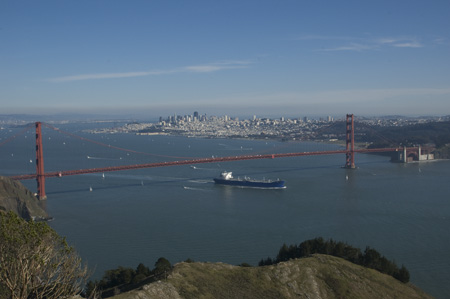
Had lunch at a fantastic Vietnamese place on Lombard St. called Pot of Pho. Pho being the “national soup” of Viet Nam. Then it was across the Golden Gate to the Marin Headlands, which I had never been to. We drove every road and went out to the ocean’s edge. It was another warm, sunny day and there were lots of people on bikes, at the beach and hiking the trails. The piece de resistance was on our way back, where we stopped for what has to be one of the all-time great views of San Francisco.

golden-gate-marin-headlands.jpg

You can see why millions “leave their heart” in San Francisco.