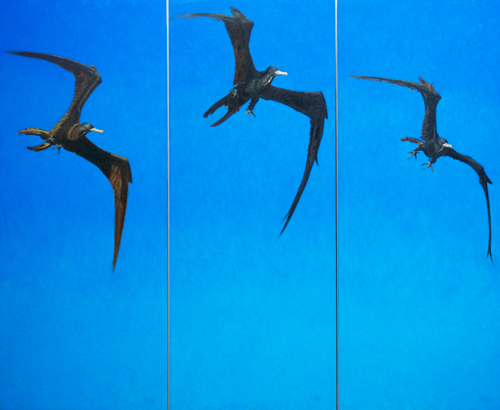
This is the third of three paintings I’ve done for the “Sea of Cortez” show, which will debut at the Arizona-Sonora Desert Museum in March.
It’s a triptych showing one Magnificent Frigatebird who came swooping in behind our boat after one of the artists caught a fish. His landing gear was down, hoping to snag it if he got a chance. I grabbed my camera and got five photos of him. I was really pleased to see these three and submitted all of them for the curator to chose from. And even more pleased when he gave me the go-ahead to do all of them as a set.
Here are the three paintings. Each of them is 40×16″:
You can see the other two paintings, “El Tigre (Nacapuli Canyon” and “Up Close-Sally Lightfoot Crab”, plus my other posts about my trip to the Sea of Cortez as part of a group of 30 artists here.
I just finished my second painting, “El Tigre (Nacapuli Canyon)”, for the group show I’m participating in, “The Sea of Cortez”, which will be opening next March at the Arizona-Sonora Desert Museum in Tucson, Arizona. The first one “Up Close-Sally Lightfoot Crab” can be viewed here.
This new painting came about as a result of my interest in comparing the Gobi and the Sonoran Desert. There are argali sheep in the mountain ranges that rise out of the Gobi, so I wondered if there were desert bighorn in the part of the Sonoran Desert that we visited, particularly the spectacularly beautiful Nacapuli Canyon.
I was given the contact information for a scientist who is familiar with the megafauna of the area. He more or less told me that he had bad news and good news. The former was that there is no record or evidence of desert bighorns in the canyon. The good news (and very good news it was indeed) is that there have been sightings, along with pugmarks and other evidence, of jaguars in the canyon. So I knew what one of my paintings would be.
Nacapuli Canyon is quite popular with visitors to the area for picnicking and hiking. Big cats tend to be very wary about the presence of humans, so while other wildlife like birds and coatimundis aren’t too difficult to see, the odds of seeing a jaguar are close to zero. But…as an artist I knew that I could “see” a jaguar in the canyon and show other people something very special about this place that might help conserve it for future generations.
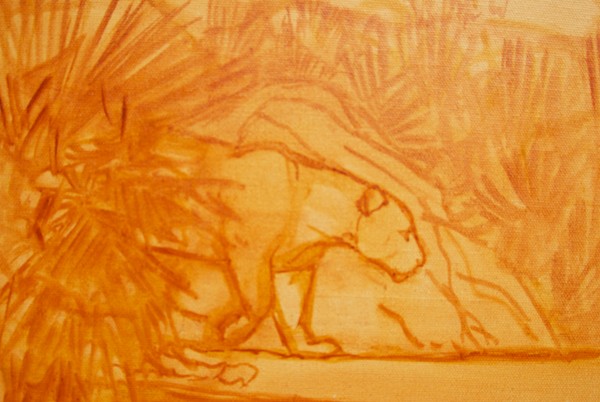
Here’s the step by step process of the creation of “El Tigre (Nacapuli Canyon)”-
One of the canyon reference photos I used. There were a total of 21 photos of the canyon, vegetation, jaguars and other big cats for paw position reference in my digital “album” for this painting.Study of the proposed painting, approved by the show curator, Dr. David WagnerCharcoal pencil studies. The lifted paw in my main reference photo was blurry, so I went through my other big cat reference and searched Google images to find paws in a similar position that were in focus. I also needed to understand the spot pattern before I started to paint it.
Finally it was time to start the painting:
Blocking in the drawing with a brush, adjusting the relationships of the various elements as I go. I used a fairly intense burnt sienna tint which I knew would show through in spots in the finished work and give it a nice glow. I also changed the proportions, making it wider than I had originally planned.Close up of the star of the show. The visible part of him is 3.5″ long. His head is 1″ from ear to nose.First color lay in, indicating the shapes of the shadowsWell into it now, working over the whole surface of the painting. I finished the canyon and made a start on the jaguar. Then I left for Mongolia for seven weeks. I tweaked the farthest mountain, lightened the sky and finished the big kitty yesterday.Detail of the waterhole and surrounding rocks in progressEl Tigre (Nacapuli Canyon) oil 36×24″
It was the second morning out on my one-week camping trip last August.We had stayed the previous night at the ger of my driver and his family, who lavished on me piles of white foods…aruul, airag, urum (dried yogurt, fermented mare’s milk, clotted cream) and more.
As we were heading west towards what I had been told was a beautiful lake, I spotted a large herd of yaks not too far from the road. Puugii, who turned out to be a great driver, pulled over and stopped. I got out to take pictures and almost immediately saw three herders coming our way at a gallop. They pulled up, all dressed in del and boots, looking very dashing, and stopped. What a photo op! I asked Puugii to ask them if I could take some pictures. There was a little hesitation, but then they nodded and I got to work, knowing already that I would be getting multiple paintings from this encounter.
I didn’t realize until I got home and took a closer look that this mal chin (herder) was checking me out with a look of calm appraisal.
You can see the other two paintings I’ve done so far here (the portrait at the bottom) and here.
Pokey Park and I and our guide/driver were exploring the wetland area of Gun-Galuut Nature Reserve, when we saw a local herder coming past us. One of the impressive things about Mongol riders is that, even at a very young age, they can ride a horse going pretty much at any gait or speed standing up and utterly still.
He rode on past us and we continued birdwatching and picture taking. Not too much later though, back he came, catching up with a brown horse, saddled and bridled, which had clearly gotten loose. In the meantime, a good-sized group of horses were heading for some open water. The brown horse dodged behind them with the rider right after him. Up came his urga (the long pole with a loop that is used instead of a rope lasso) and in short order the brown horse was captured.
Got him.
For the painting, I wanted to show Mongol horsemanship, which most people haven’t seen. The bonus, of course, was the great morning light and the setting. And…you may have noticed that the rider in the photo is wearing backwards baseball cap, but not in the painting. I’m interested in painting the Mongolia of today, but the baseball caps just don’t do it for me, however practical they are for the wearers, so I leave them off. But everything else is as I saw it that beautiful morning in August 2011.
Definitely a change of pace for me, this painting is the first one of three for the upcoming Sea of Cortez group show, which will open at the Arizona-Sonora Desert Museum on March 16, 2013. You can read about the trip and see some of the drawings I’ve done and photos I shot here.
While I was on the trip with 30 of my colleagues in March of 2011, we had access to a very nice fishing yacht whose owners generously took us out to an island that not only had these colorful, irresistible-as-subjects crabs, but also California sea lions and many species of birds.
I knew as soon as I saw them that I would want to paint one. Fortunately, there was also a Zodiac (small pontoon boat) that got us right up to the rocks. That and fast shutter speeds and I got some great reference.
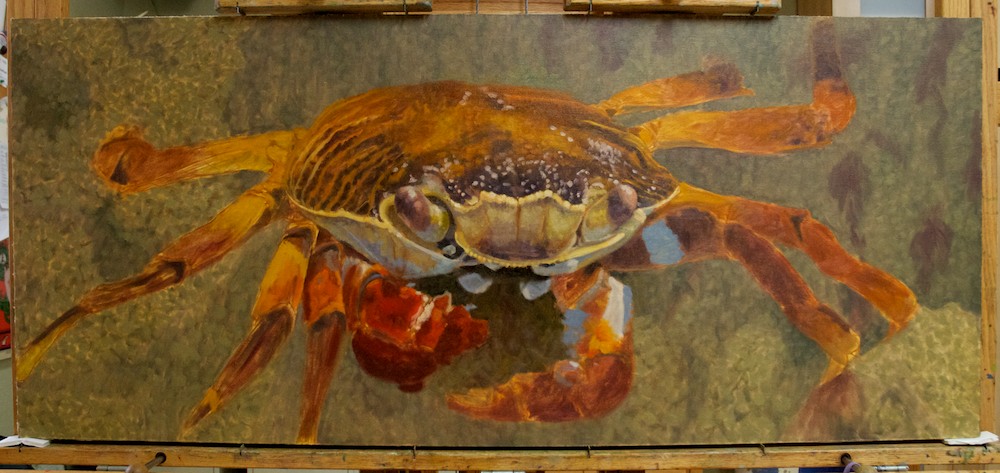
Here’s the step-by-step of “Up Close-Sally Lightfoot Crab”:
Here’s how I was able to get such great shots. We were able to get REALLY close to them.Reference photo; I knew from the beginning that I wanted to paint the crab BIG and crop in for a horizontal rectangle. I used other photos for comparison and to change the position slightly of one leg.Preliminary graphite study, 7×17″; to learn my subject, ensure that the composition worked and to establish the value patternColor rough, 6×14″; this is a really different color palette for me compared to the more restrained earth tones I use for my Mongolian subjects. Can’t remember the last time I used red and yellow pretty much right out of the tube.Grid transfer in pencil; Raymar canvas board is tinted with raw siennaThe brush drawing. I realized after I’d done the one from the pencil drawing that the crab wasn’t nearly big enough, so I wiped if off and re-drew it. By this time I’d done the graphite study and the color rough, so I “knew” him/her pretty well and it didn’t take long.First color passThis is a little more than half-way there. The next step was to catch the background up with the crab and then move on to the legs and claws and then go back and tweak everything until it was done.“Up Close-Sally Lightfoot Crab” 20×46″ oil
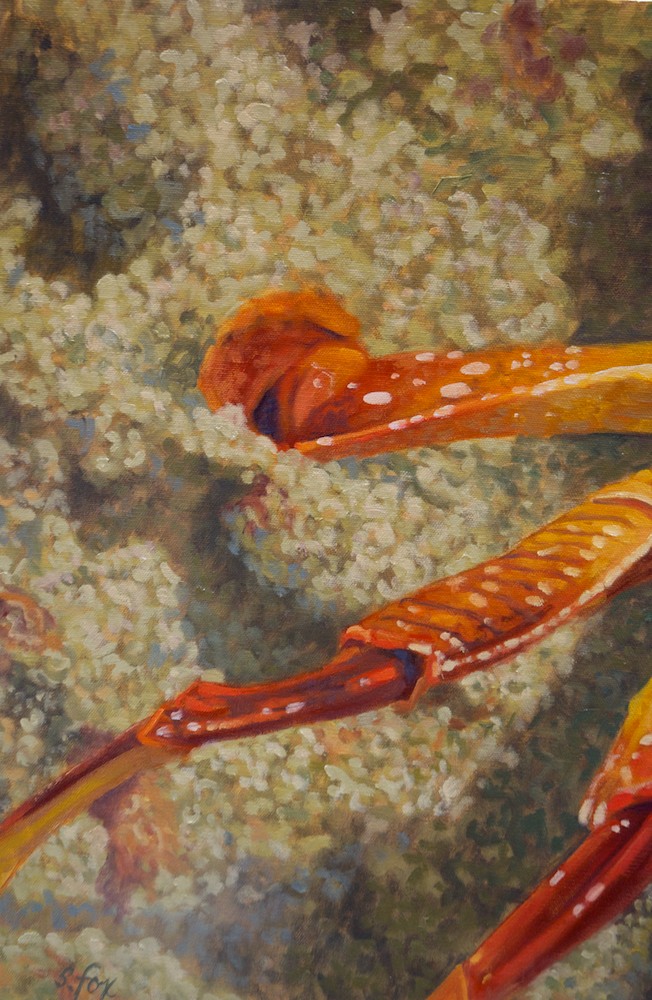
I thought I’d share some details of the crab and the background.
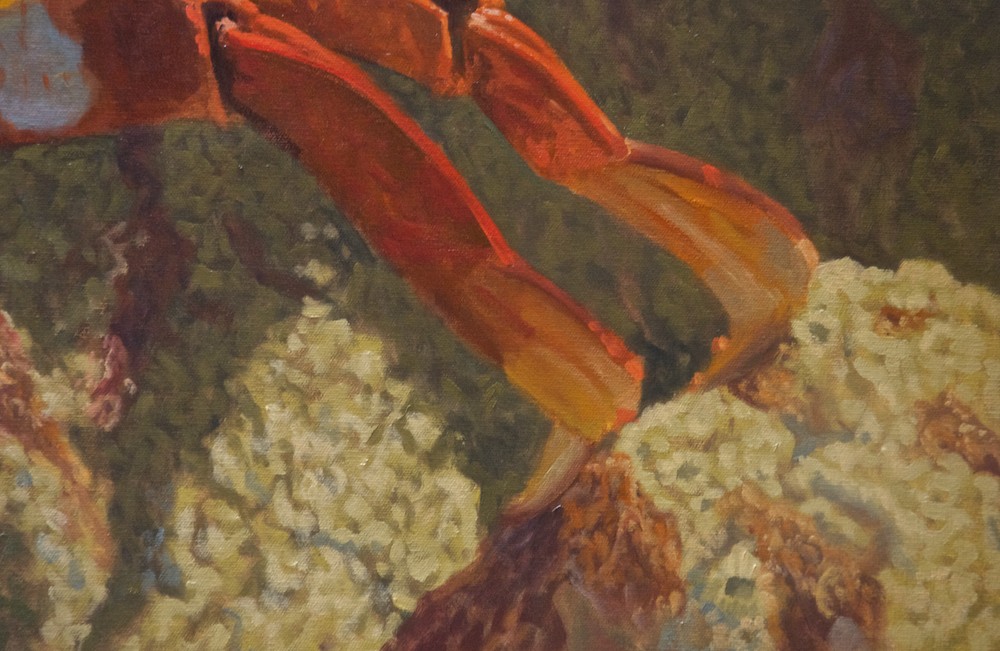
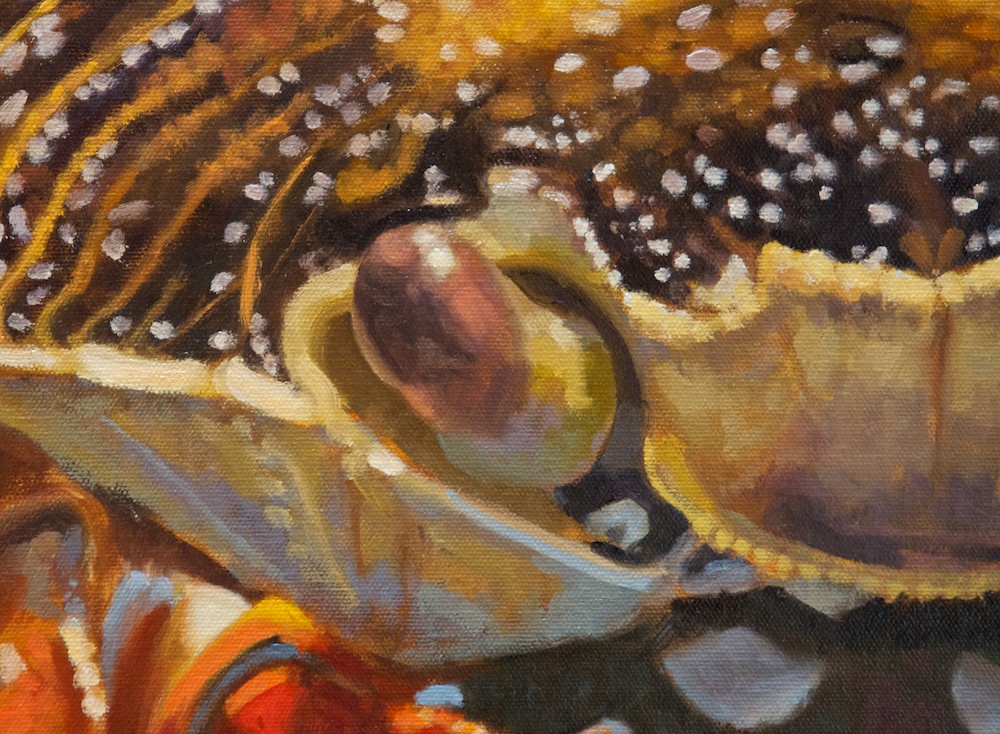
The crab was on a rock totally encrusted with barnacles. I had absolutely zero interest in painting 50 gazillion of them, so instead I analyzed the visual texture and values and then indicated those in a variety of colors and values.But just to make sure the viewer knows what they are, I did a few more finished ones in the lower right hand corner.The eyes were fun. The challenge was to get expression, to have the viewer feel that the crab is looking right at them.
The next painting for the show will truly be something completely different…a landscape with Nacapuli Canyon as its subject, with a special extra thrown in.
I’m very proud to announce that my latest takhi painting “Enchanted Evening”, has been accepted into the Society of Animal Artists’ 52nd Annual Exhibition of “Art and the Animal”. This is the fourth year in a row that I have had work in the show and they have all been Mongolia subjects, which pleases me a lot.
The exhibition will be held at the Hiram Blauvelt Art Museum, which is located in Oradell, New Jersey, and officially opens on the weekend of October 5-7. I plan to be there for all the festivities. More details later on as the opening approaches, but consider yourself invited!
The story behind the painting: Last August, nationally-known sculptor Pokey Park and I were on a two-week tour of the best wildlife watching locations. We were leaving Hustai National Park, one of the three places in Mongolia where takhi have been reintroduced, after a last horse-watching drive, which had already been very successful. Then, less than 50 feet from the road we spotted this small group of takhi coming down to a pool of water. We stopped and got our cameras ready. Would they come or not…
Trying to decide…We’re thirsty!
And here’s a short video that I shot on my Flip HD. Unfortunately we ended up with a lot of cars stacked up behind us, just like a bear or bison jam in Yellowstone. One woman came up next to me out in plain view (I was behind the open door of the car, using it for kind of a blind) and spooked them, but at least they’d all been able to drink. Enjoy!
And here it is the "real" finish again for comparison.
I was coming down out of the mountains north of Tsetserleg with my guide and driver while on a one week camping trip last August and off in the distance we saw a large herd of yaks. Of course we stopped so I could get some photos. The three herders who were with them spotted us and came riding over. I asked the guide to ask them if I could take their pictures and they said yes. I knew while I was snapping the shutter that I was going to get multiple paintings out of this chance encounter, typical of travel in Mongolia.
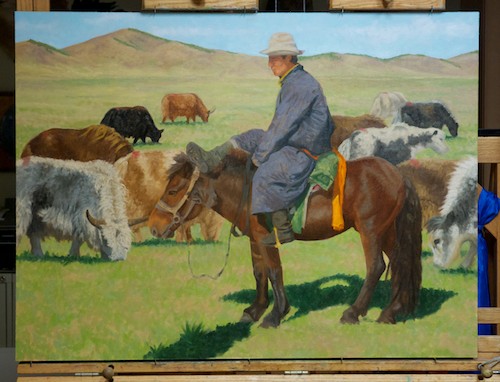
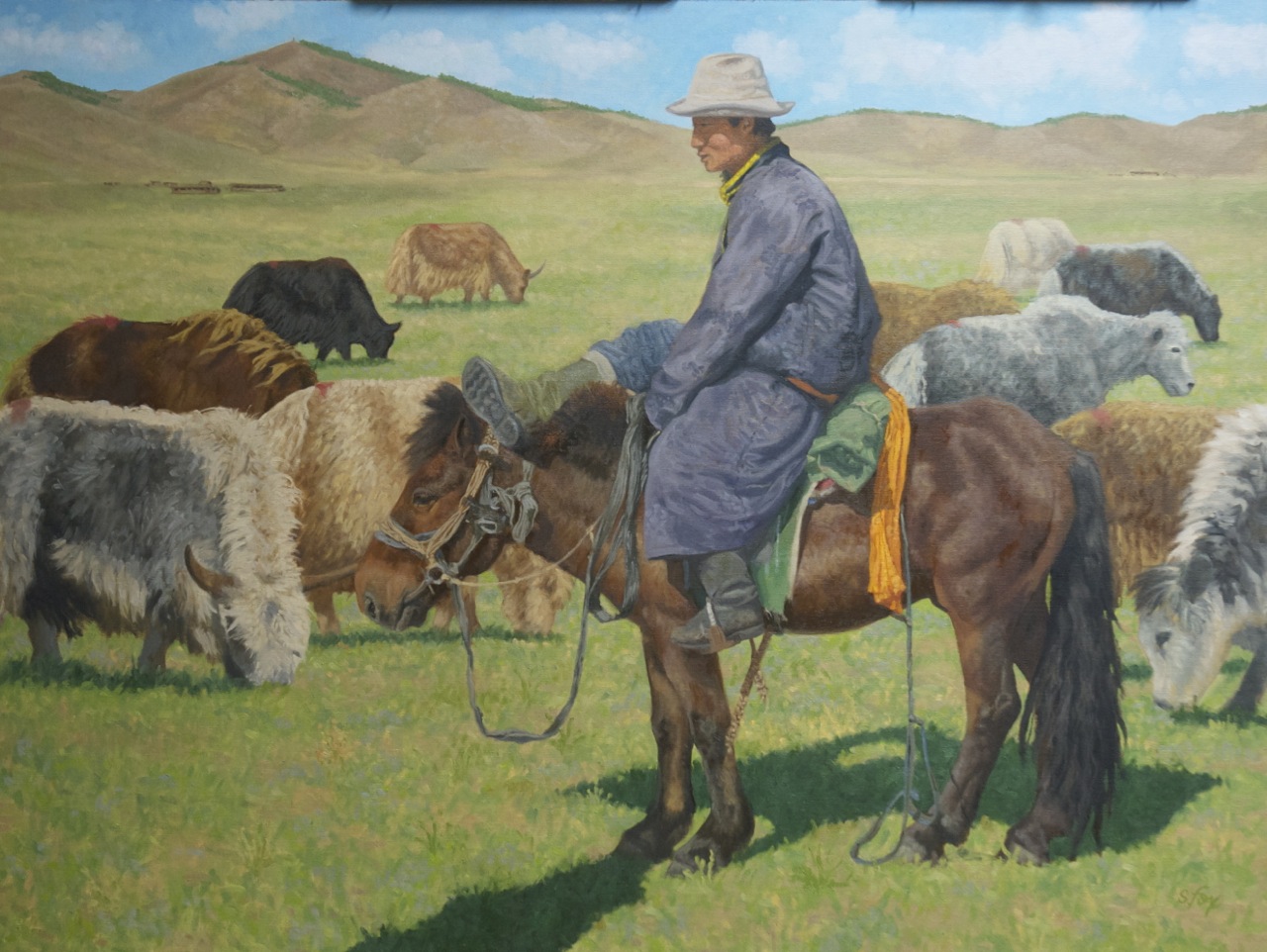
Here’s a step-by-step of my newest painting “Zun Odor (Summer Day)”:
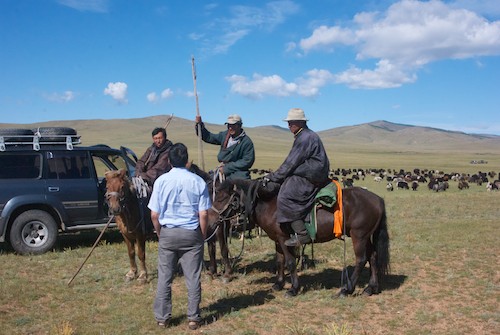
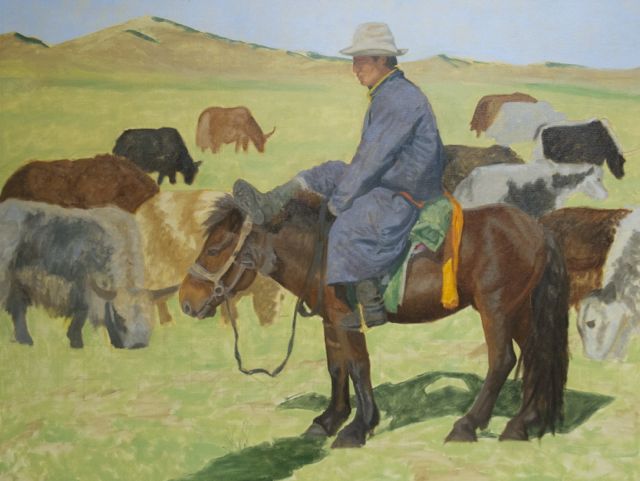
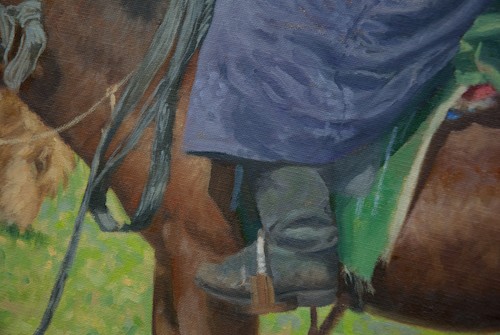
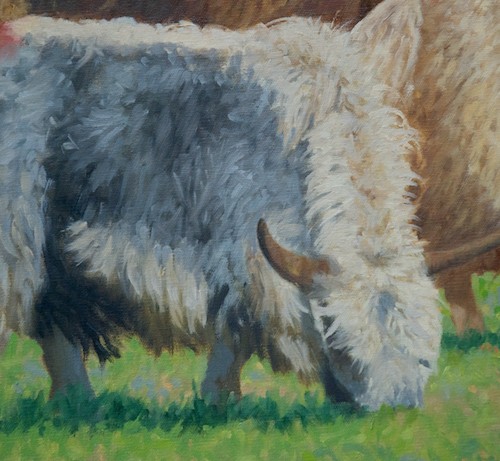
The three yak herders, Arkhangai Aimag, chatting with Puugii, my driverThe idea of the painting (and a good painting has only one) was the casual way the herder had laid his leg across the neck of the horse, who seemed to be totally unconcerned. The Mongols' relationship with their horses is really something special, going back, as it does, over 1000 years. They know each other pretty well at this point. The composition was allowed to resemble some I've seen of American cowboys and cattle, only in this case it's malchin (herders) and sarlag (yaks).This is after the first pass of laying in color on the herder, horse and landscape. It lets me see how the shapes of the yaks are working. This was the most animals, by far, that I've ever put in a painting, so it became a pretty intense juggling act, making sure that all the parts worked together.One to two passes of color overall. I'm also using my reference to make decisions about what colors the yaks will be. I wanted the right amount of variety, but not to the point where it drew attention away from the herder and his horse.Continuing on, working over the whole canvas.The finished painting. I thought. But I decided that I needed some fresh, knowledgeable eyeballs on it, so I emailed a jpg to two colleagues who, among other things, pointed out that the yaks in the background were not in correct scale. And they were right. They also thought the grey yak's head on the right was odd and I found that, after going back to my reference, that I agreed with them about that too. Back to the easel. One of the reasons I have the working process that I do is to provide the flexibility to make whatever changes or corrections are necessary at any point, even when I think I'm done and have signed the piece. I have no compunctions whatsoever about wiping out or scraping down any part at any time if it's not right."Zun Odor" (Summer Day) 30x40" oil (price on request)- the "real" finish again. Notice how the yak on the right at the herder's waist changed color twice.
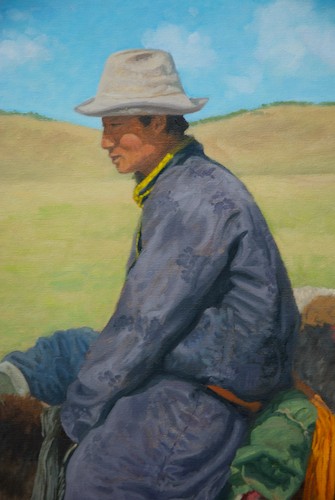
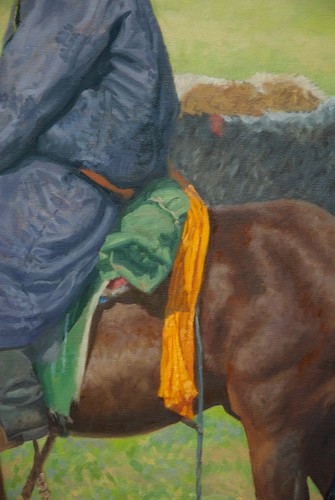
Here are some detail close-ups so you can get a better look at my brushwork:
The herderHis rain slicker and sashBoot, stirrup and tackThe horse's headOne of the yaks
Saikhan Eej (Beautiful Mother) 18x14" oil (price on request)
I was wandering around sketching at Gandan Monastery in Ulaanbaatar last year and was resting in the shade in a courtyard. There were lots of people around, monks in red and gold robes, families feeding the pigeons and older people wearing beautiful del, like this woman. I got just a few photos of her. To me she personifies the character and dignity of Mongol elders. She has seen so much in her life, so many changes. Mothers are particularly honored in Mongolia. I’ve been told that 60% of Mongol songs are about them.
One of the joys of my travels to Mongolia is the opportunity to meet or just be around these older women and men. America could learn a lot from the Mongols about how to treat the wise, experienced elders in our society.
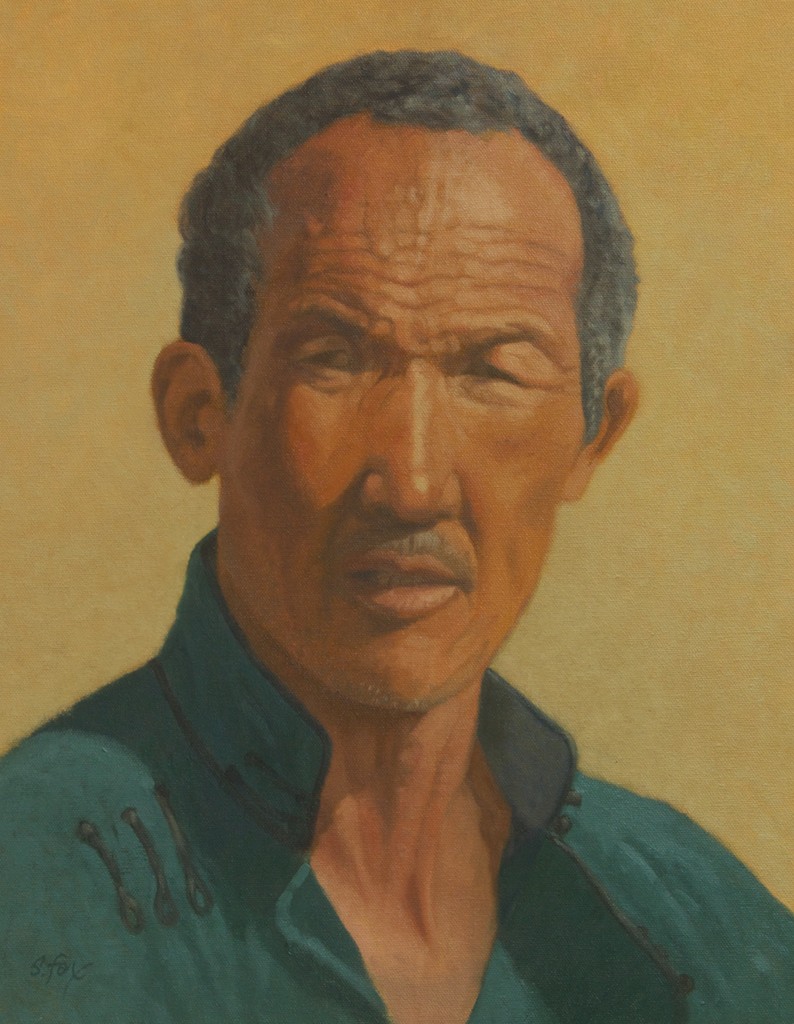
Yak Herder-Hentiii Mountains, Mongolia 18x14" oil (price on request)
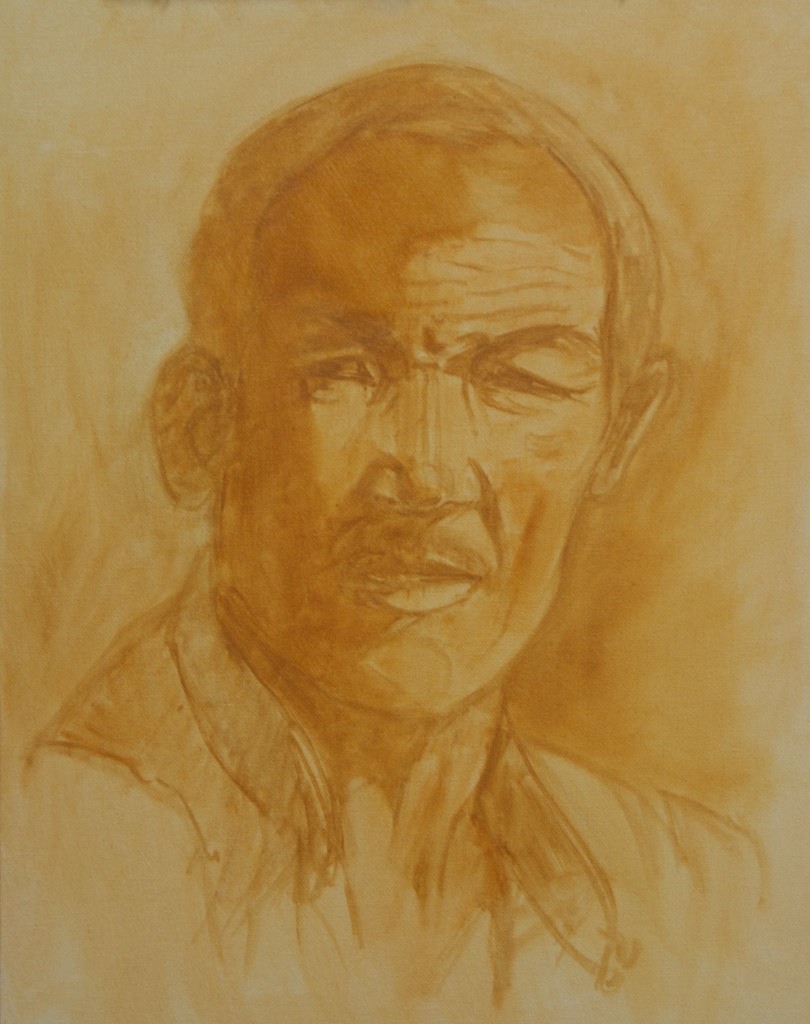
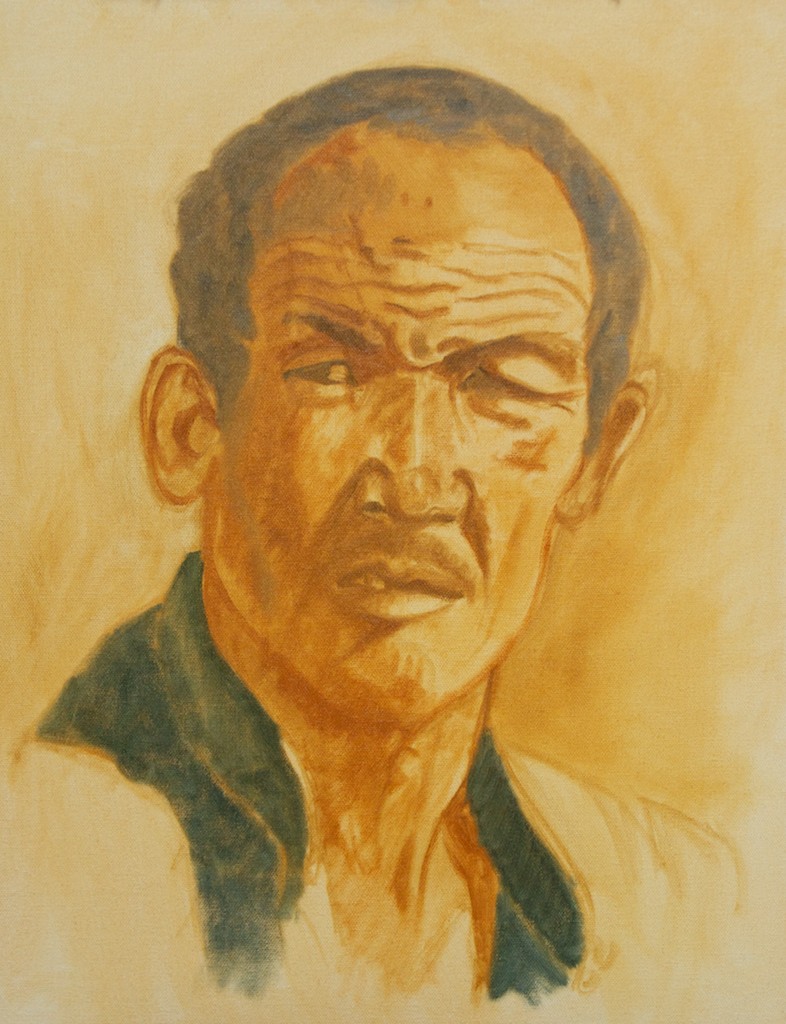
And here’s the step by step process by which I created this painting:
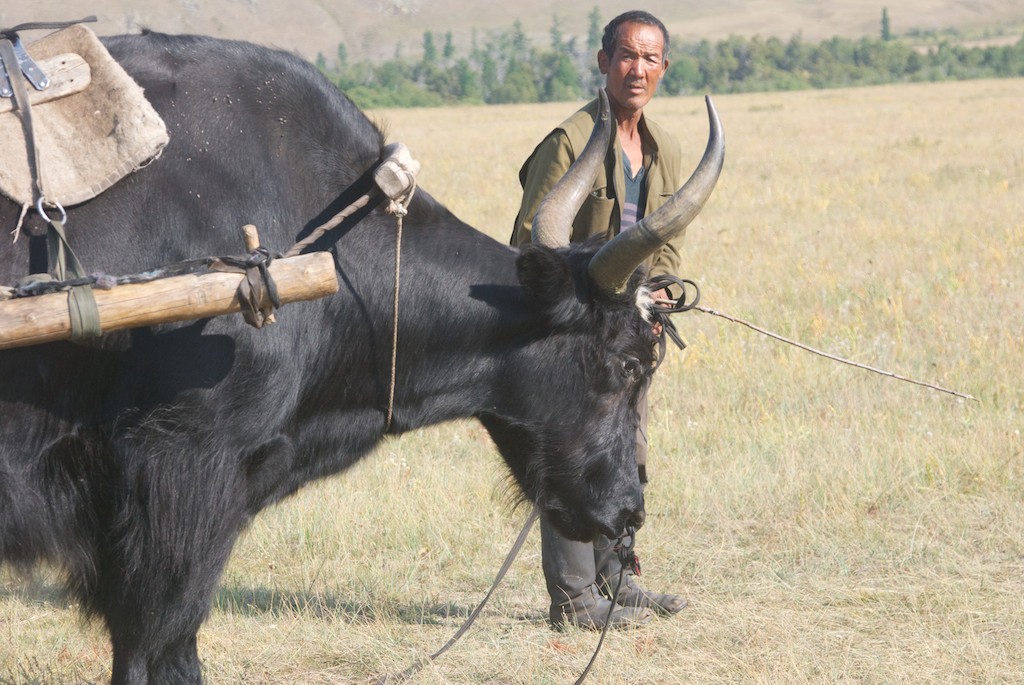
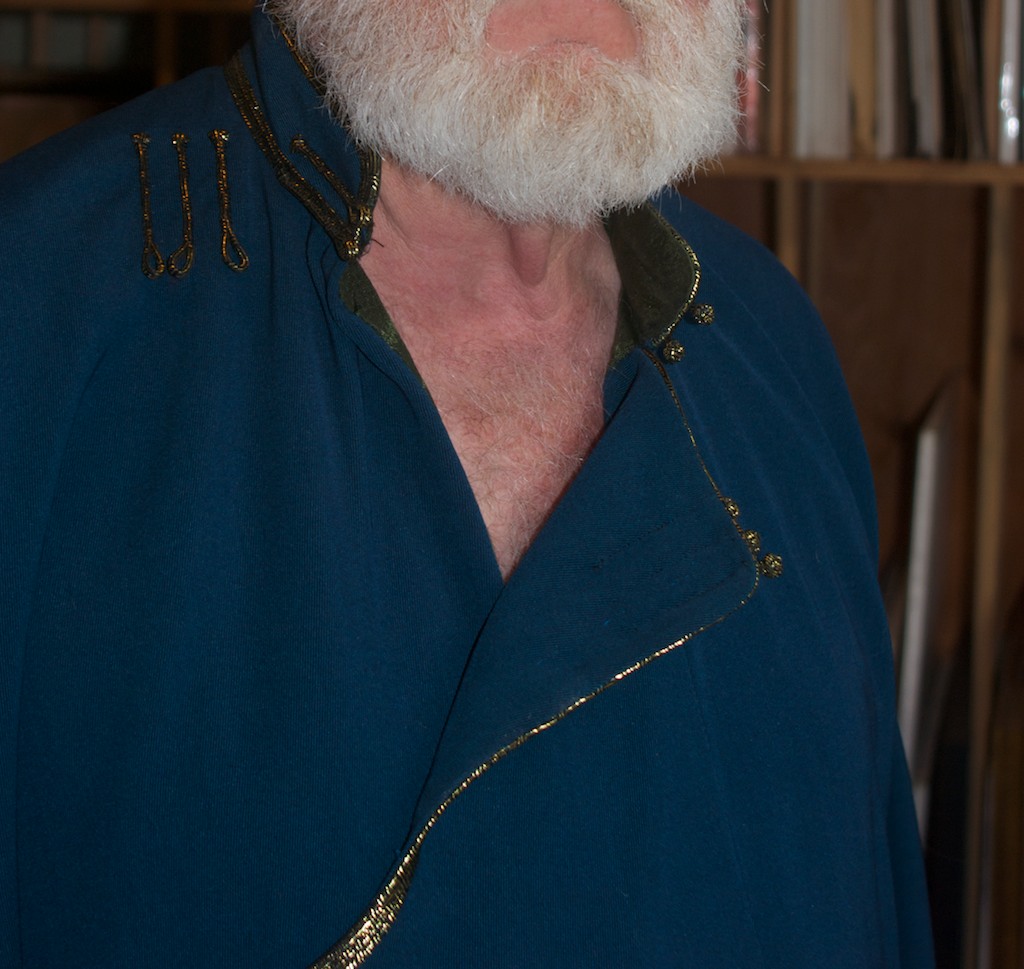
The reference photo I used of a local man who hauled water to the Jalman Meadows ger camp where I was staying with another artist this past August.I started out with a raw sienna toned RayMar canvasboard and began with a loose brush drawing for placement and position of the head and features. I've already changed him into a del instead of western clothes.Next I established the light and shadow areas.I re-drew the features and started to add some color.I went darker with the background and launched into modeling his head.I was using two or three other photos for the del and continued to model his head, paying particular attention to the features, value relationships and the various colors in the shadows.At this point I realized that the del was opening the wrong way due to the other photos i was using and that I needed much better reference for itI'd had del made for myself and my husband in 2009. He was kind enough to model for me in his.I decided to finish the bottom to the edge of the canvas and I also lightened up the background. So, once more, "Yak Herder-Hentii Mountains, Mongolia"













 Susan Fox, American Artist