Mongolia Monday- Explorers and Travelers: Henning Haslund on Mongol Horses

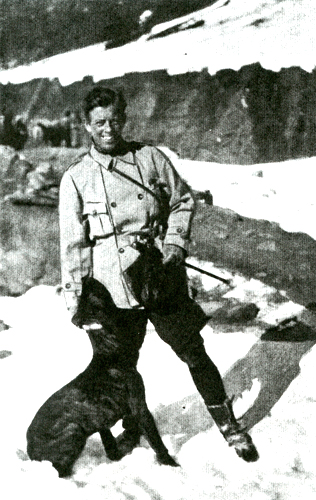
Haslund-500If all Henning Haslund had ever accomplished was to survive an expedition with Sven Hedin, that would have made him notable (Hedin’s expeditions are remarkable for the body count of both men and animals). But he is also one of the “must read” writers for anyone interested in Mongolia.

I’ve only read one so far, “In Secret Mongolia”, but the second one “Men and Gods in Mongolia” is sitting on the shelf waiting for me. I’ll be getting a copy of “Tents in Mongolia”, the third of what is really a series, also.

“In Secret Mongolia” (published in 1934) is the story of Haslund’s participation in a Danish project to establish a farm in northern Mongolia (which lasted from 1923 to 1926). Along the way he meets most of the major characters who were also in Mongolia at the time or hears tales of others, like the Bloody White Baron, Roman von Ungern-Sternberg.

He also wrote eloquently and with affection about the Mongols. Absent is the thinly veiled attitude of inherent white superiority present in many other accounts.

Here is Haslund writing about the Mongols and their horses (Note: when Haslund refers to “wild” horses, he is talking about the domestic Mongol horses, which run “wild” when not in use, not the genetically wild takhi/Przewalski’s horse):
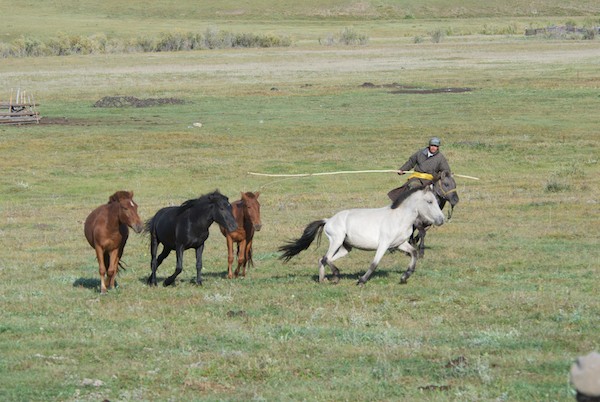
herder JM“It is a pleasure to see the Mongols in association with their horses, and to see them on horseback is a joy. If one of the wild or half-wild horses of the herd is to be caught, the Mongol rides on a specially trained catching-horse, holding in his hands an urga, a very long pole with a noose at the end. The catching-horse soon understands which horse his rider wants to get hold of, and follows it until it is cut out of the herd. Then the pursuit goes at a flying gallop over the steppe, until the Mongol gets his lasso over the pursued horse’s neck, when the catching-horse slowly but surely holds back till the wild horse is tired out, and the Mongols hurry up to saddle it. The wild horse is not let go until is has a rider in the saddle, and then it gallops, buckjumps and throws itself on the ground in the attempt to get rid of its rider. But the Mongol sits fast and the horse is soon broken.

herder 4 JM

herder 2 JMSuch horse-breaking is admirable, and the strength, swiftness and elegance of the Mongol surpass those of any ballet dancer. I once saw a Mongol ungirth and throw off the saddle from under him and continue to ride the horse bareback, bucking wildly all the time, till it was broken.

herder 6 JMHorses are the Mongol’s chief investment. He knows nothing of banks and silver does not interest him beyond the quantity that he and his women can use for ornament. But if he has many horses on the steppe, then he is a well-to-do man. Then he sits on a hillock looking out over his wealth, and counts up the many-coloured multitude of splendid animals grazing on the steppe with slim necks and flowing manes, just as a man in the west counts his notes, and when the neighing of the stallions rings bell-like over the grass lands, his eyes shine with greater pride than the ring of minted silver can call forth in us.”

Note: the horse photos in this post were taken by me last year near the Jalman Meadows eco-ger camp run by Nomadic Journeys, who does all my in-country travel arrangements. It is located in the Strictly Protected Area of the Han Hentii Mountains a few hours northeast of Ulaanbaatar. The local family who helps run the camp lives nearby and demonstrates Mongol practices and horsemanship for visitors, including riding a couple of two-year olds for the first time when I was there. They also provide horses for trekking trips.
Mongolia Monday- 5 Photos Of Favorite Places: Khar Us Nuur

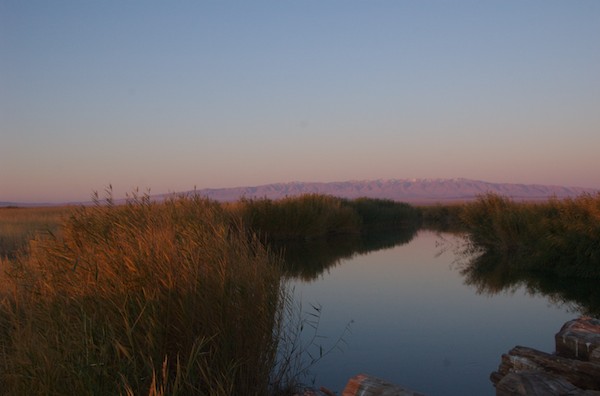
Sunrise with Jargalant Uul in the background

On my second trip to Mongolia in 2006, which I did on my own through Nomadic Journeys, I wanted to go out to the west to visit Khomiin Tal, the third location where takhi/Przewalski’s horse has been reintroduced. I flew out to Hovd, which is around 1000 miles from Ulaanbaatar, met my guide and driver and headed east about 130 miles, most of it on earth roads. I knew nothing about anything in Mongolia at that point and it was all a brand new and exciting experience.

An unexpected sight was Khar Us Nuur National Park, which has been set aside to conserve and protect a complex of three lakes and their connecting channels. It is also one of the great birding hot spots in the world. But it’s difficult to get to the lakeshore in most places due to the thick reed beds. We camped on the shore of one of the channels the last night out in the countryside. Here are some of my favorite photos of a place I’d love to go back to sometime.

The steppe
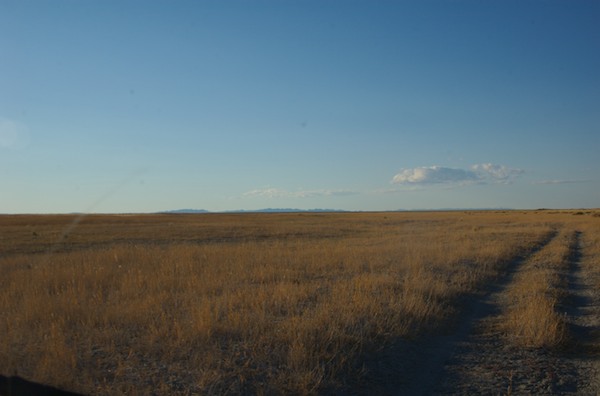
The steppe at sunset, looking back to the east with the lakes behind me. This was my first look at the legendary grassland steppes the now exist only as remnants in Mongolia.
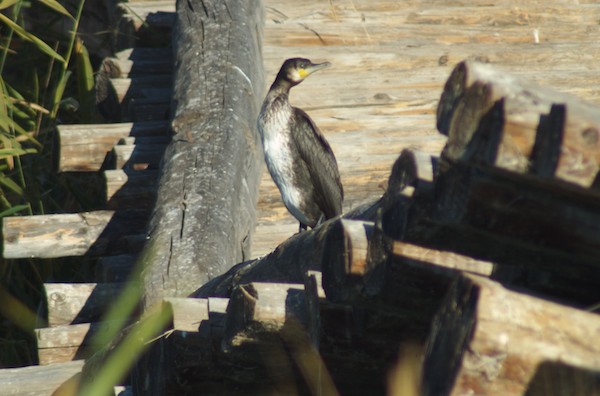
Cormorant
Great cormorant using an old wooden bridge as a fishing perch
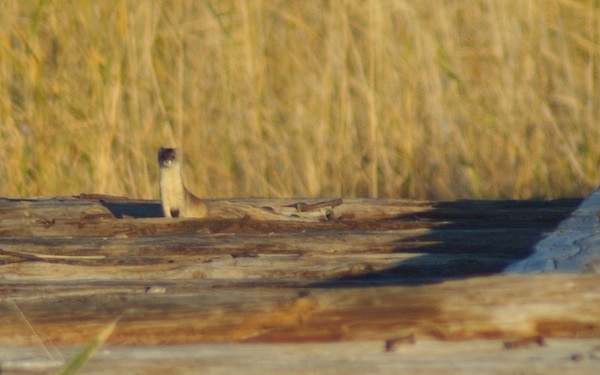
Weasel
Stoat or ermine who popped up on the old wooden bridge right near where we were camping.
Bactrian camels
Bactrian camels near the soum center, Dorgon. This was the first large herd of camels that I’d seen in Mongolia.

There is a previous post about great wildlife watching places in Mongolia that includes Khar Us Nuur. You can read it here.

New Painting Debut! “Rock Hoppin’ ” -Siberian Ibex

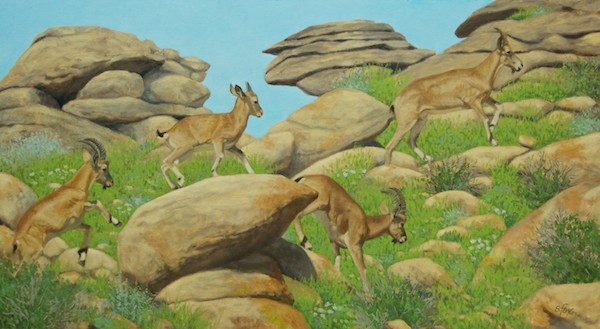
Rock Hoppin'  20x36"  oil
Rock Hoppin’ 20×36″ oil

I went to Ikh Nartiin Chuluu Nature Reserve last year with a plan to focus on getting good, paintable Siberian ibex reference. Boy, did that ever work out. On three out of four mornings, I shot over 1000 photos and watched ibex for at least five hours. They were a couple of groups of nannies, kids and juvenile billies who were hanging around some of the rock formations at the west end of the valley where the research camp is located, only a 30 minute walk.

I’ve got a lot to chose from, but loved the “rock hopping” that occurred when this group, who I had already been watching for over an hour as they rested, grazed and interacted, got up and started to move off when the big nanny did. So here she is, cautiously and seriously leading her group to wherever she’s decided they will go, while the youngsters goof off and play follow the leader up and down and on and off the rocks.

Here’s a step by step of “Rock Hoppin’ “:

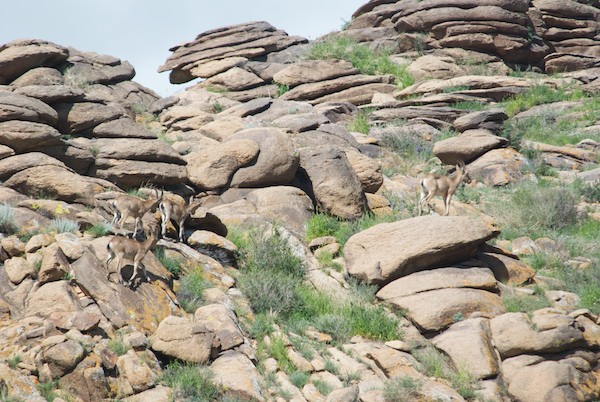
Ibex group at Ikh Nartiin Chuluu
Ibex group at Ikh Nartiin Chuluu; one of the dozens of photos I shot of this group as they moved off from left to right, the nanny leading the way and stopping at times to evaluate what’s ahead. Most of my reference showed only the rocks, but I wanted some sky also, so chose this photo for the upper left hand part of the painting, particularly that unstable formation at the top, which gives a feeling for the habitat the ibex like best.  There had been a lot of rain and the reserve was as green as anyone could remember. Wildflowers were everywhere. The photos one usually sees of this species are from way up above the tree line in mountains where there is very little vegetation. I liked showing them in a different and more colorful habitat.
Preliminary graphite study
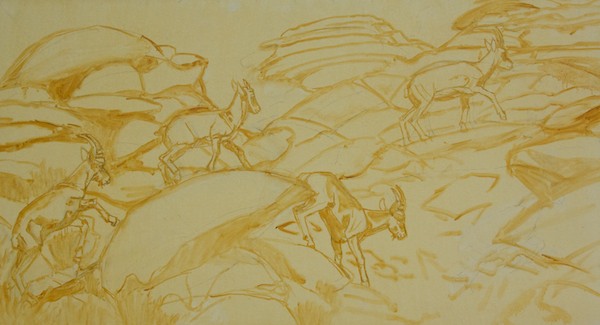
After doing a compositional drawing, I did a graphite transfer to the canvas and then re-stated the drawing with a brush
After doing a compositional drawing at the final size, I did a graphite transfer to the canvas and then re-stated the drawing with a brush. There had been a fifth ibex in the lower right, but something didn’t seem right design-wise and the solution seemed to be to remove that one, which I did. Then there was still something not right. I realized that I needed an adult ibex, the nanny who was leading the group, not a juvenal billy. This not only let me use a larger animal, which was visually more interesting, but made the painting behaviorally accurate, which is very important to me. I’ve developed a painting procedure that lets me make minor to major changes at any time in the process. I never have to put pressure on myself by “guessing right” at the beginning and then finding myself stuck when something isn’t working.
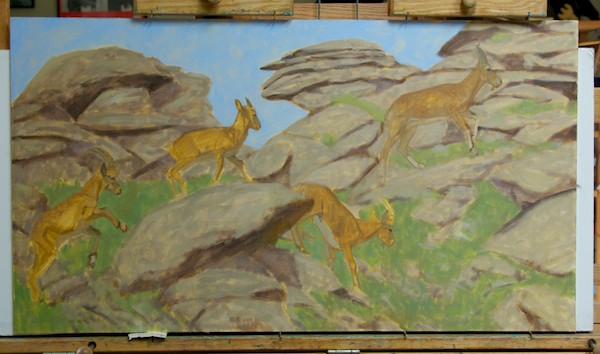
First color pass
First color pass, just laying in major shapes to make sure it all works. I used three pieces of reference for the ibex and at least three for the rocks. I planned the placement of the smallest ibex so that his/her head would be against the sky, which was not the case with the reference photo.
Modeling the ibex and the rocks
Modeling the ibex and the rocks. I’ve defined the shapes of the shadows on the rocks and can now see the pattern those create. I made sure there were large rocks pointing in from the right so that everything wasn’t moving off the canvas.
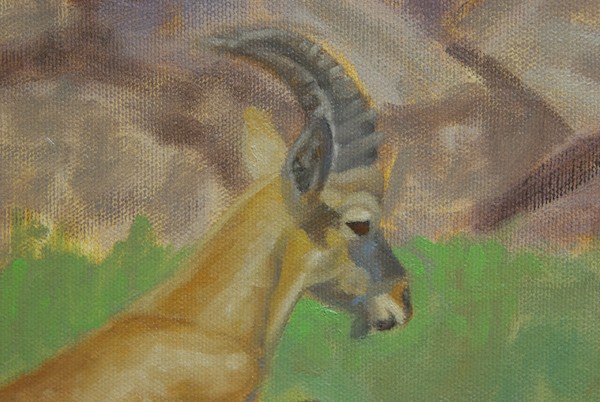
Detail of head in progress
Detail of a head in progress. From the base of the horns to the tip of the nose is 1 3/4″. I kept the shapes simple, but accurate. Detail per se is of no importance to me.
Detail of kid in progress
Detail of kid in progress. It was important to get the great gesture correct and show the muscles working.
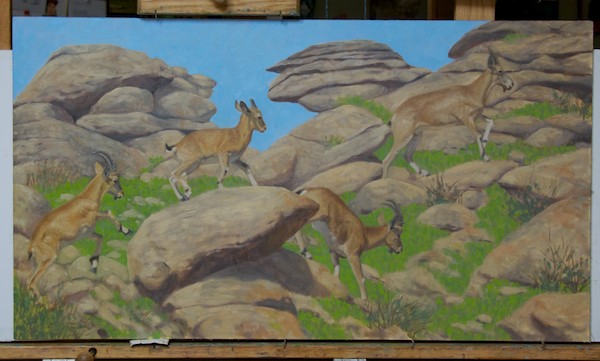
Almost done.
Almost done. After this photo was taken, I punched up everything as needed, both ibex and the rocks and finished the grass, which has about six layers of warm/cool, light/dark colors, plus the summer flowers. I also refined the branches of the wild apricot shrubs. I basically did a repaint over the whole thing pulling up the light areas and adding color variations to the rocks, including the lichens, which give a warm touch that picks up the colors of the ibex and ties them to the landscape.
Detail; finished ibex, rocks, grass
Detail; finished ibex, rocks, grass. The grass was an almost acid green since it was so fresh. I knocked it back a little in intensity since it didn’t look quite believable in a painting. I also consciously varied the colors of the ibex and the proportion of light to dark on the bodies.
Rock Hoppin'  20x36"  oil
Rock Hoppin’ 20×36″ oil

Mongolia Monday- WildArt Mongolia Expedition Supporter ASSOCIATION GOVIIN KHULAN

log goviin khulan I want to introduce you today to one of the supporters of the WildArt Mongolia Expedition, Association GOVIIN KHULAN, which is run by French khulan researcher Anne-Camille Souris. We’ve corresponded via Facebook for a couple of years and were able to meet and chat in person in Ulaanbaatar during my trip last year.

Anne-Camille also works with Mongol artists through her International Art for Conservation project.

International Art Goviin Khulan ©In the past she worked at Takhiin Tal, one of the destinations of the Expedition, studying takhi. Very few researchers were  carrying out research on khulan compared to takhi, so she switched species. There are also khulan at Takhiin Tal, which is in the Great Gobi B Strictly Protected Area. She has offered to lend her expertise in both these wild equids, for which I am greatly appreciative.

You can find out more about khulan here. And below is the information Anne-Camille sent me about her organization and its work.

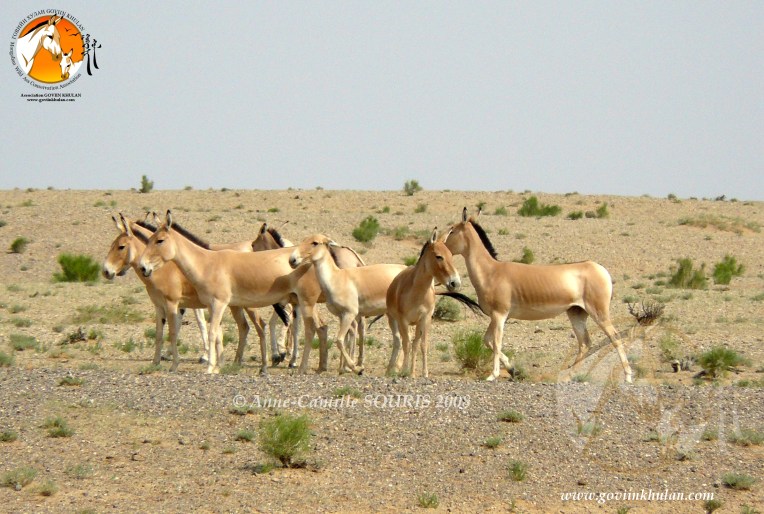
Khulans2008_2_A-C SOURIS_S.FOX_FB

“The Association GOVIIN KHULAN is a French non-profit organization that works in the southeast Gobi, Mongolia, to protect the endangered Mongolian Khulan (Equus hemionus hemionus) and its habitat in partnership with local rangers and communities.

The Mongolian Khulan – also known as Mongolian Wild Ass – is an endangered wild Equid and is one the 5 recognized sub-species of the Asiatic Wild Ass. The Mongolian Khulan represents the largest population of this species in the world. However, its population has known an important decrease by as much as 50% since the end of the 1990’s and about 15 000 individuals are now left in the wild.

The Association GOVIIN KHULAN has built a multidisciplinary approach to ensure protection of this endangered species on a long term: a) research, b) local and international information, education and awareness, c) involvement of local communities, d) partnership with local rangers,  e) technical and professional support to rangers and citizen conservationists/scientists, f) partnership with Buddhist monks, g) reinforcement of links between Mongolian culture and traditions with nature protection, and h) community development & animal and environment ethics (in progress).

Khulans2008_A-C SOURIS_S.FOX_FB

Mongolia Monday- Explorers and Travelers: Beatrix Bulstrode on Mongolian Bactrian Camels

beatrix bulstrodeFirst in 1911 and again in 1913, an intrepid British woman, Beatrix Bulstrode, traveled in and through Mongolia. The result is one of the great travel classics of all time “A Tour in Mongolia”. I’m only 78 pages in and have already found enough material for 3-4 blog posts. She was a wonderfully droll writer in the the English tradition, coming up with unforgettable phrases like “desperately unsportsmanlike” to describe her Finnish missionary traveling companion’s offer to throw a number of Chinese out of an inn to make more room for Mrs. Bulstrode. She refused for the reason stated above, and so  joined them and nine or ten Mongols either sleeping on the raised heated bed the Chinese call a k’ang or tucked into every available corner.

These days, tour companies like the one I work with, Nomadic Journeys, uses camels for cross-country trekking trips.
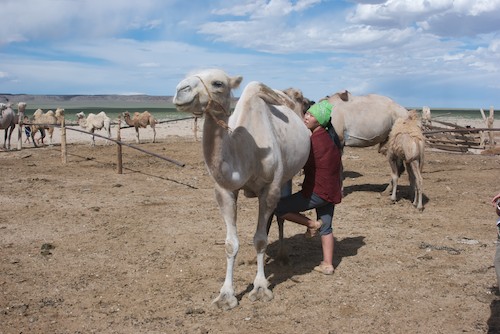
These days, tour companies like the one I work with, Nomadic Journeys, use camels for cross-country trekking trips. They carry all the baggage, tents, food and even a ger for use as a kitchen and dining hall.

As she headed north out of Kalgan up onto the Mongolian plain and the Gobi, she passed camel caravans going south. She had a wonderful ability to pick up information and write about what she saw in a vividly compelling way. Here is her description of the bactrian camels:

“The staying power of camels is proverbial. The caravans in Mongolia march from twenty-five to twenty-eight miles a day, averaging a little over two miles an hour, for a month, after which the animals require a two weeks’ rest when they will be ready to begin work again. Their carrying powers all the same do not bear comparison with the ox-cart. The ordinary load for the Bactrian, or two-humped Mongolian, camel is about 2 cwt. For riding purposes, though despised by the horsey Mongol, a good camel may be used with an ordinary saddle for seventy miles a day for a week in spring or autumn without food or water. The points of this particular species are a well-ribbed body, wide feet, and strong, rigid humps. The female camel is pleasanter to ride and generally more easy-going than the skittish young bull camel, who in the months of January and February is likely to be fierce and refractory. I have heard it said that if a camel “goes for you” with an open mouth, you should spring at his neck and hang on with both legs and arms until some one renders you timely assistance and ties him up. Generally speaking, however, they are not savage. They make as though to bite, but seldom actually do. The female might, in fact would, try to protect her young; and the cry of a cow camel when separated from her calf is as pathetic as that of a hare being run down by the hounds.”

My first time on a Mongol bactrian camel. Western Mongolia, Sept. 2006

There will be more excerpts by Beatrix in the future. Stay tuned.

Mongolia Monday- My Cashmere Goat Drawing In Switzerland

Cashmere goat,  graphite on vellum bristol
Cashmere goat, graphite on vellum bristol

Back in January, I received an email query from a graphic designer in Switzerland. She had come across the above drawing that I had done of a Mongolian cashmere goat while doing a Google Image search and wondered if I would allow my “stunning sketch” to be used for hang tags on cashmere products that are to be sold in Switzerland’s largest department store. We quickly negotiated a rights and usage fee and I sent her an image to her specifications.

But I’ve learned how this kind of thing can go after working for fifteen years as a freelance graphic designer back in the 1970s and 1980s, so I haven’t announced it even though it’s pretty exciting. My fee was deposited in my Paypal account day before yesterday, so here is the design mockup that was emailed to me showing how my drawing will be used.

My drawing of a Mongolian cashmere goat on the proposed hangtag

Of course I have no idea where the cashmere they are using originates, although the odds are that it is Mongolia, which produces the world’s highest quality, but no matter where it came from, a Mongol goat will be used to help sell it.

People do ask if artists ever sell anything off the internet and I have sold originals that way. But this is another aspect….designers looking to license images for specific uses. Fortunately my commercial illustration training and background gave me the knowledge I needed to professionally negotiate an arrangement that served both our needs. I got a nice fee for a single use of a drawing that I had already done and they got an image that serves their client. Without the internet there’s no way they would ever have found it or me.

I Have Five Entries In The “We Said Go Travel” Travel Writing Contest!


Time to milk the camels.

I’m not a “writer” but I do write, mostly on this blog. I ran across a travel writing contest sponsored by the We Said Go Travel site and decided to re-write five of my posts from my two-week camping trip in Mongolia in July 2010 and see what happens.

Everything that fits the theme, “Inspiration: A Place That You Love” and is written in grammatically correct, decent English is being posted on the website. There will be judging for cash prizes, though, by Richard Bangs, who they describe as “the father of modern adventure travel, so I might even win a few bucks.

Three of the five stories have been posted. The fourth is scheduled for March 12. I’ll update this post as the stories go live.

You can read about the contest here.

You can read my entries at these links. Enjoy!:

http://www.wesaidgotravel.com/camels-and-the-nomadic-dung-fire

http://www.wesaidgotravel.com/an-unexpected-gift

http://www.wesaidgotravel.com/mongolia-the-valley-of-the-yaks

Mongolia Monday- Juried Show News and More!

Mongol Horse Foals: Ready to Grow  14x18"  oil
Mongol Horse Foals: Ready to Grow 14×18″ oil

I am proud to announce that all three of my entries have been accepted into the Academy of Equine Art’s spring show “The Horse in Fine Art-2013 AAEA Invitational Exhibition”! I’m very pleased to be included in this invitation-only show. Once again Mongol horses will be “invading” the Blue Grass Country of Kentucky.

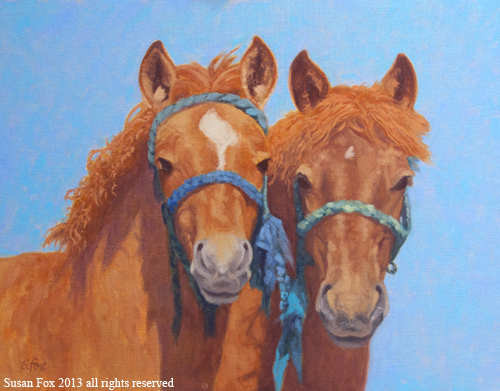
Mongol Horse #8- Watching You
Mongol Horse #8- Watching You  12×24″  oil

As it happens, all three of these paintings were from the same stop not far from Hustai National Park in August 2011. We were heading south in the morning and saw a large herd of horses right by the road. I shot dozens and dozens of photos. There were a lot of flies and the horses were circling and circling to try to get as far into the group as possible. But then they’d break up and I could get shots like the ones I used as reference for these works. The background wasn’t particularly interesting, so I left it out and just let the horses be the design element on a blue background.

Mongol Horse #9- Friends   18x24"  oil
Mongol Horse #9- Friends 18×24″ oil

The exhibition will be in two venues:

Georgetown College, Anne Wright Wilson Gallery Georgetown, Kentucky- April 12- May 24, 2013

Marietta/Cobb Museum of Art, Marietta, Georgia- April 13- July 2, 2013

You can find out more about the AAEA here.

***************

And…I have made the first cut in the We Said Go Travel website’s Travel Writing Contest. As of this writing two of my five entries have been posted and I have been told that the other three will be soon. All of them are adapted from blog posts I did about my wonderful -and wonder-filled- two week camping trip I went on in the Gobi and Hangai Mountains of Mongolia in July 2010. You can read the first two, which both start with the word “Mongolia” in the title, here.