Takhiin Tal is part of the Great Gobi B Strictly Protected Area. It is to the west of Great Gobi A, which is larger and even more remote from people and towns.
It is also part of the Dzungarian Gobi, where the last takhi/Przewalski’s horse was seen in the wild in 1969, a lone stallion at a waterhole. And it is one of the three destinations that the WildArt Mongolia Expedition will be exploring.
Great Gobi B encompasses 9000 sq. kilometers, almost 3500 sq. miles. As has been true for centuries, local herders, around 100 families with about 60,000 head of livestock, use the area to graze their animals, mostly in the winter and during their spring and fall migrations.
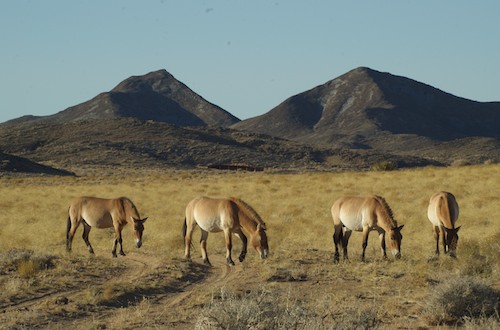
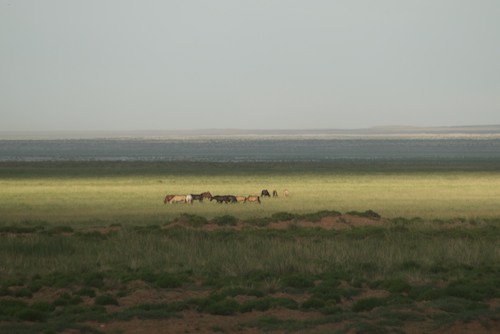
Khomiin Tal takhi, September 2006; These horses were photographed at the third release site, which is some distance to the north.
Takiin Tal was also the first of the three takhi release sites in Mongolia. The first horses arrived from Germany in 1992 through the efforts of Christian Oswald, a German businessman, and the Mongolian government. The organization he founded, ITG or the International Takhi Group, is involved there to this day, working to conserve and increase the population of the world’s only surviving species of true wild horse.
Besides takhi, the Expedition also hopes to see another endangered equid, the khulan/Mongolian wild ass, along with a variety of birds and smaller mammals.
It rained all through April, so most plants got a late start. But everything is going great now. Vegies are in, but not much to see yet.
I thought I’d share an “album” of photos that I’ve taken over the past month or so to give you look at one thing I do when I’m not at the easel, which is garden. Great exercise and very rewarding, especially this time of year.
I have a special fondness for old roses, hardy geraniums and *most* of the critters who show up. Enjoy.
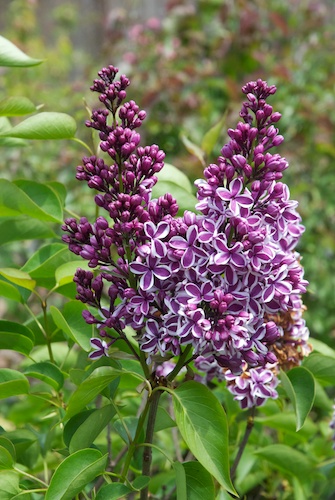
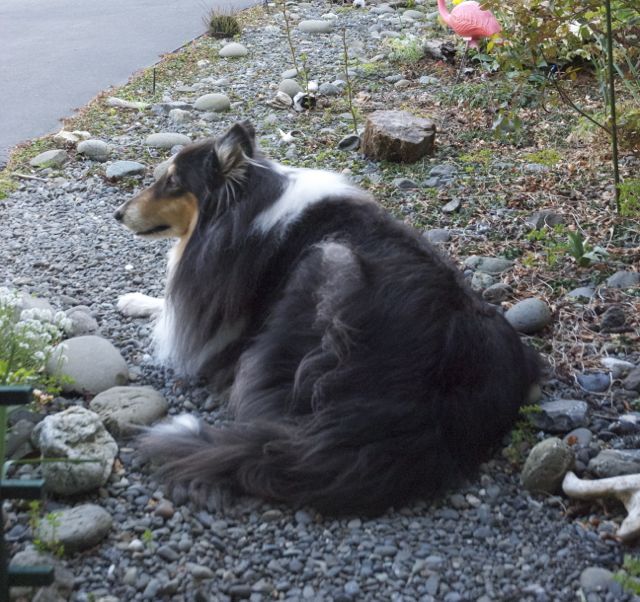
View of the front garden facing eastRough-skinned newts doing what newts do in the spring, being checked out by a couple of mosquito fish. What was interesting is that they were doing it out in the middle of the pond in broad daylight. It turns out that they are so toxic that nothing messes with them.Unidentified species of caterpillar that has colonized some Himalayan honeysuckle volunteers. And only those.David Austin English Rose “Abraham Darby”Lilac “Sensation”Unidentified caterpillar. Might turn into a sphinx moth, but don’t know for sure.Hardy geranium “Splish Splash:, which is merrily seeding itself around the garden and also hybridizing with Johnson’s Blue.The Supervisors: Niki, our tri-color rough collie boy and Eowyn, the black kittehThe reward: a nice big vase of fragrant old roses
And don’t forget to check out my WildArt Mongolia Expedition Kickstarter project. It ends July 15 and it’s all or nothing. If I don’t raise the amount I’m asking for then I receive no funding through them. I’d really appreciate your support!
Pokey Park and I and our guide/driver were exploring the wetland area of Gun-Galuut Nature Reserve, when we saw a local herder coming past us. One of the impressive things about Mongol riders is that, even at a very young age, they can ride a horse going pretty much at any gait or speed standing up and utterly still.
He rode on past us and we continued birdwatching and picture taking. Not too much later though, back he came, catching up with a brown horse, saddled and bridled, which had clearly gotten loose. In the meantime, a good-sized group of horses were heading for some open water. The brown horse dodged behind them with the rider right after him. Up came his urga (the long pole with a loop that is used instead of a rope lasso) and in short order the brown horse was captured.
Got him.
For the painting, I wanted to show Mongol horsemanship, which most people haven’t seen. The bonus, of course, was the great morning light and the setting. And…you may have noticed that the rider in the photo is wearing backwards baseball cap, but not in the painting. I’m interested in painting the Mongolia of today, but the baseball caps just don’t do it for me, however practical they are for the wearers, so I leave them off. But everything else is as I saw it that beautiful morning in August 2011.
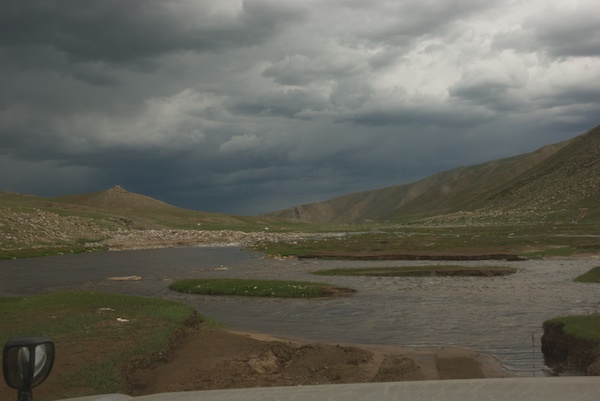
I had asked to stop near the riverside and was busy taking photos of the first wild iris I had seen in Mongolia (2010 two week camping trip)….….when my driver told me that I needed to get back in the car NOW because he was watching this. And he didn’t need The Weather Channel to tell him that the heavy rain out there in the mountains upriver from us meant that the level of the river, which we had to ford (because the bridge downstream, which was why we were on this “detour” across country, had been washed out in a previous storm) could come up very fast. Took this photo through the windshield just before we went into the water. Our destination is the tiny building you can just see against the right hand mountain in the distance. Made it across ok, but stayed in a ger camp because he thought it was too risky to camp in tents that night. And it really poured.
I was out walking the dog this morning with my husband, having observed when we left the house that it looked like it wanted to rain and, as it happened, it started to sprinkle a few moments later. It continued for a short way up the street, then stopped. He remarked that the showers were early (which had been predicted for later today).
My response was that I thought that was an inversion. Showers, and any other weather phenomena, come when they come. They are neither “late” nor “early”. That concept is a result of human-designed weather forecasting, which definitely has a margin of error and can change hourly. I made my observation by scanning the clouds, sensing what the air felt like and from having lived in Humboldt County most of my life. And I never bother with the hourly forecasts or take any particular day’s forecast as more than probabilities that one can plan around, but that are subject to change.
But it got me thinking about how detached so many people are from the “real” world. From thinking that if they’ve seen something on tv, they seen the thing itself, to animal artists who only paint captive animals thinking that they’ve seen anything truly relevant to, or reliable about, that species. (More on that in a future post)
To me, the real world is the one that would go on if humans and all their human-created stuff disappeared tomorrow. Despite the ego-driven belief of too many, our presence here is not required. It is actually a privilege that we are busily squandering.
Western Homo sapien’s collective tendency to rely on information about the world in an abstract way via human-created means and then be surprised or shocked when nature does something different bodes ill for the planet and our continued ability to live on it with any degree of comfort.
It makes me think of a possible cartoon in which someone is hunched over a computer looking at a weather report and never thinks to look out the window behind them to see the tornado bearing down on the house.
I guess this will only change when climate change is so dramatic that it simply can’t be denied anymore. But by then we’ll be, if we aren’t already, far past the tipping point and starting to learn what the saying “Mother Nature bats last” really means.
I’ve got a rather intense project under way, about which more soon, so for today I thought I’d just share some photos of our family critters, three cats and a collie. The cats all came from a shelter, Niki from a responsible breeder.
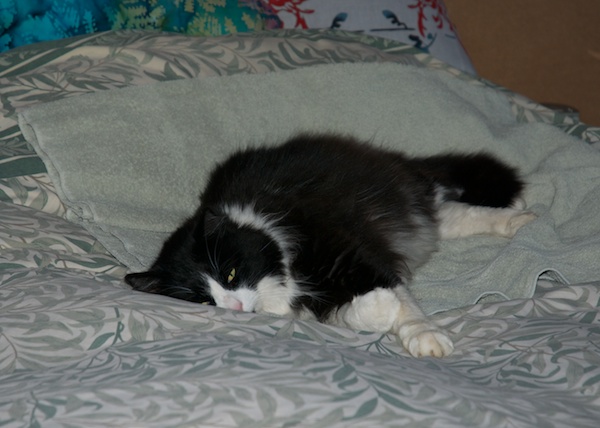
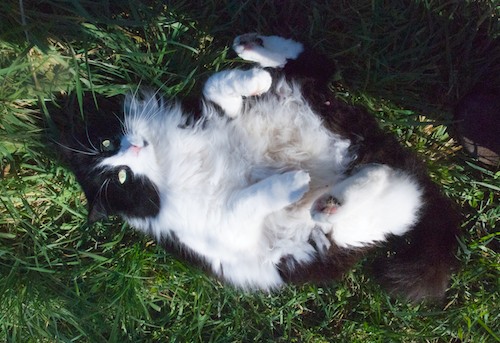
Alexander, a Really Great Cat, relaxedEowyn, who in her younger days probably could have slain the Nazgul, is now happy to help me out with paper supportMichiko, our tamed feral; we couldn’t resist that face; she brought us a dead gopher last weekNiki, our tri-color rough collie boy, self-appointed guardian of all creatures great and small
Definitely a change of pace for me, this painting is the first one of three for the upcoming Sea of Cortez group show, which will open at the Arizona-Sonora Desert Museum on March 16, 2013. You can read about the trip and see some of the drawings I’ve done and photos I shot here.
While I was on the trip with 30 of my colleagues in March of 2011, we had access to a very nice fishing yacht whose owners generously took us out to an island that not only had these colorful, irresistible-as-subjects crabs, but also California sea lions and many species of birds.
I knew as soon as I saw them that I would want to paint one. Fortunately, there was also a Zodiac (small pontoon boat) that got us right up to the rocks. That and fast shutter speeds and I got some great reference.
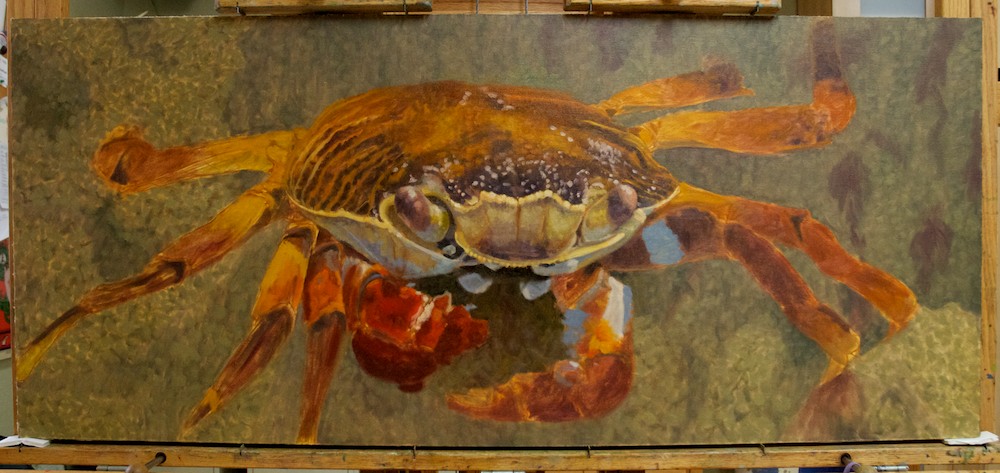
Here’s the step-by-step of “Up Close-Sally Lightfoot Crab”:
Here’s how I was able to get such great shots. We were able to get REALLY close to them.Reference photo; I knew from the beginning that I wanted to paint the crab BIG and crop in for a horizontal rectangle. I used other photos for comparison and to change the position slightly of one leg.Preliminary graphite study, 7×17″; to learn my subject, ensure that the composition worked and to establish the value patternColor rough, 6×14″; this is a really different color palette for me compared to the more restrained earth tones I use for my Mongolian subjects. Can’t remember the last time I used red and yellow pretty much right out of the tube.Grid transfer in pencil; Raymar canvas board is tinted with raw siennaThe brush drawing. I realized after I’d done the one from the pencil drawing that the crab wasn’t nearly big enough, so I wiped if off and re-drew it. By this time I’d done the graphite study and the color rough, so I “knew” him/her pretty well and it didn’t take long.First color passThis is a little more than half-way there. The next step was to catch the background up with the crab and then move on to the legs and claws and then go back and tweak everything until it was done.“Up Close-Sally Lightfoot Crab” 20×46″ oil
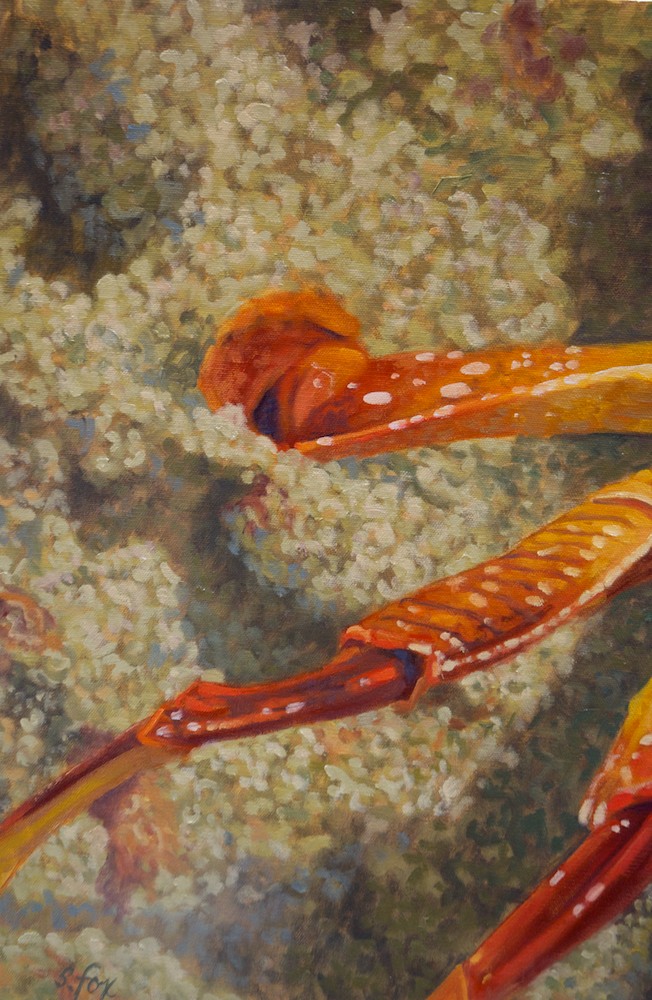
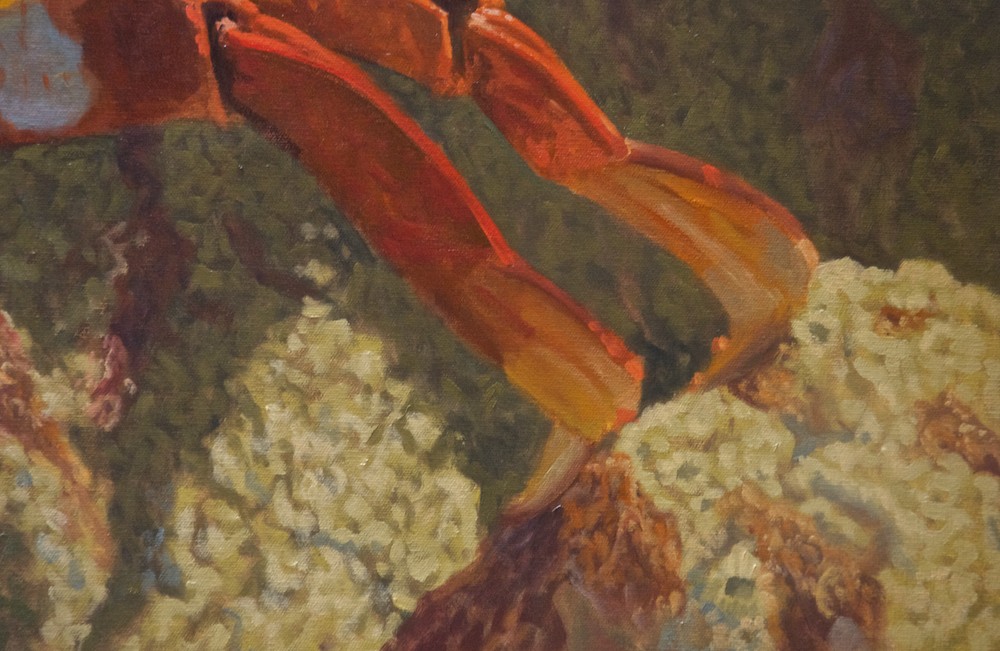
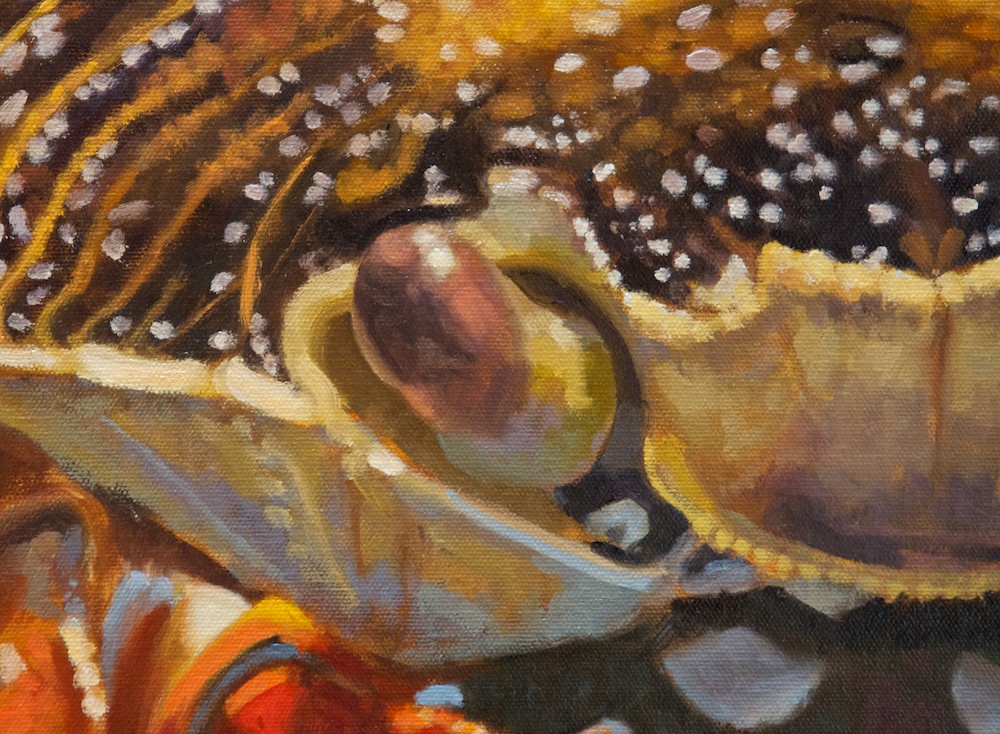
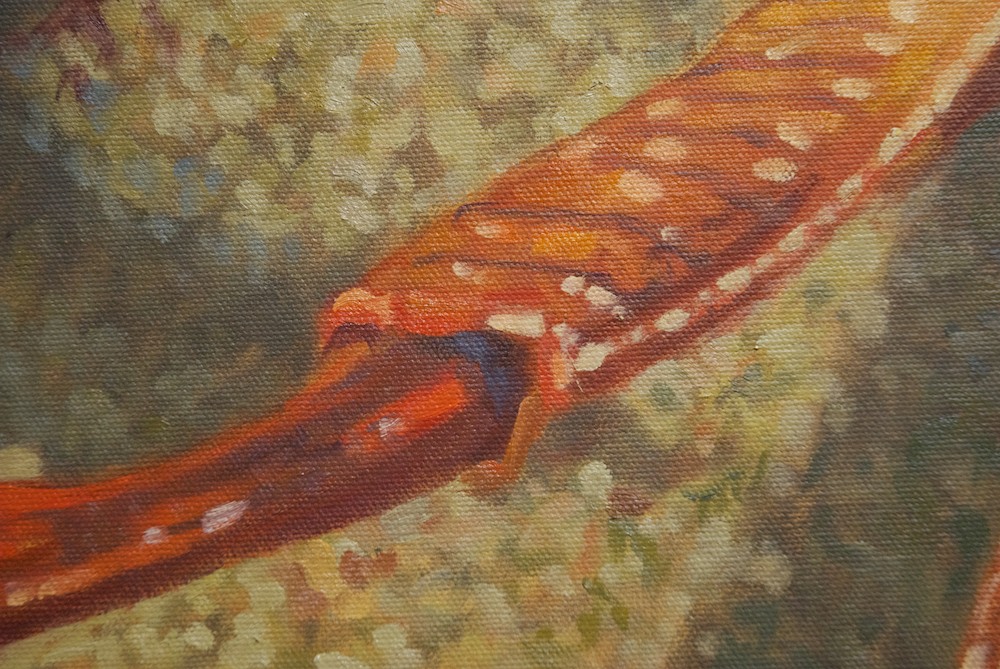
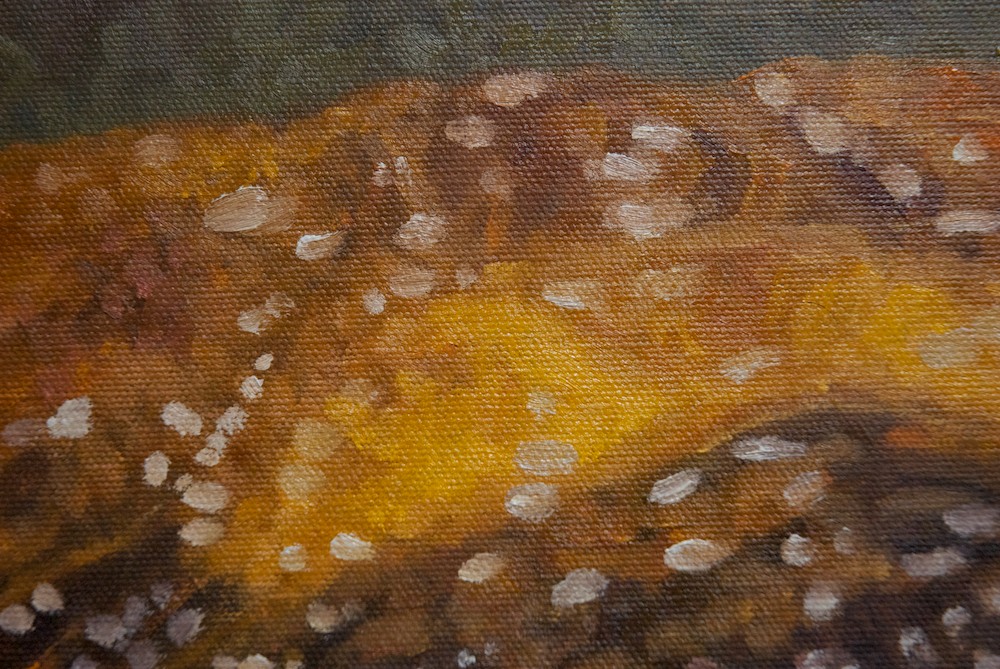
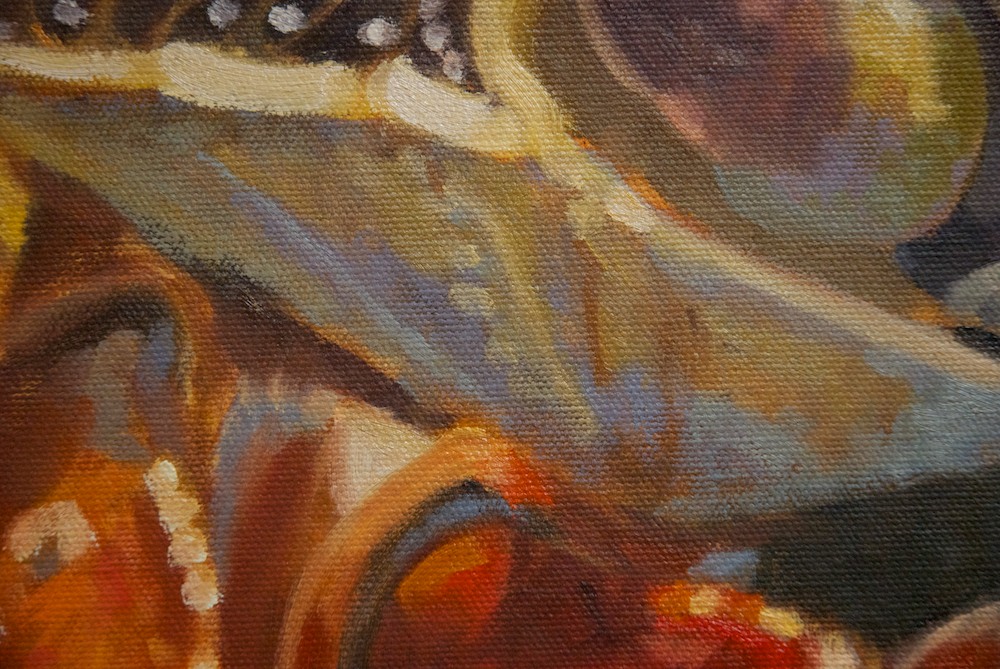
I thought I’d share some details of the crab and the background.
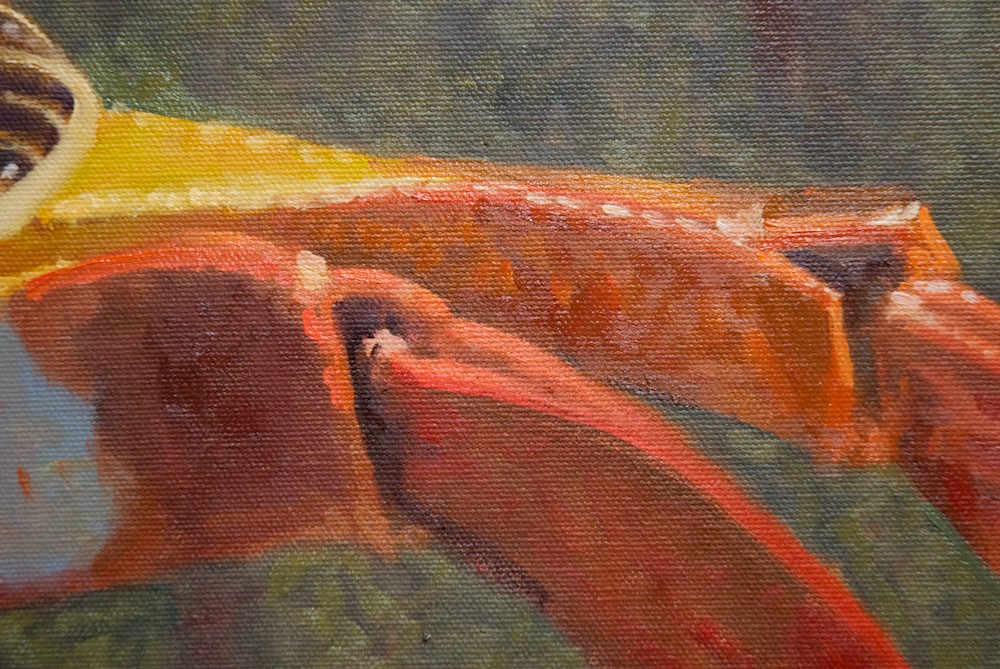
The crab was on a rock totally encrusted with barnacles. I had absolutely zero interest in painting 50 gazillion of them, so instead I analyzed the visual texture and values and then indicated those in a variety of colors and values.But just to make sure the viewer knows what they are, I did a few more finished ones in the lower right hand corner.The eyes were fun. The challenge was to get expression, to have the viewer feel that the crab is looking right at them.
The next painting for the show will truly be something completely different…a landscape with Nacapuli Canyon as its subject, with a special extra thrown in.
Color is one of the things artists love about painting, but it can also be one of the most frustrating. There are lots of “rules” out there which try to make sense of it and they are a good starting point, but ultimately every artist, as with most other aspects of painting, has to find their own way.
Here are six thoughts on color, based on my own experience and information I’ve picked up over the years. Add some of your own in the comments!
1. Color is relative. How we perceive a color’s hue and value depends entirely on what’s around it.
2. Come up with a “color plan” for your painting. Decide if it will be monochrome, use complementary colors, analogous colors, etc. Do very small (5×7″ or smaller) color roughs, if necessary.
3. Value is how light or dark a color is, separate from what hue the color is. If you get the values right, you can do anything you want with the color.
4. A good rule of thumb is when you change the value, change the temperature. Warm highlights/cool shadows. Cool highlights/warm shadows.
5. While there are a variety of useful “rules” for using color, ultimately you do whatever works to let you say what you want to say.
6. Don’t be afraid of color. Go for it!
This post is illustrated with details from my latest painting in progress. Check back next Friday to see the whole thing, plus step-by-step photos.
And……I will have a major announcement on Monday about my next trip to Mongolia!
The legendary Gobi….what images it conjures up, some true and some not, as it turns out. A land of contradictions. A desert, but mostly without sand. A byword for dryness and lack of water, but rivers flow through it, there are lakes and it’s known as the source of the sweetest and best vegetables grown in the country.
I grew up in Redwood Country….forests. I’ve always loved forests. My mom loved the desert. Me. Not so much. Until I met this desert.
A view I love…a Mongolian earth road stretching out ahead as far as one can see, Juiy 2010Time to milk the camels at the only herder’s ger for many miles. Got my first taste of camel’s milk airag, July 2010It does rain in the Gobi and everything can turn green in a matter of hours, July 2010My tent on Orog Nuur, a remote Gobi lake, just myself, my guide, the cook, hundreds of birds and gazillions of mosquitos. When camping in Mongolia, you can stop and pitch your tent pretty much wherever you want to, July 2010Last glow of evening light on The Flaming Cliffs, made famous by Roy Chapman Andrews’ Central Asiatic Expeditions of the 1920s, Sept. 2006














 Susan Fox, American Artist