I’m not a “writer” but I do write, mostly on this blog. I ran across a travel writing contest sponsored by the We Said Go Travel site and decided to re-write five of my posts from my two-week camping trip in Mongolia in July 2010 and see what happens.
Everything that fits the theme, “Inspiration: A Place That You Love” and is written in grammatically correct, decent English is being posted on the website. There will be judging for cash prizes, though, by Richard Bangs, who they describe as “the father of modern adventure travel, so I might even win a few bucks.
Three of the five stories have been posted. The fourth is scheduled for March 12. I’ll update this post as the stories go live.
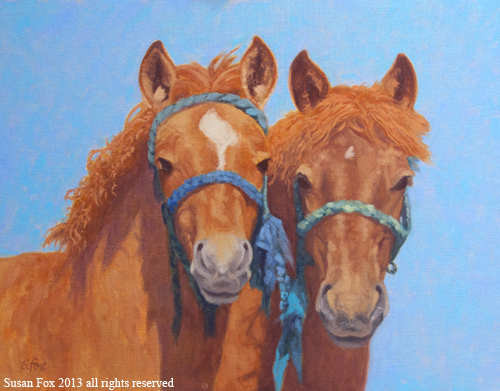
I am proud to announce that all three of my entries have been accepted into the Academy of Equine Art’s spring show “The Horse in Fine Art-2013 AAEA Invitational Exhibition”! I’m very pleased to be included in this invitation-only show. Once again Mongol horses will be “invading” the Blue Grass Country of Kentucky.
Mongol Horse #8- Watching You 12×24″ oil
As it happens, all three of these paintings were from the same stop not far from Hustai National Park in August 2011. We were heading south in the morning and saw a large herd of horses right by the road. I shot dozens and dozens of photos. There were a lot of flies and the horses were circling and circling to try to get as far into the group as possible. But then they’d break up and I could get shots like the ones I used as reference for these works. The background wasn’t particularly interesting, so I left it out and just let the horses be the design element on a blue background.
Mongol Horse #9- Friends 18×24″ oil
The exhibition will be in two venues:
Georgetown College, Anne Wright Wilson Gallery Georgetown, Kentucky- April 12- May 24, 2013
Marietta/Cobb Museum of Art, Marietta, Georgia- April 13- July 2, 2013
And…I have made the first cut in the We Said Go Travel website’s Travel Writing Contest. As of this writing two of my five entries have been posted and I have been told that the other three will be soon. All of them are adapted from blog posts I did about my wonderful -and wonder-filled- two week camping trip I went on in the Gobi and Hangai Mountains of Mongolia in July 2010. You can read the first two, which both start with the word “Mongolia” in the title, here.
Central Asian pit-viper (Echis caranatus); photographed at Ikh Nartiin Chuluu Nature Reserve, August 2010
Last week’s Mongolia Monday post was about reptiles and amphibians I’ve seen in Mongolia. It was well received on Facebook, so I decided to follow up with this excerpt from Roy Chapman Andrews’ book about his Central Asiatic Expeditions “The New Conquest of Asia- a narrative of the Central Asiatic Expeditions in Mongolia and China, 1921-1930”, in which they have a pretty intense encounter with one of the four poisonous snakes that occur in Mongolia. He appears to be referring to Agkistrodon halys intermedius (now Echis carinatus) since he states earlier in the book that “…the brown pit-viper, Agkistrodon halys intermedius, which is the only poisonous snake we have encountered in the Gobi, is fairly abundant.”
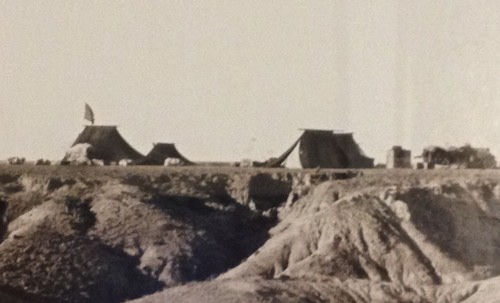
Here’s a photo of one of Andrews’ camps, taken at one of the cafes at the American Museum of Natural History. The tents are called “maikhan” or summer tents, which are lighter and even more portable than the better known felt gers.
“Our next camp, ten miles to the north of Baron Sog-in-Sumu, was very
similar to the one we had left. The tents were pitched on a great promontory
which projected far out into the basin. Near them was an obo, or religious
monument, and shortly after our arrival two lamas came to call. They were
delegates from a temple, Tukhum-in-Sumu, four miles away, and asked us
to be particularly careful not to shoot or kill any birds or animals on the
bluff. It was a very sacred spot and the spirits would be angry if we took
life in the vicinity. Of course, I agreed to respect their wishes and gave orders
at once. But we had promised more than we could fulfill, as events proved.
VIPER CAMP
In the first two hours of prospecting, three pit-vipers, Agkistrodon, were
discovered close to the tents. A few days later the temperature suddenly
dropped in the late afternoon and the camp had a busy night. The tents
were invaded by an army of vipers which sought warmth and shelter. Lovell
was lying in bed when he saw a wriggling form cross the triangular patch of
moonlight in his tent door. He was about to get up to kill the snake when
he decided to have a look about before he put his bare feet upon the ground.
Reaching for his electric flashlamp, he leaned out of bed and discovered a
viper coiled about each of the legs of his camp cot. A collector’s pickax was
within reach and with it Lovell disposed of the two snakes which had hoped
to share his bed. Then he began a still-hunt for the viper that had first
crossed the patch of moonlight in the door and which he knew was some-
where in the tent. He was hardly out of bed when an enormous serpent
crawled out from under a gasoline box near the head of his cot. Lovell was having rather a lively evening of it — but he was not alone.
Morris killed five vipers in his tent, and Wang, one of the Chinese chauffeurs,
found a snake coiled up in his shoe. Having killed it, he picked up his soft
cap which was lying on the ground and a viper fell out of that. Doctor Loucks
actually put his hand on one which was lying on a pile of shotgun cases. We
named the place “Viper Camp,” because forty-seven snakes were killed in
the tents. Fortunately, the cold had made them sluggish and they did not
strike quickly. Wolf, the police dog, was the only one of our party to be
bitten. He was struck in the leg by a very small snake, but since George
Olsen treated the wound at once, he did not die. The poor animal was very
ill and suffered great pain, but recovered in thirty-six hours.
The snake business got on our nerves and everyone became pretty
jumpy. The Chinese and Mongols deserted their tents, sleeping in the cars
and on camel boxes. The rest of us never moved after dark without a flash-
light in one hand and a pickax in the other. When I walked out of the tent
one evening, I stepped upon something soft and round. My yell brought
the whole camp out, only to find that the snake was a coil of rope ! We had
to break my promise to the lamas and kill the vipers, but our Mongols
remained firm. It was amusing to see one of them shooing a snake out of his
tent with a piece of cloth to a place where the Chinese could kill it. The
vipers were about the size of our copperheads, or perhaps a little larger.
While their fangs probably do not carry enough poison to kill a healthy man,
it would make him very ill.
The snakes inhabit bluffs throughout the desert, like the one on which
we were camped. Their great number at this particular spot was due to the
fact that it was a sacred place and the Mongols would not kill them there.
This viper appears to be the only poisonous snake in the Gobi, and we
collected but one non-poisonous species. The climate is too dry and cold to
favor reptilian life.”
———–
The entire amazing account is available free through the Internet Archive (archive.org) in a variety of formats. It can be downloaded onto iPads through an app called Megareader or saved as a pdf, for instance. There are facsimile versions and also OCR scans, which work but can be filled with errors. Here’s a facsimile version of the book itself, which includes all the photos: http://www.archive.org/stream/newconquestofcen00andr#page/n0/mode/2up
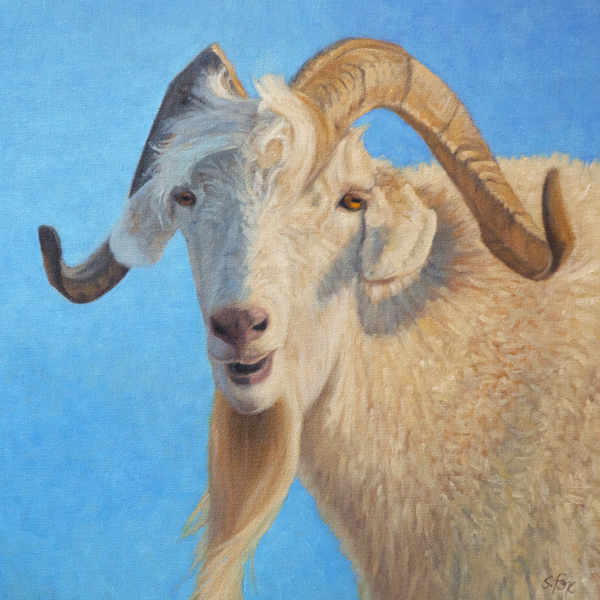
The cashmere goats of Mongolia come in all sizes, colors and horn styles, but the super-soft undercoat wool from which the world’s finest cashmere is made is always the same neutral color.
This handsome billy was one of a large herd I spotted from the ger camp at Arburd Sands last year. They were grazing their way home in great late afternoon light so I grabbed my camera, caught up with them and followed along for awhile to the sounds of munching and bleating.
My big news is that in June I will be teaching a three-hour workshop “I Got In!” How To Enter Juried Art Shows” through Eureka Art Studios in Eureka, California. You can find out more and register here. As you will see, space is limited, so sign up soon!
I’m definitely more of a mammal person, but when out in the field I take photos of anything that moves and a lot that doesn’t.
There aren’t many reptiles and amphibians in Mongolia, but I’ve seen and gotten photos of a few and here they are, starting at the top with one of the four venomous snakes in Mongolia, the Central Asian viper. This is a smallish one and was found down from the research camp at Ikh Nartiin Chuluu Nature Reserve near the spring. One of the scientists coaxed it up onto the stick and brought it to camp so we could all see what one looked like. It was the first time I’d seen a snake in all my trips to Mongolia. Roy Chapman Andrews, in one of his books, describes what was dubbed the Viper Camp when he was in the Gobi. I’ll post an excerpt from that next week.
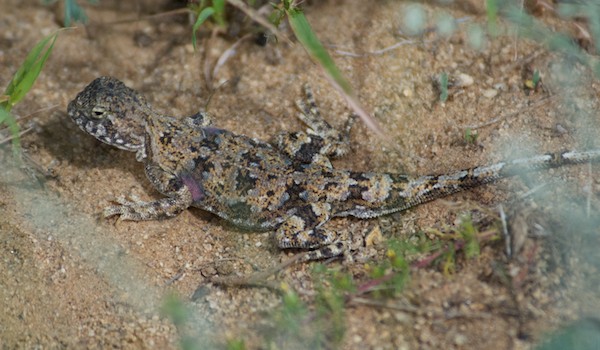
Below is a very common species of lizard, the Toad-headed agama. I usually see a few on each trip, generally at Ikh Nart.
Toad-headed agama lizard (Phrynocephalus versicolor)
The species name “versicolor” is because, even at a single location like Ikh Nart, you can see this kind of color variation…
Toad-headed agama
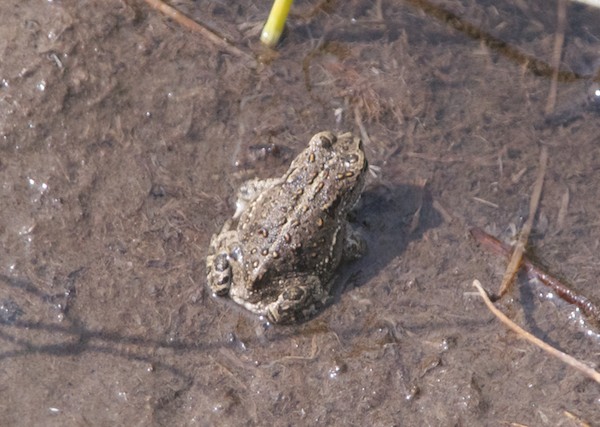
Amphibians are not the first animal that comes to mind when one thinks of Mongolia, but they’re present, even in the Gobi. I photographed these toads at Orog Nuur, a Gobi lake, in July 2010. I believe they are Mongolian toads (Pseudepidalea raddei).
Four Mongolian toads (Pseudepidalea raddei) (tentative ID)
And saw one again in the wetland area at Gun-Galuut Nature Reserve in August 2011, which is mountain steppe.
Mongolian toad, Gun-Galuut (tentative ID)
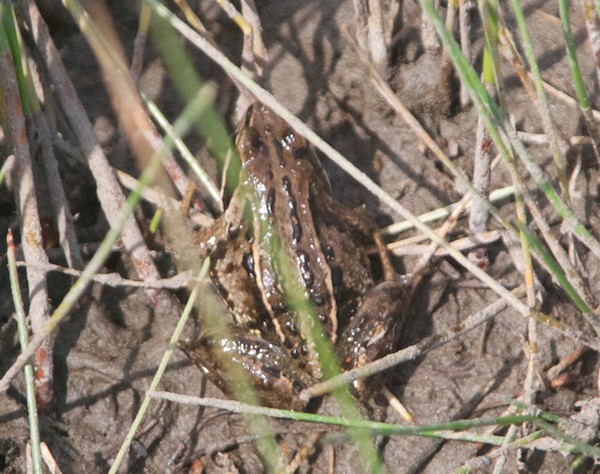
I’ve seen one frog once and not far from where I photographed the above toad, at Gun-Galuut. I believe this is a Siberian Wood Frog (Rana amurensis). Is that a cool common name or what?
Both the toad and the frog are listed by the IUCN as species of Least Concern “…in view of its wide distribution, tolerance of a broad range of habitats, presumed large population, and because it is unlikely to be declining fast enough to qualify for listing in a more threatened category.”
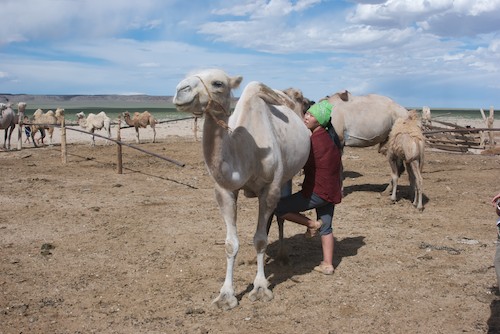
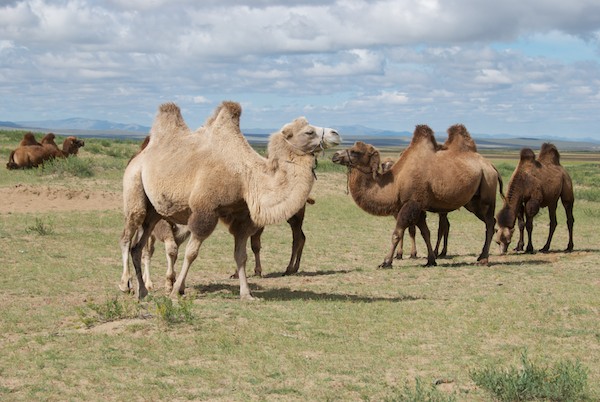
I spent most of a morning this past August sketching and photographing a herd of domestic bactrian camels who had wandered near the Arburd Sands ger camp where I was staying. I remembered this white female because she was the subject of one of my first camel paintings “Done for the Day”, which was the first painting I’d ever had accepted into the Society of Animal Artists’ juried exhibition “Art and the Animal”. And there she was again, looking as beautiful as ever in the morning light.
Bactrian camels, including my model, at Arburd Sands
And here she was in 2008 in great late afternoon light. She has a calf this year, too. And I plan to do a painting of the two of them at some point.
Done for the Day oil 17×30″
It’s pretty amazing to be able to go back to a place and recognize individuals that one has seen before. But she has a way about her and was leading the rest of the camels as they came towards me. Her white coloring also stands out.
I haven’t posted any Mongolian poetry for awhile and thought that since the Mongols just celebrated their New Year, Tsagaan Sar (White Moon), which also means the turning of winter towards spring, that I would post a poem about a herder boy doing his job despite the snow. Country children are sent out to watch over the goats and sheep at a very young age, even in the winter when the temperatures can be below freezing even during the day. But when the lambs and kids are born, they are often brought into shelter, sometimes right into the ger.
The Shepherd Boy
In a broad and luminous sky
Suddenly a snow-cloud came winging by
Overcasting the sun
And bringing a windy storm
Swathes of scented grass
Were spread over an old herder’s fence
And a tiny shepherd boy left
His many lambs and kids to suck
When the frosty snow-flakes began to fall
From the frosty-white clouds
His blazed twin lambs
And his playful blue kids
Were put into a warm stall
to be fed with delicate grass
The shepherd boy was a good master
Who looked after them through that cold winter
Not one tiny kid was lost
Instead all of them grew up
Pleasing old and young
Playing happily in the pen.
From “Modern Mongolian Poetry”, State Publishing House, Ulaanbaatar, 1989
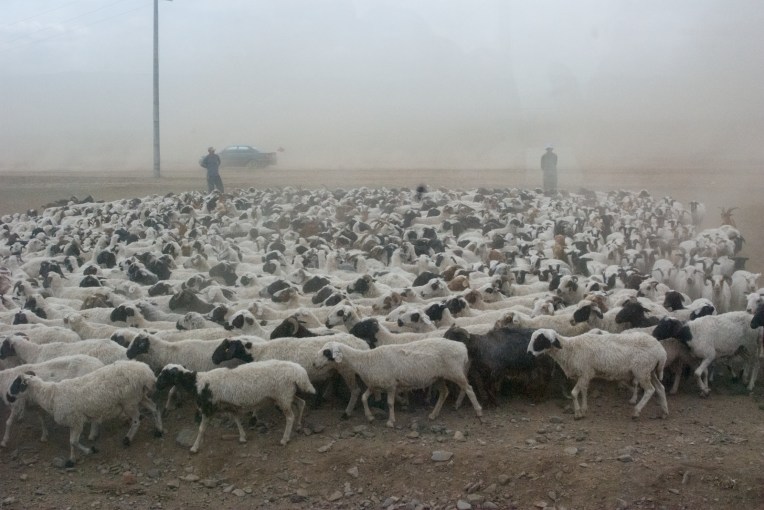
Sheep for sale by the road during the National Naadam, 2009
This excerpt is taken from “The Desert Road to Turkestan” by Owen Lattimore, published in 1929. It is his incredible account of traveling with a camel caravan from a point west of Beijing to Urumchi in present-day Xinjiang, far western China. Highly recommended and on my short list of Best Travel Books Ever.
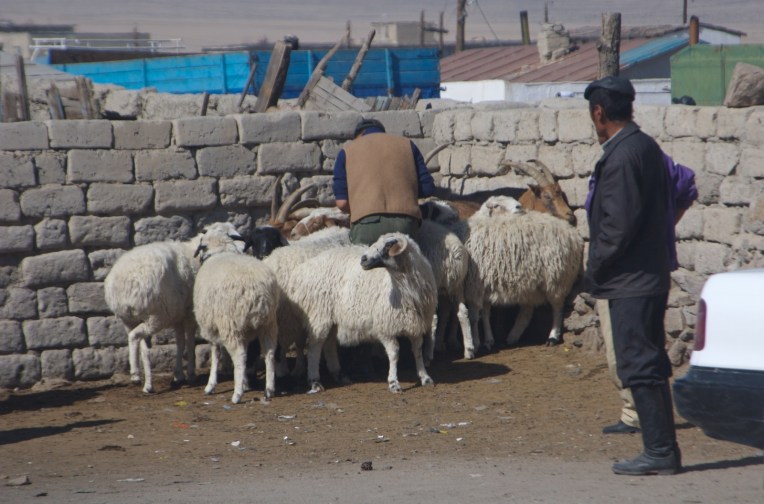
Sheep for sale in Hovd, western Mongolia, 2006
“Sheep buying is done by the Mongol usage. There is first a bargaining for quality – small sheep, good sheep, or pick of the flock, at different prices. It is usual to agree that good sheep are in question, at so much per head. The Mongol turns them out by the score, which he says are good. The buyer disputes this with scorn, making the Mongol change as many of them as he can. When at last the goodness of the herd as a whole has been admitted, the Mongol plunges among the sheep, seizes one, and cries “This is it!” “Not so, says the buyer; “it is the worst of a poor lot.” The buyer here is in the right, for I never saw a nomad, whether a Mongol, Qazaj, or Kirghiz, who failed to tackle the worst sheep with speed and skill. The Mongol protests and argues, but after awhile he seizes another; the argument begins afresh, but after several have been rejected the buyer in the upshot gets the mathematically average sheep from a mathematically average lot, the whole deal, with words and antics, having taken from half an hour to half a day.”
Flock of sheep and goats, at my driver’s ger in the mountains north of Tsetserleg, 2011









 Susan Fox, American Artist