Last week, we started with personal accounts by people who had lived in Mongolia as journalists or as a teacher. This week, it’s three selections from one of my favorite genres- travel writing. I’ve had some fun and “interesting” times on my travels and folks back home here in northern California think I’m very brave and adventurous. That’s as may be, but let me tell you, these books will put my travels into perspective in a hurry.
The first two, written about ten years apart, are the result of actually doing what a fair number of adventure travelers have probably considered or wish they had done: follow in the “hoofsteps” of Chinggis Khan’s Horde and travel across Mongolia by horse.
First up. Tim Severin:
 Tim Severin has made a name for himself re-creating famous journeys of the past and then writing compelling, informative and sometimes humorous books about what happened. I first found some of them on a remainder table in an English bookstore and have since read as many as I can get my hands on. A few examples: his first foray was to cross the Atlantic in the same kind of small leather boat that St. Brendan used when he supposedly made the same trip (The Brendan Voyage). Another was to have a traditional wooden Arabic ship called a “dhow” constructed so he could retrace the voyages of Sinbad (The Sinbad Voyage). He has also traced the route of the Crusaders from Bouillon in France to Jerusalem. In 1987-88. On horseback. By which time there were somewhat different obstacles to overcome than the ones the original Crusaders faced.
Severin’s journey across Mongolia took place in 1991, when the country was in dire economic straits from the withdrawal of the Soviets and was beginning to create a new government and civil society from ground zero after 70 years of socialism. He had been asked to help a group of Mongols travel the route of the Mongol Empire’s amazing overland communication system that made it possible for messages to cross 2/3s of the known world, from Mongolia to the Danube in about two weeks. The grand plan for this journey involved riding, in stages, a distance equivalent to that between Hong Kong and London, around 6,000 miles. He jumped at the chance because “Here was the most wonderful opportunity for me to travel freely inside Mongolia, not just as an outsider following his own program, but in the company of Mongols who were committed to rediscovering their own history. It was an opening no Westerner had ever been offered before.”
After trip preparations that became a small saga in themselves, the expedition was on its way. “At first the ride was exciting and spectacular. There was the constant rumble of 100 sets of hooves, the shouts of the herdsmen, the mob of horses surging forward….and the sheer exhilaration of riding at a fast pace across unspoiled countryside…..Sure enough, after three or four hours, the well-remembered riding aches and pains set in…The hammering, jarring flat run of the Mongol horses was as excruciating as ever….I understood why the Mongol dispatch riders had found it necessary to strap up their bodies in tight bandages…..”
The account of the trip then moves forward, interspersed with lots of information about Mongolian history and culture. Obviously, highly recommended, as are the next two.
In Search of Genghis Khan, Cooper Square Press, 2003

Stanley Stewart caught the Mongolia bug and nurtured the idea of going there for 25 years. In his 2002 book, In the Empire of Genghis Khan, Stewart, having made his way from Istanbul through Kazakhstan, finally finds himself being served dinner in a ger near the town of Bayan-Olgii in far western Mongolia. “Sated with sheep guts, we settled into after-dinner chat. Bold explained that I intended to ride across Mongolia to Qaraqorum, the ancient capital, then beyond to Dadal, the birthplace of Genghis Khan. Batur looked for me a long time without speaking. The plan was obviously too outlandish to merit comment…Batur saw no reason to try to dissuade me. Events would soon take care of that.”
As you might imagine, I really liked this description of the horses: “The relationship of Mongolian horses to the wild Przhevalsky’s horse of these regions has yet to be conclusively established (it has since been demonstrated that the domestic and wild horses diverged about 500,000 years ago) but presumably they share the same parole officer. They looked like the outlaws of the equine world….What they lacked in stature they made up for with attitude. They had carried the hordes of Genghis Khan to the gates of Vienna….Now they milled about on the slope below the ger, snorting and pawing the ground, a rabble looking for excitement and hostages. ”
Interestingly, both Severin and Stewart describe the morning process of saddling the horses as “a rodeo”.
Aided by a succession of patient interpreters, who changed out at each stage of the trip, Stewart makes his way across the vast empty interior of Mongolia. Well, not quite. “In Outer Mongolia, my social calendar was packed. Lunch invitations, drinks parties and dinner engagements came thick and fast. There were times when crossing the Mongolian steppe felt like a royal tour of which I was the unlikely focus.” All to say that, after a thousand years, the traditional customs of Mongolian hospitality are alive and well. I can personally vouch for that.
In The Empire of Genghis Khan, The Lyons Press, 2002, 2000

In their 2004 book, Long Way Round, Ewan McGregor (yes, that Ewan McGregor) and his good friend Charley Boorman decide that their lives will not be complete unless they ride their motorcyles from London to New York – by way of Europe and Central Asia. A four month jaunt of 20,000 miles, as it turned out. The reason I include their book on this list is that not only did they travel through Mongolia, but that out of all the countries they visited it was the one that grabbed McGregor and hung on.
Having finally made it to and through a border crossing in the far west that was normally only open to Russian and Mongolian goods vehicles “we rode into Mongolia, turned a corner and ran straight into a herd of yaks….” And a few minutes later, “We pulled into a clearing, where our local fixer, Karina, had been waiting for four days. She was very excited to see us and tied blue ribbons (actually blue scarves called “khadak”) to our bikes, a Mongolian shaman tradition used to bestow good luck on babies and vehicles”.
The book is largely excerpts from the diaries they both kept and, as many of you know, they were also accompanied by a small film crew. Ewan and Charley quickly find out that in most of Mongolia the word “road” doesn’t mean the same thing as it does in the west. Mongolia is not a country where you fly in, grab a rental car and head off into the countryside. Unless you have a GPS and are willing to spend a lot of time trying to puzzle out which of the endless braid of dirt tracks is the one you want, because there are no road signs. None. Not that you are all alone out there on the steppe. “At the top of the first pass, we came across a nomad on horseback with three camels and a couple of dogs. He was a stunning man, fine-featured and handsome, proudly sitting bolt upright on his horse. In the traditional garb of pointed leather herdsman’s boots, a Mongolian hat and several layers of heavy woolen clothing, he was grazing his camels at the top of the mountain. He looked so perfect and so at home in his surroundings that it could have been a hallucination.”
They do, of course, make their way to Ulaanbaatar, where they had made arrangements with UNICEF to visit some of the street children and also a center that has been set up to help them. “The conditions in which these children lived, even in a proper centre, hit me like a sledgehammer. A four-year-old girl was lying on the floor with her head against the wall. Her legs were withered and weak and she was trembling. It broke my heart to see her in such distress, so in need of love and attention, but so alone. I spent quite a lot of time with her, stroking her hair, touching her face and playing peek-a-boo with her. And then we had to leave. I hugged as many of them as I could, said goodbye and got into a car”. (Spoiler alert: I believe that after the trip, McGregor went back to Mongolia, adopted the girl and took her home to England with him, may great blessings be upon him.)
Finally, their journey took them north out of Mongolia and into Russia and Charley observed, “…I’d come to love Mongolia. It had been hell at times (Did I say that this isn’t the easiest place to travel?), but some part of me had actually relished the misery. I’d enjoyed meeting people along the road and I’d been blown away by the helpfulness of complete strangers. We couldn’t have done it without them.”
McGregor noted that “Riding across Mongolia had been incredibly demanding, but it had offered everything I’d been looking for on the trip, a pastoral paradise full of curious, open-hearted people who welcomed me into their homes because I was a passing traveler, not because I was Obi-Wan Kenobi on a bike…It had been like riding through the pages of National Geographic.”
Long Way Round, Atria Books, 2004
———-
If you are interested in learning more about the street children and how they are being helped, visit the website of the Christina Noble Children’s Foundation at www.cncf.org.
——
Next week: More books about the land and people of Mongolia.

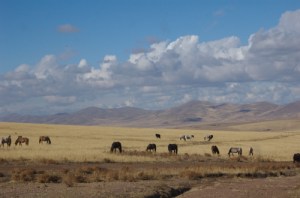 I love the colors, the clouds, the Mongol horses grazing, but compositionally it’s a long way from a painting. My plan is that this will be a major work, as in large, maybe 3’x4′ or more since I want the horses to be big enough that I can really paint each one individually. I learned this approach in art school when one of my teachers showed our class a painting he did of the Founding Fathers signing the Declaration of Independence. Why so big, we asked. Because I didn’t want to paint the heads any smaller than an inch high, he replied. Oh, we said. Taking that as a beginning, he knew how big the painting would end up being. I’m thinking each horse at 3″ to 4″ from the back to the ground. This could change, but it is a starting point.

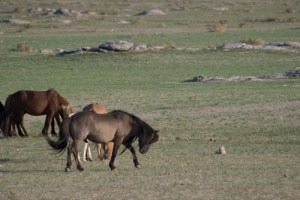 Here’s the reference image that I started with. It was taken in September 2008 at Ikh Nartiin Chuluu Nature Reserve. This group of horses wandered right past the ger camp one evening. I got lots of great pictures. Looking at them when I got home, I was struck by the stallion’s pose as he showed off around the mares. I haven’t done too many domestic horse paintings and I wanted to really focus in on understanding their structure and capturing the sheen of the coat, so I decided to use a fairly large canvas and only paint the horse.
 Here’s how I started. The support is gessoed canvas on hardboard and measures 24″x36″. I did an initial lay-in with a brush. All I cared about at this point was getting the horse where I wanted him on the canvas and indicating the proportions correctly. You can see on the front leg that is lifted where I have started to do the actual drawing.
 This step shows the finished drawing for the head, shoulder and front legs. At this point, I had dragged out all my books on horse anatomy to double check the structure and confirm that I had understood it correctly. Changes are easy to make at the drawing stage, but I’ll wipe out and re-do at any point if I see something that’s wrong. That’s just the way it goes sometimes and I don’t fight it or make excuses to myself anymore. I also have a full-length mirror behind me and I use it constantly to check the drawing for accuracy. I’ve designed the mane and the tail shapes, some of which are planned to go off the edge of the canvas so the horse isn’t floating and looks more like he just happened to be walking through the frame.
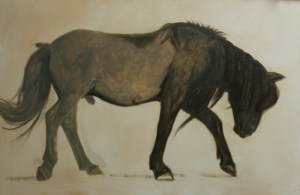 I’ve finished the initial color layers and am starting to paint with the knowledge that the strokes I make now will quite possibly be visible in the finished painting. I’m always refining the drawing as I go. One of the things that interested me about doing this particular piece is that you can’t see his eyes at all, so I wanted to capture his attitude and character from his body language and by painting him big on the canvas. I was also thinking of the design of the positive space -the horse- and the negative space -the background.
 Most of the basic lay in is done. All my darkest darks and medium tones are in, except for those patchy looking bits that I haven’t gotten to yet. Now the fun starts….all the juicy highlights, modeling and finishing touches that are a reward for the prep work leading up to it.



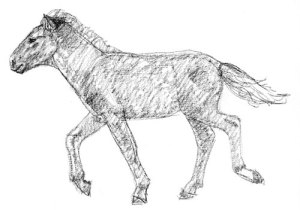
 I’m going to start posting drawings of various subjects since, after all, I am an artist, not a photographer or book reviewer. Today’s drawing is of two young takhi stallions that I photographed at Khomiin Tal, the third takhi reintroduction site after Gobi B and Hustai Nuruu. It is located in the Zavkhan province or aimag, which is in western Mongolia. I read on one of the Mongolian news websites that the herders out there lost 250,000 livestock over the winter. I haven’t found any info on the takhi, but I know that people stay out at the research camp and feed them if necessary. Twenty-two horses were initially shipped to Khomiin Tal from a semi-reserve in France which is located at high altitude in the French Alps. I would think that there would be over two dozen horses by now.


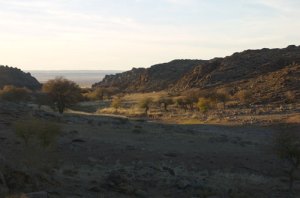

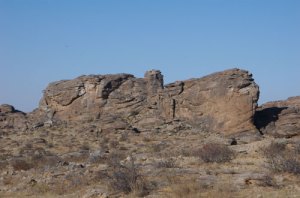
 Cinereous vulture nest
 Argali skull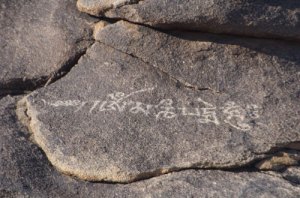


 Susan Fox, American Artist