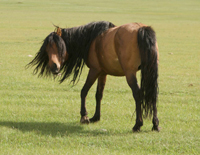
A week or so ago, I was poking around the listings on EBay that come up when you search “Mongolia” and ended up browsing through the postage stamps. Mongolia is one of those countries that, in the past, released an endless supply of stamps aimed at collectors. It brought in some income to the government during the socialist era and when times were very hard back in the early to mid-1990s during the transition to democracy.
Along with the obligatory Princess Diana commemoratives, it turns out that there is a wealth of stamps with imagery from Mongolia’s history and culture. Some of the stamps showing traditional clothing are so detailed that they to all intents and purposes qualify as primary reference material.
I had purchased some stamps on previous trips just because I liked the images and they are a well-known souvenir choice. I had also been a stamp collector many years ago as a kid. I don’t know that I would take up actual collecting again, but if I did, I would specialize in the historical and cultural subjects, along with animals (no surprise there, I imagine).
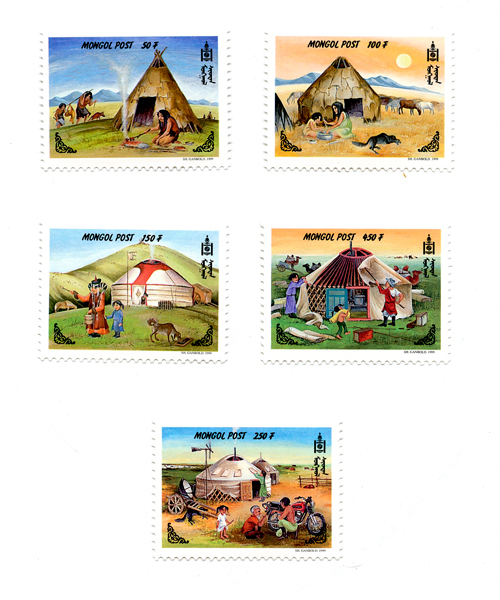
This week I’ll share the costume, history and ger-themed stamps I have. Next week will be Mongol warriors and the third part will be some with plants and animals.
Comments, information from my Mongol friends and fellow Mongolphiles welcome, as always.
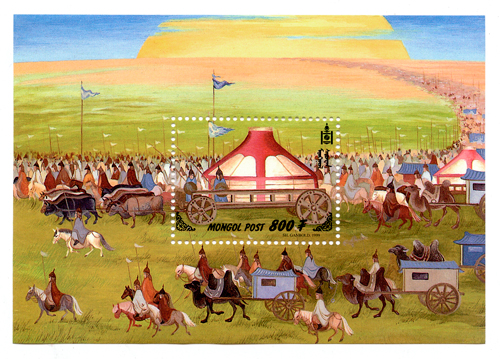
Traditional dress; the top middle is what a married Kalkh Mongol woman woreHistorical/legendary images, I believeThis set appears to be gers (which is simply Mongolian for "home") through Mongol history; ending with one that combines the old and proven with the new and modern; love the aruul drying on the roofThe Khan's ger on the move, literally a "mobile" homeTraditional life in a ger; lightweight metal stoves instead of the open brazier and people tend to wear modern clothes (but not always), but otherwise this is what they are like to this day. Notice the kids on the left playing anklebone games; the floor coverings are sheep's wool felt embroidered with handspun camel wool thread in an traditional design
This poem is from a book that I found in the Art Shop at the Museum of the Chojin Lama. It is called “Modern Mongolian Poetry (1921-1986)” and was published in 1989, just before the non-violent revolution in which Mongolia made the transition from communism to democracy. It was my first introduction to Mongol poetry.
Poets and other creative people who objected to the communist government had to be very careful in what they said, wrote and painted. There are many poems in the book extolling the wonderfulness of the socialist system, heroic workers and battle victories. But, carefully couched in metaphor, are other points of view. I’ll be posting some of both in the future, but today’s poem is about a subject that I suspect all Mongols of the time could agree on…HORSES!
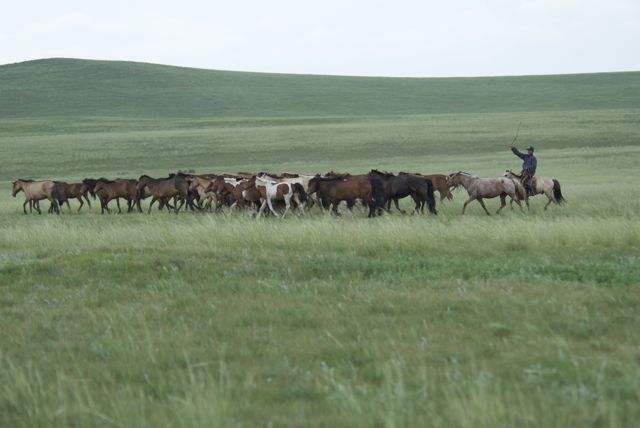
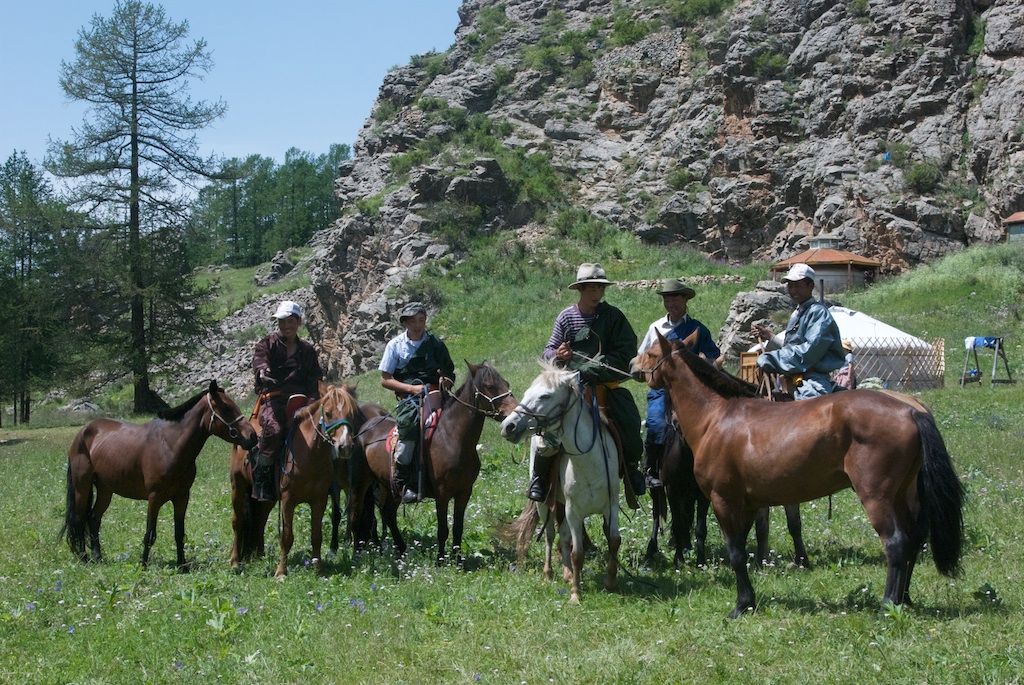
Mongol horses, Baga Gazriin Chuluu, July 2010
MONGOLIAN HORSE
Crowning our glorious motherland
With victory after victory.
Raising the victorious banner,
We always went on horseback.
As a Mongolian’s courage
Is measureless,
So the Mongolian horse’s strength
Is boundless.
When the good Mongolian people
With their history of victory
Did their good deeds
Their good horses played their part.
As a Mongolian’s courage
Is measureless,
So the Mongolian horse’s strength
Is boundless.
In doing work
For our happiness
Our spirited Mongolian horses
Will work with us ceaselessly.
As a Mongolian’s courage
Is measureless
So the Mongolian horse’s strength
Is boundless.
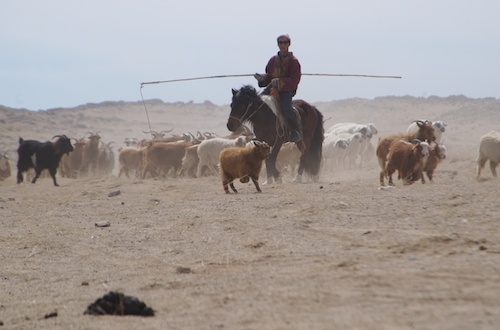
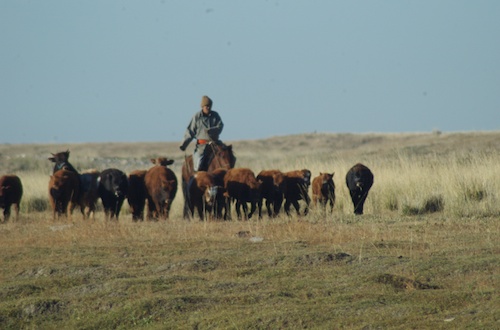
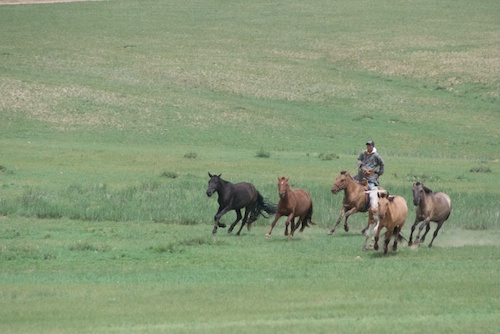
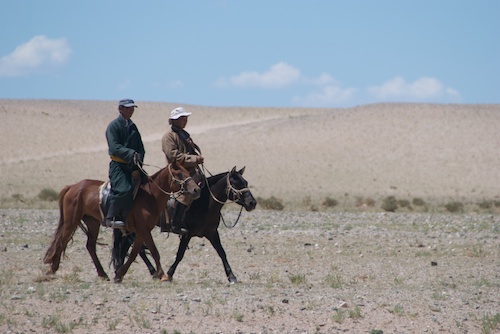
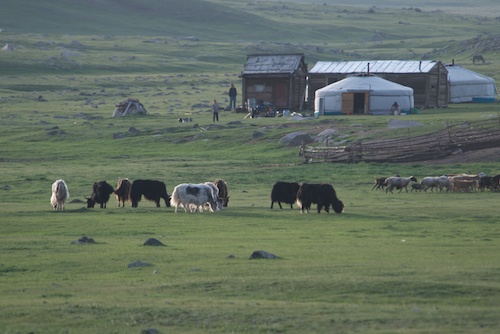
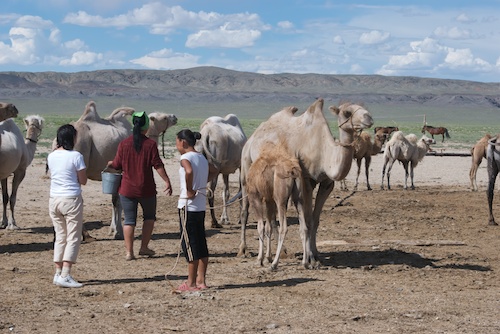
Going to let the pictures tell the story today. Here’s a collection of some of the photos I’ve taken of Mongol herders. Included are all of the Five Snouts, plus camels. Now I’m sitting here missing tsagaan idee (white food): airag (fermented mare’s milk), aruul (dried yogurt), byaslag (cheese), orom (sliced dried cream) and tsotsgii (cream, just cream, eaten using aruul as a base to put it on; heavenly). Bi ter bukh dortei! (I like it all!). Mongol friends-correct my sentence if it is wrong.
Herder with urga, Ikh Nartiin Chuluu, April 2005 (my first trip to Mongolia)Camel herder, Gobi near Bayanzag, Sept. 2006 (these are racing camels)Herding cattle near Tuul Gol (River), Sept. 2006Herding sheep and cashmere goats near Hustai National Park. Sept. 2008Rounding up horses, Gun-Galuut, July 2009Local herders coming to check out flooded river crossing, The Gobi, July 2010En route shot from car, July 2010Herder, Hangai Mountains, July 2010Time for a morning chat, Hangai Mountains, July 2010Yak herder's ger, Naiman Nuur, Hangai Mountains, July 2010Rounding up yaks, Orkhon Falls, July 2010Camel's milk airag coming up soon, the Gobi, near Orog Nuur, July 2010
I’m currently about 60 pages into what is already one of the best travel books on Mongolia that I’ve read. Henning Haslund went to Mongolia with a number of fellow Danes in the early 1920s to establish a farming and mining colony in the north not far from Khosvol Nuur. “Tents In Mongolia” is his account of that journey. It was re-printed by Adventures Unlimited Press in 1995 and retitled “Secret Mongolia”.
Henning has already demonstrated a flair for observation, so I thought that I would share this wonderful description of his and the party’s first personal contact with a Mongol in Mongolia. I really wish I had been there.
“Suddenly the caravan dogs gave tongue….Down a long slope to the eastward, a billowing cloud of dust was rolling towards us…..One, two, three, four, five riders galloped out of the dust and- we were completely disarmed.
“A sunburnt girl with a smile as fresh as a steppe morning reined in her fiery steed before our shamefacedly lowered rifle barrels. Her teeth were pearly white, her eyes as clear as day, her smile disarming, her grip on the reins strong and her movements in the saddle full of grace. She was a daughter of Mongolia, she was herself the free, wild, captivating steppe.
“She was dressed in bright-colored silks, and when she moved there was a ringing of silver and a rattling of precious stones. She shone with the joy of living, and her demeanor bore witness to pride and noble birth. Over her forehead she wore a wide, massive silver band in which were set five large pale red corals. From this diadem half a dozen small chains of coral hung down to the boldly curved and sharply drawn black eyebrows that marked her race. From the sides of the diadem and from her ears hung chains of silver ornaments and strings of corals, pearls and turquoises which fell jingling over her small strong shoulders. Her hair was kept in check by a coral-studded black veil, fastened behind by a jewelled sliver diadem.
Coral necklace, Museum of National History, Ulaanbaatar, Mongolia
“Her long robe was of pale blue silk, and over it she wore a short, sleeveless waistcoat of crimson brocade in which were interwoven dim symbols of fortune and long life. The waistcoat was fastened in front with golden laces attached to buttons of chased silver.
“Her cloak reached to her knees where it met her long black velvet riding boots. Her small, neat feet were shod in boots whose elegance was enhanced by the sharply unturned toes. Her hands were strong, but small and shapely. Her fingers were studded with coral ornaments and heavy silver rings, and thick bracelets clashed upon her wrists.”
It’s been too long since I’ve presented any Mongol poetry. It’s another aspect of their culture that is almost unknown to westerners, even though examples survive from over 800 years ago.
If you would like to learn about and read more poetry, visit previous posts here and here and here.
This one has a subject dear to the heart of pretty much every Mongol…horses:
The stories of my people soar with horses, With wings they reach the golden sun. The wind riffs through their untrimmed manes, And, down the skyroad of Khormast, They return to the lake like migrating birds, According to the customs of the golden earth. The poems of the elders soar with horses, With wings they reach the vibrant stars. From the herds of letters formed within the month, We have taken these migrating steeds. And, from the hitching posts of our poets’ horses, We have taken off for distant roads. My horse, fly high, oh my horse, Fly high, into the worlds of my desire. From our wise elders’ heights of brilliance, I offer my song to the spacious earth. My horse, fly high, oh my horse, Fly high, into the worlds of my desire.
By Ochirkhuu (1943-2001), translated by Simon Wickham-Smith
After the dramatic trip down the mountain and then arriving at our campsite just before dark, it was lovely to wake up to sunshine the next morning on a grassy hillside. Even better was the parade of horses and yaks that came right by where I was sitting as I was having morning coffee. Lazy animal watching and reference shooting again.
Our beautiful campsite near Tsenkher Mineral Springs
I found out over breakfast that we were camped near Tsenkher, another mineral spring resort. We drove to one of the ger camps, where the manager treated us to tea and snacks, arranged for us to take showers and for me to do a last small round of laundry.
The hot spring, with ovoo
We then drove north out of the mountains to the large town of Tsetserleg, where we visited a hillside temple in front of which was a very tall, new statue of the Buddha. I had been wanting a new del, so we searched around the container market, but didn’t find one that was what I was looking for. Getting to poke around a town a little was fun, though.
View of Tsetserleg with new Buddha statue
I thought our next stop was the famous monastery of Erdene Zuu, but Soyoloo’s cell phone rang and, the next thing I knew, we were back at her sister’s home. We were invited to join them and share a meal that is dear to the hearts of many, many Mongols….bodog or marmot BBQ. We arrived just as they were ready to begin stuffing the carcass with hot rocks and meat. Once the marmot was ready, we all piled into cars and went to a lovely spot on a nearby river for a picnic dinner.
The entire process was a pretty involved affair and I took around 150 images. I’m just going to show a couple here and do a separate post later on, which the status of marmots in Mongol culture certainly justifies.
Yes, the fur really is removed with a portable blowtorchDinner is served!
I was honored with the liquid that was poured out of the body cavity, which I drank and found quite good, then the tongue, which I ate and found quite good, and the first cut of meat, which I ate and….found quite good. We all washed down the feast with vodka (all together now), which was quite good.
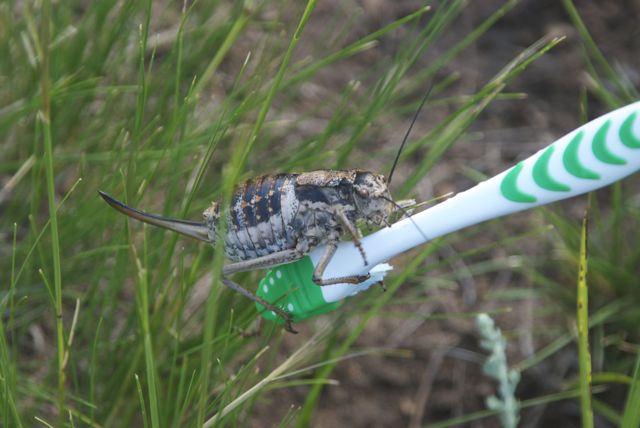
It was late afternoon by the time we said our good-byes and were on our way. We camped on a hillside along the road to Erdene Zuu. It was warm and humid. There were lots of mosquitos, so we lit a dung fire again. I use earplugs, so I slept ok, but Khatnaa and Soyoloo were kept awake by loud and numerous grasshoppers.
species of grasshopper on a toothbrush
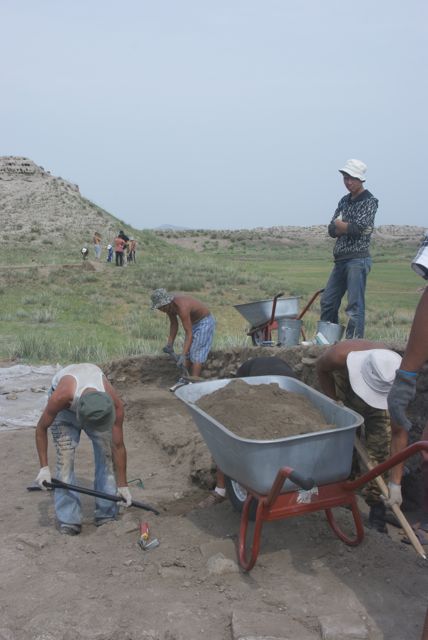
Our first stop after breaking camp were the ruins of an old Uigher city, Har Balgas. As it happened, there was an archaeological dig going on, which was interesting to watch and I got to chat with the archaeologist in charge.
Rampart ruins of Har BalgasDig in progress
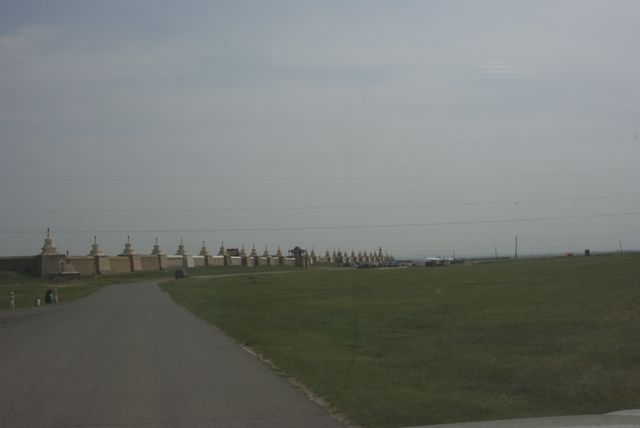
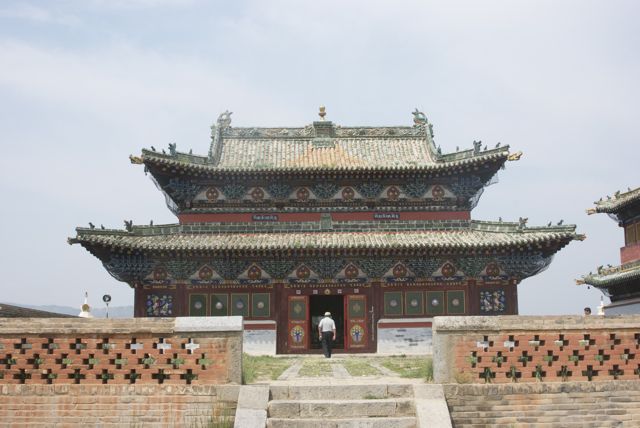
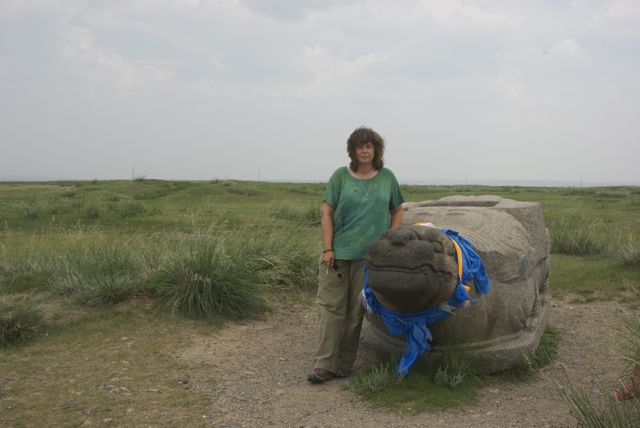
Not too much farther on, the stupa-lined walls of Erdene Zuu Monastery came into view. Not only is it adjacent to the site of the ancient Mongol capital, Kharkhorin, but it was built using stones from the old city, which was destroyed by a Ming Chinese army after the fall of the Yuan Dynasty, which had been founded over one hundred years earlier by Chinggis Khan’s grandson, Kublai Khan. A stone turtle is the only artifact left where the city had stood.
The wall around the monasteryOne of the main templesLarge stupa complexCeramic roof detailPosing with the turtle
I had gotten careless and went into the complex with no hat, sunscreen or water, so by the time this photo was taken, I wasn’t feeling very well. It was extremely humid and hot. I was ok once we were back at the car and I drank a lot of water, but this was probably the closest I’ve ever come to heat exhaustion or worse. Very foolish. But Erdene Zuu lived up to its reputation as the top tourist site in Mongolia. The temples are magnificent and I was sorry that no photography was allowed inside them.
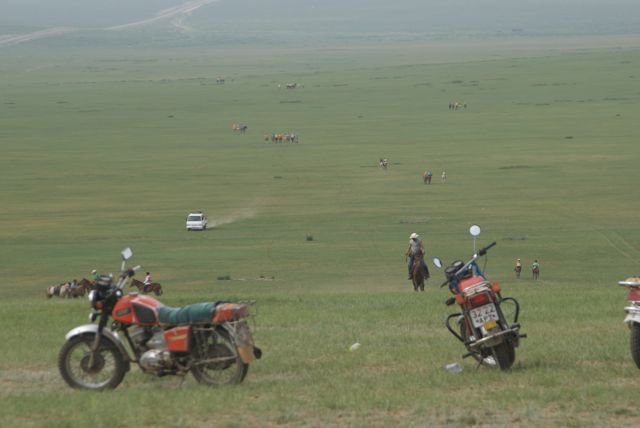
Our route now took us north, where, for our last night out, we were going to camp at a lake known for its birds. As we were driving along, I noticed a large ger encampment to the left. I almost said something to Khatnaa, but let it go. Then he had to slow down because a bunch of men and boys on horses were crossing the road. I told him about the gers. We followed the horsemen.
The one thing that I had hoped for on the trip, but had not been able to find, was a local Naadam. Now it appeared that we had stumbled onto one the last day of the trip. We pulled up into an area on a rise where a lot of cars and trucks were parked. There were horses all over the place. Khatnaa got out, spoke with someone and came back with the news that the event was essentially a family reunion. Stay or go? We’d inadvertently crashed a private party. I told Khatnaa that it was up to him to do what he thought best. We stayed. And tried to be as inconspicuous as possible. Over the next few hours I sat in the car and took around 500 photos. Our arrival had coincided with the horse race and we had gotten there in time to watch all the preparations for it.
Some of the horsemenLots of socializing on horseback; the men in fancy del and traditional hats all seemed to be the trainers
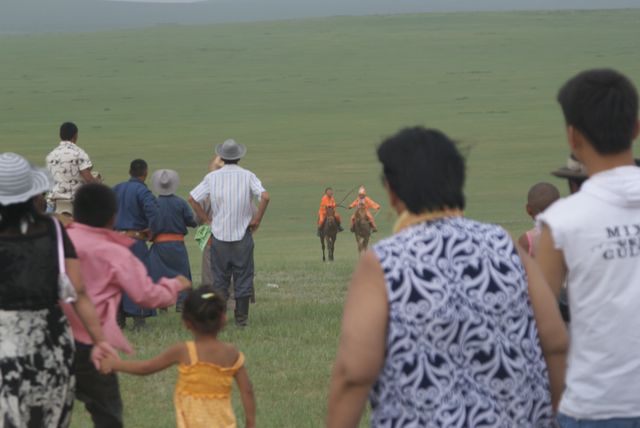
Our “cover” was blown when a young couple on a motorbike drove up and offered us fresh, hot khuushuur (fried mutton turnovers). No way we were going to pass on that. I stayed in the car until the first horses were approaching the finish line and then got out and joined the crowd.
Jockeys taking their mounts out to the starting lineNeck and neck to the finish line; the winners crossed the line at the same time
Afterwards, I was photographing a lovely black race horse who was being scraped down. A woman came up to me, took my arm, led me over to the horse and made a gesture for me to lay my palm on the sweat, which is lucky and auspicious. It was a very kind and thoughtful thing for her to do since I obviously was not one of this very big family. I was never so glad that I knew how to say “thank you” in Mongolian.
All day it had been cloudy and humid, with some squalls of rain. By the time we were on the road down to Ogii Nuur, it had gotten really windy. Khatnaa and Soyoloo managed to wrap a tarp around a picnic structure to provide shelter from the wind to cook our dinner. At dusk, it died down enough to set up camp on the lakeshore. We were all pretty tired.
The weather was much better the next morning and we got in some good birdwatching. Khatnaa had gone up to one of the ger camps along the lake the previous evening and made arrangements for Soyoloo to use their kitchen to prepare our breakfast, which was very kind of them. The owner of the camp was there and turned out to be a retired Mongol army officer, who still needed something to do, so he had started a couple of ger camps. We had a nice chat with him and his wife and then left for the final leg of the trip.
Soon we were on tarmac, leaving the earth roads I love behind. There were a few more sights to see, like a dune complex where local herders were offering camel rides and our lunch spot next to the road where I got one last round of good horse and herder photos.
Lunchtime reference opportunity
By mid-afternoon we were in Ulaanbaatar, pulling into the hotel parking lot. I had left UB on July 10. It was now July 25. I still had trips to Hustai National Park to see the takhi and to Ikh Nartiin Chuluu and, as much as I looked forward to going to both places, I was sorry to have my camping trip come to an end. It was one of the best experiences of my life. My goal was to simply go into the countryside without a set itinerary and let Mongolia come to me. It did, in ways I would literally never have dreamed of. Bayarlala!
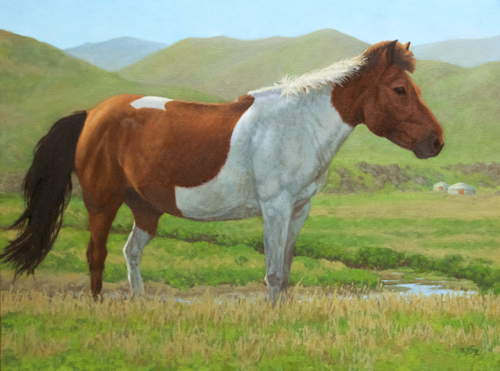
Mongol Horse #7-Getting Warmed Up 18x24" oil on canvas
This was the first painting I started after the long travel layoff. I wanted to keep it simple, so I chose this beautiful paint horse standing with his back to the morning sun. In my reference he was standing with a hill behind him, which wasn’t very interesting, so I “moved” him to a background that let me do a landscape, too. The setting is the Hangai Mountains of central Mongolia, a lush and scenic part of the country that isn’t anything like the vision most people have of the Land of Blue Skies.
After leaving the falls, our route took us along and across the Orkhon Gol until we started to climb back into the mountains.
Along the Orkhon GolBridge over the river
Once again, we were in wildflower heaven.
Up into the mountains once moreMountain wildlflowers
We were on our way up to Tovhon Monastery, a famous remote mountain retreat founded by Zanabazar, the first Bogd Khan of Mongolia and the greatest artist the country has produced. He is particularly known for his exquisite bronze sculptures of Buddhist incarnations and deities.
As we drove farther up, the earth road turned into a very badly rutted mud road, due to the recent rains. We came very close to getting stuck and Khatnaa backed down onto a flat area and said that we would walk the rest of the way, about a kilometer. That was fine with me since I had wanted to do at least a little hiking in the Hangai Mountains. What I hadn’t realized was how hot and humid it would be. But I just put one foot in front of the other and pretty soon these green prayer flags came into view.
Our destination proved to be worth every step and drop of sweat. In fact, it really felt like walking the last part had absolutely been the right thing to do.
Green prayer flags near path to monastery
We emerged out of the trees onto an open area with some gers and local guys trying to get their horses lined up for a photograph.
Local herders with horses for hire
Then it was time to make a final walk up the slope to the monastery itself. Once we were on the grounds, the view across the mountains was breathtaking.
View from Tovhon Monastery, Hangai Mountains
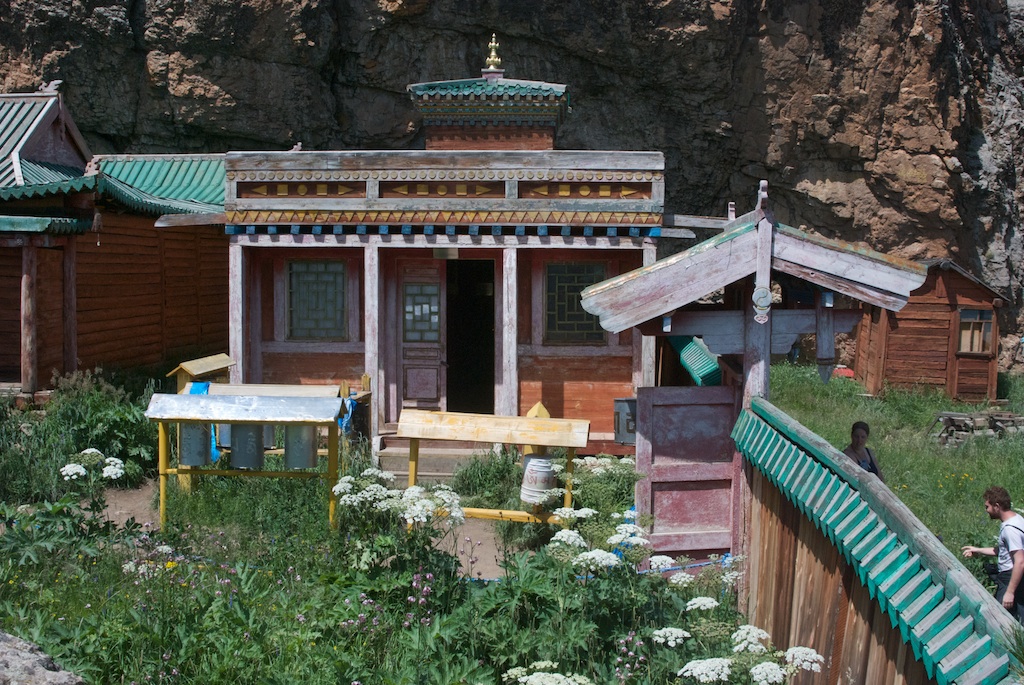
The buildings are of Tibetan/Nepalese style. Zanabazar ran afoul of the authorities more than once and this was one place where he took refuge. There are a number of small structures and stupas, but one of the main reasons people come here is to climb up the cliff that backs the monastery to pass through a “womb cave”. Doing so symbolizes death and rebirth. Men can then continue onto the top. Women are not allowed. Right or wrong, that’s simply the way it is. I was too wrung out from the hike, so I stayed below, took photos and enjoyed just sitting and being in a very special place.
Temple with prayer wheels
In the background of the above photo, you can see people beginning the climb to the top. It was very steep, really right up the cliff face. Not anything that would be allowed in the USA.
Temple building with fence and gate
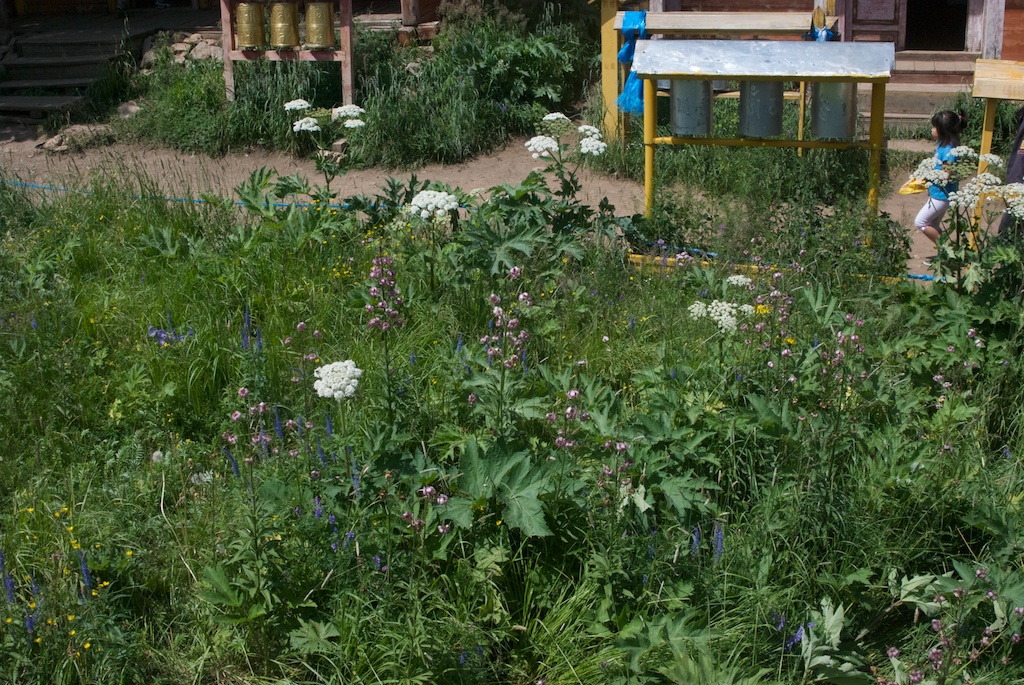
There was also a small garden. Once again, there were native plants that have been introduced into America. But what was really special were these lilies, the only time I’ve seen them in all my trips to Mongolia.]
LiliesMonastery garden with cow parsley, veronica, larkspur, hardy geraniums and the lilies
Finally it was time to take our leave and start back down. I took this last photo from down below. You can just see the top of the temple roofs.
View of monastery setting
The hike back to the car was easier, even with the ups and downs. We drove down the hill to a huge swath of wildflowers. Other tour groups had set up long tables and were having lunch. Khatnaa pulled right out into the middle of the flowers and we also had our lunch surrounded by them.
Lunchtime view
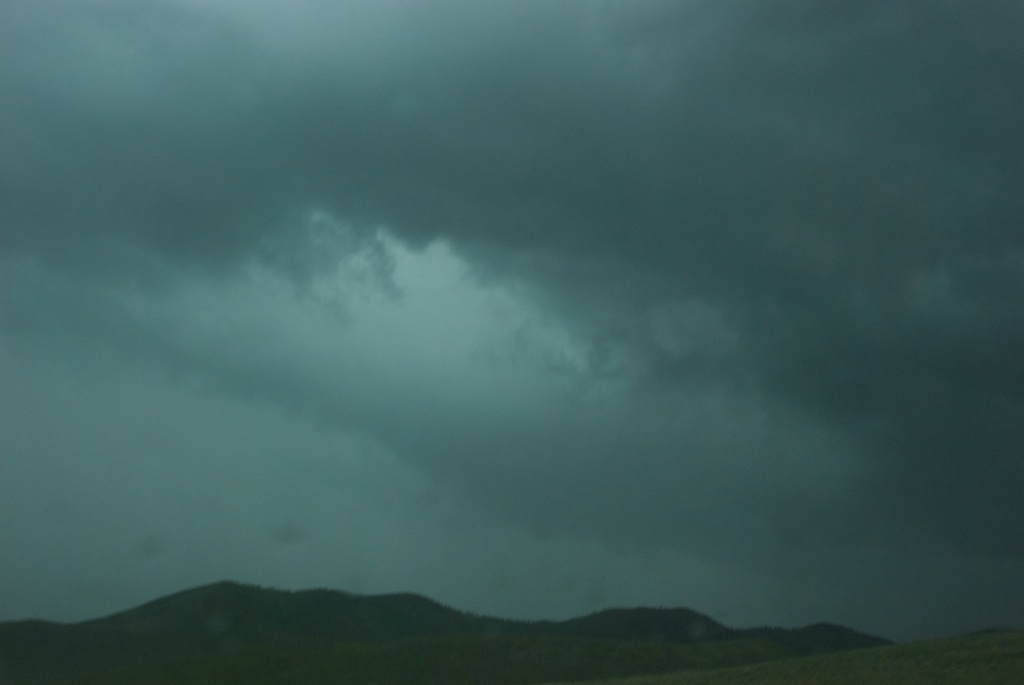
Just as we were finishing up, it started to sprinkle. Time to leave. The sun had vanished over the past hour and as we drove on, I realized that we were driving more or less straight towards some very dark and heavy clouds.
We started to see big bolts of lightning to the right and left. Then in front. We reached an elevation where we were almost up in the clouds. Diffused flashes of bright light went off directly in front of us with almost simultaneous cracks of thunder. Then it started to rain. Hard.
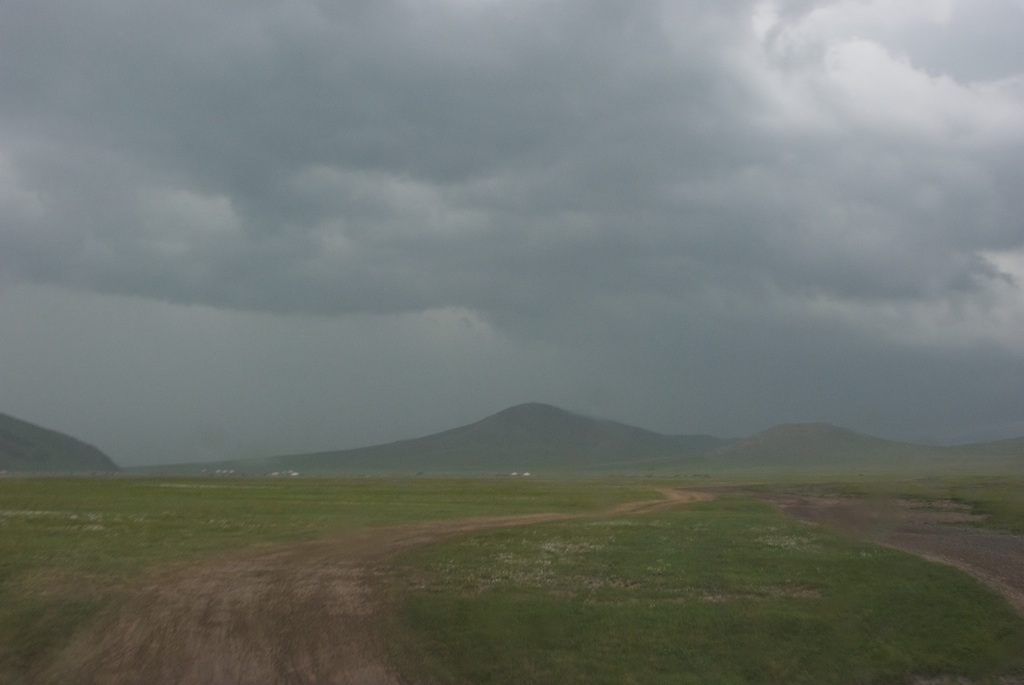
Storm clouds, but no rain yet; taken through windshield
At this point, I stopped taking pictures for awhile because I didn’t want to distract the driver. The storm had become very intense. Eventually, we came down into a high valley.
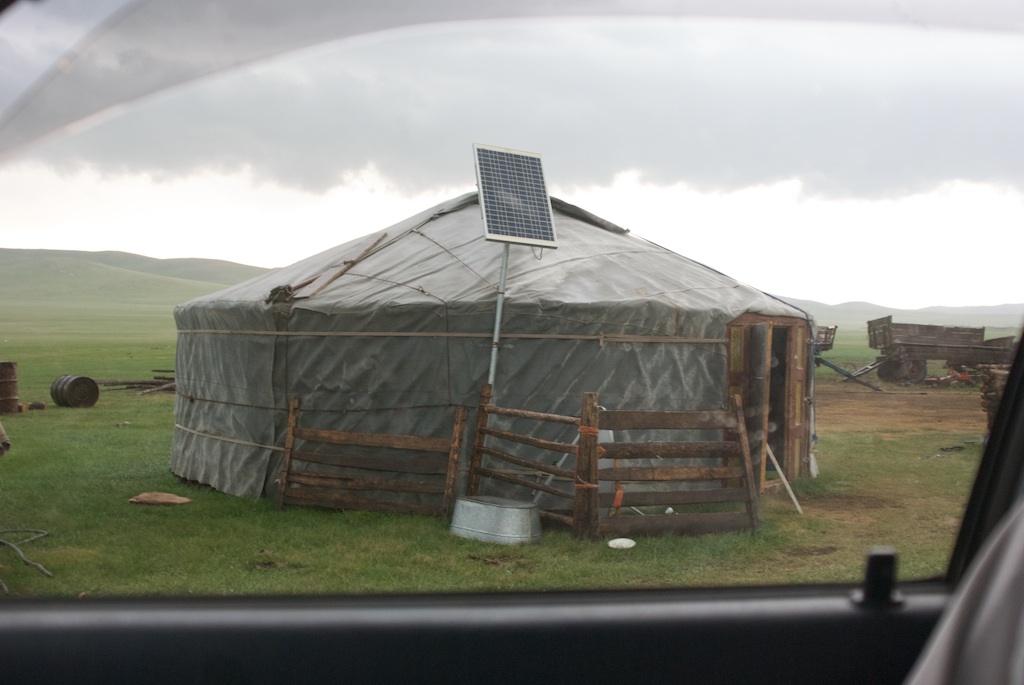
Rain in the distance; the direction we were goingA ger we made a quick stop at
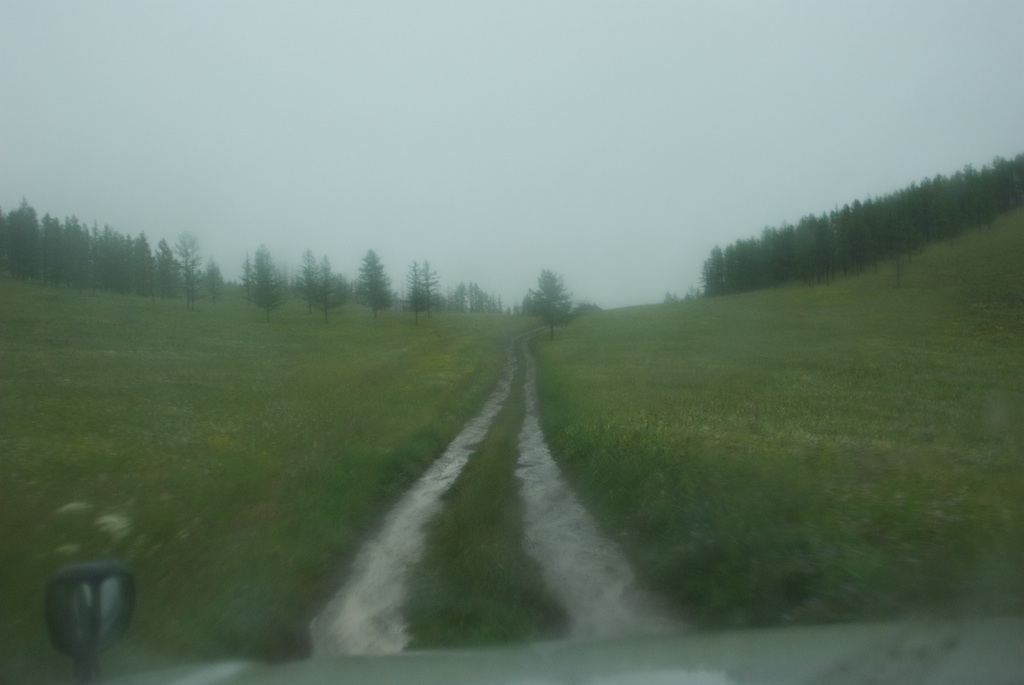
And then went back up in elevation again in driving rain.
Serious storm cloudsRoad back up into the mountains
We reached the pass. The rain had let up enough for us to circle this ovoo.
Ovoo up on the passDown into another valley
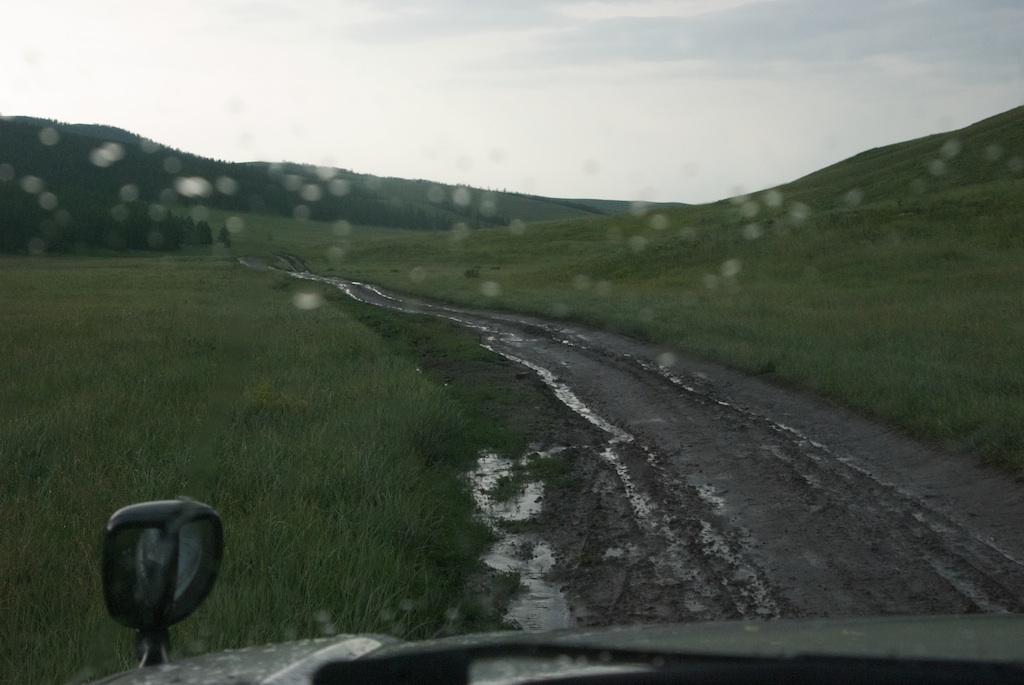
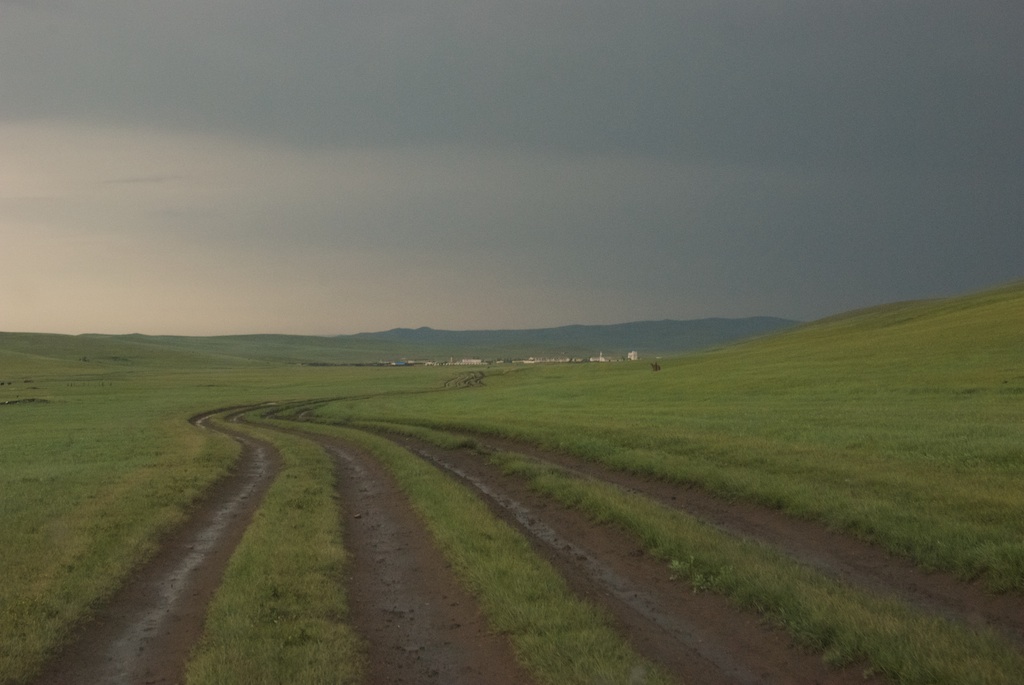
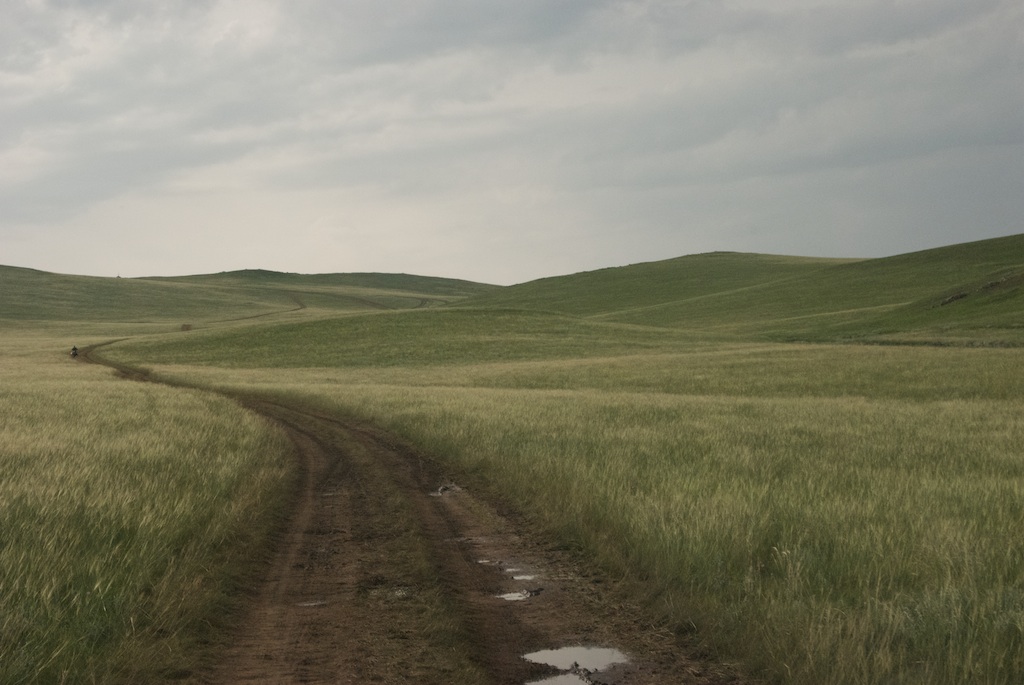
Once we came down into this valley and saw all the gers and animals, I thought to myself “Whew, we’re through it.” Wrong. We were driving toward where it had been raining, so there was an increasing water build-up on the earth roads which soon turned them to mud.
Coming down out of the mountains
The road got more and more treacherous. Once again I mostly stopped taking pictures to avoid causing any distraction. To quote from my journal:
“It had been raining heavily in the direction we were going and the roads were running with water and very slick in spots. As I sat in the passenger seat, I saw how deep the Mongol bag of tricks is for driving on in what were really impossible conditions.
“The tire treads got so caked with mud at one point we lost traction completely and slid to the side of the road. Khatnaa, somehow, by turning the wheel back and forth quickly, got us facing in the right direction and then deliberately drove down a rut (see image below) at the side of the road that had water in it to clean off the treads on one side.
“He also kept the treads clear by driving on faint paths in the grass, off the road.
“We were still at high elevation and hadn’t seen a ger since the climb to the pass, so if we got stuck, I’m not sure what our options would have been. Calling AAA certainly wasn’t one of them.”
"Mud" road; deliberately driving into this ditch seemed really counterintuitive, but it worked
Finally we really were down out of the mountains, crossing a grassy steppe lit up in beautiful storm light.
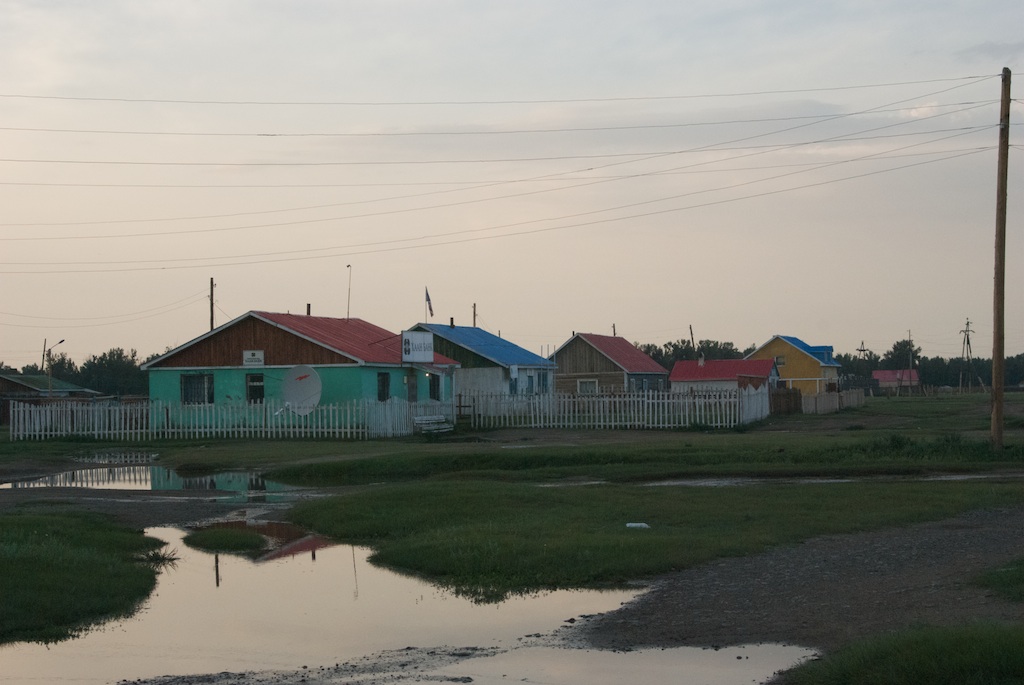
Level, almost dry earth road at lastStorm light; grab shot from car windowSoft light on the steppeSoum center houses
All this had really used up the day and, to my eternal delight, we ended up at Soyoloo’s sister’s home for dinner. And what a dinner! First, of course, was good, hot suutai tsai (milk tea), followed by airag, followed by nermal arkhi, accompanied by a big platter of aruul. Then we were served mantuu (steamed bread) roe deer venison, lenok (a kind of fish) broth and a big serving of buuz.
We also learned that, not surprisingly, the rivers were either high or flooded at most of the fording spots. Our hosts led us to a safe crossing point as an almost-full moon lit our way. We arrived at our campsite around 9:30pm and set up the tents. I don’t believe any of us had trouble falling asleep that night.
A beautiful Mongolian night
Next time: A trip into Tsetserleg, plus Uigher ruins and Mongolia’s most famous visitor destination- Erdene Zuu.
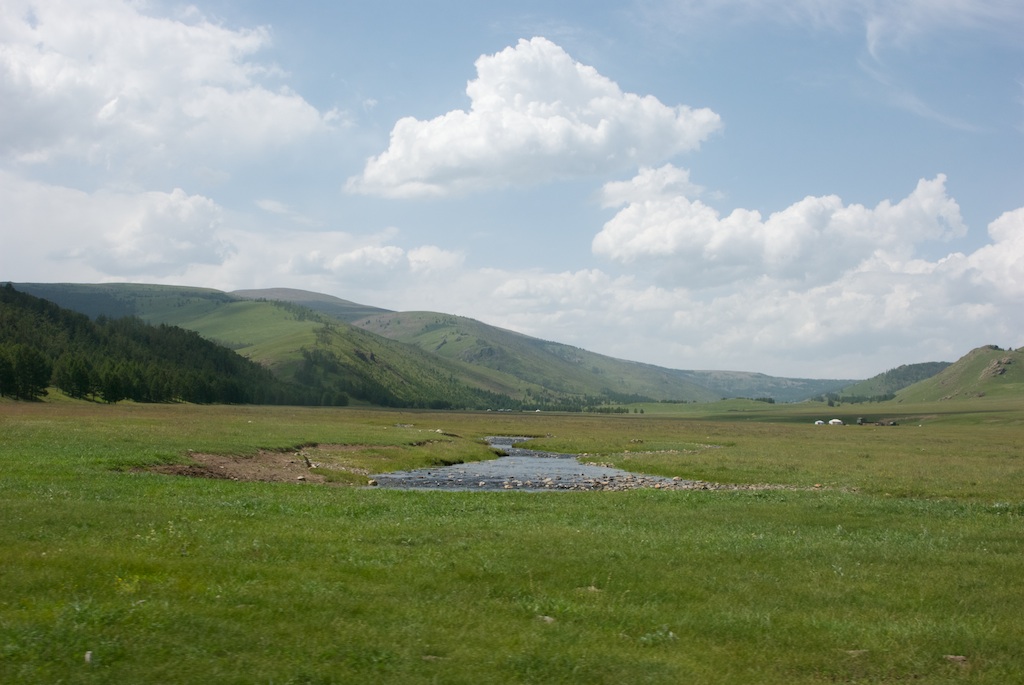
After lunch at the lovely spot that ended the previous post, we drove higher into the mountains, up where there were forests of larch trees.
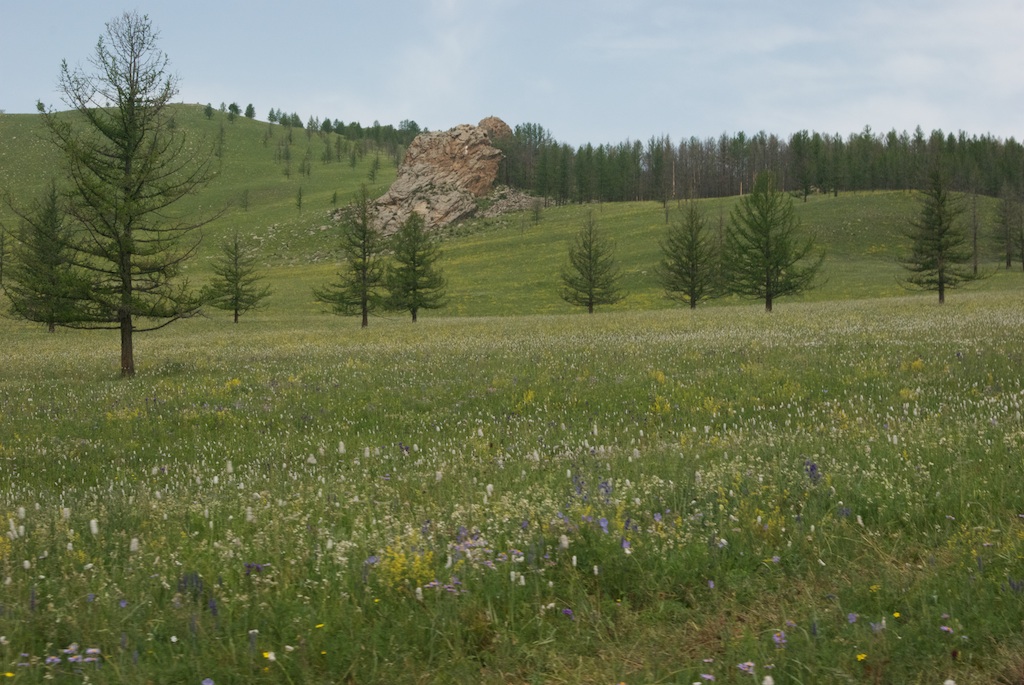
Typical beautiful scenery
Two boys we passed; what a great place to be kid on a horse!
Many of them were a reddish color, which indicated that they were dead or dying of a beetle infestation. Very sad.
We came over a pass that had a very impressive ovoo.
Ovoo made of wood, with khadak
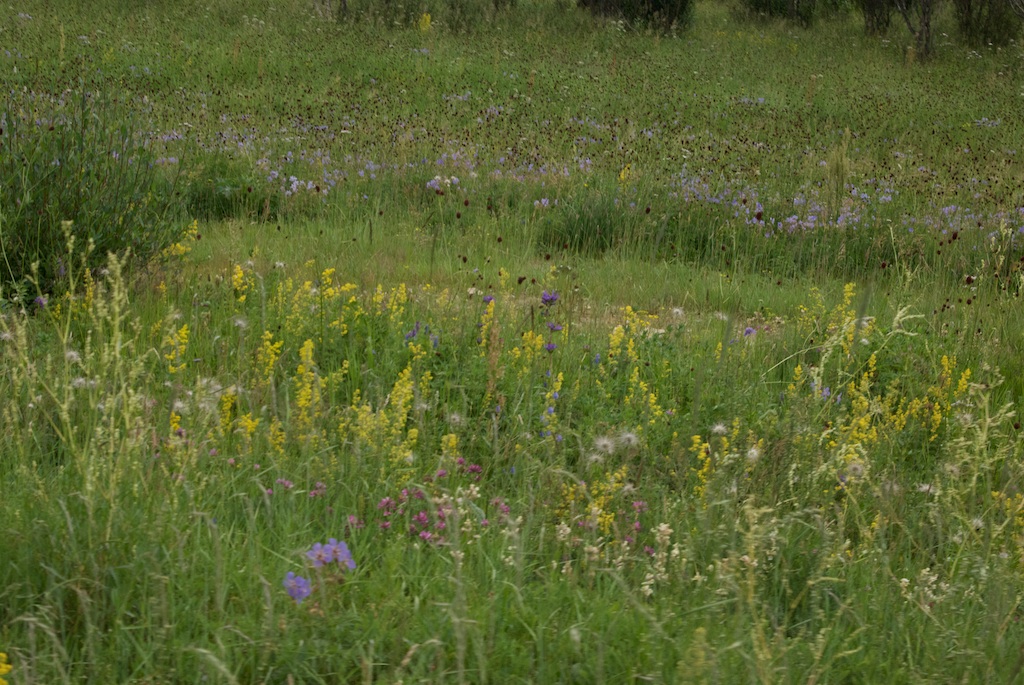
As we came up into the trees, we found ourselves in a wonderland of wildflowers. To my surprise and delight, one of the most common was very familiar – fireweed. It is an introduced plant in the United States and I see it in bloom in many places near our house and along the roadside. Little did I know that there is a little bit of Mongolia in the neighborhood.
Up into the mountains; fireweed by roadside
Large colony of fireweed
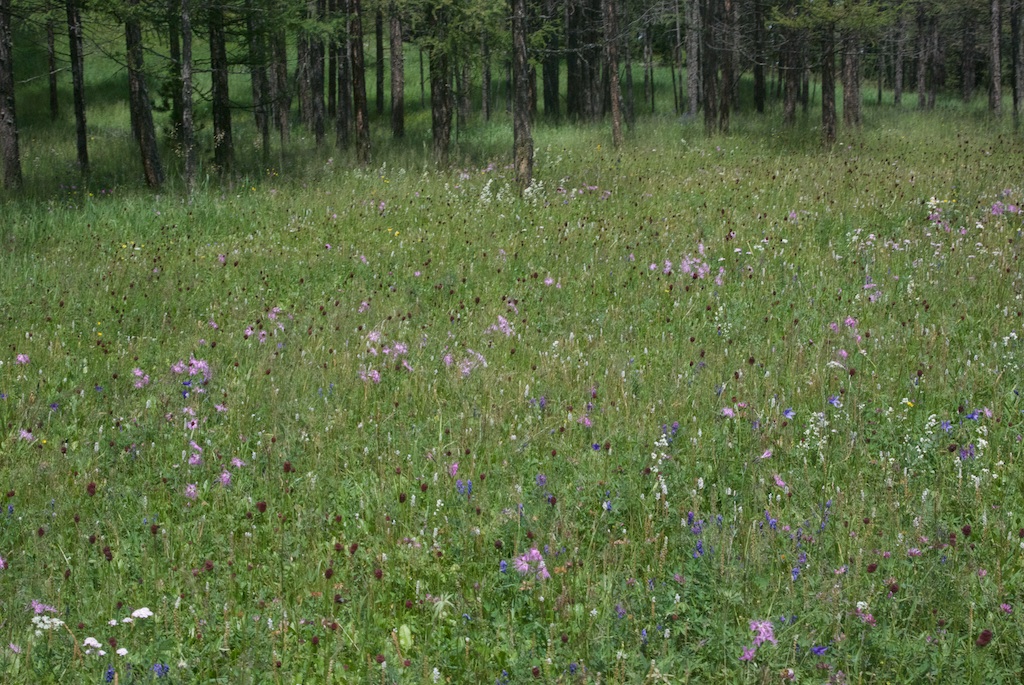
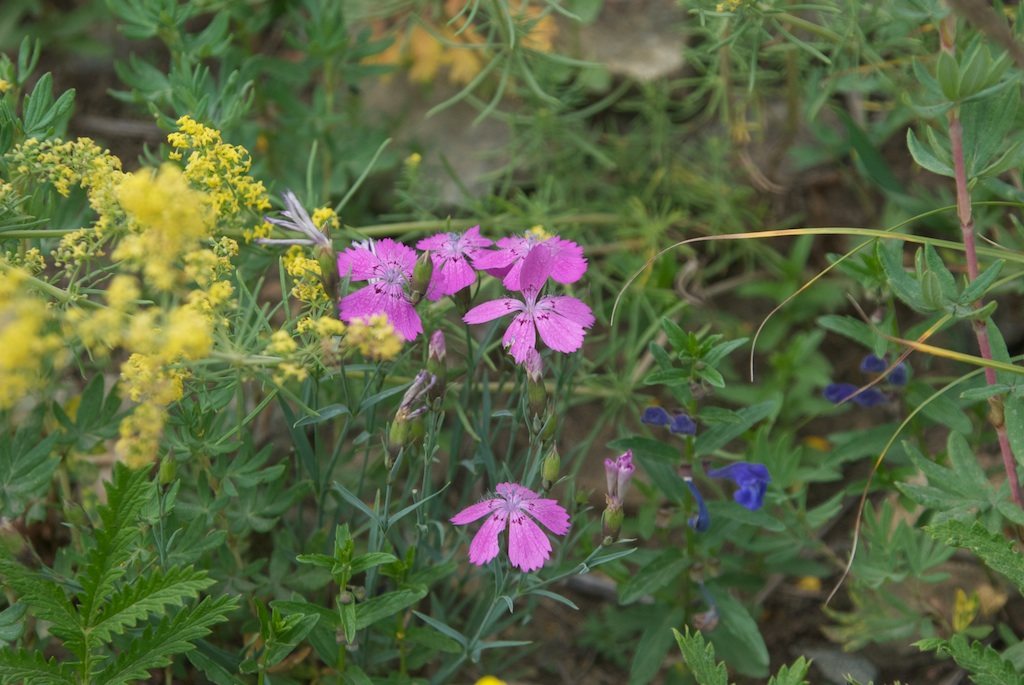
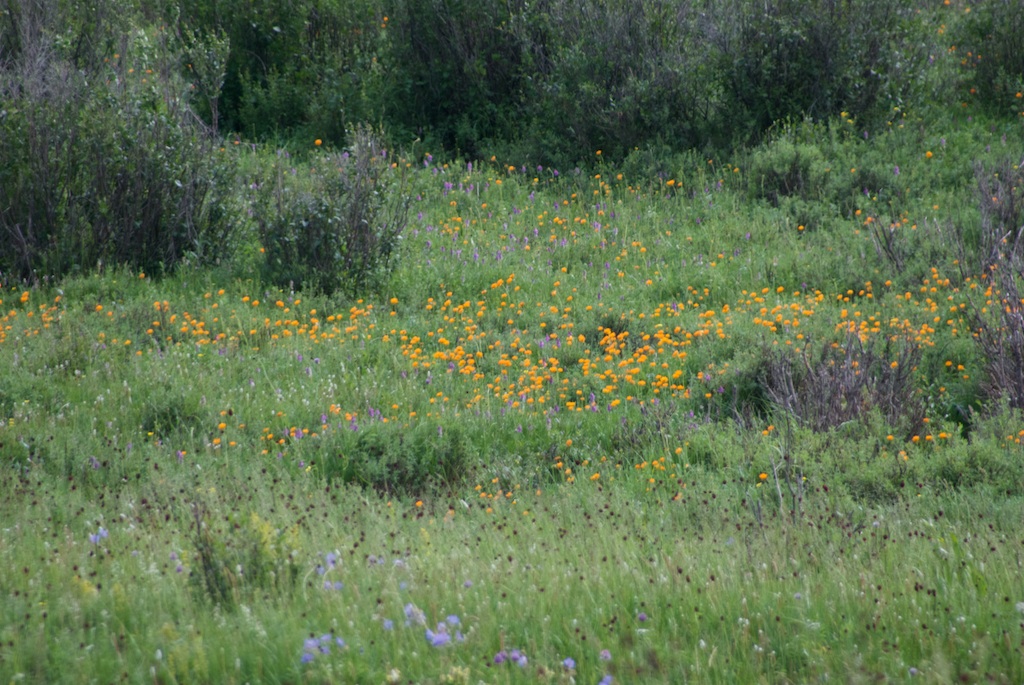
It was clearly the perfect time of year to see mountain wildflowers. I grabbed a lot of photos as we went by, but we also stopped a couple of times to get close-ups.
Wildflowers
Dianthus
Colony of troilus (orange flowers)
Bedstraw, larkspur. burnet, geranium
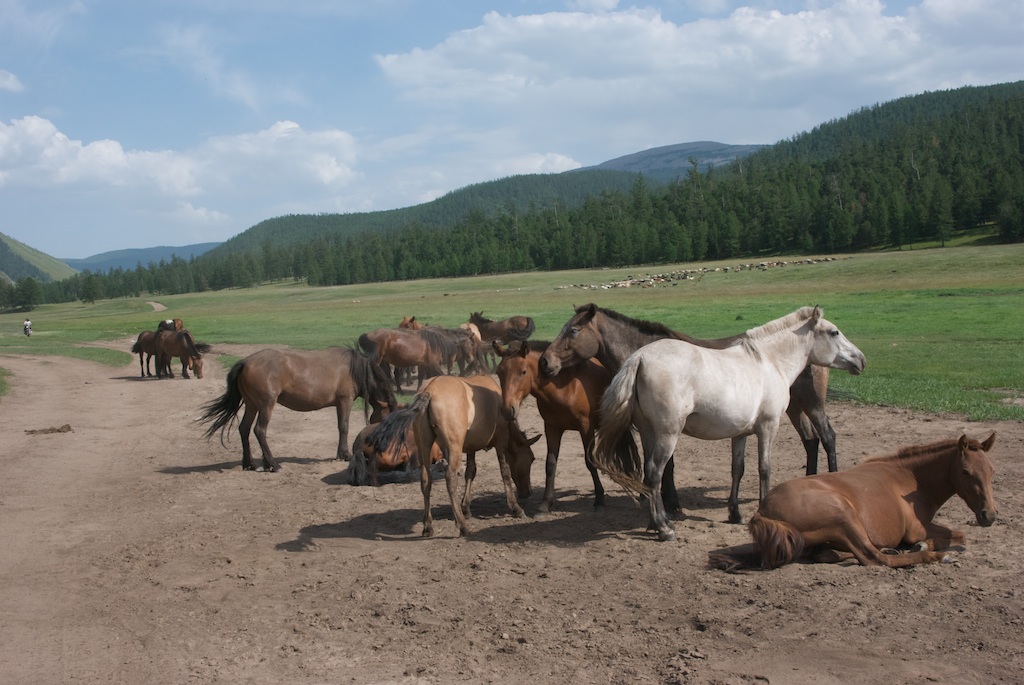
The flowers tapered off as we came down in elevation, where we passed this herd of horses.
Horses
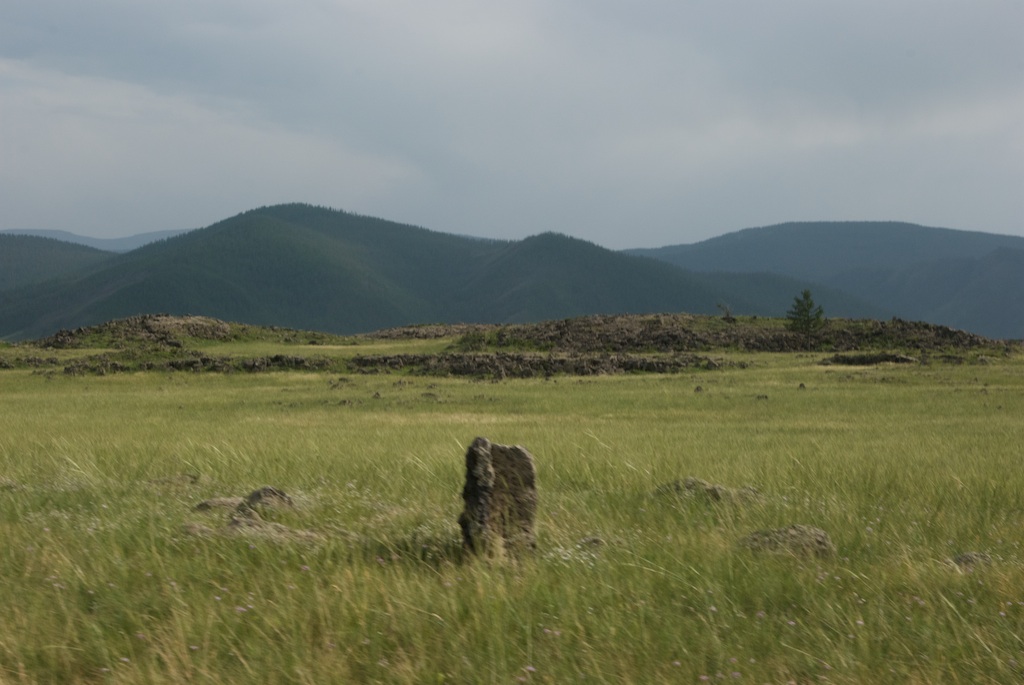
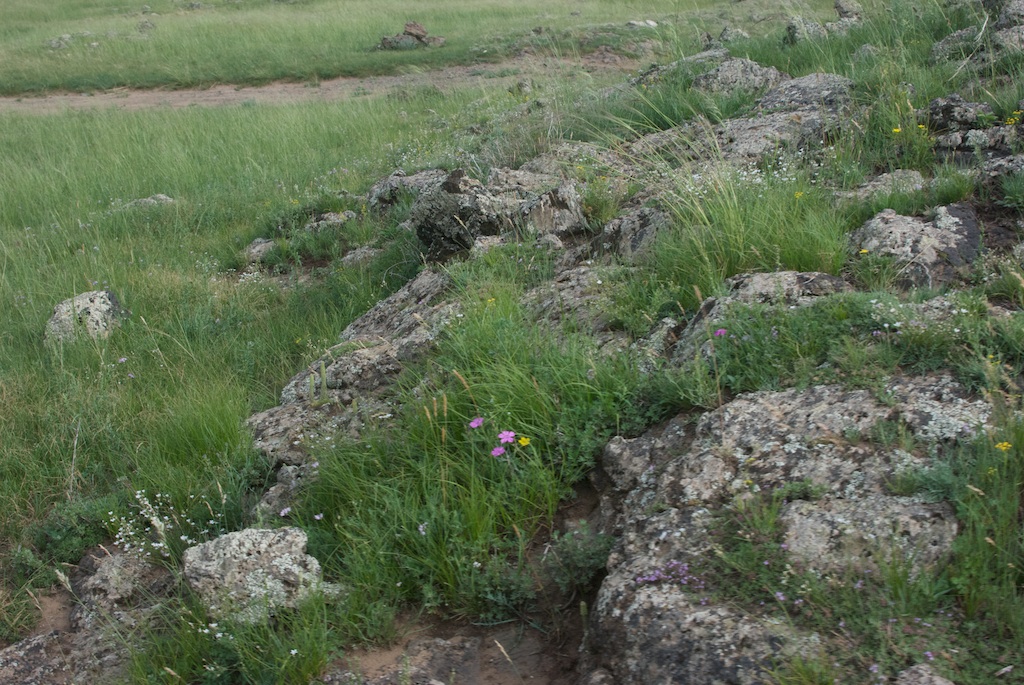
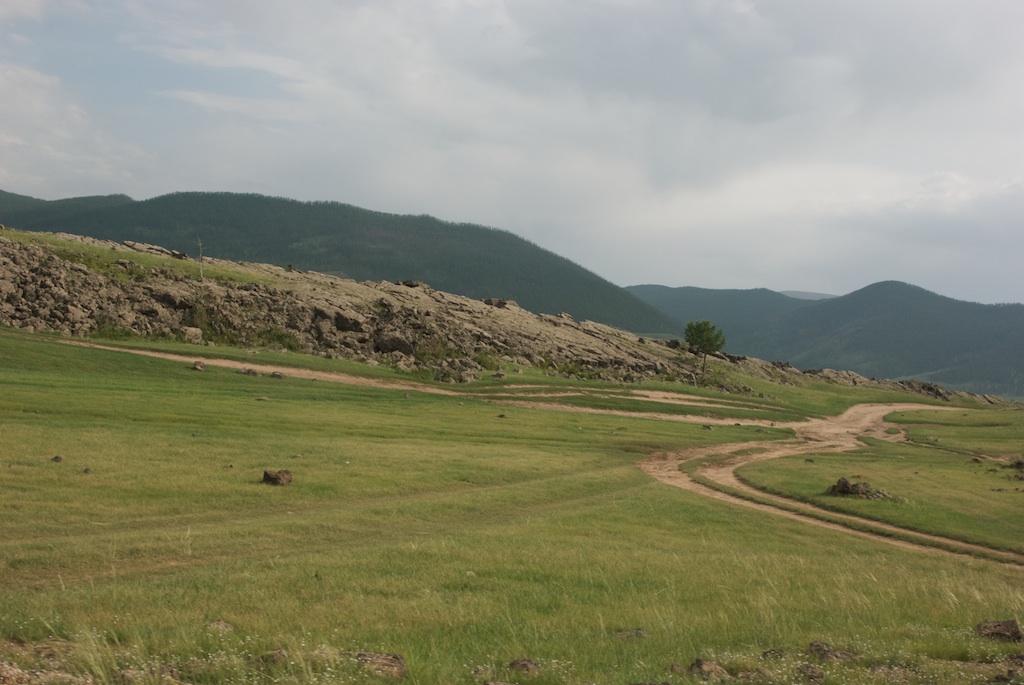
Soon we were driving across a very large valley with a lot of rock outcroppings. Upon looking at them closely, I realized that I had seen something similar in Hawaii and Idaho- lava flows. It looked as if the entire valley had been filled to some unknown depth from an ancient volcanic eruption.
Orkhon Valley
Wildflowers growing in lava formations
Edge of massive lava flow
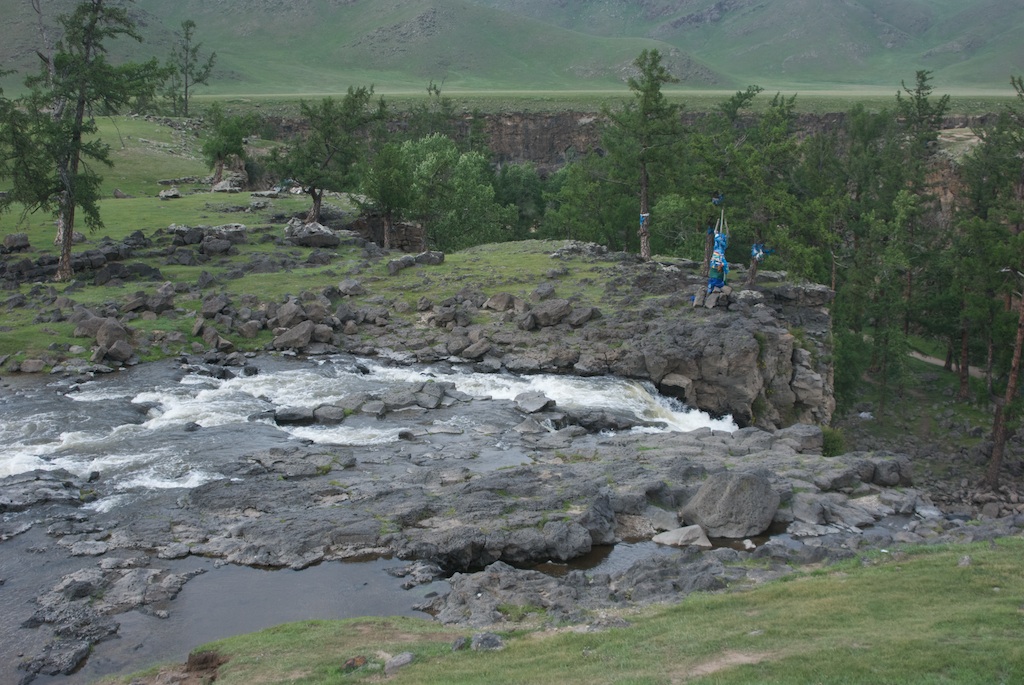
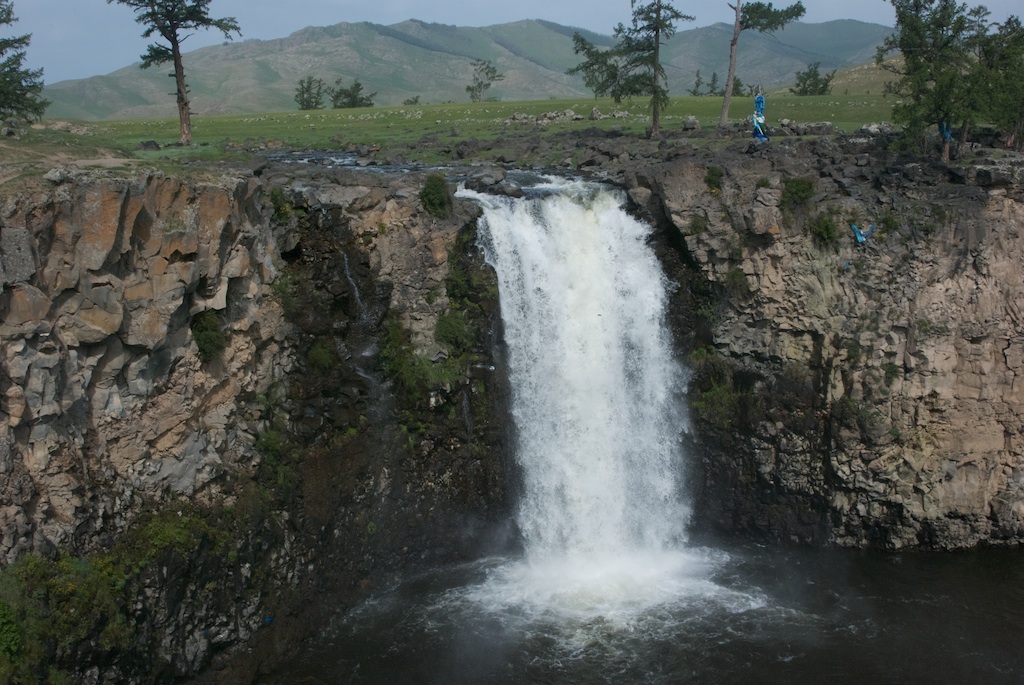
We finally approached the site of something that Mongolia isn’t particularly known for… a waterfall. The amount of water going over the edge is dependent on rainfall. Many people apparently go to the Orkhon Falls and are disappointed in how little water there is to see. We weren’t. One consequence of the rainfall that has been a part of this story from the time we were in the Gobi is that the falls were full and beautiful. It was pretty overcast, so we took a look and some photos and left to find a campsite.
At the edge
At Orkhon Falls
Once again, good yak viewing from the comfort of our camp.
My tent, with yaks
A couple of local herders came by to gather up their animals.
Local herder
The next morning was bright and sunny, so we went back to the falls before departure and I got some lovely photos.
Khatnaa, me and Soyoloo; the kid who Khatnaa handed my camera to did a nice job!
One can now see how deep the lava deposit is.
Orkhon Falls
Ovoo at edge of falls
Orkhon Gol (river)
By an interesting coincidence, another Humboldt County artist friend was not only in Mongolia at the same time as me, but she and some other folks were on a canoe trip. On the Orkhon Gol. They were far downriver from where I was, to the north. The Orkhon Gol orginates in the Hangai Mountains and flows north, where it joins the Selenge Gol, which flows into Lake Baikal.
On our way out of the area of the falls, we saw two black kites sitting on fence posts.
Black kites
Little did I know that this morning was the beginning of one of the most interesting, eventful and unexpected days of the entire trip.



































 Susan Fox, American Artist