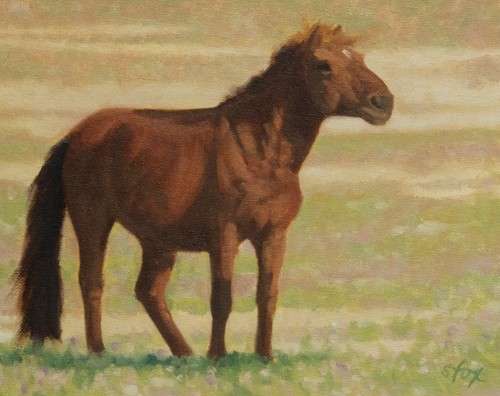
“Mongol Horse, Arburd Sands” is a study of a horse I saw one morning near the Arburd Sands Ger Camp in Mongolia. He and the rest of the herd were all grazing together in great morning light. Click to bid here
“Mongol Horse, Arburd Sands” is a study of a horse I saw one morning near the Arburd Sands Ger Camp in Mongolia. He and the rest of the herd were all grazing together in great morning light. Click to bid here
Last week was pretty intense. I had a painting to finish for submission to an invitational show (which it may or may not be accepted into; we’ll see). It’s by far the most complex and difficult one I’ve taken on so far. The kind where, once you’re well into it and can see what level of effort it’s going to take to pull it off, you wonder if you’re out of your mind. But I felt really driven to paint it, so off I went. I think it took somewhere between 60 and 80 hours, spread over about three weeks, but I wasn’t really counting. I didn’t have time.
I normally post about my painting activities on Fridays, but when you see the reference image that inspired me, I think you’ll agree that it’s right for Mongolia Monday.
I photograph the process when I do “major” paintings, both to have a record and to be able to refer back to previous points while it’s in progress. I thought you might enjoy following how this one developed.
So, to start, here’s the image that said “PAINT ME!” It was taken at a local Nadaam in the town of Erdene, which is about an hour east of Ulaanbaatar, in July of 2009. It was pouring rain when we arrived, just in time to see the finish of the horse race. Fortunately, it stopped and, although it was cloudy and muddy, we had a great time and I got at least three or four more painting ideas from the afternoon.
I loved everything about this image: The two horses neck and neck. The fact that one boy is using a traditional Mongol wood saddle and the other is riding bareback in stocking feet and how different it makes their body positions as they ride flat out for the finish line. The way the orange and yellow is repeated in their clothes and the saddle.
The only thing missing was great light. Hum, what to do? I decided that rather than trying to change the light, since July is the rainy season (or at least it’s supposed to be) in Mongolia, which means that at least some of these races happen in wet conditions, I’d just go with it and make the fact that it was a rainy day part of the story.

The background didn’t do anything for me and since most of the people who will view the final painting won’t be familiar with the setting or situation, I needed to add some context. The first step was to do a pencil drawing that included all the elements to make sure everything would go together even though I used at least six different photos for the final composition.
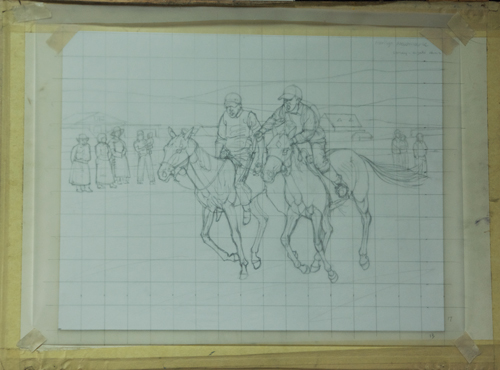
The drawing is done on 19×24″ tracing paper. The finished painting is 28×36″. The grid lines are a traditional (dated back to the Renaissance) method of transferring a drawing to the larger surface. Notice how many spectators there are and where the buildings are. I had already decided to leave out a line of cars that were behind the people.
I have also decided to paint these scenes as I see them. I’m not going to “romanticize” them by substituting traditional hats for the baseball caps or putting the kids in del. While I’m very interested in Mongolian history and might do paintings with historical themes, with historic costumes and armor, if I can get the reference, for the most part I’m interested in Mongolia as it really is right now, in the 21st century.
Once the drawing is transferred to the canvas with a pencil, I re-draw it with a brush, always correcting and refining as I go.
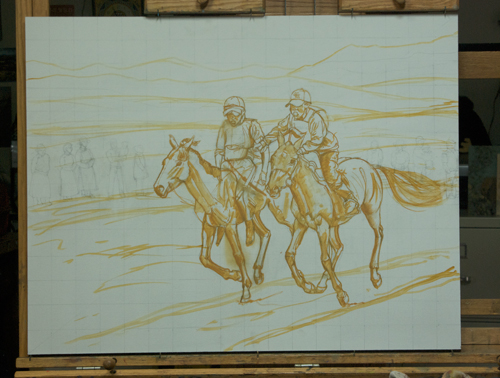
In this case, I decided to start by laying in the background first. I wanted to establish the lightest lights and also the atmospheric perspective of the mountains in the distance. You will also notice that I’ve ditched all the people on the right and cut down the number of people on the left. The buildings are gone, too. I really felt that I needed to simplify things. One of the lessons I’m learning is how what works at one size may not work at a much larger size. It’s what stalled me on the big argali painting.
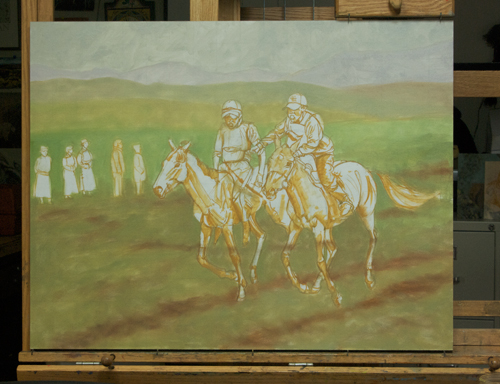
Next, I laid in the first layer of color on the figures, going dark so I could come back in with lighter colors. Everything is in what is called “local color”-the “real” color of an object not affected by a light source. Notice the drawing is pretty much gone, but that’s ok because, I know I can get it back as I go.

Now, I’m past the opening stages. The set-up is done and the constant process of painting, correcting and refining has begun. I’ve laid in the folds on the boy’s clothes and gotten the basic modeling done of the muscles and structure of the horses. Where before, the background had seemed too crowded, now it seems too empty and the people are just standing there, isolated, with no context.

Here you can see how I work. The computer is a 24″ iMac with a glossy monitor, so it’s like painting from very large transparencies. I can easily toggle back and forth between the various images that I’m using. You can see that I’ve added the buildings back in, but now they are behind the spectators, which creates one visual unit instead of two scattered ones. And now there are gers in the background. I’m thinking at this point about the white of the boy’s hats being repeated in the hats of two of the spectators, then repeated again with the gers. So it’s kind of like a bar of music with the white elements as the “notes”.

Here’s a detail of the people and buildings in progress. The good people of Erdene would probably be really confused if they saw this because I’ve used my “artistic license” to move and rearrange the structures to suit me. But I’d like to think that they’d recognize their friends and neighbors. Unfortunately, the pattern on the one woman’s blue del ended up being too visually distracting, so I had to make it just a plain blue. All the colors are intended to relate to each other in a somewhat limited palette and not compete with the jockeys. Oh, and that’s the Mongolian flag at the top of the blue building. Couldn’t leave that out. Notice also that I’ve added the road that runs through the town. It’s on a diagonal, which is more dynamic than a horizontal. I want it to support and emphasize the main action. That’s also why the lines of dirt at the horses feet are on the diagonal, as you can see in the image above.

Here’s a detail of the jockey’s faces in progress, along with the horse’s heads. They all went through three or four repaints before I got them the way I wanted them. Notice that I haven’t painted any of the tack yet, other than the orange saddle. That’s the final level of detail that I leave for the final orchestration. Also, the paint has to be dry so that if I make a mistake on a stroke I can pull it off without wrecking what I’ve done underneath.
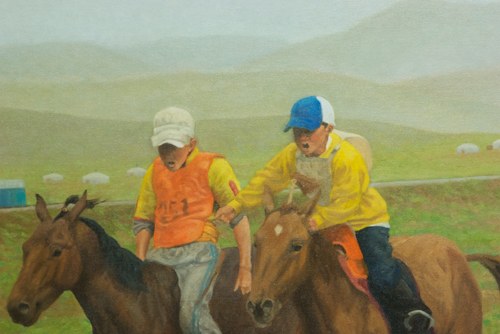
At one point, I stopped, got a piece of paper and a charcoal pencil and did a couple of studies of the boys and the bridle of the horse on the right to make sure that I understood the shapes correctly and could paint only the ones I needed.

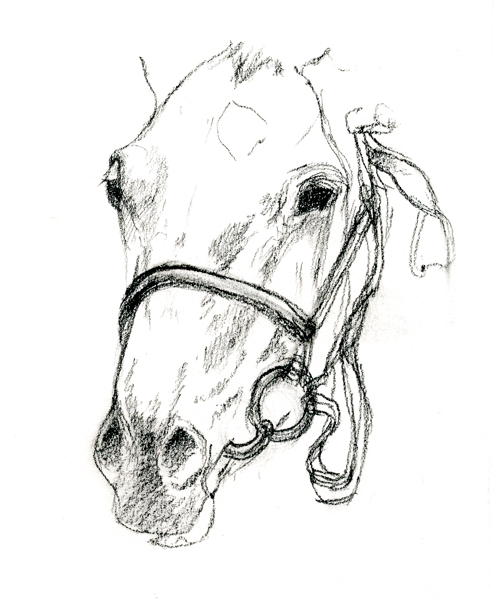
I highly recommend this. Instead of flailing around in paint, hoping to somehow get it right, do a quick drawing to work out the problem. It saves a lot of time, paint and frustration.
One thing I noticed almost at the end was that, as a design decision, I had the right-hand horse’s tail flowing off the canvas. When I was looking at another image for another reason, it hit me and I remembered that the race horse’s tails are bound part-way down. What an awful mistake that would have been. Quick scrap down and repaint.
And here is the finished painting: Rainy Day Finish; Erdene Nadaam, 2009
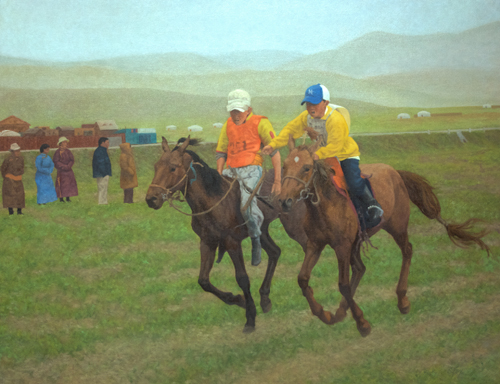
There’s this saying about combat flying- hours of boredom interspersed with moments of stark terror. At a far less dramatic level, painting seems to have a similar rhythm sometimes. We spend days or weeks working on paintings and, suddenly, some get finished, signatures go on, photos are taken and, ta da. we’re ready to move on. I finished this painting a couple of days after the one I posted last Friday.
This piece is a scene from the mountain blessing ceremony that I had the good fortune to attend at Baga Gazriin Chuluu. There had already been an anklebone shooting competition, but the horse race was the event that everyone dropped what they were doing for. The Buddhist monks who had been sitting in a tent, chanting, came out and joined their families and friends. For at least a hour before the race, the kids had been warming up the horses by walking them in a big circle, sometimes singing as they rode round and round.
The horses were two-year olds, all stallions. As it turns out the Mongol word for horse, “mor” includes the fact that the horse in an ungelded male. That’s the default. Then there are geldings and mares. Being young colts, the race was a short distance- 7km. (The main national Naadam race for fully adult horses is 56km.) As with all Mongol horse races, after warm-ups the jockeys rode their mounts out to the starting line at a walk or trot, followed by a few vehicles which I assume included the starter and some of the trainers.
Everyone went out of sight behind a large rock formation. We all waited at the finish line, a small pile of rocks which held up a pole that had a colorful red scarf flying from it like a flag.
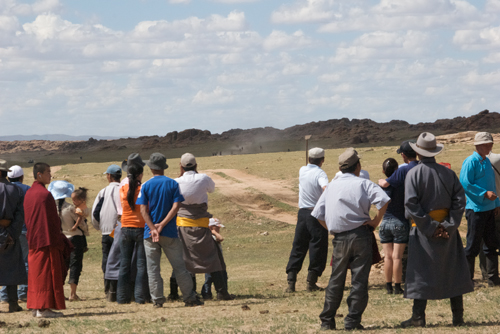
Pretty soon the crowd stirred and, looking out, we could see the dust from the horses. In just another minute or two they started to reach the finish line. I got as many pictures as I could.
The trainers checked the horses over and some scrapped the sweat off them, although none were lathered up or even looked particularly tired. Then the jockeys spent most of the next hour circling the wrestling competition, cooling down their mounts. That’s when I got the image I used in this painting.
I’ve also included the reference photos since I think too many animal artists just use whatever setting the animal is in when the picture was taken and don’t consider other options. In this case, the background was pretty boring. But, a short distance away were these really great rock formations.
The young rider:
 The background:
 Put them together and….

The rocks were deliberately placed so that the boy would be against the large shadow area. I kept things on a diagonal so that the background would be at a different angle from the main subject and keep the composition from being too static. After going 14km, the rider was still having to pull firmly to keep his mount at a walk. I wanted all the elements of the painting to support that pent-up energy.
In September of 2008, my husband and I went together to Mongolia. One of the places we stayed at was Arburds Sands ger camp. It turned into one of the most memorable experiences that I’ve had in Mongolia because we were invited to a foal branding. The post on that is here.
I got a lot of great pictures, including some of the family patriarch, Choidog. He is a famous horse trainer who won the national Naadam horse race three times in the 1960s. During socialist times, he and the other herdsmen were only allowed to have 75 horses. Twenty years after the changeover to a parliamentary democracy, he has between 300 and 400. I suspect he thinks that’s just about right, but even by horse-loving Mongol standards, it’s a lot.
I decided recently that I wanted to start painting not just the Mongol horses, but their riders, too. And where better to start than with a man who is now 80 years old, who still rides every day and whose life has been dedicated to horses?

As much as they love their horses, Mongols do not sentimentalize them and don’t give them what we would call “real” names. Choidog is riding his current favorite horse, who is simply called “Khar” or “Black”. Black could take his master 140 km to Ulaanbaatar if necessary, probably without breaking a sweat.
In this painting, Choidog is circling and looking over the horse herd that has been gathered in. Most of the foals are already tied to a picket line, but some of the men are out lassoing the others with urga, a long pole with a loop on the end.
We were told afterward, while sitting in the ger drinking airag with the family and friends, that Choidog had made his boots himself over the previous winter. The toes are upturned, not because it looks cool, but so that when walking (which people like Choidog never do if they can ride), the wearer won’t scuff the earth and damage it. The Mongols learned over a thousand years ago that they had to live with and respect the land in order to survive. Hum….
Sort of an odds and ends Friday as the year winds down. The deep freeze is over here in coastal Humboldt County and it’s back to nice normal rainy weather with nighttime lows in the 40s. I’ve been getting in some good easel time of the past few weeks. Here’s a new argali painting from reference that I shot in July at Gun-Galuut Nature Reserve. I watched this group of rams work their way across the rocky slope for almost an hour. “Uul” is Mongolian for “mountain”.

I’ve also decided that I want to paint not just the domestic Mongol horses, but the people who ride them. Which brings me back to wrestling with human figures, as described in an earlier post. I get a better result if I can scan the drawings rather than photograph them and also wanted to really hone in on accuracy, so these are smaller and done with a Sanford Draughting pencil, but on the same vellum bristol (which erases very nicely). The heads ended up being only 3/4″ high, which is pretty small, but it reminded me of a story from art school that I thought I might pass along.
One of my teachers was Randy Berrett, a very good illustrator who chose to work in oils. This was kind of masochistic, in a way, because it added a layer of complexity when he had to ship out a wet painting to meet a deadline. In any case, he was showing some examples of his work in class and one was a really large painting of the signers of the either the Declaration of Independence or the Constitution, I can’t remember which. Someone asked why he painted it so large. Randy’s answer really struck me at the time and has stayed with me. It’s something worth remembering when planning a painting. He said that he wanted the heads to be at least an inch high and that requirement controlled the final size of the painting. I’ve sized more than one painting on the basis of that criteria since then.
The first drawing combined two pieces of reference. One of the horse and one of the man. In the latter, he was in front of the horse’s head. In the former, I didn’t like the pose of the horse. Moving the man back works much better. The sweat from a winning horse is considered to be good luck. There are special scrapers made to remove it.
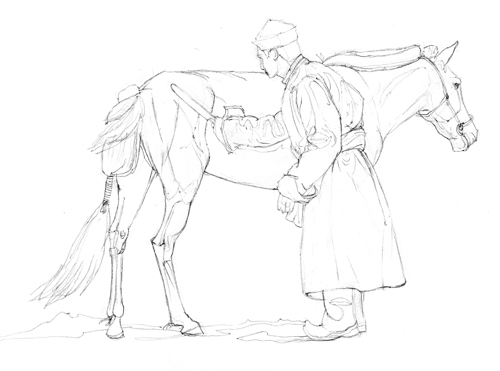
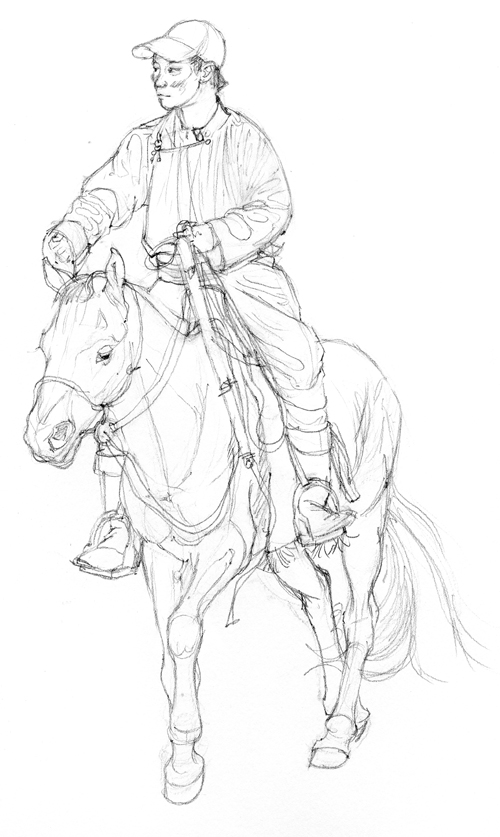
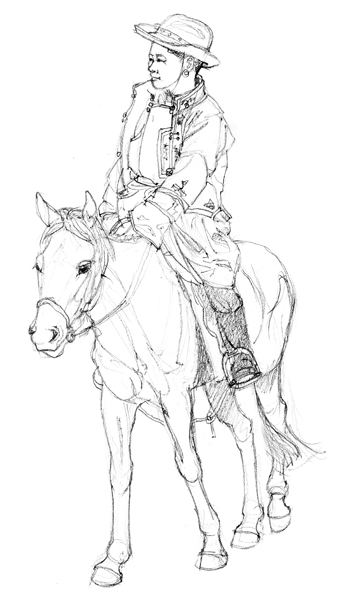
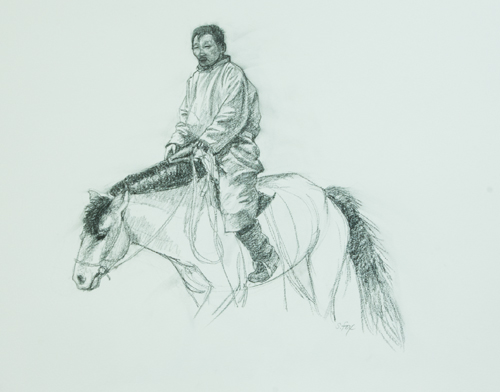
Part of the reason I did the previous two was to see if the images “drew well” and to work on horses coming forward at a 3/4 angle. The final two are head studies, in which the heads are 1 1/2″ from forehead to chin.


Finally, the folks at Eureka Books in Old Town, Eureka have decided to hold a special art show. Here’s the Call for Entries.

Drawing and painting animals has always come more easily to me than humans. No idea why, that’s just been how it is. But now, I’ve gotten really interested in the Mongol horses and the lives of the herders who breed, train, ride and race them. And I want to paint all of that, so now I really do have to get up to speed with people. These drawings are part of that process. They each took a few hours and I enjoyed doing them a lot.


Here are four more new paintings to go with the two I posted last week. I had a problem with the background in the last one and thought I’d show how it was and how I changed it.
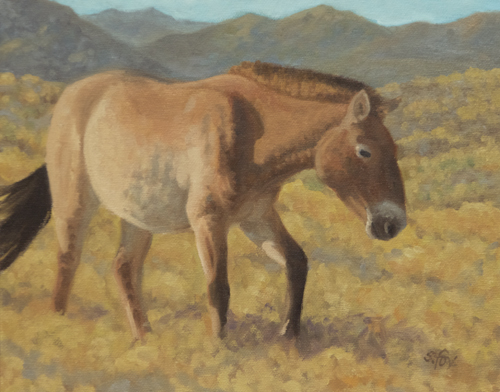
Here is one of the takhi (Przewalski’s horse) that I saw when I was at the Khomiin Tal reintroduction site in western Mongolia in September of 2006. It was first light a group of horses were coming down out of the hills to graze.

This was a harem stallion that I saw at Ikh Nartiin Chuluu last fall. He was also the model for Mongol Horse #2. It amazes me that, given the extreme environment that they are exposed to year in and year out, that these tough small horses grow such long manes and tails. But they do.
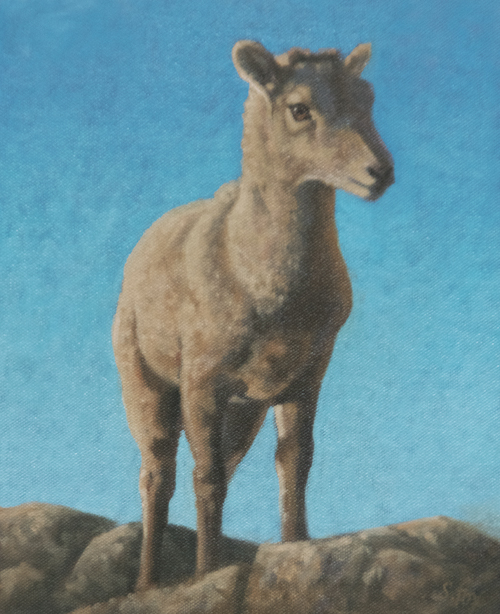
I saw this Rocky Mountain bighorn lamb with his mother near Tower Campground in Yellowstone National Park a couple of years ago. They were by the side of the road, which lacked interest as a setting, to say the least. So I moved him.

This argali ram, along with five others, gave me an eyeful on my first morning at Baga Gazriin Chuluu Nature Reserve in Mongolia in July. I wanted to work on capturing the quality of light without worrying about painting too many animals, so decided to start with a small painting. I had one idea for the rocks as you’ll see below but, on further review, something wasn’t working. Time to get out the scraper. What do you think was wrong? Answer below the second image.


There were a couple of problems. One, in getting into the grooviness of painting the rocks, I completely lost track of my light source. The rocks are in full light, but are on the same plane as the ram. Buzzz. Second, I tried to use what I knew to design the rocks more or less from memory, which resulted in a boring, distracting (what an awful combination!) set of shapes. I went back to the rocks that were in the original photos and saw that they were much less rounded, which provided a needed contrast with the curves of the ram.
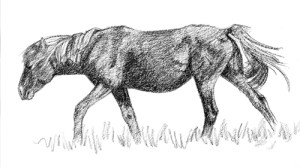
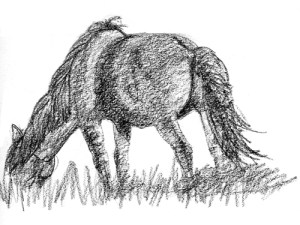
Continuing on from last week, here are some more horse drawings. I’m looking for interesting gestures and angles other than from the side.

Next week I plan to do some sketches of various combinations of horses to see how they look.
——–
Here’s a link to a story that was on CNN last week. It’s about an autistic boy whose father and mother take him to Mongolia, both to be healed by shamans and to spend extensive time on horseback.
And, as it happens, a dear artist friend of mine just sent me an autographed copy of the book that has resulted from the trip, The Horse Boy. I’m only part of the way in, but it’s a facinating book on a number of levels- the treatment of autism, Mongolia, its horses and shamanism. I’ll do a review once I’ve finished it. Suffice to say for the moment that the author experienced the same patience, tolerance and good will that I have during my travels there.
I had an idea for a painting the instant I saw this scene on the way back from the Ikh Nartiin Chuluu Nature Reserve in 2006.
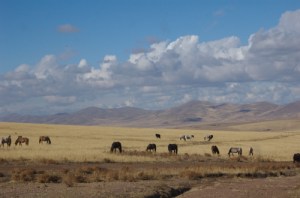 I love the colors, the clouds, the Mongol horses grazing, but compositionally it’s a long way from a painting. My plan is that this will be a major work, as in large, maybe 3’x4′ or more since I want the horses to be big enough that I can really paint each one individually. I learned this approach in art school when one of my teachers showed our class a painting he did of the Founding Fathers signing the Declaration of Independence. Why so big, we asked. Because I didn’t want to paint the heads any smaller than an inch high, he replied. Oh, we said. Taking that as a beginning, he knew how big the painting would end up being. I’m thinking each horse at 3″ to 4″ from the back to the ground. This could change, but it is a starting point.
The process I’m going to demonstrate is the one taught me at art school when I was studying to be an illustrator. I don’t always do all the steps, but this time I probably will, both because it’s a large piece and because other artists might find all or part of it useful in their own work.
The next step was to do a small thumbnail to get my initial vision down.

This took about 30 seconds, but it has the essential information: low horizon line, mountains in the background, clouds stacked up picturesqually, one large and one small group of horses grazing. The proportions aren’t right yet, so I’ll be doing more thumbnails, as many as it takes.
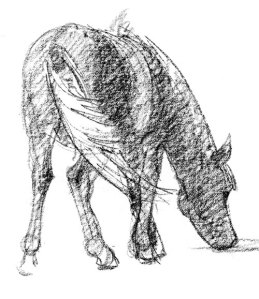
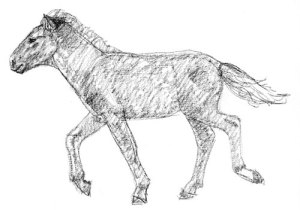
In the meantime, I’m also doing fairly quick drawings of horses grazing and moving to see which ones I think will work in the painting.

To Be Continued…..
 Susan Fox, American Artist