Why I Love Mongolia: The Land

I’ve been back a week now. Something special happened on this, my fourth trip. A lot of things came together for me and I was able to experience Mongolia and connect in ways that I hadn’t on previous trips, even though something kept driving me to return.

Some of it was simply gaining a familiarity that made this trip by turns exhilarating, relaxing and just plain fun, instead of low-level stressful. A lot of it was the two people I traveled with, Khatnaa, my guide for the first nine days, and Gana,with whom I traveled to Ikh Nart, who answered my questions with consideration and honesty, and helped me start to understand what it is to be a Mongol. But, mostly, I felt like the land itself let me in and then offered up treasure after treasure.

I’ll share some of those treasures over the next few posts. Today, it will be images of where Mongolia really starts – the land.

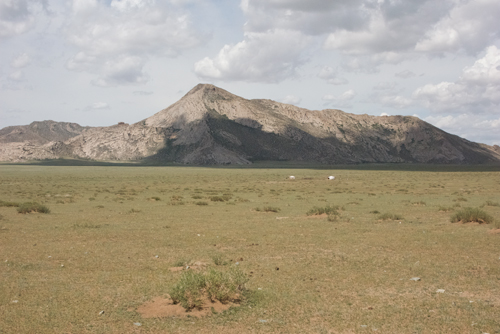
I love and grew up in forests, but traveling across the steppe is one of the things I most misss already.
I love and grew up in forests, but traveling across the steppe on the earth roads is one of the things I most miss already.
Small lake with demoiselle cranes
Small lake with demoiselle cranes in lower left
Tahilgat Hairhan
Tahilgat Hairhan
Lightning storm, Arburd Sands ger camp
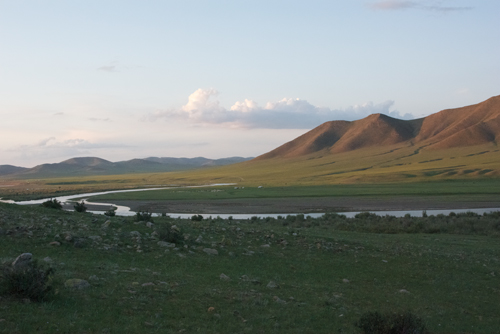
Kherlen Gul valley, Gun-Galuut
Kherlen Gul valley, morning light, Gun-Galuut Nature Reserve
Kherlen Gul and east slope of Baits Uul, morning light, Gun-Galuut Nature Reserve
Kherlen Gul valley, summer day, Gun-Galuut Nature Reserve
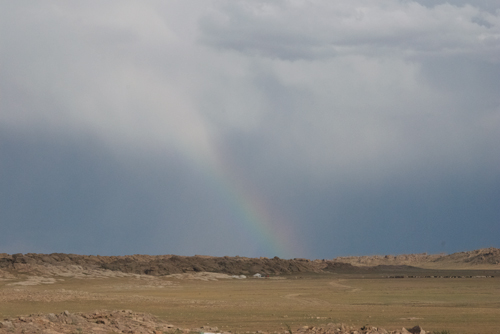
Rainbow over ger, Baga Gazriin Chuluu Nature Reserve
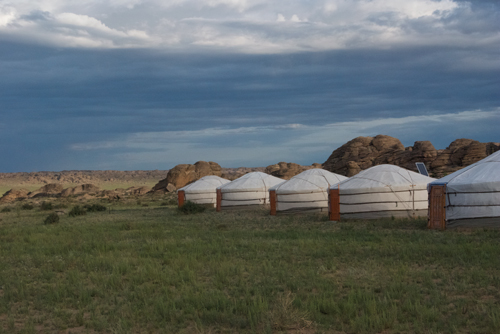
Storm light, Baga Gazriin Chuluu Nature Reserve
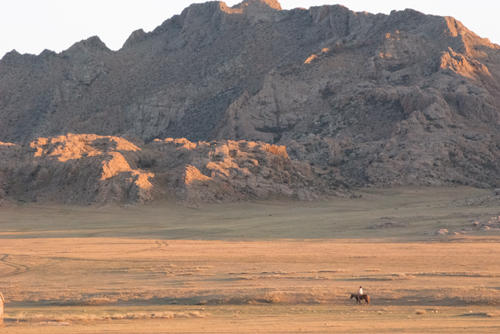
Horse and rider, early evening, Baga Gazriin Chuluu Nature Reserve
Aspens amid the rocks, early evening, Baga Gazriin Chuluu Nature Reserve
Oncoming storm, Red Rocks ger camp, Ikh Nartiin Chuluu Nature Reserve
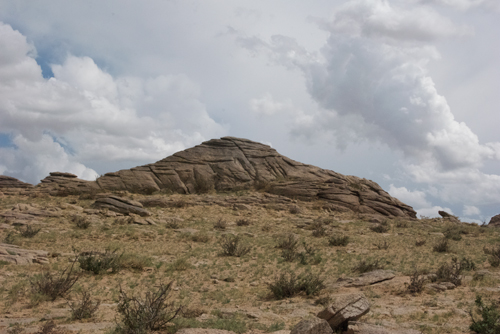
Rock formation, Ikh Nartiin Chuluu Nature Reserve
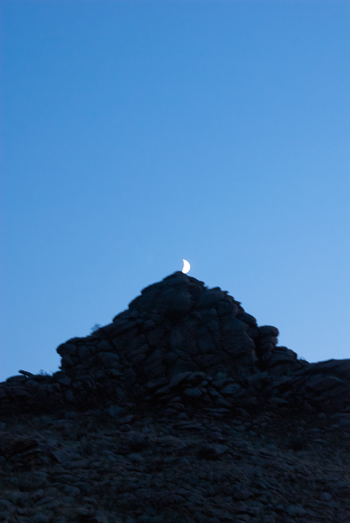
Moonrise, Ikh Nartiin Chuluu Nature Reserve

Visit my AFC Flag Expedition page

Mongolia Monday- Excerpt from My 2006 Trip Journal- Ikh Nartiin Chuluu Nature Reserve

Travelers get attached to a particular place for a variety of reasons. Maybe it was stunningly beautiful or irresistibly peculiar. Maybe it was somewhere they’d wanted to go to since childhood, finally made it and it was everything they’d dreamed of and more. Maybe something special happened while they were there. Maybe they went for one reason and discovered something unanticipated but compelling. The latter probably most applies to why Ikh Nartiin Chuluu Nature Reserve has become one of my most favorite places on the planet.

This seems unlikely to me since I’ve never been a “desert” person. That would have been my mom, who found the area around Hemet, California (the landscape, not the trashy sprawl) quite to her taste. I like my landscapes green. With trees. Preferably redwoods. Like these at Prairie Creek Redwoods State Park, about 30 minutes from our house. I spent my childhood getting to camp out at places like this. Pretty darn lucky, I’d say.

prairie-creek

But Mongolia got to me. Except for the northern part of the country, which is the southern edge of the boreal forest, trees are not what Mongolia is about. It’s the ultimate wide-open-spaces destination. I went to Ikh Nartiin Chuluu for an Earthwatch project and found a place so special that I plan to go back until I can’t travel anymore. I returned in 2006 for a short visit, just a couple of days. Here’s what happened the first day.


October 6, 2006

Woke up and 6:30, out the door in less than 10 minutes to walk down the valley. Too early for good light, but saw a couple of argali dash up the hill from the stream over 100 yds. away so no photos.
ikh-nartiin-chuluu-valley

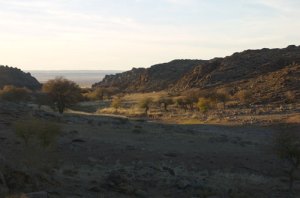
Valley where research camp is located

ikh-nartiin-chuluu-sunrise-rocks

First sun on the rocks

Came back for 7:30 am breakfast. Baaska (my guide), driver and master’s student still asleep, so headed out on my own about 8:30 am. Found my favorite huge rock! Windy but not cold. No argali or ibex. Stopped to rest and have a snack and realized that not only was the wind getting much stronger, but that the distant rocks were getting hazy with dust, just like when I was out with Rich (Dr. Richard Reading, the Earthwatch project’s Principal Investigator, and I walked back to camp in an on-coming dust storm in 2005 after the team had walked a 4km argali survey). Decided it was time to go directly back to camp since no one knew where I was, just that I would be back at 1pm for lunch. Got out the GPS, punched “Go To” POI #1 (camp) and got back just fine.
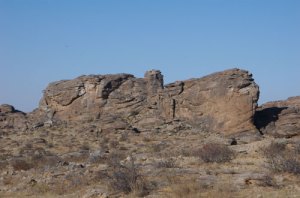
ikh-nartiin-chuluu-fav-rock

This rock turned out, from another angle, to be three formations that were overlapping, but I still like it! It’s about the size of an aircraft carrier.

ikh-nartiin-chuluu-nestCinereous vulture nest

Since I’ve never been here at this time of year and there really isn’t anyone to ask until Amgaa gets here or maybe Jed (two of the other scientists), it seemed sensible to play it safe. Maybe after lunch will be a good time to go out in the van and check out the Tibetan writings and see if we can spot any argali. The Mongolians, Baaska, student, driver, ranger are all yakking away in the kitchen ger. I’ve never known people who could sit down together, never having met before and just roll along talking like the Mongolians. It feels from the outside like the continuation of an ageless oral culture which hasn’t been undermined by tv. Yet.

ikh-nartiin-chuluu-skull2Argali skull

I hope this wind dies down. Being out in Ikh Nart again, just me and the rocks was really great.

5:15 pm- Went out in our van with the ranger at 1:30. He needed to do some telemetry and was willing to find inscriptions. We found five, but no luck at all finding the one Rich took me to last time. Saw and photographed a large herd of  ewes with, it looked like, one ram and a smaller group a few minutes later. It has really stayed windy and cold. I’m in the ger with the stove going.
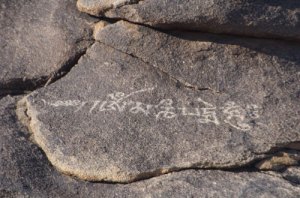
ikh-nartiin-chuluu-inscription

Tibetan inscription

ikh-nartiin-chuluu-argali

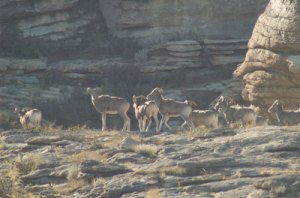
Herd of argali sheep
Mongolia Monday: The Five Snouts, Part 5

At last we come to the most important “Snout” of all for Mongolians, the horse. I was told that Mongolians sing about three things: the land, their mothers and their horses. The classic Mongolian musical instrument is the “morin khuur” or horse-headed violin. Here are some that I saw at the Mongolian Artists’ Union gallery in Ulaan Baatar.

Morin Khuur
Morin Khuur

Horses have inspired Mongolian art for a very long time. I happened on this delightful modern “horse art” in the courtyard of the Museum of the Chojin Lama in Ulaanbaatar.

Rainbow Horses
Rainbow Horses

And here’s the explanation that was nearby. This was in September of 2006 and I have no idea if they are still there, but the museum is on the list for the upcoming trip, so perhaps we’ll be lucky and get to see them again.

Rainbow Horse project sign

I find that there is often confusion between the, more or less, domestic Mongolian horse and the takhi or Przewalski’s Horse, which is the only surviving species of true wild horse. They are different species. There are domestic horses who have physical traits that indicate a past cross with the takhi, which were extinct in the wild as of 1969. I’ve seen a number of Mongolian horses with some combination of upright, brushy mane, a reddish dorsal stripe, a light eye-ring or muzzle and maybe tarsal and/or carpal stripes on the legs.

As one travels about the countryside, the herder’s establishments are a blend of old and new. Motorbikes, solar panels and satellite dishes aren’t uncommon, but everywhere there was always at least one horse saddled, bridled, hobbled and ready to ride at a moment’s notice. Mongols are, after all, the original horse culture.

The Mongolian horses are beyond tough. They are left to roam at large most of the year and manage to survive weather, down to -40F in the winter, that would kill most other horses. I have read at least two accounts of western writers who traveled across Mongolia by horse and who described the morning saddle-up as “a rodeo”.

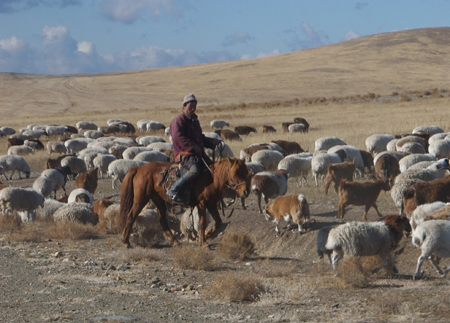
Herding sheep
Herding sheep and goats

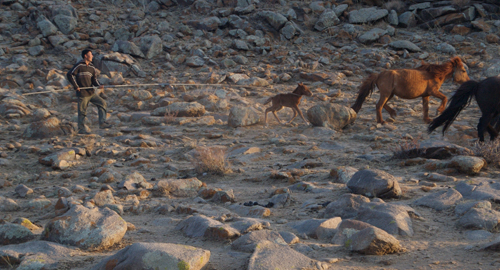
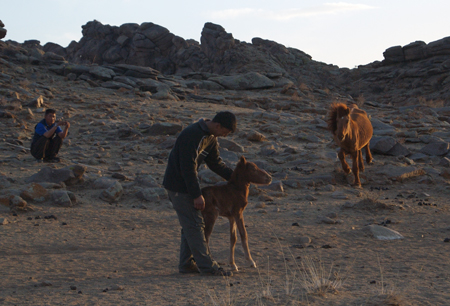
One evening at Ikh Nart, we watched a young Mongolian man capture a foal with an “urga”. Mom was not amused and kept a close eye on things.

Catching the foal
Catching the foal
Getting the foal used to human handling
Turning the foal loose and here comes the mare

One of the things that amazed me when I saw them for the first time at Ikh Nartiin Chuluu was that even though it was spring (and anyone who has been to Mongolia knows what that means weather-wise: cold, wind, dust storms) and most of the horses were terribly thin, many had long- flowing manes and tails that were gorgeous.

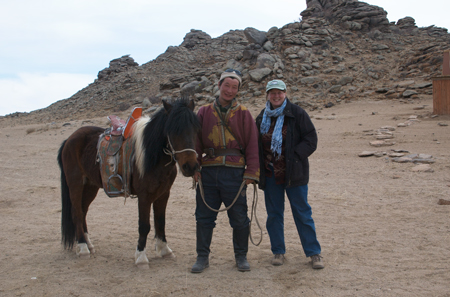
This was one of my favorite pictures from my first trip in the spring of 2005. The young herder was perfectly happy to have his picture taken with me as long as his horse was included. No problem.

Ikh Nart herder and I

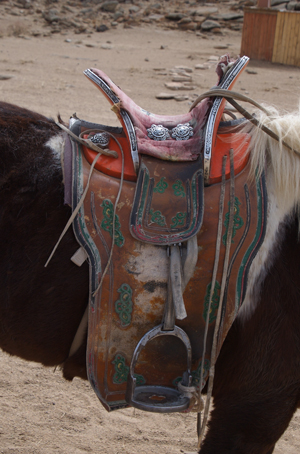
And here a close-up of the saddle. The silver bosses on the side are to “encourage” the rider to ride standing in the saddle.

Mongolian saddle
Mongolian saddle

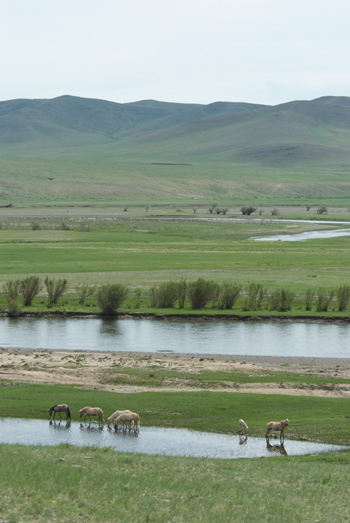
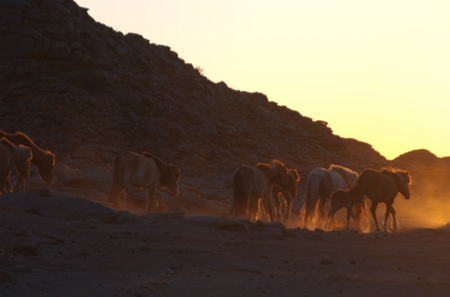
Finally, another one of my favorites; a herd of horses coming down to the stream to drink at Ikh Nartiin Chuluu.