The Big Argali Painting, Part 3

When we last left the big argali painting (36×40″), I had worked through the composition and drawing. You can read that post here.

I finally got back to it this week. The first step was to use the good old grid system to transfer the drawing in pencil. Then I restated and refined it with a filbert (a flat brush with a rounded end) and a light tan tone. Scale does make a difference and the ram at the bottom, which looked ok in the smaller drawing, didn’t cut it when the head was around 13″ from the back of the horn to the nose. Back to the reference. And a much better head position. I taped a piece of tracing paper onto the bottom of the canvas and drew the new head. Once it was done, I moved the paper around until I had him where I wanted him. Then I did a transfer with graphite paper and a #7 pencil. The tricky part was where he overlapped the hind legs of the ram above him.
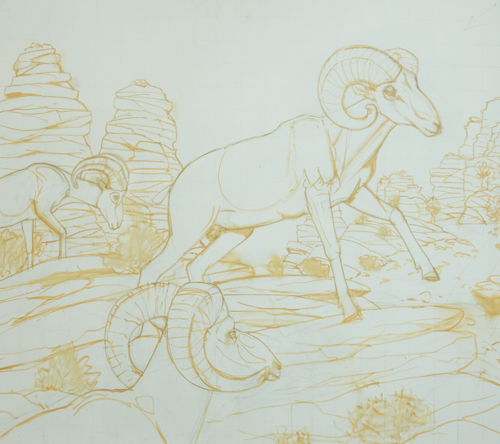
Brush drawing
Brush drawing

Now that I could see the painting at the final size, it was time to do the color rough. I have good reference and a pretty clear picture in my head of where I want to end up, so I decided to combine thinking value with working out the color scheme. All I’m after is the overall pattern of relationships, so it’s just blobs of color, but it has the information I need to get started.

Color rough, approx. 8x11"  on canvas paper
Color rough, approx. 8x11" on canvas paper

I set the rough down where I could see it and then started painting. The first step, for me, is to cover the entire canvas with a medium dark tone that is somewhat opposite the color temperature I’ll eventually end up with. This is all scumbled in with a fairly dry brush. The fun really begins when I start to add the lights in over the darks. Whoohoo!
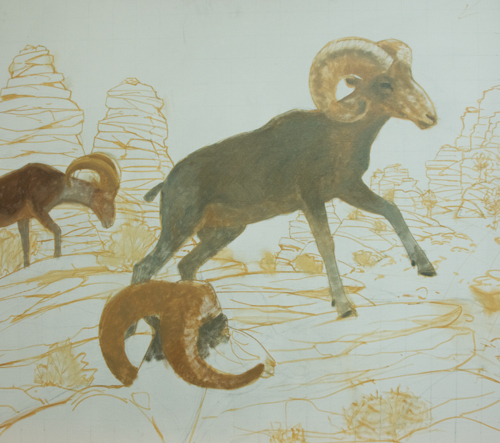
Initial color lay in

The main ram is present. There’s someone home in there, even though the eye is only indicated with a rough shape. I’ve added the first layer for the sky. It will go one step darker and cooler and then I’ll paint lighter, warmer tones over it, but still letting a little of the original color show through.

First tone for the sky

Next, it was time to “rock”, as in scumble in the first tones of the rocks. The light is coming from the right, so I want to establish my light side and shadow side right away and also introduce some visual variety and form. I’ve also added the darkest darks for the shrubs. I stood back at that point to see if they made a good pattern in and of themselves. Ok so far. May need a couple more on the right and left edges.

I’m looking in the mirror a lot at this point as I define the shapes of the rocks. If you look on the right, you can see where I’ve eliminated some pinnacles. The ram’s head felt too confined. He needed more air in front of him.

Initial background tones

I spent the afternoon working my way across the canvas. The drawing is mostly lost at this point, but that’s ok because I have it stored in my head, hand and on the tracing paper. The next step is to find it again. I’ve redone the grazing ram (again) and lengthened the front leg of the main ram. Before continuing, I’ll do a proportion check. Argali have big bodies with very thin legs, so they sort of look “wrong” on the hoof.
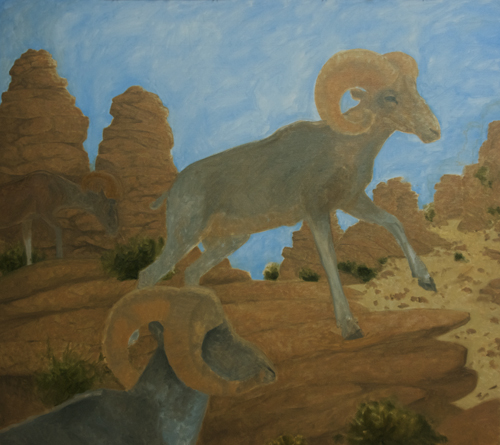
Initial lay in done
Initial lay in done

I’m kind at the point, which many artists hit, when I hate the painting. The drawing was so nice and now things are a dull, undefined mess. All I can see at the moment are the things that are “wrong”. Now is when it’s important to hold onto the vision in my head of the painting I want to do. Here’s the one part I still like. It’s the top of the far left side pinnacle.

Rock pinnacle detail

Four New Paintings!

Here are four more new paintings to go with the two I posted last week. I had a problem with the background in the last one and thought I’d show how it was and how I changed it.

Heading Down For Breakfast 8x10" oil on canvasboard (price on request)

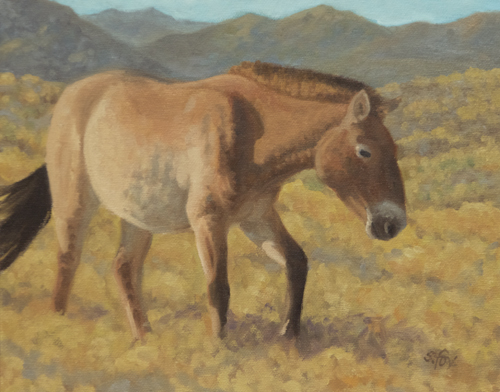
Here is one of the takhi (Przewalski’s horse) that I saw when I was at the Khomiin Tal reintroduction site in western Mongolia in September of 2006. It was first light a group of horses were coming down out of the hills to graze.

Mongol Horse #4; Afternoon Graze  9x12" oil on canvasboard
Mongol Horse #4; Afternoon Graze 9x12" oil on canvasboard (price on request)

This was a harem stallion that I saw at Ikh Nartiin Chuluu last fall. He was also the model for Mongol Horse #2. It amazes me that, given the extreme environment that they are exposed to year in and year out, that these tough small horses grow such long manes and tails. But they do.

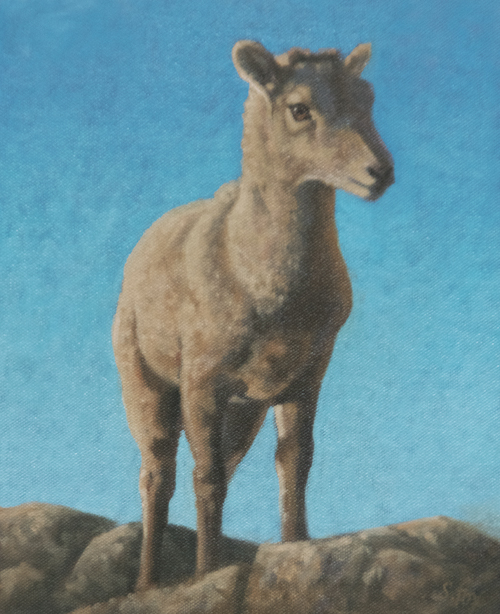
Top O' The Morning 10x8" oil on canvasboard (price on request)

I saw this Rocky Mountain bighorn lamb with his mother near Tower Campground in Yellowstone National Park a couple of years ago. They were by the side of the road, which lacked interest as a setting, to say the least. So I moved him.

Catching the Morning Light 9x12" oil on canvasboard (price on request)

This argali ram, along with five others, gave me an eyeful on my first morning at Baga Gazriin Chuluu Nature Reserve in Mongolia in July. I wanted to work on capturing the quality of light without worrying about painting too many animals, so decided to start with a small painting. I had one idea for the rocks as you’ll see below but, on further review, something wasn’t working. Time to get out the scraper. What do you think was wrong? Answer below the second image.

First version
First version
Detail of scraped out area

There were a couple of problems. One, in getting into the grooviness of painting the rocks, I completely lost track of my light source. The rocks are in full light, but are on the same plane as the ram. Buzzz. Second, I tried to use what I knew to design the rocks more or less from memory, which resulted in a boring, distracting (what an awful combination!) set of shapes. I went back to the rocks that were in the original photos and saw that they were much less rounded, which provided a needed contrast with the curves of the ram.

The Final Drawing. Really.

Came back in this morning and looked at the last version with fresh eyes…..and realized that in trying to solve one problem with the ram on the left, that I’d wrecked the rhythm of the composition. The ram’s head needs to be down. Here are the two versions. I think you’ll see what I mean. What I had:

Argali 2What it got changed to:

Argali-4What I just revised it back to:

Argali-5

Now I have the more dynamic zig-zag line between the top line of the left and main rams. Version 2 made things too static. Better visual variety. Argali run up the rocks like water flowing uphill. And down with equal ease. I wanted to try to catch at least some of my visual impression of that movement. They are so at home in the amazing rocky outcrops they prefer.

Why I am posting all this preliminary stuff? Because people, including other artists, mostly only see the end result or pretty, finished drawings which creates an unrealistic idea of how messy and time-consuming the creation of a painting can be. I’ll flail around for as long as it takes. And that’s ok. The important thing is to get what I want, if I can.

The New Big Painting, Cont.

Sometimes having another, educated eye can really help. Since this is a big painting which will require a big time commitment, I decided to consult with another wildlife artist who I have taken a workshop with and whose judgment I trust. She knows me and knows what my goals are for my work. I sent this image to her on Friday and got her response this morning.

For reference, the first version from the previous post:

Argali-big-draw

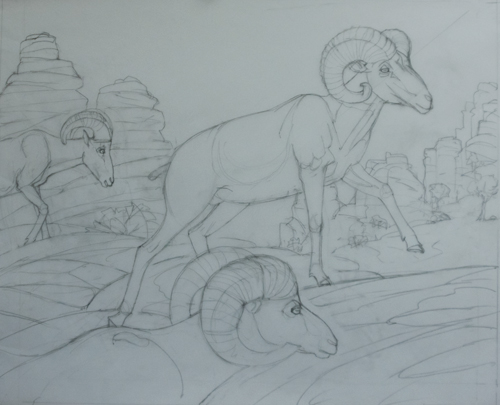
The next version. I also decided to make the sheep on the right a juvenile to provide variety for the horns, along with adding some of the body and changing the head position.

Argali 2

Here’s the critique:

“These guys remind of me of desert bighorn – horns and heads large for lightly built bodies (though desert bighorn have much thinner horns). The mouth on the rear youngster is a little uncertain (what’s he doing?). I’d like to see more suggestion of muscle in the body – particularly hindquarters – of the main ram. His front left leg feels a little stiff – I like the movement in his overall gesture, but the knee and pastern don’t flow as well. He seems a little over at the knee on his right front. I know sheep aren’t built like horses, but sometimes (to borrow from Bob Kuhn) the artist has to make changes that look better, even if they’re not as accurate.

The front partial ram head/horns ought to be larger to indicate perspective; his body seems larger, as it should, but head/horns don’t seem as large relative to his body as the main ram’s.

Painting all those rocks will be great fun! I love rock and snow – so graphic. Everything in the composition leads us to the right and the main ram’s head – should be striking. You might consider turning his head towards us a little to keep the viewer from zipping out to the right – but it should still work as it is too.”

This are exactly the kind of technical notes that I was hoping for from someone who only knows what I’ve showed them, not what I think I’m trying to do.

This afternoon I did the re-drawing, erasing where needed. The muzzle of the ram on the left head got a little too big. I’ll fix that tomorrow, but otherwise it’s all working. As far as the first observation of the critique- in fact, the argali are very solidly built compared to desert bighorns. The big argali rams also weigh twice as much, 200 lbs. vs. 400 lbs. But both have very slender legs in relation to the bodies.

Argali 3

Now I have some good visual variety. The three argali are all different sizes and angles. I have the directional flow that I want, but I need to make sure that the viewer’s eye doesn’t “flow” off the right hand side. The stacked rocks will be the “stopper”. I’ve minimized the horizontal planes and added some shrubs and more small trees, aspens that I saw at Baga Gazriin Chuluu.

The next step is the value study. Value is light and dark relationships, separate from color. I already know that the area of highest contrast will be the main ram’s head against the sky.

UPDATE 8-25-09:

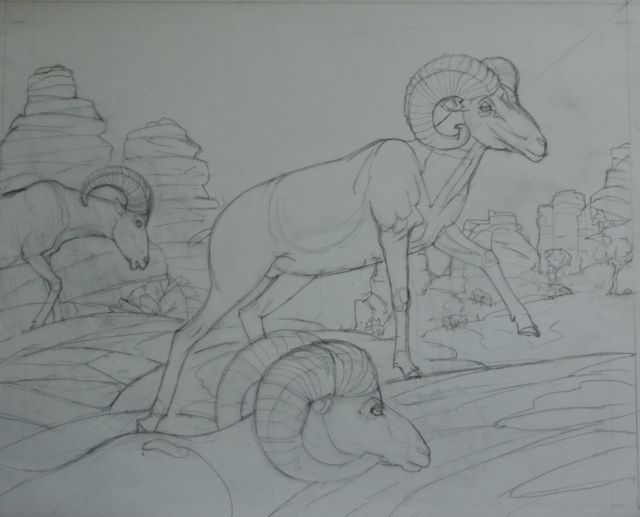
The re-drawing is done. I ended up changing the whole head and neck of the ram on the left side and straightening the foreleg of the main ram a little more. One of the lessons I learned when I worked in the sign shop doing hand-drawn lettering was the difference that, literally, the width of a #2 pencil point was between right and wrong. When I saw it for the first time, it was like a big, bright light came on. It was so obvious. And it’s true when drawing animals or anything else. I will always be grateful to the owner of the shop for giving me the opportunity to train my eye to discern differences that fine. The acceptable tolerance was 1/64 of an inch when drawing letters a few inches high.

I still see little things in the drawing that bug me, but I’ll deal with them when I do the brush drawing on the canvas. Being bugged about something is one of the ways that I know a painting isn’t done yet. And when nothing bugs me anymore, I’m done, which really means that I’ve solved all the problems. The itch to fix what I can see isn’t right is one of the things that drives me on a painting. I Just Can’t Stand It.

Argali-4

I also lightly drew some more rock towers on the right for my “stopper”. They will be simple shapes in aerial perspective.

UPDATE 6pm:

I lied. I did one more overlay this afternoon with a mechanical pencil (HB lead) to really refine the drawing and get it ready for the value study. Every version allows me to be more decisive about tricky shapes like the horns. Plus, I wanted to more thoroughly work out the background and foreground. And I still wasn’t happy with the ram on the left, so he got re-drawn. Again.

I’m using Canson tracing paper for the first time and, wow, is it nice. I used to use whatever was cheapest, but no more. All but the last drawing, which I’ll post tomorrow, was done with a Sanford Draughting Pencil. They were Eagle Draughting Pencils when I first started buying them many years ago and appear to have been owned by at least two other companies between then and now. Fortunately, they’ve never been “improved”, so they’re as good as ever.


How I Start a Big Painting & A Favorite Photo from Mongolia

One of the advantages of my illustration training is the process that we were taught for putting a picture together. I don’t do all the steps all the time, but now that I’m about to start one of the largest paintings I’ve done so far, I need the control that the process gives me.

My first sighting of argali at Baga Gazriin Chuluu Nature Reserve, thanks to Onroo the local camp staffer who knows the place and where the animals tend to hang out, was a group of rams in wonderful morning light. Mostly they were grazing and resting. For this painting, however, I wanted action. The essential image popped into my head and then it was a matter of getting it down on paper, which is one reason why the thumbnail process is so valuable.

Here’s some of the reference that I’m using:

Argali-G-G

I liked the pose of the big ram who is third from the left. This photo was taken at Gun-Galuut Nature Reserve. I dumped the image into Photoshop and did a horizontal reverse to get him going the direction I wanted. And then zoomed in as much as possible. The next three are from Baga Gazriin Chuluu. Talk about reference eye candy.

Argali-ref-shot

Argali-ref-shot-3

Argali-ref-shot-2

I did a couple of drawings of the main sheep to try out position and gesture.

Argali-2

In this one I added the a background to see how that worked.

Argali-1My idea is to channel a little Edgar Degas and have the animals coming in from the frame, not have all of them within the frame. This is too static, but it gives me something to bounce off of. Gotta start somewhere.

Here’s the thumbnail sheet. I’m trying to figure out where the three masses of sheep will be in relation to each other. Then I did another, larger sketch.

Argali-thumbThis is more what I had in mind. Almost everything is on a diagonal, which gets rid of the too-static quality of the previous sketch. As I draw and re-draw the animals, I’m able to get to “know” them better and can refine and push the poses.

I spent a good chunk of yesterday doing a finished scale drawing that will be transferred to the canvas via the ancient and honorable grid system. I ended up with three layers of tracing paper. The bottom one had the lines for the edge. The second one had the drawing of the sheep. The third was the landscape. I did one and it’s really nice, but not right for this painting. Replaced it with a new sheet and re-did it. When I was satisfied that I had more or less what I wanted, I re-drew the argali, once again refining and tweaking the drawing.

At this point, I have solved the design/composition problem and the drawing problem. Both may be re-visited at any time as needed if I see something that needs fixing, but the next step is a value study, that is, the pattern of lights and darks. We were told in art school that if we get the values in a picture correct, then we can do anything we want with color, which I have found to be true. One of the tasks that needs doing to take the Gun-Galuut argali and the image of the sunny rocks and make them work with the Baga Gazriin Chuluu morning light. For that I’ll do a color study.

I hunted through my reference once again for the sheep images that I thought would work best. And here is, so far, finished drawing. Still not sure about the argali on the left. I’ll see how it looks to me on Monday. I also think I need a little more “air” on the right side and maybe the top. Not much, maybe a half-inch.

Argali-big-draw

Finally, a favorite photo from the local Naadam at Erdene. Waiting for the race results.

Erdene-rider,-pink-del

Plans are Coming Together

Let’s see….my Flag Expedition page should be live soon over at Artists for Conservation. I have confirmed that the weather is likely to be hot, hot, hot. Unless it rains, in which case it could be cold enough that I’ll want my down bag.

I spent three hours on the phone last night with Gana Wingard, the scientist with whom I am working on the women’s craft cooperative. She sent me a great email this morning entitled “The Grand Plan” and then noted that, of course, it’s all subject to change. But we now have hashed out a way forward and know what we need to do, who we need to talk to over there and when and in what order it will probably happen.

It reminds me of one of my favorite exchanges towards the end of one of my all-time favorite movies “The Wind and the Lion”. The Raisuli and his men are on their way to a small village, returning Mrs. Pedicaris and her two children to a contingent of American marines and, after hearing their destination described, along with the myriad dangers likely to be lurking there and the possibility that he could be killed,  The Raisuli says “It is good”. His right hand man says “What is good?’. The Raisuli answers “It is good to know where we are going.”

It turns out that Gana will be bringing radio telemetry equipment because she needs to find all the radio-collared argali or as many as possible before the next Earthwatch team arrives on August 2. There are plans to try a new population survey method since, at this point, it’s not really known how many animals are in the reserve. This is great news for me, since I will now be able to go out looking for sheep with someone who knows the reserve really well and is as motivated as I am to spot the animals.

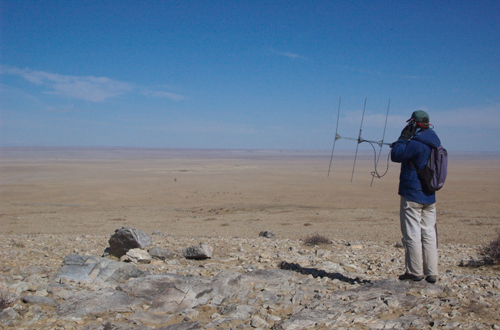
Here are a couple of photos that I took on previous trips of the scientists using radio telemetry equipment. The research project now has some GPS collars, which send in the data via satellite, but those are relatively expensive, so there are still animals that need to be tracked the old fashioned way.

Amgaa doing radio telemetry just below an ovoo, Sept. 2006
Jed Murdoch searching for a collared Pallas Cat; he never got a signal and the cat had vanished, April 2005
Jed Murdoch searching for a Pallas Cat he had captured and collared; he never got a signal and the collar was never found, April 2005
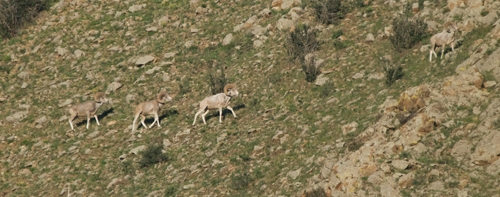
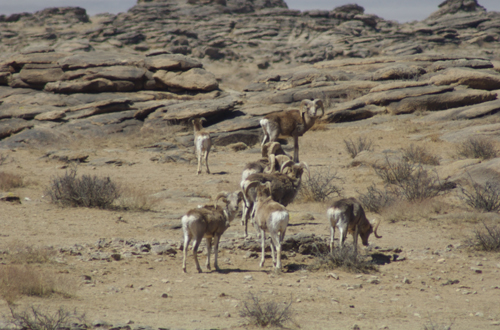
My "grand finale" sighting in 2005; a good-sized group; note the ewe left front wearing a radio collar
My "grand finale" sighting in 2005; a mixed group of eight argali; note the ewe left front wearing a radio collar; one of the handy things about argali is their habit of stopping to look back, which provides an opportunity to get photos of something besides their butts as they run away

Our plan is to “game drive” in the mornings and evenings, when it’s relatively cooler (Gana said that temperatures went over 100F last July. Okaaay.). During the day we will have our meetings with the women, for which the groundwork is being laid by another of the scientists, Amgalanbaatar (which means “peace hero” in Mongolian; see above photo), who we all call “Amgaa”. He is now at the reserve and is passing the word about the meeting and the hoped-for dates. Everything is tentative because summer is when the women have the most work do to, milking animals, making aruul and airag and also felt. We don’t know how many will come, but we know that they are interested. They will need to arrange to have someone watch the children and will want to be home in time to make dinner. Gana expects that they will arrive both on horses and motorbikes.

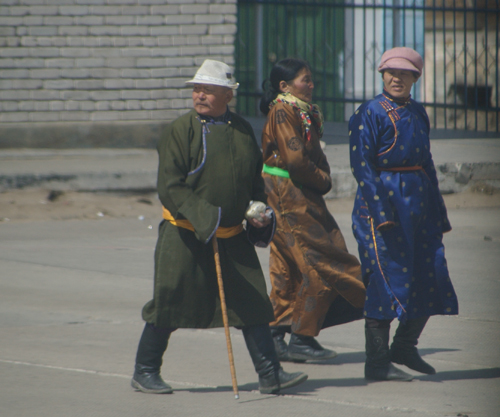
There are about 100 families living in and around the reserve, depending on their livestock for their living. The women all know how to sew and, in fact, the country women are the repository of the skills needed to make garments like del (the long robes). The younger women who have been brought up in town don’t learn to sew anymore. The material to make a del, outer fabric, liner fabric and trim costs about $30. Some of the women also do embroidery and since that’s something I’ve done on and off for many years, I’m really looking forward to seeing their work.

Three Mongols wearing del; train station, April 2005

After talking with Gana, we’ve scheduled a third day for me to get together with any of the kids who are interested in art. I’m taking some sketchpads, pens and pencils. Should be a fun way to pass a hot afternoon.

We plan to go to Ikh Nart on the 23rd and return to UB on the morning of the 28th. That will give me a day and a half to tie up loose ends. Five days and counting………..

Visit the AFC site here

It’s Official! I’m Going Back to Mongolia!

portrait

{Address}

Visit the AFC site here

Mongolia Monday- Painting Mongolia Subjects

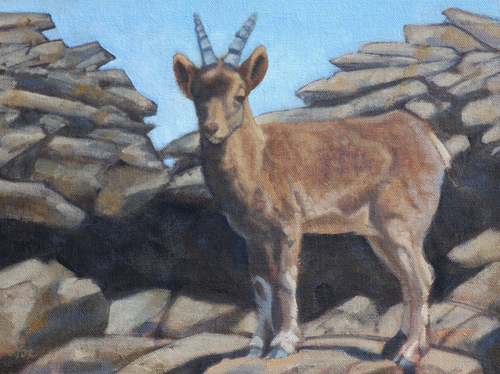
I thought that I would start to share how I put my Mongolia paintings together, starting with a subject from Ikh Nartiin Chuluu Nature Reserve. I had never been to a place anything like it and before I began any finished gallery paintings, I needed to learn to paint the various elements, both the land and the animals. Here are two studies of the rocks, one of a young ibex and a finished 15×30 of two argali-

Ikh Nart Rocks #1  oil  12x16
Ikh Nart Rocks #1 oil 12x16
Ikh Nart Sunrise  11x14 oil
Ikh Nart Sunrise 11x14 oil
Young Ibex 9x12 oil
Young Ibex 9x12 oil
Ikh Nartiin Chuluu Argali  15x30 oil (price on request)
Ikh Nartiin Chuluu Argali 15x30 oil (price on request)

Since most people are not familiar either with the species or the  place, I wanted this first painting to show the kind of landscape that argali like; not just mountains, but upland areas with these rocky outcroppings. You can see the steppe down below and off in the distance. These were two rams who were spending at least part of the day together. It turns out that argali don’t form permanent harems or herds. Animals of all ages and both genders group and re-group throughout the day in numbers, at least from what I saw, from one to twenty or so and everything in between.

Mongolia Monday – Argali Studies

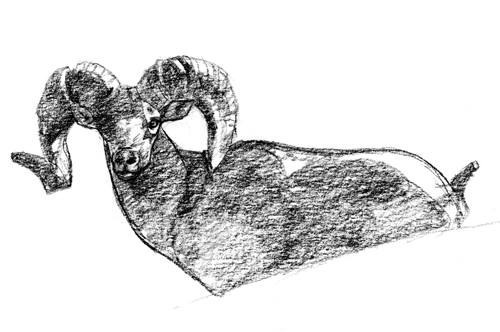
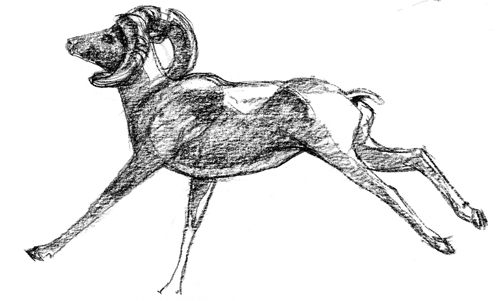
With the New Year come new painting projects. We try to take time off between Solstice and New Year’s Day because that’s when things slow down for my husband, who is the executive director of an information technology consortium, but I can’t stay out of the studio completely. I have a bunch of ideas for paintings with Mongolia subjects and this morning I thought I’d do a few drawings of argali and try different drawing media. All of these are done on 2-ply vellum bristol. None of the four took more than 15-20 minutes. The idea was to limber up after a break without worrying about doing a pretty, finished drawing. I wanted to catch the character of the animal and the rhythm of their body and movement. Please DO try this at home.

Argali Ram, Ikh Nartiin Chuluu, Sept. 2008

This is a try-out to see how he “draws” since I have a painting idea in mind. He’s a big, old ram with battered horns that will be an interesting challenge to paint.  I also like the shadow pattern on his head. Drawn with a 6B Wolff’s Carbon pencil.

Argali Ram Running, Ikh Nartiin Chuluu, Sept. 2008

The gold standard in fieldwork for wildlife artists is the animal Doing Something. Prey animals like argali tend to be running away, so lots of butt shots. But this one took off from stage right to stage left, giving me a perfect chance to record a variety of leg positions. Also drawn with a 6B Wolff’s Carbon pencil.

Argali ewe climbing, Ikh Nartiin Chuluu, Sept. 2008
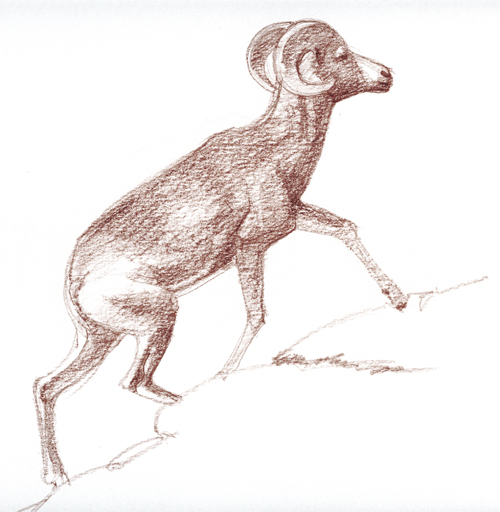
Young Argali Ram Climbing, Ikh Nartiin Chuluu, Sept. 2008

Another jackpot. He’s going up the rocks parallel to me. Drawn with a Cumberland Derwent Drawing pencil, Venetian Red. These have a fair amount of wax in them, so are more like a fancy crayon. They feel soft on the paper. I don’t think I got  very interesting line quality, but did feel that I caught the tension in the hindquarters as he is about to push off.

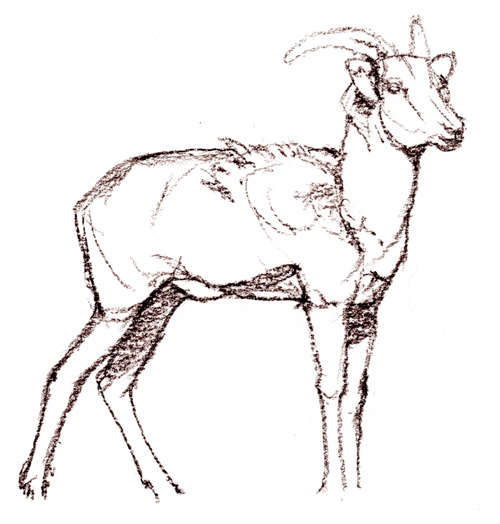
Argali Ewe Standing, Ikh Nartiin Chuluu, April 2005

This one is from pictures I shot on my first trip to Mongolia in April/May of 2005. The animals still had their winter coats. This ewe was part of a small herd which had come down to a stream for water one morning. I find 3/4 head views challenging, partly because I know that I have to compensate for the flattening effect of the photograph. Drawn with a 2454 Conte crayon. I hadn’t used these in awhile and found I liked the line quality and the way the Conte felt on the paper. This sketch took maybe ten minutes.

So you can see that what you draw with can really change the appearance of your drawing. The only way to know what will work best for you is to experiment with different combinations.