It’s clear that one lesson we, as a species MUST learn, is to share. All of these animals have just as much right to be here as we do. As they go, in the end, so shall we.
I’ve never made a point, for the most part, of specifically seeking out endangered or threatened species to photograph for my paintings. But, as it’s happened, in less than ten years I’ve seen two dozen, plus one, all in the wild. Quite a surprise, really.
Sometimes they’ve been pretty far away, but that in no way diminished the thrill of seeing them. Close-ups in a zoo or other captive animal facility can be useful, within certain limits, but seeing a wild animal in its own habitat, even at a distance, is much more satisfying and gives me ideas and information for my work that I couldn’t get any other way.
In no particular order, because they are all trying to survive on this planet:
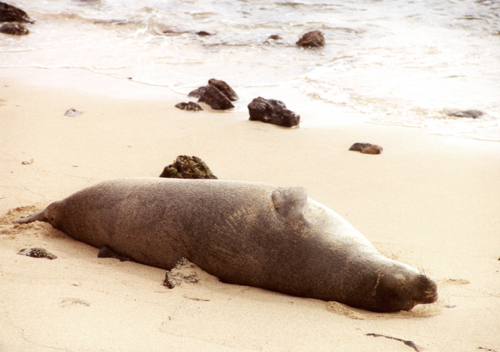
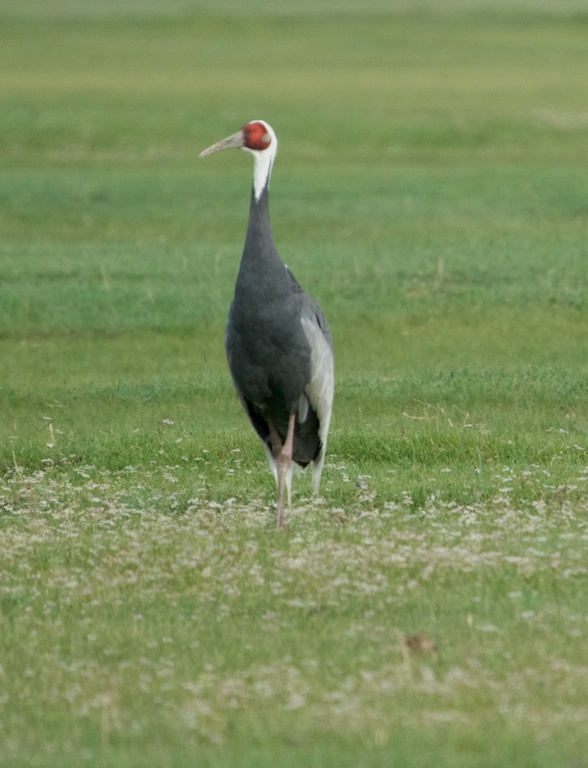
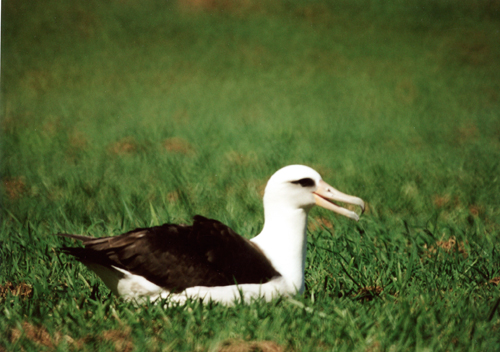
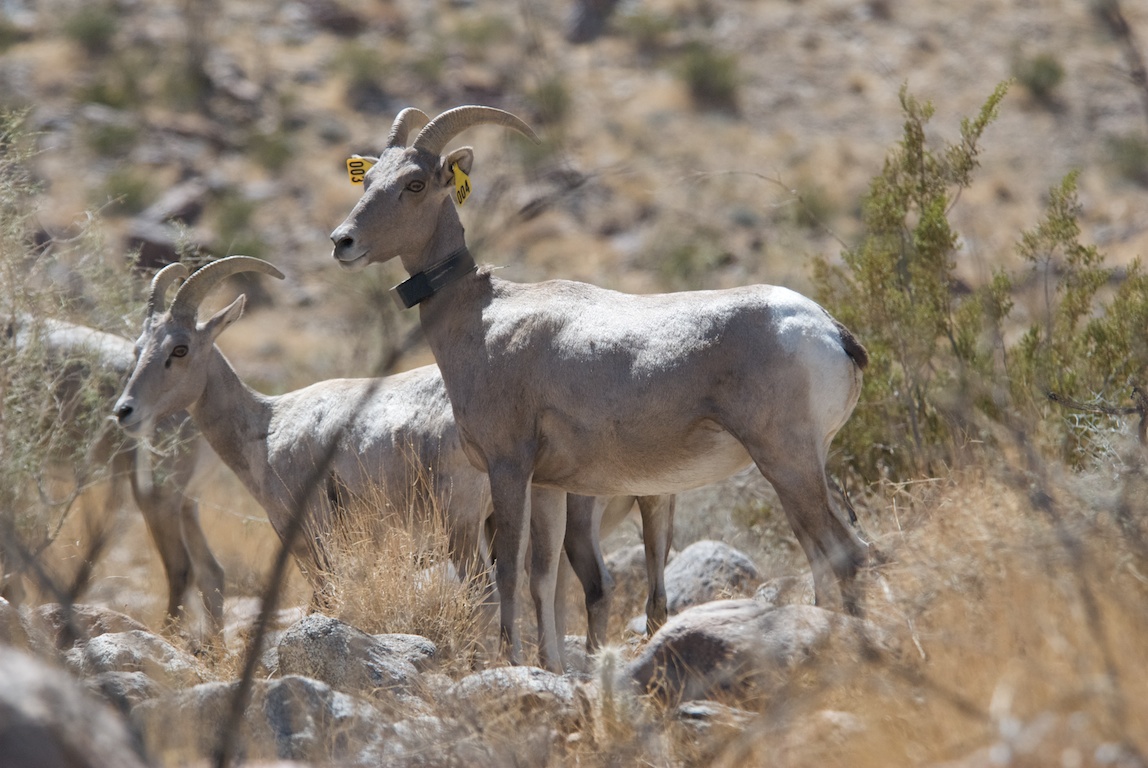
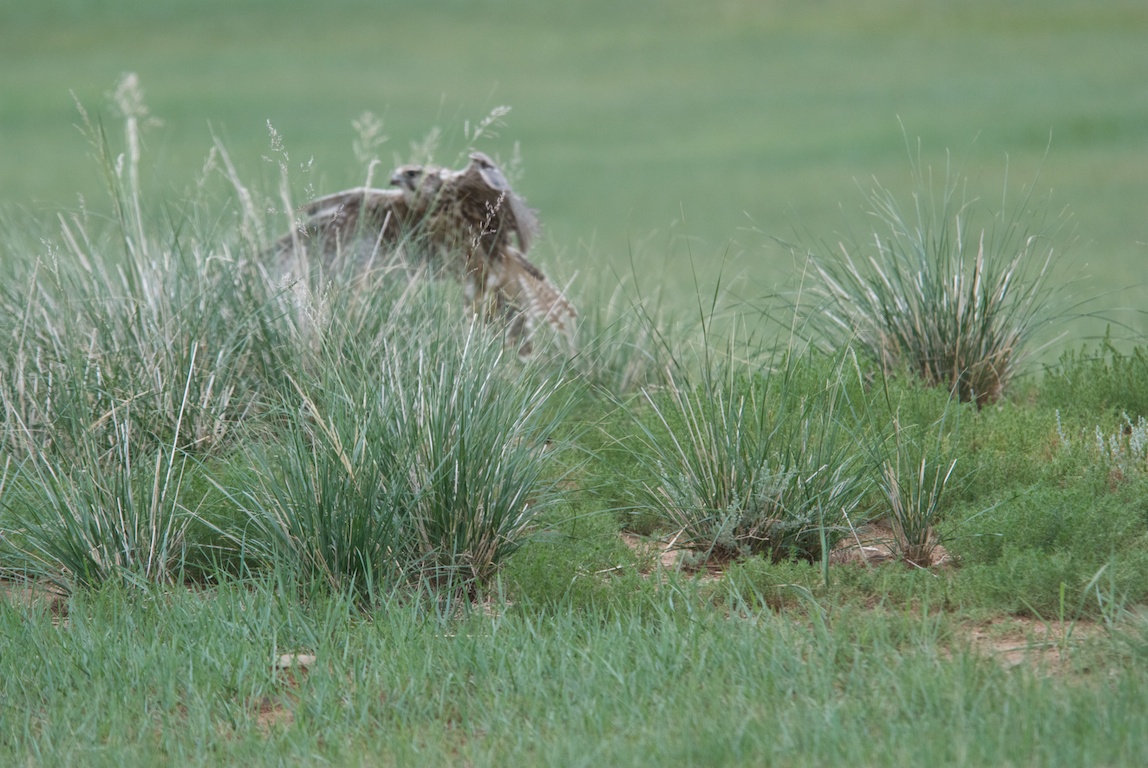
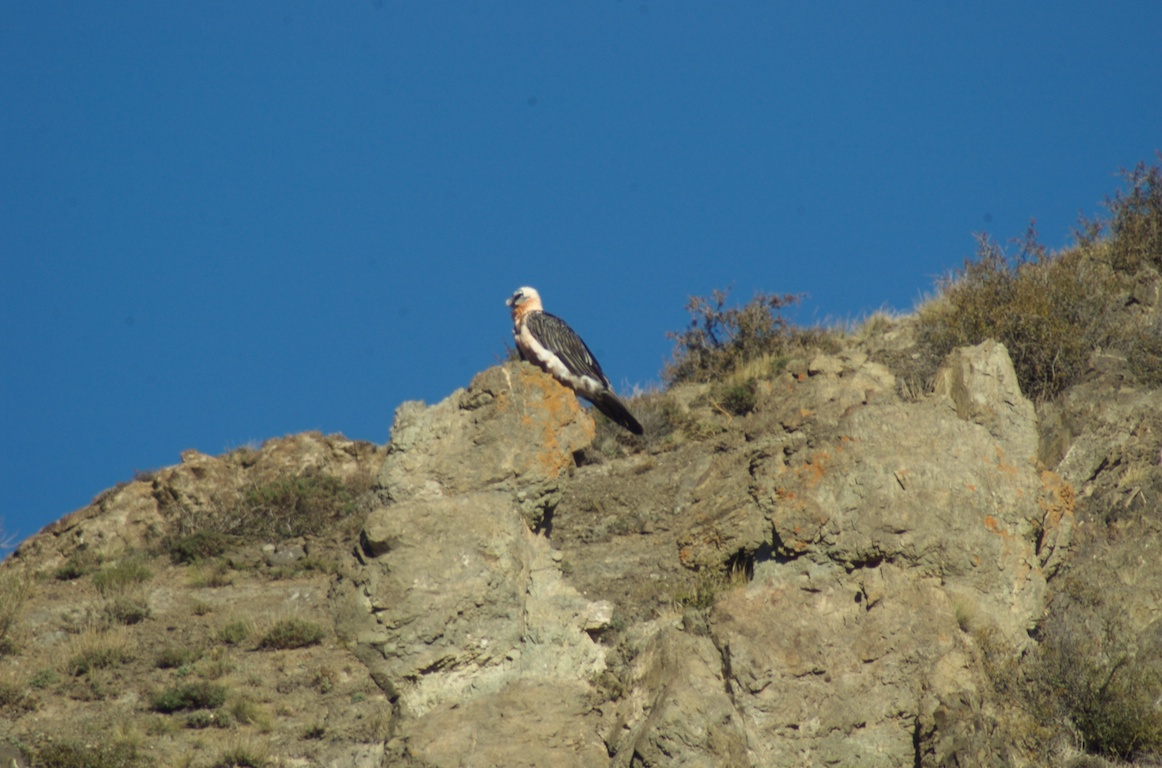
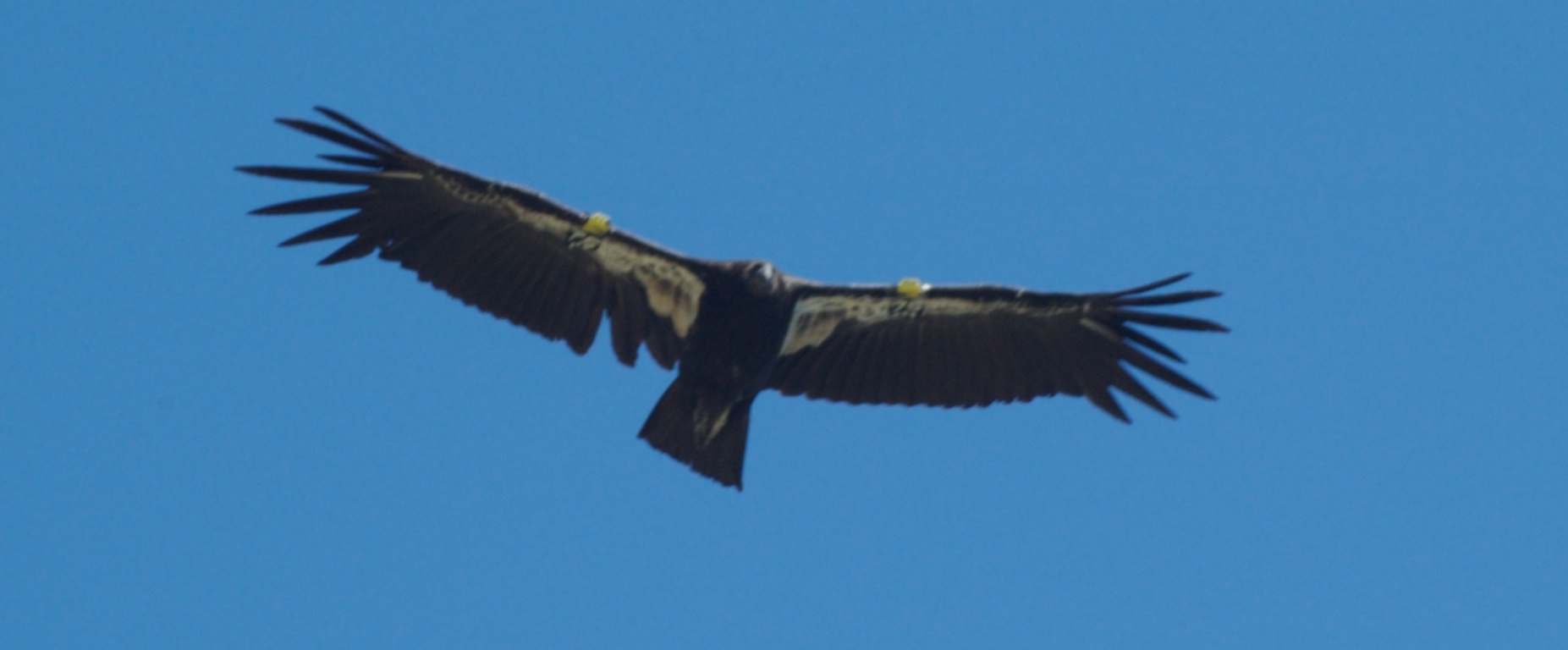
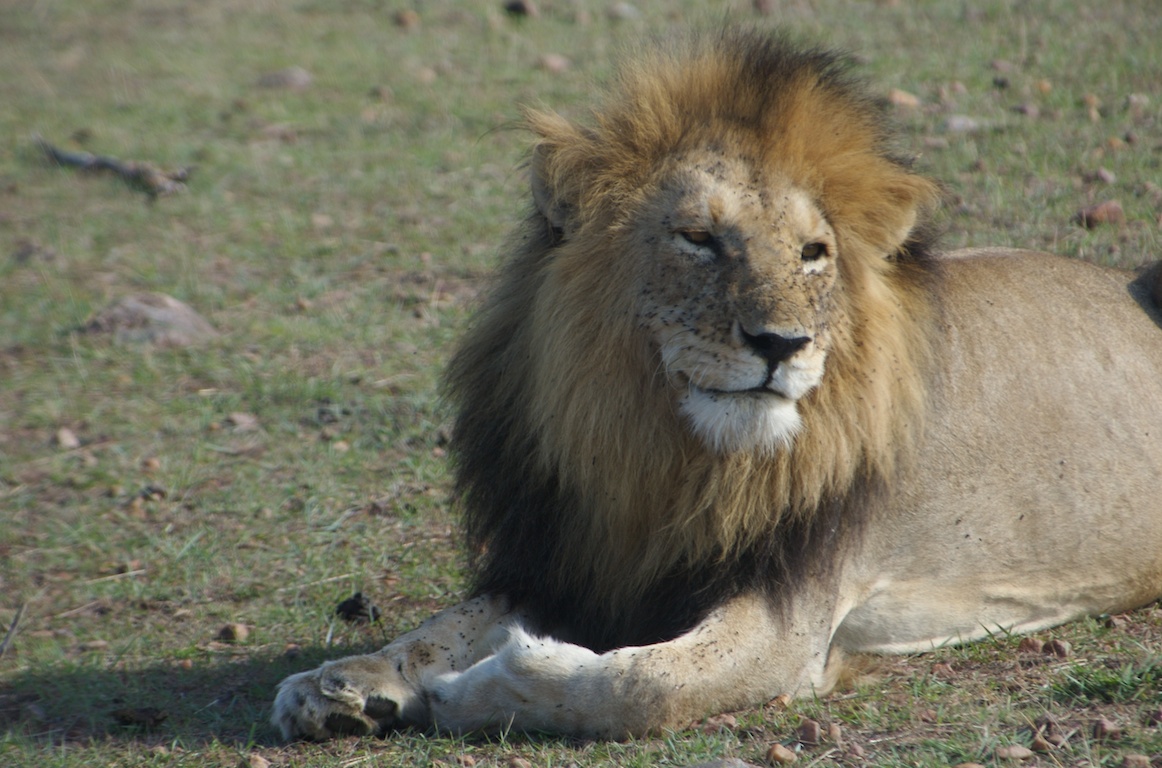
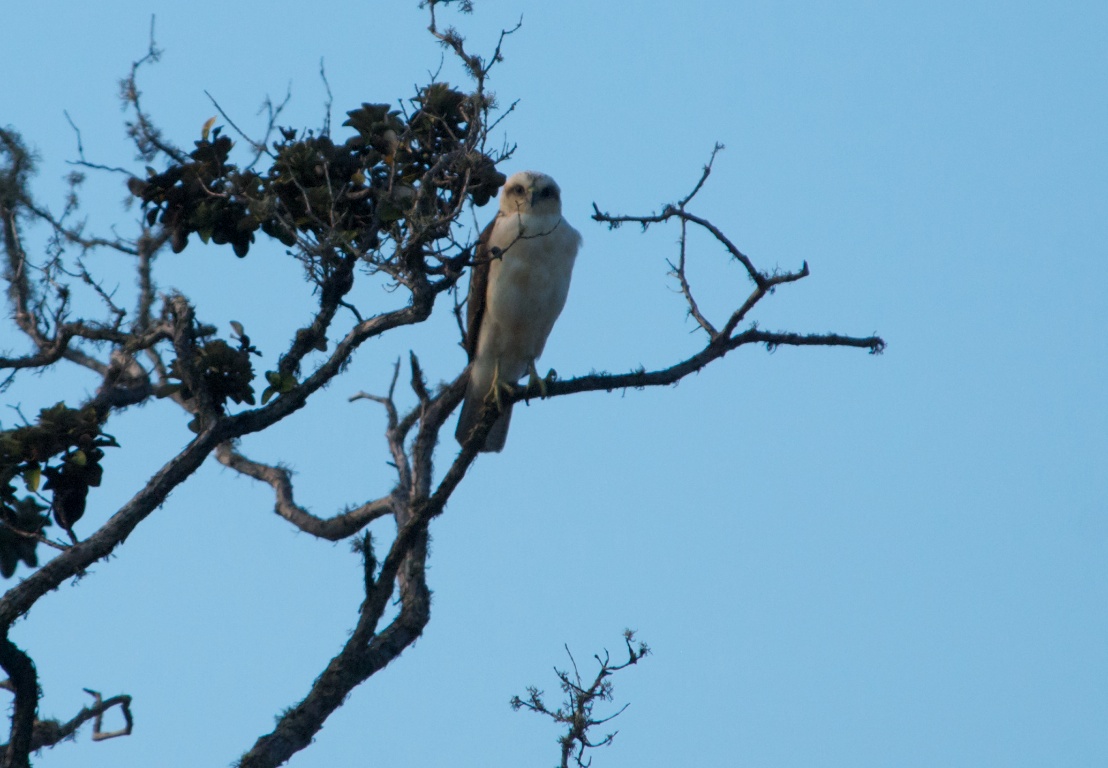
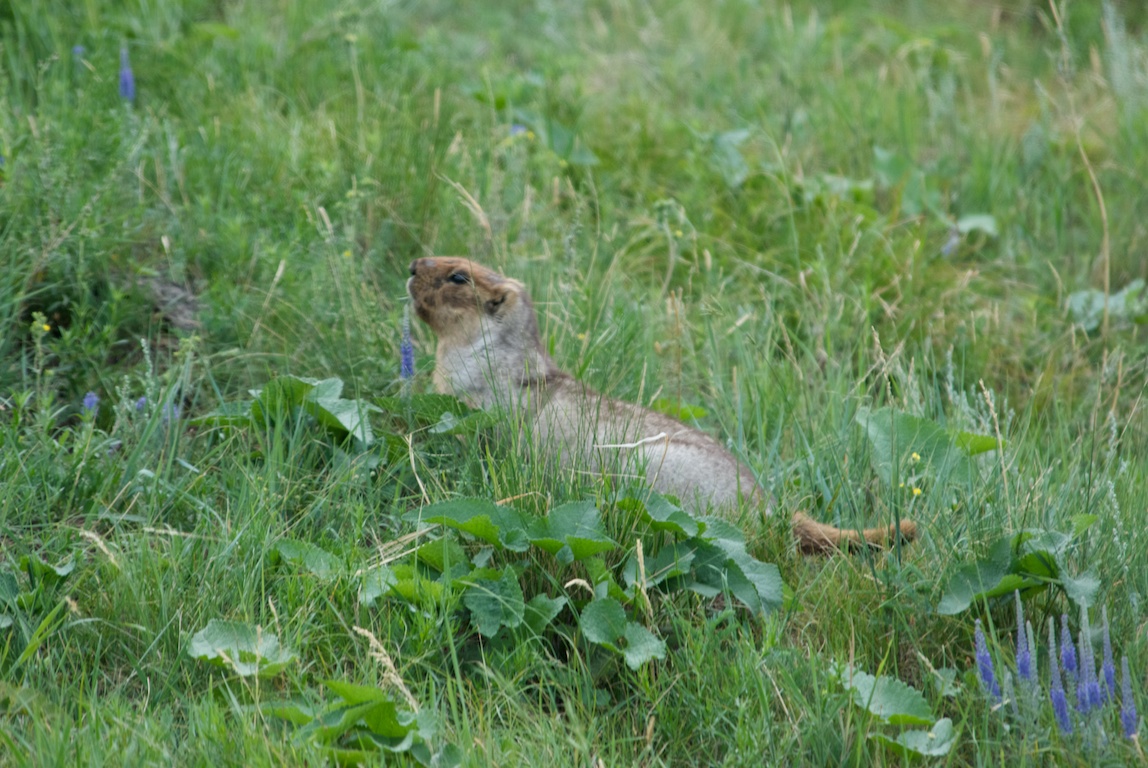
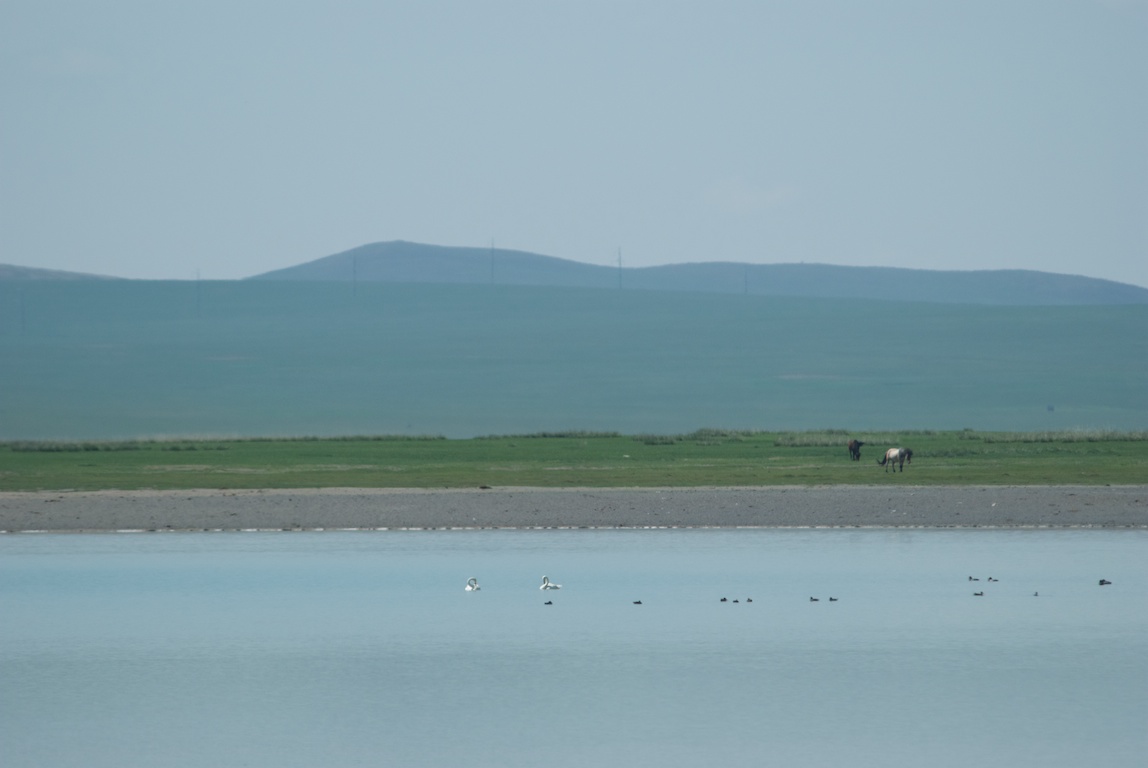
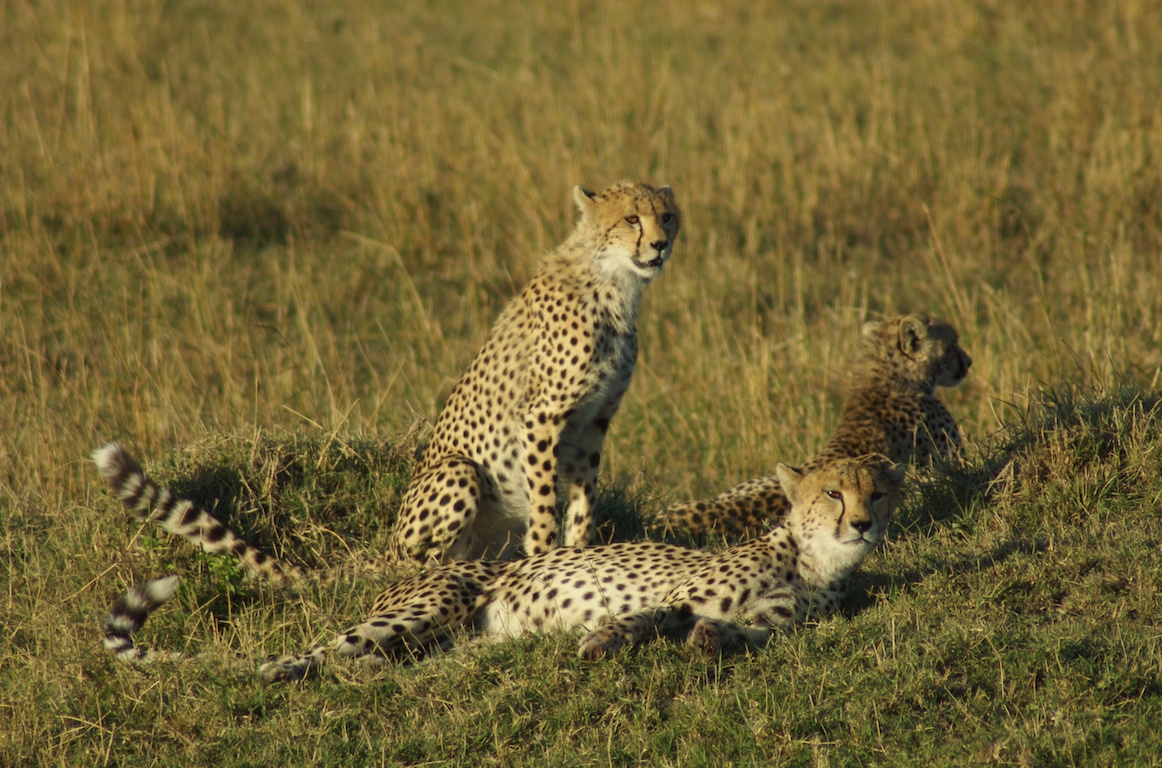
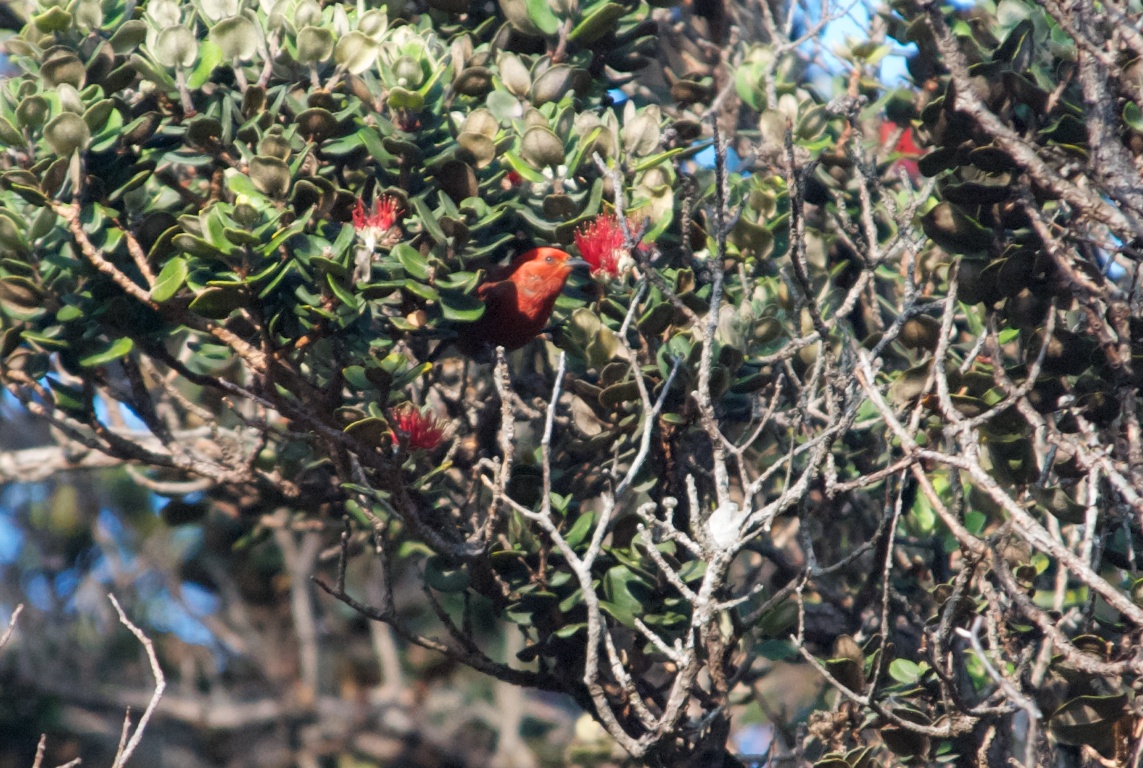
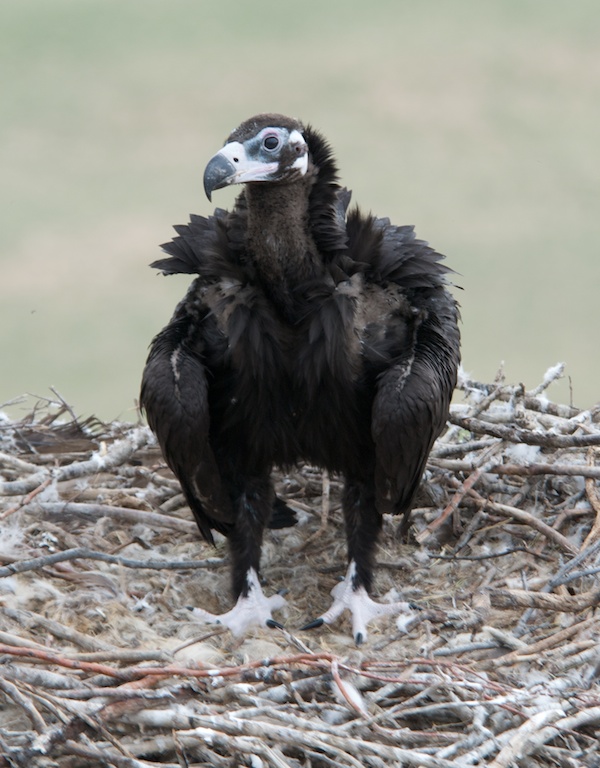
Takhi, Hustai National Park, MongoliaMonk Seal, Kauai, Hawaii, United StatesWolf, Lamar Valley, Yellowstone National Park, Wyoming, United StatesWhite-napped crane, Gun-Galuut Nature Reserve, MongoliaWhite Rhino, Lewa Downs Conservancy, KenyaLaysan Albatross, Kauai, Hawaii, United StatesTule Elk, Point Reyes National Seashore, California, United StatesRothschild's Giraffe, Soysambu Conservancy, KenyaNene, Hawaii Big Island, Hawaii, United StatesDesert Bighorn, Anza-Borrego State Park, California, United StatesGrizzly Bear, Yellowstone National Park, Wyoming, United States (Bear 264)Saker Falcon, near Hangai Mountains, MongoliaGreen Sea Turtle, Hawaii Big Island, Hawaii, United StatesGrevy's Zebra, Lewa Downs Conservancy, KenyaLammergeier, Gobi Gurvansaikhan National Park, MongoliaCalifornia Condor, Central Coast, California, United StatesAfrican Lion, Masai Mara, KenyaHawaiian Hawk (Juvenile), Volcano National Park, Hawaii Big Island, Hawaii, United StatesSiberian Marmot, Hustai National Park, MongoliaWhooper Swans, Gun-Galuut Nature Reserve, MongoliaCheetahs, Masai Mara, KenyaApapane, Hawaii Big Island, Hawaii, United StatesTrumpeter Swans, Yellowstone National Park, Wyoming, United StatesCinereous Vulture (Juvenile), Baga Gazriin Chuluu Nature Reserve, MongoliaArgali, Ikh Nartiin Chuluu Nature Reserve, Mongolia
Just for a little context….Prairie Creek State Park, Humboldt County, California
I grew up in forests. Redwood forests, to be exact. Camping out meant drippy, foggy mornings and warm sweatshirts with, maybe, sunshine in the afternoon. In August. None of it ever bothered me because I loved being enclosed by those wonderful trees. My mom always loved the desert. Me? Not so much.
Then I went to Mongolia and on my second trip in 2006 spent a few days in the Gobi. And found it quite interesting. Enough to want to go back.
Which I did in July of 2010. And got hooked. Totally. It was hot, sometimes humid, we had to be careful to make sure we had enough water, we fought off mosquitos with dung smoke at a remote lake and I can hardly wait to go there again. I love the Gobi.
Gobi earth road, through sand and saxaul forest near Orog Nuur (remote lake)
So when Dr. David Wagner invited me as one of 30 artists to spend a week traveling to, learning about, sketching, painting and photographing the Sonoran Desert and then creating work for a 2013 show at the Arizona-Sonora Desert Museum in Tucson, Arizona, I accepted immediately, thinking it would be interesting to compare and contrast these two arid environments.
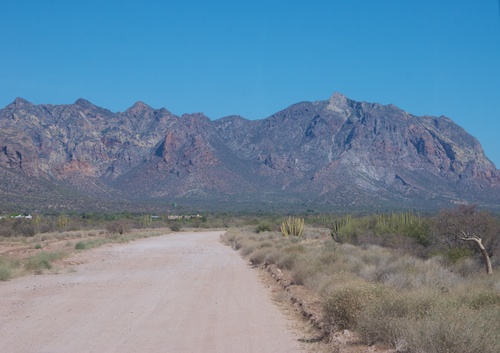
“Earth road” going towards Nacapuli Canyon, Sonoran Desert
I’ve pulled together my research and travel experiences and here’s what I’ve learned, illustrated with images from both places.
GEOGRAPHY:
SONORAN DESERT: Located in both the United States and Mexico
THE GOBI: Located in both Mongolia and China
Which means that both deserts cross an international boundary.
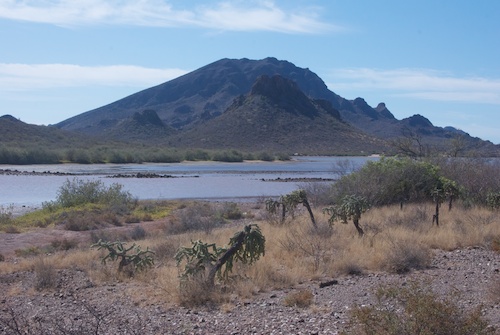
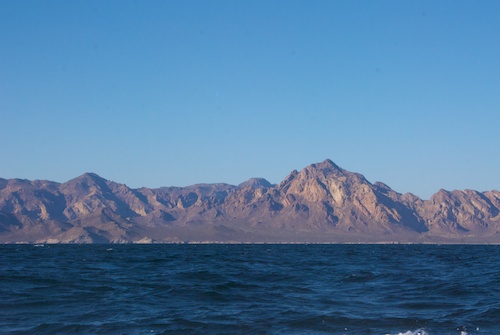
Tetakawi Hill: Mountain and sea, Sonoran DesertMountains and lake: Orog Nuur with Ikh Bogd mountains; demoiselle cranes at lakeside
SIZE:
SONORAN DESERT: 100,000 sq. miles
THE GOBI: 500,000 sq. miles, which makes it the 5th largest desert in the world
Nacapuli Canyon, Sonoran DesertYolyn Am (Vulture Gorge), Gobi Gurvansaikhan National Park, Sept. 2006
ELEVATION:
SONORAN DESERT: sea level to 12,600ft (San Francisco Peaks, Arizona)
THE GOBI: 3,000-5,000 ft. above sea level on a plateau; the highest mountain peak reaches almost 13,000 ft. (Gobi Altai mountains)
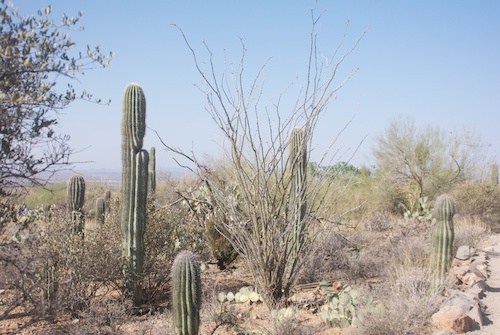
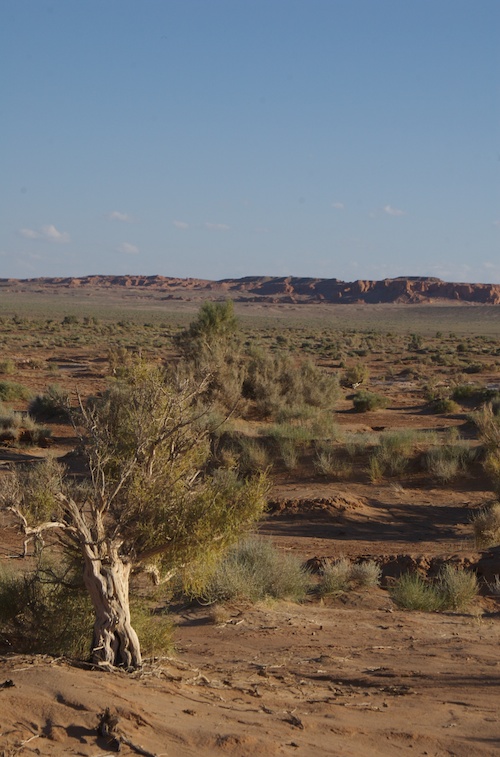
Sonoran Desert landscape with chollo and saguaro cactus, Arizona-Sonoran Desert Museum groundsGobi landscape, saxaul trees with Flaming Cliffs in the background
CLIMATE:
SONORAN DESERT: Hot with some colder winter areas at higher elevation. Snowfall rare except in mountains. Temperatures: summer- up to 120F (180F surface temperature has been recorded in Lower Colorado River Valley); winter- average low of 39F. Rainfall: bi-seasonal rain pattern- Dec./Mar., July/mid. Sept.; in some areas, multiple years without rain. Wind: winds blowing onshore bring the summer “monsoon” rains; hurricanes possible.
THE GOBI: “Cold” desert due to location on a plateau. Frost and snow can occur on the dunes. Temperatures: summer- up to 140F; winter- down to -40F; up to 50F temperature swings in 24 hours. Rainfall: one rainy season-July/August; up to 7.6″, some years with no rain. Wind: winds up to 85mph can create dust storms (usually occurring in March/April) large enough to be seen from space.
Estero Solado, a tidal estuary with no inflow, therefore it is always salineThe Flaming Cliffs beyond small Gobi lake, Sept. 2006
MARINE INFLUENCE:
SONORAN DESERT: Coastal areas on the Baja Pennisula and the east coast of mainland Mexico experience marine influence.
THE GOBI: Mongolia is a land-locked country, so the Gobi has no marine influence.
SONORAN DESERT: There are seven ecoregions: Tundra, Coniferous Forest, Temperate Coniferous Forest, Grassland, Chaparrel, Desert, Thornscrub (wet desert), Tropical Forest (source: Arizona-Sonora Desert Museum); sand dune fields of various sizes common.
THE GOBI: There are two or five ecoregions, depending on the source: 1) Eastern Gobi Desert Steppe, Gobi Lakes Valley Desert Steppe (World Wildlife Fund) 2) Eastern Gobi Desert Steppe, Alashan Plateau Semi-desert, Gobi Lakes Valley Desert Steppe, Junngar Basin Semi-desert, Tien Shan Range (“Alternative sources” Wikipedia entry for Gobi Desert); 5% of the Gobi is covered in sand dunes, much of the remainder in gravels of various kinds.
Avocets in the Estero Solado, Sonoran DesertAvocets, Orog Nuur, The Gobi, July 2009
HUMAN ACTIVITY:
Animal herding is common in both places. In the Sonoran Desert, there are cattle and some horses. The cattle graze on their own, the horses get fodder. In the Gobi, there are domestic bactrian camels, goats and some horses. In the more arid areas, camels do the work of horses. All animals graze on their own unless there is a severe winter, then they are fed fodder.
Food growing occurs where there is enough water. In the Sonoran Desert, water comes from springs, groundwater and wells. The growing season is very short- July and maybe into August. In the Gobi, there are lakes in some areas, springs and wells. The growing season may be as long as from April to October, depending on rainfall.
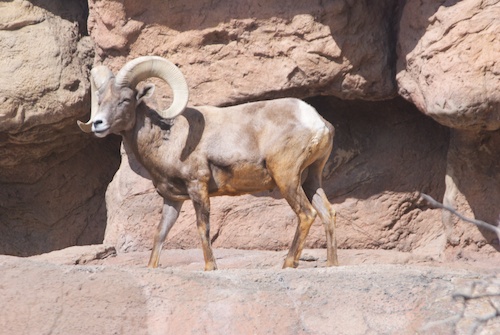
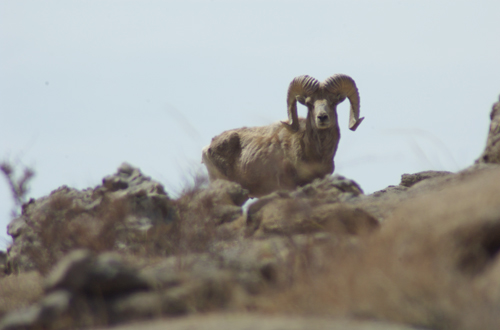
Desert bighorn ram, Arizona-Sonoran Desert Museum, March 2010Argali ram, Ikh Nartiin Chuluu Nature Reserve, April 2005
WILDLIFE:
SONORAN DESERT: 60 mammal species, including desert bighorn, jaguar, Mexican grey wolf, kangaroo rats, saiga antelope; 350 bird species, 15 which are endemic; over 100 reptile and 20 amphibian species. Endangered mammals: jaguar, Sonoran desert pronghorn. Endangered birds: cactus ferruginous pigmy owl, southwestern willow flycatcher
THE GOBI: 40 mammal species, including argali sheep, snow leopards (Altai Mountains) grey wolf, jerboas, Sonoran pronghorn antelope; the only reasonably reliable count for bird species that I could find on the web is 240 (from the Juuchin Tours website) specifically for Gobi Gurvansaikhan National Park. 15 reptile and amphibian species. Endangered mammals: Gobi bear, wild bactrian camel. Endangered birds: lammergeier, houbara bustard
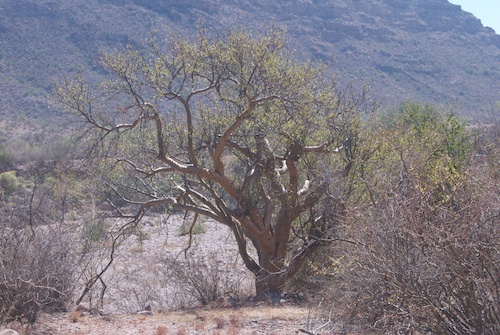
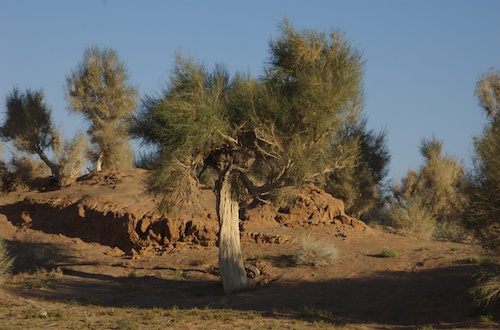
Sonoran desert tree that stores water in its trunkSaxaul tree, which has wood so dense from slow growth that a branch, thrown in the water, will sink
FLORA:
SONORAN DESERT: 2000 species of plants; known for: saguaro cactus
THE GOBI: 410 species of plants; know for: saxaul trees
For my Mongol friends, a desert that meets the sea
So there you have it. What I found to be a useful and interesting comparison of two of the great deserts of the world.
I want to thank Dr. Wagner for inviting me along on this wonderful trip and all my fellow artist traveling companions. Did we have fun or what? You’re the best!
My plan was to go back to Kenya in 2005 for an Earthwatch Institute-sponsored research project “Lions of Tsavo”. But I was leafing through the new Expedition guide and a project I hadn’t seen before caught my eye, “Mongolian Argali”, whatever those were. Oh. Wild sheep. But….Mongolia. Now there was a place that seemed like it might be interesting to travel to. And who knew how long the project would last. Some went on for a decade or more. Others only for a year or two. I called the Earthwatch office, changed projects and, without realizing it at the time, changed my life.
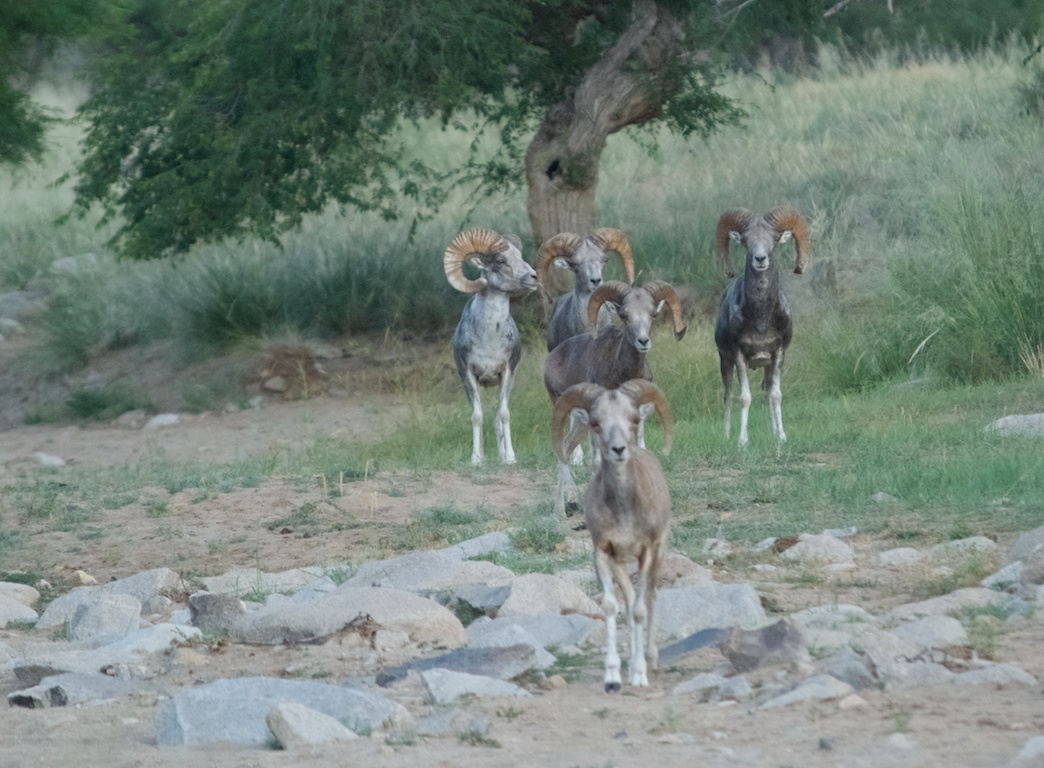
Argali (Ovis ammon) are the world’s largest mountain sheep. A big ram can weigh close to 400 pounds. The horn curl can reach 65″. Their preferred habitat is rocky uplands, mountains and steppe valleys. They are currently listed on the IUCN Red List as Near Threatened and Appendix II of CITES. Accurate population estimates are hard to come by. The most current one is perhaps as many as 20,000 in Mongolia. It is known that the total continues to drop in the western and central parts of the country, is stable in the south, but seems to be increasing in the east.
Group of four argali rams, Ikh Nartiin Chuluu, 2005
Threats include poaching, both for subsistence meat and for the horns, which are now in demand in China for use in traditional medicine. It has also been shown that there is a nearly 100% grazing overlap between the wild argali and domestic livestock, which includes horses, sheep, goats and cattle. Predation by the herder’s domestic dogs, particularly on lambs in the spring, is also a problem. Trophy hunting is not currently a large factor, but the license fee income (18,000 USD) ends up going almost entirely to the federal government. Very little trickles down to either the local people or for conservation projects. One response at the local level has been to create reserves where hunting is not allowed.
As you can see below, there is now an Argali Conservation Management Plan. My on-going involvement with the womens’ craft collective comes under item four on the list.
“Additional conservation measures are desperately required in Mongolia. Clark et al. (2006) outlined the following:
• Implement the recommendations outlined in the Argali Conservation Management Plan. • Improve enforcement of existing legislation that would help conserve argali. • Enhance conservation management in protected areas where argali are found at high population densities, and increase the capacity of protected areas personnel and other environmental law enforcement officers. • Work to improve the livelihoods of local communities in areas where argali are protected by local initiatives and re-initiate community-based approaches to argali conservation (Amgalanbaatar et al. 2002a). • Develop public education programmes to raise awareness of the status of and threats to the species. • Continue ecological research, monitor population trends, and study the impacts of threats, including work in the Altai and Khangai Mountains to complement research occurring in the Gobi Desert. • Implement the recommendations from the Mongolian Wildlife Trade Workshop as outlined in Wingard and Zahler (2006).
Argali ewes and lambs, Ikh Nartiin Chuluu, 2005
Until a joint research effort was started by the Mongolian Academy of Sciences and the Denver Zoological Foundation at the Ikh Nartiin Chuluu Nature Reserve in 2001, very little was known about argali ecology, behavior and population status. This was the research that I had signed up to help with as part of the second Earthwatch team ever to go to Mongolia.
It was April of 2005. Spring in Mongolia is a time of cold, wind and dust storms. Daytime temperatures during the team’s two week stay, living in a traditional felt ger, sometimes only reached 32F. I had the time of my life. When they found out I was an artist, one of the scientists asked if I would be willing to go out and do direct behavioral observations. And that’s what I did for the last three days, trekking out alone into the 43,000 hectare reserve with a clipboard, data forms, GPS, cameras, water bottle and snacks, trying to see the sheep before they saw me, otherwise any data I collected was invalid.
I saw this large group at Ikh Nartiin Chuluu in 2008; seventeen animals, I think, and they ran up that vertical cliff like water flowing uphill
Although a lot of the animals were in poor condition coming out of a typical Mongolian winter in which temperatures can plunge to -40F, I saw many groups that included rams, ewes and lambs, gathered some useable data and got some pretty good photographs. It was a perfect two-fer. I was able to contribute to scientific knowledge of a species and at the same time get information that would be invaluable for painting them.
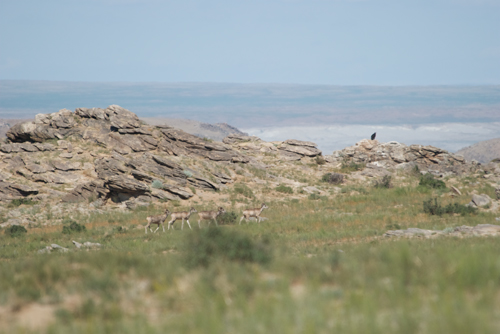
A typical sighting of some ewes and older lambs at Ikh Nart, but with a cinereous vulture, the world's largest, sitting on a rock in the background; in the distance is the desert steppe
I’ve been back to Ikh Nart five times since then and argali have become a particularly favorite subject. I’ve also seen them now at two other locations: Baga Gazriin Chuluu Nature Reserve and Gun-Galuut Nature Reserve.
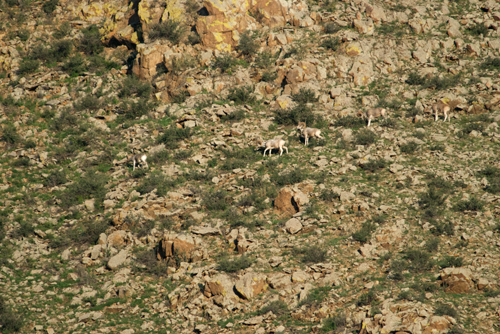
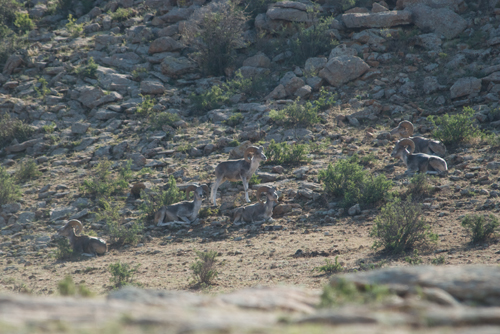
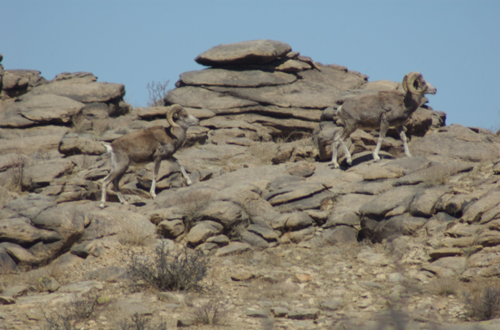
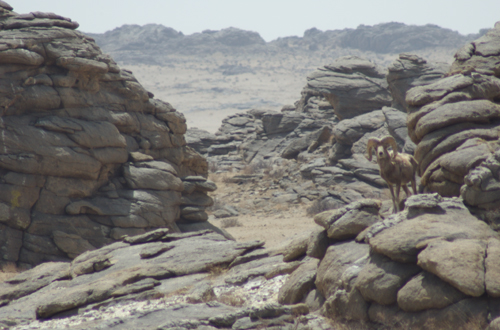
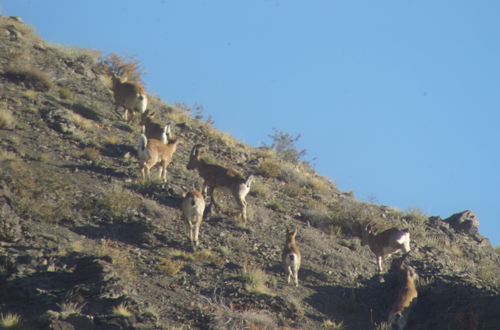
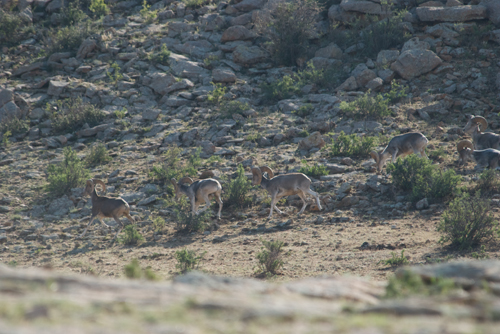
Driving into Ikh Nart in 2008; a grab shot from the car of four ramsRams on rocky hillside at Gun-Galuut Nature Reserve in 2009; the key to spotting them is to look for movement and those long, thin legs, which don't seem to quite fit the landscape; this was with my 80-400 mm lens (effectively 600mm on a digital body) at maximum zoomThis group of rams, at Baga Gazriin Chuluu Nature Reserve were about 800 meters away within plain view of the road through the park; "lazy" animal watching
I thought that I would share some of the photos I’ve taken and the paintings that have come out of them. It usually takes around three, often quite a few more, reference shots since I move animals around, change backgrounds or whatever it takes to make a composition work. I’m only going to show the main animal reference that I worked from. This fieldwork is critical. When working on a painting, I’m also remembering what it was like to be at that place, how the wind felt, the utter quiet when I stopped for a break, then trudging along, looking up and seeing that the sheep had already spotted and were watching me.
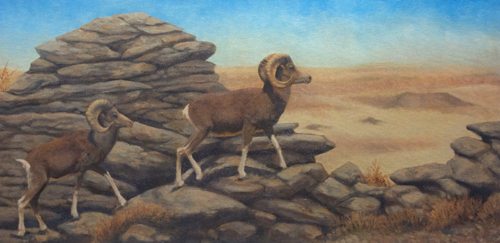
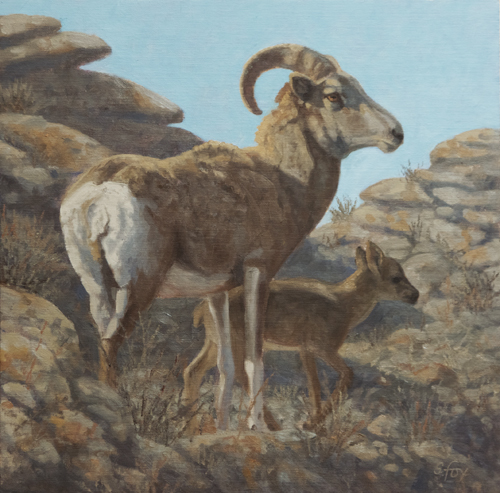
For one of my first argali paintings, I wanted to show them in the fantastic landscape of Ikh Nartiin Chuluu; April 2005Ikh Nartiin Chuluu Argali 15x30" oilArgali ewe, Ikh Nartiin Chuluu; April 2005; I added a lamb and moved the ewe up so her head would be against the sky for maximum contrastArgali Ewe and Lamb, Ikh Nartiin Chuluu; 12x12" oil on canvasboardOld ram, Ikh Nartiin Chuluu; April 2005; He's probably long gone, but we spent a, for me, memorable half hour together as he let tag along behind him after checking me out; that's also him in the first photo at the top of this postMutual Curiosity 17x30" oil
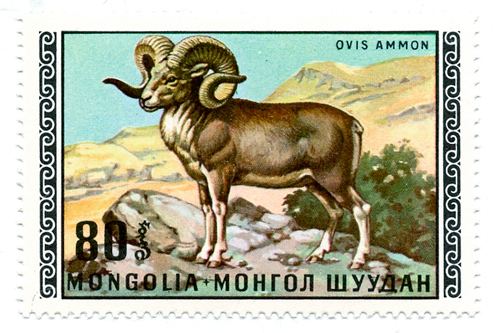
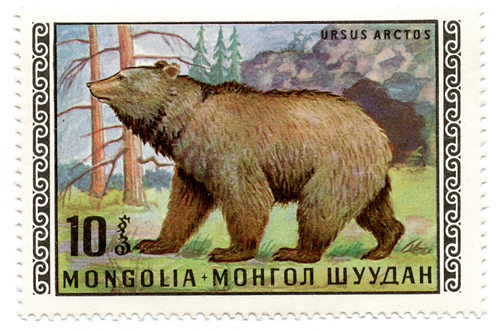
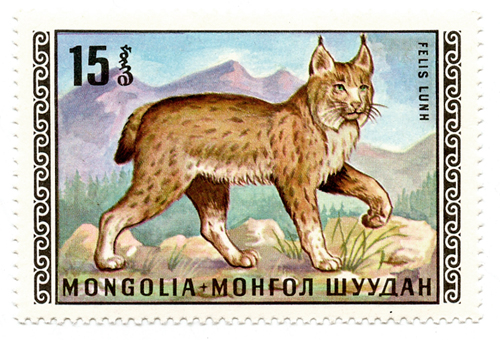
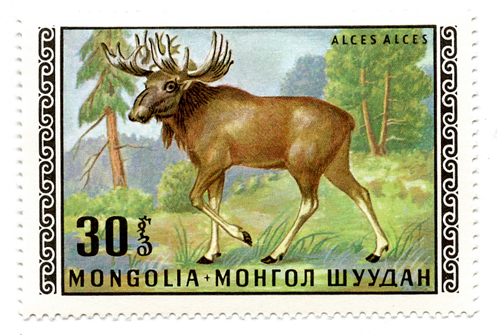
I ordered these to get the first stamp shown, but the whole set, uncanceled and in perfect condition, is so well-done that I wanted to share them all with you. I think that they are of interest not only because of their subjects, but as lovely little works of art. I wish I knew who the artist was.
Argali (Ovis ammon); the legs are a little short, but otherwise this is quite good; found in the high mountain zone and mountainous areas of the GobiBrown bear (Ursus arctos) : found in the northern mountains of Mongolia , which is the southernmost part of the taiga or boreal forestLynx (Lynx lynx); found in the taiga (forest zone)Siberian marmot (Marmota sibirica); has undergone a tremendous population crash in recent decades; now exists in localized populations; found in the mountain forest steppe transition zone and the steppeMoose (Alces alces), called "elk" in Europe: found in the taiga; same species as found in North AmericaWild boar (Sus scrofa); found in the mountain forest steppe transition zone; a small population also inhabits the reed beds of Khar Us NurWolf (Canis lupus); found in the taiga, mountain forest steppe and steppe
Next week, I’ll be featuring two Mongolian equids, the takhi and khulan.
I find that I have a perfect opportunity to demonstrate how critical good reference is and what a difference familiarity with a species makes in how well one is able to draw and paint it. Besides showing off my latest work.
I first went to Mongolia on an Earthwatch Institute-sponsored project “Mongolian Argali” in the spring of 2005 at the Ikh Nartiin Chuluu Nature Reserve. I had two Nikon D70 digital SLRs that shot 6MB RAW files. Quite good at that time. My lens was a Tamron 100-300 with a 2x doubler, which made it slow, but did let me get decent stuff from quite a distance. I took 735 images of argali sheep during my two weeks on the project and I was hot to paint them when I got home. For reasons that are now lost in the mists of time, I chose the image below for my first head study (file under “What was I thinking?”)
Now, granted I could zoom in on it quite a bit and I was really interested in understanding the shapes, not details, but still. Why didn’t I pick one like this?
Much closer. Better light. Structure of things like the area around the eye easier to see. Maybe I was seduced by the beautiful set of horns on the ram. Oh well, live and learn.
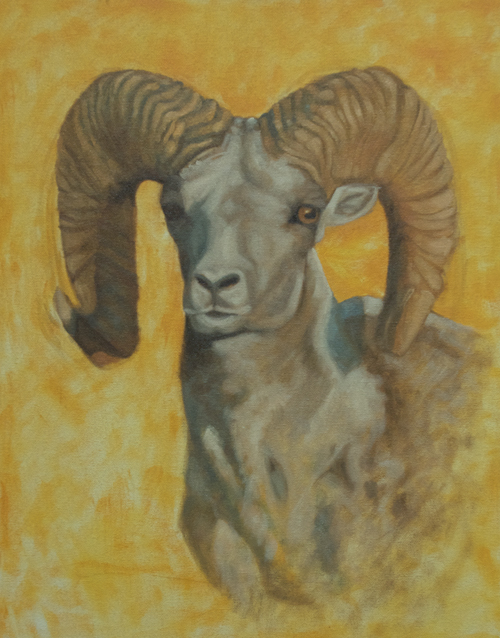
In any case, I sent a jpg of the finished study to the Mongolian scientist I worked with and he thought I’d done a very good job, which was nice to know. But……the painting continued to bug me, so I did a re-paint. And then another. And futzed with it some more. And then life moved on, the painting was shelved and that was that. So now it’s kind of a mess and I’m not going to work on it again. The only image I have of it when it looked finished is on a promo page I did for myself. The image below is scanned from that, so it’s not great, but it does show my first attempt to paint an argali head.
Fast forward to this year’s trip during which I spent a week at Ikh Nartiin Chuluu and shot 852 images of argali. I now have Nikon D80s which have 12MB RAW files (you are shooting RAW format, aren’t you?) with a Nikon Nikkor AF VR-80-400 and the difference in the optics is obvious.
Here’s the shot before the reference shot. It’s a little out of focus, but I make it a practice to never, ever put my prime painting reference images on the internet. But my subject, the ram in the middle, has pretty much the same head position.
Now THAT’S some good stuff to paint from! Scroll back up to the previous image and see how flat the light is by comparison. I really handicapped myself right out of the gate.
I’ve now been painting and drawing argali for five years and have been back to the reserve to observe and photograph them four more times. I’ve also learned a lot more about their behavior and what their lives are like. All of that feeds into my paintings so I’m not just rendering their surface appearance, as too many wildlife artists are wont to do.
One piece of advice I would give to aspiring animal artists is to absolutely paint what you love when you feel the need to paint it, but consider focusing in on one or two species and get to know them really well in all aspects. I think you will soon perceive a difference in what you have put into a painting with those subjects versus those which you approach casually because you happen to have a photo that you like.
Here’s the step by step of the new painting:
Brush drawing, indication of shadow shapes, laying in a background tone; notice that it goes into the animal
Adding a cool tone to the shadow areas
Starting to model the forms of the head and horns; things look a little ugly at this point
Working on the light areas, continuing to define the form and structure
Almost there; time to punch up the areas that are most important
The travel season is almost upon us. I’ve got my plane tickets for my July departure to Mongolia. For anyone else thinking about or planning to go there, I thought I’d offer one list a week for six weeks, of six “themes” for things to see, with six suggestions. I’ll start with the one that’s probably nearest and dearest to my heart – wildlife viewing destinations. I’ve been to all of them at least once.
Takhi grazing, Hustai National Park
1. For horse-lovers, Hustai National Park is a must if you are going to Mongolia. It is one of three places where tahki (Przewalski’s horse) have been reintroduced and is only about two hours west of Ulaanbaatar, mostly on tarmac road. You may also see marel (a species of elk), Mongolian gazelle, marmots and a variety of birds, such as demoiselle cranes, golden eagles, saker falcon, and black storks. There is a permanent ger camp that is open year around. The main building has a pleasant dining hall. There are three large concrete “gers”. One houses a gift shop, one has displays about the park and another is where presentations about the park are given by staff scientists. You can explore the park by vehicle, on foot or horseback. When I was last there in the fall of 2008, there were 15 harems of over 200 horses.
Reedbeds, Khar Us Nuur National Park
2.Bird-watchers should consider traveling out to western Mongolia to go to Khar Us Nuur (Black Water Lake) National Park. Khar Us Nuur is the second largest freshwater lake (15,800 sq km) in Mongolia . The Khovd river flows into it, creating a large marsh/wetland that is home to the largest remaining reed beds in Central Asia. The lake provides habitat for wild ducks, cormorants, egrets, geese, wood grouse, partridges, the rare relict gull and also the herring gull. May and late August are the best birding times. Another freshwater lake, Khar Nuur (Black Lake), which is connected to Khar Us Nuur via a short river called Chono Kharaikh, hosts the migratory and globally threatened dalamatian pelican. Direct access to the lakeshore is limited due to the reedbeds, but there is open shoreline near the soum center (county seat) on the north shore and an observation tower on the east side. As far as lodging, I can’t make any recommendations since I was rough camping when I was there, but I’m sure there’s something in or near Hovd, the main town. From Ulaanbaatar, flying to Hovd is the only practical way to get there since it’s about a thousand miles west of the capital.
Siberian ibex, Gobi Gurvansaikhan National Park
3. The legendary Gobi is home to Gobi Gurvansaikhan National Park, created partly as a refuge for an endangered population of wild bactrian camels. They are in a remote and inaccessible (except for researchers) part of the park, however. There are also snow leopards and argali, which visitors should not expect to spot. What there is a good chance of seeing are Siberian ibex, pika, two species of gazelle, steppe eagles, golden eagles, lammergier or bearded vultures, black vultures and a variety of smaller birds. I stayed at Nomadic Journeys’ Dungenee eco-ger camp, which is taken down at the end of each season, leaving almost no trace. The kitchen and dining “room” are in connected gers. The setting is terrific, on an upland that has the park’s mountains in one direction and the Gobi stretching out in the other. To get there from Ulaanbaatar one either drives south on the main road, which is an earth road and takes, I think, two days, or flies into Dalanzadgad, which takes about two hours.
View of Steppe Nomads Ger Camp overlooking Kherlen River; the wetland is off to the right with the base of Mt. Baits behind it, Gun-Galuut Nature Reserve
4.A relatively new park, Gun-Galuut Nature Reserve is only a couple of hours east of Ulaanbaatar, mostly on tarmac road. There are two main wildlife attractions here: around 100 argali mountain sheep, which live on Mt. Baits and a wetland area with endangered white-napped cranes, along with a variety of other birds like cinereous vultures, demoiselle cranes, black storks, whooper swans, ducks and terns. The permanent ger camp has a lodge which houses a dining hall and bathroom facilities. There are many activities to choose from besides wildlife watching, including boating, archery, yak cart and horse riding, hiking and homestays with herder families, all of which provide employment for local people. This was the first stop on my Artists for Conservation Flag Expedition in July of 2009.
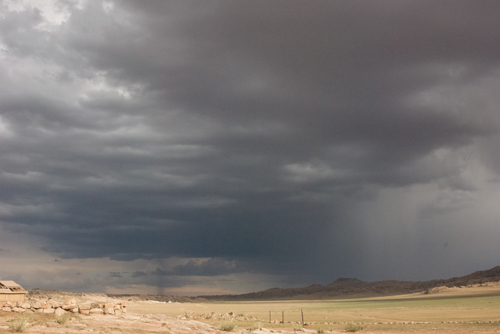
View from my ger, with passing summer rain storm, Baga Gazriin Chuluu Nature Reserve
5. I knew nothing about Baga Gazriin Chuluu Nature Reserve when I arranged to go there as part of my July 2009 Artists for Conservation Flag Expedition other than it had argali. I was only there for two days, but they were two of the most memorable days I’ve had in four trips to Mongolia. The reserve is home to about 60 argali, which are more tolerant of people and vehicles than the ones I’ve seen elsewhere, along with Siberian ibex, cinereous vultures, columbia rock doves and other birds. The rocky uplands cover a smaller area than Ikh Nart (no.6 below), and are easy to get around in on foot or by vehicle. There is a ger camp tucked up against one of the rock formations with an amazing view down the valley. A concrete “ger” serves as the dining hall and has a covered patio area. There is a toilet/shower block, for which the water is heated by solar power. Baga Gazriin Chuluu is about a six hour drive on an earth road southwest of Ulaanbaatar.
Argali ewe with two lambs; one with radio collar, Ikh Nartiin Chuluu Nature Reserve
6. And last, but certainly not least, Ikh Nartiin Chuluu Nature Reserve, my destination when I first went to Mongolia on an Earthwatch project in spring of 2005. Ikh Nart may be the best all-around place to see wildlife in the country. There are argali mountain sheep, Siberian ibex, corsac fox, red fox, tolai hare, cinereous vultures, golden eagles, black kites, kestrels and many other birds. Nomadic Journeys also has an eco-ger camp here, Red Rocks, and offers guided and unguided trips. It is a great place to hike. There are fabulous rock formations, some of which have Tibetan inscriptions carved on them. You will need a GPS since, while there are some dirt tracks, there are no marked trails. This was the third stop on my Artists for Conservation Flag Expedition in July of 2009. Ikh Nart is a seven hour train ride or a five to six hour drive south and slightly east, mostly on tarmac, from Ulaanbaatar.
There are more photos in other posts on this blog. Look under “Mongolia” on the blog roll at the right or do a name search.
If you’re watching the Olympics you know that it sometimes seems more like ads interspersed with some sporting events than the other way around. I’ve also realized that I don’t know how argali sheep are put together as well as I need to, especially the legs, and I’ve got a major takhi painting coming up
Put the two together and I’m getting some good sketching time in. I’ve got all my images from my last two trips to Mongolia on my MacBook Pro, sitting in iPhoto, which happens to have a great enlargement function. I’ve set the laptop on a small folding table (are they still called “tv trays”?) and am using a 9×12″ sketchbook.
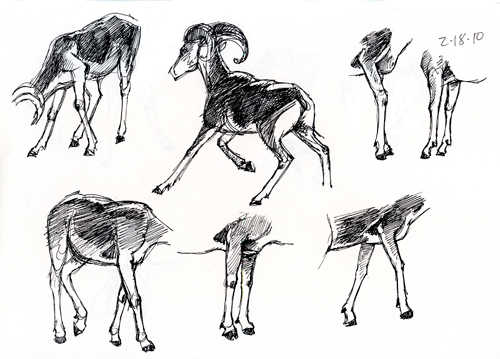
These are drawn with a fine felt tip pen with no preliminary pencil work. I either get it or I don’t. None take more than about five minutes, so there isn’t a lot of time invested. The purpose is to hone in on areas that I don’t understand as well as I should. Purely process, not result. Plus, I keep in mind that photos flatten objects, so I need to compensate for that when drawing three dimensional animals.
I started with a page of takhi, plus a cow I saw at Hustai.
Then I moved on to argali. One of the challenges is to keep the legs and body in proper proportion since the legs are really skinny and long. There isn’t a lot of muscle definition to play with, like with horses, so one has to nail the overall shape.
I’m struggling with the horns, too. They move back and around in space and I’m suspicious of how the camera might distort them. What I really need is to draw from the live animals. But there are none in zoos that I know of and in the wild you’re lucky to watch them from 600 meters (over 600 yds.)
Ideally, I’d have my Leica Televid spotting scope, which would solve the problem, except that it is entirely impractical to haul it around in the terrain where the argali are, at least for me. So it’s photographs and a pair of domestic ram’s horns that I brought back from England some years ago. I don’t have access to taxidermy mounted argali, but the problems there would whether or not the horns are typical, how good the quality of the mount is and is it a Mongolian argali. Notice that I started on the left with only basic shapes and didn’t worry about modeling or “color”.
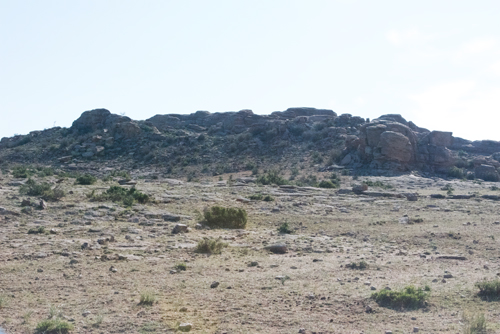
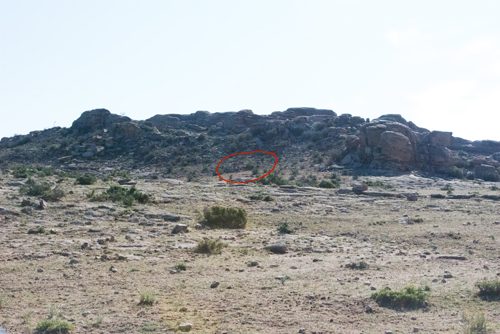
The best images I have of argali so far are a group of six rams at Baga Gazriin Chuluu Nature Reserve. They were considerate enough to have parked themselves in the open within sight of the main road through the reserve in great morning light. I would have been lucky to have spotted them, but the local man living in the reserve who my guide hired to go out with us both mornings that I was there saw them right away. Here’s a long shot from where we stopped. They’re right back against the rocks, in the middle.
I’ve circled them in red.
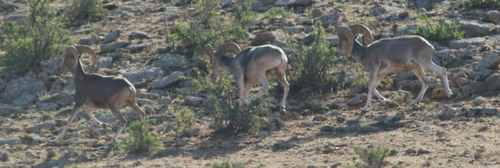
Piece of cake, right? Here’s what I got when I zoomed in with my Nikon Nikkor VR 80-400 lens. These are 10mg files, so they can take quite a bit of enlargement and stay sharp. I’ve got about 84 images total to work with. There’s something useful in all of them. Love these guys.
Here’s a close-up of the three rams in front. A perfect Exhibit A of the subject of a previous post about why you have to get out there and do the fieldwork. There’s no other way to get this kind of reference (Buying it from someone else doesn’t count). Game ranch animals won’t do it either. They’re out of context and, unless you’ve observed the species in the wild, you have no idea whether or not any behavior that you see is “real”.
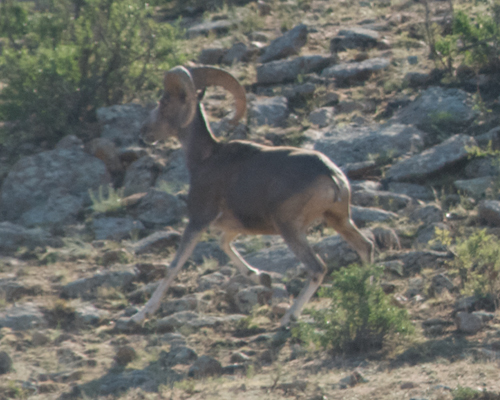
And closer yet of one I drew last night. Everyone was fat and sassy and in great condition. Notice that the younger ram is much browner than the older ones. His behavior was different, too. He was a little more skittish, kept more space between himself and the others than they did between each other and was last in line when they all finally moved up into the rocks.
Great stuff! Action, a terrific pose, rim light. Here’s the page of sketches that include this ram.
Give it a try! It’s a great way to keep training your eye.
Sort of an odds and ends Friday as the year winds down. The deep freeze is over here in coastal Humboldt County and it’s back to nice normal rainy weather with nighttime lows in the 40s. I’ve been getting in some good easel time of the past few weeks. Here’s a new argali painting from reference that I shot in July at Gun-Galuut Nature Reserve. I watched this group of rams work their way across the rocky slope for almost an hour. “Uul” is Mongolian for “mountain”.
On The Slopes of Baits Uul, Gun-Galuut 18x24" oil on canvasboard (price on request)
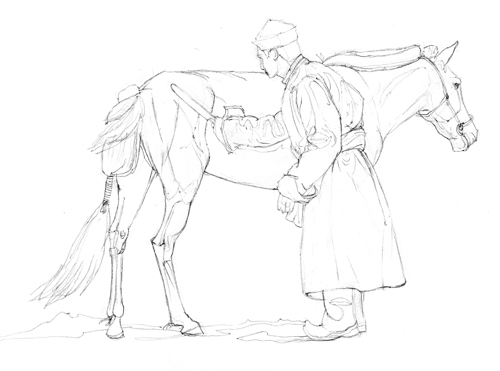
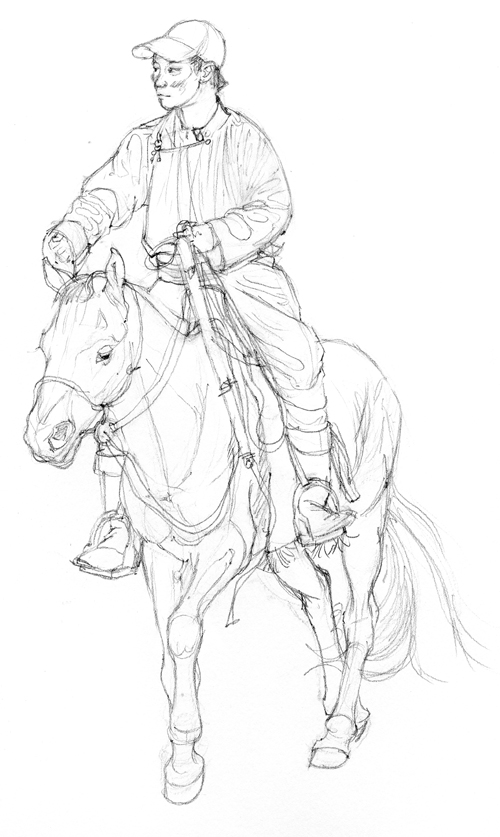
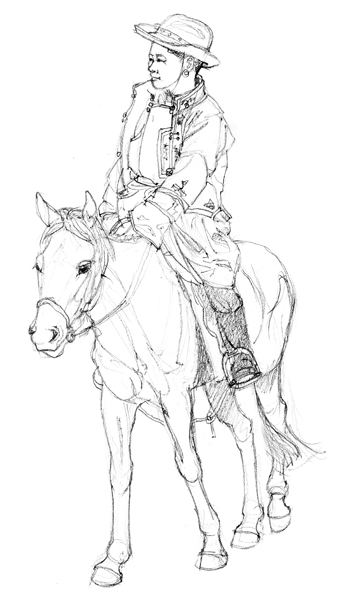
I’ve also decided that I want to paint not just the domestic Mongol horses, but the people who ride them. Which brings me back to wrestling with human figures, as described in an earlier post. I get a better result if I can scan the drawings rather than photograph them and also wanted to really hone in on accuracy, so these are smaller and done with a Sanford Draughting pencil, but on the same vellum bristol (which erases very nicely). The heads ended up being only 3/4″ high, which is pretty small, but it reminded me of a story from art school that I thought I might pass along.
One of my teachers was Randy Berrett, a very good illustrator who chose to work in oils. This was kind of masochistic, in a way, because it added a layer of complexity when he had to ship out a wet painting to meet a deadline. In any case, he was showing some examples of his work in class and one was a really large painting of the signers of the either the Declaration of Independence or the Constitution, I can’t remember which. Someone asked why he painted it so large. Randy’s answer really struck me at the time and has stayed with me. It’s something worth remembering when planning a painting. He said that he wanted the heads to be at least an inch high and that requirement controlled the final size of the painting. I’ve sized more than one painting on the basis of that criteria since then.
The first drawing combined two pieces of reference. One of the horse and one of the man. In the latter, he was in front of the horse’s head. In the former, I didn’t like the pose of the horse. Moving the man back works much better. The sweat from a winning horse is considered to be good luck. There are special scrapers made to remove it.
Scraping the sweat after the race, Baga Gazriin ChuluuLocal herder, Erdene NaadamBoy on horse, Erdene Naadam
Part of the reason I did the previous two was to see if the images “drew well” and to work on horses coming forward at a 3/4 angle. The final two are head studies, in which the heads are 1 1/2″ from forehead to chin.
Local herder, Erdene Naadam
Finally, the folks at Eureka Books in Old Town, Eureka have decided to hold a special art show. Here’s the Call for Entries.
Spent pretty much all of my easel time on the argali painting this week. I think I’ve got it on track now. I need to do some detail drawings of the horns of all three to make sure I understand their structure and perspective before I begin the final stage on them.
I tried painting the big ram light all over, like my reference of him, yesterday, along with defining his neck and shoulder muscles. Came in this morning and realized that I needed to go back to the original color rough because I’d lost the value contrast I needed and the interesting color variation that the younger rams have on their heads and bodies. So I ended up going in dark over light, which worked just fine.
end of day 10-21-09
I also added a couple more layers of color to the sky- a light warm and a light cool, knocked back the right side background with a pale glaze and the left shadow side with an ultramarine blue glaze to cool it down.
This morning I started on the young ram on the left and pretty much have him where I want him. Then I went back to the main ram and repainted him from head to tail.
end of day 10-22-09
I’m starting to get the light quality I’m after. Next, I believe, will be the left side and foreground rocks to “catch them up” with the rest.
































 Susan Fox, American Artist