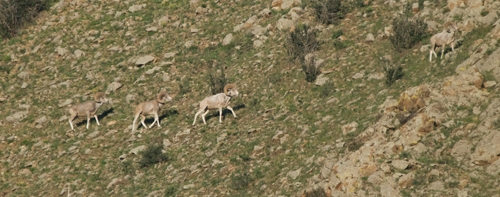
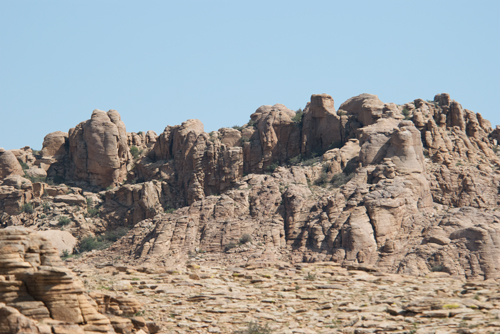
The Big Argali Painting, Part 3

When we last left the big argali painting (36×40″), I had worked through the composition and drawing. You can read that post here.

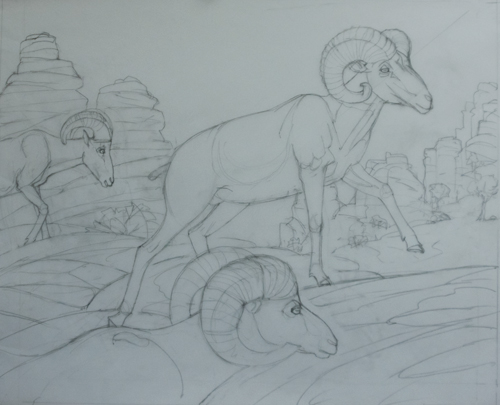
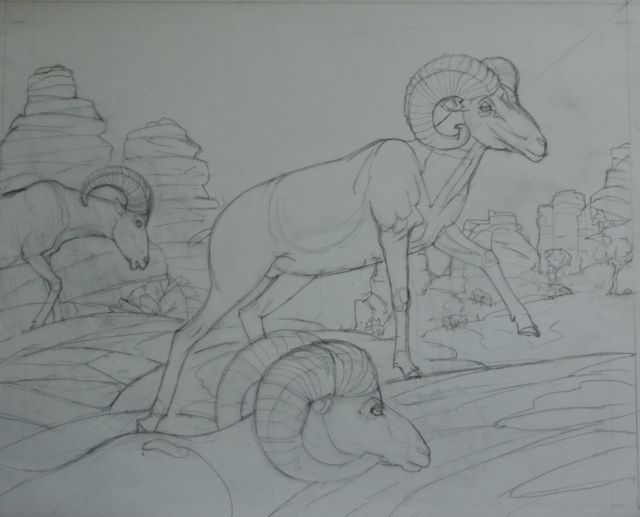
I finally got back to it this week. The first step was to use the good old grid system to transfer the drawing in pencil. Then I restated and refined it with a filbert (a flat brush with a rounded end) and a light tan tone. Scale does make a difference and the ram at the bottom, which looked ok in the smaller drawing, didn’t cut it when the head was around 13″ from the back of the horn to the nose. Back to the reference. And a much better head position. I taped a piece of tracing paper onto the bottom of the canvas and drew the new head. Once it was done, I moved the paper around until I had him where I wanted him. Then I did a transfer with graphite paper and a #7 pencil. The tricky part was where he overlapped the hind legs of the ram above him.
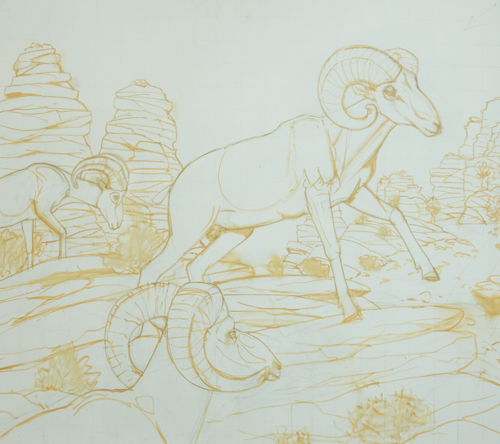
Brush drawing
Brush drawing

Now that I could see the painting at the final size, it was time to do the color rough. I have good reference and a pretty clear picture in my head of where I want to end up, so I decided to combine thinking value with working out the color scheme. All I’m after is the overall pattern of relationships, so it’s just blobs of color, but it has the information I need to get started.

Color rough, approx. 8x11"  on canvas paper
Color rough, approx. 8x11" on canvas paper

I set the rough down where I could see it and then started painting. The first step, for me, is to cover the entire canvas with a medium dark tone that is somewhat opposite the color temperature I’ll eventually end up with. This is all scumbled in with a fairly dry brush. The fun really begins when I start to add the lights in over the darks. Whoohoo!
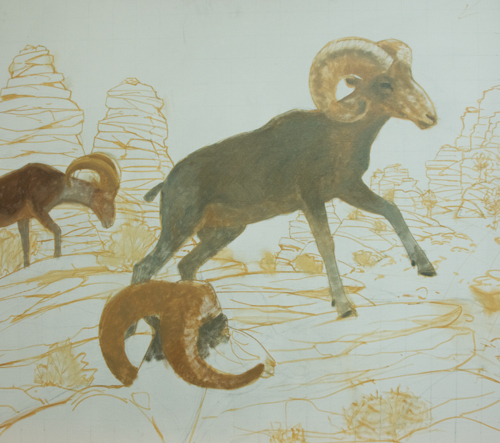
Initial color lay in

The main ram is present. There’s someone home in there, even though the eye is only indicated with a rough shape. I’ve added the first layer for the sky. It will go one step darker and cooler and then I’ll paint lighter, warmer tones over it, but still letting a little of the original color show through.

First tone for the sky

Next, it was time to “rock”, as in scumble in the first tones of the rocks. The light is coming from the right, so I want to establish my light side and shadow side right away and also introduce some visual variety and form. I’ve also added the darkest darks for the shrubs. I stood back at that point to see if they made a good pattern in and of themselves. Ok so far. May need a couple more on the right and left edges.

I’m looking in the mirror a lot at this point as I define the shapes of the rocks. If you look on the right, you can see where I’ve eliminated some pinnacles. The ram’s head felt too confined. He needed more air in front of him.

Initial background tones

I spent the afternoon working my way across the canvas. The drawing is mostly lost at this point, but that’s ok because I have it stored in my head, hand and on the tracing paper. The next step is to find it again. I’ve redone the grazing ram (again) and lengthened the front leg of the main ram. Before continuing, I’ll do a proportion check. Argali have big bodies with very thin legs, so they sort of look “wrong” on the hoof.
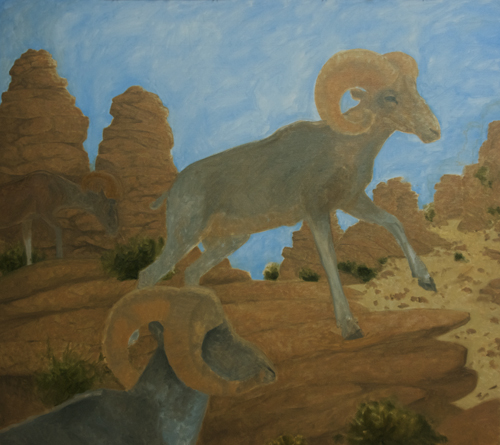
Initial lay in done
Initial lay in done

I’m kind at the point, which many artists hit, when I hate the painting. The drawing was so nice and now things are a dull, undefined mess. All I can see at the moment are the things that are “wrong”. Now is when it’s important to hold onto the vision in my head of the painting I want to do. Here’s the one part I still like. It’s the top of the far left side pinnacle.

Rock pinnacle detail

A Special Visit to the American Museum of Natural History

I was one of a large group of artists in attendance this past weekend at the opening of the Artists for Conservation juried show “The Art of Conservation”, which is at the Hiram Blauvelt Art Museum in Oradell, New Jersey. There were two full days of activities planned for us and we made the most of them.

Considering my lifelong interest in animals and nature, I’m almost embarrassed to admit that while I have been to New York a few times, until this past Friday I had never been to the American Museum of Natural History (AMNH). On the other hand, the amazing tour we were taken on by Stephen C. Quinn, Senior Project Manager in the Exhibition Department, who is also a member of Artists for Conservation, along with being on the Executive Board of the Society of Animal Artists, more than made up for it. (We also had a day at the Bronx Zoo, courtesy of the Wildlife Conservation Society, but you’ll have to wait for the paintings to see what I found there.)

Stephen first treated us to a presentation on the legendary AMNH dioramas that fill the Akeley Hall of African Mammals, the hall of North American Mammals, Sanford Hall of North American Birds and other parts of the museum. The research, skill and art that went into their creation is also pretty legendary.

(Animal artists take note:) Nothing in them is generic. The background settings are all real places. Museum artists were sent out into the field and did wonderful studies en plein air. The animals themselves are all individuals, which lifts them far beyond any other taxidermy animals I’ve ever seen. Each specimen was carefully measured in the field and that data was used to create exact forms on which the skins were mounted. Attention was paid to each muscle so that it accurately reflects whether it was tensed or relaxed. These are the only mounts that I feel that I could confidently draw from and know that they are accurate.

African lions
African lions
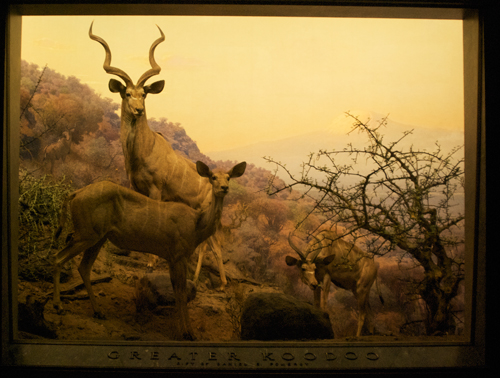
Greater kudu
Greater kudu
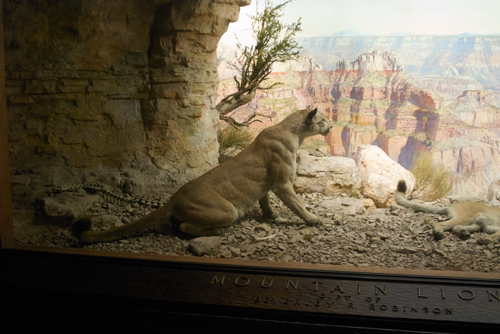
Cougar
Cougar
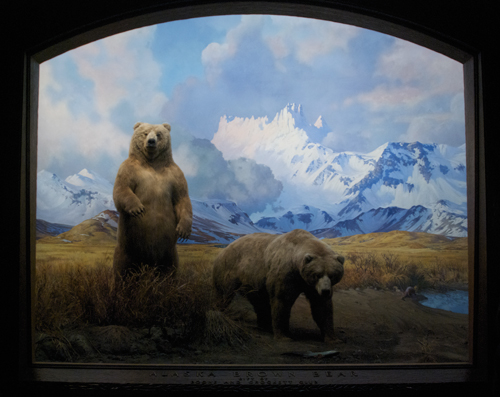
Alaskan brown bears
Alaskan brown bears
Alaskan brown bears, background diorama detail
Alaskan brown bears, background detail
Alaskan brown bear, background diorama detail
Alaskan brown bear, background detail
Bighorn sheep
Bighorn sheep
Bighorn sheep, background diorama detail
Bighorn sheep, background detail from around the curve on the left
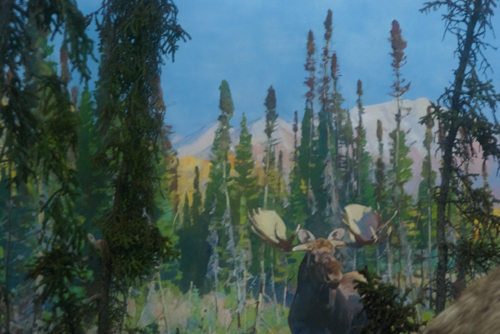
Moose, background by Carl Rungius
Moose, background detail
Moose, background detail; yup, it's a Rungius
Background; I must not have thought much of the animals because I didn't photograph them
Background; I forgot to photograph the rest of it

The backgrounds are like little master classes in landscape painting. Absolutely stunning. The above images just hit the highlights of some of the details that caught my eye.

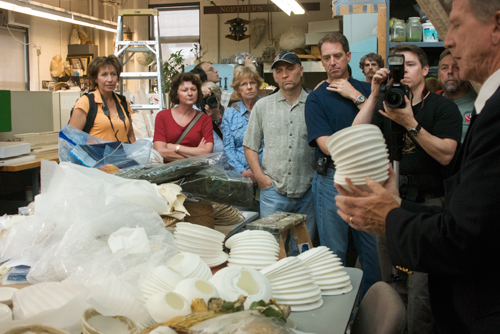
As it turns out, a very special exhibition on the Silk Road, “Traveling the Silk Road: Pathway to the Modern World”,  opens on November 14 and Stephen took us behind the scenes into the studios and workshops where all the preparations are being done. We also got to see the space where it will all be installed Real Soon Now. A major feature is a partial reconstruction of the sunken dhow (a type of Middle Eastern ship which is “sewn” together, not nailed) that was recently featured in National Geographic magazine. It was found packed with thousands of bowls and other merchandise being exported from China to the Middle East. Until it sank.

The dhow section under construction with some of the pot. A mould was taken from one of the real ones.
The dhow section under construction with four of the pottery jars. A mold was taken from one of the real ones.
Some of the bowls, ready to be painted
Stephen tells us about how the bactrian camels are being made
A board with some of the reference the artists are using
The mold for casting the camels' bodies
A few of the camel heads

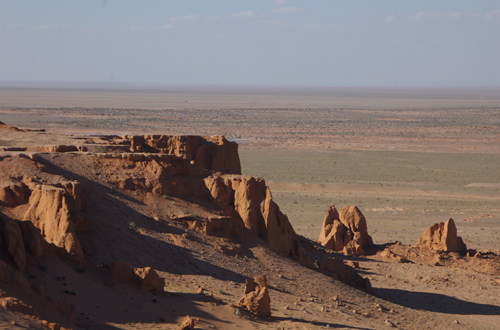
Eventually we were turned loose to explore the museum on our own for a couple of hours. I knew exactly what I wanted to find – some of the fossils that Roy Chapman Andrews’ Central Asiatic Expeditions of the 1920s brought back from The Flaming Cliffs (which are located in the Gobi, Mongolia; you knew I’d work Mongolia into this somehow, right?). Andrews was there as part of his work for the museum, so that’s where all the goodies ended up. I visited the cliffs myself in September of 2006 and was able to sit a short distance away to watch them as the sun went down. Flame they did, as you will see below.

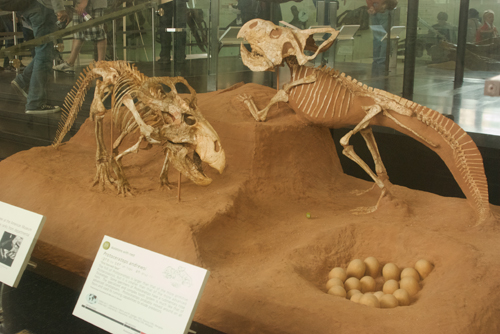
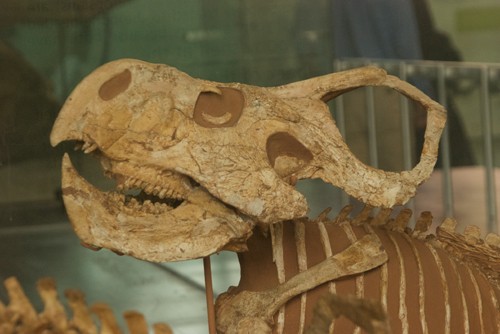
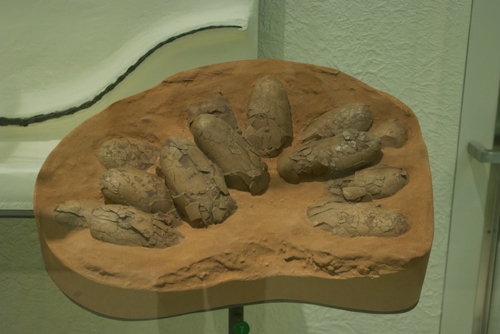
It took a little searching, but I found a most of an entire wall in the Ornithischian Hall dedicated to those finds, including a clutch of fossilized protoceratops eggs. The first dinosaur eggs ever found came from Andrews’ Expeditions work at The Flaming Cliffs or, as the Mongols call the area, Bayazag, which approximately means “Place of the saxaul trees”.

Protoceratops pair
Protoceratops pair
Head detail
Head detail
Fossil dinosaur eggs; they had one that you could touch, too!
The Flaming Cliffs with the saxaul "forest" in the background

Saxaul trees grow very, very, very slowly, so the wood is extremely dense. So dense, in fact, that if a piece of it is thrown in water it will sink. Most of the trees that I saw were ten feet high or less, so this isn’t “forest” as most Westerners think of it. And, not surprisingly, given the state of the planet, they are slowly disappearing due to being cut for fuel. Not quite endangered yet, but getting there.

Sunset, The Flaming Cliffs
Detail
Detail of the incredible color; Amusingly, the Mongols I was with found the moonrise happening behind me to be of much more interest

Lining the walls of the fossil rooms above the displays were some of the paintings that Charles R. Knight did during the time he worked at the museum. One of the first animal drawing books I got as a child was “Animal Drawing, Anatomy and Action for Artists”. I wasn’t really old enough to read it, but I copied and looked at the pictures for hours. As far as I know, it’s still available from Dover Books, but probably for more than the princely sum of $2.00 that my parents paid for it in the early 1960s. I really ought to go back and read it now. Might as well learn from the best.

Painting by Charles R. Knight

As a final bonus, there was this lovely drawing by J. B. Shackleford, who participated in the Central Asiatic Expeditions as the official photographer. His place in paleontological history is assured, as you will see from this quote from Michael Novacek’s  terrific book “Dinosaurs of the Flaming Cliffs”:

“The expedition photographer, J.B. Shackelford, hung back with the caravan of spindly-wheeled Dodge motorcars. To pass the time, Shackleford took a brief walk. Far to the north on the horizon he could see some volcanic hills that looked like islands floating in a sea of pink sands. As he walked in this direction, he saw an abrupt edge to the burnished grass, and a thin orange line beyond. He walked to the edge of the plateau. There below him extended a fantasy land of orange-red cliffs and spires. As Andrews later wrote, “Almost as though led by an invisible hand, he (Shackleford) walked straight to a small pinnacle of rock on top of which rested a white fossil bone.” This was the skull of a parrot-beaked, frill-headed dinosaur, a year later named Protoceratops andrewsi.”

Drawing by J.B. Shackleford

I probably didn’t even manage to see half of the museum, so I have ample excuse to go back again. Which I shall.

Four New Paintings!

Here are four more new paintings to go with the two I posted last week. I had a problem with the background in the last one and thought I’d show how it was and how I changed it.

Heading Down For Breakfast 8x10" oil on canvasboard (price on request)

Here is one of the takhi (Przewalski’s horse) that I saw when I was at the Khomiin Tal reintroduction site in western Mongolia in September of 2006. It was first light a group of horses were coming down out of the hills to graze.

Mongol Horse #4; Afternoon Graze  9x12" oil on canvasboard
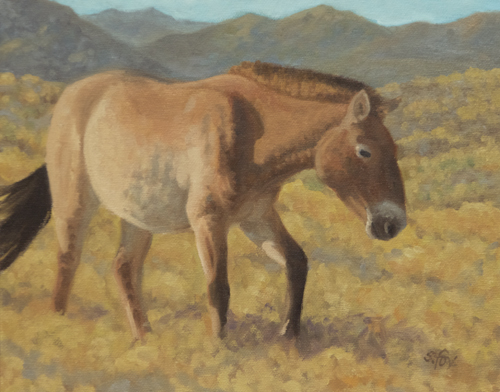
Mongol Horse #4; Afternoon Graze 9x12" oil on canvasboard (price on request)

This was a harem stallion that I saw at Ikh Nartiin Chuluu last fall. He was also the model for Mongol Horse #2. It amazes me that, given the extreme environment that they are exposed to year in and year out, that these tough small horses grow such long manes and tails. But they do.

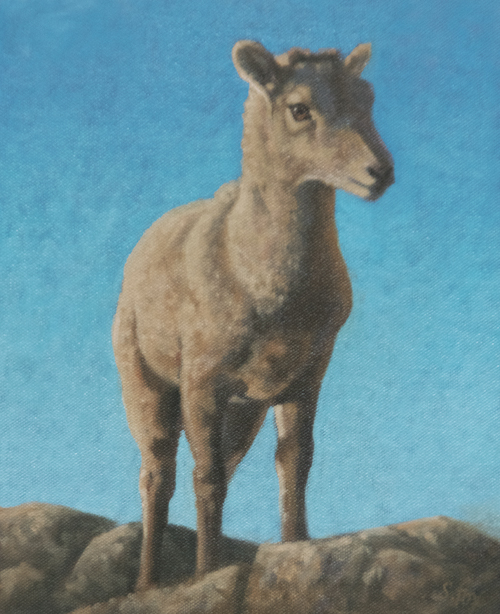
Top O' The Morning 10x8" oil on canvasboard (price on request)

I saw this Rocky Mountain bighorn lamb with his mother near Tower Campground in Yellowstone National Park a couple of years ago. They were by the side of the road, which lacked interest as a setting, to say the least. So I moved him.

Catching the Morning Light 9x12" oil on canvasboard (price on request)

This argali ram, along with five others, gave me an eyeful on my first morning at Baga Gazriin Chuluu Nature Reserve in Mongolia in July. I wanted to work on capturing the quality of light without worrying about painting too many animals, so decided to start with a small painting. I had one idea for the rocks as you’ll see below but, on further review, something wasn’t working. Time to get out the scraper. What do you think was wrong? Answer below the second image.

First version
First version
Detail of scraped out area

There were a couple of problems. One, in getting into the grooviness of painting the rocks, I completely lost track of my light source. The rocks are in full light, but are on the same plane as the ram. Buzzz. Second, I tried to use what I knew to design the rocks more or less from memory, which resulted in a boring, distracting (what an awful combination!) set of shapes. I went back to the rocks that were in the original photos and saw that they were much less rounded, which provided a needed contrast with the curves of the ram.

Two New Paintings!

I’m applying (for the third time; I’m nothing if not persistent and it does pay off in the end) for a major juried show which requires work 9×12″ and smaller. So that’s what I was doing last week and this week- four to six small paintings that will form a decent, cohesive body of work. I leave for the Artists for Conservation “Art of Conservation” show opening weekend next Wednesday, so the clock is ticking.  For those of you following The Big Argali Painting, I’ve got the grid on the drawing and on the panel, but have had to put it aside until after I get back on the 28th.

My criteria for choosing reference for all of these small works was: #1 great light, #2 a mix of Mongolian and North American subjects and #3 a strong, simple composition.

Here are two that, I think, at least at the moment, are done. No spiffy titles yet.

Greylag Goose  6x8" oil on canvasboard
Greylag Goose 6x8" oil on canvasboard (price on request0
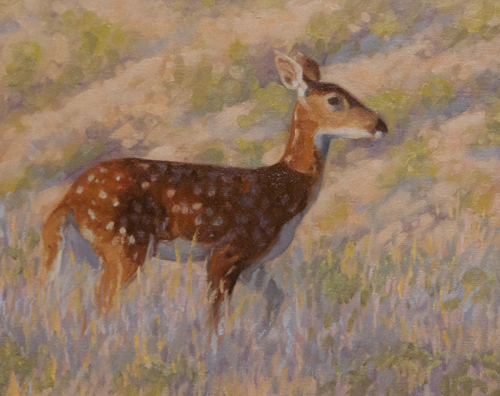
Young White-tail Deer 8x10" oil on canvasboard
Young White-tail Deer 8x10" oil on canvasboard (price on request)

Can’t remember for sure when or where I photographed the goose, but it’s painted from a print, so it was before 2004. I think it was on a trip to England.

The deer was photographed at the National Bison Reserve not too far from Missoula, Montana. Highly recommended for wildlife viewing.

On-going Notes from the Society of Animal Artists Show Opening- I’ve Been Elected to the Executive Board

Sept. 7

I’m not in Kansas anymore and there’s no place like home. Interesting trip back which started when I found out at the Wichita airport that my flight home via Sacramento had been canceled and that I would have to stay overnight in San Francisco. United Airlines never contacted me, even though they seem to have my correct email address and I was checking email twice a day. They will be hearing from us. I ended up at the Hilton near the airport. The guy behind the counter listened to my tale of woe and gave me a “Preferred” room for $70. Very spiffy room with big LCD tv hanging on the wall. Lamps next to the bed with dimmers, very comfortable bed, great omelet for breakfast, so it all worked out.  A big, fat Win for Hilton.

Pleasantly uneventful last leg. It’s nice and sunny. Hope to be back in the studio tomorrow with wonderful memories of all the great artists and art I saw at the opening.

Sept. 6

The annual membership meeting was held in the morning. Lots happening. The Society is closing the office it has maintained at the Salmagundi Club in New York, which will save a ton of money. The Society is now based in Colorado, home of the President and our Administrator. There are big, exciting plans afoot for our 50th anniversary Art and the Animal Show to be held in San Diego next year. A week’s worth of events, a Life Achievement Award for Robert Bateman, who will be in attendance, enough room for lots of member’s work and also large works, talks, workshops, possible trips to Marineworld and the San Diego Zoo Wild Animal Park. Members coming in from all over the world.

But the big news, personally, was that I have been elected to serve on the Executive Board of the Society! I sent in the required “Why I want to do this” letter, but didn’t really expect anything to come of it for at least a year or two. However,  a couple of long-time Board members dropped off, so the Nominating Committee tapped me and another gentleman to run, so we’re both in. I plan to attend the November meeting in New York, although my term doesn’t start until January. I’m really excited about this opportunity to get more involved in the Society and to work with the other board members, superb animal artists all.

After the meeting, most of us adjorned to the zoo for one more round of sketching and photographing the animals.

We gathered in the evening at 5pm for “Social Time”. Everyone brought their show catalogs and we spent over an hour getting each other to sign their respective pages. It was kind of like a high school year book signing at the end of the school year, but without the social drama. A great deal of fun.

Then it was time for dinner. I had the good fortune to have picked the most fun table and probably the rowdiest, sitting with Jan Martin McGuire, Paul Rhymer, Joni Johnson-Godsy, Kelly Singleton, a couple of spouses and another very amusing artist whose name I didn’t get. At one point Diane Mason’s husband came over and told us that they were going to split us up. I guess we were having too much fun ;0).

The final business was the handing out of the awards. One good friend, who shall remain anonymous until he is officially notified, received an Award of Excellence and a number of new friends, who I met this weekend, also got awards. Our new President, Diane Mason, who has already brought amazing energy and new ideas to the organization, got a well-deserved standing ovation.

I drive back to Wichita tomorrow to catch an afternoon flight for home.

My camel painting on the wall at Art and the Animal

Sept. 5-

As those of you who followed the run-up to my Mongolia trip may remember, I bought a Flip video recorder for the trip. As it turned out, I really never used it. Too much else to think about. But I brought it with me and yesterday I was watching some timber wolves at the zoo and thinking about how to capture in paint that graceful, loose-limbed stride they have. Then I remembered, duh, I have the Flip with me.

Here’s a sample. It will be interesting now to draw from this kind of reference-
Sept. 4, later-

Later-
Back from the opening, at which there were around 40 artists. There have been a few sales already, which is good news for everyone. I’ve only seen Art and the Animal in the show catalogs. This is the first time I’ve seen it in person. It appears, from some of the comments that I’ve heard, that this show is particularly good, so I’m even more proud to be a part of it. Sat at dinner with another artist, Kim Diment, who I met on Simon Combes’ last safari in 2004. We ended up regaling the table with tales from the field- elephant encounters, hippo incidents, etc. Sculptor Karryl had a great wild dog story. Saw them pull down an impala in Botswana. Perfect dinner table conversation. If you’re animal artists.
Amur Leopard
Amur Leopard

Sept. 4-
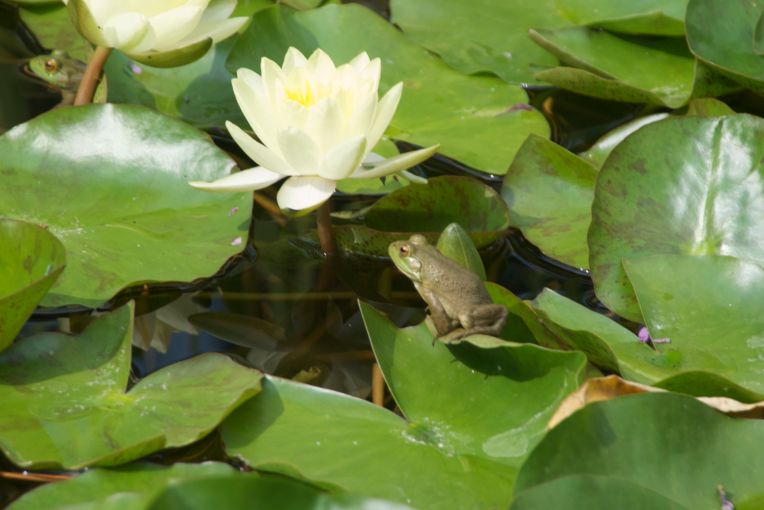
Spent most of the day sketching at the Rolling Hills Wildlife Adventure zoo and taking pictures. So far, the big hit seems to be a small pond outside the entrance to the museum that has water lilies and at least ten frogs, who may now be some of the most photographed frogs in history. At a place where there are snow leopards, amur leopards, Indian rhinos, black swans, orangutans and other exotic creatures, it seems like every time I walk out of the museum there’s at least two or three artists photographing the frogs. The opening reception is this evening. Should be fun!

Frog

Sept. 3-
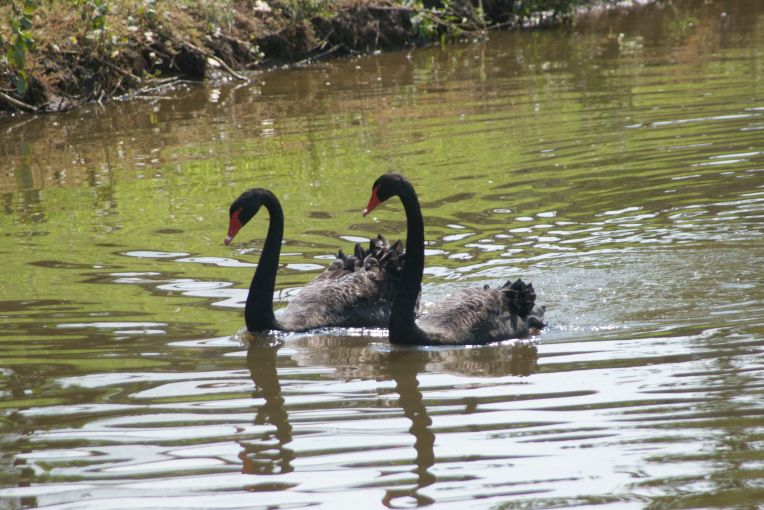
Back from the Art and the Animal show venue, Rolling Hills Wildlife Adventure. About eight of us are here a day early. They fed us a lovely brunch and then we got to see the show, which is filled with superb work. After that, we were taken on a walking tour of the zoo, which has everything from capuchin monkeys to asian rhinos. We invade a local Italian restaurant at 6:30.

Black Swans
Black Swans

Sept. 2
Hanging out at the Country Inns and Suites in Salina, Kansas after visiting the Tallgrass Prairie National Reserve. Gloomy, grey day, so nothing to photograph. It is, after all, thousands of acres of….grass, but represents a significant chunk of the 5% or so of that ecosystem that is left. They hope to reintroduce bison at some point, but not remove the domestic cattle, which is too bad.

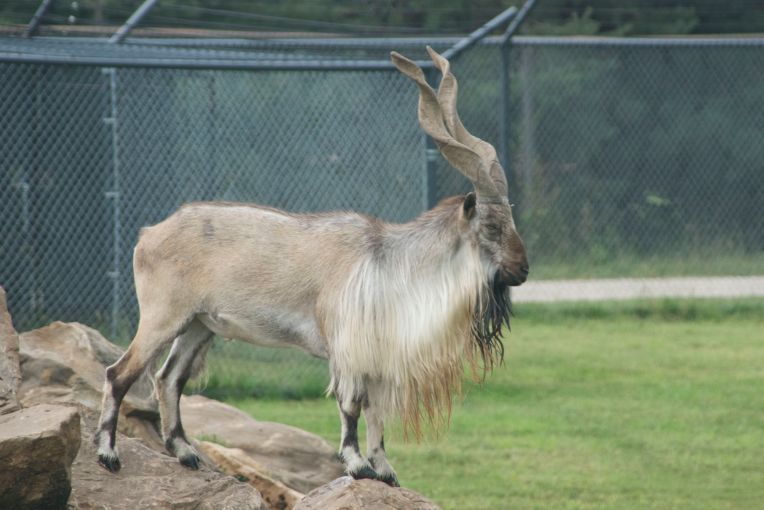
Transcaspian Urial
Transcaspian Urial

Sept. 1-

Trip started with a 90 minute delay due to weather in San Francisco, not uncommon for the 8:50 am flight. My next two legs were bumped to later flights, so I got into Wichita at 9:30 instead of 7:30. I so love arriving in places I’ve never been after dark and having to find a motel on the other side of town. But it all worked and the Fairfield Inn and Suites was quite nice. Super comfy bed.

The Final Drawing. Really.

Came back in this morning and looked at the last version with fresh eyes…..and realized that in trying to solve one problem with the ram on the left, that I’d wrecked the rhythm of the composition. The ram’s head needs to be down. Here are the two versions. I think you’ll see what I mean. What I had:

Argali 2What it got changed to:

Argali-4What I just revised it back to:

Argali-5

Now I have the more dynamic zig-zag line between the top line of the left and main rams. Version 2 made things too static. Better visual variety. Argali run up the rocks like water flowing uphill. And down with equal ease. I wanted to try to catch at least some of my visual impression of that movement. They are so at home in the amazing rocky outcrops they prefer.

Why I am posting all this preliminary stuff? Because people, including other artists, mostly only see the end result or pretty, finished drawings which creates an unrealistic idea of how messy and time-consuming the creation of a painting can be. I’ll flail around for as long as it takes. And that’s ok. The important thing is to get what I want, if I can.

The New Big Painting, Cont.

Sometimes having another, educated eye can really help. Since this is a big painting which will require a big time commitment, I decided to consult with another wildlife artist who I have taken a workshop with and whose judgment I trust. She knows me and knows what my goals are for my work. I sent this image to her on Friday and got her response this morning.

For reference, the first version from the previous post:

Argali-big-draw

The next version. I also decided to make the sheep on the right a juvenile to provide variety for the horns, along with adding some of the body and changing the head position.

Argali 2

Here’s the critique:

“These guys remind of me of desert bighorn – horns and heads large for lightly built bodies (though desert bighorn have much thinner horns). The mouth on the rear youngster is a little uncertain (what’s he doing?). I’d like to see more suggestion of muscle in the body – particularly hindquarters – of the main ram. His front left leg feels a little stiff – I like the movement in his overall gesture, but the knee and pastern don’t flow as well. He seems a little over at the knee on his right front. I know sheep aren’t built like horses, but sometimes (to borrow from Bob Kuhn) the artist has to make changes that look better, even if they’re not as accurate.

The front partial ram head/horns ought to be larger to indicate perspective; his body seems larger, as it should, but head/horns don’t seem as large relative to his body as the main ram’s.

Painting all those rocks will be great fun! I love rock and snow – so graphic. Everything in the composition leads us to the right and the main ram’s head – should be striking. You might consider turning his head towards us a little to keep the viewer from zipping out to the right – but it should still work as it is too.”

This are exactly the kind of technical notes that I was hoping for from someone who only knows what I’ve showed them, not what I think I’m trying to do.

This afternoon I did the re-drawing, erasing where needed. The muzzle of the ram on the left head got a little too big. I’ll fix that tomorrow, but otherwise it’s all working. As far as the first observation of the critique- in fact, the argali are very solidly built compared to desert bighorns. The big argali rams also weigh twice as much, 200 lbs. vs. 400 lbs. But both have very slender legs in relation to the bodies.

Argali 3

Now I have some good visual variety. The three argali are all different sizes and angles. I have the directional flow that I want, but I need to make sure that the viewer’s eye doesn’t “flow” off the right hand side. The stacked rocks will be the “stopper”. I’ve minimized the horizontal planes and added some shrubs and more small trees, aspens that I saw at Baga Gazriin Chuluu.

The next step is the value study. Value is light and dark relationships, separate from color. I already know that the area of highest contrast will be the main ram’s head against the sky.

UPDATE 8-25-09:

The re-drawing is done. I ended up changing the whole head and neck of the ram on the left side and straightening the foreleg of the main ram a little more. One of the lessons I learned when I worked in the sign shop doing hand-drawn lettering was the difference that, literally, the width of a #2 pencil point was between right and wrong. When I saw it for the first time, it was like a big, bright light came on. It was so obvious. And it’s true when drawing animals or anything else. I will always be grateful to the owner of the shop for giving me the opportunity to train my eye to discern differences that fine. The acceptable tolerance was 1/64 of an inch when drawing letters a few inches high.

I still see little things in the drawing that bug me, but I’ll deal with them when I do the brush drawing on the canvas. Being bugged about something is one of the ways that I know a painting isn’t done yet. And when nothing bugs me anymore, I’m done, which really means that I’ve solved all the problems. The itch to fix what I can see isn’t right is one of the things that drives me on a painting. I Just Can’t Stand It.

Argali-4

I also lightly drew some more rock towers on the right for my “stopper”. They will be simple shapes in aerial perspective.

UPDATE 6pm:

I lied. I did one more overlay this afternoon with a mechanical pencil (HB lead) to really refine the drawing and get it ready for the value study. Every version allows me to be more decisive about tricky shapes like the horns. Plus, I wanted to more thoroughly work out the background and foreground. And I still wasn’t happy with the ram on the left, so he got re-drawn. Again.

I’m using Canson tracing paper for the first time and, wow, is it nice. I used to use whatever was cheapest, but no more. All but the last drawing, which I’ll post tomorrow, was done with a Sanford Draughting Pencil. They were Eagle Draughting Pencils when I first started buying them many years ago and appear to have been owned by at least two other companies between then and now. Fortunately, they’ve never been “improved”, so they’re as good as ever.


I Looked Out The Window This Morning……

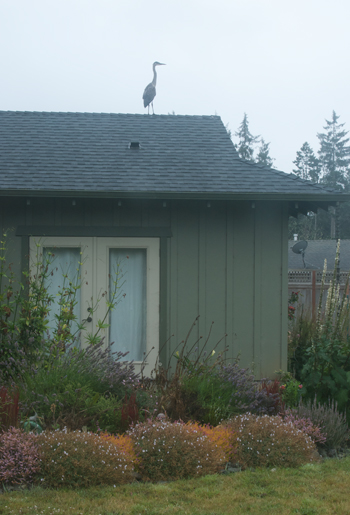
Just in time to see this great blue heron take off from the backyard and swoop up onto the roof of my studio. Fortunately the camera was handy, even though I had to shoot through the glass.

GBH-on-roof

GBHeron

How I Start a Big Painting & A Favorite Photo from Mongolia

One of the advantages of my illustration training is the process that we were taught for putting a picture together. I don’t do all the steps all the time, but now that I’m about to start one of the largest paintings I’ve done so far, I need the control that the process gives me.

My first sighting of argali at Baga Gazriin Chuluu Nature Reserve, thanks to Onroo the local camp staffer who knows the place and where the animals tend to hang out, was a group of rams in wonderful morning light. Mostly they were grazing and resting. For this painting, however, I wanted action. The essential image popped into my head and then it was a matter of getting it down on paper, which is one reason why the thumbnail process is so valuable.

Here’s some of the reference that I’m using:

Argali-G-G

I liked the pose of the big ram who is third from the left. This photo was taken at Gun-Galuut Nature Reserve. I dumped the image into Photoshop and did a horizontal reverse to get him going the direction I wanted. And then zoomed in as much as possible. The next three are from Baga Gazriin Chuluu. Talk about reference eye candy.

Argali-ref-shot

Argali-ref-shot-3

Argali-ref-shot-2

I did a couple of drawings of the main sheep to try out position and gesture.

Argali-2

In this one I added the a background to see how that worked.

Argali-1My idea is to channel a little Edgar Degas and have the animals coming in from the frame, not have all of them within the frame. This is too static, but it gives me something to bounce off of. Gotta start somewhere.

Here’s the thumbnail sheet. I’m trying to figure out where the three masses of sheep will be in relation to each other. Then I did another, larger sketch.

Argali-thumbThis is more what I had in mind. Almost everything is on a diagonal, which gets rid of the too-static quality of the previous sketch. As I draw and re-draw the animals, I’m able to get to “know” them better and can refine and push the poses.

I spent a good chunk of yesterday doing a finished scale drawing that will be transferred to the canvas via the ancient and honorable grid system. I ended up with three layers of tracing paper. The bottom one had the lines for the edge. The second one had the drawing of the sheep. The third was the landscape. I did one and it’s really nice, but not right for this painting. Replaced it with a new sheet and re-did it. When I was satisfied that I had more or less what I wanted, I re-drew the argali, once again refining and tweaking the drawing.

At this point, I have solved the design/composition problem and the drawing problem. Both may be re-visited at any time as needed if I see something that needs fixing, but the next step is a value study, that is, the pattern of lights and darks. We were told in art school that if we get the values in a picture correct, then we can do anything we want with color, which I have found to be true. One of the tasks that needs doing to take the Gun-Galuut argali and the image of the sunny rocks and make them work with the Baga Gazriin Chuluu morning light. For that I’ll do a color study.

I hunted through my reference once again for the sheep images that I thought would work best. And here is, so far, finished drawing. Still not sure about the argali on the left. I’ll see how it looks to me on Monday. I also think I need a little more “air” on the right side and maybe the top. Not much, maybe a half-inch.

Argali-big-draw

Finally, a favorite photo from the local Naadam at Erdene. Waiting for the race results.

Erdene-rider,-pink-del