Eggs and Elk

Ok, here it is, as promised. Sure to bring a million dollars at auction 1oo years after I’m dead and gone (which means it will probably go for about five bucks). Took about 30 minutes.
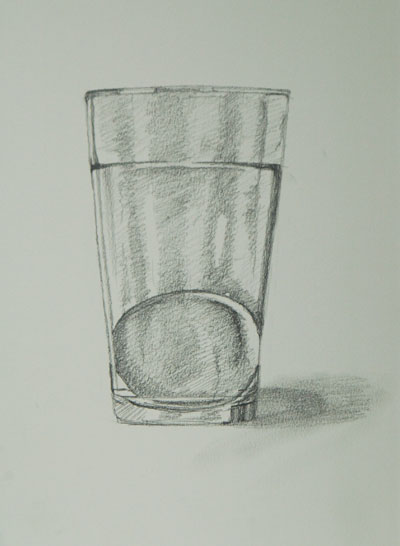
egg-in-water-glass.jpg

I thought that I might start to post works in progress which, one, always gives me something to blog on, and two, may provide one answer to “How do you artists do this stuff?” So, here we have a start of a cow elk that I photographed in Yellowstone in June of 2005, along with the reference photo. I was “game driving” between Mammoth and Norris and up on a hillside a group of elk were grazing. As you can see, they were in one of the burned areas. Lots of downed tree trunks and fresh new pines coming up.
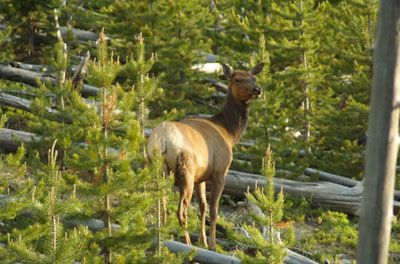
yellowstone-elk2005-06-25.jpg

cow-elk-in-progress.jpg

The first questions I ask myself when I have an idea for a painting or am inspired by reference I shot are:

1. What makes me want to paint this? In this case, it’s a combination of the light, her graceful pose and I haven’t done an elk painting for awhile. A painting needs one strong idea and everything else is subordinated to it (Thanks, Scott Christensen). Every artist finds their own way to do that.

2. What is the best size and proportion of canvas to communicate the idea of this painting? (Thank you, John Banovich) As you can see, since my idea is the cow elk with the great light, most of the background was extraneous, so I chose a vertical format. This is a simple subject and, for me, didn’t really call for a big canvas, 16″x12″ seemed about right. But someone else might have decided that female animals don’t get the prominence in the art world they deserve and done her six feet high. Both are equally valid choices. I’ve had viewers of my paintings comment that they like seeing something besides bloated trophy males and enjoy my more off-beat subjects, which is encouraging. But ultimately I paint what I want, the way I want and then try to find a market.

3. As I lay in the drawing with a brush, I’m already thinking about the value (light/dark) pattern. I want the area of highest contrast where I intend the viewer’s eye to land. So, from the beginning I’m altering my reference to suit the idea of the painting. This brings us to the use of photographs in painting; the good, the bad and the sometimes seriously ugly. I have strong opinions about it (surprise. not.), but that’s a topic all by itself. Suffice to say for now that if you don’t have a strong idea of what your painting is about, then you may end up as one of those legion of artists who end up copying their photos, rather mindlessly sometimes. The key is “mindless”. Photorealists have made a quite conscious choice to work a certain way. Do what you want how you want, but do it by choice, not default.

So, here we are after two sittings. During the first, I solved the design: where the animal would be, how big and roughly how the surrounding habitat would go. In the second, which took about an hour. I refined the drawing, laid in my darkest tones and figured out roughly where the small pine trees would be, watching out for bad tangents (which is when two objects on different planes touch, which destroys the illusion of three dimensions) and deciding where the areas of highest contrast would be. California landscape painter Kevin Macpherson comments in one of his books (buy both if you want to self-study oil painting) that a painting is a series of corrections, which is so, so, SO true. When everything is corrected, you’re done. So simple, really.

Final notes (for now): I work mostly with round brushes. I like the calligraphic marks I can make with them, having been a calligrapher and sign painter at one time. I go 3-5 shades darker in value all over and then come back in with successively lighter values. I also try to work “lean to fat”, artist talk for going from thin paint to thick paint. Look at some traditional oils next time you’re at a fine art museum and you can see it. It’s one reason only seeing reproduction is of such limited use. Everything is flattened out. Original paintings have a literally third dimension of paint thickness. Fellow artist Julie Chapman’s work is a perfect contemporary example. You can’t really appreciate her lush, juicy brushwork unless you’re looking at the real thing.
Rats!

Had one of our first episodes in 2008 of what we call “Animal Planet” last night. Heard a noise in the kitchen, cat in living room suddenly watchful, David went to kitchen and called me. I went in to see…a medium-sized brownish, black rat perched on top of one of our dining table chairs with another cat or two prowling beneath. Rat’s back was damp, but seemed otherwise undamaged.

I’ll lengthen the suspense by noting that while I’m not sure of the species, it was probably a young black rat. Largish ears, cute face with big, sparkling black intelligent eyes.

I’m always tempted to run for the camera, but it’s more important to get a wild animal back outside where it belongs and I didn’t want this guy (or girl) jumping down and getting under something like the refrigerator, which would have caused me to miss the end of the American Idol results show (boo hoo). When it’s mice or lizards or birds, I grab rubber gloves, catch and release. (The hummingbird required a pond net. However, that’s another story.) But I didn’t want to risk a rat bite, so I used a large wide-mouth jar that happened to be sitting on the counter and, after a couple of tries, got the rat to dash into it. We enjoyed a nice long look at our unexpected visitor and then I released him/her next to a pile of alder logs and branches a short distance from the house.

Peregrin, our only male cat, was probably the one who brought the rat in, but seemed only momentarily put out when it vanished.

And yes, I have no fear or hatred of rats. They are smart, canny survivors, but belong outside eating bugs and slugs, not inside providing hunting sport for the cats.

ART TALK

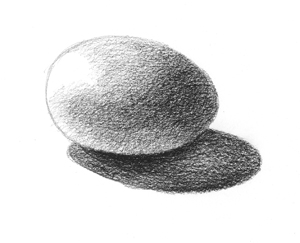
So here’s my version of a very basic drawing exercise that any other artists reading this are probably familiar with. It’s deceptively simple. Draw an egg lit with light from one source. Doing this will, ahem, illuminate something that was worked out by artists in the Renaissance-how light falls on objects. If you look at portraits from that time, the formula is easy to see and has five parts: Light, core shadow, shadow, reflected light and cast shadow. There is also often one bright spot in the light area called the highlight. Anyone can easily set up an egg, shine a desk light on it, take a pencil and paper and have a go. Even people on the road in RV’s. Right, Rene?

egg-1.jpg

Aperture and a Few Favorite Photos

In between trying to get a number of paintings done, I’ve spent one full day of each of the last two weekends importing my images into Aperture, the digital photo manager that I had pre-installed on the iMac. I think I’m almost halfway there. All of Kenya 2004, Mongolia 2005 and 2006, two trips to Wyoming and one to Montana are in, plus some personal stuff and photos of paintings. The two trips to Mongolia come to 5,792 total. Kenya 2004, the art workshop safari with Simon Combes and nine other artists, totals 5,116. Wyoming, which includes Yellowstone, the Grand Tetons, the areas around Jackson and Dubois totals 3,824. Can you imagine how much paper and ink it would have needed if those had been prints? Or plastic, paper and ink if they were slides? And how much shelf space I’d need. So far, it’s all on the iMac’s hard drive, which will be backed up to our Buffalo Terastations.

Digital is by far the most environmentally friendly way to acquire and store images and music. I’m ready for movie downloads to our tv anytime now.

elephant-and-vehicle.jpg Samburu 2004

Aperture’s image organization system is based on projects, albums and folders. Half the battle was understanding how I would want to find things well enough to set up the essential system before I started importing. I finally went with projects based on location. Images can only be in one project, but can be in multiple albums. So, I’ve done the initial imports into country projects that have specific location albums in them. Therefore, the Mongolia project has albums for Hustai National Park 2005, Hustai National Park, 2006, Khomiin Tal 2006 and so on. I had realized when I was still working with IMatch on the PC that I needed to be able to not only go to a specific location, but also when I’d been there, so this time every location name also includes the year. The next step will be to copy all the animals into specific species albums, along with various landscape features like rocks and trees, time of day like sunsets, and weather features like clouds. Everything will be batch keyworded and have appropriate metadata added. Maybe by the end of baseball season.

nmwa-marmot.jpg

Marmot at National Museum of Wildlife Art (He’s real.)

I bought an after-market book on Aperture with a DVD tutorial that I’m working my way through. I got a handle on importing and dove in because my images look so completely stunning on the glossy 24″ iMac monitor that I needed to start working from it immediately. I’ve been cruising through a bunch of my photos this afternoon, especially all my argali reference from Mongolia, and I can honestly say that for the first time I can really see what my 6mb Nikon D70’s can do. Wow.

me-and-tshuu.jpg

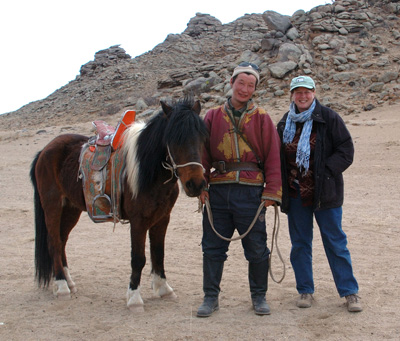
Local herder and I at Ikh Nartiin Chuluu Nature Reserve, Mongolia

My paintings are going to take a big step forward. John Banovich, who I was fortunate enough to have a workshop with, told us that “you are only as good as your reference”. That is so, so true. I can’t even believe that I ever thought that 4×6 or even 5×7 prints would give me a good result. I now have the equivalent of huge transparencies that I can work from in daylight.

Hope to post some new paintings by late next week. Heading down to San Francisco for the weekend and taking along a blue heeler from the shelter who needs to go to rescue. Next entry I’ll tell the story of my first transport two weeks ago. Super short version-four dogs, ten hours driving.

A Snowy Day at Sea Level

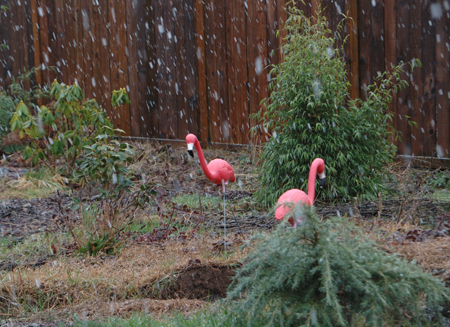
About 1:30 yesterday afternoon, while I was importing images to my iMac, it started to snow! Not powder, just wet icy stuff, but snow nonetheless. Here’s a couple of photos of the garden and yard. I really like the juxtaposition with the flamingos (they’re part of my in-progress “tropical” garden; the place where all the plants with hot colors will go).

snow-and-flamingos.jpg

For awhile it was really coming down

snow-in-back-yard.jpg

ART TALK

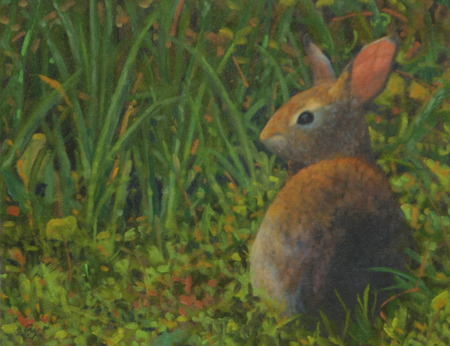
The painting below is called “Warmth of Spring”, which we’ll all be ready for soon, if not right now. It’s from reference that I shot a few years ago when we lived on 20 acres some miles north of where we are now. I loved the warm light coming through the brush rabbit’s ear and the variety of plant textures around him or her.

warmth-of-spring450.jpg

The original of this painting is available, as is a limited edition giclee.

It’s Just Not Fair

So, inches of snow in Atlanta, Georgia and it’s supposed to be around -13F in Green Bay tomorrow for the Packer/Giants game. In most of the country, it’s time for gardeners to kick back with a cup of tea or cocoa, peruse seed and plant catalogs and dream about the gardening season to come. Me? I spent the afternoon weeding. Weeding! In January! It’s like winter has never come, even though it’s been alternately cold and rainy. The grass and weeds invading my flower beds just don’t get that they are supposed to give it a rest already. Sheesh. Where’s the off button?

ART TALK
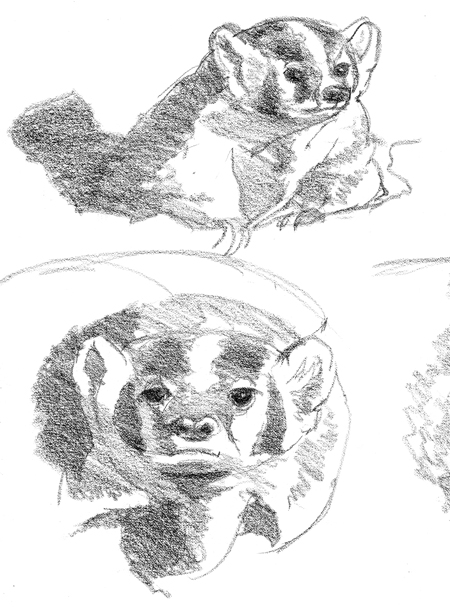
Many people are interested in how artists do their work. For me, it usually starts with drawings. It’s how I like to familiarize myself with a species that I haven’t painted before and, anyway, I just like to draw. Currently on the home page of my website is my first painting of a badger. Before I started it, I did a number of drawings to learn what a badger looks like. Here are two of them-

Daisy drawings

Her name was Daisy and she belonged to the Triple D Game Ranch in Montana. I “met” her at a animal drawing workshop taught by dynamite wildlife artist Julie Chapman. She was about 20 years old, with loads of badger attitude. She died a couple of years ago, although I didn’t know that when I did the painting or these drawings.

A Tale of Two Cats

I’ve had the good fortune to take two trips to Kenya, one in 1999 and the second in 2004. It really is the greatest animal show on earth. What is happening there now is terribly disheartening. The Kenyan people have never known what it is like to have an honest, competent government and they deserve better. But when you have a young, educated population (most Kenyans finish high school and many have university educations), a lack of good jobs, a majority of the population that stills thinks more in terms of what tribe they belong to than being Kenyans and a one of the three most corrupt governments in the world, the stage is set for the situation that is occurring now. Kenya is very dependent on tourist income and when things exploded, I could hear the sound of safaris being cancelled. I don’t think that it would dangerously unsafe to travel there right now, since visitors have been wisked from the airport to the heavily guarded hotels and then out into the parks and reserves, also guarded, for a very long time due to the serious crime problem in Nairobi, but I wouldn’t take the chance myself until things calm down. The frustration level is clearly very, very high.

On a happier note from happier days for the country, I was fortunate enough to go on an art workshop safari with the late Simon Combes and nine other artists in October of 2004. (I plan to share some of my travel stories and the paintings that came out of them in this blog.) Afterwards, I flew back down to the Masai Mara and stayed a few days at a fantastic tented camp, Kekero, which in on the Talek River. Close enough that hippos woke me up at night with their grunting and roaring. Boo hoo. The routine, either on safari or at a tented camp, is to be awakened before dawn, which, with Kenya being on the equator, is always around 6am. Coffee and some cookies are delivered and you have 15-30 minutes to pull it together, get dressed and be out at the vehicles. So, every morning, you get to see the very light of the day, which suggested the title of this painting, “First Light”

First Light

He was a beautiful big boy, still resting after a night of feasting. It was magical to sit there as little by little the sun illuminated him in warm morning light. We had him all to ourselves and hung around until he got up and wandered off.

On the domestic front, I would like to introduce Persephone, who will be seven this year. We had gone to look at a puppy and the woman mentioned a cat she had rescued. Short version: the kitten wouldn’t get down off a fake ficus tree when ordered (!?) to do so, so was grabbed and thrown across the room into a wall. Grandson calls Grandma, who rushes over and takes the cat. Too many dogs in house, so cat ends up in the back carriage house of her small Victorian where we saw her, liked her, adopted her (puppy went to someone else). I watched for neurological damage, but she seemed fine (I know, some would say, with cats who can tell). We did have to take her to the vet for the removal of a front canine that had split vertically into three pieces after we noticed her jaw was swollen, undoubtedly an impact injury, but other than that she’s been fine. This is one of my favorite pictures from when she was about a year old.

Persephone

She has ended up being not exactly a svelte cat, despite a weight management diet. She’s just an endomorph and has nicknames like The Princess, the Bon Bon and The Plush Princess. She is lightning fast though. I saw her catch a gopher once. Strike, pull it out of the hole in a split instance and then carry it off to eat the whole thing. Here’s a more recent photo. She really is a beautiful cat, but, boy, is she a princess.

Persephone 2

Happy New Year!

Back in the saddle again for 2008. Lots to look forward to.

All the kittens I fostered have found new homes. I thought that I would start to introduce that permanent animal members of the household. First up- Niki, our four year old tricolor rough collie, self-appointed guardian of all creatures large and small. Here’s picture of him with Tucker and Katie. Niki had laid down by the crate and the two kittens came over and got as close as they could. All of them quickly became fearless of my 75 lb. dog.

niki-tucker-katie.jpg

We finally had our first ducky visitors to our pond, three hooded mergansers. One male, two females. I thought, uh oh, there go the goldfish, since mergansers are diving ducks and, sure enough, while we watched, they caught and ate two big ones. But we have since seen at least eight or nine in their usual hangout, so we didn’t do too badly. Michiko spotted them and instantly became a fan. More about her in the next week or so.

michiko-merganser.jpg

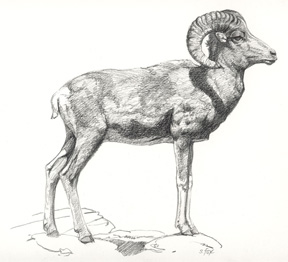
In art news, the latest issue of the newsletter of the Society of Animal Artists features drawings that I have done of Mongolian wildlife. Here’s three of them, an argali ram, an ibex billy and a takhi mare and foal (Przewalski’s Horse). They were done on 2 ply bristol with a Wolff’s carbon pencil.

argali-ram-standing-blog.jpg

ibex-billy.jpg

takhi-mare-and-foal-heads-blog.jpg

HAPPY HOLIDAYS!

I’ll be back after the 25th. In the meantime, please bear with me.

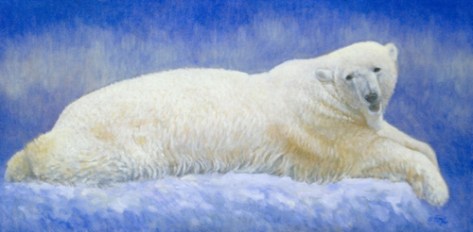
The Recliners #2-Polar Bear

Ok, Time For Some Art

I love to paint. I love to travel. I love animals. Put it all together with supportive husband who used to stack up the frequent flyer miles, and you get a nature artist who has been lucky enough to go to Kenya twice, Mongolia twice and North American wildlife ground zeros like Yellowstone, the Grand Tetons and Glacier to sketch, observe and photograph a mouthwatering variety of wildlife and their habitats.

Ikh Nartiin Chuluu Argali

The painting above is “Ikh Nartiin Chuluu Argali”, a 15″x30″ oil on canvas. The name translates as “Great Sun Rocks Sheep”. My first trip to Mongolia was in April of 2005 to participate in an Earthwatch Institute project “Mongolian Argali”, which are the world’s largest mountain sheep. A ram can weigh over 400 lbs. and have a horn curl of 65″. In this painting I felt that I was introducing a species that not many people have seen, so I wanted to show them in their environment in the reserve, which is a large area of rocky outcroppings rising up above the steppe, which you can see in the background. “Ikh Nart” is about a five to six hour drive southwest of Ulaanbaatar on a road that largely parallels the railway line to Beijing.

They blend in very well with the rocks and so I designed my composition with the idea that the viewer would see the lead ram first since its head is in high contrast against the background and the second ram, well, second.

For more on my travels, visit my website. For more on the reserve, visit the website listed to the right.