Available Next Week on EBay- Small, Affordable, Original Oil Paintings!

Like many artists, I’m trying to figure out what my sales options are given the current economic climate. I’m also interested in seeing if I can sell art directly on the internet. And, a few months ago, I was showing some friends some of the small studies I do to work on various aspects of painting and one encouraged me to try selling them. Taking this all together, I have decided to offer a “new line” of small oils that I am calling “Studio Studies”, because, well, that’s what they are.

As anyone who paints most days a week knows, they do stack up after awhile and I have a few dozen that I’ve decided I’m willing to find new homes for.

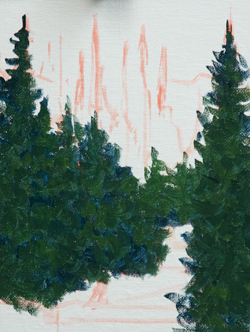
I plan to start offering them a few at a time on EBay, starting next week. Here’s a small preview, starting with one that I photographed in progress, so it’s a short step-by-step demo of how I do these mostly 6″x8″ studies that usually take less than two hours. The idea is to quickly capture a light effect, so detail isn’t relevant. This should look familiar to anyone who has taken Scott Christensen’s Ten Day Plein Air Intensive, because that’s who I learned this approach from and I really like it.

STEP-BY-STEP 8″X 6″ STUDY (from last Friday’s post)-

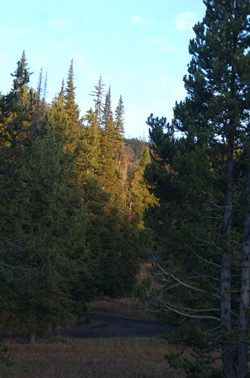
An image I shot up on Dunraven Pass in Yellowstone National Park at first light. What I was working on the was the color temperature shifts from shadow to light.

Photo reference
Photo reference
Initial lay-in
Initial lay-in
Starting with darkest darks
Starting with darkest darks and basic shapes
Adding light and medium tones
Adding light and medium tones; notice brushwork to create trees
Dawn on Dunraven Pass; 8"x 6"

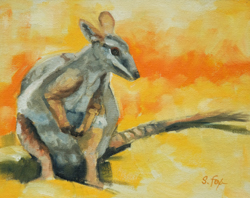
Here’s a couple more. First a demo that I did in about an hour at the Marin Art Festival of a small kangaroo which I photographed at a zoo.

Little Kangaroo- 8"x10"

And a landscape a few minutes from our house looking east from Clam Beach to the bluff. It was summer and the foxgloves were blooming. They’re not a native, but they look like they belong here in Humboldt County.

Clam Beach Bluff; 6"x8"

Finally, since I strongly believe that artists should help and support each other, here, from Alison Stanfield, who runs ArtBizCoach, is some solid advice on “Community”. Thanks, Alison! (Hope it’s readable. Let me know if it’s not.)

community

ART THOUGHT FOR THE DAY

The artistic mind is one that takes years to develop. Painting never gets easier. Struggle is not something that one goes looking for. It will find you. Just give it time.

Scott Christensen, The Nature of Light

Mongolia Monday- Bizarre to Beautiful “Bugs”

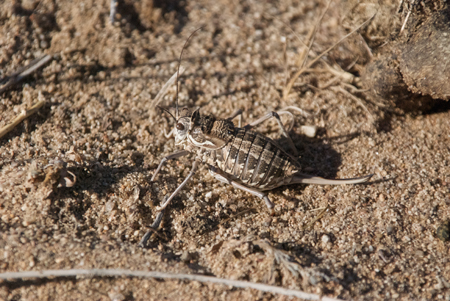
I probably should have run this post last week before Hallowe’en, but, in any case, here’s a variety of the insects that I’ve seen in Mongolia. Not all that many and I don’t know what the species are. Field guides are kind of thin on the ground for Mongolian wildlife. So if anyone can ID these critters, let me know and I’ll update this post.

The photos were shot on my 2006 and 2008 trips. I used a Nikon D70 with a Tamron 28-300mm lens in 2006 and a Nikon D80 with a Promaster (made by Tamron) 28-300 in 2008.

Saw this one in the Gobi. It was big- close to 3″ long.

Saw this one at Ikh Nartiin Chuluu Nature Reserve. There were specimens at the Natural History Museum in UB but, unfortunately, the labels were all in cyrillic Mongolian, which I can’t read. Yet. They are related to grasshoppers, but aren’t. That much I was able to find out.

Grasshopper at the ger camp, Hustai National Park

Another grasshopper photographed at Hustai.

Large, almost 3″ grasshopper photographed near Dungenee Ger Camp, Gobi Desert.

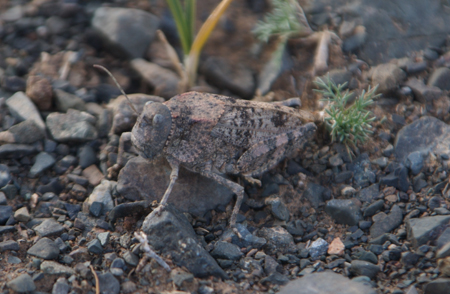
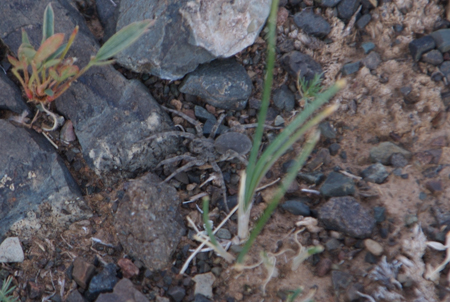
Photographed same location as above. This one really matched the rocks.

Only spider I’ve seen in three trips to Mongolia. Photographed same time as the two grasshoppers above.

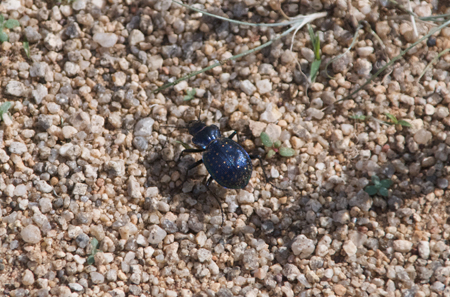
Beetle at Ikh Nart. The challenge was waiting until it scurried out into the sun so I could catch the deep blue color.

This was really one of the most dramatic wildlife spectacles I’ve seen in Mongolia. The beetle had pounced on the brownish insect and the battle was on, with the latter trying to escape from the former. The beetle inexorably manuevered the brown one around for what we thought was the death grip in which they were head to head. Then, suddenly, the brown one broke free and got away. It went on for minutes. I took quite a few pictures, but this one seemed to show the situation with the most clarity.

Ikh Nart butterflies.

Good Advice for Wildlife Artists

Personally, I have found that learning from good teachers is a great time-saver. What could take years of trial and error can maybe be addressed in an hour and then you get to move on to the next challenge.

In that spirit of benefiting from those who have gone before, here’s some thoughts about the making of wildlife art that I find worthwhile, illustrated with a few of the reference photos I’ve shot through the years.

KEN CARLSON:

“One of the challenges of painting a number of animals, particularly pronghorns, is to design an interesting grouping. What I try to achieve is an appealing overall shape; an uncontrived, natural look to the grouping…”

National Bison Reserve pronghorns; this one has possibilities
National Bison Reserve pronghorns; this has possibilities, but the "grouping" needs a lot of work

BOB KUHN:

“…the need to convey those gestures, poses and attitudes that spell out the character unique to the animal.”

Lake Nakuru cape buffalo; typical "I dare you"
Lake Nakuru cape buffalo; typical "I dare you". The painting I used this reference for will be on my website by the end of November

GUY COHOLEACH:

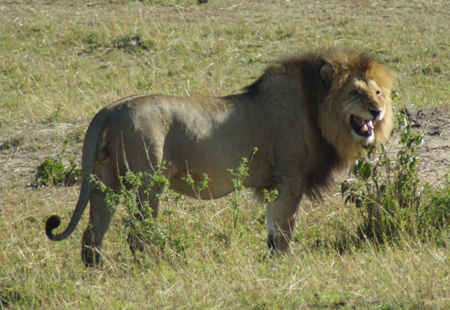
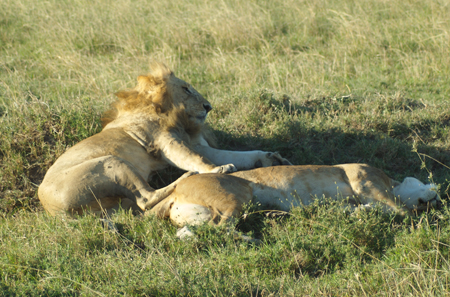
“You look into the eyes of a leopard in a zoo, and sure, you can get a lot out of them. But look into the eyes of a lion 30 feet away from you, when you’re standing right in front of him with no rifle, and let me tell you, they look a lot different. They do.”

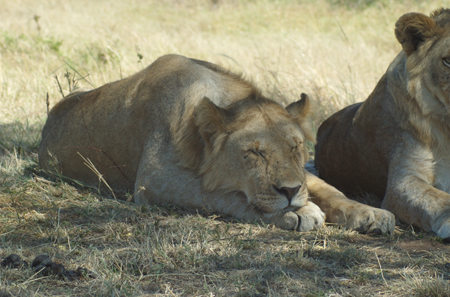
Masai Mara lion; I was in a car, but still...
Masai Mara lion; I was in a car, but still...(Actually, he's flamen. There was a more dominant lion nearby who was with a lioness.)

NICHOLAS HAMMOND author of Modern Wildlife Painting:

“The best of modern wildlife painters show us the mystery and death, memory and beauty and what is to be learned, or lamented, loved or wept for.”

And it helps to have an assistant

Happy Hallowe’en!

And Samhain, too!
And Samhain, too!

New Paintings and Equipment Review

I’m just finishing a second productive week in the studio after my return and, boy, does it feel good. As did getting out yesterday afternoon and planting some new roses and spring bulbs.

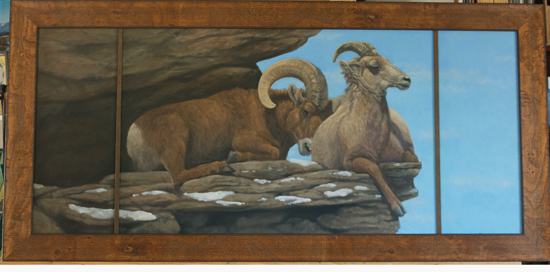
HEAVY LIES THE HEAD

I’ve got a number of pieces in progress, but wanted to share this one that was completed before I left. It was in the Wild Visions 2 show and I hadn’t had a chance to photograph it until a couple of days ago. I’ve never done a three-panel piece and I’m thrilled with the framing. Unfortunately, the framer has gone out of business and there isn’t anyone else around here who can do this kind of custom work. Drat.

Heavy Lies the Head   oil   20"x 46"
Heavy Lies the Head oil 20"x 46"

The animals, bighorn sheep,  were photographed at the Denver Zoo. It was a warm morning and the ram couldn’t keep his eyes open. His head kept, drooping, drooping, until it sank onto the back of the ewe, who never even blinked. The pose was irresistible, but I did check with Laney, a nationally known artist who specializes in bighorns, to ensure that this behavior could have happened in the wild.

Of course they needed a more interesting setting, so I found some nice rock formations that I had shot up on Logan Pass in Glacier National Park, where bighorn sheep are often seen. Laney suggested adding the bits of snow so that the presence of the ram and ewe together would be consistent with the season.

Besides the great pose, I wanted to try to capture the feeling of the environment bighorns live in and how casual they are about heights that would make a lot of people faint with vertigo.

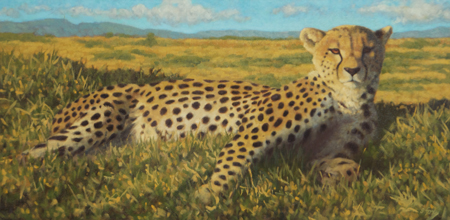
CHEETAH HEAD STUDY

Some animal’s heads are more challenging than others. There are subtleties to the forms that, if they are missed, leave the viewer who knows better feeling that the painting was “close, but no banana”. Cheetahs seem to be one of the difficult ones. I think I’ve seen more badly drawn and painted heads of cheetahs than maybe any other animal, so I’ll hang it out there and offer for your perusal this new head study.

Cheetah Head Study
Cheetah Head Study oil 9"x 12"

EQUIPMENT REVIEWS

All in all, everything worked as it was supposed to.

My husband was very happy with his LL Bean Katahdin 20F sleeping bag. He liked the larger size and the fact that it was rectangular. The Climashield fill kept him comfortable. The only down side was that it didn’t pack down as small as my down bag.

My Katahdin 20F down bag was great, as usual. One of the nice things about the rectangle is that it can double as a comforter. This is handy in a ger, which has regular beds with sheets and blankets. It can get cold at night though, but unzipping the bag and throwing it over the bed worked well. And if the mattress was too hard, as is sometimes the case, I used the bedding as a “pad” and just slept on top of it in the bag.

The LL Bean ripstop cotton pants were absolute winners. We wore ours day after day and they seemed to shed dirt and never felt icky. My husband likes them so much, he now wears them for his everyday pants.

Loved having the New Balance walking shoes for around town and camp as a change from the hiking boots. Hadn’t made space for that before. The LL Bean Cresta Hikers were, once again, comfortable and functional. David bought a pair of Keen hiking boots, which he really likes for their comfort and breathability. What we found, however, during the deluge at Ikh Nart, when we had to walk around 40 yards to the toilet, was that his boots wetted through pretty quickly. Now, he hadn’t waterproofed them, because we hadn’t anticipated such hard, out-of-season rain, but my boots kept my feet dry throughout. They are leather, which I probably wouldn’t buy now unless I could source them to humanely raised cattle, but they really performed.

The Smartwool socks rocked! The Thorlos tended to get sweaty. Next trip I’ll take more Smartwool for the field and a few Thorlo light hikers for around town.

Loved the Patagonia fleece for comfort, but will probably replace it to reduce bulk. It took up a lot of space in my duffle. The Travelsmith jacket was great. Too bad they don’t make it anymore. The only problem was that the patch pocket got caught on something and ripped loose.

I love, love, love my Icebreaker 100% merino wool thermals! The top and bottom together take up less space than one piece of the other brand. I didn’t need them very much, but found them very comfortable when I did wear them.

It’s interesting how things are going full-circle for some outdoor gear. All there used to be was cotton and wool. Then the new, improved synthetics came along and, overall, they were an improvement in weight, performance, etc. But I’m finding that the new cotton and wool products work as well, if not better, and are not made with petroleum by-products.

The MetroSafe 2000 purse was good, as usual. Very functional, practical and unobtrusive.

My old standby neck scarf and hat did the job, also as usual.

Camel ride at Arburd Sands

The luggage came through fine. It was nice to have the lower rigid-side compartment on the bottom of the big one for odd, ends, extras and art purchases. It’s a rolling Sportsman’s gear bag from LL Bean. The small one, which Bean doesn’t make anymore, holds the camera equipment, toiletries bag and the minimum needed to survive a day or two without the big bag.

ART THOUGHT FOR THE DAY

There is a common foundation from which all the arts rise, and that is the need for self-expression on the part of the artist,-expression of his own personal experience, whether it be by words, as with literature; by sound, as with music; by pigment or with plastic shape, as with the graphic arts. But there is a further condition attendant upon this expression of which we do not always take account, namely, that the artist’s personal experience must be emphasized by strong feelings, by enthusiasm, by emotion, or the result is not art.”

Notes on the Art of Picture-Making by C.J. Holmes, Slade Professor of Fine Art, Oxford University, 1909

Mongolia Monday

I started some fun paintings from my new Mongolian reference last week and thought I’d share a couple of them in progress. I’m experimenting with a new way of starting, based on something I learned from John Seerey-Lester. Up till now I’ve begun by drawing directly with the brush, using line. It’s a default from being a “drawer” as a child. One of the major things I learned in art school was to see shape instead of, or in addition to, line.

Since I don’t use a projector, I draw directly from images on my monitor or a preliminary drawing. I sometimes get in trouble and spend a lot of time correcting. What to do?

Something must have been purcolating while I was away from the easel, because it suddenly occurred to me to do a light lay-in of the shapes with a big brush for size, proportion and location, wipe it out so that it is a ghost shape and then start the “real” drawing. It’s already made a difference.

So, here’s two in progress:

A Mongolian stallion 24″x36″

Mongol Horse stallion

And a bactrian camel 20″x28″

Bactrian camel
Bactrian camel

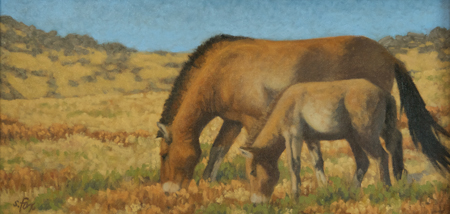
Also, here’s one of the paintings that was accepted and will be available for purchase at the Society of Animal Artists show “Small Works, Big Impressions” at The Wildlife Experience near Denver, Colorado.

It’s called “Breakfast for Two” and is a takhi mare and foal that I saw at Hustai National Park.

Breakfast for Two
Breakfast for Two

Equipment reviews on Friday and more paintings!