Mongolia Monday- Tsagaan Sar=great food

We hosted our Mongolian friend, her husband and two other couples for a Tsagaan Sar party this past Saturday night. Tsagaan Sar is the Mongolian New Year and the name means “White Moon”. In Mongolia, it’s about three days of visiting, gift-giving and lots of food and drink. As I was thinking about what to post today, I realized that I haven’t written about the food and, when I poked around my photos, found that I’ve ended up with quite a few images (I take pictures of everything). So, here’s an “album” of Mongolian food, with commentary. My apologies in advance for any homesickness this may cause my Mongolian readers.

Salt deposit, western Mongolia

One of our stops when I was in western Mongolia in 2006 was this huge salt deposit. And, yes, we drove right out over that “bridge”. If you’ve ever played the game “Civilization”, then you can understand how this resonated with me. For how many thousands of years have people been coming here to get salt?

Harvesting salt, western Mongolia

There happened to be two men doing exactly that. Some of our party had to give it a try. At the end of the handle is a scoop with holes in it to let the liquid run out. It seemed to be trickier to do than it looked, so the local guys were pretty amused.
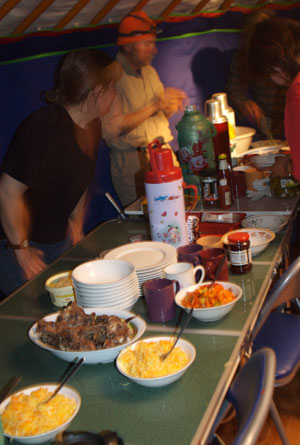
Mongolian BBQ during the Earthwatch project, 2005

The brown meat in the bowl is goat. The “Mongolian BBQ” that we get in the US is a Chinese invention and has nothing to do with how real Mongols eat. Their diet has traditionally been meat and dairy, diary and meat. Sheep and goats are slaughtered by cutting a slit in the stomach area, inserting a finger, hooking and pulling a vein (Thank you, Narantsogt, for the correction from what I had previously written. He has more info in the comments section) . Pretty humane and it keeps blood from going all over in a country where there isn’t extra water for cleanup.
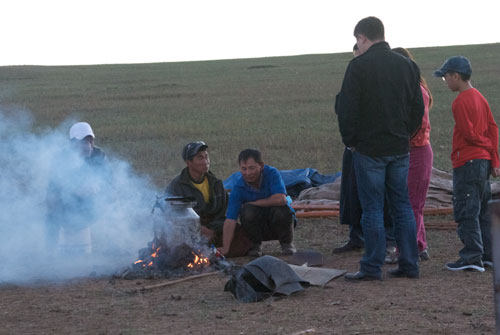
Real Mongolian BBQ, Arburd Sands

Here’s the meat in the pot after the foal branding at Arburd Sands. We were invited, but it was getting dark and it looked like the guys were settling in for a very convivial evening that was going to run very late.

Goat meat, Khomiin Tal

Sometimes the goat is simply butchered and hung up in the ger for use. I was told that this much goat meat would feed 3-4 Mongols for about two weeks. The humidity in Mongolia hovers around 10% max., so meat will keep in the dry air. On the other hand, the Mongols have been eating this way for centuries and have defenses against whatever might get into the meat. Westerners don’t, so we have to be careful what we eat. The head will be on the menu too. Nothing is wasted.

Meat for sale
Meat for sale

We stopped in a soum center (county seat) in western Mongolia for lunch. While we were waiting for our food, I saw these three ladies with meat to sell. They saw me take the picture and I went over and managed to tell them that I was from California. More smiles. Hope they sold out.

Buuz
Buuz

Maybe the most beloved item of Mongolian cuisine. Families make thousands of them for Tsaagan Sar. Generally the filling is mutton. I asked if I could take pictures and, from their expressions, their reaction was along the lines of, “Well, if you want to photograph something sooo ordinary, be our guest….What will those visitors think of next?” I guess the equivalent here would be taking pictures of a McDonald’s. I ate four. I practically had mutton fat running down my arm. They were one of the best things I’ve ever had when traveling. I can’t possibly miss them as much of the Mongols, but I’m really looking forward to my next trip.

There’s a recipe for buuz here. We’ve done them now with lamb and on Saturday we used ground beef. We are going to try to find mutton later this year.

On to dairy:

Aruul
Aruul

Aruul is essentially dried milk. Mare’s milk is heated up on the ger stove and separated. The solids (which Narantsogt says he remembers as cheese and yogurt) are mixed with water and flour and formed into a variety of shapes and put out in the sun to dry, usually on the top of the ger. It tastes kind of like an slightly acidic yogurt and is an acquired taste, I would think, for most westerners. It took me about three bites. Careful bites, with my molars, because this stuff is hard. But it’s the perfect snack food in the field. Pure protein.

Mongolian "clotted cream"

We were visiting a ger adjacent to Hustai National Park and, instead of aruul, I was offered this: pure cream to spread on the bread. Oh my goodness. I really had to get a grip on my manners, because I could easily have eaten all of it. But one has to remember that the Mongols will give you the last of what they have and do without in order to meet their obligations as hosts and many live pretty close to the edge.

Then they handed me a glass, which I assumed at first was the usual milk tea. After a few sips it dawned on me that it had to be the legendary airag (or kumiss, fermented mare’s milk). This was in September, so it was very late in the airag season. It can be “problematical” for western digestive systems and the feedback loop is very, very short. I decided to throw caution to the winds and drank about 4-5 oz. No problem. Whew.

Airag, vodka, cheese, Arburd Sands

Last year, at Arburd Sands, we were hosted by a local horse trainer and his family, who have 300+ horses. So there was LOTS of airag. This vessel was full to the brim. Fortunately, we weren’t expected to drink the entire contents of those rather large bowls. I think the idea was more for the host to be able to demonstrate the household’s generosity by offering brimming cups. The vodka was Chinggis Khan Gold, I think, which was excellent. The little cubes behind it were a soft cheese. Also delicious.

Finally, a menu item that I have not had the opportunity to try yet, but which is probably as near and dear to as many Mongol’s hearts as buuz. That would be….marmot.

Siberian marmot, Hustai National Park

The Mongols who like marmot, REALLY like marmot. When speaking of it, they get this kind of far away look as if remembering every bite they’ve ever had and are savoring it all over again. I’ll leave the hunting details to another time. If any Mongols reading this want to send me an accurate description and/or account, I’ll gladly post it. The traditional preparation involves gutting the animal and removing the fur with a, wait for it, blowtorch. Then it’s cooked over a  fire. On a cultural note, it turns out marmots living in Mongolia are the original disease vector for the bubonic plague (Black Death) that hit Europe in the late 1340s.

When you’ve come in from the countryside, there are lots of good restaurants in UB, including…a Chinese-style Mongolian BBQ, which has proved to be very popular with the actual Mongolians.

BD's Mongolian BBQ, Ulaanbaatar
BD's Mongolian Barbeque, Ulaanbaatar

If you are going to Mongolia, get the Lonely Planet guide.

For more on Tsagaan Sar and things Mongolian, I HIGHLY recommend the Asian Gypsy blog.

Mongolia Monday- Excerpt from My 2006 Trip Journal- Ikh Nartiin Chuluu Nature Reserve

Travelers get attached to a particular place for a variety of reasons. Maybe it was stunningly beautiful or irresistibly peculiar. Maybe it was somewhere they’d wanted to go to since childhood, finally made it and it was everything they’d dreamed of and more. Maybe something special happened while they were there. Maybe they went for one reason and discovered something unanticipated but compelling. The latter probably most applies to why Ikh Nartiin Chuluu Nature Reserve has become one of my most favorite places on the planet.

This seems unlikely to me since I’ve never been a “desert” person. That would have been my mom, who found the area around Hemet, California (the landscape, not the trashy sprawl) quite to her taste. I like my landscapes green. With trees. Preferably redwoods. Like these at Prairie Creek Redwoods State Park, about 30 minutes from our house. I spent my childhood getting to camp out at places like this. Pretty darn lucky, I’d say.

prairie-creek

But Mongolia got to me. Except for the northern part of the country, which is the southern edge of the boreal forest, trees are not what Mongolia is about. It’s the ultimate wide-open-spaces destination. I went to Ikh Nartiin Chuluu for an Earthwatch project and found a place so special that I plan to go back until I can’t travel anymore. I returned in 2006 for a short visit, just a couple of days. Here’s what happened the first day.


October 6, 2006

Woke up and 6:30, out the door in less than 10 minutes to walk down the valley. Too early for good light, but saw a couple of argali dash up the hill from the stream over 100 yds. away so no photos.

ikh-nartiin-chuluu-valley

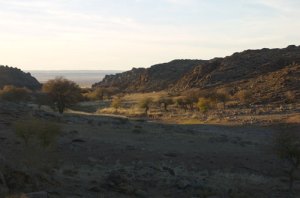
Valley where research camp is located

ikh-nartiin-chuluu-sunrise-rocks

First sun on the rocks

Came back for 7:30 am breakfast. Baaska (my guide), driver and master’s student still asleep, so headed out on my own about 8:30 am. Found my favorite huge rock! Windy but not cold. No argali or ibex. Stopped to rest and have a snack and realized that not only was the wind getting much stronger, but that the distant rocks were getting hazy with dust, just like when I was out with Rich (Dr. Richard Reading, the Earthwatch project’s Principal Investigator, and I walked back to camp in an on-coming dust storm in 2005 after the team had walked a 4km argali survey). Decided it was time to go directly back to camp since no one knew where I was, just that I would be back at 1pm for lunch. Got out the GPS, punched “Go To” POI #1 (camp) and got back just fine.

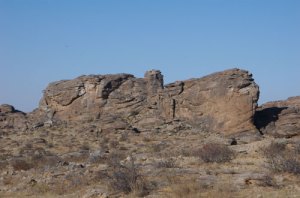
ikh-nartiin-chuluu-fav-rock

This rock turned out, from another angle, to be three formations that were overlapping, but I still like it! It’s about the size of an aircraft carrier.

ikh-nartiin-chuluu-nestCinereous vulture nest

Since I’ve never been here at this time of year and there really isn’t anyone to ask until Amgaa gets here or maybe Jed (two of the other scientists), it seemed sensible to play it safe. Maybe after lunch will be a good time to go out in the van and check out the Tibetan writings and see if we can spot any argali. The Mongolians, Baaska, student, driver, ranger are all yakking away in the kitchen ger. I’ve never known people who could sit down together, never having met before and just roll along talking like the Mongolians. It feels from the outside like the continuation of an ageless oral culture which hasn’t been undermined by tv. Yet.

ikh-nartiin-chuluu-skull2Argali skull

I hope this wind dies down. Being out in Ikh Nart again, just me and the rocks was really great.

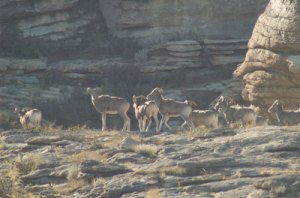
5:15 pm- Went out in our van with the ranger at 1:30. He needed to do some telemetry and was willing to find inscriptions. We found five, but no luck at all finding the one Rich took me to last time. Saw and photographed a large herd of  ewes with, it looked like, one ram and a smaller group a few minutes later. It has really stayed windy and cold. I’m in the ger with the stove going.

ikh-nartiin-chuluu-inscription

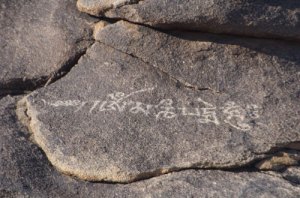
Tibetan inscription

ikh-nartiin-chuluu-argali

Herd of argali sheep

Mongolia Monday- Excerpt From My 2006 Trip Journal; Takhi Watching at Hustai National Park

On my first trip to Mongolia in spring of 2005, I managed to get a couple days at Hustai National Park, enough to know that I wanted to go back when the daytime high was more than 32F with howling wind (ah, early May in Mongolia!). Hustai is the most accessible place to see reintroduced takhi, or Przewalski’s horse. For 2006, I arranged to have the use of a car, driver and guide so that I wasn’t dependent on driving around with other, non-artist visitors.

I needed to be in the park at dawn and at the end of the day in order to get what I’d missed before because of cloud cover- takhi in great light. This excerpt is from my first day.

9-27 10:15 am Wed.

Just got back from the morning “game drive”. Left a little after 7:30 am and got to the valley just in time to catch the light about 8 am. Hit the jackpot, Two takhi just on the shadow side and then coming into the sun.

Takhi Mare and Stallion at sunrise, Hustai National Park

Went back up to (the) pass, seeing more takhi and the 2 eco-volunteers from France who I sat with last night. Missed a great shot of a bull marel (a species of elk) because the driver didn’t stop in time. Continued over and down around the backside of what my guide says is called “God Mountain” because all the spire-like piles of rock look like flames of fire. There were takhi at the base of a particularly picturesque part of it and the guide asked me to take her picture. She pointed out another mountain where she said lynx live.

Guide with takhi in front of "God Mountain", Hustai National Park

We continued on into what she says is called “Happy Valley” and it sure was for me. Came upon 2 groups of takhi, one waterhole. I think the issues were who got to drink first and can I steal some of the other guy’s mares. (There are 3 largish songbirds pitty-pattying around on the top of the ger as I write this entry)

Takhi harems at waterhole, Hustai National Park

We entered a part of the valley with trees along one side and it turns out they are saxaul, which I didn’t expect to see until I went south (and it turns out that I hadn’t. Something must have gotten lost in translation, because I found out this last trip that they for sure weren’t saxaul trees). There were also some domestic horses, which the driver got out to shoo away. We circled around out on the grasslands and saw 2 small and 1 large group of gazelle. Final stop was the research center, which was looking pretty sad and almost derelict last time. It’s humming now. Offices for the ec-volunteers, the managers, biologists, ecologists and a kitchen. There’s even curtains on the windows.

So, I’ve gotten my evening light and early morning light. Now it’s just seeing what kind of behavior I can record.

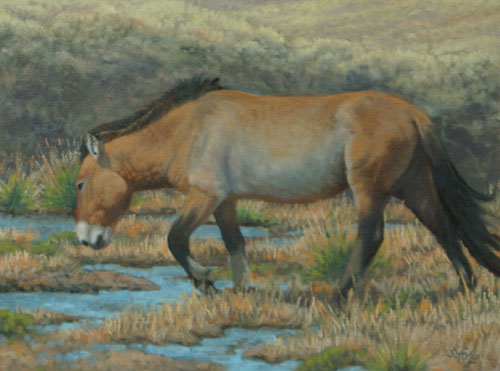
I liked the waterhole setting and plan to eventually do a big painting with both harems that tries to show what I saw that morning. In the meantime, I had this reference from elsewhere in the park of a mare with a beautiful gesture.

Morning Drink oil  12"x16"
Morning Drink oil 12"x16" (price on request)

Mongolia Monday- Excerpt from my 2006 Trip Journal; to Khomiin Tal to see the Takhi

I had found out that a third takhi reintroduction was taking place in western Mongolia and, somewhat blithly as it turned out, decided that I HAD to go there. Jan at Nomadic Journeys set it up and on the morning of September 21, I flew 1,000 miles west to the town of Hovd. My guide, Octyabr, met me at the airport and after paying 67,500 tugrigs for overweight bags (around $70), off we went. That evening, I caught up on the day:

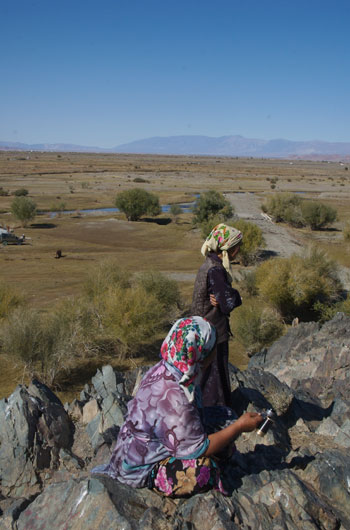
September 21, 7:30 pm- Stopped for the night by the (a) river. What a day. didn’t get out of town until 2:50. Two German students, October (English spelling), driver, cook (who actually turned out to be a local guy who knew the route to the place: the German students did the cooking to “pay” their way) and me, in the end. Typical Mongolian expedition. Students needed 20 min., so went to October’s home for tea and bread. Then it was: hire a driver, go to the bank, top off the tank, stop at store, drop off father, let driver pick up gear. There may have been more, but I forget. (There was- lunch at a local cafe) Then I find out that it’s 300km to Khomiin Tal and we won’t get there today. Stopped to climb a rock overlook. Fabulous view of river valley with Kazak (sic) gers. Next stop was a brick factory. Oh, I forgot they packed an inflatable raft and fishing gear. But sailing down the road through spectacular scenery with the Mongols singing away was terrific!

Here’s a couple of photos. There’s more on my website.

Kazakh women outside of Hovd
Camping by a river; my tent is the red one

Mongolia Monday- Sain Bain Uu!

Which is Mongolian for “Hi!” or “Greetings”. It’s pronounced, roughly, “sain” as in sandwich, “ban” as in bandaid, “uu” as in oval.

I’ve just downloaded what looks to be a very useful Mongolian language program from Transparent Language. The next trip is coming up in July and I want to be able to communicate better. Before my 2006 trip, I was able to  find a local Mongolian woman who tutored me in basic pronunciation and vocabulary, along with some simple sentences. It’s amazing how far you can get with: please, thank you, excuse me, yes, no, hello, goodbye, I like….., and knowing the numbers from one to ten. But it didn’t help when I heard a cool song on the driver’s MP3 player and had no way of asking who the artist was. I have a Lonely Planet Phrasebook and a “cheat sheet” from my tutor, but that’s not enough.

I have some familiarity with learning a new language. Spanish (see below), some basic Japanese (I can still count to ten!) when I was 14, two years of German in high school (wish I’d taken one year of German and one of French) and some Middle English and Anglo-Saxon in college. At one point I’d decided to teach myself Welsh. It was a short point.

Like many languages, Mongolian has sounds that don’t exist in English, so that’s a challenge. One travel writer describes spoken Mongolian as sounding like two cats fighting, but I’ve found that to be somewhat of an exaggeration. The guys seem to play up the gutteral sounds more than the women, especially in the countryside. There are rolled “r”s, which means that after 40 years, my stupid junior high Spanish class has finally turned out to be good for something. And there is a sound that is similar to the double “L” in Welsh. Vowels that are “doubled”, like in the sign below or in “Ulaanbaatar”, are audibly extended, as in Khan vs. Khaaan.  One of the sounds that I have found most challenging so far is “g”. It seems to be something like “uudo”, with a slightly rolled “d”, but I’m sure I’m mangling it into something hilarious. The Mongols are blessedly tolerant of anyone who takes a swing at their language and seem to appreciate the attempt.

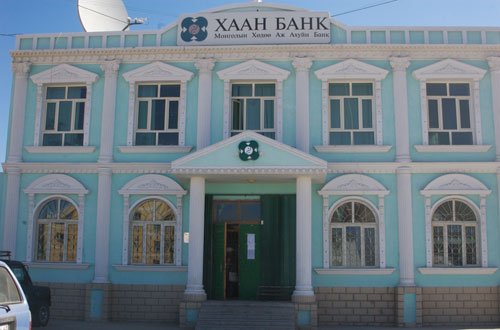
Their alphabet is a close adaptation of  Russian Cyrillic and I’ll be learning that, too. It will be nice to be able to read at least some of the signs in Ulaanbaatar. Like these (I used to be a sign painter and still can’t resist taking pictures of signs that catch my eye). There’s just enough overlap with the Roman alphabet to be slightly maddening. You feel like you can almost read it, but no.

Khaan Bank, Hovd, western Mongolia
Khan Bank, Hovd, western Mongolia

Although, in this case, it was more the beautiful building that I wanted a picture of. But good to know that this is a bank, if one is running low of cash. One of the first signs I was able to read.

Gers and tents for sale at the Narantuul Market, UB

I took this photo partly because I had no time to inquire about details like prices and didn’t want to lose track of them since I would really like to get a tent like the one on the right.

Pet shop sign, Ulaanbaatar

Since my dog is a tri-color rough collie, the same breed as the dog on the sign, I had to get a picture. I’ve wondered since then if there are actually any collies in Mongolia. They certainly have a coat that would be handy in the cold weather. Lassie Forever!

Street sign, central Ulaanbaatar

Now, how could anyone resist a drink that will give them the energy of the Mongol Horde?

Mongolia Monday- Then and Now

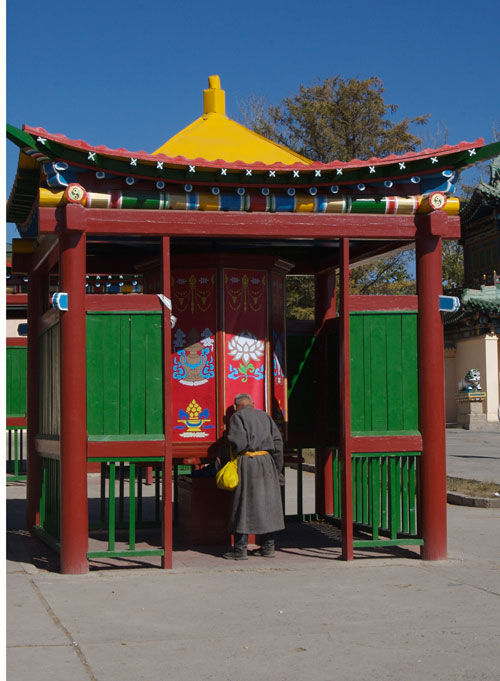
I’m not sure that this photo, taken by Roy Chapman Andrews, is from Gandan Monastery, but the prayer wheel is certainly close in size and design to the one I saw there.

Large prayer wheel
Large prayer wheel

Here is the one I saw.

Large prayer wheel at Gandan Monastery, Sept. 2006

People had written on it with a variety of pens, probably prayers.

Gandan Monastery prayer wheel, closeup
Gandan Monastery prayer wheel, close-up

Mongolia Monday- Excerpt From My 2006 Trip Journal

I keep a journal on all my “interesting” trips, along with a sketchbook, and thought that I would occasionally share some entries. In 2006, I read The Great Railway Bazaar by Paul Theroux on the first part of the trip and was inspired to try my hand at recording something more descriptive, rather than just short “Today I was in western Mongolia, the van broke down and I got food poisoning.” diary-type entries. Here’s what it was like to get clean at a ger camp in the Gobi:

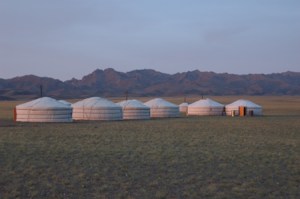
Dungeree Ger Camp, Gobi, 2006
Dungeree Ger Camp, Gobi, 2006 (Gurvansaikhan mountains in background)

October 2, 2006  1:15pm:

Ah, the joys of clean hair and body. Once it was ready, I went to the shower ger. There was a stone path leading to a wood slat platform. A big metal bowl of hot water was sitting on top of the stove, in which there was a roaring fire. A small stand held one pair each lg. and small plastic sandals. There was a hook for ones clothes. The shower was provided by a pump sprayer just like what one would buy at the garden shop or hardware store with a spray head attached. One fills it (although it was already ready for me) with a combination of hot water from the stove and cold water from a can by the wall. Pump up the pressure and voila! a perfectly acceptable hot shower in the middle of the Gobi. It was still a little chilly, so I had a fire ready to go back at my get, so I am now (more or less) clean, dry and warm, a lovely combination much appreciated on this kind of trip.

Mongolia Monday – Then and Now 2

I thought I’d start off the New Year with the subject that’s most near and dear to Mongolians’ hearts –  horses.

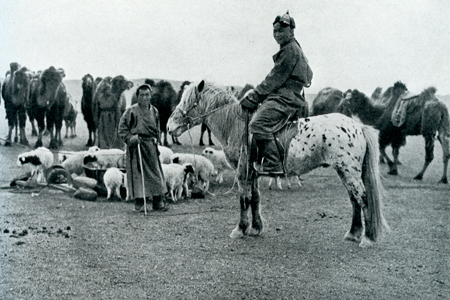
Here’s an old photo from the late 1920’s, taken on one of Roy Chapman Andrews’ Central Asiatic Expeditions:

Mongolian herder, late 1920's

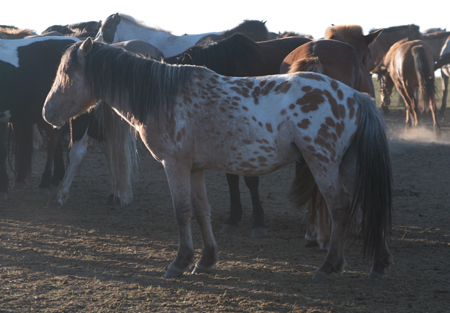
Here’s a horse I saw this past September:

Mongolian horse, Arburd Sands

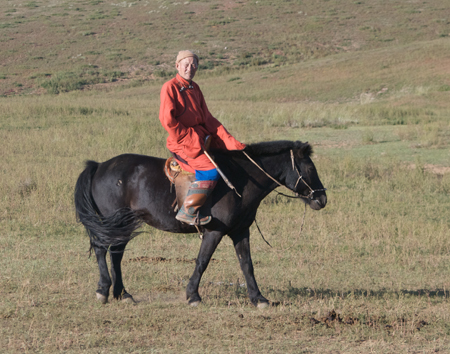
And here’s the herder who owns the horse. Other than the head gear, not much has changed. The long robe or “del” is the perfect garment for the climate and environment. And while I have seen herders wearing the traditional  pointed hat, they tend to be mostly the young men. Baseball caps are what one usually sees. The older men often wear snappy-looking fedoras.

Choidog, Arburd Sands

On Friday I’ll be debuting my latest Mongolian horse painting!

100 Posts!- Culture Vultures in San Francisco and Snowy Roads

To my amazement, this is the one hundredth post that I’ve done since I started to blog last January. It seemed to happen so fast. I guess it really is true that time flies when you’re having fun. Thank you to everyone who reads and comments!

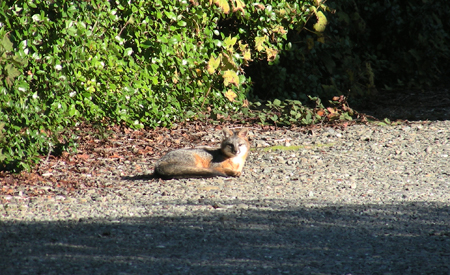
We just got back from a four day trip to San Francisco, which is about six hours south of where we live. We knew that the weather was predicted to be “interesting”. Little did we know. But first, here’s a really special photo my husband took before we left. I was out running errands, he went to get the mail and saw this little grey fox snoozing in the sun right out in the driveway of a house across the street. He got the camera and he/she was still there. This is one of the best shots. Pretty cool.

Grey Fox
Grey Fox

As anyone who has cats and dogs knows, they figure out pretty quickly when something is up and the humans are going away. Some get anxious and some, well, don’t.

Persephone
Persephone

When we left, the ocean looked like this:

Clam Beach near McKinleyville

We speculated on where we might see snow on the mountaintops and maybe even on the road. I figured Rattlesnake Pass between Laytonville and Willits.

Near Confusion Hill, Humboldt County, US101

Wrong. This was almost an hour north in Redwood Country, where we rarely see snow on the coast.

Near Leggett, US101
Near Leggett, US101

Mmm, it’s getting heavier and right down to the road.

North of Willits, US101

It’s a….Winter Wonderland!

Oak trees just north of Laytonville, US101

Snow, snow all along the route. Laytonville and Willits were covered with snow. Really beautiful and an unusual treat for us coastal northern Californians where the average temperature in January is 55F.

View from our room
View from our room

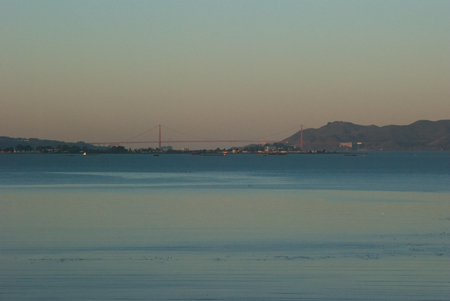
But we got to our room at the Emeryville Courtyard Marriott and had this killer view of San Francisco at sunset. And the Golden Gate Bridge.

The Golden Gate Bridge

Notice the clear skies. So we had nice weather, but cold, for what we came down to do: Family visit, the Yves St. Laurent show “Style”, at the de Young Museum and the Afghani treasures show, “Afghanistan” at the Asian Art Museum. A bonus at the de Young was an absolutely knock-out show of geologic forms, “Systematic Landscapes” in a variety of media by Maya Lin, who designed the Viet Nam War Memorial in Washington D.C.

We got in a stop at IKEA, too.

Of course we took advantage of the culinary richness of the Bay Area, eating Thai (Boran, Solano Ave., Berkeley), Ethiopian (Addis, Telegraph Ave., Oakland), Italian (Pasta Pomodoro, Bay Center, Emeryville) and seafood (Sea Salt, San Pablo Ave.. Berkeley). At the Sea Salt Restaurant, I couldn’t an unexpected opportunity to try the legendary drink Absinthe for the first time. There were three choices and I went for the St. Georges, which is distilled in Alameda, right down the road from Berkeley. It was…..amazing. A little goes a really long way. We found it at a, hate the name, BevMo and indulged in a bottle, which ought to last a couple of years depending on how many artist and other friends care to try it.

And, since David had accidently put his cell phone through the washing machine and our contract was up next spring anyway, we went to an Apple store and got iPhones. Absolutely revolutionary devices. Effortless to use. Intuitive. More stuff than you ever thought you’d want to do. The procrastination possibilities are almost endless. And the phone works just fine, too.

The trip home yesterday was in rain, hard rain and pounding, monsoon-like rain. We were glad to collect the collie boy and kick back for a quiet evening.

I’m going to take next week off and celebrate the holidays with family. Mongolia Monday will return on the 29th. Before we left, I got this photo of Michiko snuggled in her chair amongst some garlands that I’d draped over it.

Michiko
Michiko

HAPPY HOLIDAYS!