The 2016 WildArt Mongolia Expedition Has Returned!

wild bactrian camels
Wild bactrian camels, en route to Great Gobi A Strictly Protected Area

I’m still in Mongolia with adventures to come, but wanted to share some favorite images from the Expedition. Once I’m home I’ll be doing my usual multi-part series covering all aspects of the trip. As far as weather, we had some of everything….snow, rain, wind, heat and cold, typical Mongolia. As far as sights, also typical, there was something worth having seen every day.

We did not see any Gobi bear, which was not surprising considering their rarity, but we did see tracks and scat. Just as special, we saw a herd of a dozen wild bactrian camels (see above photo), of which there are estimated to be around 900. They crossed the road in front of us some hundreds of yards away (the image above is cropped). Unlike the domestic version, they can really RUN.

snow
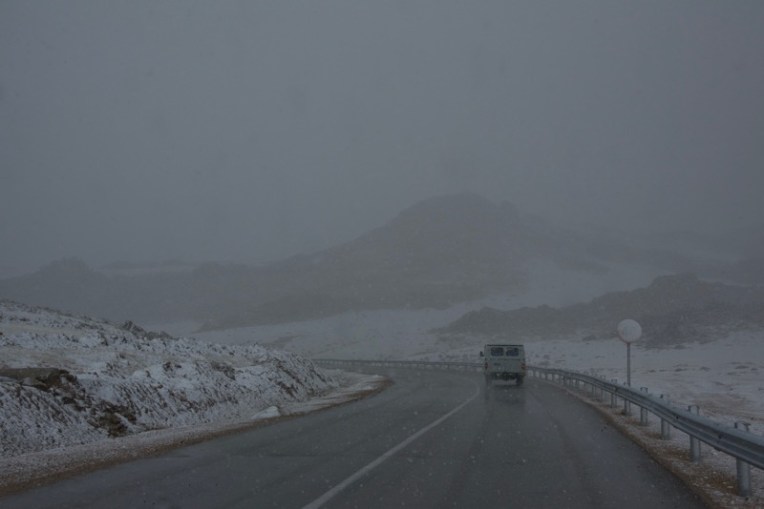
Second day out May snowstorm between Arvaykheer and Bayanhongor
Ranger and last line of mountains
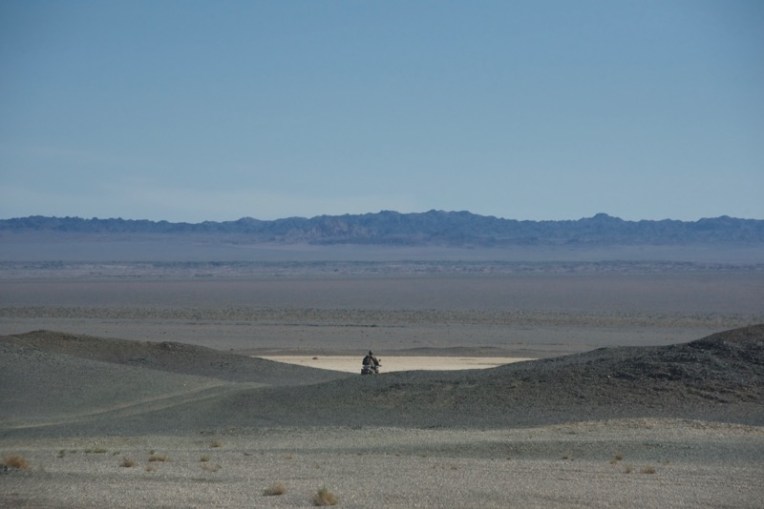
A local ranger leads us ever south into the deep Gobi
Me in GG A
After a five day drive we arrived in the Great Gobi A Strictly Protected Area. This photo was taken not far from one of the feeding stations.
Feeding station
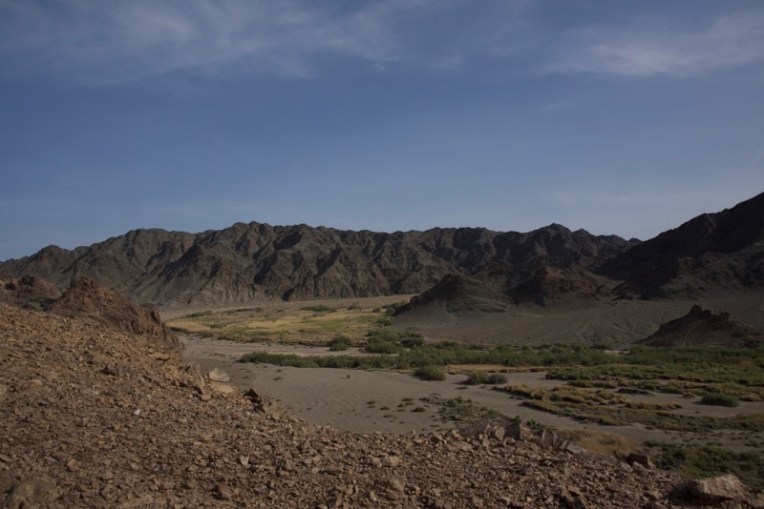
Valley with oasis about a kilometer hike from camp where two Gobi bear feeding stations are located. The photo of me above was taken in the grey sandy area just beyond the ridge.
Grass snake – Version 2
One afternoon at our campsite, I was sitting in the shade of our dining tent writing in my journal and all of a sudden I saw a snake coming towards me. It was the second steppe ribbon racer we’d seen, the other having been on the way south when we had to stop for awhile while the drivers cleared a blocked fuel pump. This one went right through camp and into this bush, holding still long enough to get some nice photos.
Pallas' pika – Version 2
When we headed back north we went on past Bayanhongor another 30km to Erdenesogt Soum, where we camped for a few days. We didn’t realize it when we set up camp, but quickly found that we were in the middle of a very large colony of Brandt’s voles, who were very entertaining. All I had to do to get dozens of photos was sit in a camp chair with my camera and fire away.


saker falcon
And of course there were also raptors around, including this lovely saker falcon.
flashy stallion – Version 2
En route to our final stop, Hustai National Park and the Mongolian Bankhar Dog Project, we camped in an area where the local herders had a lot of horses, including this very flashy stallion, who was kept busy for awhile chasing off a much younger challenger.
Hustai takhi
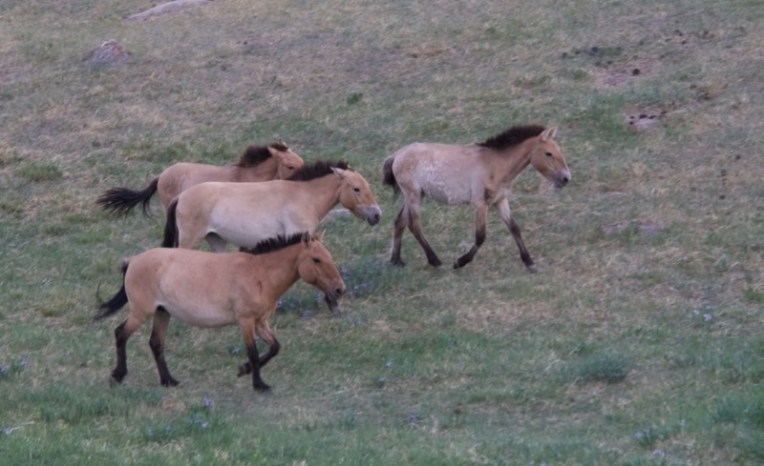
The weather was overcast, but the takhi were still wonderful. We saw up to seven family groups at one time in the main valley.
Baagii and bankhar
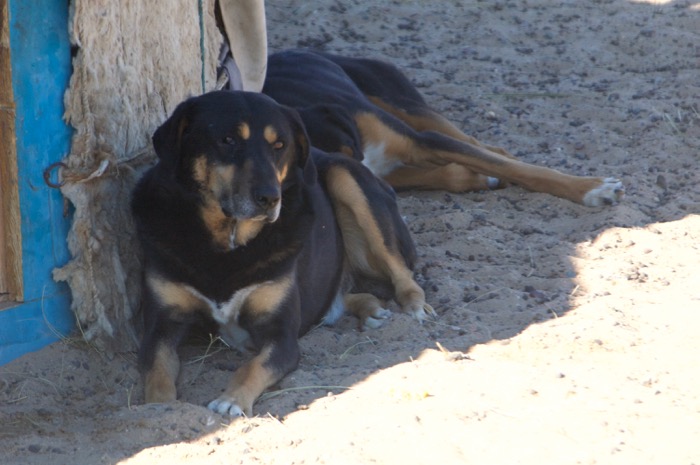
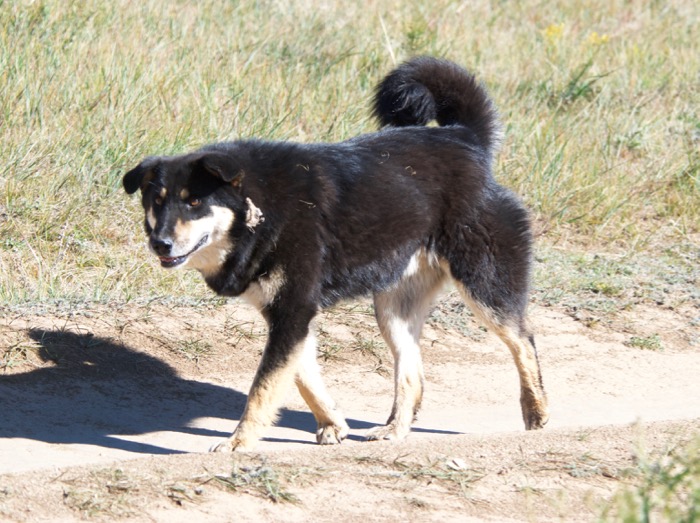
Batbaatar Tumurbaatar of the Mongolian Bankhar Dog Project with one of the male bankhar. Lots more to come on this important effort to both revive the tradition of using bankhar as livestock guardian dogs and, in doing so, help with the conservation of predators like the endangered snow leopard.
MBDP herder – Version 2
We were able to meet and talk with a local herder who has one of the project’s pups, a nine month old male.
group shot, MBDP
And finally, for now, a group shot at Hustai. From left to right: Batbaatar Tumurbaatar (Baagii), Susan Fox, Oliver Hartman from Jungles in Paris (film company), Kim Campbell Thornton (nationally known pet writer and journalist) and Greg Goodfellow, director of the project in Mongolia


The 2016 WildArt Mongolia Expedition Departs Tomorrow!

WildArt Logo 2016 600

I arrived in Ulaanbaatar, Mongolia last Sunday evening. This past week has been spent in confirming a number of things with the tour company, Nomadic Journeys, who is handling all the logistics, meeting with the guide and lead driver, getting acquainted with the two other participants who arrived over the last couple of days (we went to the National Museum of Mongolia and the Museum of the Chojin Lama today) and repacking for three weeks on the road. We depart tomorrow morning. We’ll return to Ulaanbaatar on June 10.  In between there will be much to see as we travel to the far southern part of Great Gobi A Strictly Protected Area and then back north to the buffer zone of Hustai National Park to meet up with the Mongolian Bankhar Project.

So, as the Mongols would say, “daraa ulzii”…see you later!

Susan

Introducing the Mongolian Bankhar Dog Project!

bankhar

I am truly honored and excited to announce that the Mongolian Bankhar Dog Project will now be a featured conservation organization for this year’s WildArt Mongolia Expedition! Accompanying the announcement are photos I’ve taken of bankhar over the years.

dog and herder

To quote from their mission statement: “The Mongolian Bankhar Dog Project is a 501(c)3 nonprofit organization whose mission is to help slow down and reverse the desertification of the Mongolian Grassland Steppes, and to preserve and protect traditional Mongolian culture. We strive toward these goals by resuscitating the traditional use of the livestock guardian dog known as the ‘Bankhar dog’.”

Khomiin Tal to Hovd2006-09-23

“Lethal predator control (shooting, trapping, poison) and retribution killings of predators are major threats to predator populations in Mongolia. The use of the Livestock Protection Dog has been shown to reduce predation on domestic livestock by 80-100%, eliminating the need for lethal predator control and allowing predators to target natural prey species instead of domestic ones.”

dog pack

The predators in question are snow leopards and wolves. Desertification means the the herders must move their animals to higher elevations, into snow leopard territory, with the risk that entails. Wolves have always preyed on domestic animals, but environmental degradation has contributed to decreasing populations of wild prey species such as the gazelles, which has in turn increased their predation on livestock. Add climate change, which is resulting in unstable and more severe weather, and the struggle for herder families to survive, much less thrive, has become increasingly difficult. Yet the Mongols have always felt themselves to be a part of nature and believe that wildlife, including predators, has as much right to live as they do, a dramatic contrast with attitudes one often encounters in the US.

WAME 2013

The Mongolian Bankhar Dog Project addresses all these issues, but of particular interest to me is how the program reduces the killing of the endangered snow leopard and also wolves, who seem to be holding their own and who play an important role in Mongol culture since the Mongols believe that they are descended from a blue wolf and a doe.

bankhar argument – Version 2

The herders have always had general-purpose guardian dogs. The difference is that, as is done in a number of other countries, the program’s puppies are bonded with the livestock from the earliest age and, once placed, stay with the sheep and goats 24/7. Even though the project is still relatively new, it has already been proven to work. The herders don’t lose animals and the predators, a critical part of a healthy ecosystem, survive.

Dog Hustai – Version 2

Our last stop on the Expedition will be near Hustai National Park (one of the three takhi/Przewalski’s horse reintroduction sites in the country), where local herder families have “adopted” puppies bred by the project. We will meet with them, learn about their lives, experiences and the place of wolves in Mongol culture, reporting back what they have to say. We’ll also meet with project staff and learn first-hand about what I believe to be a very important conservation initiative, one that I’ve had the pleasure of being in contact with from the beginning.

bankhar front viewYou can learn more about the Mongolian Bankhar Dog Project here.

Announcing The 2016 WildArt Mongolia Expedition (Space Available)

WildArt Logo 2016 600

It gives me great pleasure to announce the
2016 WildArt Mongolia Expedition!

The fourth Expedition will travel to the Great Gobi A Strictly Protected Area (see map below) to try to see critically endangered Gobi bear and, if possible, meet with the researchers. The current estimate is that there are around 40 bears. That’s all. They are a brown bear (Ursus arctos gobiensis). There are also wild bactrian camels (including a breeding facility that I’m going to try to arrange for us to visit), khulan/Mongolian wild ass, Gobi argali, Siberian ibex and Pallas’ cat, along with a variety of birds and small mammals. Wolves are present, but it’s unlikely we’ll see them. This is a remote place that tourists never go to. I am also arranging for us to visit with staff and local herder families who are involved with the Mongolian Bankhar Dog Project, which is breeding the traditional mastiff-type guard dogs, bonding the puppies with livestock and placing them with families who live where their animals are exposed to predation. The dogs will stay with the sheep and goats 24/7. One goal of the project is to reduce the killing of predators like snow leopards and wolves. Another is to address desertification, an increasing problem in Mongolia.

If you have never tried field sketching, I will be happy to provide instruction. It’s a very special way of recording what one has seen and quite different than “just” taking photos (although I take thousands of those, too).
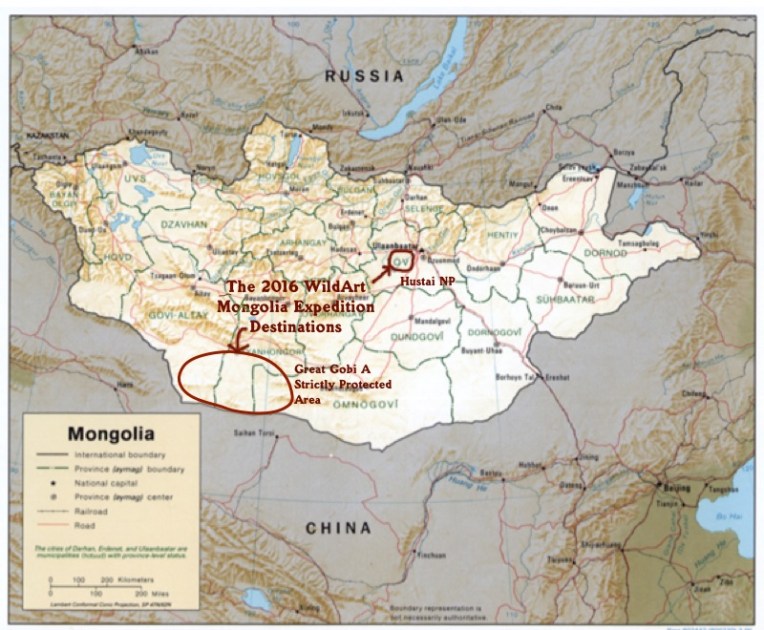
2016 WAME map 800

EXPEDITION INFORMATION:
I have limited space this time. I can take three more participants. There are currently three, including myself. That is three people per Land Cruiser so that everyone has a window seat.

Dates: May 22-June 10, 2016 (these dates give us the best chance to see the bears and avoids the worst of the summer heat)

Cost: $3900 per person double occupancy, excluding airfare to Mongolia, alcoholic beverages, lodging before and after the Expedition (people will probably have different plans; there are nice guesthouses that charge $25/$35 a night for a private room, including breakfast and also the Bayangol Hotel (which was a little over $100 a night in 2015 if booked through Nomadic Journeys).

Nomadic Journeys, who have made all my in-country travel arrangements for nine of my ten trips to Mongolia (the first was an Earthwatch project in 2005), will be handling, as usual, all the arrangements and logistics. We will be tent camping (in stand-up tipitents, possibly with cots) and traveling in Land Cruisers with drivers, guide and cook. All meals are included (vegetarians can be accommodated with advance notice; vegans regretfully cannot). A three season sleeping bag is necessary. As mentioned above we’ll be going to a place that is remote even for Mongolia, so I’ll be renting a satellite phone in case of emergencies.

It is necessary to plan for two nights in Ulaanbaatar before your international flight home, just in case we’re delayed in the field.

To reserve your place on the Expedition, please pay a $300 deposit on the Nomadic Journeys website here. For “Trip Name”, write WildArt Mongolia Expedition. While you’re on their site you can explore their options for before or after the Expedition, including self-guided ger camp stays.

If you have any questions, please don’t hesitate to write to me via the contact form on my website. Further information will be sent on expected weather conditions and equipment/clothing suggestions to those who are participating.

Susan Fox