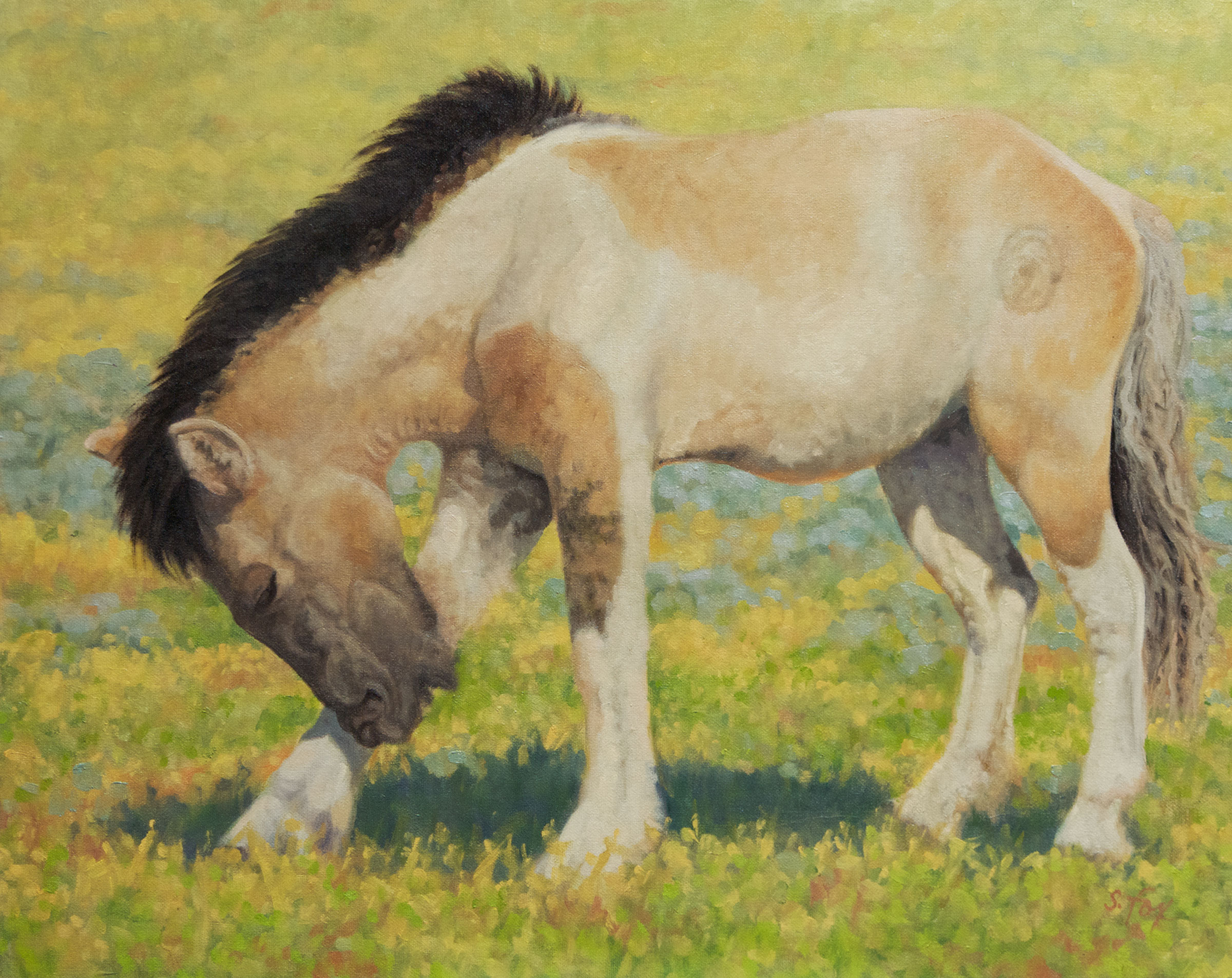
I received word this afternoon that my painting “Mongol Horse #3-Young Stallion” has been accepted into Art and the Animal, the prestigious 50th Annual Exhibition of the Society of Animal Artists. This is the second year in a row I have had work in the show. Last year it was bactrian camels, the detail of which is currently on my masthead.
I’ll be at the opening weekend of the show, which will debut at the San Diego Natural History Museum the first weekend in September. More later….
Mongol Horse #3-Young Stallion 16x20" oil on canvasboard
I’m please to announce that the Letter from Mongolia which I recently wrote for Wildlife Art Journal was posted on their website this morning! It’s illustrated with lots of paintings, drawings and photos, many from my Artists for Conservation Flag Expedition last July. Thank you to Todd Wilkinson and the rest of the staff for providing the only publication (it’s online only, no print version) dedicated to wildlife art!
And yesterday I finished the warthog painting. Here’s the step-by-step from last week. I’m calling it “Gonna Run In 3…2…1”
Late last year, a Facebook friend posted something about a new art auction site, to be run by someone called The Brigham Galleries. The short story is that the owners had decided to close their “bricks and mortar” gallery location on Nantucket and instead sell exclusively through online auctions. They saw that there is a price gap between art sales on eBay (generally below $1000) and the big auction houses like Sotheby’s (generally over $500,000). That’s quite a bit of open territory. I went to their site and saw a couple names I recognized on their list of artists and became a fan on their Facebook page.
They announced an opportunity to submit work for the first auction as a “Juror’s Pick” and I decided to submit something. No cost, no risk. Why not give it a whirl? And, the painting above made the cut as a Juror’s Pick!
It’s been a bit of a long road for the women to get it all organized and has taken longer than they expected to get the site up and running. But, as of today, the auctions have begun! The listings are here. Mine is at the bottom of the first page. It’s Lot 35, Lot Item 1102. The auction will be for two weeks.
I’m very pleased with the quality and variety of work that they have for this very first round.
Will I get sales? Who knows? But it’s a new model that I hope will be successful. There is minimal risk to the artist- the work stays in the studio until it sells. And minimum expense- no shipping work back and forth, reasonable listing fees and an extremely reasonable commission upon sales.
We interrupt our regularly scheduled series on cool things to see and do in Mongolia because I got a packet in the mail yesterday informing me that my painting “Choidog and Black” has been accepted into a special exhibition of the American Academy of Equine Art, “The Horse in Fine Art, a Salute to the World Equestrian Games 2010”, which are being held in the United States for the first time ever.
Submission was by invitation only, so that was gratifying all by itself, but to have a painting accepted is a thrill! Especially when the invitation encouraged artists to submit images that reflected the events to be held at the Games, such as dressage, show jumping, reining and endurance, none of which I have ever seen in person. The only work of mine that the Academy has seen was the Mongol horse piece which was in their fall juried show, so I figured they knew that that was what I do and what they would get.
I submitted three paintings, two of horse racing with the boy jockeys ( here and here) and one of Choidog, the horsetrainer. They chose what I would consider the “purest” Mongol one, because he is wearing traditional clothing, not the modern clothes the kids have on. I hope they post the show on their website so I can see the other paintings!
Choidog and Black 18x24" oil on canvasboard
So I am in the happy position of having one of my Mongol subject paintings in a show that will be viewed by horsey people from all over the world. Nice way to start the week.
Next Monday, I’ll return to my six part series with my personal choices for the six best souvenirs to bring home from Mongolia.
This article was in Andrew’s latest newsletter. I don’t have a lot of experience with commissions, having only done a few dogs and one horse portrait over the years. When I read this article, I saw that it had a lot of good information that would be of interest not only to the artists among you, but anyone who has thought about commissioning a piece of art but wasn’t sure how to go about it. I think that if everybody follows their respective “tips”, the odds are that it will be a happy experience all around.
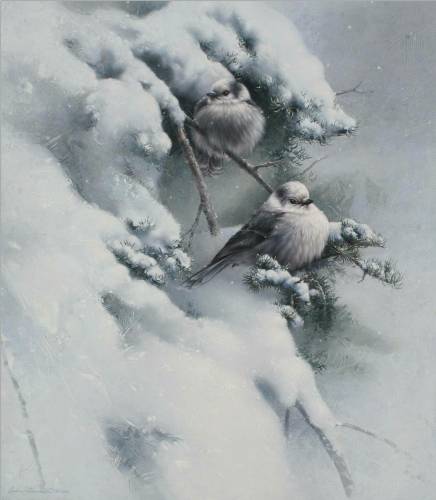
By way of introduction: Andrew has gained national attention through his involvement with the Society of Animal Artists, feature coverage in such publications as Southwest Art, American Artist, Wildlife Art, and The Artist’s Magazine, among others. and has held three highly successful one-man shows at Pacific Wildlife Art Galleries. He has also participated in exhibits at the Bedford and Hearst Galleries, and the Oakland Museum. His work has toured nationally with Birds in Art and the Society of Animal Artists, which has honored Andrew’s work with Awards of Excellence for two consecutive years. Andrew’s work can be found in the National Museum of Wildlife Art in Jackson, Wyoming, the Leigh Yawkey Woodson Art Museum, Wisconsin, and numerous private collections across the country. He is currently represented by the venerable Trailside Galleries in Jackson Hole, Wyoming. You can see more of his work here.
"A Very Wyer Winter" acrylic on board, 24 x 21" 2009
So, without further ado, here’s Andrew Denman on “The Delicate Art of Commissions:
As long as there have been artists committed to earning a living with their work, there have been collectors and patrons eager to commission art that speaks directly to their own tastes and preferences. Many artists have a love- hate relationship with commissions; they certainly offer the comfort and convenience of a “sure sale,” but may artists feel an uncomfortable sense of restriction, of guidelines outside one’s own whims and fancies bogging down the creative process. It’s unfortunate, because commissions (like the one above) can be among the most rewarding and profitable experiences an artist can have. The following are tips for both artists and patrons on how to successfully pursue a commission.
TIPS FOR ARTISTS:
1. Only take commissions that interest you. The primary fear of many artists who refuse commissions altogether is that taking a commission necessarily means painting whatever a client demands and “selling out.” This is hardly an issue if you only take the jobs that speak to you as an artist. Moreover, remember that just because it didn’t start out as “your idea” doesn’t mean a commission can’t become a painting that fully represents you as an artist. Remember the Sistine Chapel was a commission too!
2. Spend time with the client, carefully assessing likes, dislikes and project requirements. Presumably, if a collector has sought you out, he has seen and enjoyed previous work. Take note of the client’s favorite pieces, and be sure you understand specifically what he likes about them. Be certain to learn the deal breakers. If you know the two or three things you have to avoid or must include (say the client wants a painting of a barn swallow, hates the color blue, especially loves your attention to fine detail, and wants to make sure the painting will look good in a driftwood frame) then you can exercise your creativity in all other areas.
3. Be certain to have the commissioner approve of a sketch or study before you begin work on the final piece. If some small element needs adjusting, this is the time to do it. I only ask for a deposit after this stage so the client doesn’t feel any obligation until he knows exactly what he’s getting. If the client is dissatisfied, I still have a nice study ready to use for other purposes.
4. Do take a deposit before you begin painting. One of the benefits of commissions is that you have some money coming in while you are working, not just after completion. Be prepared, however, to return the deposit if the client is dissatisfied. It may never happen to you (and it probably won’t) but a happy client might still buy from you in the future. A disappointed client stuck with a painting he doesn’t like certainly won’t and will never send any referrals your way.
5. Agree on a deadline. Many artists hate working under pressure and many of us have show schedules to consider and galleries to supply, so commission deadlines of a year or more are not uncommon. The key is to let your collector know exactly what to expect. If a hard deadline is one of the project requirements (such as for a birthday or anniversary gift) be honest about your ability to meet the deadline. It’s better to turn down a job than to take on more work than you can handle and sacrifice the quality of your art.
6. If you are still uncomfortable with commissions, consider a “First Right of Refusal” arrangement. Unlike commissions, first rights of refusal involve no deposits and no deadlines. A client who is interested in a painting of a bison, for instance, will simply have “first dibs” on your next bison painting, which you may finish next week or two years down the road. The client feels no obligation and you have total creative control, but you’ve given a collector special treatment that is unlikely to be forgotten, whether he buys the specific piece you offer him or not. Keep a running list of such requests and follow through.
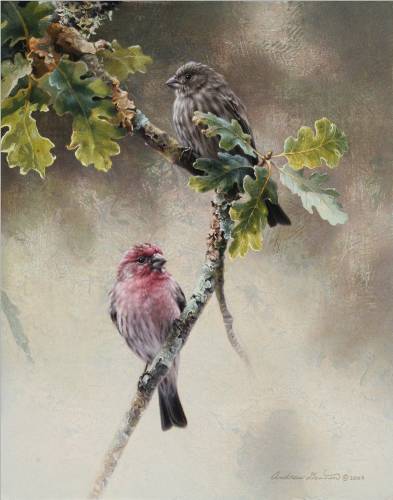
"The Hawthorne Pair" acrylic on board, 12 x 9 1/2" 2009
TIPS FOR COLLECTORS:
1. Be selective about the artists you approach with your ideas. Entering into a commission is entering into a relationship with an artist that could last months or years. Make sure that you and the artist can communicate effectively and amicably from the start. Any artist should be flattered that you thought of him to create that special piece, but make sure your project speaks to the artist’s interests and personality before making your approach.
2. When you tell the artist your idea, don’t rattle off a laundry list of requirements. Be very clear about what’s really important to you and leave the nitty gritty details to the artist’s imagination. Start by sharing with the artist your favorite pieces and clearly describe what speaks to your sensibilities. It’s challenging enough for an artist to take the image in his own head and translate it to the canvas; it’s nearly impossible for him to take the image in your head and bring it to life. Commissioning a fine art piece isn’t about finding someone to paint that idea you’ve always had in your head; it’s about providing the seed of inspiration that inspires an artist to create something that belongs to him as much as it does to you.
3. Honesty combined with tact goes a long way. Ask to see a study up front and be frank about your impressions. Artists can be touchy about criticism, but this is your ball game, so don’t apologize for your input. Simply avoid vague criticisms, broad generalities, and major changes from the idea you originally discussed. As long as you clearly state any concerns and offer your suggestions in a respectful manner, remembering to defer to the artist’s professional judgements (except where deal breakers are concerned), no reasonable artist should take offense. If your suggestions are met with annoyance or hostility, this is the time to part ways. Either the artist is unreasonable or the two of you simply aren’t communicating effectively, in which case neither of you are likely to be pleased with the final result.
A Final Note:
Collectors, when all is said and done, make sure the artist knows how pleased you are with the final piece. Creating a work of art requires hard work and a very special talent, which is why you’re contracting it out in the first place, and a piece of original art that truly meets or surpasses your expectations is to be cherished, as is the artist who created it.
Artists, remember that a collector who admires your work, seeks you out, and wants to be a part of your creative process is a great gift, not to mention an invaluable testament to your abilities as an artist. When you find a commissioner who is a pleasure to work with, be sure to express your appreciation too, and take care to nurture the relationship in the years ahead.
———
Susan here:
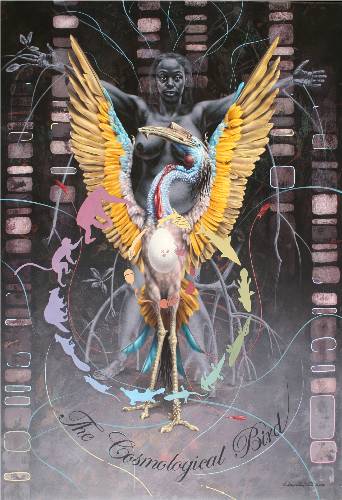
I’ve seen a lot of Andrew’s work. He does what is needed to say what he wants to say and doesn’t give a fig about stylistic consistency. But this last piece is really, well, different than anything else I’ve seen him do. Maybe I’ll have him back to tell us the story of this commission.
"The Cosmological Bird" acrylic on board, 34 1/2 x 24" 2008
We had a heck of a series of winter storms last week here in California. And this week a large chunk of the rest of the country is getting wacked. It’s stay indoors season. Not a great time to paint outdoors, unless you’re one of those seriously hardcore plein air folk, or do fieldwork if you are an animal artist. Snow is one thing, but driving rain and hail, high winds or ice storms are something else. What to do (drums fingers on table)? Here’s some ideas:
1. Ask yourself- What are you really bad at?- Trees? Water? Fur? Eyes? Be honest. We all have our strengths and weaknesses. I remember my artist sister-in-law telling me about a classmate at art school whose use of color was, apparently, pretty awful. He made a commitment to improve and is now a nationally known artist and illustrator known for, among other things, his incredible use of color. What I learned from this story is that, with hard work and a willingness to struggle and learn, a weakness can be turned into a major strength.
There's probably at least six exercises that one could do from this photo. What are they?Cinereous vulture, Bronx Zoo; opportunity to show depth and form in an eye study; the photo flattens the image; what do you have to do to compensate?
Exercise: Set aside some time each week to work on something that’s hard or that you feel is a weak point in your work. Do little studies that should only take a hour or two. Don’t bit off a big chunk like “water”. Break it down into smaller problems like reflections or what pebbles look like through water. Robert Bateman says that he used to sit and watch water for hours to learn what the pattern was. You could throw stones in a big mud puddle to study ripples.
2. Take a look at your old work- Creating art can be very discouraging. Sometimes it seems like we’re just spinning our wheels. Progress in gaining any skill is usually incremental. Someone who hadn’t seen my work for awhile was visiting my studio recently and commented that my work had taken a great leap since they’d last seen it. I found that very gratifying, but also interesting. I do occasionally paint something in which it all comes together and there is a big move forward, but that’s the exception.
old reference 4x6" photo (cropped) from 1996Painting (cringe) from 1997; it looked ok to me at the time; I could write an entire post now about what's wrong with itBrush drawing from a couple of weeks ago for an 8x8" painting; the difference should be obvious
Exercise: Get some of your favorite beverage, pull out your old work and set it up next to your latest pieces. What do you think? I hope you see steady improvement over time, which should give you some well-deserved encouragement. If you don’t, then see if you can figure out why. Be honest. I know some artists who seem to think that amount of years spent painting equals good work. Not true at all. Twenty-five years of doing the same subjects in the same way with the same technical problems still means mediocre paintings.
3. Evaluate your photo reference- a famous wildlife artist who I was lucky enough to study with a couple of times told us that “you’re only as good as your reference”. I have found that to be absolutely true. Every time I’ve been able to upgrade my camera equipment or how I view my reference, my paintings have shown immediate improvement. You can’t put in what’s not there unless you know the subject extremely well. Trust me on this. The biggest leap for me was going from film to digital, which let me move from prints to the equivalent of big transparencies. I’m slowly purging my photo print reference of all the kinda-sorta images that I know aren’t good enough.
Impala painting from photos shot during my 1999 trip to Kenya; flat as a piece of paper with everything in local color my main reference photo; notice the absolute lack of any perceivable light sourceThompson's Gazelle; no hint of a background, but you know there's light because of that cast shadow on the neck
Exercise: Go through your reference, in whatever format, with a fresh eye. Ask yourself- How much work will it take to make this into something? Does it really represent what it was that caused me to take the picture in the first place? Is it blurry? (I tend to keep those because there still might be a hoof or other information that I can use, but I don’t use blurry images for primary reference. Or let’s just say that every time I’ve done it, I’ve regretted it.) Is it under- or over-exposed? How about the lighting? Is it interesting? Or is it flat?
4. Start a sketchbook- You know you “should”. One of my teachers in art school did a lot of storyboard work for major San Francisco ad agencies. High pay, super short deadlines, no time to shoot reference. He did a drawing a day besides whatever work he had. While I was in his class, we all did a drawing a day. I had fun using my favorite felt tip pens and also Berol color sticks, which were new for me. So it was a chance to try different media, too.
Table and chair; not easy to get the perspective rightBut no one says it has to be literally realisticI tend to do this kind of drawing with carbon or charcoal pencils in the studio, but still use felt pens on location
Exercise:For one week, do a drawing a day. Of anything. You can set up a still life, draw furniture, work from magazine photos. With any media. But draw. Then add a second week. See what happens. Send me a 500 pixel jpg of your favorite and I’ll post them here.
5. Dream your dreams- Blue sky time. If resources, monetary and otherwise, were not a factor, what would you be doing as an artist? Some of us want to paint full-time, which I am fortunate enough to be able to do. Others want a special place in their home where they can do their art or want to go to a workshop or travel to Italy or…..the possibilities are as endless as the ways artists express themselves.
Dream big, but don't miss the stuff that might be close by
Exercise: Set aside an evening and make a list. Try to be specific. Instead of just “workshop”, how about “I want to study plein air painting with…..”? Or not just “I want to travel”, but “I want to go to Kenya and see wild lions”. Then think about what steps you can take to achieve one or more of your dreams. Get on the internet and see what you can learn about how other artists have achieved their dreams, both for inspiration or ideas.
So, there you have it. Five ideas and look! It’s April already!
Lots coming up in 2010…but first I’m doing some necessary career “housekeeping” like updating my marketing plan, setting up a budget spreadsheet, continuing to add info. to my Flick! painting records, planning a couple of gallery submissions and starting to think about what paintings I want to do for the jured shows I plan to enter. I even got in some drawing time earlier in the week between doing…..absolutely nothing useful.
At Trinidad State Beach, Dec. 25; photos by my husband, David
How about you other artists? What are you doing to get ready for what we all hope is a happy and (more) prosperous new year? If you feel like you need to take the next step to get your career moving, I highly recommend “I’d Rather Be In The Studio” by Alison Stanfield. She also has a great blog that you can subscribe to. Good, solid stuff every week.
That’s the business side. What are you going to do to nurture your art? Try a new media? Take a workshop? Concentrate on a particular subject? Travel to an inspiring place? Or……
(Photos taken within a half hour of our home. Yes, we are really lucky to live in northern California!)
Mongol Horse #3- Young Stallion 16x20 oil on canvasboard
“Mongol Horse #3- Young Stallion” has been juried into Art Horse Magazine’s “EX ARTE EQUINUS III!
You can see it here There will not be a physical show. Images of the art, in a variety of media, will be published in the summer issue of the magazine and a selection will included in a limited edition book, both due in March. I’ve made it into the book and greatly look forward to getting a copy.
Lesley Humphrey, who placed first in painting in Ex Arte Equinus II, was the painting juror for this year. Her juror’s statement is here and is very well-written.
And if this image looks familiar, yes, this painting was juried into an American Academy of Equine Art show earlier this year.
A Facebook artist friend posted a link to a web page which said a survey showed that 96% of Americans value art in their communities, but only 27% value artists. What’s up with that?
That page is part of the site of United States Artists, whose mission is to provide direct support to artists by means of substantial grants. Really substantial grants. Like $50,000 each for 50 artists EVERY YEAR. Before you start hyperventilating with anticipation, artists have to be nominated. You can’t just apply. Anyway, check out the site. And feel warm and fuzzy about the fact that someone has finally figured out that most of us work really hard at our art, but don’t make a lot of money at it and that the money has generally gone to cultural institutions, not the people who do the actual creative work.
Needless to say, I wish United States Artists every success.









 Susan Fox, American Artist