Having A Lovely Time

But first….this is post number 300! Thank you to everyone who has visited, left comments and has otherwise been supportive. I really appreciate it!

Hard to believe that my trip back east is almost over. Wednesday was the Society of Animal Artists board meeting, which was very productive and worthwhile. There were fifty applicants for membership. Eleven were accepted.

The next day, my host, Guy Combes, needed to get some work done, so I got to see one of his paintings in progress and just kick back. Around lunch time he took me over to the headquarters of Greenwich Workshops, who publishes Guy’s giclees and also handles his originals. They’re located in a lovely old brick building in the small town of Seymour. But once you’re inside in the production rooms, it’s state-of-the-art.

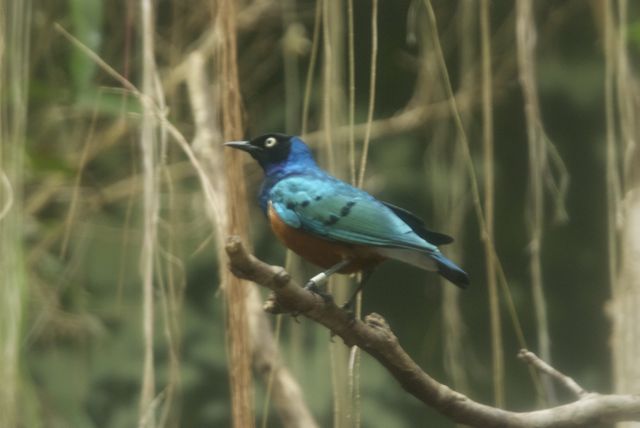
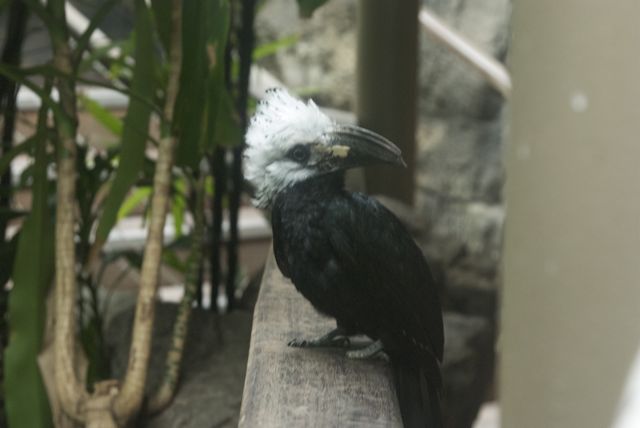
The following morning, we drove down to the home of Alison Nicholls, a fellow Flag Expedition grant recipient. Her trip was to study African wild dogs. The three of us starting talking art and animal shop immediately, continuing on into the next day as we took the train into New York to go to the Central Park Zoo. It’s a small facility, owned and operated by the Wildlife Conservation Society, but it plays an important role in introducing city children to wildlife and conservation. The highlight was the tropical bird aviary. Here’s a few images:

Superb Starling (East Africa)
Long-tailed hornbill (East Africa, but not Kenya)
Victoria crowned pigeon (Indonesia and New Guinea)

Back at Allison’s, we went out for a great seafood dinner, still talking shop. It’s been a real treat for me since Allison and Guy have been to many interesting places that are different from where I’ve been.

Today we’re going to drive up to New Haven to hit a couple of museums, probably the British Collection and the Peabody, both based at Yale University.

Mongolia Monday- Juried Show News!

We interrupt our regularly scheduled series on cool things to see and do in Mongolia because I got a packet in the mail yesterday informing me that my painting “Choidog and Black” has been accepted into a special exhibition of the American Academy of Equine Art, “The Horse in Fine Art, a Salute to the World Equestrian Games 2010”, which are being held in the United States for the first time ever.

Submission was by invitation only, so that was gratifying all by itself, but to have a painting accepted is a thrill! Especially when the invitation encouraged artists to submit images that reflected the events to be held at the Games, such as dressage, show jumping, reining and endurance, none of which I have ever seen in person. The only work of mine that the Academy has seen was the Mongol horse piece which was in their fall juried show, so I figured they knew that that was what I do and what they would get.

I submitted three paintings, two of horse racing with the boy jockeys ( here and here) and one of Choidog, the horsetrainer. They chose what I would consider the “purest” Mongol one, because he is wearing traditional clothing, not the modern clothes the kids have on. I hope they post the show on their website so I can see the other paintings!

Choidog and Black 18x24" oil on canvasboard

So I am in the happy position of having one of my Mongol subject paintings in a show that will be viewed by horsey people from all over the world. Nice way to start the week.

Next Monday, I’ll return to my six part series with my personal choices for the six best souvenirs to bring home from Mongolia.

Rewarding Day At Point Reyes National Seashore

As promised, here’s a look at Point Reyes National Seashore on a fabulously beautiful day.

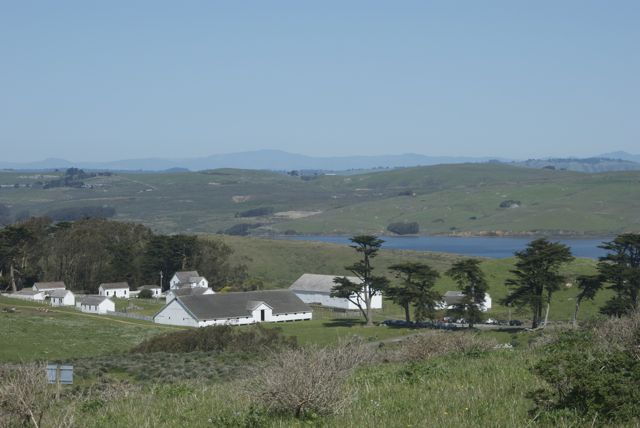
Pierce Ranch buildings at the northern tip of the park

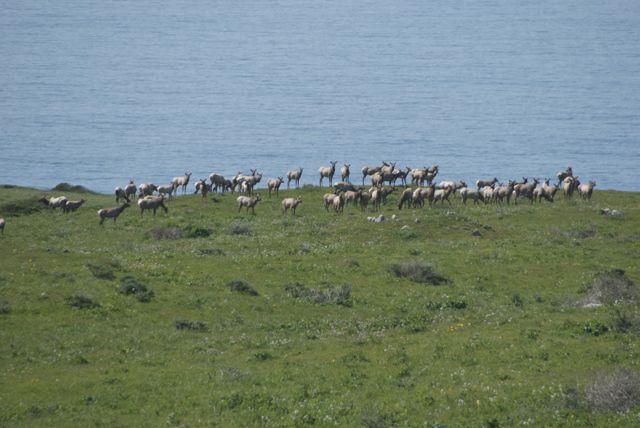
Unlike most national parks, people still live and work within its boundaries. There are over a dozen dairy and cattle ranches dating back to 1852 still in operation, plus an oyster farm. Back in the mid-20th century, developers wanted to turn the whole area into a new city. After a long battle, that was defeated and now this incredible part of west Marin County is preserved for everyone to enjoy. Including around 450 tule elk, which is what brought us to the park yesterday. They had been extirpated from the area by 1860. Nearly a century later, they were re-introduced. They are smaller than the better-known Roosevelt elk, whose southern-most range stops about 300 miles north in Humboldt County.

tule elk grazing
Tule elk; what a backdrop! The Pacific Ocean
Tule elk; part of a herd of about sixty

When it comes to wildlife, one never knows what to expect. We had great luck and saw four different herds, all from the road. I didn’t have my long lens, so these images were taken with the 28-300. You can see that the elk weren’t very far away. Below are more images of other parts of the park.

Looking north; elk are to the left
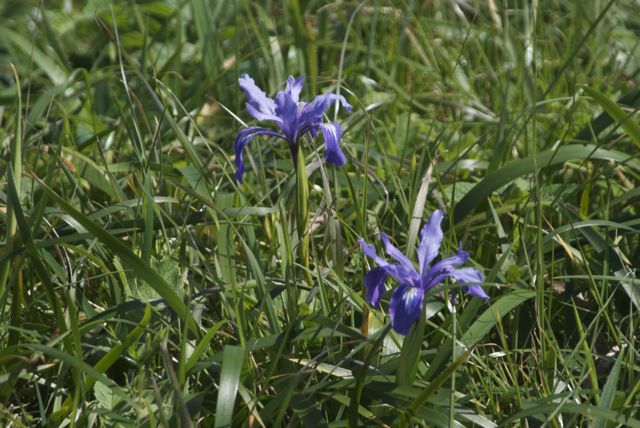
Native Douglas iris; it was blooming in big clumps all through the park
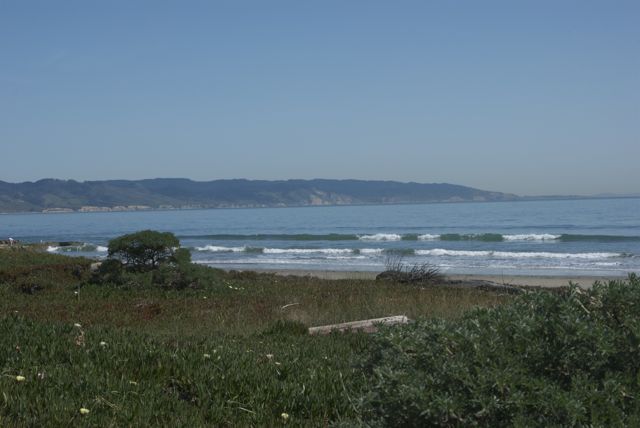
Near the lighthouse at the southern-most point, looking north along beach
Drake's Bay, to the east of previous image, looking south towards San Francisco

Yes, THAT Drake. Sir Francis Drake made a landfall here in 1579. He stayed here about five weeks, hauling the Golden Hinde onto the beach to careen her, which means pulling her out of the water and leaning her on her side to clean the hull of barnacles and seaweed. He and his crew encountered local Miwok indians who supplied them with boiled fish and meal ground from wild roots.

Another of the old ranches; on our way out of the park

Point Reyes, as you can imagine, is a magnet for local and visiting plein air painters. Now that I’ve been able to reconnoiter, we’ll plan a future trip so we can stay in the area and have time for me to paint, too. There are a lot of small resort motels, a private campground in Olema and vintage hotels, B&Bs and good restaurants in Point Reyes Station. We had lunch at the Pine Diner. Cobb Salad to die for.

More on Point Reyes on the official site here

Friday Follies

We’re on a weekend trip to the San Francisco Bay Area. Taking care of some business in Santa Rosa this morning, getting a second key made for the VW Eurovan (long story) and then it’s fun time.

The next stop will be Point Reyes National Seashore, which is on the north side of the Golden Gate in Marin County. At the northern end is a tule elk reserve, which is the main reason we’re going to the park. With luck I’ll be able to post photos late this afternoon or tomorrow morning, along with information on this species of elk that is smaller than the better-known Roosevelt elk.

I’m also hoping to get good reference for small paintings that I’m going to do for the Marin Art Festival in June. Perfect work/play day.

The weather is spectacular. It was 72F in Santa Rosa at 8pm last night. Crazy for March, but very pleasant. Clear as a bell and sunny this morning, so it should be beautiful over on the coast and even warm.

In Case You Get Discouraged As An Artist Sometimes….

I think we’ve all had the experience of looking at art that is really, really good. It’s both an inspiration and sometimes a cause of despair. But one of the traditional ways to train one’s eye is to look at good art. Lots of it. In the original.

Then there are the days in the studio when we wonder why we ever thought we could do this. We know (I hope) what our goal is for a particular painting, but we Just Can’t Quite Get There.

It can be easy to lose perspective. Sometimes it’s helpful to remember that the artists we so admire didn’t begin at the high level we associate with their work.

I happen to have accumulated over the years some examples in print of early work by some very well-known artists, along with their mature work. I thought I’d offer three examples today.

I want to make it clear that I don’t believe that any of the early examples are “bad” or inferior in any way. The purpose of showing them is simply to demonstrate that everyone’s art evolves over time (or should). They are illustrations, not easel paintings, so they were done as jobs for an art director, with whom the artist didn’t always see eye to eye. The limitations of commercial work are what led them to become what we think of as Fine Artists, who paint or painted only for themselves.

Keeping that in mind:

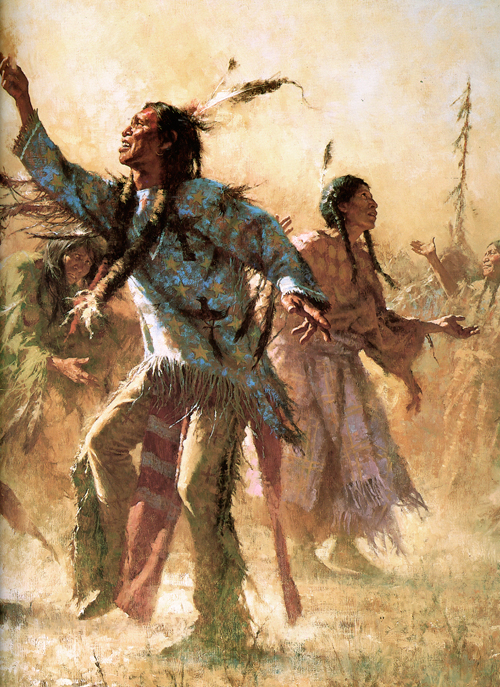
Howard Terpning is one of the most prominent American painters working today. I knew his name as an illustrator and it wasn’t until I became a painter that I encountered him as a fine artist. His work didn’t attract me much since I’m not that interested in Native Americans, his specialty. But I was at a workshop with John Banovich, who is known for his African wildlife paintings, particularly lions and elephants, and there in his studio, kept near his easel, was a book of Terpning’s work. John picked up the book and explained that it was worth studying for the quality of the painting, separate from the subject matter. I took my turn paging through it and saw immediately what John meant, so I bought my own copy as soon as I got home. I learned a valuable lesson that day: don’t let subject matter get in the way of learning from a great artist.

Nice narrative from the rabbit's point of view. 1966
Detail from "Hope Springs Eternal-Ghost Dance" 1987

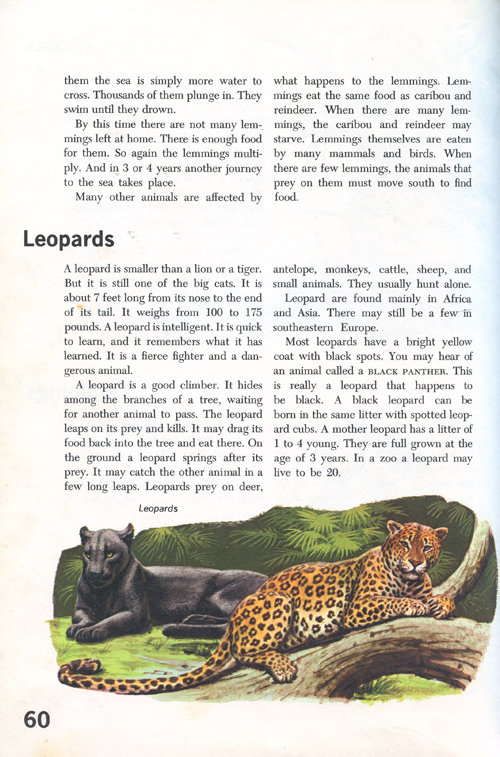
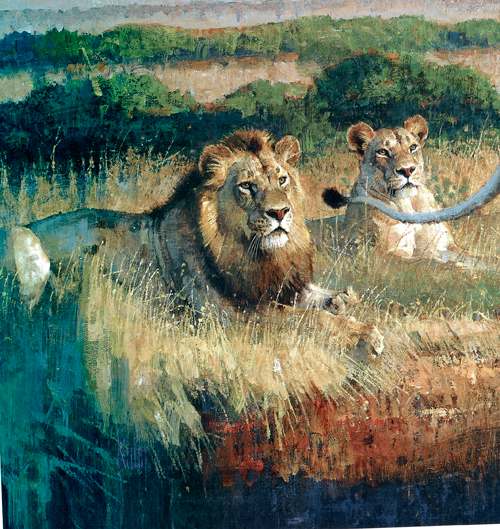
Guy Coholeach, as far as I know, has always been an animal artist, although when he was an illustrator I suspect he took the jobs as they came, regardless of subject matter. I do remember knowing and admiring his work from long before I went back to art school and got a degree in illustration. When I became an animal artist myself, there he was, one of the most prominent wildlife painters in the field. He’s probably best known for his paintings of the Big Cats. One of the things I find inspiring about his work is that he doesn’t arbitrarily limit himself to one “style”, but does what’s needed to express his vision of a subject. So his work can range from very tight and beautifully rendered to juicy and painterly. In either case, his drawing, composition and paint handling is impeccable.

From "The Look-It-Up Book of Mammals, 1967
Detail of "Hanging Out", 1989

Bob Kuhn is my idol. Simple as that. Especially when I was struggling on all fronts trying to do a decent painting, I’d get stuck on some aspect and ask myself “What would Bob do?”. I’d get down my Bob Kuhn books (I have all of them) and go through them until I found his solution. I’d bounce off it to come up with what worked for me, knowing that ultimately I had to find my own way and not rely on someone else. Not to knock other artists at all, but I personally don’t have, and have never had, any interest as a painter in detail per se. In an art genre where highly detailed work has been the standard, Bob Kuhn was a beacon of light and hope that I could find a place in the animal art world while working in a painterly manner. I also learned from him not to compromise on getting the best reference possible, to draw from live animals as often as possible and to be knowledgeable and accurate in how I portray a species in their anatomy, behavior and habitat. Can’t ask for more than that from your hero.

He always did action like no one else. 1952
Detail of "Lions Waiting for Night to Fall", 1978

This Will Probably Get Me In Trouble, But The Problem Isn’t Just At SeaWorld…..

OPINION ALERTI don’t think that you will be left in any doubt as to my opinions in the following piece. Civil, thought-out comments are welcome. All others will go in the virtual round file. And the protestations of those whose income relies in any way on the use of captive wild animals for profit will be taken with Upton Sinclair’s quote in mind: “It is difficult to get a man to understand something when his job depends on his not understanding it.I’m not out to necessarily change anyone’s mind or behavior, but if I make you uncomfortable about some assumptions you’ve had, well, I’ve done my job.

So, SeaWorld is in the news again with another “attack” by a killer whale/orca, resulting in a human death. SeaWorld is one of the public faces of Animals As Entertainment. Do not be deceived by their blather about science. They wouldn’t spend a dime on it if they didn’t need to to reassure the public that they are doing “good things” that benefit the animals. The trainers are simply enablers.

Heather Houlahan, over at her blog Raised By Wolves, has a dynamite post on the issues involved in “training” wild animals like orcas, how the so-called positive methods used have bled over into the training of domestic dogs and what really goes on in getting a five ton marine mammal to do what you want, say, to let you collect its urine.

At the intersection of humans, animals and profit, the interests of our species almost always triumph. But there’s some level of at least sub-conscious discomfort because the people involved seem to consistently insist that they love animals. But their income and the care of their families is dependent on the orca/wolf/lion etc. performing as needed. There is an inherent conflict here that the parties involved need to, no, must, ignore.

A partly hidden world of using animals to perform for profit are the game ranches that provide genetically wild animals for photographers, movies, tv and, increasingly, animal artists. When visiting them you hear the same thing as from places like SeaWorld: “Oh, they’re wild. They could hurt you. Can’t be trained by anything but positive methods.” Which means, I guess, that they aren’t actually beaten. But they live in a sensory-deprived environment, unable to express their normal behaviors and instincts and are totally dependent on humans for food…..just like the marine mammals at SeaWorld.

I’ve seen an adult snow leopard kept in a cage maybe equal to its full length (barely including the tail), only taken out for “training” and to perform. A baby bear who was allowed to shock itself on an electric wire to “teach” it to stay with in the enclosed area. A badger who could not be handled, so her claws had grown to around twice the normal length. She was kept in a cage and only brought out for photo opps at a pre-dug hole, never getting to dig herself. But, hey, she lived to over twenty, so she must have had a good life, right?

These places breed animals too. Want a cherry-red fox, a particularly desirable color variant? If you’re in that world, you know who to call. Need a white wolf/black jaguar/bobcat/lynx/grizzly cub/cougar/snow leopard/Siberian tiger/Barbary lion? They’re all out there, for a price, just waiting to become stars who make their owners (with luck, lots of) money.

And what happens to the ones who don’t want to socialize to humans or simply refuse to perform and pay their way? I have no personal knowledge, but the economics of running such a business and the fact that zoos and sanctuaries, as far as I know, won’t take these “surplus” animals is suggestive.

The animals at both the ranches that I’ve gone to are kept in enclosures that are, from what I’ve seen, the same size or smaller than the worst, crappy old-time zoo cages that you can imagine. But since the ranches are “regulated” by the Agriculture Department, they come under the heading of livestock, just like cows and pigs, so official zoo standards of care don’t apply. Sweet, uh?

If the accredited zoo standard of care for game ranch wild animals was required, these places would be out of business tomorrow. And lax state regulation and oversight is probably one reason why the ranches are located in the states they are. But I actually did hear the owner of one place complaining about the owner of another because his violations were so constant and egregious that it had brought the Feds down on him and now all the others were facing increased scrutiny. Life is SO unfair.

The motive is the same as with places like SeaWorld- using captive, genetically wild animals for profit by making them perform certain behaviors for humans as and when required. The ranches, so far, fly under the public and animal welfare radar. But pretty much every calendar and a lot of magazine articles that you see and read, with photos of snow leopards, wolves, cougars and the like, are almost certainly captive animals from these ranches. I’ve even recognized some. Oh, there’s Jimmy the cougar and Princess the snow leopard (made-up names).

I must admit to some frustration with artists who profess to care about wild animals enough to spend their professional lives painting them, but have let their desire to be physically close to them and get reference images blind them to what is going on from an animal welfare standpoint. (See above quote by Upton Sinclair) And of course the people who own the ranches are nice folks. I don’t doubt it. I’ve met some of them. I’m sure they believe it when they say that their animals are treated well. But there’s that pesky inherent conflict again.

(I’m ambivalent about zoos, too. But, as another artist put it, she sees the animals in them as the individual sacrifices necessary to save entire species. And real conservation and science goes on at most of them. So, to me, they can justify their existence, more or less. However, I’ve talked to more than one keeper who seemed very certain that they knew what a given animal in their care needed to be “happy”. But is any kind of human introduced “enrichment” or fiddling with the enclosure really enough? And how can the humans really know? See above quote by Upton Sinclair. I’ve seen a depressing amount of stereotyped behavior like pacing and paw-licking at all the “good” zoos.)

The question, to my mind, isn’t how genetically wild animals are treated in captivity when used for human entertainment and profit, but whether should they be kept at all.

(A final note: I have no use for PETA or any other animal rights organization of their ilk. PETA kills 97% of the animals that are unfortunate enough to fall into their clutches. Their agenda is to end the keeping of all animals by humans. They are batshit crazy extremists. See this post on Pet Connection for more information. My concern is animal welfare. And if you are unclear on the difference, use teh googles.)

Mongolia Monday- Favorite Ger Photos

Two of the things I like best about traveling to Mongolia are staying in a ger and visiting people in their gers (“ger” means “home” in Mongolian).

Actress Julia Roberts was hosted by a family of horse trainers during the filming of an episode of the PBS series “Nature” called “The Wild Horses of Mongolia” (which isn’t what it was about, although there was a little takhi footage from Hustai National Park included). At the end, she’s sitting in a ger filled with Mongolians, looking into the camera with this big grin, saying something to the effect of “I’m sitting here in this ger and I don’t understand a word of what these people are saying, but I’m as happy and content as I’ve ever been in my life.”

Yup, she nailed it. I feel the same way. There’s something about the quality of space created by a ger that is very special. I’ve been in clean ones, dirty ones, sat on stools, beds and the floor, seen beautifully furnished ones and ones with next to nothing in them and I get the same content feeling in all of them. Hand me a bowl of suutei tsai (milk tea) or airag (fermented mare’s milk) and some aruul (dried yogurt) or tsotsgii (cream) and I’m a happy camper (and a cheap date too, I guess, although my husband would probably beg to differ). Anyway, here are some of my favorite images of gers from my four trips to Mongolia.

First, ger camps:

My ger at Gun-Galuut Nature Reserve (AFC Flag Expedition), July 2009
Dungenee Ger Camp (Nomadic Journeys), Gobi Gurvansaikhan National Park, Sept. 2006
Dungenee ger interior; notice large rock to help hold it down in high winds, Sept. 2006
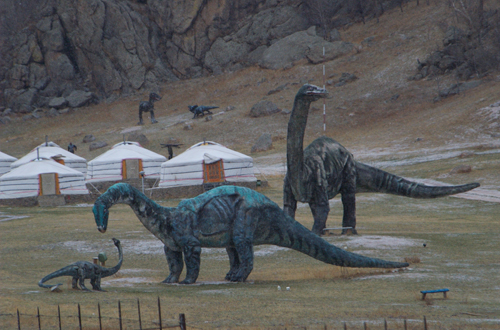
Dinosaur Ger Camp, Gorkhi-Terelj National Park, May 2005 (haven't stayed here; yet)
Arburd Sands Ger Camp (Nomadic Journeys) with lightening storm, July 2009
Red Rocks Ger Camp (Nomadic Journeys) with oncoming storm, July 2009; two hours of heavy rain soon followed
Dining ger door, Red Rocks Ger Camp, Ikh Nartiin Chuluu Nature Reserve, Sept. 2008

In 2005, I got to visit a ger factory and see how they are made:

Ger factory, Ulaanbaatar, May 2005

Then we went to the Black Market where you can buy anything ger; from individual parts to the whole thing.

Everything ger at the Black (or Narantuul) Market

The research camp at Khomiin Tal (takhi reintroduction site) in western Mongolia is spectacularly sited in a river valley:

The research camp at Khomiin Tal, western Mongolia, Sept. 2006
Ger interior with goat meat, Khomiin Tal, western Mongolia, Sept. 2006

My first experience of staying in a ger was during my first trip to Mongolia on an Earthwatch project “Mongolian Argali” (now called “Wildlife of the Mongolian Steppe”; highly recommended) in the spring of 2005. The camp is much bigger now; seven gers, two containers and a volleyball court:

The research camp at Ikh Nartiin Chuluu Nature Reserve, Earthwatch project, April 2005
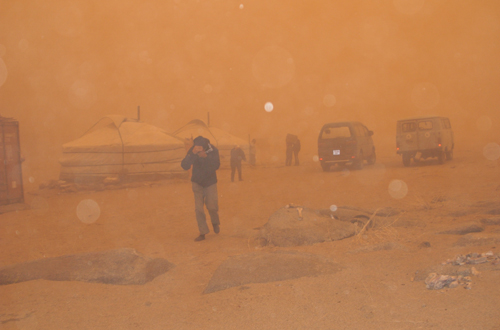
Typical spring dust storm, Ikh Nartiin Chuluu Nature Reserve research camp, April 2005; photo taken out the door of the ger; circles are the flash bouncing off dust particles; the wind was howling, too

And, private homes:

Small ger with aruul drying on the roof; en route from Baga Gazriin Chuluu Nature Reserve to Ulaanbaatar, July 2009; my guide helped me buy some aruul from the family
Prosperous establishment in the Gobi, Sept. 2006; they breed racing camels
Dung fuel with traditional gathering basket, western Mongolia, Sept. 2006; the owner manages a nearby salt deposit
Ger in western Mongolia, Sept. 2006; we bought fresh cow's milk from her
Gers above the Tuul River, near Hustai National Park, Sept. 2006; they have great view!
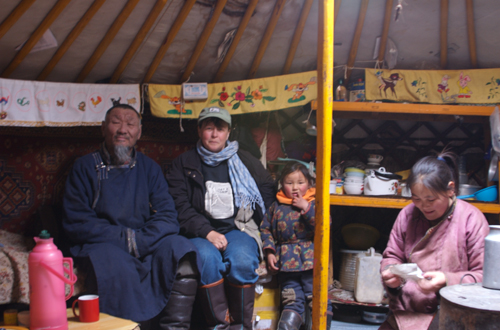
Ger visit, near Hustai National Park, May 2005; my first encounter with Mongolian hospitality, but not the last!

Mongolia Monday- New Painting Debut!

Last week was pretty intense. I had a painting to finish for submission to an invitational show (which it may or may not be accepted into; we’ll see). It’s by far the most complex and difficult one I’ve taken on so far. The kind where, once you’re well into it and can see what level of effort it’s going to take to pull it off, you wonder if you’re out of your mind. But I felt really driven to paint it, so off I went. I think it took somewhere between 60 and 80 hours, spread over about three weeks, but I wasn’t really counting. I didn’t have time.

I normally post about my painting activities on Fridays, but when you see the reference image that inspired me, I think you’ll agree that it’s right for Mongolia Monday.

I photograph the process when I do “major” paintings, both to have a record and to be able to refer back to previous points while it’s in progress. I thought you might enjoy following how this one developed.

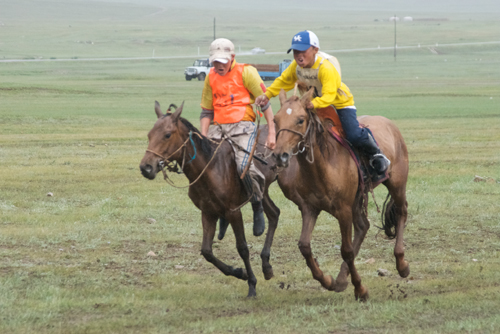
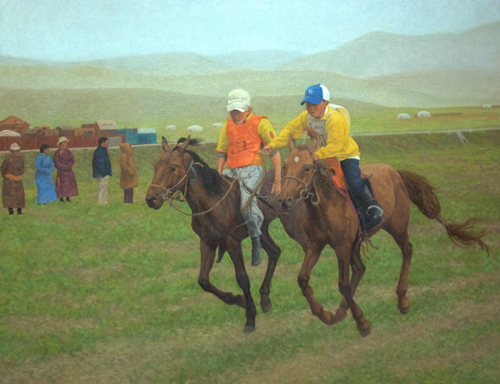
So, to start, here’s the image that said “PAINT ME!” It was taken at a local Nadaam in the town of Erdene, which is about an hour east of Ulaanbaatar, in July of 2009. It was pouring rain when we arrived, just in time to see the finish of the horse race. Fortunately, it stopped and, although it was cloudy and muddy, we had a great time and I got at least three or four more painting ideas from the afternoon.

I loved everything about this image: The two horses neck and neck. The fact that one boy is using a traditional Mongol wood saddle and the other is riding bareback in stocking feet and how different it makes their body positions as they ride flat out for the finish line. The way the orange and yellow is repeated in their clothes and the saddle.

The only thing missing was great light. Hum, what to do? I decided that rather than trying to change the light, since July is the rainy season (or at least it’s supposed to be) in Mongolia, which means that at least some of these races happen in wet conditions, I’d just go with it and make the fact that it was a rainy day part of the story.
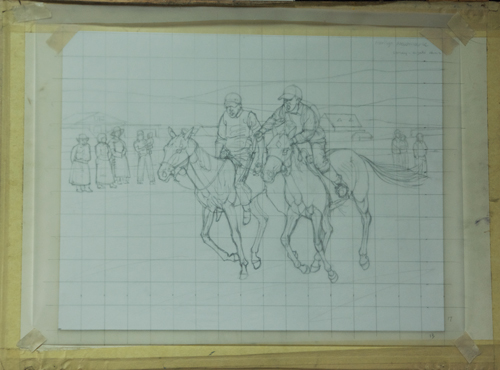
The  background didn’t do anything for me and since most of the people who will view the final painting won’t be familiar with the setting or situation, I needed to add some context. The first step was to do a pencil drawing that included all the elements to make sure everything would go together even though I used at least six different photos for the final composition.

The drawing is done on 19×24″ tracing paper. The finished painting is 28×36″. The grid lines are a traditional (dated back to the Renaissance) method of transferring a drawing to the larger surface. Notice how many spectators there are and where the buildings are. I had already decided to leave out a line of cars that were behind the people.

I have also decided to paint these scenes as I see them. I’m not going to “romanticize” them by substituting traditional hats for the baseball caps or putting the kids in del. While I’m very interested in Mongolian history and might do paintings with historical themes, with historic costumes and armor, if I can get the reference, for the most part I’m interested in Mongolia as it really is right now, in the 21st century.

Once the drawing is transferred to the canvas with a pencil, I re-draw it with a brush, always correcting and refining as I go.
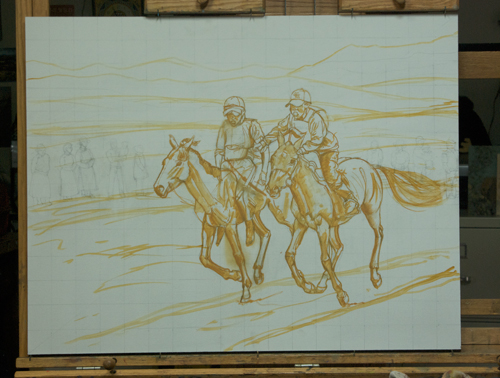
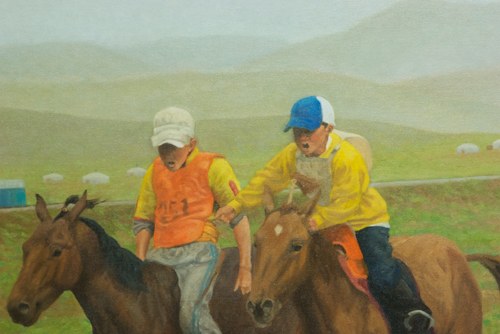
In this case, I decided to start by laying in the background first. I wanted to establish the lightest lights and also the atmospheric perspective of the mountains in the distance. You will also notice that I’ve ditched all the people on the right and cut down the number of people on the left. The buildings are gone, too. I really felt that I needed to simplify things. One of the lessons I’m learning is how what works at one size may not work at a much larger size. It’s what stalled me on the big argali painting.
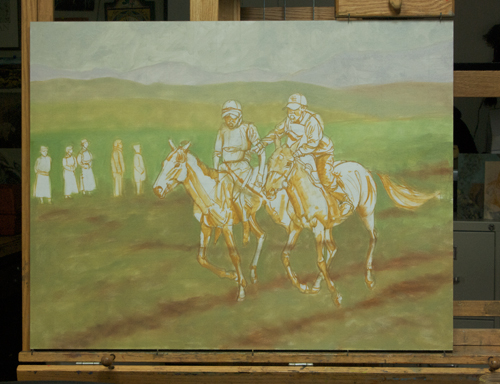
Next, I laid in the first layer of color on the figures, going dark so I could come back in with lighter colors. Everything is in what is called “local color”-the “real” color of an object not affected by a light source. Notice the drawing is pretty much gone, but that’s ok because, I know I can get it back as I go.

Now, I’m past the opening stages. The set-up is done and the constant process of painting, correcting and refining has begun. I’ve laid in the folds on the boy’s clothes and gotten the basic modeling done of the muscles and structure of the horses. Where before, the background had seemed too crowded, now it seems too empty and the people are just standing there, isolated, with no context.
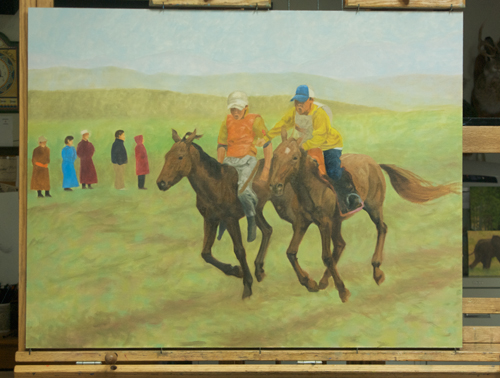
Here you can see how I work. The computer is a 24″ iMac with a glossy monitor, so it’s like painting from very large transparencies. I can easily toggle back and forth between the various images that I’m using. You can see that I’ve added the buildings back in, but now they are behind the spectators, which creates one visual unit instead of two scattered ones. And now there are gers in the background. I’m thinking at this point about the white of the boy’s hats being repeated in the hats of two of the spectators, then repeated again with the gers. So it’s kind of like a bar of music with the white elements as the “notes”.

Here’s a detail of the people and buildings in progress. The good people of Erdene would probably be really confused if they saw this because I’ve used my “artistic license” to move and rearrange the structures to suit me. But I’d like to think that they’d recognize their friends and neighbors. Unfortunately, the pattern on the one woman’s blue del ended up being too visually distracting, so I had to make it just a plain blue. All the colors are intended to relate to each other in a somewhat limited palette and not compete with the jockeys. Oh, and that’s the Mongolian flag at the top of the blue building. Couldn’t leave that out. Notice also that I’ve added the road that runs through the town.  It’s on a diagonal, which is more dynamic than a horizontal. I want it to support and emphasize the main action. That’s also why the lines of dirt at the horses feet are on the diagonal, as you can see in the image above.

Here’s a detail of the jockey’s faces in progress, along with the horse’s heads. They all went through three or four repaints before I got them the way I wanted them. Notice that I haven’t painted any of the tack yet, other than the orange saddle. That’s the final level of detail that I leave for the final orchestration. Also, the paint has to be dry so that if I make a mistake on a stroke I can pull it off without wrecking what I’ve done underneath.

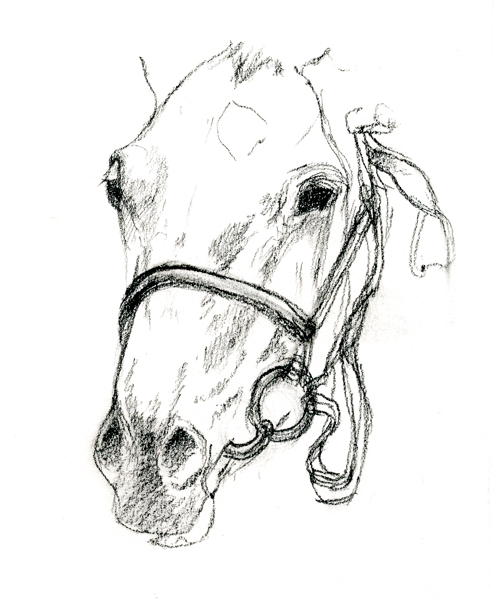
At one point, I stopped, got a piece of paper and a charcoal pencil and did a couple of studies of the boys and the bridle of the horse on the right to make sure that I understood the shapes correctly and could paint only the ones I needed.
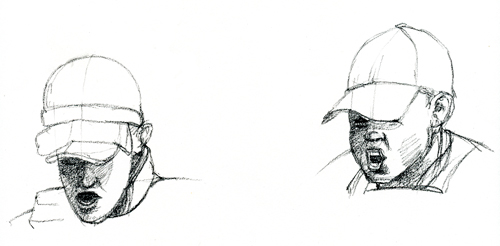
I highly recommend this. Instead of flailing around in paint, hoping to somehow get it right, do a quick drawing to work out the problem. It saves a lot of time, paint and frustration.

One thing I noticed almost at the end was that, as a design decision, I had the right-hand horse’s tail flowing off the canvas. When I was looking at another image for another reason, it hit me and I remembered that the race horse’s tails are bound part-way down. What an awful mistake that would have been. Quick scrap down and repaint.

And here is the finished painting: Rainy Day Finish; Erdene Nadaam, 2009
Mongolia Monday- The Saga Of The Scissors

When I went to Mongolia last July on my AFC Flag Expedition, I knew that arrangements had been made to meet with some unknown number of women at the Ikh Nartiin Chuluu Nature Reserve research camp to talk about helping them set up a felt crafts cooperative. I sorted through all my sewing stuff and came up with a pretty good-sized bag of needles, thread, notions and one extra pair of very good sewing scissors to donate to the cause. You can read about the meeting and see photos of the four intense days I spent with the women here.

The scissors, I found out late on the third day, were very, very, did I say very, popular. I was asked during a last meeting of everyone, if I could get more scissors. Sure, I said, how many pair? One for everyone, so 20 pair. I knew I could figure out some way to do this, so I said yes.

Then a burly man in a del, clearly one of the herders who had spent most of his life out of doors and who had quietly come in and was sitting by the door, raised his hand. Through my translator, he shyly asked if it would be possible to get 21 pair. His wife hadn’t been able to come to the meeting, but he would like to give a pair to her because it would make her happy. Yes, of course. I still choke up a little when I remember him sitting there in a ger full of women (Mongol women can be formidable), summoning up the courage to ask a total stranger for something for his wife.

My gift scissors being used to cut out the fabric for a del for my husband. The women made two, one for each of us, in three days. Notice that there is no paper pattern. The skill to make these traditional Mongol garments is either passed down or there are classes where it is taught.

Then, during a series of “competitions” that celebrated the end of the meetings, everyone divided up into teams to do skits. One team did theirs on where the scissors were because everyone was wanting to use them.

I think what is being said is something like "I need to cut this. Where are the scissors?"

Fast forward and I’m back at home. My husband generously offered to donate the money to purchase the scissors through his company. I got on the internet and in touch with one of the staff people at the Denver Zoo Foundation. It turned out that a fabric store chain had 8″ Gingher sewing scissors on sale at a very good price. Sewers know that Ginghers are about the best you can get and that’s what I wanted the ladies to have.  So they were ordered and delivered to my contact person at the Zoo.

Next was how to get them to Mongolia. We’d hoped to send them over with someone, but no one was going in the near future, the scissors weighed a fair amount and, with security being what it is, we felt like it was a lot to ask for someone to take them on a plane, even in checked luggage.

The Director of the Conservation Biology Department, which is who I work through, said that the only reliable way to make sure they got to where they needed to go was via FedEx, so that’s what we did. That cost over $400. My husband had included $100 for shipping in his original donation and the Zoo picked up the rest. So far so good.

The scissors arrived at the airport and then it got complicated with customs paperwork that none of us knew had to be done ahead of time. More fees, which my husband covered. But the scissors were in UB and in the possession of the right person, who would make sure they got to where they needed to go.

All along I’d had this vision of the scissors arriving in the winter when the women didn’t have as much work to do, so would have time to make felt items to sell this summer. And it would be cold and things would be difficult, but maybe this would be a nice mid-winter surprise. And I would be announcing that this endeavor of my Art Partnerships for Mongolian Conservation had been successfully concluded.

Unfortunately, this winter has turned out to be what the Mongols call a “Zud”, heavy snow and extreme cold, as in below -40F, which is a “normal” winter low. Haiti has the world’s attention, deservedly, but for those of us who care about Mongolia, there is a crisis happening there, too. I wrote to the scientist who goes to Ikh Nart every month and who is going to deliver the scissors, asking how my friends are. His reply was that he hasn’t been able to contact anyone, but will let me know when he does. I suspect that he can’t even get to the area right now. Conditions may not improve until April. I know that the Mongols are resourceful people and they’ll help each other through this, but I am concerned. I’ll be very glad when I hear that everyone is ok.

I’ll post as soon as I have news. In the meantime, I’m making my plane reservations for the next trip in July/August.