Fume control: small desk fan, metal can with lid for rags, VOC air filter
There’s nothing quite like painting in oil. For me, it’s a childhood dream come true. But along with all the advantages comes the disadvantage of the fumes or volatile organic compounds (VOCs).
VOCs can’t be seen, but that doesn’t mean that they can’t be hazardous to your health. While there are many compounds out there that are more problematic than the mediums and solvents we use with artist’s oils, it pays to educate yourself about the possible affects. The EPA has a page devoted to the topic.
I know a couple of local artists who have had serious problems with their reaction to VOCs. One had to quit painting in oil for awhile and switch to watercolor. He has been able to go back to oils, but also now has a studio with really good ventilation. The other artist has had to switch to watercolor permanently.
With them as an example, I decided that I had better get serious about the air quality in my studio because I didn’t want the same thing to happen to me.
Here are four ways to improve the air in your studio. They range from pretty cheap to pretty expensive, so you might have to choose the combination that works best for you in terms of space and finances. But do educate yourself on the issue and take whatever steps you can.
First, the three items that are in the photo at the top, from left to right:
1. I have a small table fan to my left that keeps the air between me and the easel moving. I think we can underestimate or not even think about the miasma of fumes we sit in as they come off the paint once it has medium or solvent in it, our brushes and the painting surface.
2. I have a small steel trash can with a snug-fitting lid under my desk, which is next to my easel. All rags go into that as soon as I’m done with them. Then they go to HazMat disposal. This also reduces the fire danger that comes from flammable rags laying around. I worked for a sign painter back in the late 1970s who had been in two different shops which burned down because of the spontaneous combustion of paint and solvent soaked rags, so I learned proper storage and disposal a long time ago.
None of the volatile stuff that we use as oil painters should EVER go to a landfill. And I would never lay rags out flat and let them release their fumes into the air of my studio while they dry. If you want to do that, take them outside.
3. I have a air cleaner with a VOC carbon filter running at all times when I’m working. One that really does the job is not cheap, but I bought an IQ Air HealthPro Plus and have never regretted it. It’s a roll-around floor model that I keep on the right hand side and can push back into the corner if I want it out of the way.
And, finally:
4. Use non-volatile mediums and solvents as much as possible. One of life’s little ironies is that a lot of the best-performing, most-love oil painting materials are also the most toxic and/or volatile.
If there’s something like Liquin or damar varnish that you just can’t live without, then find healthier alternatives for your other requirements. Google “non-toxic artist oils” for more information.
Be aware that odorless mineral spirits, which is what I currently use as a solvent, does not mean that there are no VOCs. It simply means you can’t smell them. So I keep the lid on the jar except when I’m painting.
I just bought some walnut oil and will be experimenting to see if I can use it instead of Liquin. I switched many years ago to citrus-based Turpenoid Natural for cleaning my brushes.
To be a well-rounded artist with as much information as possible at one’s disposal, I think it’s important get outside of one’s genre and see what else is out there.
The classic piece of advice is to visit great museums and see masterpieces in the original and I agree with that.
But, seeing a great painting and understanding what one can and maybe, should, learn from it are two different things.
Today I’m going to present two works each from five great artists, none of whom are “animal artists”, although almost all of them included animals in their work at one time or another.
I’m going to offer you a thought or two about how you might explore what I believe the artist has to offer. See what you can think of that uses the ideas in these paintings, but with animal subjects.
First is Roy Anderson, one of the great living painters of Native Americans. These images are from a book “Dream Spinner, The Art of Roy Anderson”, which I found at Settlers West Gallery in Tucson this past March for, can you believe it, $10. They may still have some. I don’t know if they will mail them out, but it can’t hurt to call and ask.
At the back of the book is a whole section on how Mr. Anderson creates his paintings, worth more than twice the price of the book for the excellent advice and information he offers.
Here is a master class in color and value relationships. The painting has three “layers” from front to back. Imagine if this was a herd of wildebeest trudging through the dust of the Serengeti.
This one is similar to the first Roy Anderson painting I saw and which just blew me away. I love the strength of the backgrounds. No fear of color here! How could one vignette an animal with this as an inspiration? I must admit, though, that I’ve thought about how to present a Mongol herder in his traditional garb, using my own ideas of shapes and colors for the background.
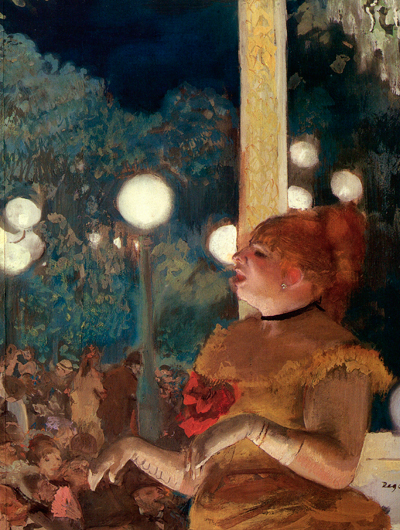
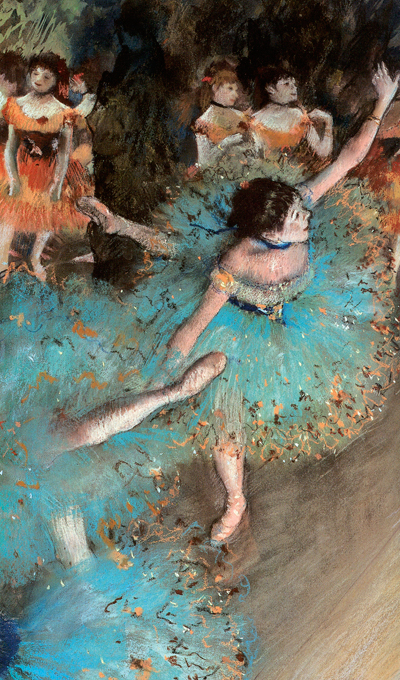
Second is Edgar Degas, who was equally accomplished in painting, pastel and sculpture.
What inspires me personally about his work is his revolutionary compositions, in which figures and other elements are “cut-off’ by the edge of the canvas.
If you find your compositions getting a little stale or have realized that you tend to plop your subject in the middle of the canvas, looking through a book of Degas’ work will blast you loose.
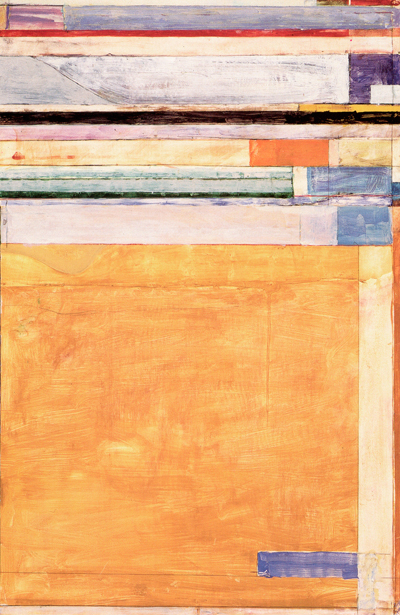
Third is Richard Diebenkorn, an abstract painter who scandalized his contemporaries in the 1950s by introducing recognizable figures into his work at a time when that was considered beyond the pale.
How could this composition be adapted to an animal subject? Like Degas, Diebenkorn has used an unconventional placement of his subject, tight against the left edge and facing more or less off the canvas.
All good painting has a solid abstract structure underneath. Robert Bateman, the legendary wildlife artist, started as an abstract painter and then applied that knowledge to his animal art. Here is a Diebenkorn abstract from the 1990s that could inspire a representational composition.
Fourth is Dean Cornwell, known as the Dean of American Illustrators. He trained in mural painting with Frank Brangwyn in England and it shows in his ability to put together panoramic images with lots going on.
The inspiration in this piece is having the foreground and even the main character in shadow, contrasted with the bright, colorful background.
Cornwell’s rich, decorative approach and fantastic draftsmanship have something to offer artists in any genre.
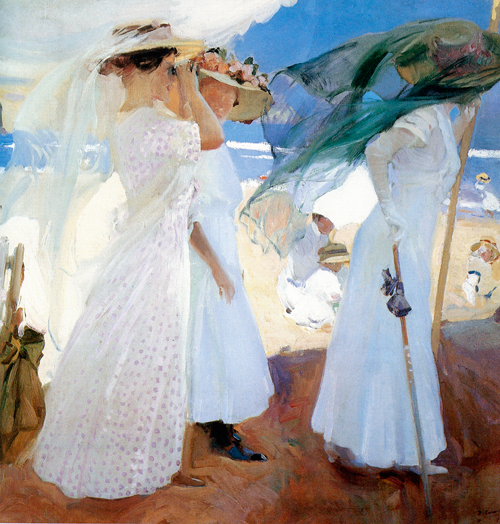
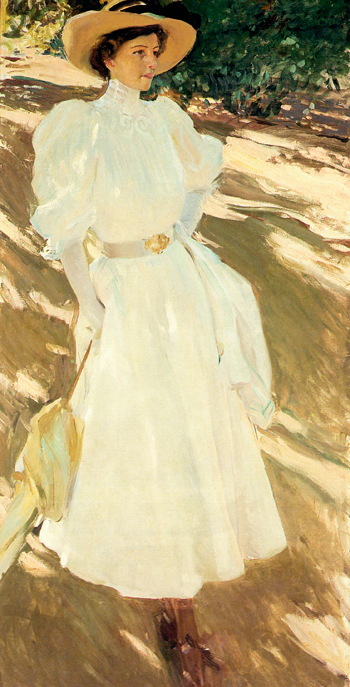
Fifth is Joaquin Sorolla, known for his incredible ability to paint light.
It’s easy to get caught up in what is called “local color”, the inherent color of a subject. This and the next painting illustrate the truth that the color of something depends on the light (and also what the object is next to). We accept that the three ladies in the foreground are wearing white, but there is not a speck of pure white paint on any of their dresses.
How many colors can you count in this “white” dress?
The paintings:
They Sing Towards the Sun 40×72″ oil (detail)
Elk Robe Medicine 36×26″ oil
The Song of the Dog 22 5/8×17 7/8″ gouache and pastel over monotype on paper
The Green Dancer (Dancers on Stage) 26×14 1/4″ pastel and gouache on paper
Coffee 57 1/2x 52 1/4′ oil
Untitled No. 12 38×25″ crayon, graphite and acrylic on paper
Continuing on from last week, I knew that I was going to do a big painting (big for me, at this point) when the five rams walked across the stream bed in the beautiful morning light.
I also knew that it would be a complex piece that would take more planning than I’d done in the past. I’ve started a couple of big paintings, only to have them bog down and fail because, while I did do preliminary sketches and drawings, I found that I hadn’t really solved some critical problems and then was faced with figuring them out on the canvas. A recipe for frustration and failure.
Not this time. First, I thought about what it was that made me want to paint this scene. It was not only the argali, but the interesting alternating pattern of light and shadow, which started in the foreground and went all the way back. And it was important that it be about my emotional response to this very special experience.
Here’s one of the reference shots. I create Albums in Aperture where I can put all the images I’m using on a painting. In this case, thirteen. Here’s the lead ram.
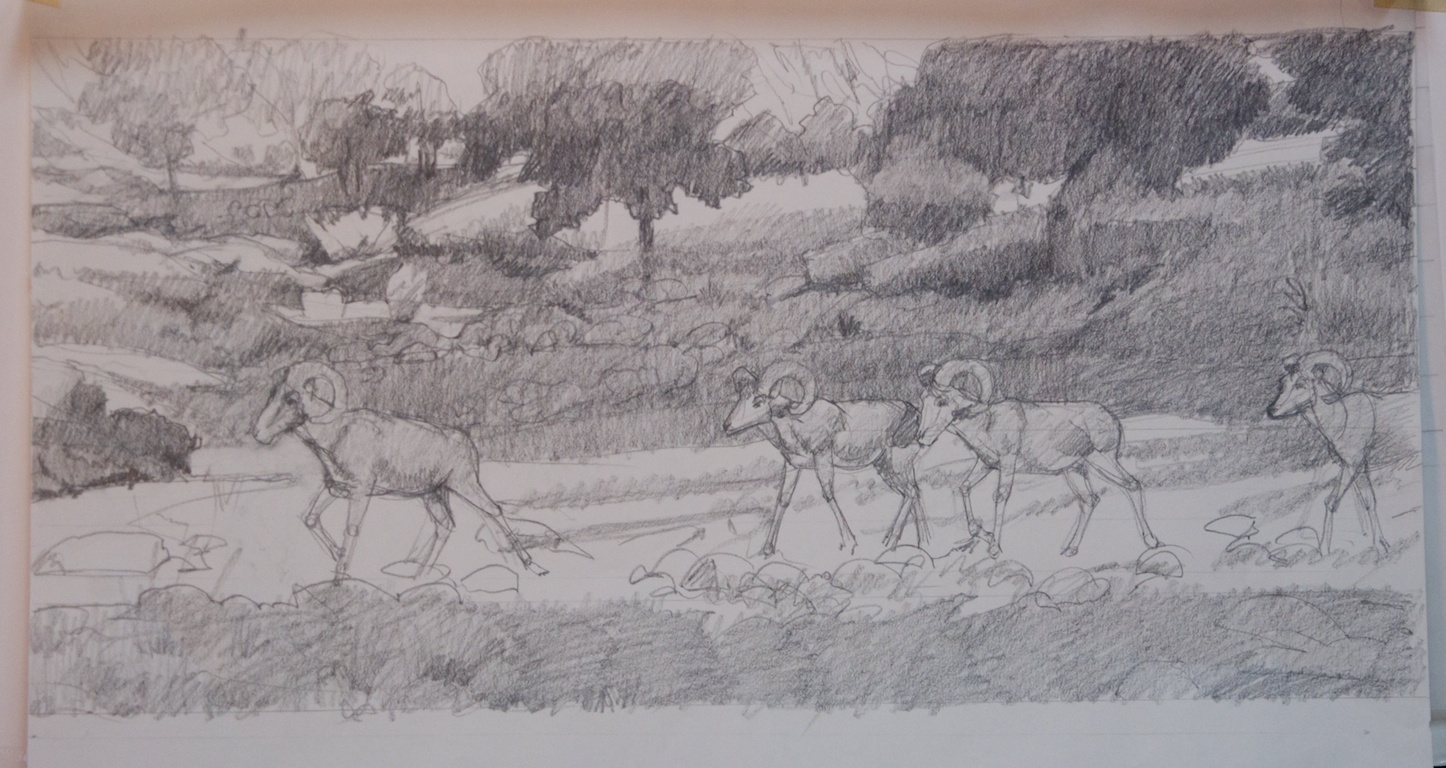
Since I had a pretty clear image in my head of where I wanted to end up, I didn’t do thumbnails this time. And, having struggled with understanding how to work larger, I decided to start larger right away. This is the first layout, done on 19×24″ Canson Calque tracing paper.
As you can see, I adjusted the proportions as needed. I wanted the emphasis to be on the rams, but still show enough of the background to place them in a specific setting and show that alternating light and shadow pattern.
You will also notice that I have an even number of animals, which breaks a “rule”. But they are in an uneven number of “groups”. This doesn’t happen by accident. Or if it does, then there is a conscious decision to keep it.
I had also done a finished drawing of the two rams, which some of you saw a few months ago on Facebook (you can “Like” my public page here).
The next step was to do a small color rough to figure out how I would achieve the visual effect I was looking for. This is on a 6×8″ canvasboard. I blocked out the part that didn’t fit the proportion.
What was critical was to play up the golden light on the ram’s horns and to make sure the argali were the objects of highest contrast by placing them against the central shadow shape. Notice that I’m just painting blobs of color to get the relationships down.
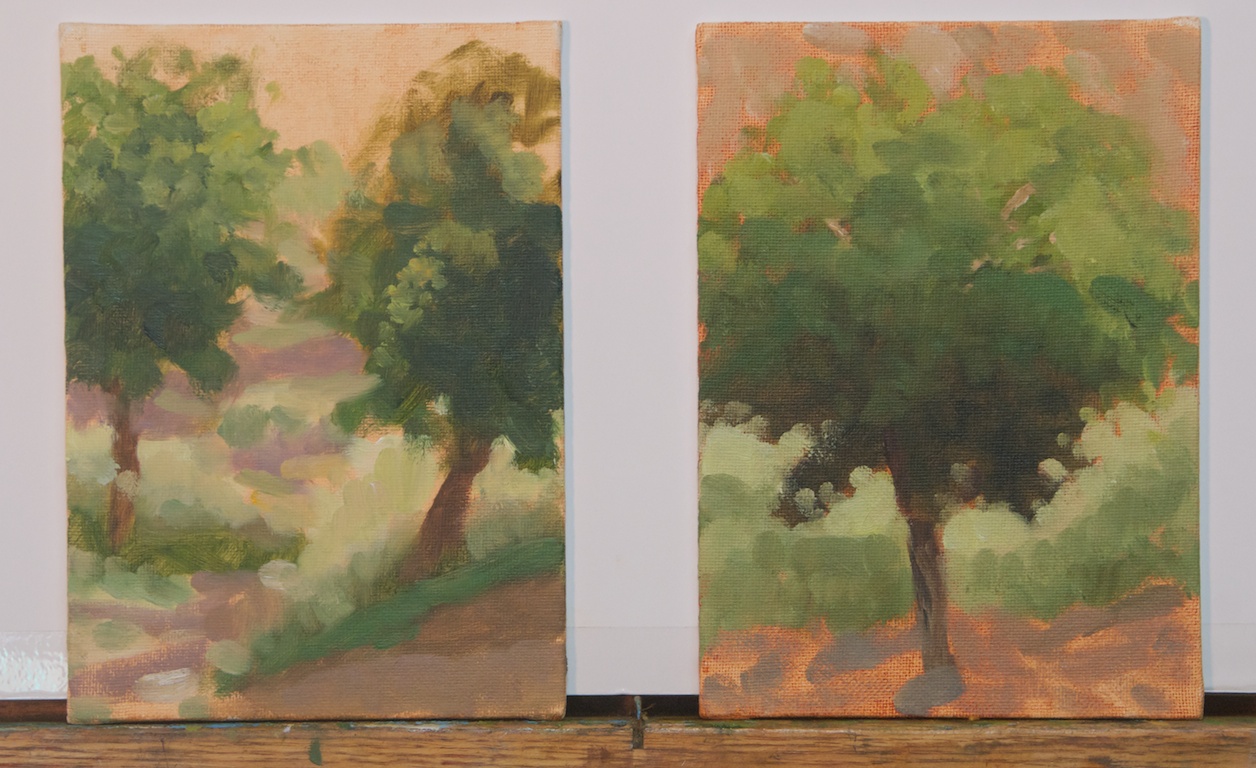
The central tree has a cast shadow. This is something that has given me trouble in the past. The shapes, edges and value relationships have to be just right. So I did a couple of studies of just that tree, along with another to figure out some of the same things where the stream bed goes back into space.
Now it was time to do a large value study, 12×24″. I adjusted the relative position of the rams, moving the pair forward a little.
I had to know if what I had come up with would work at the final size I had decided upon- 24×48″. This is where I’d gotten into trouble before. I asked an artist colleague for advice and he said to take my finished drawing to a copy place and have it blown up to the final size, which I think is a really good idea.
But I chose to try something else. I have found great value in the re-drawing process. It allows me to refine, correct, simplify and really learn to know my subjects in a way that would not be possible if I simply did a drawing, transferred it and started to paint, or worse, heaven forbid, projected them. The depth of understanding and flexibility I get is critical to the quality of my finished product.
First I put a sheet of tracing paper over the drawing above and drew a one inch grid on it.
Then I placed my untoned canvasboard on the easel and ruled a grid on it in pencil. I taped tracing paper to it. It took three sheets to cover it. I lightly sketched a transfer drawing so that every element was in the right spot.
Once the background was laid in, I taped on three more pieces of tracing paper and did the final pencil drawings of each argali. Now I had this:
Because the argali were all on their own pieces of paper, I could do a final check on position and easily move them if needed. I also now had the whole composition at the final size and could see that it did, in fact, work. Whew!
I removed the tracing paper, toned the canvas, re-attached it and, using a No. 7 pencil and a sheet of homemade graphite transfer paper, transferred the drawing.
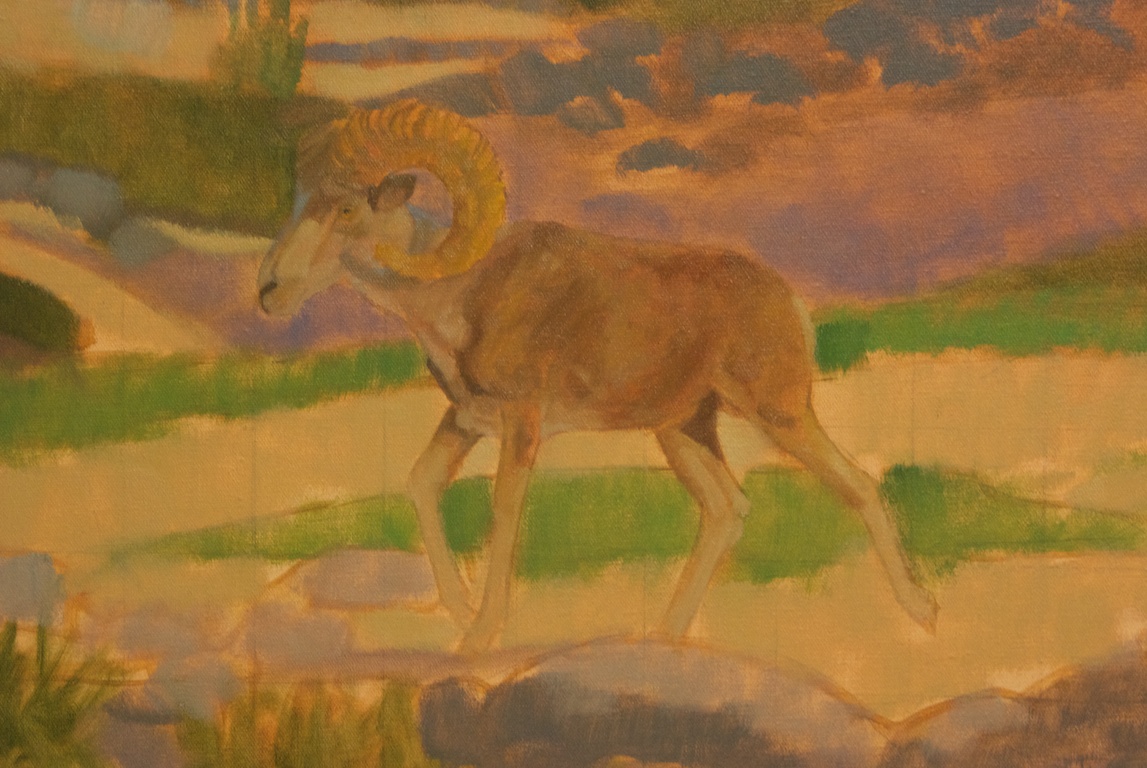
Using the tracing paper drawings as a guide and referring back to the photo reference if necessary, I carefully re-drew the argali with a brush, figuring I’d get the most important elements down first. Here’s a close-up which also shows the loose lay-on of the background. Notice that you can see three of the four hooves. They vanish later as I decide to add additional and larger rocks to create more of a visual separation between the sheep and the viewer.
Here’s the finished drawing, with basic values starting to be indicated. Notice that the rocks in the foreground and middle ground are just roughed in. No need to spend a lot of time on them at this point.
Finally it was time to start adding color! I work all over a canvas in a sitting, keeping the edges soft and letting colors “bleed” into each other. This lets me control where the harder edges will be later on. I’ll also “lose” the drawing, knowing that, having drawn the animals multiple times, I can “find them” again with no problem. First I established the shadow shapes, letting the undertone be the light.
Here’s a close-up of the lead ram in progress. Still keeping it loose, but working on light and shadow and correct structure.
I started to see a problem in the forequarters and it nagged at me for a couple of sittings until I realized that the leg closest to the viewer was too far forward. Moving it and the shoulder back about a quarter of an inch solved the problem. His head was also a little too small. That’s a big advantage of working this way. I can make changes at any point in the process, which turned out to be really important when I was trying to keep track of so many pictorial elements and their relationships to each other.
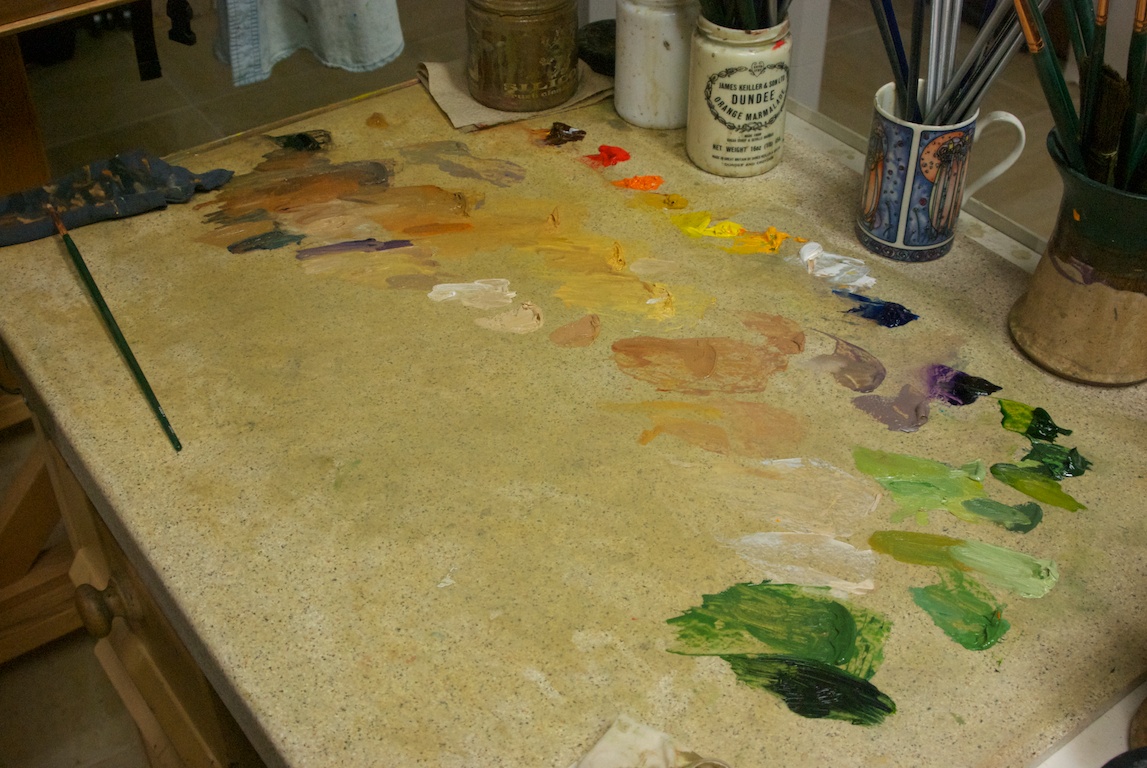
Let’s take a quick break. Here’s my palette. For this painting, I used my standard color range: transparent oxide red, cadmium red medium, cadmium orange, yellow ochre light, cadmium yellow pale, cadmium yellow, titanium white, ultramarine blue, Winsor violet (dioxine), sap green, terra verte, chromium oxide green.
Missing this time around is cobalt blue and magnesium blue hue. I mix my own earth colors and greys. My black is a mix of transparent oxide red and ultramarine blue. I can easily shift the color temperature by changing the proportions.
The palette itself is a scrap of Swanstone solid surface countertop. I got the idea from another art blog and I like it much better than the glass one I’d been using.
Ok, back to the painting. I’m probably about mid-way through at this point. All the value relationships are set (at least I thought so) and basic colors are on.
Oh, darn. I realized that having all the rams in the same light wasn’t very interesting. I went back to my reference images and found a nice shot of the very first one coming out of the shadows. Now I needed to put the fourth ram in that light. Aperture is great for this since it lets you show multiple images at once.
Much better. Having solved that final, somewhat major problem, it was now a matter of simply pushing on, solving all the problems, making decisions, tweaking and tweaking (what Scott Christensen more elegantly calls “orchestration”).
Until, finally, after far longer than I have ever spent on a single painting, it was done.
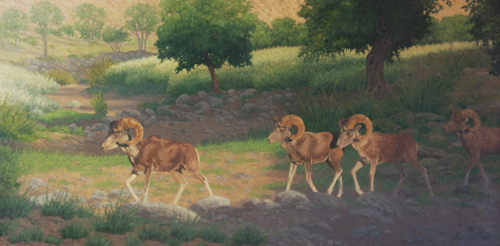
Then They Walked Out Into The Morning Light 24x48" oil
My plan was to go back to Kenya in 2005 for an Earthwatch Institute-sponsored research project “Lions of Tsavo”. But I was leafing through the new Expedition guide and a project I hadn’t seen before caught my eye, “Mongolian Argali”, whatever those were. Oh. Wild sheep. But….Mongolia. Now there was a place that seemed like it might be interesting to travel to. And who knew how long the project would last. Some went on for a decade or more. Others only for a year or two. I called the Earthwatch office, changed projects and, without realizing it at the time, changed my life.
Argali (Ovis ammon) are the world’s largest mountain sheep. A big ram can weigh close to 400 pounds. The horn curl can reach 65″. Their preferred habitat is rocky uplands, mountains and steppe valleys. They are currently listed on the IUCN Red List as Near Threatened and Appendix II of CITES. Accurate population estimates are hard to come by. The most current one is perhaps as many as 20,000 in Mongolia. It is known that the total continues to drop in the western and central parts of the country, is stable in the south, but seems to be increasing in the east.
Group of four argali rams, Ikh Nartiin Chuluu, 2005
Threats include poaching, both for subsistence meat and for the horns, which are now in demand in China for use in traditional medicine. It has also been shown that there is a nearly 100% grazing overlap between the wild argali and domestic livestock, which includes horses, sheep, goats and cattle. Predation by the herder’s domestic dogs, particularly on lambs in the spring, is also a problem. Trophy hunting is not currently a large factor, but the license fee income (18,000 USD) ends up going almost entirely to the federal government. Very little trickles down to either the local people or for conservation projects. One response at the local level has been to create reserves where hunting is not allowed.
As you can see below, there is now an Argali Conservation Management Plan. My on-going involvement with the womens’ craft collective comes under item four on the list.
“Additional conservation measures are desperately required in Mongolia. Clark et al. (2006) outlined the following:
• Implement the recommendations outlined in the Argali Conservation Management Plan. • Improve enforcement of existing legislation that would help conserve argali. • Enhance conservation management in protected areas where argali are found at high population densities, and increase the capacity of protected areas personnel and other environmental law enforcement officers. • Work to improve the livelihoods of local communities in areas where argali are protected by local initiatives and re-initiate community-based approaches to argali conservation (Amgalanbaatar et al. 2002a). • Develop public education programmes to raise awareness of the status of and threats to the species. • Continue ecological research, monitor population trends, and study the impacts of threats, including work in the Altai and Khangai Mountains to complement research occurring in the Gobi Desert. • Implement the recommendations from the Mongolian Wildlife Trade Workshop as outlined in Wingard and Zahler (2006).
Argali ewes and lambs, Ikh Nartiin Chuluu, 2005
Until a joint research effort was started by the Mongolian Academy of Sciences and the Denver Zoological Foundation at the Ikh Nartiin Chuluu Nature Reserve in 2001, very little was known about argali ecology, behavior and population status. This was the research that I had signed up to help with as part of the second Earthwatch team ever to go to Mongolia.
It was April of 2005. Spring in Mongolia is a time of cold, wind and dust storms. Daytime temperatures during the team’s two week stay, living in a traditional felt ger, sometimes only reached 32F. I had the time of my life. When they found out I was an artist, one of the scientists asked if I would be willing to go out and do direct behavioral observations. And that’s what I did for the last three days, trekking out alone into the 43,000 hectare reserve with a clipboard, data forms, GPS, cameras, water bottle and snacks, trying to see the sheep before they saw me, otherwise any data I collected was invalid.
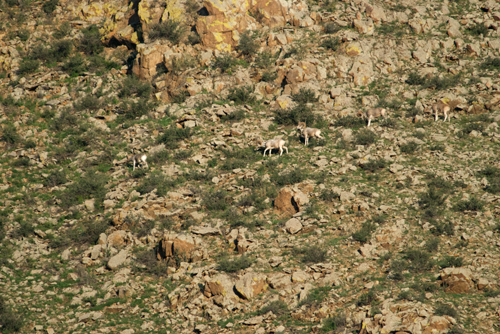
I saw this large group at Ikh Nartiin Chuluu in 2008; seventeen animals, I think, and they ran up that vertical cliff like water flowing uphill
Although a lot of the animals were in poor condition coming out of a typical Mongolian winter in which temperatures can plunge to -40F, I saw many groups that included rams, ewes and lambs, gathered some useable data and got some pretty good photographs. It was a perfect two-fer. I was able to contribute to scientific knowledge of a species and at the same time get information that would be invaluable for painting them.
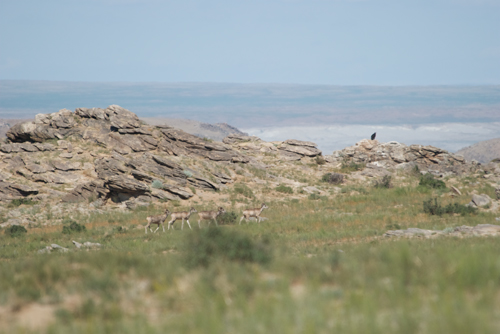
A typical sighting of some ewes and older lambs at Ikh Nart, but with a cinereous vulture, the world's largest, sitting on a rock in the background; in the distance is the desert steppe
I’ve been back to Ikh Nart five times since then and argali have become a particularly favorite subject. I’ve also seen them now at two other locations: Baga Gazriin Chuluu Nature Reserve and Gun-Galuut Nature Reserve.
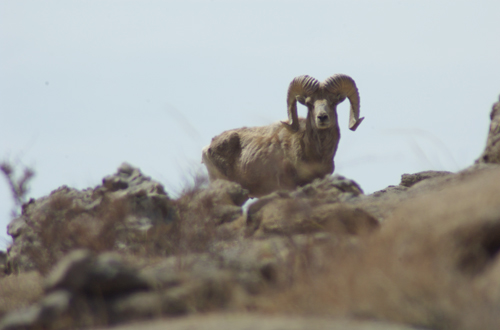
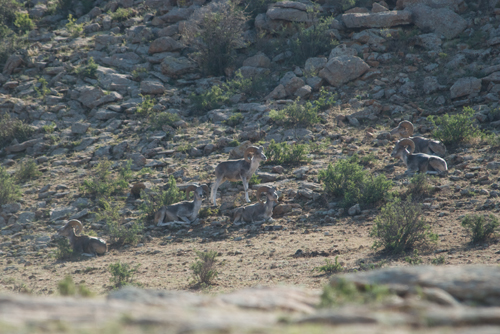
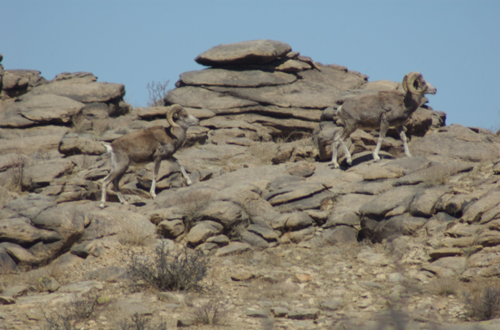
Driving into Ikh Nart in 2008; a grab shot from the car of four ramsRams on rocky hillside at Gun-Galuut Nature Reserve in 2009; the key to spotting them is to look for movement and those long, thin legs, which don't seem to quite fit the landscape; this was with my 80-400 mm lens (effectively 600mm on a digital body) at maximum zoomThis group of rams, at Baga Gazriin Chuluu Nature Reserve were about 800 meters away within plain view of the road through the park; "lazy" animal watching
I thought that I would share some of the photos I’ve taken and the paintings that have come out of them. It usually takes around three, often quite a few more, reference shots since I move animals around, change backgrounds or whatever it takes to make a composition work. I’m only going to show the main animal reference that I worked from. This fieldwork is critical. When working on a painting, I’m also remembering what it was like to be at that place, how the wind felt, the utter quiet when I stopped for a break, then trudging along, looking up and seeing that the sheep had already spotted and were watching me.
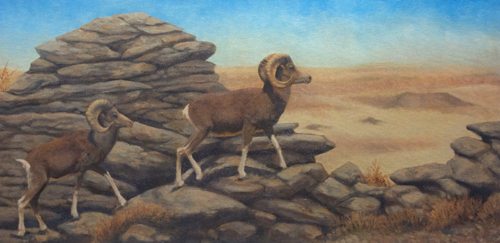
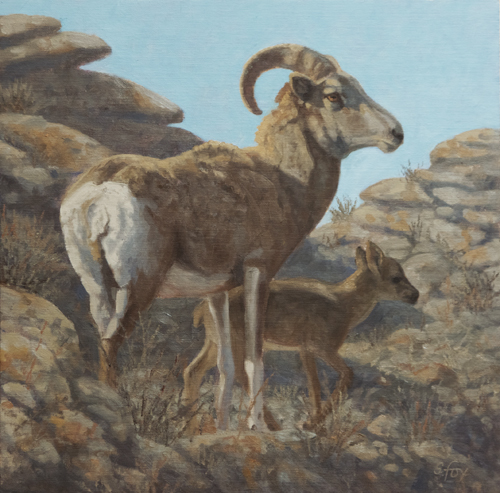
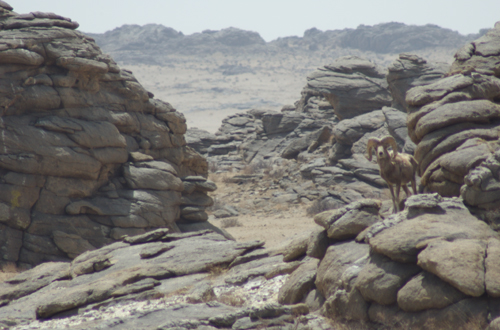
For one of my first argali paintings, I wanted to show them in the fantastic landscape of Ikh Nartiin Chuluu; April 2005Ikh Nartiin Chuluu Argali 15x30" oilArgali ewe, Ikh Nartiin Chuluu; April 2005; I added a lamb and moved the ewe up so her head would be against the sky for maximum contrastArgali Ewe and Lamb, Ikh Nartiin Chuluu; 12x12" oil on canvasboardOld ram, Ikh Nartiin Chuluu; April 2005; He's probably long gone, but we spent a, for me, memorable half hour together as he let tag along behind him after checking me out; that's also him in the first photo at the top of this postMutual Curiosity 17x30" oil
Notice the little drawing of a plein air painting setup, circa 1914
“But how do I know when it’s finished?”….is one of the many plaintive cries of the painting student.
There are probably almost as many answers as there are painting teachers.
And I think it depends on how far down the road of understanding an artist has gone. I know it has changed for me over the sixteen years that I have been painting.
These days, I have a pretty good idea of what problems I need to solve and how I’m going to do it. Once I have, voila, the painting is done.
However, as students and new painters are battling on many fronts at once, it’s easy to keep going and going and going…..until, well, It’s Dead, Jim.
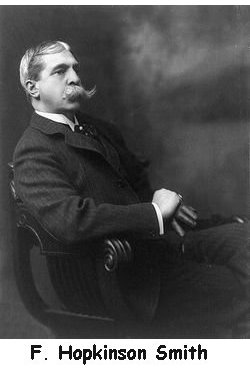
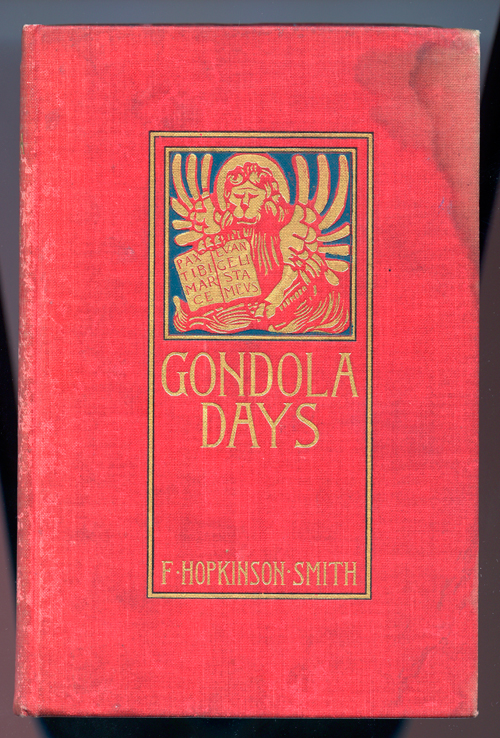
F. Hopkinson Smith
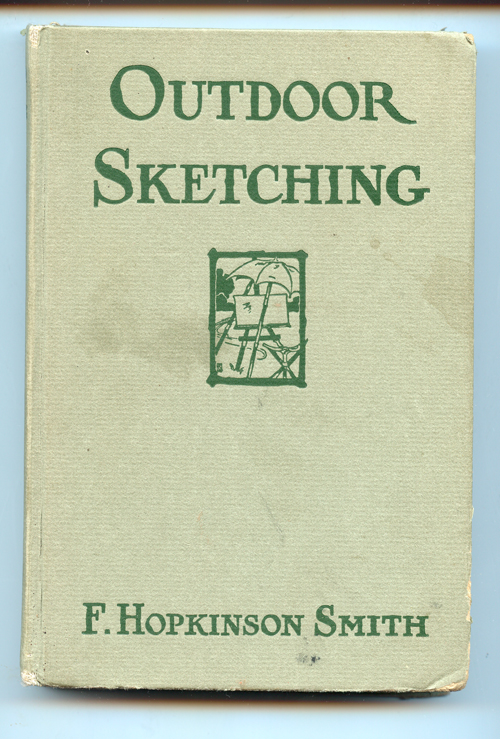
But, once again, dipping randomly into one of my old art instruction books, this time “Outdoor Sketching” by F. Hopkinson Smith, I find another method, effective but probably not well known. The book is a presentation of four talks that he gave at The Art Institute of Chicago in 1914. Wish I’d been there. This excerpt is from his talk on Composition.
“The requirements are thoughtful and well-studied selection before your brush touches your canvas; a correct knowledge of composition; a definite grasp of the problem of light and dark, or, in other words, mass; a free, sure, and untrammelled rapidity of execution; and, last and by no means least, a realization of what I shall express in one short compact sentence; that it takes two men to paint an outdoor picture: one to do the work and the other to kill him when he has done enough.”
Hopkinson Smith may have written the most interesting and witty book on outdoor sketching that most artists have never heard of. There will be more….
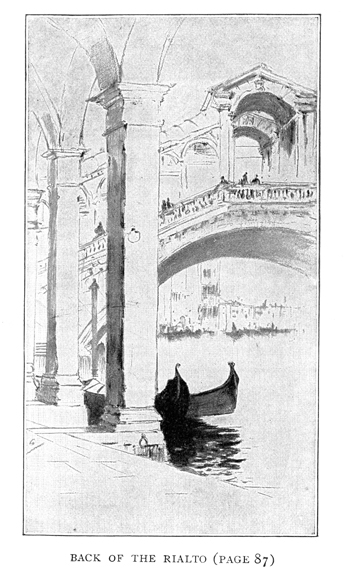
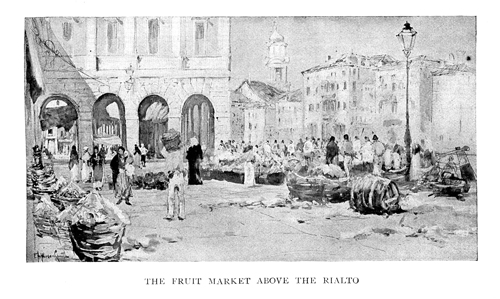
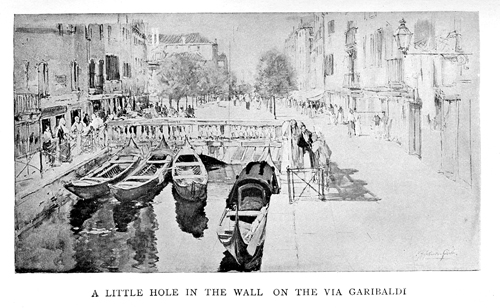
But in the meantime, here are some of his sketches from “Gondola Days”, which is in my personal library. As you will see, he knows whereof he speaks:
I have a small collection of old books about the practice and techniques of oil painting, watercolor, drawing and sketching. This morning, trying to figure out what to blog about today, I pulled “The Practice of Oil Painting-And of Drawing as Associated with it” by Solomon J. Solomon, R.A. (Royal Academy) off the shelf. I purchased it some years ago in England for the princely sum of six pounds, fifty pence. There is no copyright date, but a portrait of a young girl with short hair suggests that it was published in the 1920s to 1930s.
Opening the book randomly, I found some study advice that is as relevant now as it was then, so thought that I would share it.
It’s from Chapter XII, Hints on Arrangements-Solecisms in Composition:
“We do not get stronger by watching other men lift weights. Nor are weights lifted or pictures composed, either at the beginning or at any time, without effort. Good composition calls for a far higher mental capacity than mere painting (interesting observation), which is in itself difficult enough…
When in the course of your reading you come across a pictorial episode, visualize it and sketch the scene as it strikes you. There are, nowadays, so many beautiful illustrations to be seen (alas, those days are mostly gone); you may well learn, from some of them, how figures are grouped, and how accessories are placed to complete the pictorial arrangement. Such mental notes, added to your unceasing practice, will greatly increase the facility with which you will be enabled to arrange and compose artistically.
When visiting a picture or sculpture gallery, take a sketchbook with you. Your memory will not suffice to recall the results of your analysis of compositions. Study particularly the placing of heads, half and full length portraits and figures, and the main structural lines and colour massed of decorative designs. Mark the arrangement of light and shade (chiaroscuro) in Dutch and Spanish pictures, which have such fine technical qualities, and when anything strikes you as particularly beautiful, draw it, and in drawing it search for the secret of its beauty.”
My main takeaway from the studies above was a greater understanding of what it means to “work from lean to fat” and how many small, subtle touches of tone and color go into painting at the level of a Rembrandt or Hals. This is why it is so critical to see great original art. Reproductions just aren’t the same
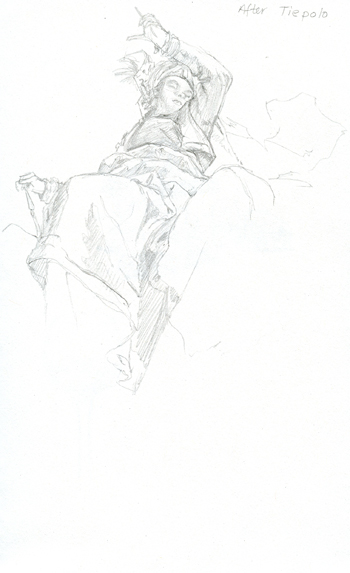
From Tiepolo
* The images are from studies that I’ve done myself. All but the first and last were from a show at the Metropolitan Museum of Art in 1995, “Rembrandt, Not Rembrandt”. The Tiepolo was from an incredible show of his preliminary drawings for one of his ceiling “jobs”. I’ve never been able to find a book with more than a couple of ok reproductions of them.
There’s a certain rhythm to creating paintings. I usually have a number of them underway at various stages of completion. Of course, most of them are hanging around unfinished. Then I get to the final sitting on one of them and pretty soon, Ta Da!, it’s done!
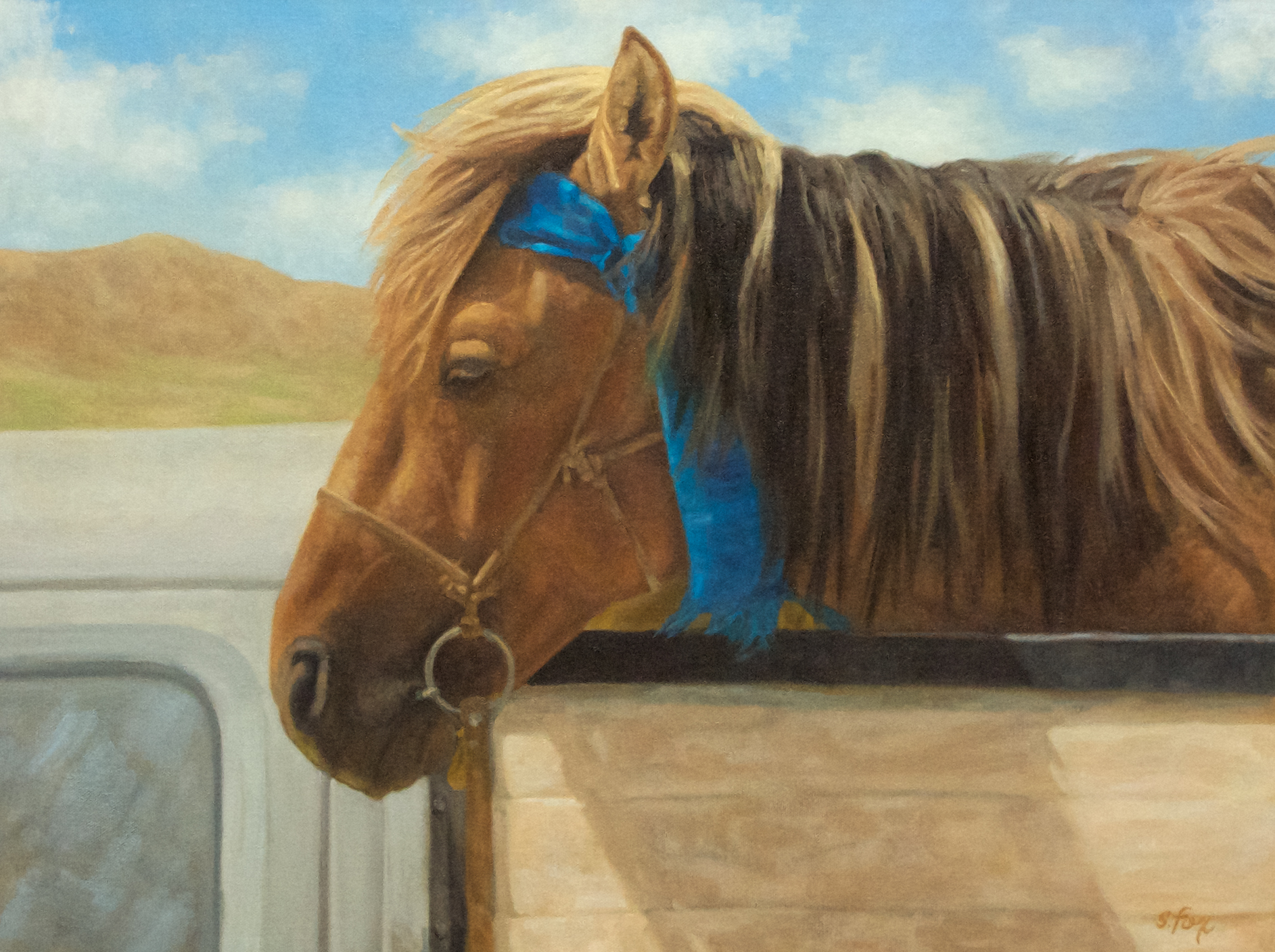
I finished one yesterday and one this morning. First, my latest Mongol Horse series painting:
Mongol Horse #6, Race Winner 18x24" oil on canvasboard price on request
I shot the reference for this one on my camping trip in Mongolia this last July. We had pulled into a soum center, which is the American equivalent of a county seat. My guide went over to some trucks filled with horses and chatted with the men, who were taking a break in the shade since it was a warm day at the northern edge of the Gobi. I stayed in the car, but got some good photos. My goal in this piece was to capture the wonderful quality of light that is one of the things I love about Mongolia.
This is a typical Mongol horse who is being taken on a “Naadam (festival) tour” for the horse race events. He’s a winner since he’s wearing a blue scarf called a khadak. He’s not spiffy looking compared to a thoroughbred, but he can also run 20 miles or more without stopping. I also always like seeing the bi-colored manes, which adds a bit of flash.
Minii Govi (My Gobi) 16x12" oil on canvasboard
I grew up with the redwood forests of northern California and have never been a “desert person”. But I love the Gobi (which means “desert” in Mongolian). This scene was also from my 2010 camping trip. The air was incredibly clear, almost crystalline. And it was obvious why Mongols call their country “The Land of Blue Skies”. This is a small piece that I’ve done for myself to start to understand how to paint an amazing part of the world.
I had the opportunity to spend yesterday morning and early afternoon at the Metropolitan Museum of Art in New York City before my evening flight home. (I was there for a Society of Animal Artists board meeting and added a little time for other things). My main purpose was to see the Kublai Khan exhibition. He was the grandson of Chinggis Khan, which I hadn’t realized until I started to learn about Mongol history. That will be a Mongolia Monday post at some point.
Afterwards, I wandered through the 19th Century European painting galleries and was reminded once again that there is no substitute for seeing masterpieces in the original. I also noticed quite a few paintings with animal subjects. I didn’t have my Nikon, just my iPhone. So the following images aren’t great, but they will serve to share my favorites.
I didn’t remember to photograph the labels for all of them, I’m sorry to say, but did track down titles and artist for all except one. But it really doesn’t matter who did them. The takeaway is to see and appreciate the great lineage of animal art that those of us who have chosen our fellow creatures as subjects are part of.
Tiger and Cubs- Gerome
Animal art has a long and honorable history in European painting and was not dismissed with the snobbery so many of us encounter today.
detail of horse painting- Bonheur
It is instructive to see how artists of the period, who had tremendous ability as painters in a variety of subject matter, could also do a specialized subject like animals extremely well. That is often not the case today.
Detail, camel
There was one entire room dedicated to European artists who painted North African subjects. Many also traveled to the Middle East. The collective term for them is Orientalists. I should do a post on them sometime since their approach and reaction to what they saw is interesting for any artist who, like myself, is also fortunate enough to journey to distant places.
Before the Audience- Gerome
What IS that black cat doing there? A spy, perhaps?
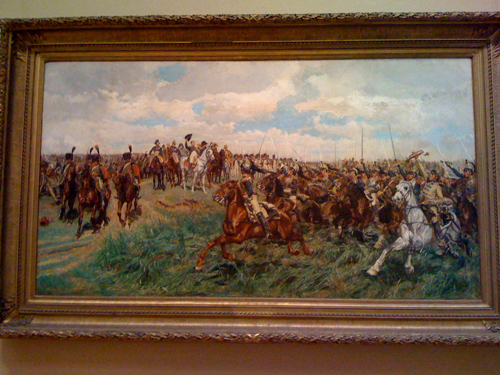
Friedland detail- Messonier
This is a detail from a massive painting of one of Napoleon’s greatest victories, with a cast of dozens. This horse is around 5″ from top of head to bottom of hoof. Stunning description of action and anatomy. Here’s the whole thing:
Friedland- Meissonier
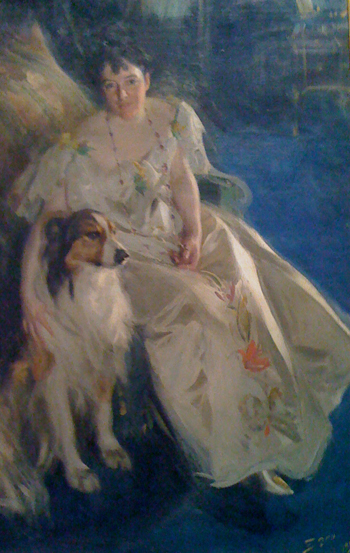
Since we have a rough collie in the family, I naturally had to have a photo of this one, which has a more old-fashioned shape to the head:
Mrs. Walter Rathbone Bacon- Zorn
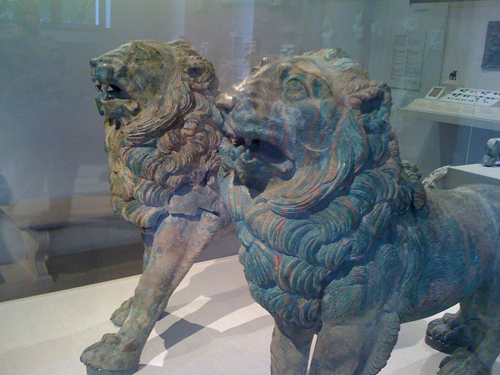
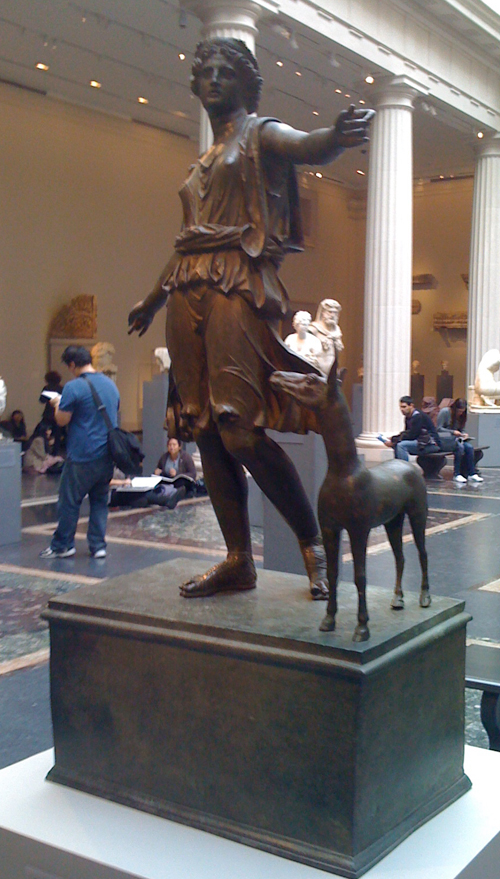
The Met also has a phenomenal collection of Greek and Roman sculpture. The main hall was filled with schoolkids drawing from the marble and bronze figures.
Bronze lions, ancient Greece
If you have access to a museum with animal sculpture, you have a great rainy day opportunity to go sketch animals that will hold still.
Statue of Artemis/Diana
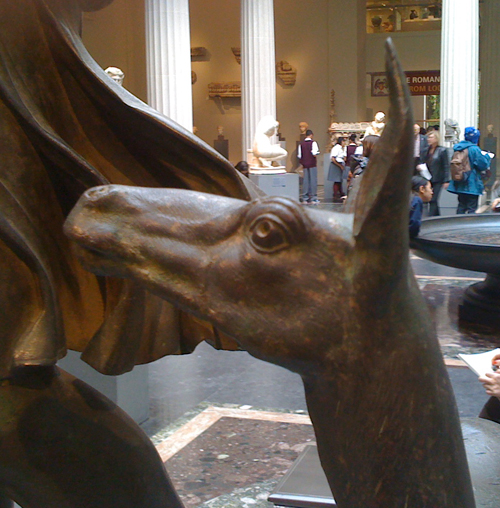
It’s interesting to note how artists interpreted something like the head structure of a deer over 2,000 years ago.
detail of deer's head
I also want to strongly make the point that there is no substitute for seeing great art “live”. Reproductions in books and posters are, at best, rough approximations. The color is probably not accurate. The size certainly isn’t. And size matters. The visual impact of a painting like “Friedland” is due in no small part to its large dimensions: 53.5″ high and 95.5″ wide.
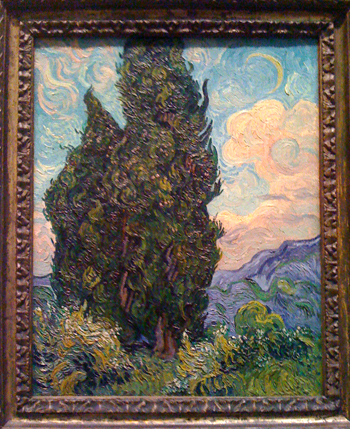
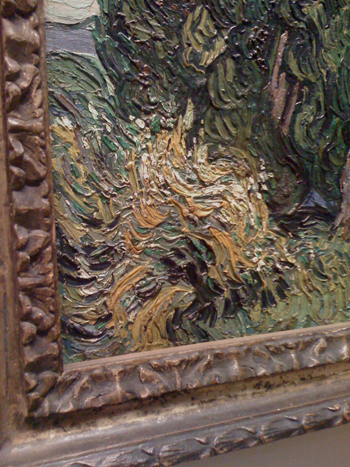
But what I think is missing almost the most is that a painting has a visual texture, sometimes subtle, sometimes not. Printing an image of a painting on a flat piece of paper eliminates that aspect completely. As an admittedly dramatic example, here is a Van Gogh. First the whole work. Then a detail shot at an angle that shows how the paint was applied. When he put it on this thickly, the painting almost becomes a live thing.
van Goghdetail
A painting like this is about more than the image. It’s also about paint as paint.
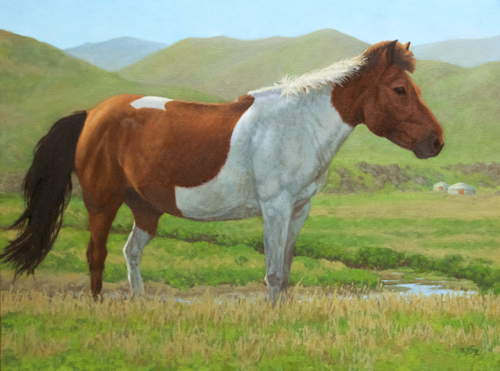
Mongol Horse #7-Getting Warmed Up 18x24" oil on canvas
This was the first painting I started after the long travel layoff. I wanted to keep it simple, so I chose this beautiful paint horse standing with his back to the morning sun. In my reference he was standing with a hill behind him, which wasn’t very interesting, so I “moved” him to a background that let me do a landscape, too. The setting is the Hangai Mountains of central Mongolia, a lush and scenic part of the country that isn’t anything like the vision most people have of the Land of Blue Skies.





















 Susan Fox, American Artist
