(This is a re-post since for some unknown reason it was posted as a Page, not a post when I originally did it last Friday)
While I first went to Mongolia for the wildlife, after a trip or two I started to notice the domestic animals, what the Mongols call The Five Snouts: horses, sheep, goats, camels, and cattle, which include “real” cattle and also yaks.
Mongol yaks are found in the northern part of the country, up in the mountains. Like the other “snouts”, they provide a number of products and functions, including being trained for riding. There will be a painting of that at some point, which I saw in the Hangai Mountains in 2010.
Sometimes they are crossed with cattle to create a hybrid called a “khainag”, which are stronger than the pure yaks and more easily trained to pull carts. But they don’t really look the same. The heads are a somewhat different shape and the coat can be much shorter.
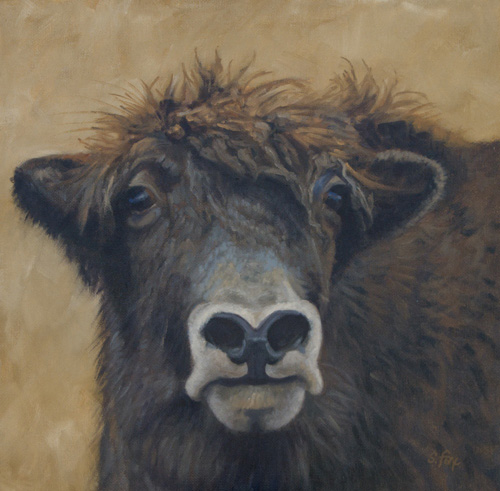
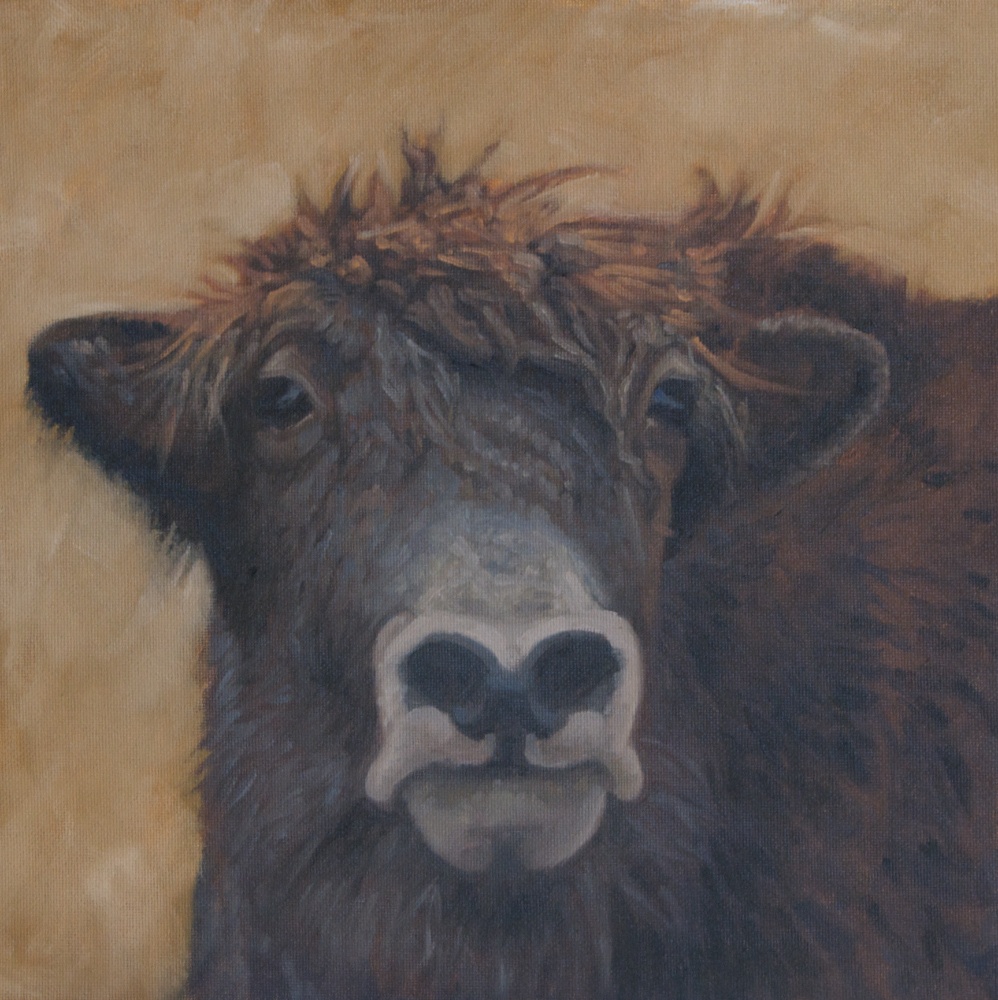
The pure yaks make me smile whenever I see them. The cow yak in the painting is one that I saw this past August at Gun-Galuut Nature Reserve.
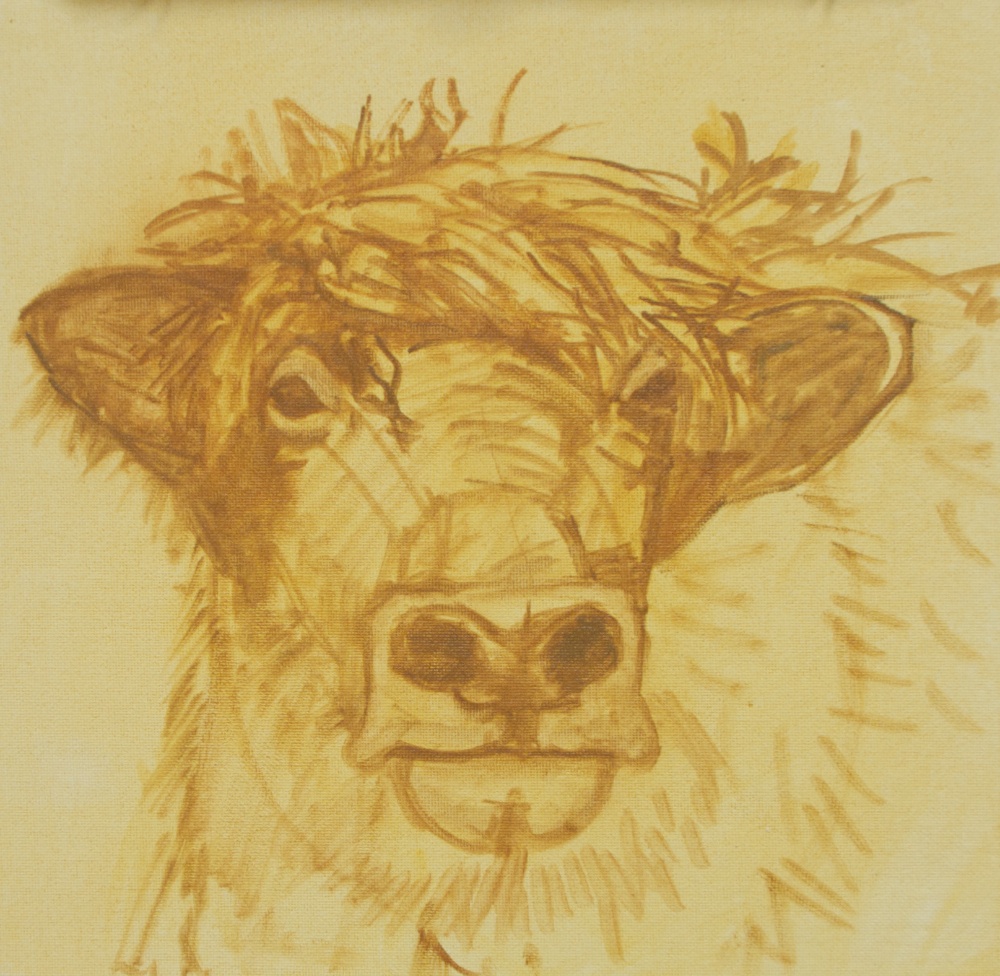
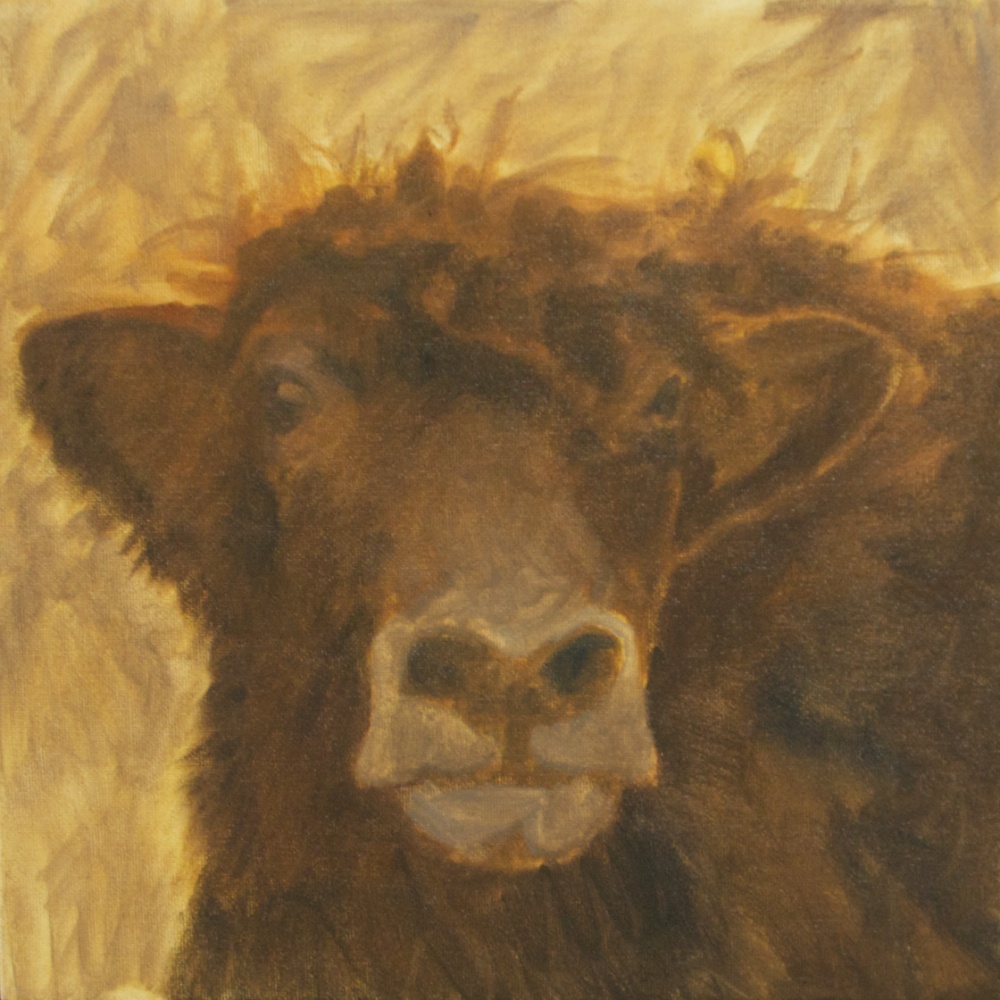
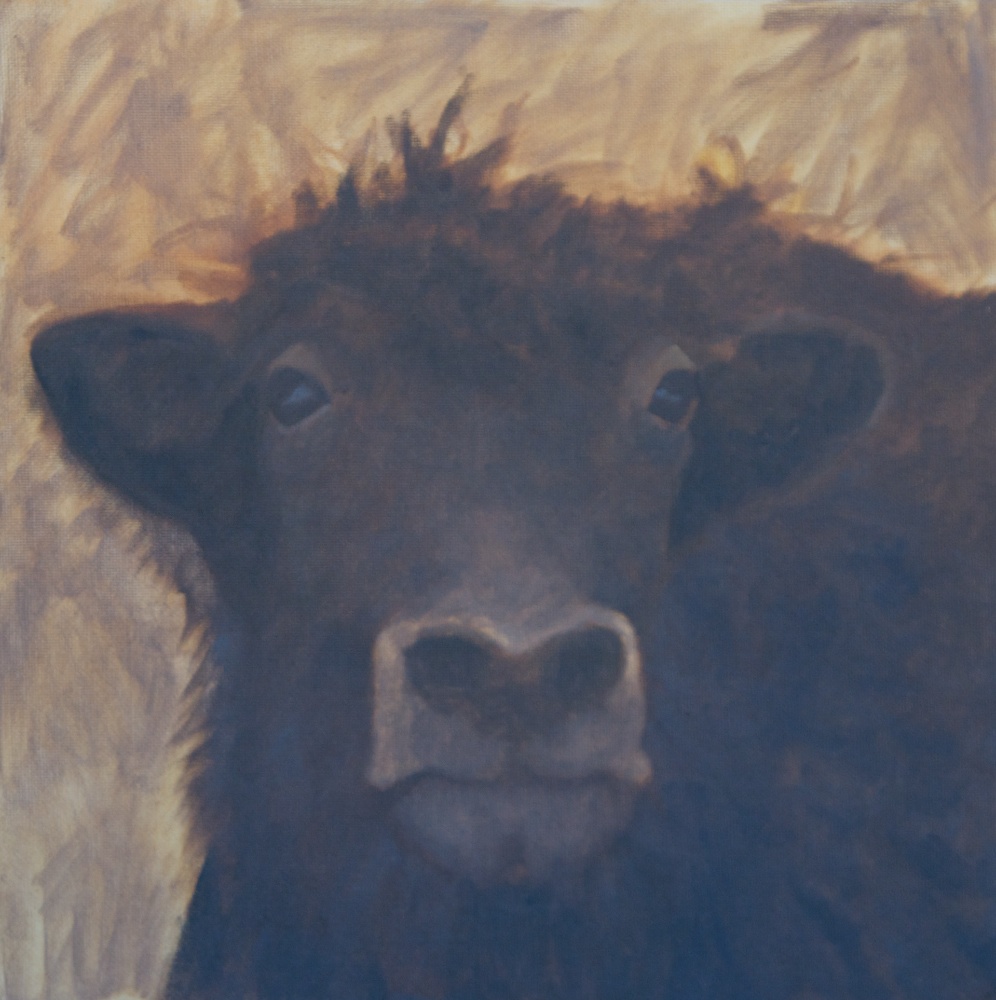
Here’s a step-by step of “Checking You Out”:
The reference photo. Not great light, but I liked her head with its fuzzy topknot and white muzzle; I also wanted to work on doing a 3/4 view.I decided that a square format would work well and started on a tinted canvas with a brush drawing, both in raw siennaThe next step is to get color all over the canvas and establish the relative values of her head, going darker; I'm always correcting the drawing as needed as I paintI now have my darkest dark areas in a cool tone and will come in lighter and warmer over it. The muzzle's been moved a little and the eyes re-stated also.Everything is now set up for the final push as I will refine shapes, tweak edges and work on value contrastOnce again....Checking You Out 12x12" oil (price on request)
It’s always interesting to sit down at the easel again after a “lay-off”. This time it was over six weeks. Things feel awkward and thoughts of “Oh, jeez, will I remember how to paint.” flit through one’s head.
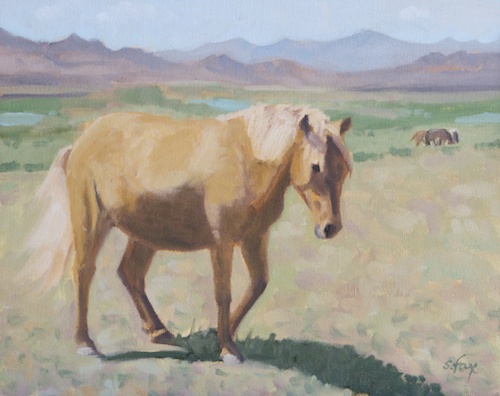
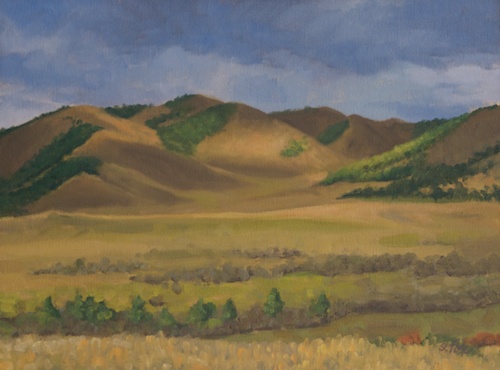
But it always works out. I get back in the saddle by doing a few small, warm-up pieces using my newest reference. This time I picked three different subjects that I thought had great light, so that I could work on light/shadow and value relationships. The first two were done in two sittings with a some additional tweaking after I’d let them sit overnight. The third took somewhat more time since I was also working to catch a likeness and keep the shadow somewhat high key.
Shar Mor (Yellow Horse) 8x10" oilLight On Hills 9x12" oilYak Herder 12x9" oil
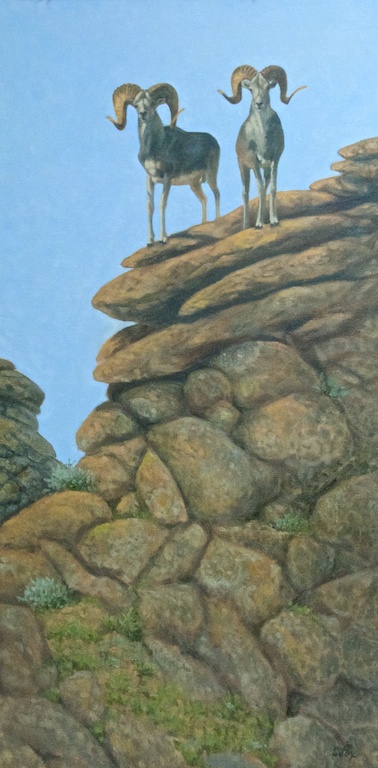
I had gone out very early from the research camp at Ikh Nartiin Chuluu Nature Reserve this past July and had settled down on a rock to see who would show up at the water hole.
I looked up and saw these two rams checking me out as they scanned their surroundings.
The sun was just hitting the cliff tops, so they really stood out against the morning sky.
For the painting, I wanted to give a sense of the landscape that they live in and how comfortable they are on tilted surfaces that would make most of us somewhat nervous.
Soon after I took this and some more photos, they came down onto the valley floor and joined up with some buddies for a drink and a graze.
I got to watch them for about half an hour.
And yes, after 2 1/2 years, I’ve updated the look of my blog with a new theme. I finally found one that I liked and that has new features and functions the previous one lacked. Let me know what you think!
First Summer, Takhi Foal 18x24" oil hot off the easel
1. Suck it up and accept the fact that you are an entrepreneur and that you are running a business. Artists can handle business stuff. We are not, by definition, airy, fairy flakes. Get organized, get Quicken for financial recordkeeping, Evernote for keeping track of everything and make the commitment to nurture your career. No one else will do it for you or as well.
2. Create a marketing plan or you won’t have a clue about what to do. Without a context and the bigger picture, how can you know whether or not doing a particular show makes sense or if you should do prints or sign with that gallery? Not having a plan is throwing spaghetti against the wall and hoping something (like money) sticks. Find your local Small Business Development Corporation office and take advantage of their free and low-cost services. I did and it’s really paid off. Literally.
Ready for North Coast Open Studios, June 11, 2011
3. Make social media work for you. Yeah, I know “but I already spend too much time on the computer (whine)”. Like it or not, online career-building is where it’s at now and has the major advantage is that it’s often free, unlike traditional advertising and promotion. These days you must have: a website that you can update yourself (I use Go Daddy. There are others that are probably simpler to set up but don’t offer the design flexibility; google “artists websites” to see what’s out there); a blog (This is a WordPress blog. Blogger works fine also, but the backend isn’t as sophisticated); a Facebook public page (easy to set up); a Twitter account (you’ll need to experiment to see how well it works for you); a newsletter (Constant Contact is the way to go); a LinkedIn profile (lots of artists there these days) and whatever else you find out there that can help get the word out about your work. It’s the synergy between all this that is what counts. There is no “one place to be”. The question is “how many places can I be?”
4. Always do the very best work you can that reflects your passion and point of view, NOT what you think the market wants. That way lies imitative, mediocre art that is always going to be two steps behind. Be the best YOU can be and then back it up with numbers 1 and 2.
Work in progress
5. Buy Alyson Stanfield’s book“I’d Rather Be In The Studio: the artist’s no-excuse guide to self-promotion” and check out her website and blog. She’s the best resource out there for ideas, advice and encouragement for building an art career. One of the things she emphasizes over and over is how critical your mailing list is because these are the people who are interested enough in what you do to let you contact them with news of what you’re up to.
Notice all the links? That’s no accident. Part of the purpose of this post and the links is to drive traffic to this blog.
Feel free to add any further thoughts and ideas in the comments!
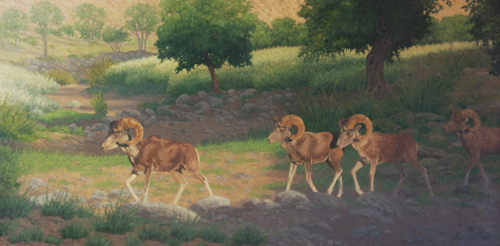
Continuing on from last week, I knew that I was going to do a big painting (big for me, at this point) when the five rams walked across the stream bed in the beautiful morning light.
I also knew that it would be a complex piece that would take more planning than I’d done in the past. I’ve started a couple of big paintings, only to have them bog down and fail because, while I did do preliminary sketches and drawings, I found that I hadn’t really solved some critical problems and then was faced with figuring them out on the canvas. A recipe for frustration and failure.
Not this time. First, I thought about what it was that made me want to paint this scene. It was not only the argali, but the interesting alternating pattern of light and shadow, which started in the foreground and went all the way back. And it was important that it be about my emotional response to this very special experience.
Here’s one of the reference shots. I create Albums in Aperture where I can put all the images I’m using on a painting. In this case, thirteen. Here’s the lead ram.
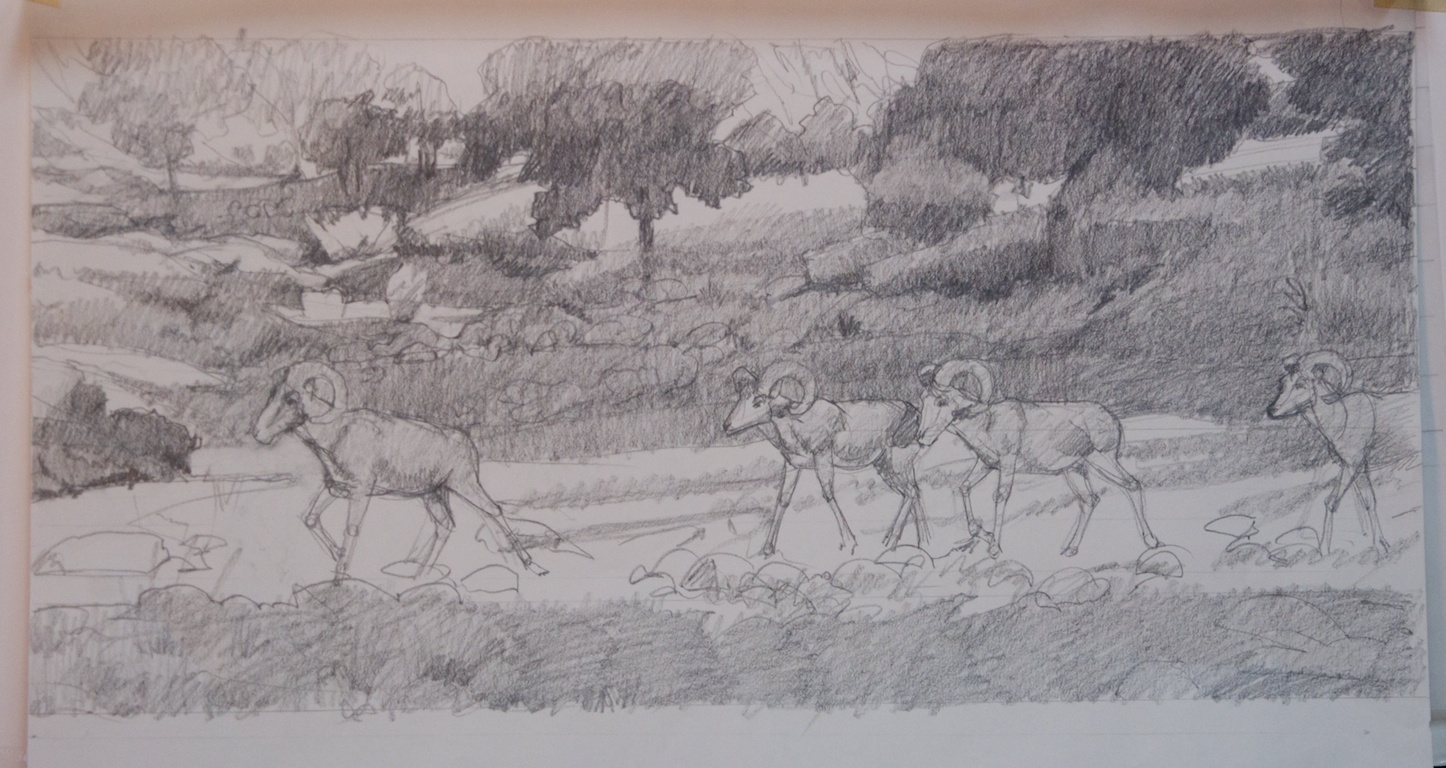
Since I had a pretty clear image in my head of where I wanted to end up, I didn’t do thumbnails this time. And, having struggled with understanding how to work larger, I decided to start larger right away. This is the first layout, done on 19×24″ Canson Calque tracing paper.
As you can see, I adjusted the proportions as needed. I wanted the emphasis to be on the rams, but still show enough of the background to place them in a specific setting and show that alternating light and shadow pattern.
You will also notice that I have an even number of animals, which breaks a “rule”. But they are in an uneven number of “groups”. This doesn’t happen by accident. Or if it does, then there is a conscious decision to keep it.
I had also done a finished drawing of the two rams, which some of you saw a few months ago on Facebook (you can “Like” my public page here).
The next step was to do a small color rough to figure out how I would achieve the visual effect I was looking for. This is on a 6×8″ canvasboard. I blocked out the part that didn’t fit the proportion.
What was critical was to play up the golden light on the ram’s horns and to make sure the argali were the objects of highest contrast by placing them against the central shadow shape. Notice that I’m just painting blobs of color to get the relationships down.
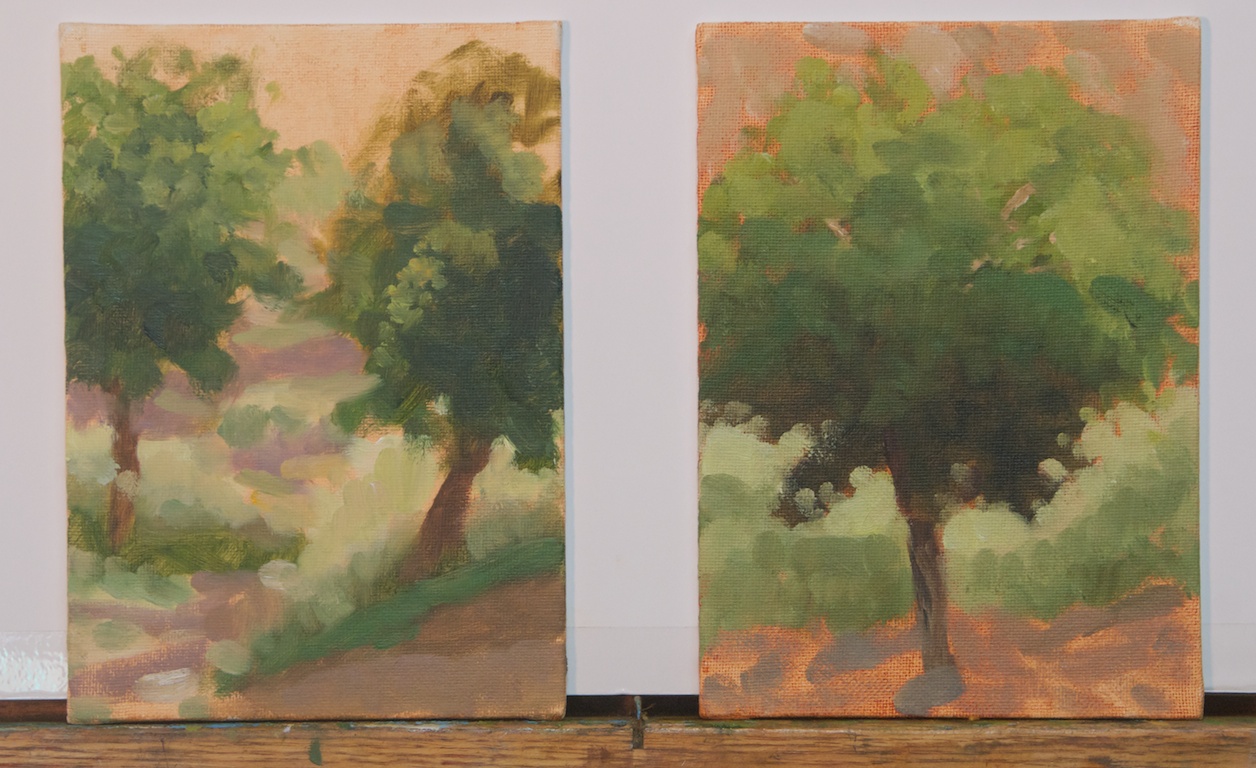
The central tree has a cast shadow. This is something that has given me trouble in the past. The shapes, edges and value relationships have to be just right. So I did a couple of studies of just that tree, along with another to figure out some of the same things where the stream bed goes back into space.
Now it was time to do a large value study, 12×24″. I adjusted the relative position of the rams, moving the pair forward a little.
I had to know if what I had come up with would work at the final size I had decided upon- 24×48″. This is where I’d gotten into trouble before. I asked an artist colleague for advice and he said to take my finished drawing to a copy place and have it blown up to the final size, which I think is a really good idea.
But I chose to try something else. I have found great value in the re-drawing process. It allows me to refine, correct, simplify and really learn to know my subjects in a way that would not be possible if I simply did a drawing, transferred it and started to paint, or worse, heaven forbid, projected them. The depth of understanding and flexibility I get is critical to the quality of my finished product.
First I put a sheet of tracing paper over the drawing above and drew a one inch grid on it.
Then I placed my untoned canvasboard on the easel and ruled a grid on it in pencil. I taped tracing paper to it. It took three sheets to cover it. I lightly sketched a transfer drawing so that every element was in the right spot.
Once the background was laid in, I taped on three more pieces of tracing paper and did the final pencil drawings of each argali. Now I had this:
Because the argali were all on their own pieces of paper, I could do a final check on position and easily move them if needed. I also now had the whole composition at the final size and could see that it did, in fact, work. Whew!
I removed the tracing paper, toned the canvas, re-attached it and, using a No. 7 pencil and a sheet of homemade graphite transfer paper, transferred the drawing.
Using the tracing paper drawings as a guide and referring back to the photo reference if necessary, I carefully re-drew the argali with a brush, figuring I’d get the most important elements down first. Here’s a close-up which also shows the loose lay-on of the background. Notice that you can see three of the four hooves. They vanish later as I decide to add additional and larger rocks to create more of a visual separation between the sheep and the viewer.
Here’s the finished drawing, with basic values starting to be indicated. Notice that the rocks in the foreground and middle ground are just roughed in. No need to spend a lot of time on them at this point.
Finally it was time to start adding color! I work all over a canvas in a sitting, keeping the edges soft and letting colors “bleed” into each other. This lets me control where the harder edges will be later on. I’ll also “lose” the drawing, knowing that, having drawn the animals multiple times, I can “find them” again with no problem. First I established the shadow shapes, letting the undertone be the light.
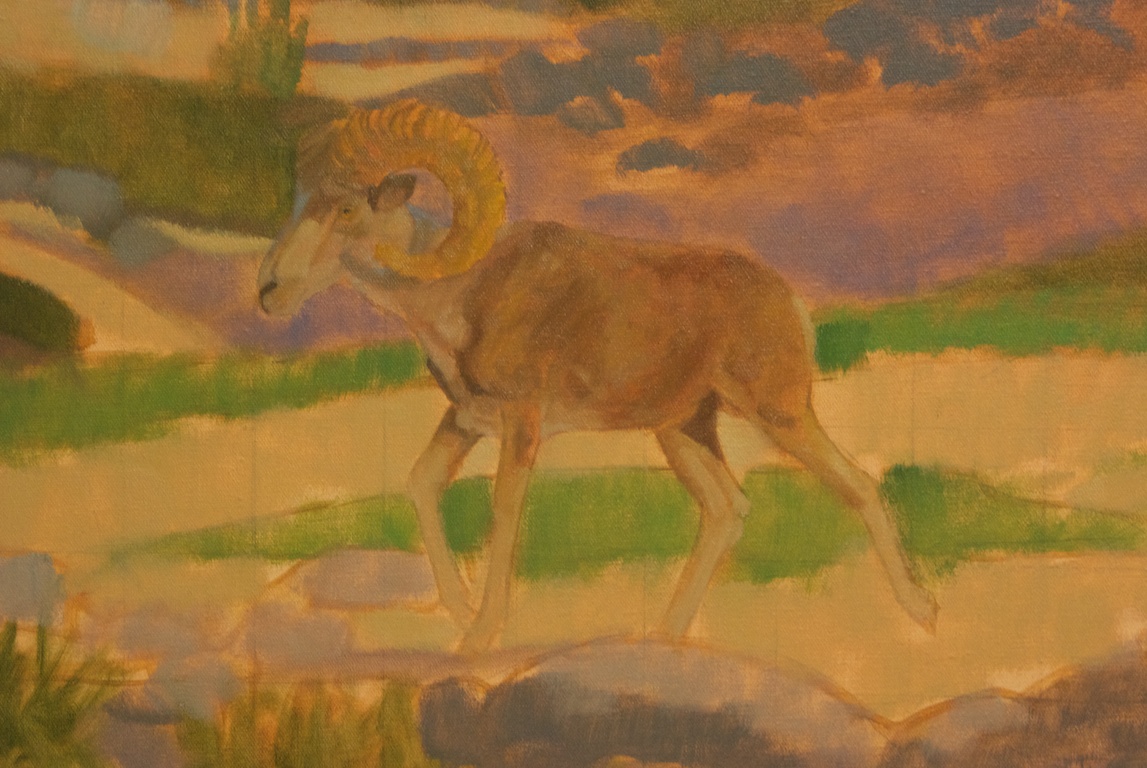
Here’s a close-up of the lead ram in progress. Still keeping it loose, but working on light and shadow and correct structure.
I started to see a problem in the forequarters and it nagged at me for a couple of sittings until I realized that the leg closest to the viewer was too far forward. Moving it and the shoulder back about a quarter of an inch solved the problem. His head was also a little too small. That’s a big advantage of working this way. I can make changes at any point in the process, which turned out to be really important when I was trying to keep track of so many pictorial elements and their relationships to each other.
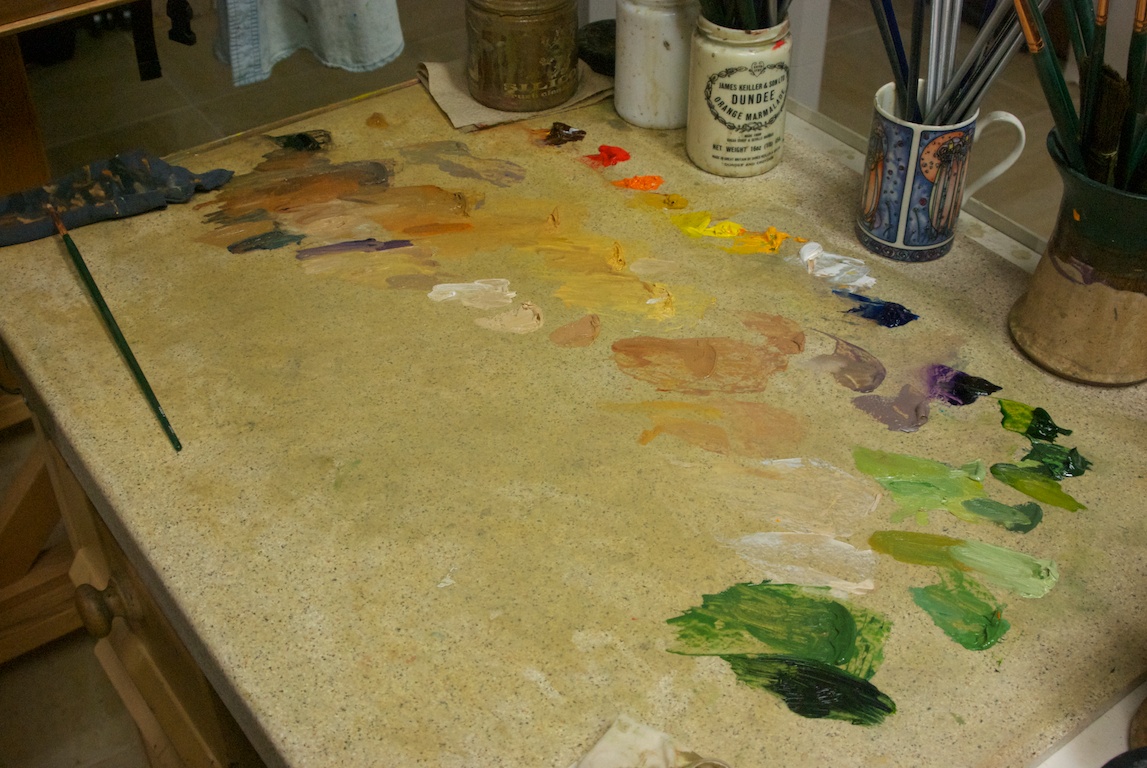
Let’s take a quick break. Here’s my palette. For this painting, I used my standard color range: transparent oxide red, cadmium red medium, cadmium orange, yellow ochre light, cadmium yellow pale, cadmium yellow, titanium white, ultramarine blue, Winsor violet (dioxine), sap green, terra verte, chromium oxide green.
Missing this time around is cobalt blue and magnesium blue hue. I mix my own earth colors and greys. My black is a mix of transparent oxide red and ultramarine blue. I can easily shift the color temperature by changing the proportions.
The palette itself is a scrap of Swanstone solid surface countertop. I got the idea from another art blog and I like it much better than the glass one I’d been using.
Ok, back to the painting. I’m probably about mid-way through at this point. All the value relationships are set (at least I thought so) and basic colors are on.
Oh, darn. I realized that having all the rams in the same light wasn’t very interesting. I went back to my reference images and found a nice shot of the very first one coming out of the shadows. Now I needed to put the fourth ram in that light. Aperture is great for this since it lets you show multiple images at once.
Much better. Having solved that final, somewhat major problem, it was now a matter of simply pushing on, solving all the problems, making decisions, tweaking and tweaking (what Scott Christensen more elegantly calls “orchestration”).
Until, finally, after far longer than I have ever spent on a single painting, it was done.
Then They Walked Out Into The Morning Light 24x48" oil
Cinereous Vulture, Ikh Nartiin Chuluu, Mongolia 16x20" oil on canvasboard
I happen to love vultures, who form a big part of nature’s clean-up crew. Cinereous vultures are the largest raptors in Eurasia. They can weigh up to 30 lbs and have a 10′ wingspan. As it turns out, Ikh Nartiin Chuluu is a “hotspot” for them, with almost 250 known nests, a quarter of which are used each year. One of the interesting things about this species, as you can see from my painting is that, unlike other vultures, the adult’s heads are not bare of feathers.
It has recently been learned that that a large number of juvenile vultures, many of which are born and fledge during the spring and summer at Ikh Nart, winter in South Korea, thanks to a combination of GPS radio collars, wing tags and dedicated observers.
So far, the species seems to be doing well in Mongolia. I sincerely hope that continues because they are always an impressive sight as they soar overhead in the beautiful blue skies.
There’s a certain rhythm to creating paintings. I usually have a number of them underway at various stages of completion. Of course, most of them are hanging around unfinished. Then I get to the final sitting on one of them and pretty soon, Ta Da!, it’s done!
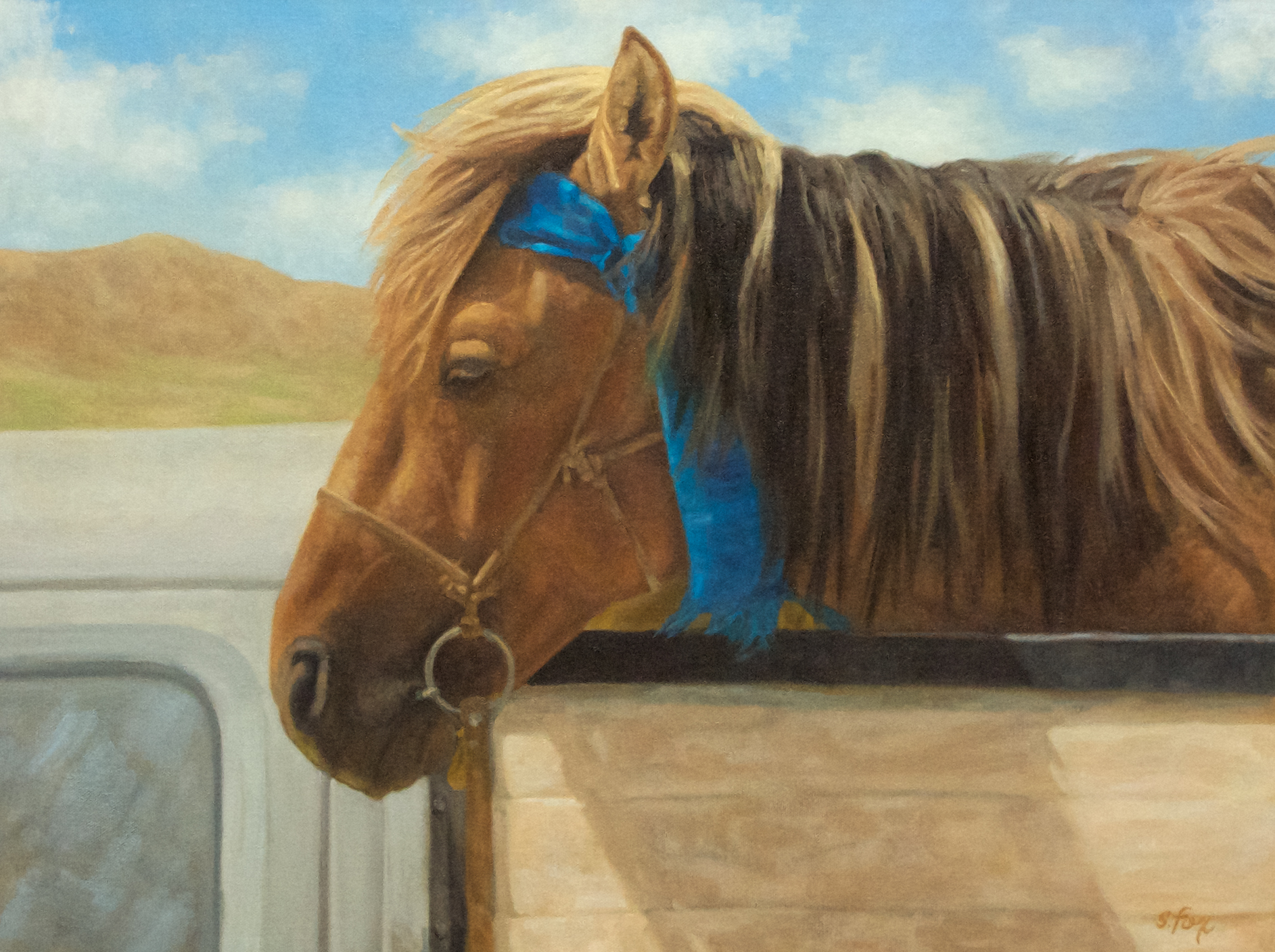
I finished one yesterday and one this morning. First, my latest Mongol Horse series painting:
Mongol Horse #6, Race Winner 18x24" oil on canvasboard price on request
I shot the reference for this one on my camping trip in Mongolia this last July. We had pulled into a soum center, which is the American equivalent of a county seat. My guide went over to some trucks filled with horses and chatted with the men, who were taking a break in the shade since it was a warm day at the northern edge of the Gobi. I stayed in the car, but got some good photos. My goal in this piece was to capture the wonderful quality of light that is one of the things I love about Mongolia.
This is a typical Mongol horse who is being taken on a “Naadam (festival) tour” for the horse race events. He’s a winner since he’s wearing a blue scarf called a khadak. He’s not spiffy looking compared to a thoroughbred, but he can also run 20 miles or more without stopping. I also always like seeing the bi-colored manes, which adds a bit of flash.
Minii Govi (My Gobi) 16x12" oil on canvasboard
I grew up with the redwood forests of northern California and have never been a “desert person”. But I love the Gobi (which means “desert” in Mongolian). This scene was also from my 2010 camping trip. The air was incredibly clear, almost crystalline. And it was obvious why Mongols call their country “The Land of Blue Skies”. This is a small piece that I’ve done for myself to start to understand how to paint an amazing part of the world.
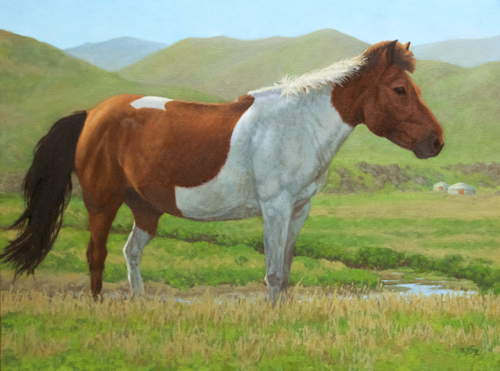
Mongol Horse #7-Getting Warmed Up 18x24" oil on canvas
This was the first painting I started after the long travel layoff. I wanted to keep it simple, so I chose this beautiful paint horse standing with his back to the morning sun. In my reference he was standing with a hill behind him, which wasn’t very interesting, so I “moved” him to a background that let me do a landscape, too. The setting is the Hangai Mountains of central Mongolia, a lush and scenic part of the country that isn’t anything like the vision most people have of the Land of Blue Skies.











 Susan Fox, American Artist
