I never get tired of going to Hustai National Park in Mongolia. It’s the best place in the world to see takhi or, as they are known in the west, Przewalski’s horse. I saw this stallion with his harem in August of 2013. It had been a good year for all the animals in Mongolia, both domestic and wild. The takhi looked great!
Takhi harem, Hustai National Park
Here’s part of the harem moving along for their morning graze. A dominant mare leads them and decides where they will go. The harem stallion usually brings up the rear, keeping an eye on everyone. At the time I was there I was told there were around 300 horses divided into 15 harems, plus some bachelor groups. Hustai National Park is only a two-hour drive, mostly on paved road, from Ulaanbaatar. So it should be on the “Must See” list for any animal or horse lover traveling to Mongolia.
Takhi/Przewalski’s horse is the only surviving species of true wild horse. At one point there were only 54 of them in the world. Now there are, I believe, over 2000. They have been reintroduced to three locations in Mongolia, including Hustai. The other locations are very remote and not set up for visitors, so this is the place to see them.
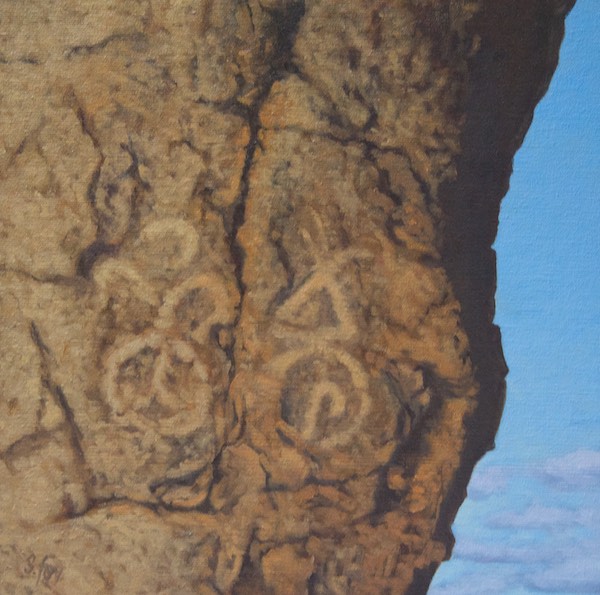
Although Ikh Nartiin Chuluu Nature Reserve is known as a great wildlife destination where it’s pretty easy to see argali sheep and Siberian ibex, it’s also turning out to be a treasure house of archaeological and cultural artifacts and sites. Among them are inscriptions and petroglyphs, including the subjects of my painting, which are part of a variety of images on a large rock near a well. You can see them in the photograph below which I took in 2008.
Rock with petroglyphs, Ikh Nartiin Chuluu
Research into this facet of the reserve only began a few years ago through an Earthwatch-sponsored project “Archaeology of the Mongolian Steppe”. The over 70 sites recorded so far cover 6,000 years of human habitation, including at least one site dating from the time of Chinggis Khan.
“Petroglyphs, Ikh Nartiin Chuluu” will be in the upcoming Redwood Art Association show “Elements: Earth, Water, Fire, Air”, from February 23 to March 20.
I spent four wonderful days at Delger Camp, a ger camp I booked through Nomadic Journeys, this last trip to Mongolia. I’d seen the camp and area a couple of times. The 2013 WildArt Mongolia Expedition stayed there on its last night out, so I knew it would be a great place to paint on location, which it was. I also took a ton of photos, including some of the sunset shown in the painting. It was a wonderfully relaxing and inspirational stay.
Delger Camp
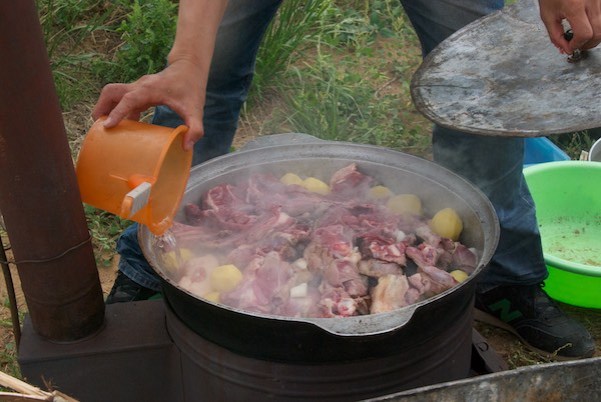
I had the entire area of valleys, mountains, dunes and wetlands to amble around in, stopping to paint when the fancy, and scenery, struck me. The staff was great and knowing I like Mongolian food, made khuushuur for me for lunch one day (fried mutton turnovers). They also made khorhog (real “Mongolian BBQ”) one night. Here’s a photo of it ready to cook on the stove with hot rocks in the pot. It was delicious!
Khorhog ready to cook
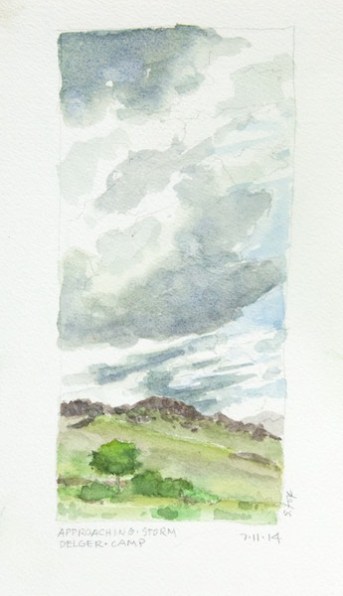
And here’s one of the watercolors I did just sitting in front of my ger. I’m looking forward to going there again this year to do more!
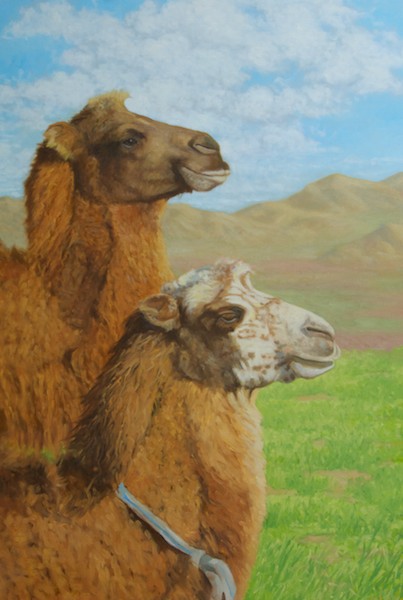
I’ve seen these camels a number of times now at a ger camp that I stay at, Arburd Sands. Nowhere else in my travels in Mongolia since 2005 have I ever seen one with a white face like this. He’s big, too. His legs have the same kind of spotted markings. These two were part of a large group belonging to a local herder. They were grazing and hanging around quite near to the camp. I sat and sketched them one morning along with taking a lot of photos.
Here’s one of the pages of sketches I did in 2012 which includes the white-faced camel in the upper right.
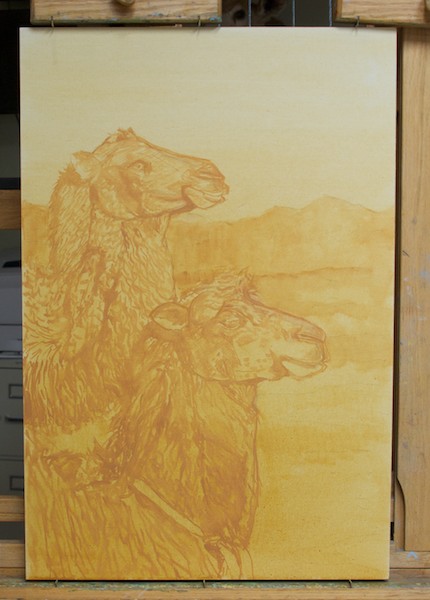
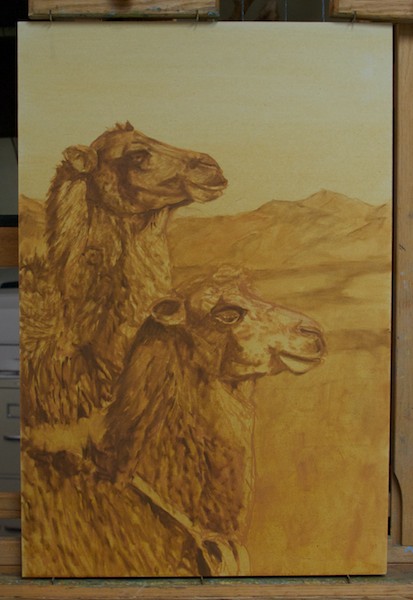
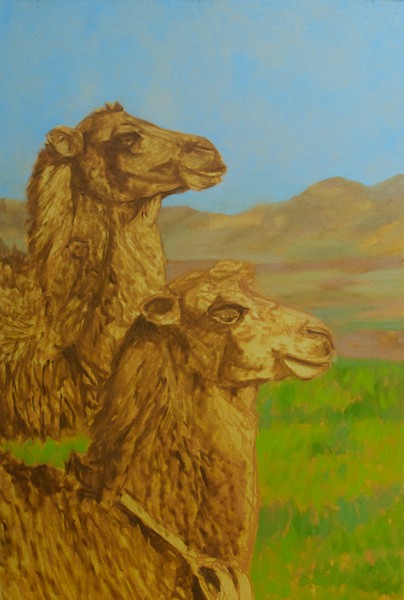
And here’s the step by step of the painting:
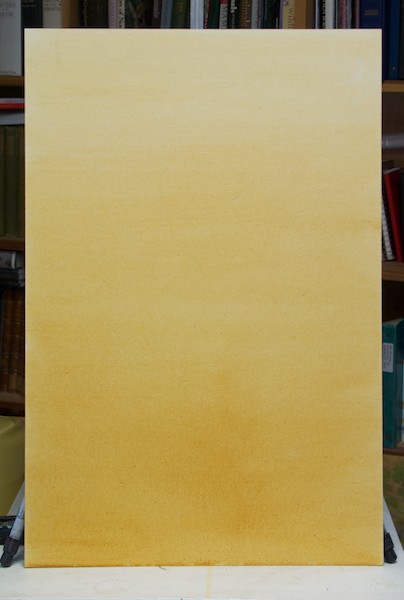
The drawing and value study; 14×11″ graphite on drawing paperI drew a one by one inch grid on a piece of tracing paper to do a traditional graphite transfer to the canvas panelHere is the enlargement grid and drawing transfer. It doesn’t have to be exact, just close enough so that the elements are the right size and in the right place. I use a transfer sheet that I made myself by covering the back of a piece of tracing paper with lead from a soft pencil. I use a 7H pencil to do the actual transfer tracing.The Raymar canvasboard panel tinted with raw sienna. You can barely see the lines of the transfer if you look closely.The initial brush drawing of the camels.Now the background has been added.The next step is to bring up the dark values of the camels, referring to my drawing as needed. I’m already indicating the wooly texture of their coats.Initial color lay-in of the background.First color pass on the camels. I correct the drawing as I go, if necessary. I decided that I really didn’t like the eye of the brown camel, so I went back to my reference and found another camel whose eye shape looked better.I mostly finished the camels in one long sitting, but still went back and tweaked the heads a couple of times. I’ve now added clouds to the sky. I had originally planned to leave the sky just blue, but it didn’t feel right. I’ve also modeled the mountains in the background and started to work on the grass.Once again: Bactrian Camels, Bayan-Onjuul Soum, Mongolia oil 30×20″
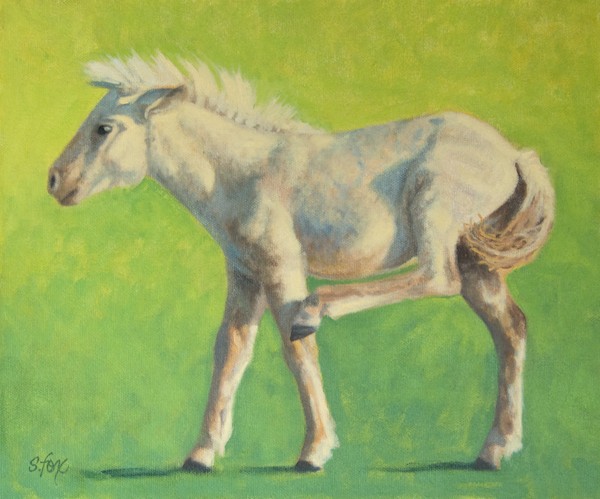
I’ve been working on some smaller pieces of domestic Mongol animals, just focusing on my subject and not worrying about a background other than colors. I loved the gesture of this Mongol horse foal who is finally gaining the coordination needed to raise one leg to scratch an itch.
“Mongol Goat” 12×12″ oil
The best cashmere in the world comes from the goats of Mongolia. They come in a riot of colors, shapes, sizes and horn style, but the undercoat is pretty much the same on all of them. I was particularly taken with the bold black and white pattern of this fellow.
These two takhi/Przewalski’s horses were part of a harem of eight that I watched and photographed for quite awhile at Hustai National Park last September. This “grooming” behavior is as much about social connection and relationship reinforcement as it is about any actual grooming. The harem stallion is on the right and one of his mares is on the left. I loved being able to paint them in such beautiful morning light.
These two Mongol horses were part of a large herd that I saw at Gun-Galuut Nature Reserve in August of 2011. The mosquitos were pretty bad, so they were spending the day standing in a large shallow pond surrounded by a wetland area. Although it is a nature reserve, the local herders are allowed to use the valley as they always have during the times when the ground-nesting cranes aren’t incubating eggs.
Herd of Mongol horses at Gun-Galuut Nature Reserve with the Steppe Nomads eco ger camp in the background. The reserve is only a two-hour drive from Ulaanbaatar
The reference for “Goviin Boroo (Gobi Rain)” was taken in July, 2010 on my amazing two week camping trip. The rains were really good almost everywhere that year and the Gobi, contrary to how most westerners picture it, was green, green, green in many places, including this area near Orog Nuur, a remote Gobi lake where we spent the night.
“Goviin Boroo (Gobi Rain)” 18×24″ oil
I loved the layers of clouds, the streak of sunlight on the grass and the complimentary colors of green and red and knew I’d do a painting of the scene at some point.
You can read about the camping trip by selecting Mongolia 2010 from the drop-down categories menu.
I went to Ikh Nartiin Chuluu Nature Reserve last year with a plan to focus on getting good, paintable Siberian ibex reference. Boy, did that ever work out. On three out of four mornings, I shot over 1000 photos and watched ibex for at least five hours. They were a couple of groups of nannies, kids and juvenile billies who were hanging around some of the rock formations at the west end of the valley where the research camp is located, only a 30 minute walk.
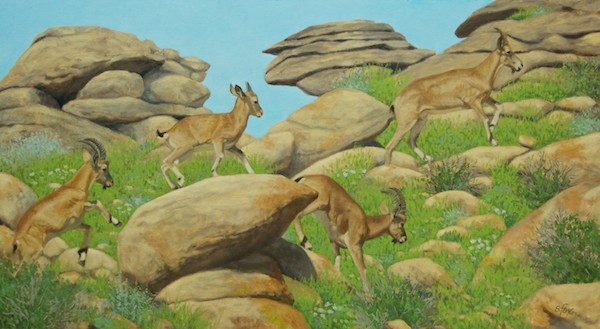
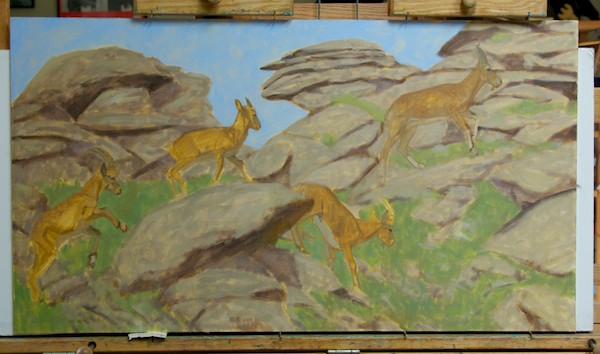
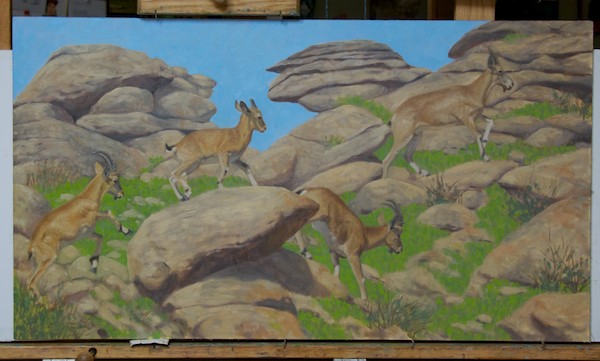
I’ve got a lot to chose from, but loved the “rock hopping” that occurred when this group, who I had already been watching for over an hour as they rested, grazed and interacted, got up and started to move off when the big nanny did. So here she is, cautiously and seriously leading her group to wherever she’s decided they will go, while the youngsters goof off and play follow the leader up and down and on and off the rocks.
Here’s a step by step of “Rock Hoppin’ “:
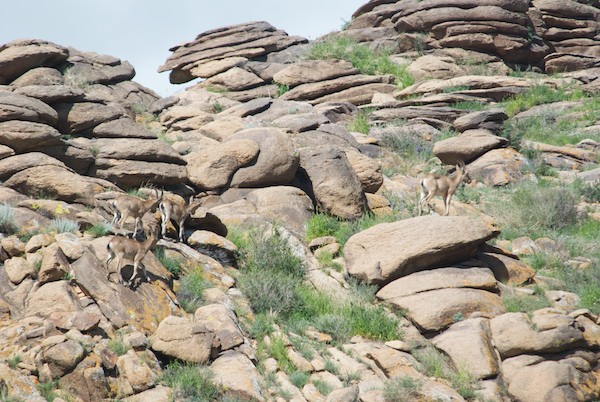
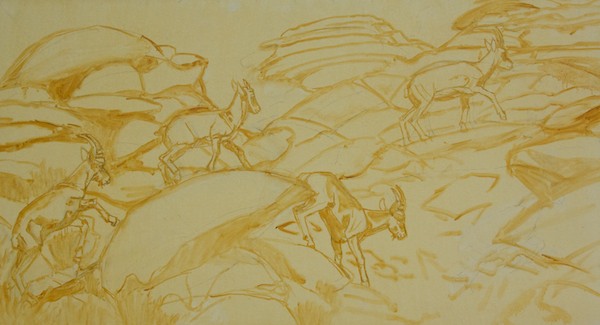
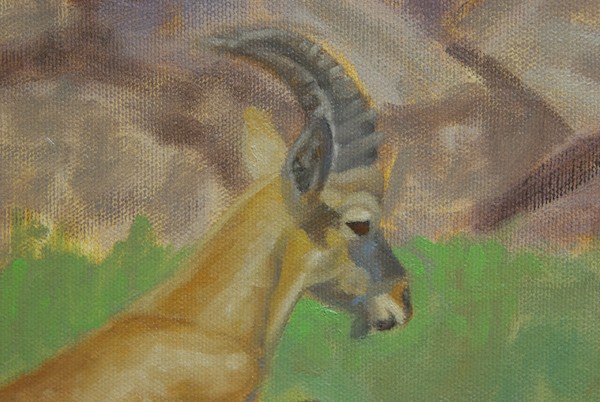
Ibex group at Ikh Nartiin Chuluu; one of the dozens of photos I shot of this group as they moved off from left to right, the nanny leading the way and stopping at times to evaluate what’s ahead. Most of my reference showed only the rocks, but I wanted some sky also, so chose this photo for the upper left hand part of the painting, particularly that unstable formation at the top, which gives a feeling for the habitat the ibex like best. There had been a lot of rain and the reserve was as green as anyone could remember. Wildflowers were everywhere. The photos one usually sees of this species are from way up above the tree line in mountains where there is very little vegetation. I liked showing them in a different and more colorful habitat.Preliminary graphite studyAfter doing a compositional drawing at the final size, I did a graphite transfer to the canvas and then re-stated the drawing with a brush. There had been a fifth ibex in the lower right, but something didn’t seem right design-wise and the solution seemed to be to remove that one, which I did. Then there was still something not right. I realized that I needed an adult ibex, the nanny who was leading the group, not a juvenal billy. This not only let me use a larger animal, which was visually more interesting, but made the painting behaviorally accurate, which is very important to me. I’ve developed a painting procedure that lets me make minor to major changes at any time in the process. I never have to put pressure on myself by “guessing right” at the beginning and then finding myself stuck when something isn’t working.First color pass, just laying in major shapes to make sure it all works. I used three pieces of reference for the ibex and at least three for the rocks. I planned the placement of the smallest ibex so that his/her head would be against the sky, which was not the case with the reference photo.Modeling the ibex and the rocks. I’ve defined the shapes of the shadows on the rocks and can now see the pattern those create. I made sure there were large rocks pointing in from the right so that everything wasn’t moving off the canvas.Detail of a head in progress. From the base of the horns to the tip of the nose is 1 3/4″. I kept the shapes simple, but accurate. Detail per se is of no importance to me.Detail of kid in progress. It was important to get the great gesture correct and show the muscles working.Almost done. After this photo was taken, I punched up everything as needed, both ibex and the rocks and finished the grass, which has about six layers of warm/cool, light/dark colors, plus the summer flowers. I also refined the branches of the wild apricot shrubs. I basically did a repaint over the whole thing pulling up the light areas and adding color variations to the rocks, including the lichens, which give a warm touch that picks up the colors of the ibex and ties them to the landscape.Detail; finished ibex, rocks, grass. The grass was an almost acid green since it was so fresh. I knocked it back a little in intensity since it didn’t look quite believable in a painting. I also consciously varied the colors of the ibex and the proportion of light to dark on the bodies.Rock Hoppin’ 20×36″ oil
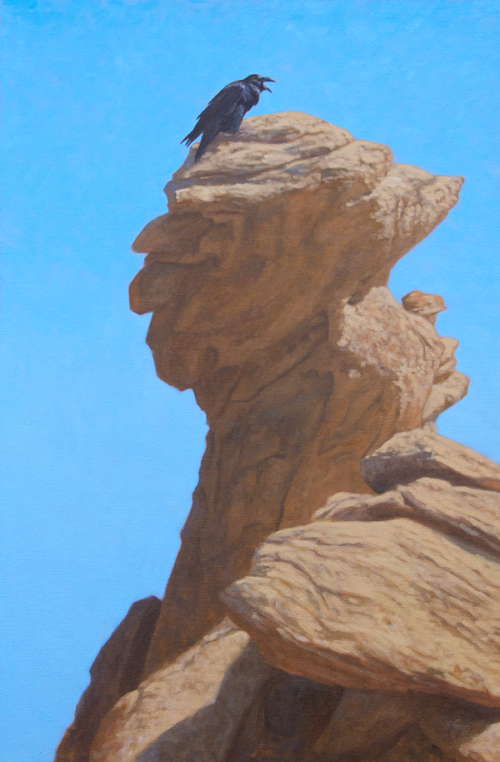
I was watching, sketching and photographing a group of ibex near this instantly recognizable rock formation at the west end of the valley where the research camp is located at Ikh Nartiin Chuluu Nature Reserve. Suddenly a raven landed on top of the rock and stayed for quite bit, occasionally announcing his presence. There were also endangered less kestrels swooping around and some red choughs, so it was quite a busy morning.














 Susan Fox, American Artist