Mongolia Monday- Oyu Tolgoi, The Face Of “Minegolia”; Resource Extraction On An International Scale Comes To Mongolia

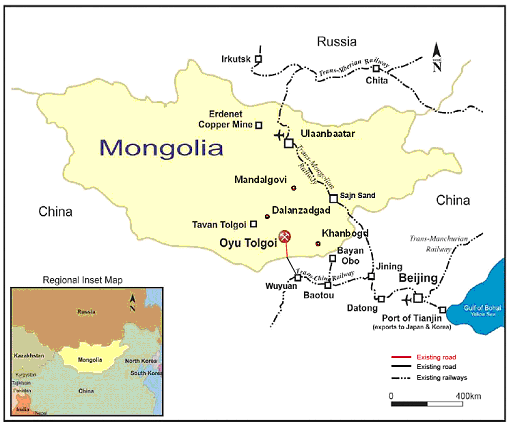
Map showing location of both Oyu Tolgoi and the coal mine, Tavan Tolgoi

The world’s largest undeveloped copper deposit, which also turns out to include significant deposits of gold and silver, is located in the Gobi of Mongolia at a site called Oyu Tolgoi, which means “Turquoise Hill”. The story of choosing who will operate the mine and how that was negotiated is a long and convoluted one. The super-short version: Nothing much happened until the Democratic party took power a few years ago. Not long after, a joint venture of two huge mining concerns, Ivanhoe and Rio Tinto, along with the government of Mongolia, was formed and work began.

Why would I blog about this?

Two reasons:

First, it will be a major test of how well Mongolia is able to enforce its environmental laws, since this the first mine to come online since the changeover from communism to democracy. It will be both open pit and underground. The size of the deposits is mind-boggling: (as of 2010) 79 billion pounds (35,833,000 tonnes) of copper, and 45 million ounces (1,275,000,000 grams) of gold. In ten years, over 3 million ounces of silver is expected to be produced. The copper extracted on a yearly basis will account for 3% of the world total.

Mining activity at this site is expected to continue for 45 years and account for 30% or more of Mongolia’s GDP. Mongolia has set up a sovereign wealth fund to handle the anticipated $30 billion in royalties and tax revenue. Once the contracts were signed a little over a year ago, Mongolia received its first check for….$10 million. How will the traditional Mongol land ethic, not to mention environmental and conservation considerations, hold up in the face of this kind of money pouring into the country?

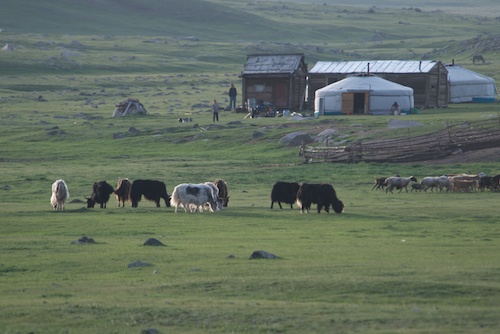
The mine site

Needless to say, this single mine is a total economic game-changer in a country where the current average income is $3200 a year. And this is one mine. There is a huge coking coal deposit, Tavan Tolgoi, also in the Gobi, that will be developed in the not to distant future. There is already a new east-west railway planned to move the coal to the current north-south line, along with many other planned improvements in infrastructure.

Second, I personally know two Mongols who work at Oyu Tolgoi. One was a bird researcher I met on my very first trip to Mongolia in April of 2005 when he was at Ikh Nart during the Earthwatch team. I saw him again my first evening in UB this past July when I was invited to attend the farewell dinner for the most recent Earthwatch team. He had recently become the Environmental Officer at the mine. We’ve been Facebook friends for almost a year.

The second is a guide I’ve had on two of my trips, once in 2006 and again in 2008. He has worked as the Safety Officer for the subcontractor who is sinking the main shaft for, I think, a little over three years. He’s down at the site for a month at a time and must stay within the fence perimeter. Then he comes back home to UB for two weeks. He found me on Facebook a few weeks ago and we had a great “catching up” chat.

Employee housing: gers, of course

The two men have met a couple of times at the mine site, so it’s a small world story. To be continued….
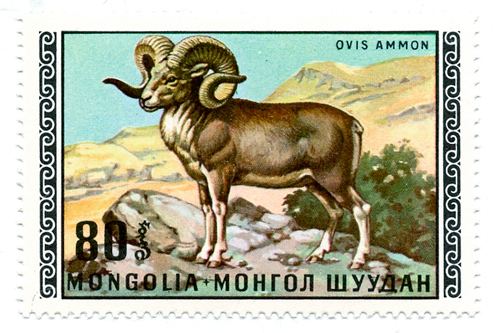
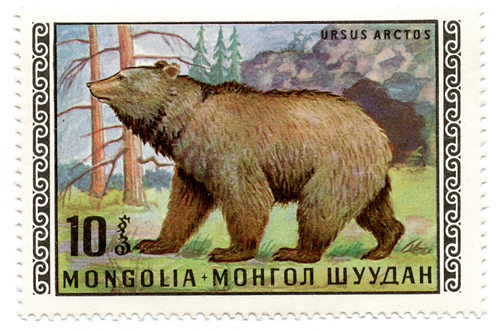
Mongolia Monday- Postage Stamps, Part 3: A Beautiful Set Of Wildlife Images

I ordered these to get the first stamp shown, but the whole set, uncanceled and in perfect condition, is so well-done that I wanted to share them all with you. I think that they are of interest not only because of their subjects, but as lovely little works of art. I wish I knew who the artist was.

Argali (Ovis ammon); the legs are a little short, but otherwise this is quite good; found in the high mountain zone and mountainous areas of the Gobi
Brown bear (Ursus arctos) : found in the northern mountains of Mongolia , which is the southernmost part of the taiga or boreal forest
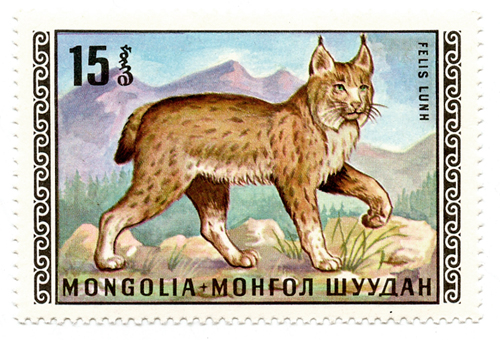
Lynx (Lynx lynx); found in the taiga (forest zone)
Siberian marmot (Marmota sibirica); has undergone a tremendous population crash in recent decades; now exists in localized populations; found in the mountain forest steppe transition zone and the steppe
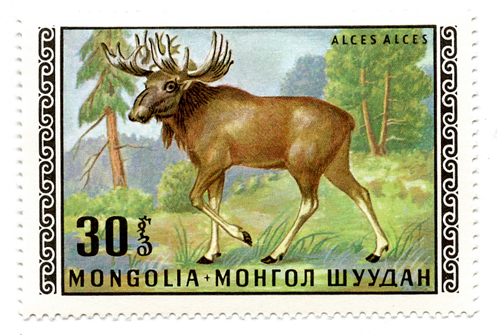
Moose (Alces alces), called "elk" in Europe: found in the taiga; same species as found in North America
Wild boar (Sus scrofa); found in the mountain forest steppe transition zone; a small population also inhabits the reed beds of Khar Us Nur
Wolf (Canis lupus); found in the taiga, mountain forest steppe and steppe

Next week, I’ll be featuring two Mongolian equids, the takhi and khulan.

Mongolia Monday- In Honor of Tsagaan Sar (the Mongolian New Year): At The Door Of The Skytent by Ts. Bavuudorj

At the door of the skytent,
holding a golden lantern,
by the light of my golden lantern, I can see
that the old ones are coming,
mounted high upon white clouds.
A gentle creature, smelling still of milk
is coming, wading through the milky ocean.
Through tantric practise and endless recitation,
a monk has shrunk his body, small as an elbow, and
he’s coming, flying cross-legged.
The door of the skytent
swings quietly open…
Twenty-one young girls, their eyes all-seeing and clear,
are coming into the Buddha’s presence.
The pure heart, free of sorrow,
free now from the world,
have thrown the door wide and stand amazed.
A child comes to her mother, and
a mother comes to her child, and
they go seeking the profundity they lack.
The door of the skytent
swings quietly open…
And every time that door swings quietly open,
It steals a count of breaths
from life’s red bulb.
Gold and silver fishes,
impermanent, seem permanent
inside.
They are content in their own way.
at the door of the skytent
holding a golden lantern….

Translated from the Mongolian by Simon Wickham-Smith, with whose kind permission this poem is presented to my readers

The image at the top is from Onglyn Monastery, one of the many that was destroyed in the late 1930s by the communist government. The ruins are extensive since there were two large monasteries that faced each other and could house over 1000 monks, but there is a re-building effort under way, including the small temple building where I took this photo. It seemed appropriate to use an image from a “re-birth” for a poem posted to celebrate Tsagaan Sar, the White Moon, and the beginning of a new year.

Final note: I’m waiting for some new animal stamps to arrive from eBay for Part 3 of my posts on Mongolian stamps.

Mongolia Monday- Postage Stamps, Part 2; Mongol Warriors

Continuing with a look at some interesting Mongolian postage stamps, this week is a set of what the text at the top of them says (in English, which is convenient) are “The Chinggis Khan’s Militant Soldiers”.

The original art, as credited on the stamps, is by T. Otgonbayar and the date of issue seems to be 1997.

One of the things I like about these as a reference source is that the images were created by a Mongol artist, not a westerner working from whatever sources, probably secondary/tertiary, that they could find.

First is a set of single stamps, three with swordsmen, three with horsemen and two with archers.

The piece d’ resistance is a triptych of the Mongol army in full panoply. What a sight they must have been! It is estimated that at the time the Mongols were conquering city after city, the total number of them was maybe one million. The army probably had 100,000 soldiers. Total. Each one had about five horses. So a half million horses to find graze for. And there was no supply line, no logistics challenges like modern armies face. Being a nomadic people, many soldiers had their gers and families with them, but instead of moving to new pastures, they just kept heading west. No one was longing for home and loved ones, because home was with them wherever they went.

Swordsmen; the one on the left carries a horsehair standard
Horsemen; notice the two cheetahs on the far right stamp; that's something I want to find out more about
Archers; only English longbowmen could approach the ability of the Mongol archers
The Mongol Horde; "horde" is the only Mongolian word that has come unchanged into English; notice, once again, the two cheetahs on the right; and also the black and white horsehair standards; white ones are still used today as important symbols of the Great Mongolian State

Two New Paintings! “Mongol Horse #6, Race Winner” & “Minii Govi (My Gobi)”

There’s a certain rhythm to creating paintings. I usually have a number of them underway at various stages of completion. Of course, most of them are hanging around unfinished. Then I get to the final sitting on one of them and pretty soon, Ta Da!, it’s done!

I finished one yesterday and one this morning. First, my latest Mongol Horse series painting:

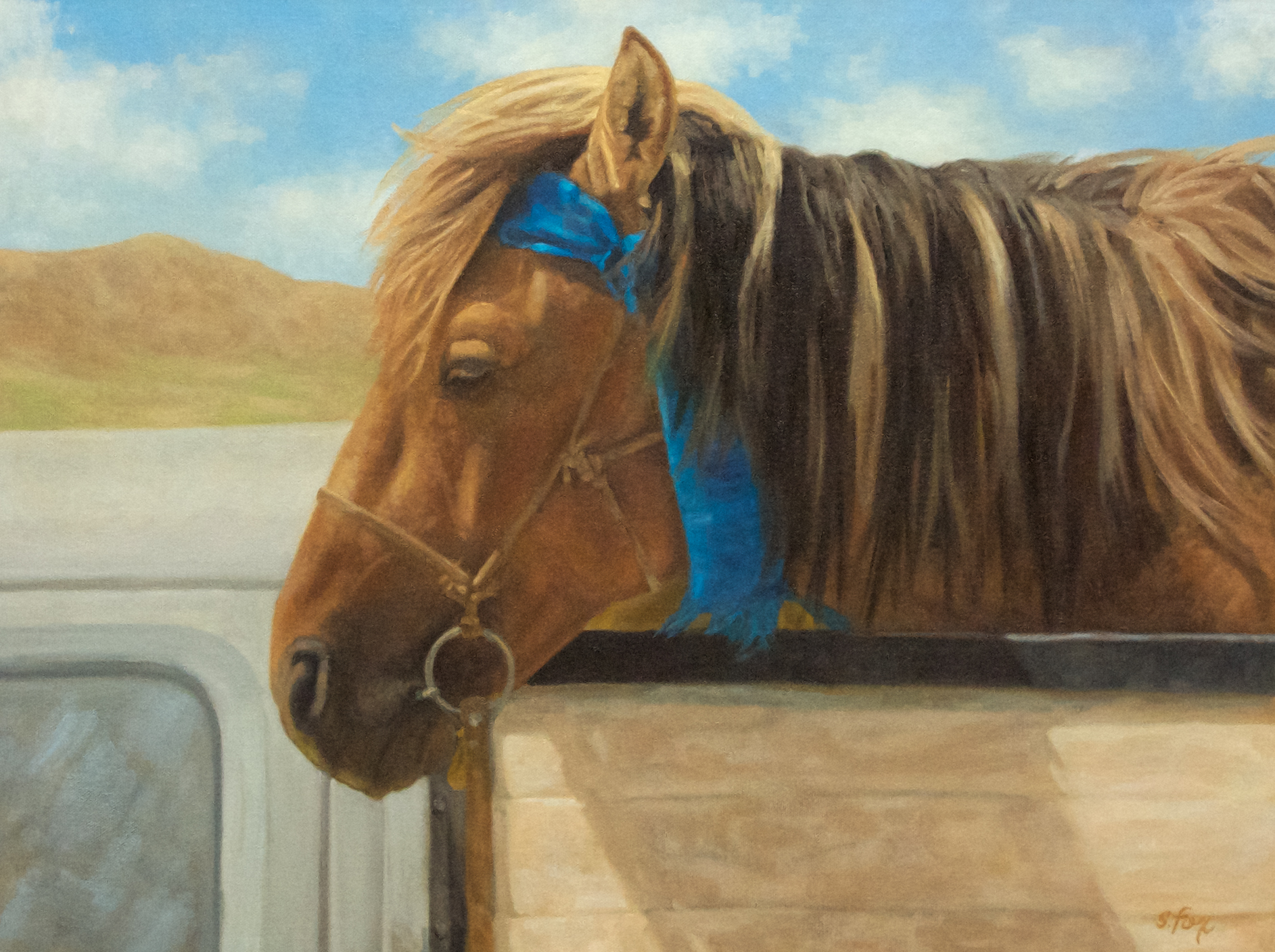
Mongol Horse #6, Race Winner 18x24" oil on canvasboard price on request

I shot the reference for this one on my camping trip in Mongolia this last July. We had pulled into a soum center, which is the American equivalent of a county seat. My guide went over to some trucks filled with horses and chatted with the men, who were taking a break in the shade since it was a warm day at the northern edge of the Gobi. I stayed in the car, but got some good photos. My goal in this piece was to capture the wonderful quality of light that is one of the things I love about Mongolia.

This is a typical Mongol horse who is being taken on a “Naadam (festival) tour” for the horse race events. He’s a winner since he’s wearing a blue scarf called a khadak. He’s not spiffy looking compared to a thoroughbred, but he can also run 20 miles or more without stopping. I also always like seeing the bi-colored manes, which adds a bit of flash.

Minii Govi (My Gobi) 16x12" oil on canvasboard

I grew up with the redwood forests of northern California and have never been a “desert person”. But I love the Gobi (which means “desert” in Mongolian). This scene was also from my 2010 camping trip. The air was incredibly clear, almost crystalline. And it was obvious why Mongols call their country “The Land of Blue Skies”. This is a small piece that I’ve done for myself to start to understand how to paint an amazing part of the world.

Mongolia Monday- Mongol Postage Stamps, Part 1: Clothes And Culture

A week or so ago, I was poking around the listings on EBay that come up when you search “Mongolia” and ended up browsing through the postage stamps. Mongolia is one of those countries that, in the past, released an endless supply of stamps aimed at collectors. It brought in some income to the government during the socialist era and when times were very hard back in the early to mid-1990s during the transition to democracy.

Along with the obligatory Princess Diana commemoratives, it turns out that there is a wealth of stamps with imagery from Mongolia’s history and culture. Some of the stamps showing traditional clothing are so detailed that they to all intents and purposes qualify as primary reference material.

I had purchased some stamps on previous trips just because I liked the images and they are a well-known souvenir choice. I had also been a stamp collector many years ago as a kid. I don’t know that I would take up actual collecting again, but if I did, I would specialize in the historical and cultural subjects, along with animals (no surprise there, I imagine).

This week I’ll share the costume, history and ger-themed stamps I have. Next week will be Mongol warriors and the third part will be some with plants and animals.

Comments, information from my Mongol friends and fellow Mongolphiles welcome, as always.

Traditional dress; the top middle is what a married Kalkh Mongol woman wore
Historical/legendary images, I believe
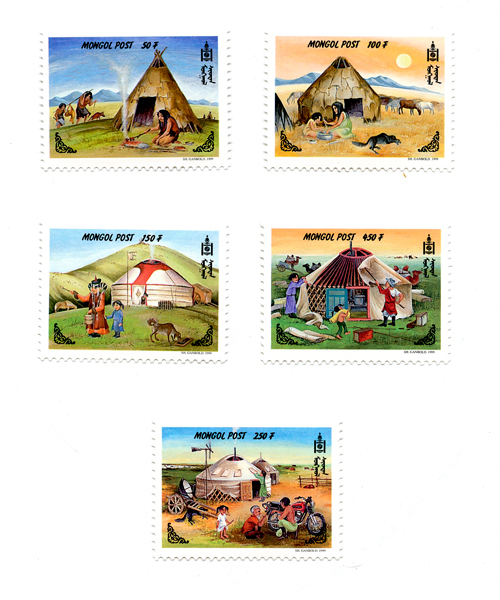
This set appears to be gers (which is simply Mongolian for "home") through Mongol history; ending with one that combines the old and proven with the new and modern; love the aruul drying on the roof
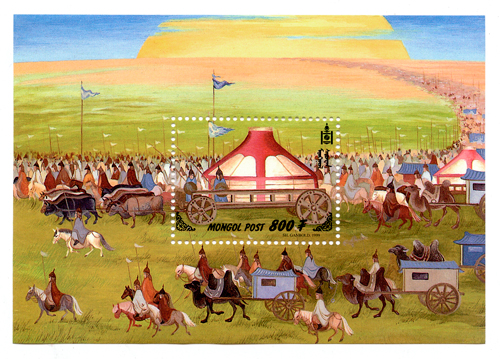
The Khan's ger on the move, literally a "mobile" home
Traditional life in a ger; lightweight metal stoves instead of the open brazier and people tend to wear modern clothes (but not always), but otherwise this is what they are like to this day. Notice the kids on the left playing anklebone games; the floor coverings are sheep's wool felt embroidered with handspun camel wool thread in an traditional design

Mongolia Monday- “Mongolian Horse”- A Poem

This poem is from a book that I found in the Art Shop at the Museum of the Chojin Lama. It is called “Modern Mongolian Poetry (1921-1986)” and was published in 1989, just before the non-violent revolution in which Mongolia made the transition from communism to democracy. It was my first introduction to Mongol poetry.

Poets and other creative people who objected to the communist government had to be very careful in what they said, wrote and painted. There are many poems in the book extolling the wonderfulness of the socialist system, heroic workers and battle victories. But, carefully couched in metaphor, are other points of view. I’ll be posting some of both in the future, but today’s poem is about a subject that I suspect all Mongols of the time could agree on…HORSES!

Mongol horses, Baga Gazriin Chuluu, July 2010

MONGOLIAN HORSE

Crowning our glorious motherland
With victory after victory.
Raising the victorious banner,
We always went on horseback.

As a Mongolian’s courage
Is measureless,
So the Mongolian horse’s strength
Is boundless.

When the good Mongolian people
With their history of victory
Did their good deeds
Their good horses played their part.

As a Mongolian’s courage
Is measureless,
So the Mongolian horse’s strength
Is boundless.

In doing work
For our happiness
Our spirited Mongolian horses
Will work with us ceaselessly.

As a Mongolian’s courage
Is measureless
So the Mongolian horse’s strength
Is boundless.

Dalantain Tarvaa

Mongolia Monday- Images of Malchin (Mongol herders)

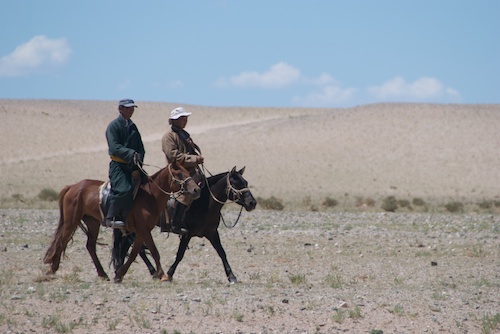
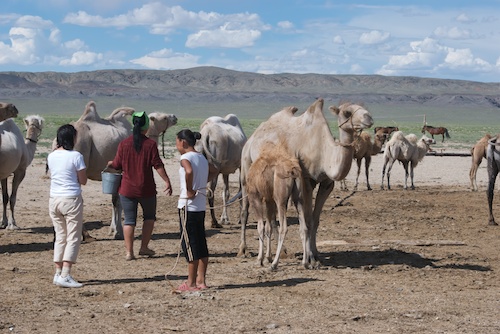
Going to let the pictures tell the story today. Here’s a collection of some of the photos I’ve taken of Mongol herders. Included are all of the Five Snouts, plus camels. Now I’m sitting here missing tsagaan idee (white food): airag (fermented mare’s milk), aruul (dried yogurt), byaslag (cheese), orom (sliced dried cream) and  tsotsgii (cream, just cream, eaten using aruul as a base to put it on; heavenly). Bi ter bukh dortei! (I like it all!). Mongol friends-correct my sentence if it is wrong.

Herder with urga, Ikh Nartiin Chuluu, April 2005 (my first trip to Mongolia)
Camel herder, Gobi near Bayanzag, Sept. 2006 (these are racing camels)
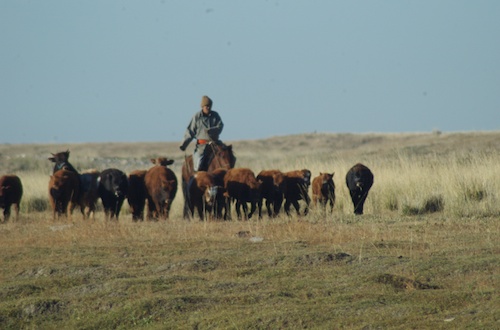
Herding cattle near Tuul Gol (River), Sept. 2006
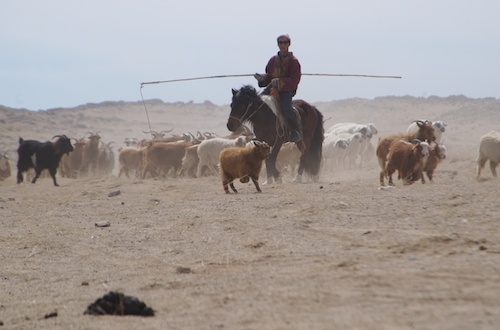
Herding sheep and cashmere goats near Hustai National Park. Sept. 2008
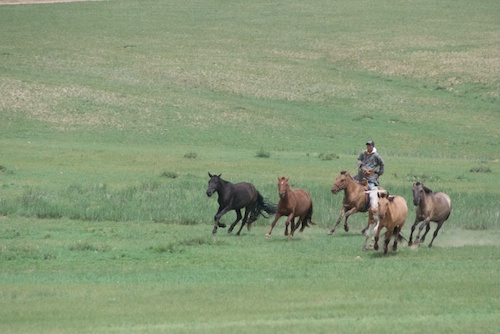
Rounding up horses, Gun-Galuut, July 2009
Local herders coming to check out flooded river crossing, The Gobi, July 2010
En route shot from car, July 2010
Herder, Hangai Mountains, July 2010
Time for a morning chat, Hangai Mountains, July 2010
Yak herder's ger, Naiman Nuur, Hangai Mountains, July 2010
Rounding up yaks, Orkhon Falls, July 2010
Camel's milk airag coming up soon, the Gobi, near Orog Nuur, July 2010

Mongolia Monday- A Poem About A Grandmother

Three generations at Baga Gazriin Chuluu mountain blessing naadam, July 2009

Grandma, Please Go On Telling Your Stories

When grandma finished
Milking her cows
I always asked her
To tell me her stories

Some of the stories
Made me laugh
Some made me weep
And some made me sad or even brave

Thus, my grandma conveyed
The words of sadness
And of happiness
To my little heart

Thus, my grandma
Introduced me to the world
Through her magic stories
In my childhood

Grandma, did you learn
All those stories from your Mummy,
Or did you just make them up yourself?

Granny, go on telling your stories now
I would love to hear them,
To learn them well and then
I’ll tell them to my own children.

Dojoogyn Tsedev