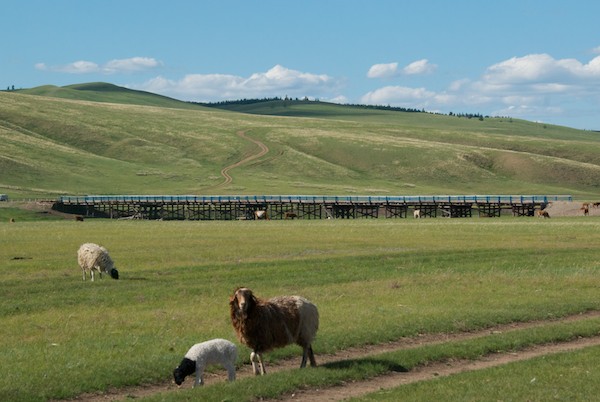
The WildArt Mongolia Expedition 2014, Part 4: Binder Soum to Toson Hulstay Nature Reserve

Binder Nuur
Binder Nuur

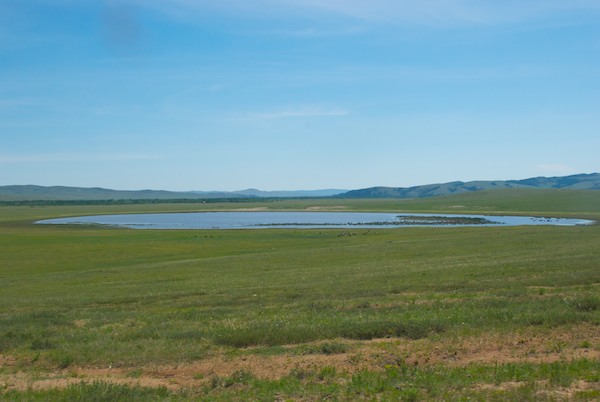
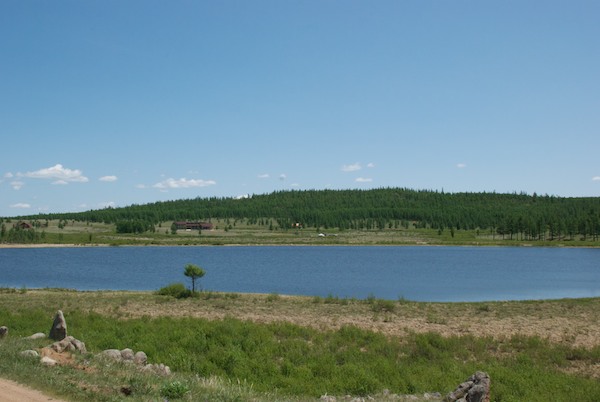
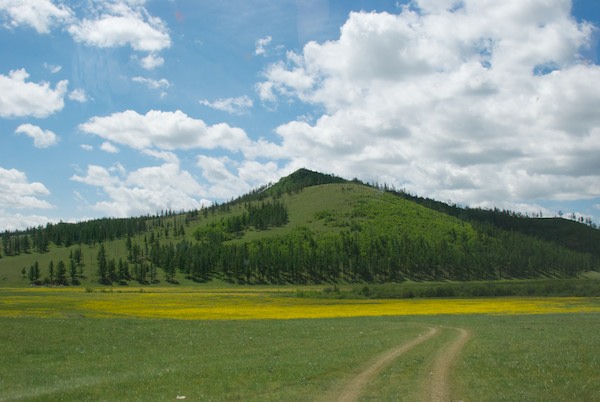
Our stay in Binder was at an end and I got one last shot of the lake as we drove away. We were now heading northeast towards Dadal and, after that, south to Toson Hulstay Nature Reserve. But since the journey always is the destination in Mongolia, there was plenty to see and experience in between…

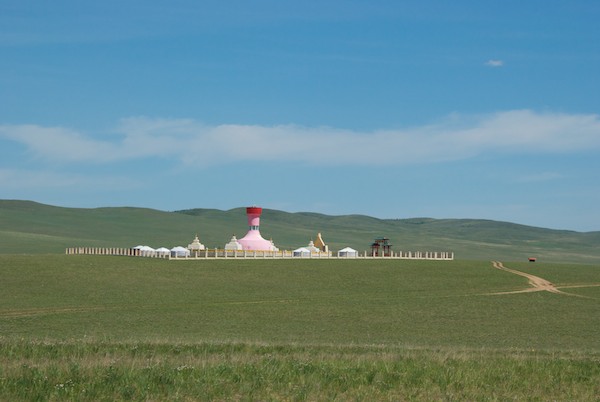
My lead driver, Erdenebat, who seems to have been everywhere in Mongolia during his 14 years as a professional driver, brought us to this recently built memorial to the Queens of Mongolia. I gather that the local people are hoping it will draw visitors. Unfortunately I wasn’t able to get the name of the Soum where it’s located, but will update this post when I do. It may have been Bayan-Adarga. As you’ll see, if you’re in the area, it’s definitely worth a stop!

Memorial to the Queens of Mongolia
Entry gate
Entry gate with the hat-shaped memorial building within the enclosure.
Each queen is represented by a portrait
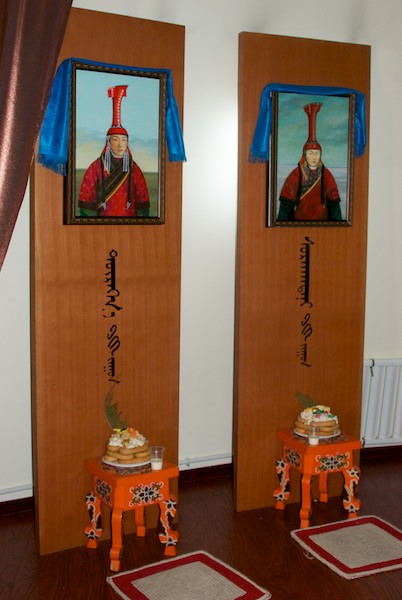
Each queen is represented by a portrait.
The extensions on their headgear was intended to bring them close to Tenger. The higher your rank, the higher the extension.
The extensions on their hats were intended to bring them close to Tenger, the Eternal Blue Sky. The higher your rank, the higher the extension you were allowed.
In the center were the traditional white horsetail standards. White ones for peace, black ones for war.
In the center were traditional white horsetail standards. White ones stand for peace, black ones for war.
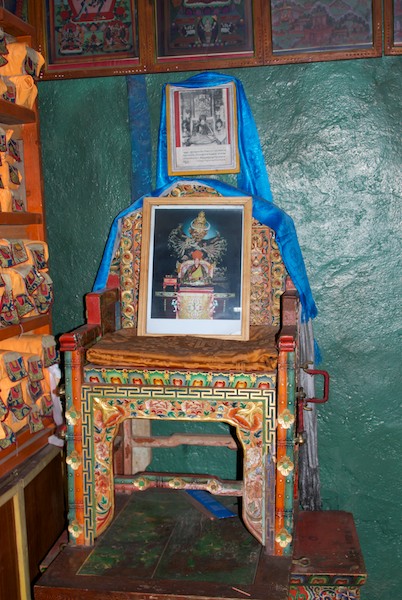
Decoration on the back of a throne.
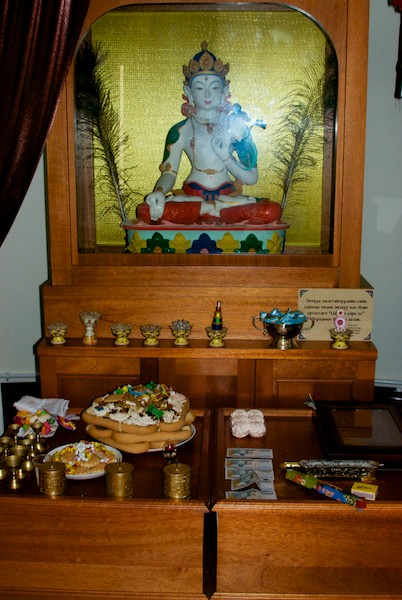
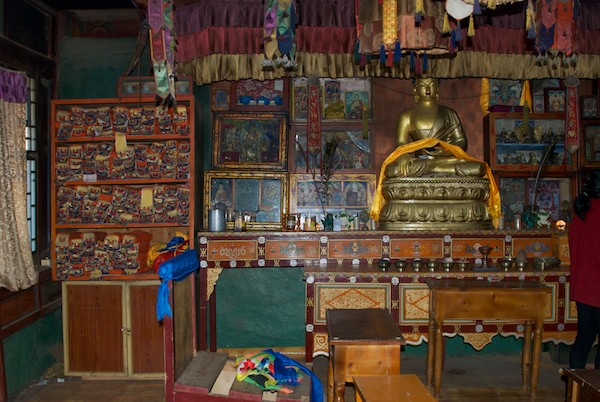
The main altar.
The main altar.
Close-up of the offerings.
En route through the Han Hentii Mountains
En route through the Han Hentii Mountains.
Wild lilies
Wild lilies
Scenery....
Scenery. The white-trunked trees are birches.
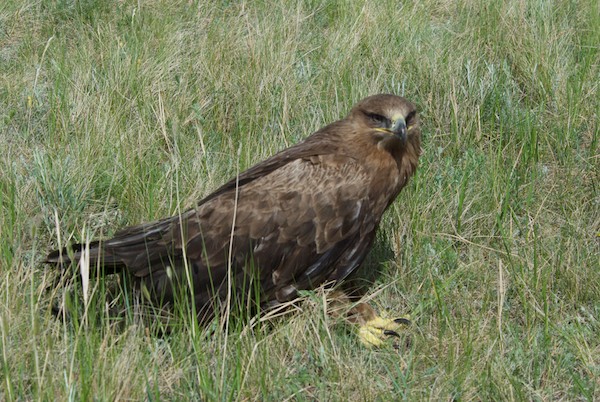
Golden eagle.
Golden eagle. The bird was right by the road and barely able to fly, with what looked like an injury to one wing.  Erdenebat got this great photo.
Our car had gotten out quite a bit ahead
Our car had gotten quite a bit ahead and Erdenebat realized that we couldn’t see the others, so we back-tracked and found that Puugii’s car had a problem with the brake on one side, which involved a fluid leak. We were a LONG way from any town and there is no “roadside assistance” service. But the drivers are also, by necessity, excellent mechanics and they know their cars inside and out. In less than an hour the problem was fixed and we were on our way.
We finally reached our goal for the day...the legendary Onon Gol, the center of the Mongol heartland
We finally reached our goal for the day…the legendary Onon Gol, the center of the Mongol heartland.
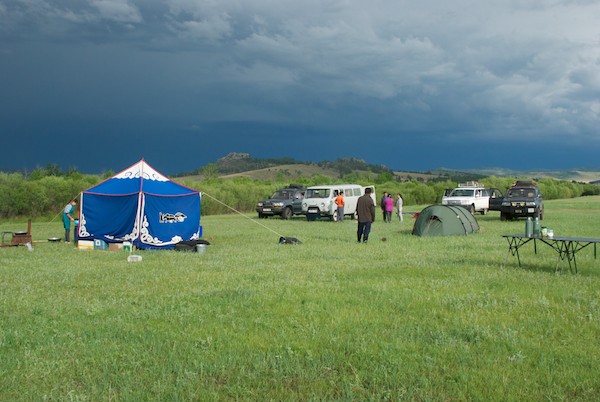
We camped on the river, using dung fires in the evening to hold the mosquitoes at bay
We camped on the river, using dung fires in the evening to hold the mosquitoes at bay. We stayed here for three nights, two full days. One morning a few horses came down to the river, adding a picturesque touch.
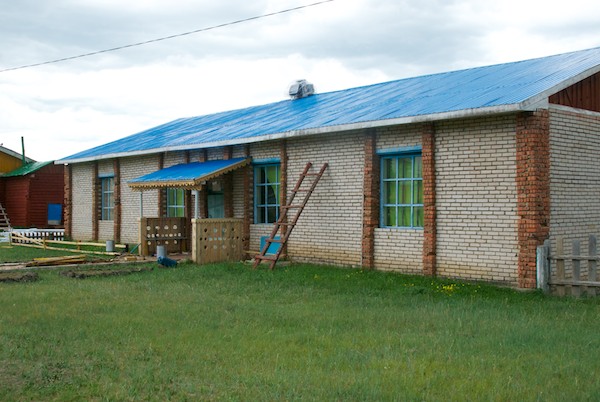
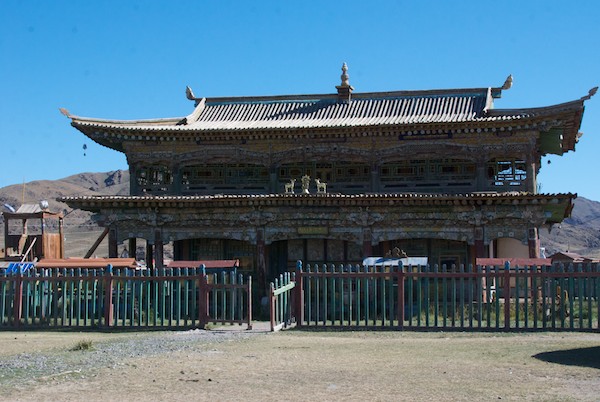
We took a day trip into Dadal, well-known for the nearby sites connected with Chinggis Khan. Perhaps less known is the local museum. Don't be fooled by the modest exterior. Wait till you see what's inside.
We took a day trip into Dadal, well-known for the nearby sites connected with Chinggis Khan. Perhaps less known is the local museum. Don’t be fooled by the modest exterior. Wait till you see what’s inside.
But first, one of the statues of animals nearby.
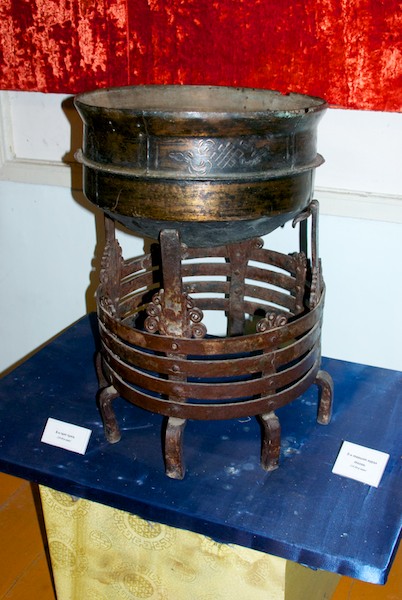
Before they had enclosed stoves, this is how a ger was heated and food prepared.
As a contrast....this old mechanical adding machine.
As a contrast….this old mechanical adding machine.
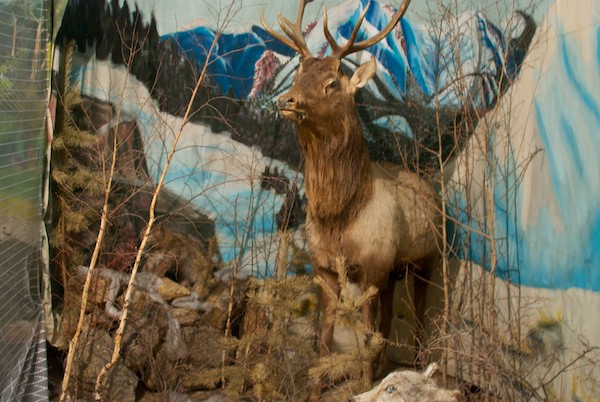
There was also a small natural history section with taxidermy-mounted animals.
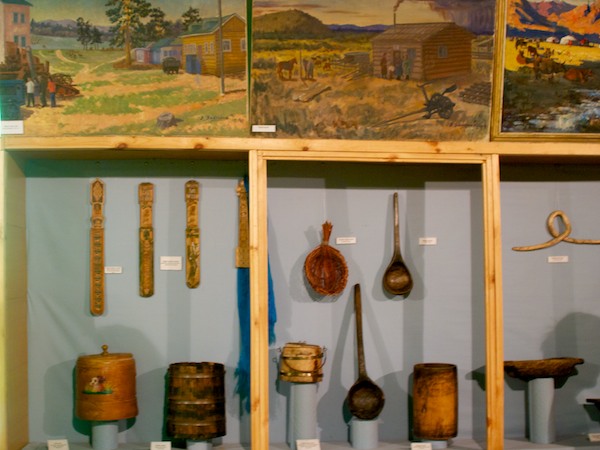
It was hard to get back far enough to get everything in, but here is one of the display cases with everyday utensils. There was art all around the room, too.
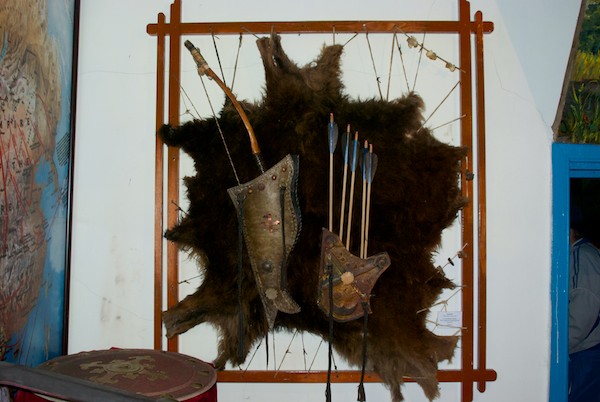
Traditional archery equipment mounted on a bearskin rug.
Traditional archery equipment mounted on a bearskin rug. The museum staff is trying to raise money to renovate the building and I was happy to contribute.

Our next two stops form part of the standard tour route in this area of the country. I generally avoid these places, but wasn’t going to miss anything connected with Chinggis Khan.

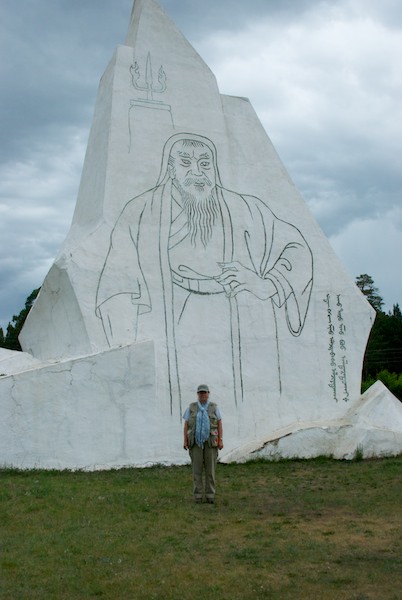
Posing in front of the Chinggis Khan monument.
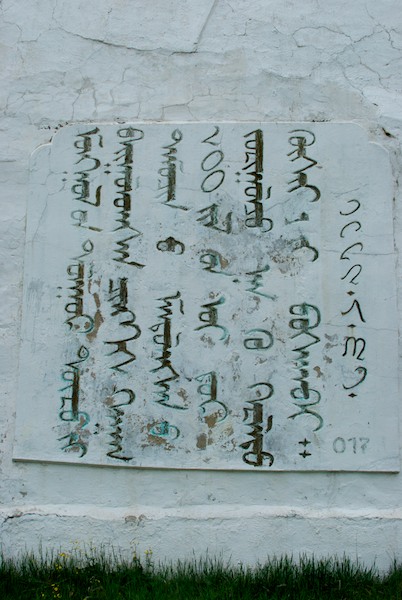
Inscription on the monument in Mongol vertical script, the alphabet that Chinggis Khan chose when the Mongols had acquired an empire that  now had to be administered.
Inscription on the monument in Mongol vertical script, the UIgher alphabet that Chinggis Khan chose when the Mongols had acquired an empire that now had to be administered. It is taught in the schools today and has also become an important calligraphic art form. (I don’t know what it says, so would welcome a translation)
The Expedition drivers: Erdenebat, Ogii and Puugii. And our guide, Tseegii. A great crew!
The Expedition drivers: Erdenebat, Ogii and Puugii. And our guide, Tseegii. A great crew! They are standing in front of the ovoo that marks the area where Chinggis Khan was born.
Chinggis Khan's nutag (the place where he was born).
Chinggis Khan’s nutag (the place where he was born).
We returned to camp and found that a violent storm had come through while we were gone.
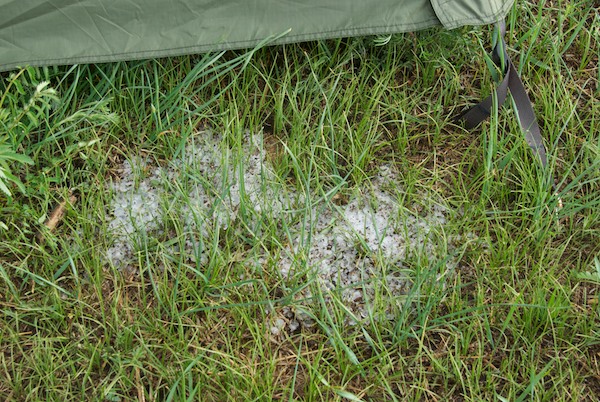
Including hail.
Including hail.
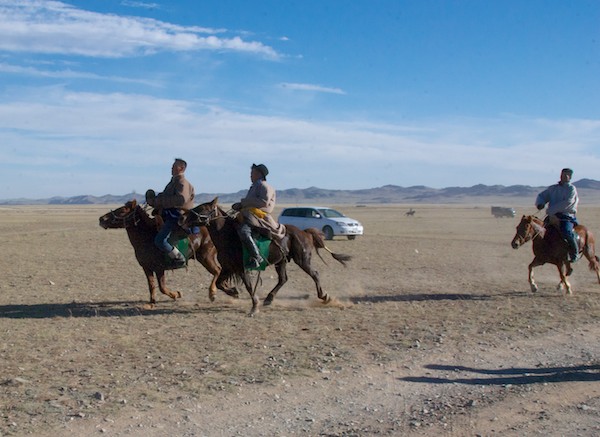
After breaking camp we went into the soum center to go to the store. I stayed in the car and got some great photos of this local horseman.
After breaking camp the  next morning we went into the soum center to go to the store. I stayed in the car and got some great photos of this local horseman.
We stopped to visit this family. It started to seriously rain and they were kind enough to invite us into their summer cabin to have our lunch.
We stopped to visit this family on our way south. It started to seriously rain and they were kind enough to invite us into their summer cabin to have our lunch. The woman on the left is Khalkh Mongol. The woman on the right is Buryat Mongol. The man is the son of one of them.
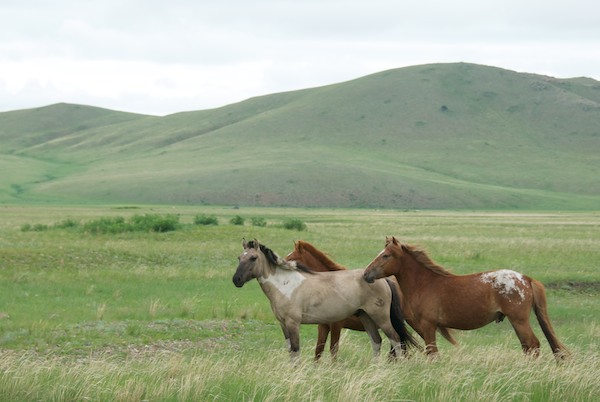
Gratuitous photo of Mongol horses.
Gratuitous photo of Mongol horses. At this point we were coming down out of the mountains onto the steppe.
We stopped at this ovoo and I learned
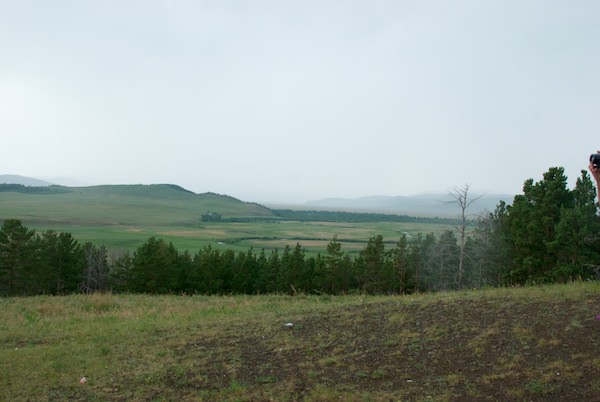
We stopped at this ovoo and I learned that we had arrived in Toson Hulstay Nature Reserve, the largest steppe grassland reserve in the country.

The steppe and Mongolian gazelles next week!


The WildArt Mongolia Expedition 2014 Part 3: The First-ever International Crane Festival, Binder Soum, Han Hentii Aimag

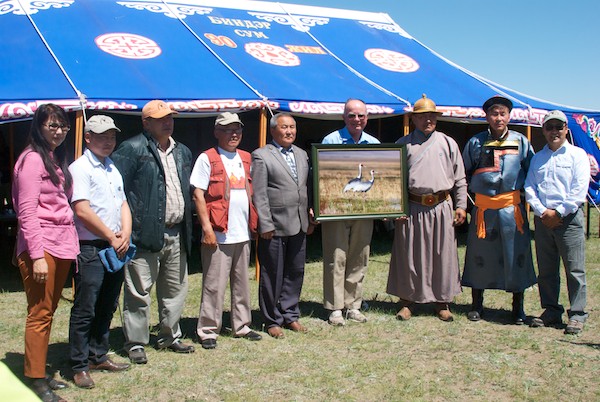
Dr. George Archibold. Founder of the International Crane Foundation, was honored at the opening ceremony.
Dr. George Archibold. Founder of the International Crane Foundation (holding the photograph), was honored at the opening ceremony. On the far right is Nyambayar Batbayar, the Mongol researcher in charge of the crane study. (If anyone reading this can identify any of the other people in the photo, please do so in the comments and I’ll add them)

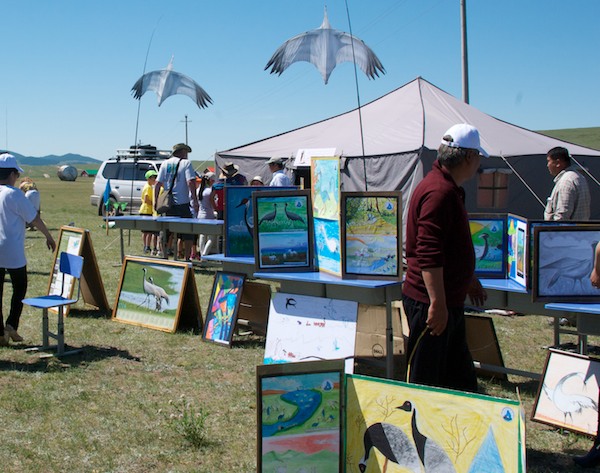
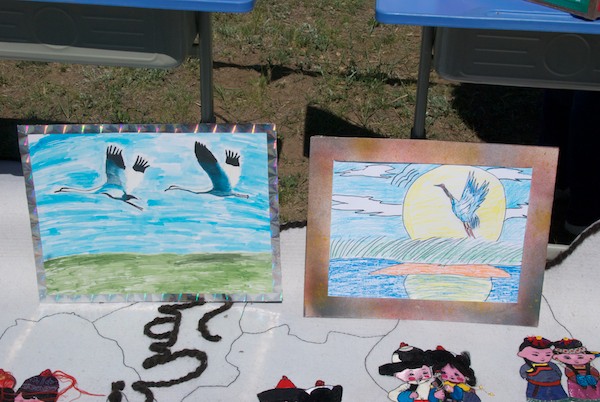
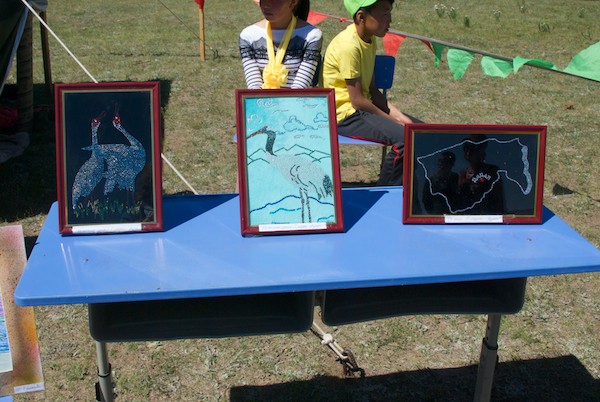
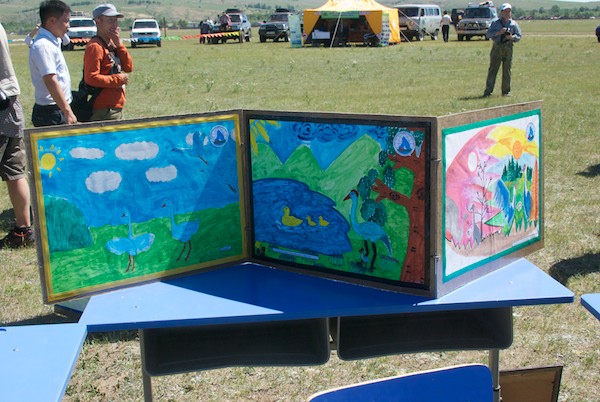
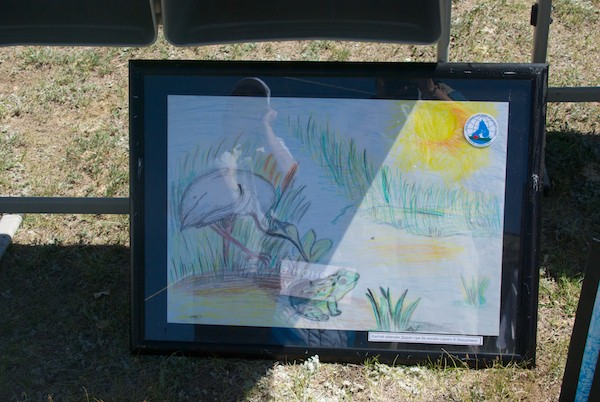
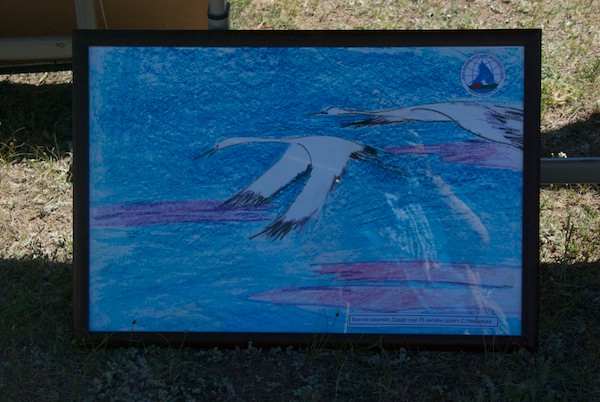
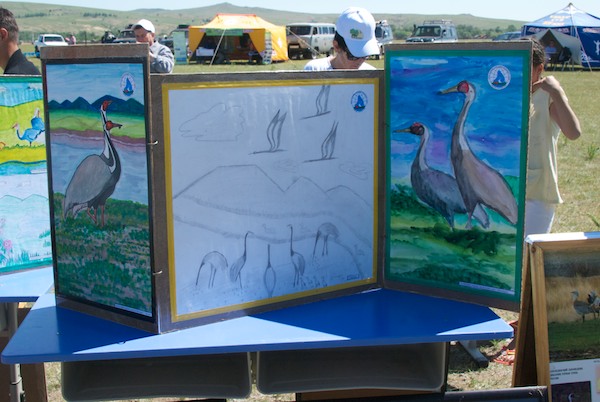
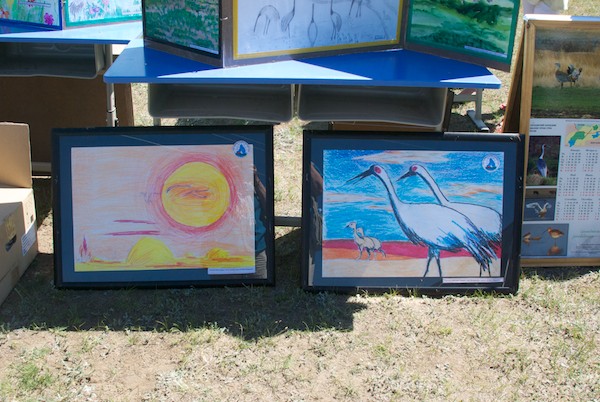
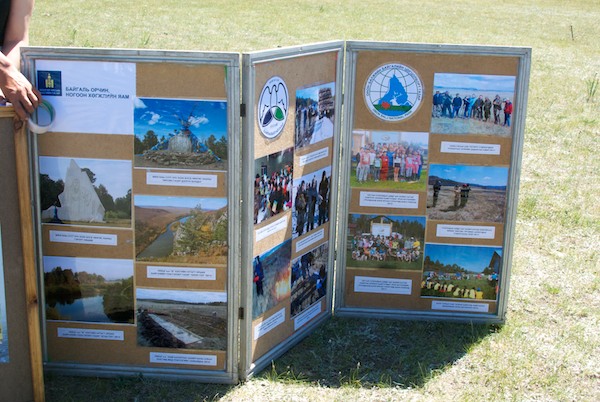
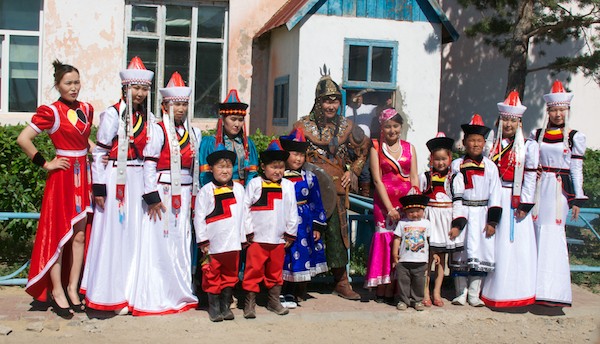
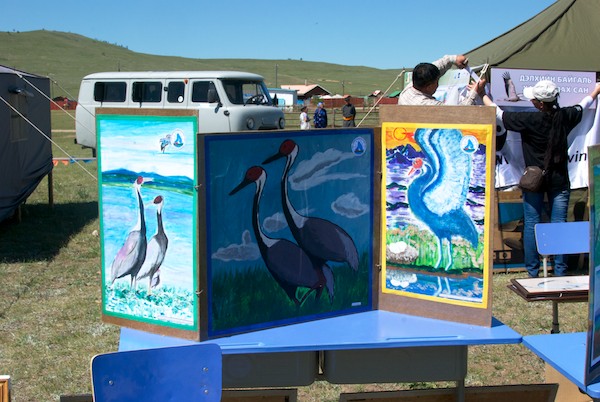
On June 13, as planned, we attended the first International Crane Festival, which was held in the soum center of Binder, Han Hentii Aimag. It was a wonderful day and great to be able to, by our attendance, support the local community and the researchers. The first thing I noticed was a very large display of art created by local children. Since the main mission of the WildArt Mongolia Expeditions is to find ways to use art to support conservation, I could not have been happier to see this. I tried to photograph every piece and I’ve posted all those images, plus the opening ceremony and other activities. You may notice that the traditional clothes look different than what you usually see in my posts and that is because we were in Buryat Mongol country, which extends from northeastern Mongolia north into southern Siberia. Buryat dels have a distinctive front design and their boots and hats are different than the Khalkh Mongol versions. The feeling of being welcomed, however, was the same as everywhere else I’ve been in Mongolia.

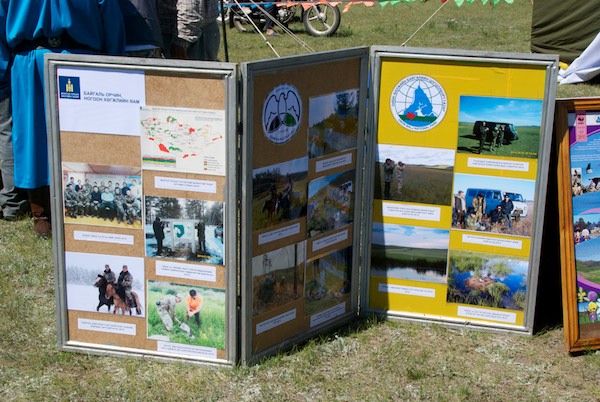
Informational map
Informational map
Informational poster
Dr. Archibald doing a filmed interview
The art display area

ICF 4ICF 5ICF 6ICF 7ICF 8ICF 9ICF 10ICF 11ICF 12ICF 13ICF 14ICF 15ICF 16ICF 17ICF 18ICF 19ICF 20ICF 21ICF 22ICF 23ICF 24ICF 25ICF 26ICF 27

Printed materials
Printed materials
Photos
Photos
Photos
Photos
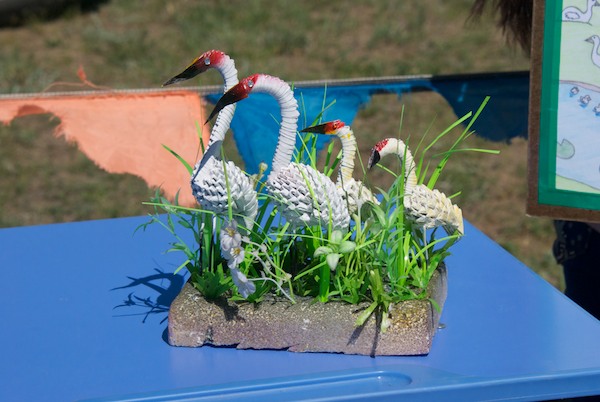
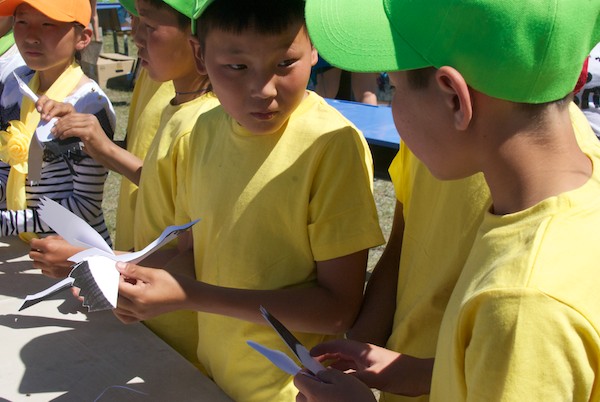
Activity table for local kids. They're making paper cranes.
Activity table for local kids. They’re making paper cranes.
I thought this was a great idea.

Then it was time for the opening ceremony!

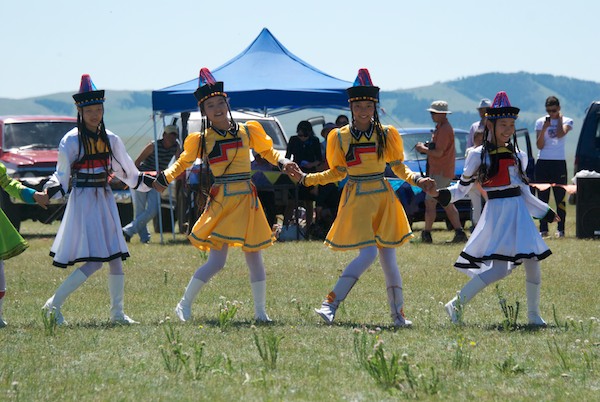
Buryat dancers
Buryat Mongol dancers
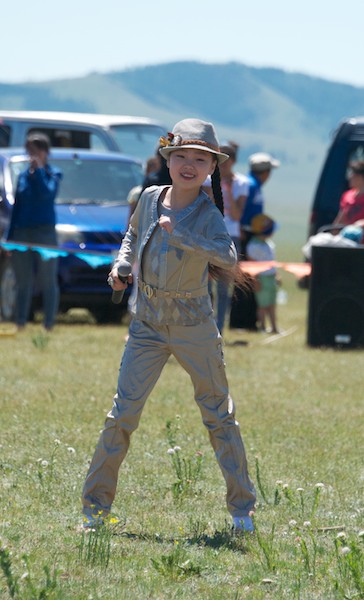
Solo performer. She really rocked it!
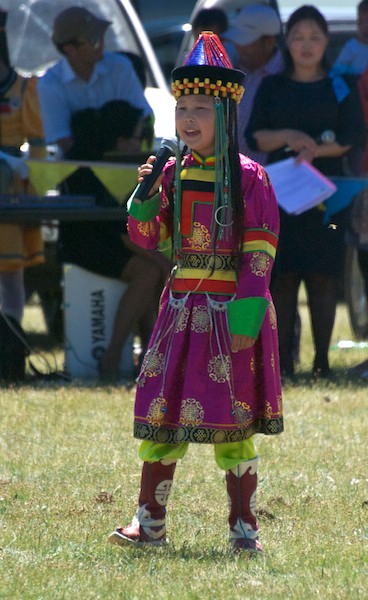
Young singer in Buryat clothes.
Young singer in Buryat clothes. I liked the contrast with the girl in the photo above.


She did a dance about fetching water that I'd like to learn more about.
She did a dance about fetching water that I’d like to learn more about.

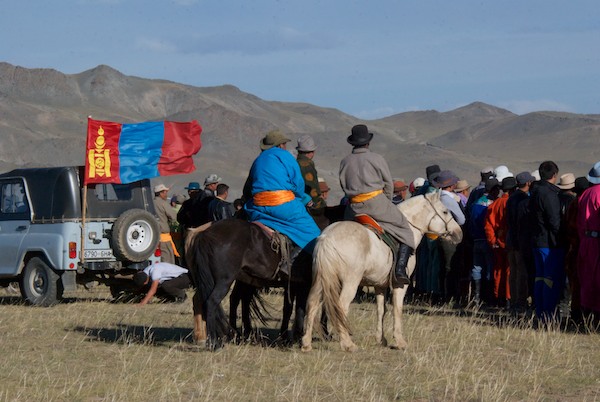
The festival had all the usual events..horse race, wrestling, anklebone shooting and more…

The anklebone shooting competition.
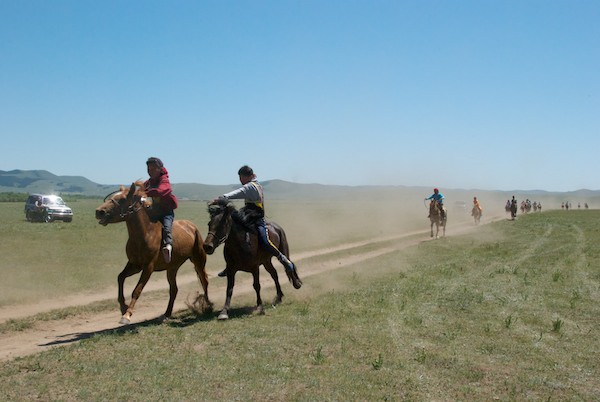
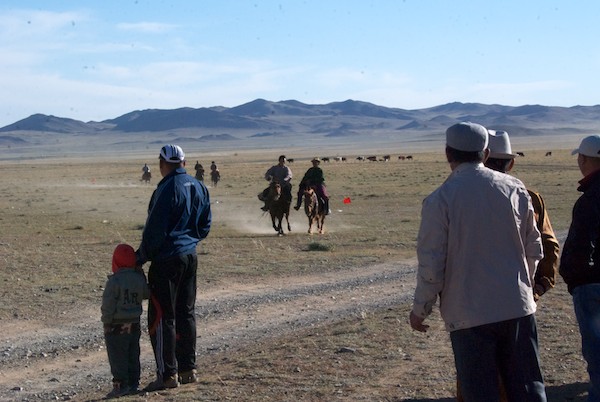
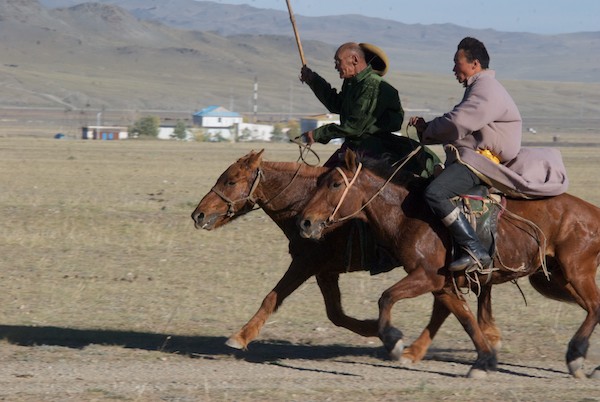
The finish of the horse race.
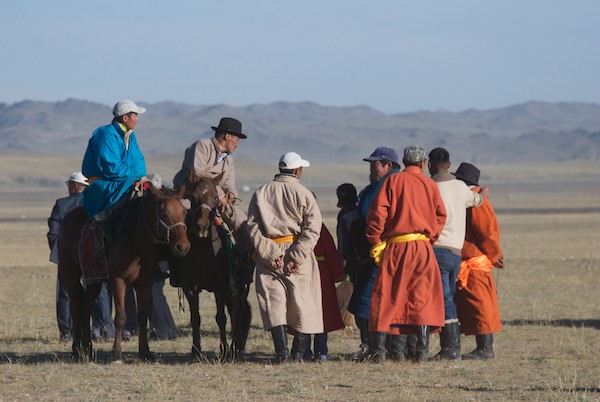
Cooling down her mount. The race horses always have the binding on the tail, so easy to tell which ones they are.
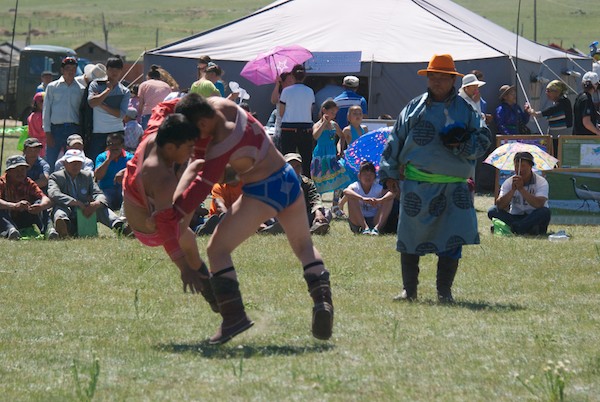
Mongol bukh (wrestling).
I got some great action shots!
During the break between rounds, these kids came out into the arena and picked flowers.
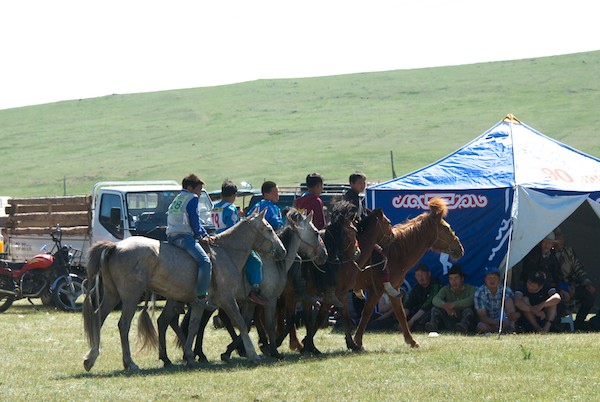
The five winners of the horse race riding in formation. They did a couple of full-circle wheels in unison. I was quite impressed.
The five winners of the horse race riding in formation. They did a couple of full-circle wheels in unison. I was quite impressed since, as far as I know, the horses are not trained for this kind of thing at all.
We went to the shop in town and came upon this group who gave a concert that evening.
We went to the shop in town and came upon this group who gave a concert that evening. A colorful ending to a great day!

The WildArt Mongolia Expedition 2014, Part 2: Gun-Galuut Nature Reserve to Binder Soum

Ovoo with prayer wheels

We left Gun-Galuut Nature Reserve after breakfast and drove northeast into the Han Hentii Mountains. It was good to get off the tarmac and onto earth roads again.

Khokh Nuur
We stopped for lunch at Khokh Nuur, a VERY important historical site since it’s where Temujin called the khural (council or meeting) that declared him Chinggis Khan, leader of all the Mongols.
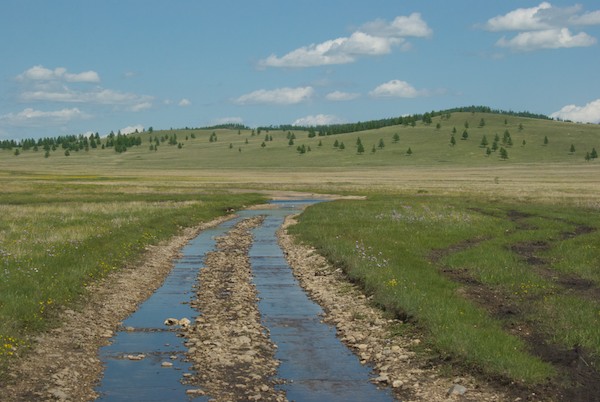
Sometimes the roads were more water than earth...
Sometimes the roads were more water than earth. Summer is the rainy season in Mongolia and it had been raining a lot just about everywhere in the country, so a great year for the herders and their animals since it meant lots of good grass.
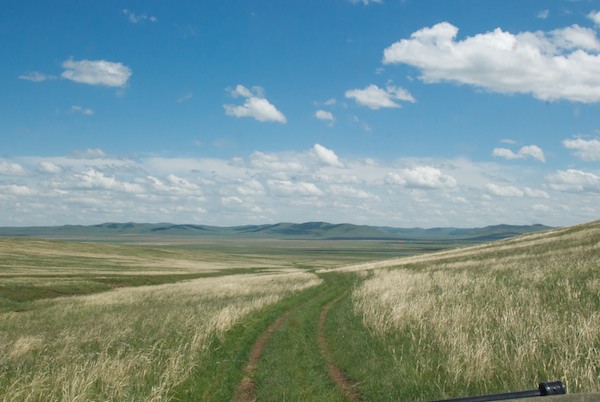
It was a glorious drive deep into the Mongolian countryside on a perfect summer day.
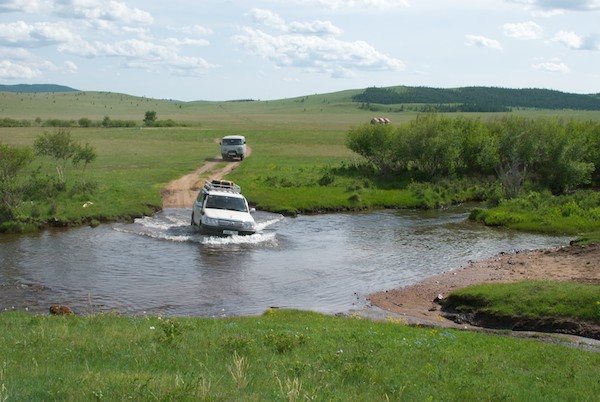
It had been raining a lot so there were streams to ford.
Since it had been raining a lot there were streams to ford.
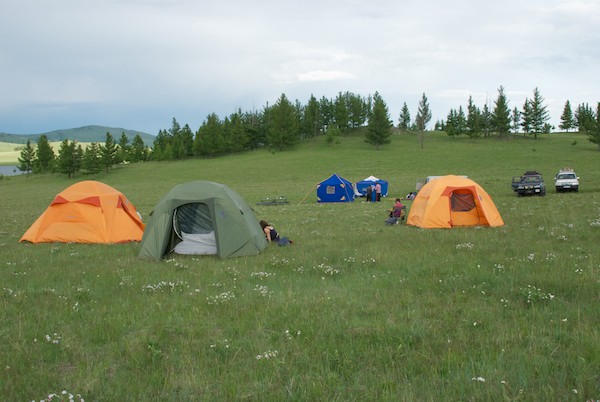
We camped by this lake.
We camped by this lovely lake the driver of my Land Cruiser, Erdenebat, knew about.
All set up and relaxing in camp.
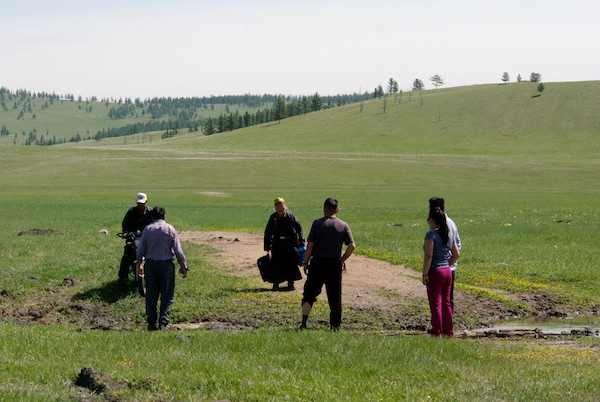
At one of them, which was more mud than water, a man and woman on a motorbike came along
The next day at one small crossing, which was more mud than water, a man and woman on a motorbike came along right after us. They were kind of stuck because she could have gotten very dirty or injured if the motorbike fell over in the mud and it was too wide to safely step across.
One of our drivers, Puugii, solved the problem.
A helping hand and she made it across just fine.
Scenery.
Scenery.
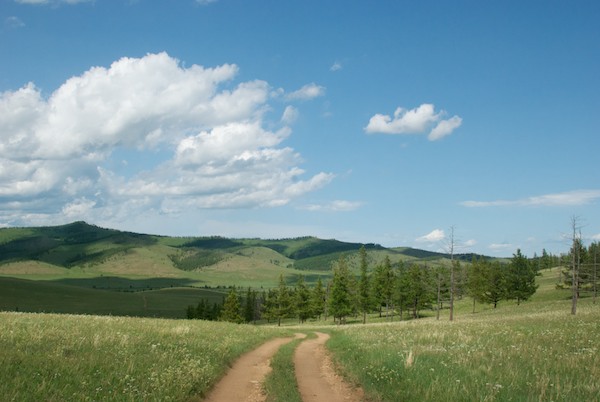
More scenery. I'd never been to the Han Hentii Mountains before and now I understood why they are such a popular destination for the Mongols. So beautiful.
More scenery. I’d never been to the Han Hentii Mountains before and now I understood why they are such a popular destination for the Mongols. So beautiful.
One of the drivers got a little to close to this yak and had to run for it. The other drivers loved it.
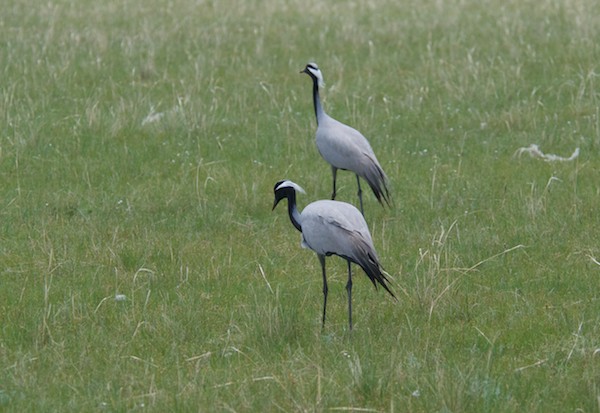
We stopped for lunch and almost immediately spotted this pair of demoiselle cranes!
Local dogs often show up out of apparently nowhere when one stops to eat. They wait patiently until you leave most of the time.
Local dogs often show up out of apparently nowhere when one stops to eat. They wait patiently until you leave, most of the time. They often seem friendly, but have not been vaccinated against rabies and are not used to being petted or touched, so it’s best to keep one’s distance.
As we drove on, we saw this large flock of demoiselle cranes.
We were heading towards the site of a major new crane study. My driver had directions, but couldn't follow them
We were heading towards the site of a major new crane study. My driver, Erdenebat, had directions, but couldn’t follow them because the valley floor was too wet from the rains. So he picked his way along the mountain slopes, using a compass to keep our heading correct. It was quite a feat of navigation that I didn’t appreciate until he explained to me what he had been doing and why.
Along the way we saw the pair of endangered white-napped cranes.
Along the way we saw this pair of endangered white-napped cranes.
The crane research station
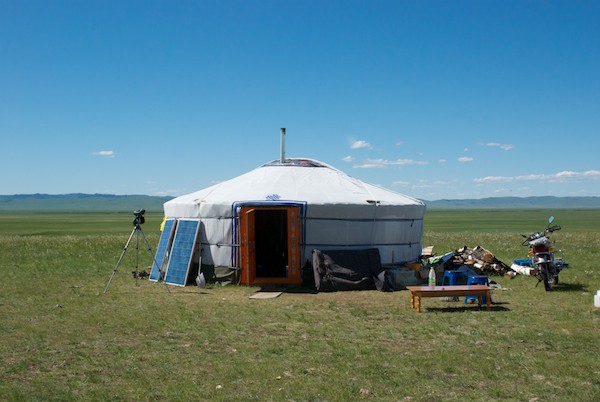
The crane research station is new, so there is only one ger so far. From this vantage point they can scan the surrounding countryside for miles for up to six species of cranes.
The research project is a collaboration between Mongol, Russian and Chinese scientists. The Mongol scientist in charge is Nyambayar Batbayar
The research project is a collaboration between Mongol, Russian and Chinese scientists. The Mongol scientist in charge is Nyambayar Batbayar who took the time to give us a great briefing and answer all our questions. He is also the Director of his own NGO, the Wildlife Science and Conservation Center of Mongolia.
We left the research station and headed towards our next destination, Binder, crossing this old-fashioned timber bridge.
It is a bit of an adrenaline rush to drive out onto something like this...
It’s a bit of an adrenaline rush to drive out onto these bridges if you’re not used to them.
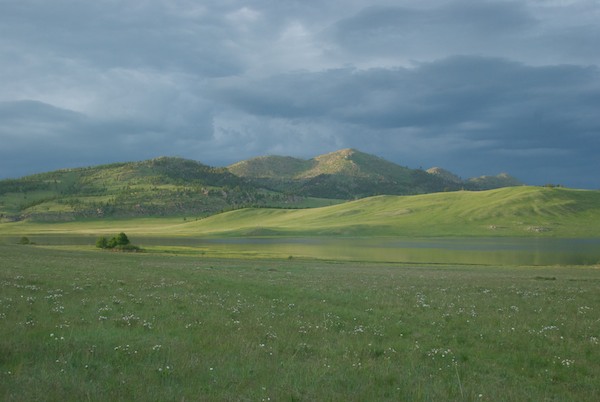
Binder Nuur (Binder Lake). We were able to camp on the lakeshore.
Binder Nuur (Binder Lake), which was a short distance from the soum center town of Binder. We camped on the lakeshore.
We immediately saw many white shapes, which proved to be over 60 whooper swans.
Full moon sunset over Binder Nuur.

We came to Binder for the first-ever International Crane Festival. And that will be the subject of my next post.


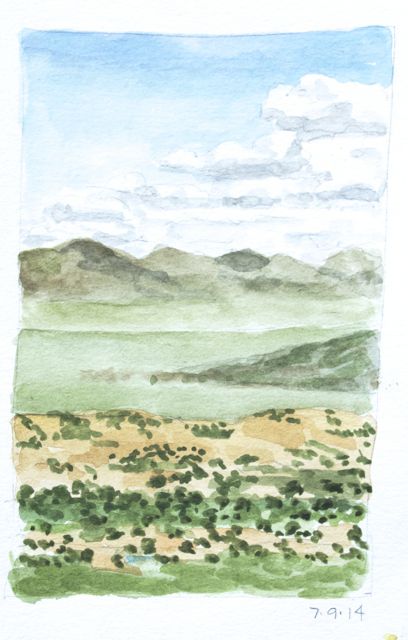
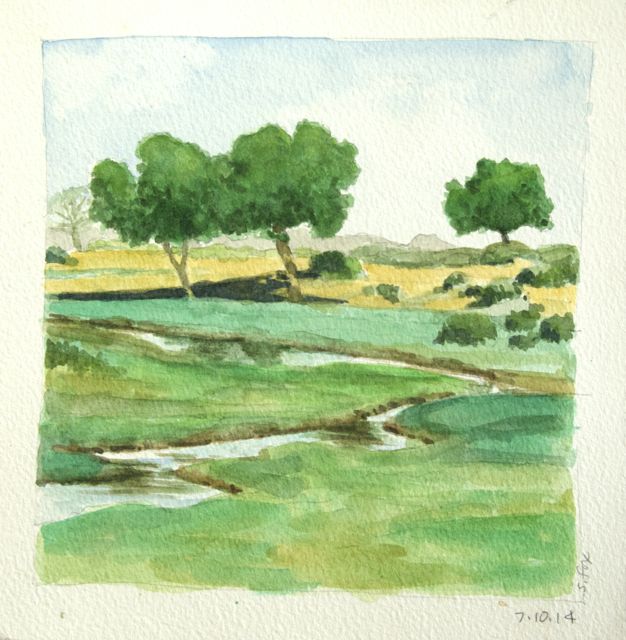
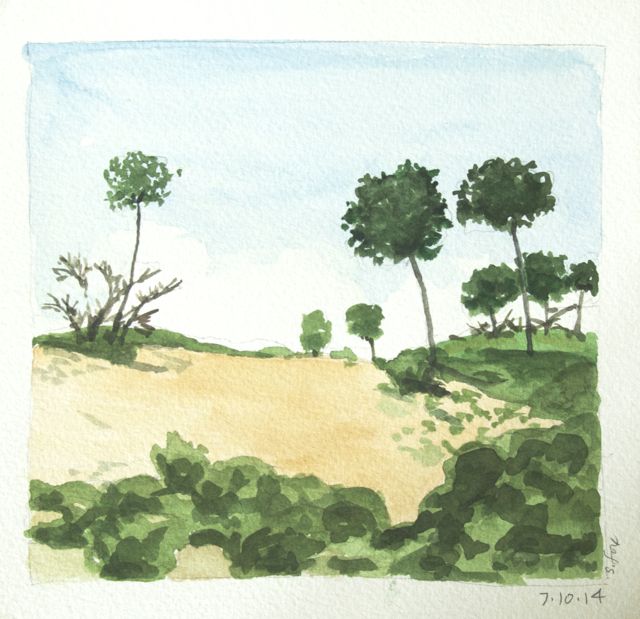
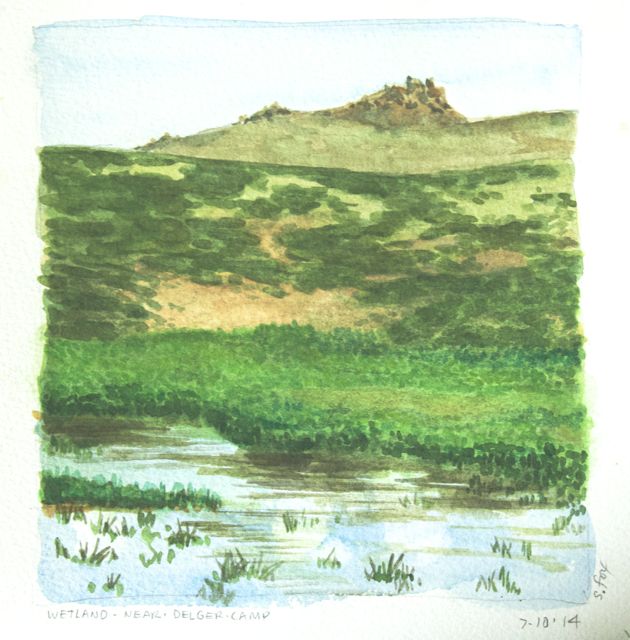
Mongolia Watercolors And Sketches So Far; Having A Wonderful Time!

View from my ger, Delger Camp

I just returned from four great days at Delger Camp, operated in conjunction with Nomadic Journeys, and which is located at the Khogno Khan Nature Reserve, about six hours west of Ulaanbaatar. Staying in one place for awhile is very useful for getting in serious painting time. I do quick pen and ink sketches while on the road, but there’s usually not time to get out the watercolors.

Along with the paintings and sketches from this current trip, I also thought I’d share other pieces I’ve done up to now. Everything was photographed in less than optimal conditions in the apartment I have the use of, but I felt that sharing them while I’m still here would be fun and have an immediacy that would be missing if I waited until I get home in a couple of weeks.

They were done with either a Winsor Newton Cotman watercolor travel set or Yarka poured pigment watercolors and a Robert Simmons Sapphire brush. The paper is either Arches 140lb cold-pressed or a w/c paper I brought back from the Lake District in England many years ago. The pen sketches were done in a 7×5″ Pentalic Nature Sketchbook. I used a non-waterproof pen with a Koi waterbrush for the one with the tone and a .01 Sakura Micron pen for the others.

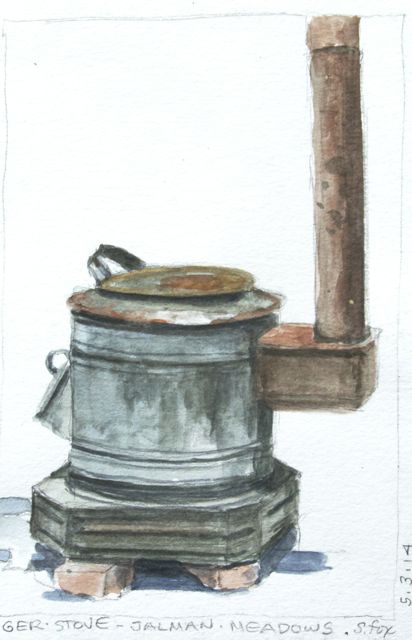
Gloomy day
Gloomy day, so I did this watercolor study of the stove in my ger
Cloudy and rainy day
Cloudy and rainy day studies at Jalman Meadows and Gun-Galuut
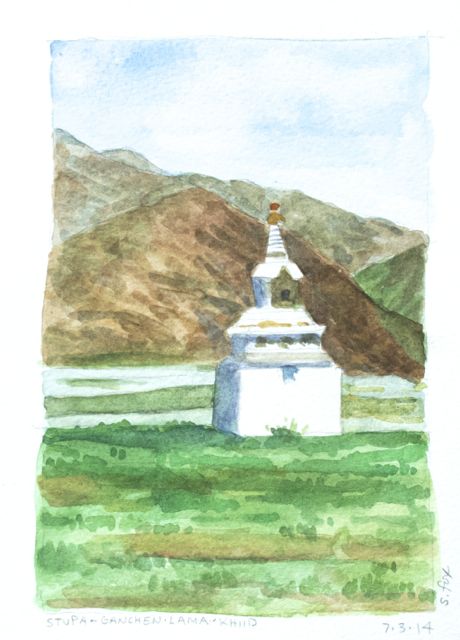
Stupa above river valley at Ganchen Lama Khiid, Erdenesogt
Stupa above river valley at Ganchen Lama Khiid, Erdenetsogt
Prayer wheel at
Prayer wheel at Ganchan Lama Khiid, Erdenetsogt
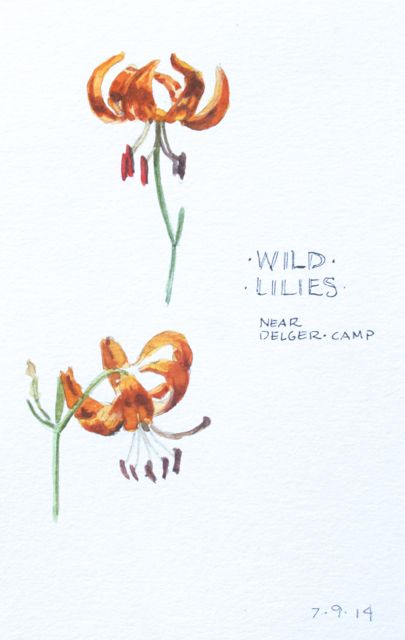
Lily studies, Delger Camp
View of sand dunes, Delger Camp
Valley north of Delger Camp
Wetland/dune area
Wetland/dune area
Dunes and trees
Dunes and trees
Variety of vegetation
Variety of vegetation, wetland area and surroundings
Storm light and storm clouds at Delger Camp
Rain to the south
Rain to the south
Clouds coming by
Clouds coming by
Mountains to the north of camp
Toned sketch
Toned sketch
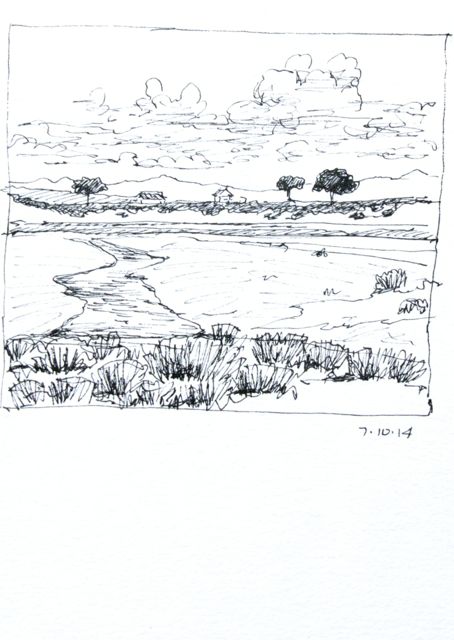
Quick sketch of wetland area (the driver was coming any minute to pick me up)
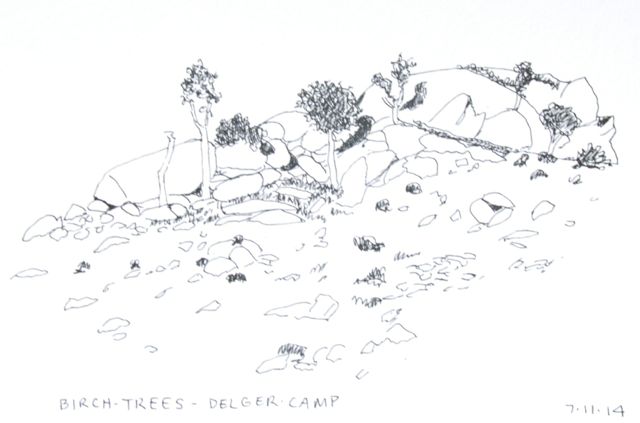
Rocks and trees
Rocks and birch trees
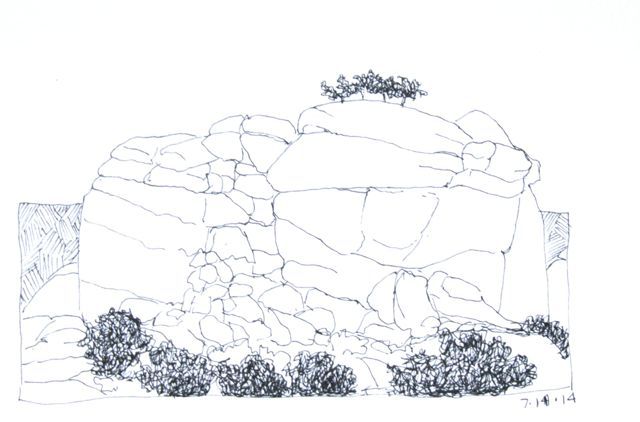
Rock formation
Rock formation
Wild poppies
Wild poppies
Birch tree
Birch tree


The WildArt Mongolia Expedition 2014 Has Returned!

gazelle headerWe returned to Ulaanbaatar on June 21 and I immediately had to throw myself into preparations for the 2013 Expedition group art exhibition, which will be the subject of my next post and is open now at the Union of Mongolian Artists Gallery until July 7.

The 2014 Expedition was a great success! Here’s some of the highlights. There will be a series of posts once I’m home.

We saw cranes in the Han Hentii Mountains and attended the first-ever International Crane Festival in Binder Soum. We received an excellent briefing on the major crane study which has now gotten under way and in a future post I’ll cover what the researchers are doing, how they’re doing it and what they hope to learn. Below is one of the study subjects, demoiselle cranes with two chicks.
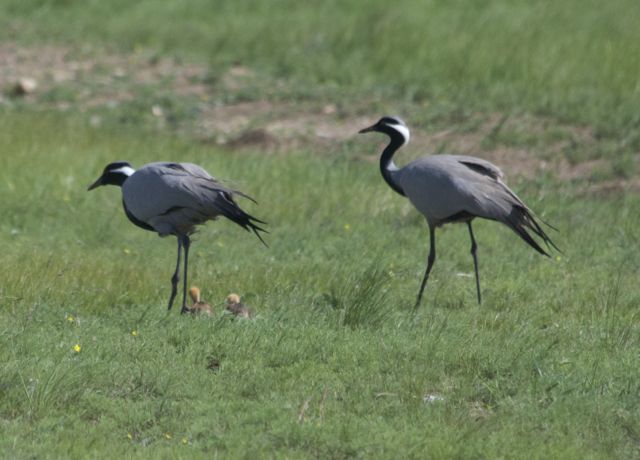
demoiselle cranesThe crane festival was wonderful. There was a show of crane art created by local school children, an opening ceremony with dancers and singers, a horse race, Mongol wrestling and an anklebone shooting competition.

crane festThe opening ceremony included a traditional dance by young Buryat Mongol girls.

buryat dancers 2Mongol-style wrestling (Bukh)

binder wrestlersThe finish of the horse race.

horse raceAnklebone shooting.

shagaAll to celebrate crane conservation! I also got to meet Dr. George Archibald, founder of the International Crane Foundation, who was there with a group of researchers and supporters.

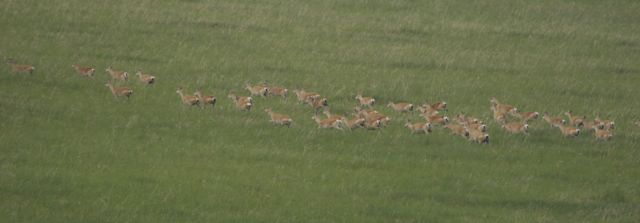
Our next major destination was Tolson Hulstay Nature Reserve, home to between 40,000 and 60,000 Mongolian gazelles. We saw them, a couple of times in large numbers, every time we drove out into the reserve, which also has a dozen small to medium-sized lakes. I fell in love with the grassland steppe and will certainly be going back there. I was able to interview one of the six rangers and get a lot of good first-hand information that I’ll be sharing in a future post.

Mongolian gazelle. Below and at the top of the post.

gazelles 2

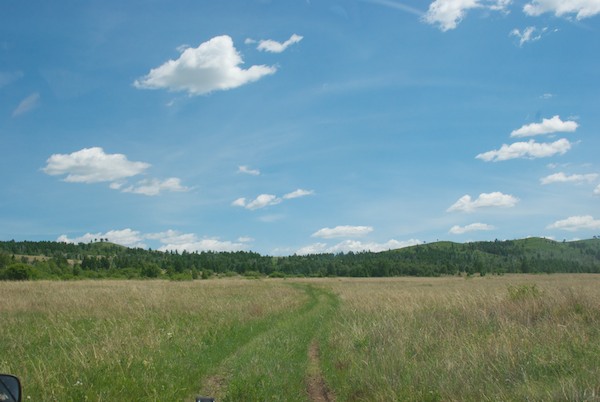
The legendary grassland steppe. Toson Hulstay is the largest preserved and conserved area of it left. steppeThe rainy season had started early. Great for the herders and their animals, who look to have a very good year with excellent grazing. But for traveling by car, it got a little interesting sometimes…
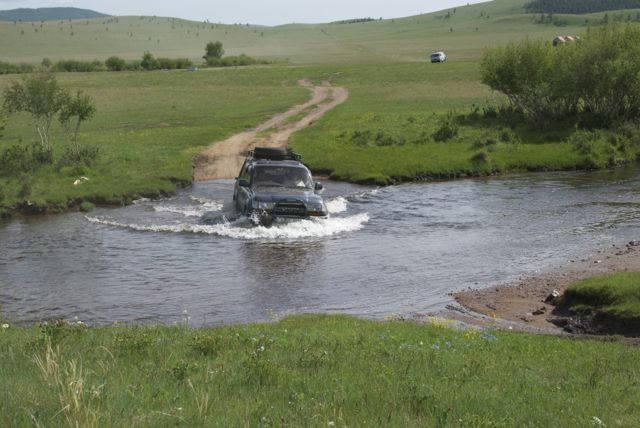
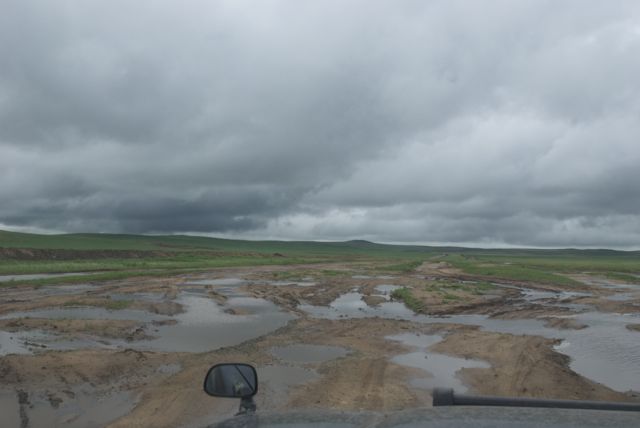
car crossing earth roadBut of course it was worth it!


I’ve Arrived In Mongolia! International Children’s Day In Ulaanbaatar
 

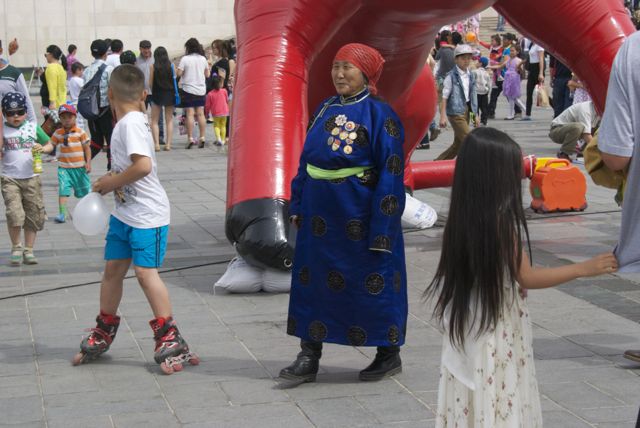
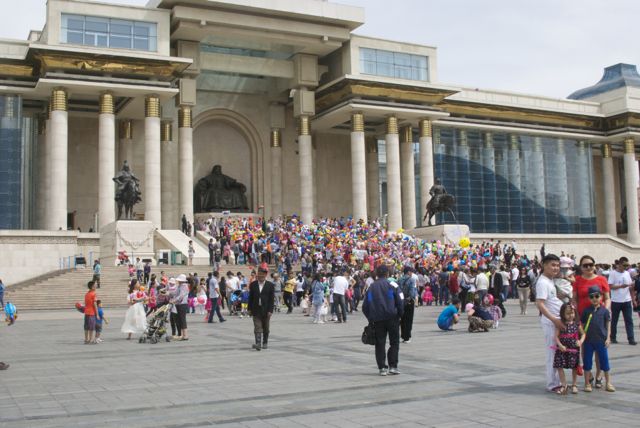
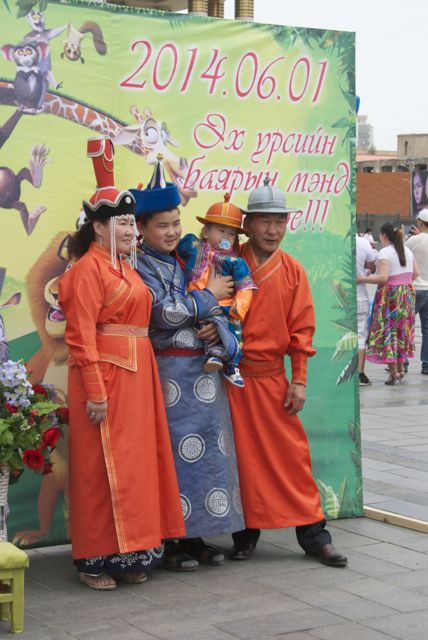
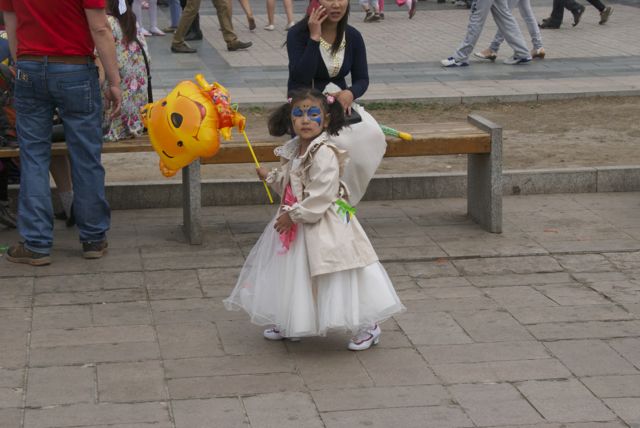
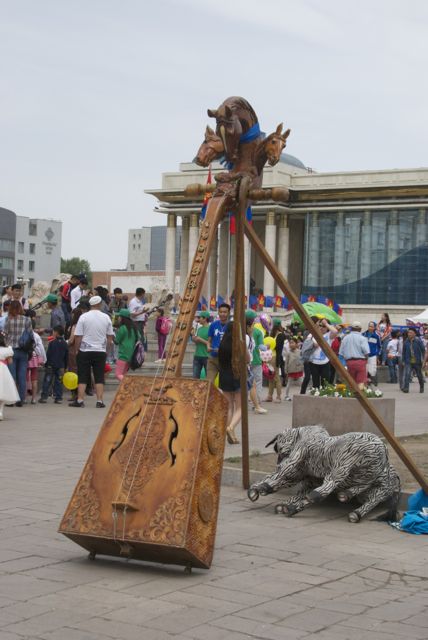
2icd International Children’s Day isn’t celebrated in the USA that I know of and suspect most Americans have never heard of it. It’s the exact opposite in Mongolia where it’s a big, big holiday. I just happened to be in Ulaanbaatar, having arrived a day earlier, and spent over two hours at Chinggis Khan Square, taking photos and thoroughly enjoying the day-long celebration.

Here’s a selection from the over 400 images I shot:

1icd

3icd4idc5idc7idc6idc8idc9idc10idc11idc12idc13idc14idc15idc16idc17idc18idc19idc20idc21idc22idc23idc24idc


Mongolia Pre-departure Odds And Ends


Takhiin Tal Staliion oil 18x24" one of the dozen paintings I'll be showing during the WildArt Mongolia Expedition group art exhibition
Takhiin Tal Staliion oil 18×24″ one of the dozen paintings I’ll be showing during the WildArt Mongolia Expedition group art exhibition

A week from today I leave for eight weeks in Mongolia, my ninth trip in ten years. Good friends to see and places to go, especially the second WildArt Mongolia Expedition to the northeastern mountains and steppes to see cranes and Mongolian gazelles. They’ll be eight of us, myself, Mongol artist Tugsoyun Sodnom who went last year and six artists and photographers from Australia. We’ll be traveling in comfort this time in Land Cruisers, but still getting to camp in the countryside.

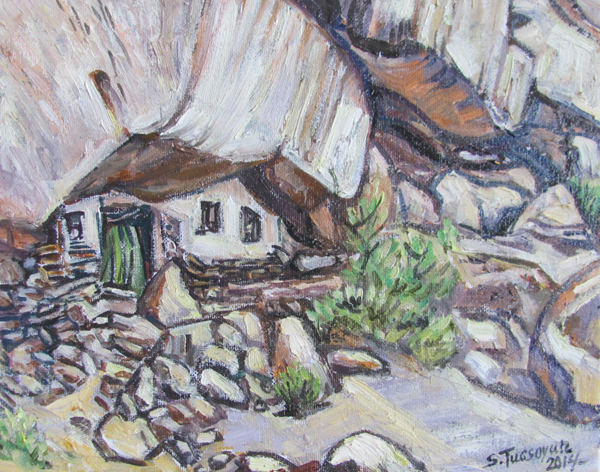
Painting of lama's retreat by Tugsoyun Sodnom
Painting of lama’s retreat by Tugsoyun Sodnom; one of her works that will be in the group exhibition

Two other important events that I’m either a part of or will attend:

Tugsoyun, myself and Oidoviin Magvandorj (the other Mongol artist who went last year) will be having a three-person exhibition of paintings inspired by the Expedition to the Gobi. It will be at the Union of Mongolian Artists Gallery in Ulaanbaatar from June 27 to July 8. There will be an opening ceremony on the 27th at 1900hr/7pm and is open to the public.

Dalanjargalan Soum, the community where the women’s felt craft collective that I support is located, is celebrating its 90th anniversary on July 23-24 and I plan to attend. I’m so looking forward to sharing this special event with the friends that I’ve made there since I first met the collective ladies in 2009.

Otherwise, I’m planning some short trips to the countryside to do as much painting and sketching as I can. I should have wifi when I’m in Ulaanbaatar and will post updates when I can.

Daraa uulzii (See you later!)


The WildArt Mongolia Expedition, Part 14: The Incomparable Gachen Lama Khiid

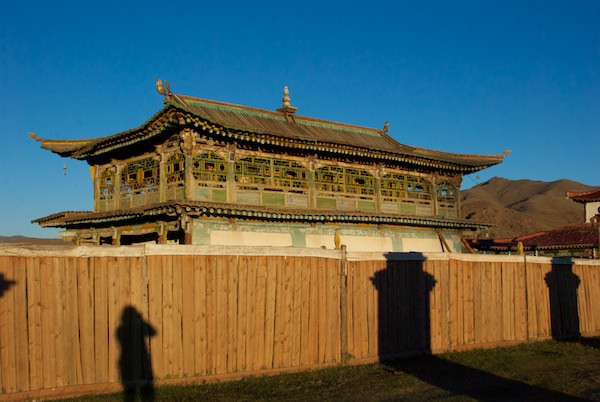
The old temple
The old temple.

I had first come to Gachan Lama Khiid on my two-week camping trip in 2010. I had never heard of it and was completely enchanted. So when the idea was floated about taking a different route back for at least part of the return to Ulaanbaatar, I thought of coming back and sharing this place. No one knows about it, really, not even many Mongols. If you google it, my previous post from 2010 is pretty much what comes up.

I think the old temple, the only structure besides the main gate which was left after the destruction of the monasteries in the late 1930s, is one of the most beautiful buildings I’ve ever seen. This time we were able to talk to the lamas and a staff person who live and work and worship there and learn more about it. A new temple has been built and we were allowed to enter and take photos in it and also the old temple.

The old temple is badly in need of restoration. One side is so unstable that it is propped up with timbers. There are a large number of exquisite works of art on the walls, most of them in need of attention. One can see areas of wood rot in parts of the structure. The monks came up with a restoration plan and sent it to the appropriate government ministry two years ago, but have not yet gotten a response. I promised them that I would see what I could do. This post is partly to keep that promise, but I will also be following up once I’m back in Mongolia this June (there was no time left last year and the monks are almost impossible to contact due to poor mobile phone reception). I documented as much of the damage as I could and have posted some of those images here as reference and to show some of what needs to be done. Honestly, this place should be on the list of World Heritage Sites.

A final note: The monastery is not set up for visitors. I’m not sure what facilities are available in the soum center nearby. If you go, plan to have everything you need and be respectful. Namaste.

We arrived after dark and it was very cold. And going to get colder as we were up in the Hangai Mountains almost due north of Bayanhongor. People were found and we were not only given permission to camp right on the monastery grounds, but allowed the use of one of the outbuildings for cooking and eating. The next morning we emerged to morning light that cast a magical glow on the temples…

The old temple
The old temple.
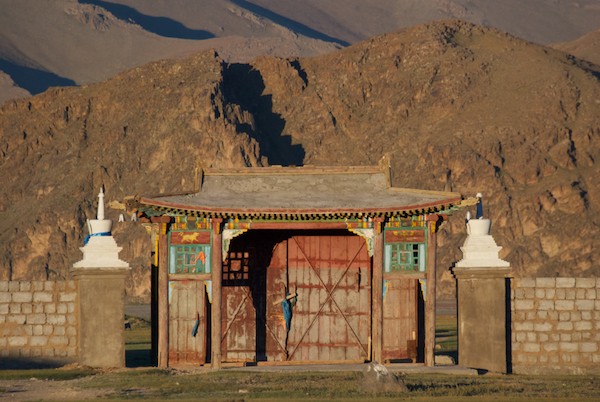
The surviving gate
The surviving gate; a new enclosure is being built around the complex.
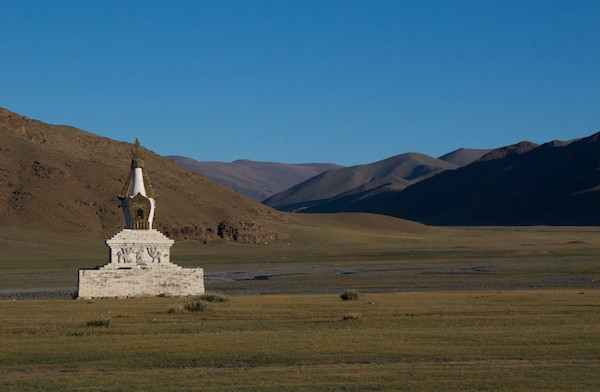
Stupas
Stupas with the river in the background.
Stupa
Stupa.
The "kitchen"
The “kitchen”. Soyoloo, our cook, and Tseegii, our guide, making breakfast for everyone.
Entrance to the "kitchen"
Entrance to the “kitchen”.
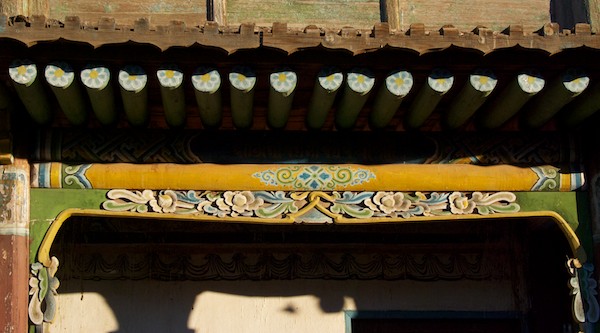
Corner detail
Corner detail showing the delicate fretwork.
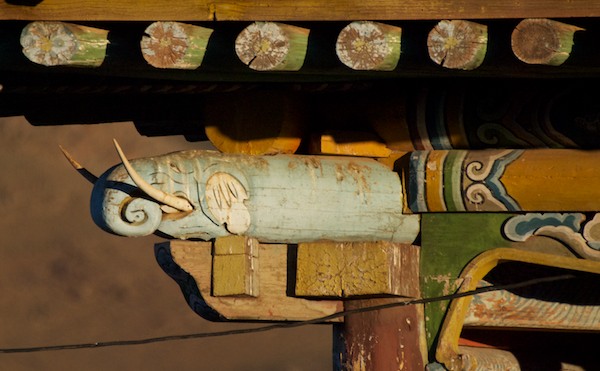
Blue elephant
Blue elephant.
Blue guardian
Blue guardian.
Carved and painted lotus
Carved and painted lotus.
Doorframe carving
Doorframe carving.
Corner animal and bell
Corner animal and bell.
Schematic of monastery before most of it was destroyed.
Sign over door in three languages: Tibetan, Mongol bichig script, Chinese
Sign over door in three languages: Tibetan, Mongol vertical script, Chinese.
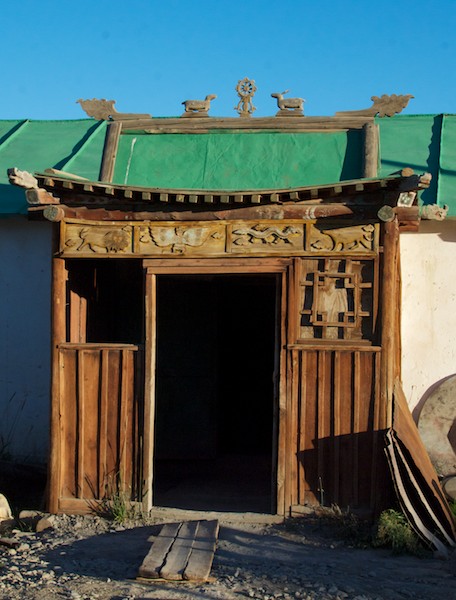
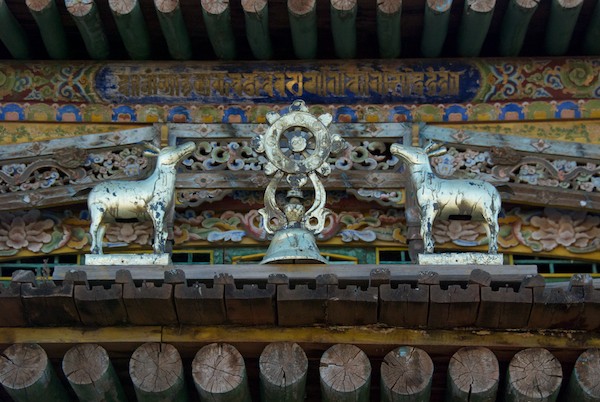
Buddhist symbol set of deer and wheel over door
Buddhist symbol set of deer and wheel over door. It is said that the first creatures to come to the Buddha when he sat under the Bodhi Tree to teach were two deer.
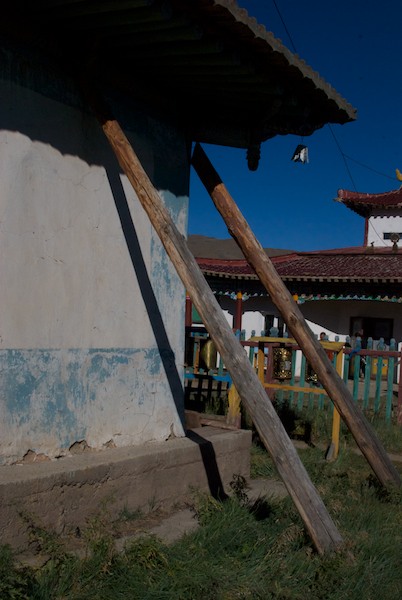
Timbers supporting one corner of the old Temple
Timbers supporting one corner of the old Temple.
Wall painting.
Wall painting.
Wall paintings.
Wall paintings.
Old temple interior.
Main altar in the old temple.
Wall paintings.
Wall paintings.
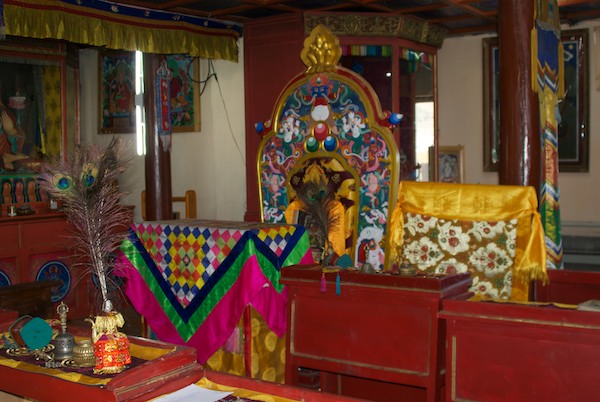
Lama throne.
Lama throne.
Altar figurines.
Altar figurines.
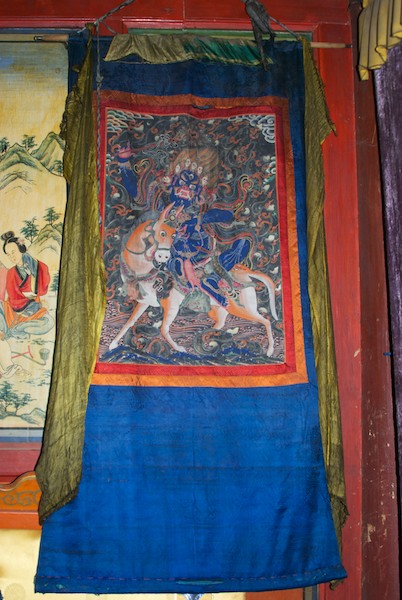
Thanka.
Thanka.
Wall paintings.
Wall paintings.
Wall painting of the monastery in the winter. This one was everyone's favorite, including me.
Wall painting of the monastery in the winter. This one was everyone’s favorite, including me.
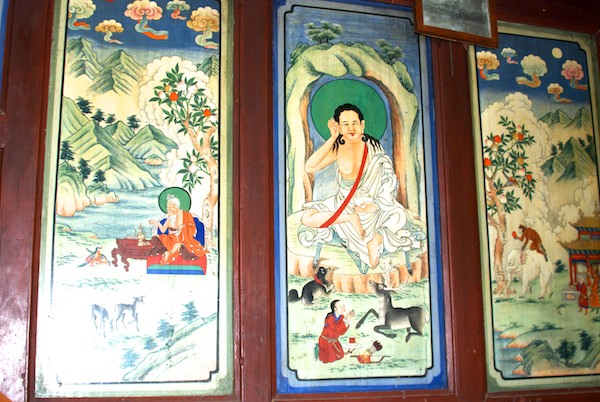
Door panel painting at the interior entrance to the old temple. Also a favorite.
Altar in the new temple.
Lama throne in the new temple.
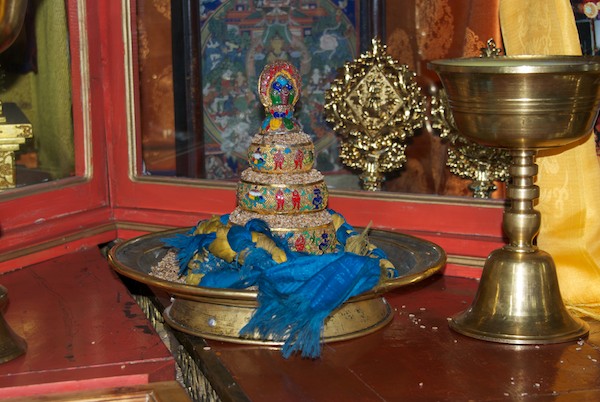
Ritual objects.
Ritual objects.
Temple bowl
Temple incense offering bowl.
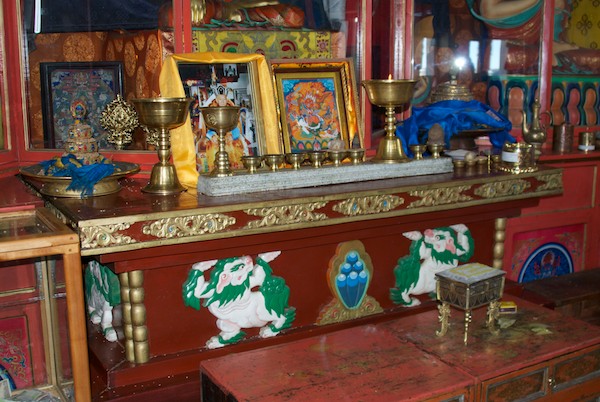
The main altar in the new temple.
Another view of the altar.
The right side of the altar.
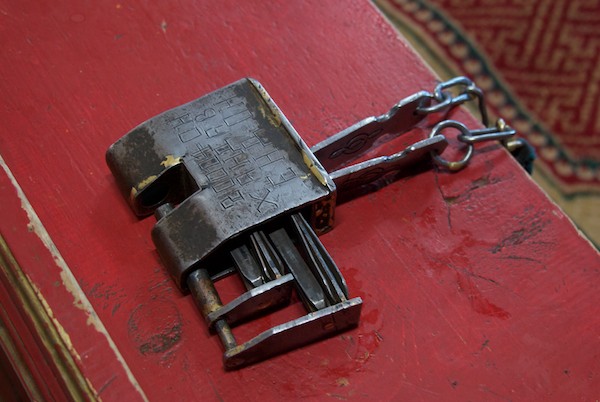
A very old lock and keys.
Monk showing us a ceremonial staff.
Old table with stunning lacquer work.
Old table with stunning raised lacquer work.
Old door latch.
Old door latch.
The old temple.
The old temple. Unfortunately, we had to leave before the sun got to the front. But at the link above there’s a photo of it in full light.
The new temple.
The new temple.


The WildArt Mongolia Expedition, Part 13: An Ambling Horse Race In Bayahongor

What are they watching?

We finally came full circle, in a way, and arrived back to Bayanhongor, from where we had turned south towards the Gobi over two weeks earlier. As we came into town we saw a big crowd and…horses. What was going on? We drove over to the parking area, stopped and jumped out with our cameras. It was a horse race, but not like any I’d seen. For one thing it was on an oval dirt course instead of across the countryside. For another the horses sure didn’t seem to be going very fast. It turned out to be a race for a very special gaited Mongol horse called an ambler. Some horses are born with the ability to pace, which means both legs on one side move together. They are highly prized because they give a smoother ride than the regular Mongol horses who have a shortened gait which is an adaptation to minimize the danger of breaking leg if the horse steps in something like a marmot hole. What a wonderful and unexpected photo opp and experience this was almost at the end of the Expedition!
It's a horse race!
It’s a horse race!
This time most of the riders were adult men.
I'd never seen Mongol horses move like this before.
I’d never seen Mongol horses move like this before.
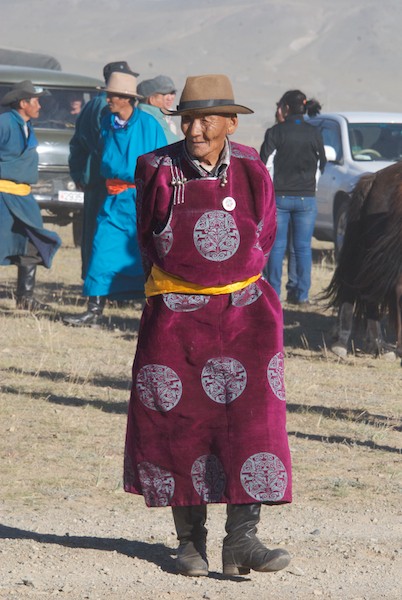
And I loved how some of the riders were wearing very fancy del.
At the finish line.
At the finish line.
Best. Dressed. Man.
Best. Dressed. Man.
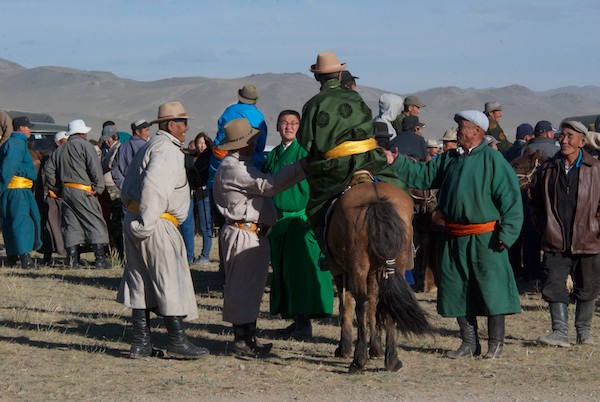
One of the winners, apparently.
Everyone seemed to having a seriously good time.
Mugging for the camera.
Smiling for the camera. Love the peace sign.
On our way north
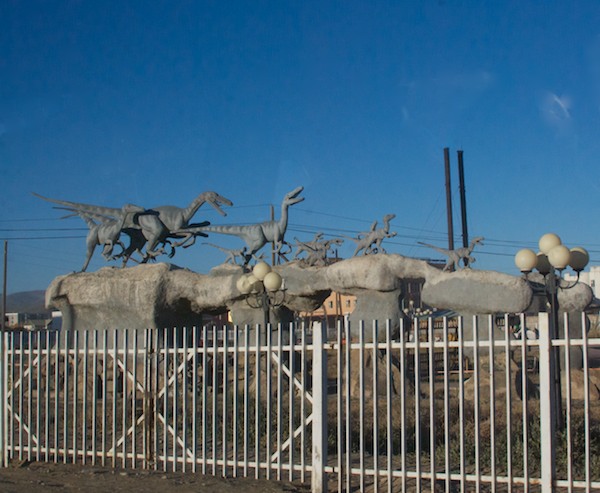
On our way north we passed….a dinosaur park. The light was going and we had a ways to drive to no time to stop. Just grabbed some shots from the van.
I want this for our backyard.
Back out into the countryside,
Back out into the countryside, going north into the Hangai Mountains to a monastery that I visited and fell in love with in 2010, Ganchen Lama Khiid. You can read about that first visit here.
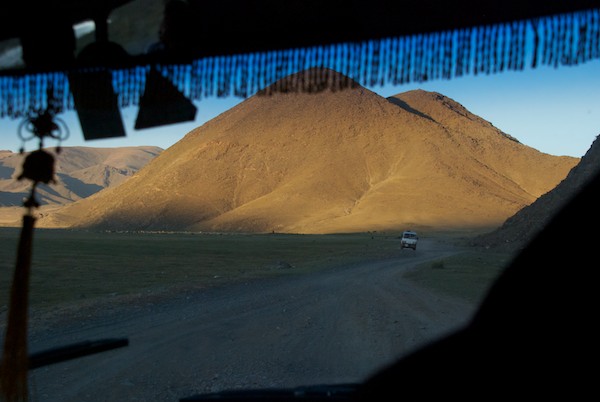
It was July and green
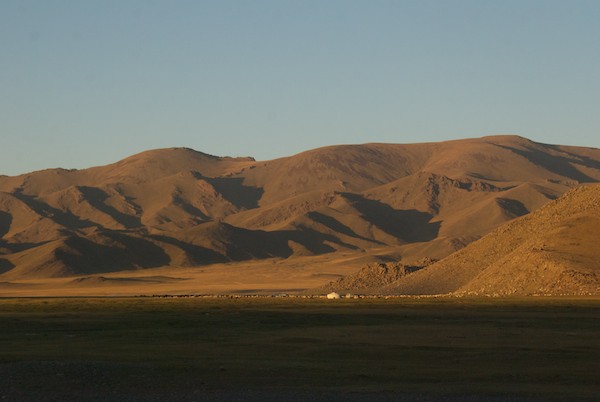
It was July and green the first time I went up this road. Now it was September and the land was golden in the setting sun.
It truly was a beautiful fall evening.

But it was also going to be cold. We drove on as it became dark and finally arrived at the Monastery….