I started some fun paintings from my new Mongolian reference last week and thought I’d share a couple of them in progress. I’m experimenting with a new way of starting, based on something I learned from John Seerey-Lester. Up till now I’ve begun by drawing directly with the brush, using line. It’s a default from being a “drawer” as a child. One of the major things I learned in art school was to see shape instead of, or in addition to, line.
Since I don’t use a projector, I draw directly from images on my monitor or a preliminary drawing. I sometimes get in trouble and spend a lot of time correcting. What to do?
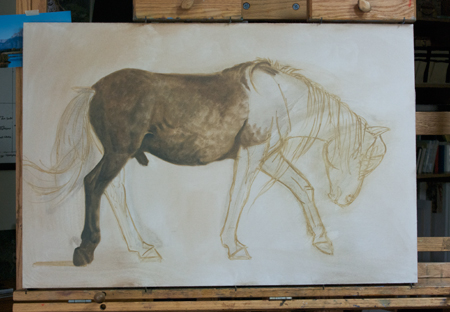
Something must have been purcolating while I was away from the easel, because it suddenly occurred to me to do a light lay-in of the shapes with a big brush for size, proportion and location, wipe it out so that it is a ghost shape and then start the “real” drawing. It’s already made a difference.
So, here’s two in progress:
A Mongolian stallion 24″x36″
Mongol Horse stallion
And a bactrian camel 20″x28″
Bactrian camel
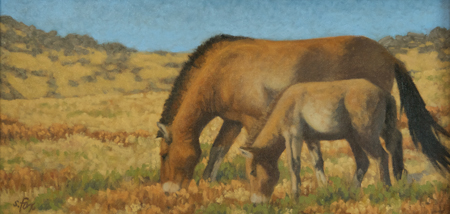
Also, here’s one of the paintings that was accepted and will be available for purchase at the Society of Animal Artists show “Small Works, Big Impressions” at The Wildlife Experience near Denver, Colorado.
It’s called “Breakfast for Two” and is a takhi mare and foal that I saw at Hustai National Park.
I don’t know about other artists, but after a long trip it takes a little internal shove for me to get going again. I need to shake the rust off, get in the groove, just….start…..working.
I also spent some time thinking about my work procedures. I love to paint and tend to dive in, flail around and pull it together, or not. I’ve got some ideas about what I want my work to look like and have come to conclusion that I need to spend more time on the preliminaries, especially for larger works. That means drawing, drawing, drawing. Plus value and color studies as needed.
Winter is when I try to push my work to the next level and experiment and, since the first winter storm of the year arrived yesterday, I guess it’s time.
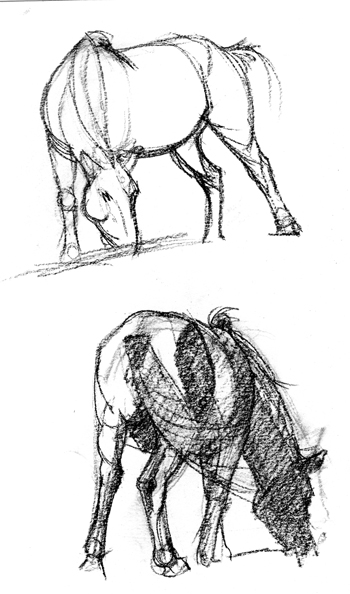
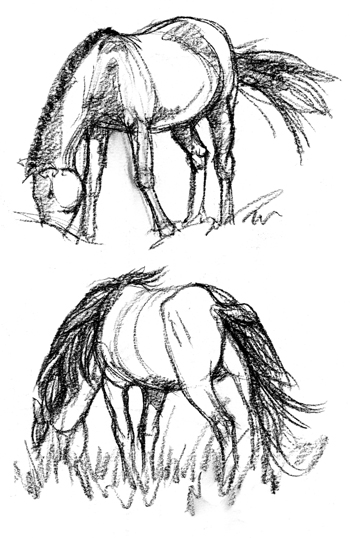
This week I’ve done a pile of charcoal drawings of the Mongolian horses, which I got fantastic reference photos of. I’ve always struggled for some reason with poses where the horses have their heads down, grazing, so I decided to get a handle on that once and for all. What worked was doing the body first and then adding the head. I’d been doing it the other way around, to my eternal frustration.
Here’s a selection of some I feel came out ok. They are done with a 6B extra soft General Charcoal pencil on 2 ply Strathmore Vellum Bristol and are unretouched. I’m always looking for what will add to the illusion of three dimensional structure and a body in space and what will help me get a handle on the anatomy.
These took 15-20 minutes each.
I also want to get some action into my work, so here’s a couple of running horses.
No idea if any of these will find their way into paintings, but I enjoyed doing them.
ART THOUGHT FOR THE DAY
“Artistic growth is, more than anything else, a refining of the sense of truthfulness. The stupid believe that to be truthful is easy: only the great artist knows how difficult it is.”
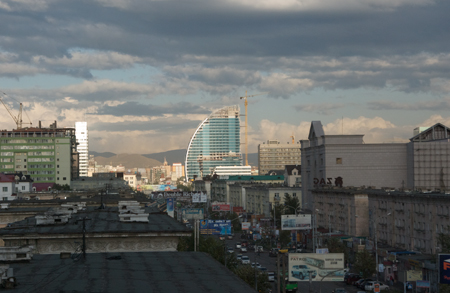
Back home safe, sound and pretty functional. I use a jet lag program from a book I found years ago at our local travel store, “Overcoming Jet Lag”. I think it’s still available on Amazon. It consists of a variety of things to do to rapidly shift one’s body clock to destination time. For me, it makes all the difference in the world on a nine time zone shift like the trip I just took. Here’s a last look, for now, of Ulaanbaatar-
Ulaanbaatar skyline along Peace Ave., with new office building under contruction
To wrap up the trip- got to the airport and gate area at the Chinggis Khan International Airport in UB around 10 am for a noon departure to Beijing, no problem. Boarded the Air China plane, no problem. Problem. Delay due to bad weather. Unclear what or where. Sat on ground. They served lunch. After two hours, we were deplaned and told that the flight would go at 4pm. At 4pm they announced a 6pm departure. Watched a sumo match on the tv (the world champ is a Mongolian, would you believe?). Read and got something to eat.
At 6pm, they started an announcement in Mongolian. All the Mongolians made happy noises and jumped to their feet. The rest of us joined them. Flight went, at last.
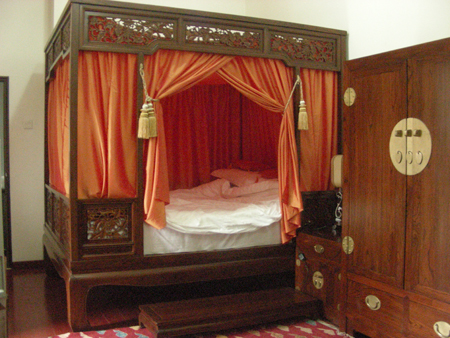
I had thought that I would have an afternoon and evening to poke around Beijing, so had booked into what the English call “character accommodation”- a converted old courtyard house, the Beijing Sihe Hotel, in a hutong neighborhood near the city center. Instead I arrived sweaty and exhausted around 9:30 pm. So I got to be there less than 12 hours, but what a wonderful place! I found them through http://www.tripadvisor.com, my go-to site for hotel/trip recommendations. They rate higher than a lot of the big, luxury hotels and the staff was great! Check this out-
Door to my room at the Beijing Sihe HotelView from my roomMy bed, no fooling
Back to the Beijing Capital Airport the next morning, through the worst smog I have ever seen. So much for those blue skies we all saw during the Olympics. On the other hand, the new airport terminals for international flights are utterly mindblowing, especially compared to what one had to deal with before. Whatever else, as far as I’m concerned, if the Olympics had done nothing other than prompt construction of the new terminals, that alone justifies awarding the games to China (but don’t get me started on Tibet).
On the way to the airport
Flight from Beijing to San Francisco and from there to home were delightfully uneventful. I’ve spent the last few days catching up, unpacking, cataloging the 2300+ images I shot, etc. Next week, it’s back to the easel!
Arrived in Ulaanbaatar yesterday afternoon. Managed to get together with a couple of the Mongolian scientists that I met on the Earthwatch project in 2005 and got an update about what is happening at Ikh Nartiin Chuluu.
And….had a hoped-for email from my husband informing me that I have had two paintings accepted in the Society of Animal Artists show “Small Works, Big Impressions”! One is of two young marmots and the other is of a takhi mare and foal. The show will be at The Wildlife Experience in Parker, Colorado, which is just south of Denver. More after I get home.
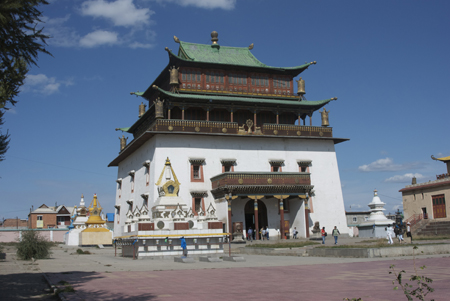
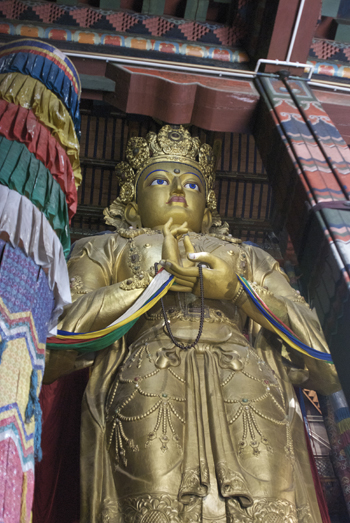
But first, the day before my husband, David, left for home, we walked up to Gandan Monastery and around the downtown. There are more monastery photos on my website but the last time the main temple building was closed. This time we were able to go in and see the gigantic statue of Buddha.
Main temple, Gandan MonasteryBuddha statue, which is almost as tall as the building
David flew home on the afternoon of the 14th after I had left for Ikh Nart. Colleen, the other artist who accompanied us for part of the trip, and I spent the first day trekking around the reserve. We went out with the driver the second and third mornings. The afternoon of Day Two, two busloads of 26 Swedish tourists, who had come from Moscow via the Trans-Siberian Railway, arrived for a couple of nights, so things were very lively. Here’s a selection of images from Ikh Nart, trip 2-
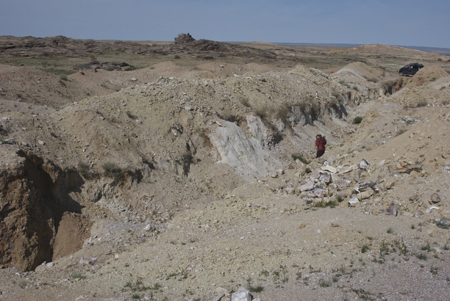
Open pit gem mine
One of the conservation challenges the reserve faces is illegal mining for gems like amethyst. The addition of more rangers has mostly stopped this kind of thing, but the damage remains and will have to be repaired as funding allows. That’s Colleen in the trench for scale.
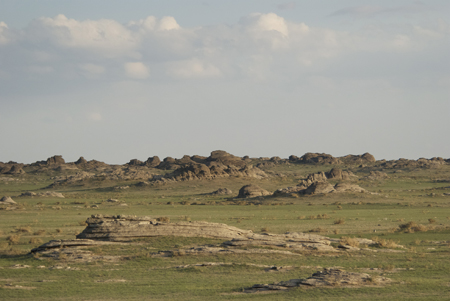
Rock formations
On the other hand, this is the kind of thing, besides the wildlife, that makes Ikh Nart special, the amazing rock formations.
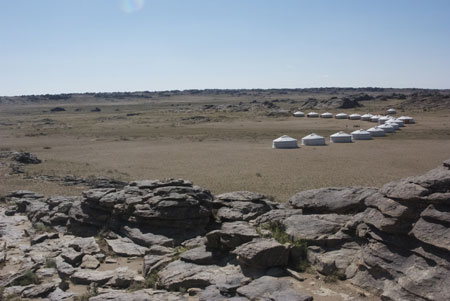
Rock formationView looking south from campArgali sighting
Saw very few argali. They were clearly elsewhere, as were the herder families. The rains didn’t come when they were supposed to, so everybody left. Then it rained like crazy, as described in a previous post, and things greened up. It looked like some families were coming back as we left.
Horses near the ger camp
I thought that that’s what seeing these horse meant, but learned last night that the herders take their sheep, goats and camels, but leave the horses on their own. Looks like they’re doing ok to me.
The reserve faces a number of threats, including overgrazing and climate change, so the challenges exist on a micro and macro level. At one time the grass came up to the bellies of the cows. I hardly saw any grass. It is being replaced by “forbs”, perennial plants, some of which is edible by livestock and some not. I have no idea what the possibility is of reversing this, if it can be done at all. Climate change may trump everyone’s efforts. So, the work then will be to help the country people adjust to the new reality. I don’t know what the prognosis is for the wildlife. The argali seem to be holding their own, so far, which is good.
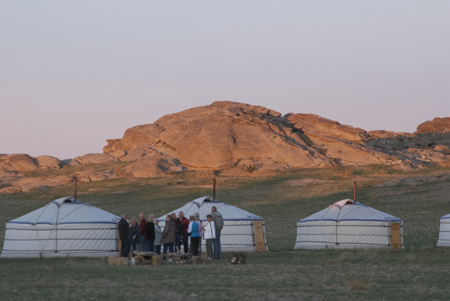
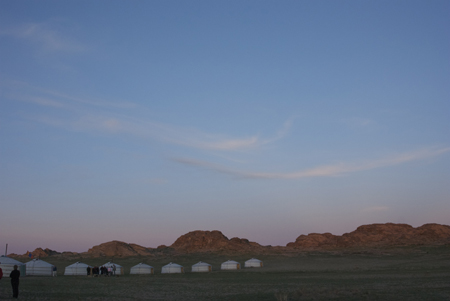
One of the things I love about Ikn Nart are the sunrises and sunsets on the rocks. So, to conclude my Mongolian trip blog, here’s a couple of final images from one of my favorite places in the world.
Sunset with SwedesSunset over the ger camp
Thanks to all of you who followed along and left comments. I had no idea whether this would work or not and I’m glad it did. It’s pretty amazing when you think about it. Not that long ago, just making an international phone call from Mongolia would have been a challenge. Now Mongolia is as connected to the rest of the world as the USA. Most Mongolians can’t afford their own computers yet, but there are lots of internet cafes to provide access
I fly to Beijing tomorrow, stay overnight and then home. Hope to be back at the easel after catching up on mail, petting the cats, kissing my sweetie, etc. Oh, and getting at least the basic cataloging done on the over 2300 images I’ve shot. I can hardly wait to get painting again!
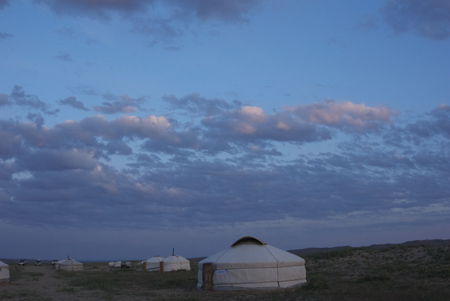
Back at the Bayangol Hotel this afternoon. I’m sorry we didn’t get to western Mongolia, but our time at Arburd Sands was fantastic! The ger camp is owned by a local herder family and is located amongst a 20 km long stretch of sand dunes, which form a sort of northern border to the Gobi. The head of the family, Choidog, is one of the most famous and honored horse trainers in the country. His 40-something son, Batbadrach, won the national Nadaam horse race two years running when he was 8 and 9 years old. They currently have around 300 horses.
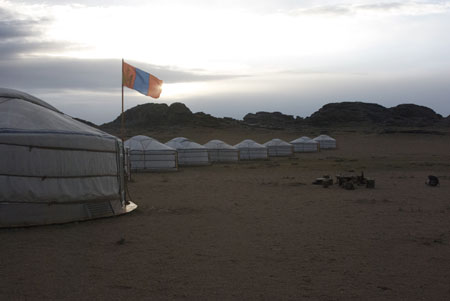
Arburd Sands ger camp at sunrise
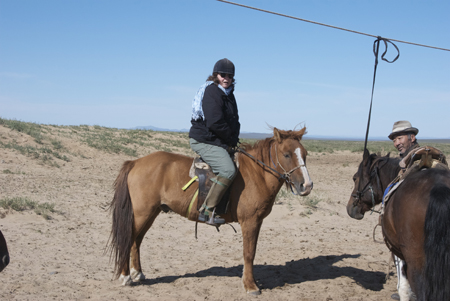
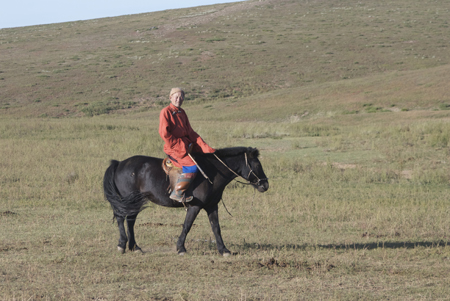
The ger camp is pretty laid back. Activity options include trekking around the dunes and surrounding countryside, horse riding and camel rides. David and I opted for a one hour horse ride the first day (and a camel ride the second). I asked about the Mongolian saddles and it turned out that they had a modified one for me to use. It didn’t have the big silver studs on the sides of the seat, but did have a thin felt pad. Otherwise it was basically the same saddle the Mongols have used since the time of Chinggis Khan. And it wasn’t uncomfortable at all for just a hour, even given that I have hardly ever ridden a horse. So, here’s David and I, ready to ride. It was great!
David on Mongolian horseMe on Mongolian horse
My horse, who has no name except maybe “Brown Horse”, and I did quite well. He was willing to trot and was easy to “steer”. I had sat on horses while they moved a few times in the past. This was the first time I ever felt that I was really riding. I was able to stand in the saddle a few times to see what it felt like since the Mongolians ride that way from childhood. They must have thighs of steel. The stirrups are tied together under the horse’s belly, which does make standing quite a bit easier than it would be otherwise.
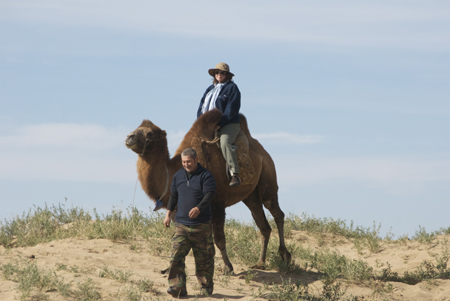
The herd of bactrian camels, which belong to other local families and our camp hosts Batbadrach and his wife Desmaa, numbers around 30. Some are trained for riding. Others pull carts loaded with camping gear. All but one of the riding camels were out on a trek with other visitors, but we got to take turns riding him. It was just as much fun as in 2006. Photo by David.
My 2008 camel ride
The herd tended to be around camp in the morning and late afternoon, so I got lots of pictures of them in great light. Here’s one:
Bactrian camels, Arburd Sands
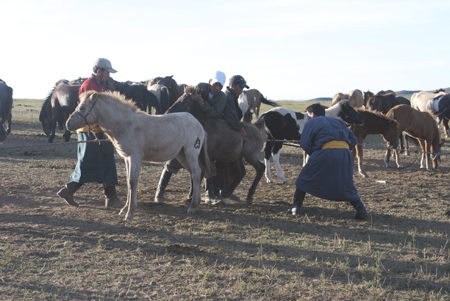
Yesterday morning, we were asked if we would like to go to an annual family event, the branding of the year’s foals. Of course we said yes, but not knowing what to expect. What we got was one of the reasons why travel is so worth the time, money and intermittent hassle- being present at something that was not a set-up for tourists, but getting to share part of a Mongolian country family’s way of life that has continued without interruption for over a thousand years. I was able to record it all and have some of the best photos I have ever taken. Here’s a few highlights:
Foals lined up for brandingCatching foal with urgaaBatbadrach branding foalAirag and vodka ready to imbibeChoidog, Lhamsuren, Sodnam, Surenjav
I had asked to take the women’s picture at the after-branding party and Choidog got up from his spot on the floor and joined them, putting on his hat, which was presented to him by the president of Mongolia and has a silver horse on the top. I looked through the viewfinder and it was a total National Geographic moment. Even now, looking at it on this post, I can hardly believe that I was so fortunate to have taken this picture. I’ll be sending copies to all of them. Sodnam is Choidog’s sister, Lhamsuren is Batbadrach’s mother and Surenjav is the mother of one of Batbadrach’s friends and also his brother’s mother-in-law. It’s a big family. Desmaa couldn’t tell us how many grandchildren Choidog has.
Choidog's favorite place, on his horse
To conclude- at the ger camp for the first night was a Swedish travel writer named Steven. We all sat together for dinner and had a great time exchanging stories. He had come to Mongolia by way of the Trans-Siberian Railway. The next day he was asked if he was going to come back to Mongolia. He said yes in a very strong, definite way. I asked how long he had been here. He replied “Four days”. Yup, he’s got it bad, just like me.
So we were sitting in the lobby of the Bayangol and who should walk in but Baaska, who was my guide for the Gobi and Ikh Nart legs of my trip in 2006! One of the nicest surprises I could have had. And, and to top it off, the driver was Omroo, who was my driver in the Gobi. Perfect. Off we went.
It turns out that the paving has been torn up for replacement on the regular road and it’s a dusty mess, so we went literally across country on the dirt tracks, so I got to see a part of the area that I hadn’t before.
Hustai ger camp at park headquarters
We arrived late afternoon, got settled into our ger and had a nice dinner in the dining hall. The other artist who was joining us for the rest of the trip came in and we all met for the first time. She had come over earlier to participate in the eco-volunteer program that Hustai runs. The volunteers are trained and then help with the on-going research of the takhi reintroduction. There are now well over 200 horses.
Hustai takhi harem, late afternoon
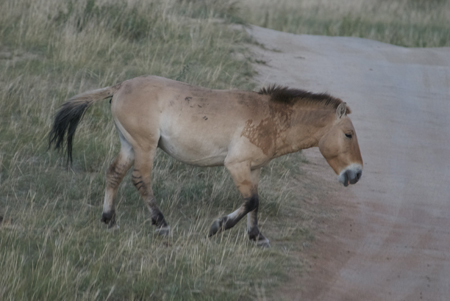
We spent the next three days driving through the park in the morning and afternoon viewing the horses and I got lots of great reference photos. There are now 24 harems in the park, up from 15 the last time I was there. The stallion with the biggest harem has been named Temujin, which was Chinggis Khan’s birth name. We got to see him and his “girls” late one afternoon. Here’s a closeup of a takhi we saw, but you’ll have to wait for the painting to see Temujin.
Hustai takhi
We were also able to tour around to see a Buddhist ruin, a Turkic grave site and a deer stone.
Bronze Age deer stone; deer help souls go to the sky after death
It turned out that there was a science conference at the same time we were there and loads of other visitors, so the park was really busy.
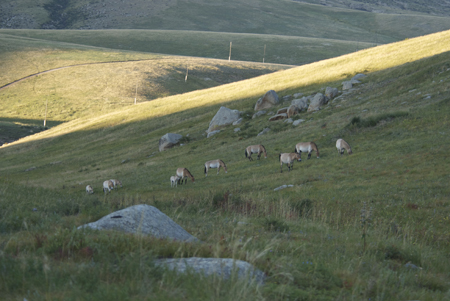
We came back yesterday afternoon across country again, but by a different route and had a lovely picnic lunch by a stream lined with willows. There were also some Mongolian horses nearby and I was able to get some excellent photos of them that I’m really looking forward to painting.
We’re now in UB for the day, leaving for Arburd Sands ger camp tomorrow. Internet availability is turning out to be “interesting”, so I may not be back on until the 12th. But it’s being quite a trip and these posts are only hitting the highlights.
Back in the room after dinner and wanted to post a few images from today. This is the first time that I have taken my laptop on one of these “adventure” trips and, with David to sort out the technical issues, I’m able to blog, check email and follow the news for the first time. Tomorrow afternoon we go out to Hustai National Park, about two hours from UB. Then we’ll have three days to watch the takhi (Przewalski’s Horse) and tour around the area. Although there will be electricity available in the gers, there is no internet connection. In fact, the park has no phone, but uses a radio to communicate.
We walked up to the Nomadic Journeys office this morning and got some trip details sorted out, then went to Le Bistro Francais for lunch. Chicken in white sauce and Mongol beer for two. Afterwards, we walked over to the Zanabazar Art Museum, which had been closed my last trip. Zanabazar was a Buddhist monk who created extremely fine bronze sculptures of Buddhist manifestations like White Tara and Manjushri. He is a national hero to the Mongolians. Unfortunately, the sculptures are under glass and I couldn’t get decent photos, but there are some on the museum website http://www.zanabazarmuseum.org/.
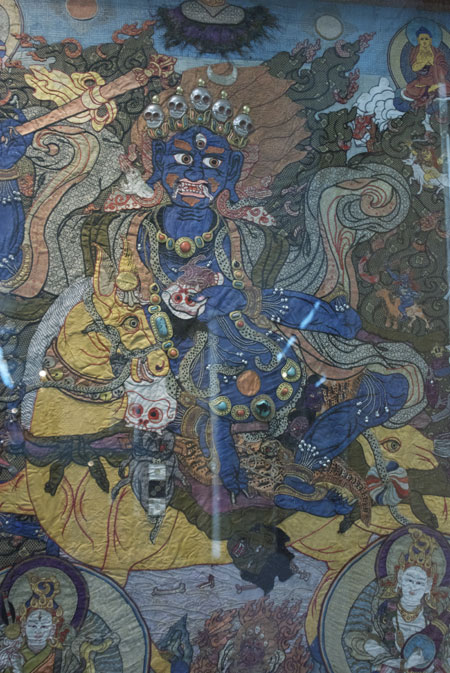
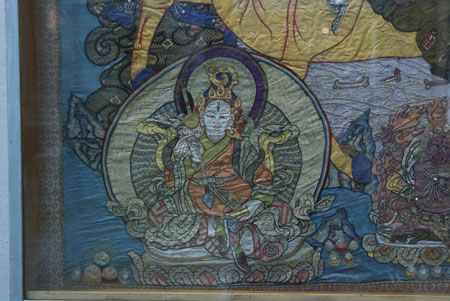
I did get some images of one of the incredible cloth applique thankas. I’ve done various kinds of embroidery for years and have never seen anything like this. The streak is a light reflection in the glass.
Applique thanka
And a closeup of the figure in the lower left hand corner.
Applique closeup
Downstairs at the museum is the Red Ger Art Gallery, where one can find contemporary Mongolian art for sale. We bought a couple of pieces of original calligraphy, including one that says “Chinggis Khan”. And then there were “the horse shoes”…..around $300 for the set. I did say that the Mongolians are a horse culture, didn’t I?
Finally, some of you may have heard of “Engrish”, which is the term given for writing that closely resembles but doesn’t exactly cut it as standard English. Product directions are notorious in that regard. Then there is this notice in the elevator at the Bayangol-
Bayangol elevator sign
So, before I commit an improper purpose I’ll sign off and hope to come back with tales of Hustai takhi.
We left the hotel on time, a quick stop by the Nomadic Journeys office, and we were on our way. All the way to the edge of UB, where we pulled into a gas station because….a hose had split. Cell phone call went out to the driver’s son. Two attempts to epoxy it back together. Wouldn’t hold.
Can we fix it?
So we swapped cars with the son, who drove us to Ikn Nart in record time in order to get there before dark. The camp cook who was with us knew the way, which was good, since the dirt track in only had some rocks with rough arrows on them for direction. We arrived to a beautiful warm summer evening. Balmy, in fact.
At around 3:30am, David heard the camp guys outside the ger, pulling the top cover closed because of howling wind and rain. For the next 26 hours, on into the following night, it almost never let up. The toilet was around 50 yards from the ger, so we just changed back into the wet clothes when we needed to go up there. I was still feeling punk from the cold I wasn’t quite over with when we left, so a day of enforced rest wasn’t entirely a bad thing.
It wasn’t particularly cold, but as the day wore on, we saw damp areas start to appear in the cloth covering that faced the wind. Finally some water started to drip in in spots. The gers are covered with what our guide called “Russian canvas” for waterproofing and it mostly worked. Tuya, our guide, came back to the ger to chat after dinner and we could see that it was getting worse and worse. One of the camp guys came in and said that one of the other gers was dry, so we pulled together our stuff in about a minute and moved. A fire was quickly lighted in the stove (wood and dung) and we settled in for the night without any idea of how long the storm would last. For all we knew, we had driven six hours to sit in a ger for three days.
But the next morning was sunny, cold and windy and we went on our first trek after breakfast. Amazingly, we encountered the ranger who I remembered from the Earthwatch project from 2005. He had been out all night in the storm and had lost 10 sheep and 3 goats, which we calculate was about 15% of his animals.
By afternoon, it was warm, sunny and blue skies and the same the next day. Here are some photos from the rest of our stay. We came back to UB yesterday and are at the Bayangol Hotel. It’s now 10:30am Tuesday morning and we are headed out to wander around and museum hop. More this evening (my time). Also, I’ve inserted some photos in the previous posts.
Before the stormRed Rock Ger CampMaikhant helping sheep after stormHorses grazing near ger campArgali, what I came here for mostlyDavid enjoying the sun in front of our gerMe and the cook's kitten
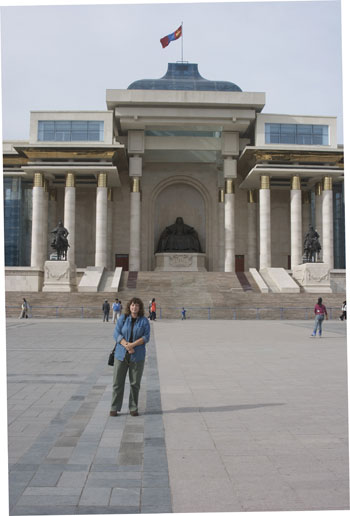
We made it! Our flight from Seoul was rescheduled to the following day due to high winds in UB. (Luggage drama story to come). So, instead of arriving Monday, we arrived Tuesday. Yesterday, Wednesday, was spent sorting out the intinerary with Jan at Nomadic Journeys for a variety of reasons I’ll go into later since I’m on battery power at the tour office right now since the internet connection was down at the hotel. We did get out in the afternoon and walked to Sukhbaatar Square and saw the new improved Government Building that now has an incredible Mongol facade with a huge statue of Chinggis Khan. I’ll post photos later if I can.
UB is looking noticeably spiffier since I was here two years ago. More prosperous, too. We are staying at a hotel called the Bishrelt Plaza. Very friendly staff, good food in the restaurant, room big, a little tatty around the edges but perfectly useable and there were renovations going on while we were there.
It is now 10:15am on Thursday, August 28. At noon, we leave for Ikn Nartiin Chuluu. Back to UB on the 2nd.
Weather yesterday was sunny and warm. Today cloudy and warm.
It’s great to be back and less than two hours from the trip really getting under way.
In front of the Chinggis Khan memorial, Sukhbaatar Square, Ulaanbaatar






















 Susan Fox, American Artist
