Mongolia Monday- New Gear for Next Trip

As promised last week, here’s look at two items I recently purchased for my next trip to Mongolia. In both cases, they are “upgrades” that I hope will perform and function better than what I’ve used in the past.

First up, my new camera/day pack. I’ve used a good sturdy general purpose daypack from REI for quite a few years and it did what I wanted until I got a MacBook Pro which is larger than my old IBM x31. I solved that problem with a messenger bag from Timbuk2 that I reviewed here last year.

The cameras fit in the old pack, but had to be put into it vertically side-by-side with some kind of cloth wrapped around one to keep them from banging together. Not very satisfactory. And it got worse when I was able to upgrade to a Nikon Nikkor 80-400mm lens last year which is much longer and bigger in diameter than my old zoom telephoto. The jury-rigged set-up even made my guides nervous.

I started out looking for a pack which had the depth and padded dividers that would let me safely carry the two cameras as I had before. On the road, the pack is on the floor at my feet so I can grab either body in a hurry or zip it up and go without a bunch of fussing around.

I searched the internet and found a couple of possibilities, but realized that the only way to know for sure was to take both cameras to my local camera shop (Swanlund’s) and see what actually worked. And, as it turned out, the one I’d thought would, didn’t. But the young guy who was helping me, all of five days on the job, pulled a KATA pack off the wall and handed it to me. I’d seen the brand when I was looking on the web, but knew nothing about them. Turns out they’re an Israeli company which specializes in “Protective Carrying Technology”, which means gear bags and bullet-proof coats that can literally go into a combat zone. Might be, uh, overkill for my purposes, but I did want something that will protect my cameras.

So I sat on the floor with both Nikons and their lenses and a Digital Rucksack DR-465. What the young sales guy pointed out was a top compartment which would hold one camera and a bottom compartment with zippers that slid back far enough that I could get the body with the 28-300 lens in and out easily. And he was right.

There’s a loop on the back for a tripod and a zippered net pocket on one side for a water bottle. There are three zippered storage pockets in the front and the top compartment has a pocket along the back that will hold pens, notebook, cellphone, etc. The bottom compartment has a re-configurable or totally removable padded divider. Included is a rain/dust cover that comes in its own bag.

The inside is a lovely goldenrod and it has a purpose. It’s a color that will make it as easy as possible to find whatever is in the pack when it’s dark. Really dark.

The company points out in its literature that it doesn’t look like a camera bag, which is true, and that’s not a bad thing at all. The straps feel like they are well-designed ergonomically and will be comfortable with a full load hiking in the field. So, all in all, I think I’ve got a winner here. I’ll know for sure by the end of the first round of travel in the countryside.

KATA Digital Rucksack D-R 465, without cameras
KATA Digital Rucksack DR-465- with cameras

I’ve also gotten a new jacket. I needed something less bulky than the reliable old Travel Smith jacket I’ve used since 1999. I wanted wind and at least a little rain resistance. The weather in Mongolia is very changeable and one needs to have good outerwear.

The best deal in my price range (pretty low) was an REI Windbreak Thermal Jacket for $89.95 (and I had a 20% off coupon),which they describe as their warmest wind-blocking fleece. They claim it will do the job in up to 50mph winds, which ought to be sufficient. It also has a water repellent for light rain. I have a poncho already for real rain, a certainty if Mongolia has a normal summer. The exterior pockets zip up and there are also large pockets on the inside, which I think will be handy.  The styling is such that I can wear it around UB and not look like I just crawled in from the Gobi.

I’ve been wearing it every day when we go out to walk the dog and, so far, I like it a lot. But, once again, field use will tell the tale.

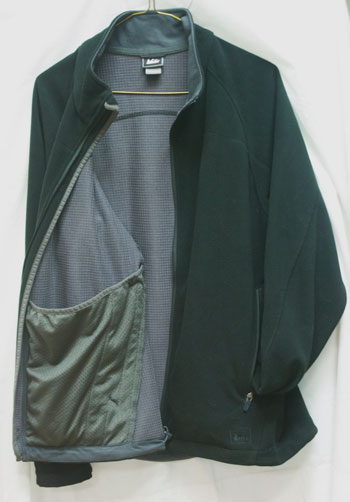
REI Windbreak Thermal Jacket

Just got an email from Amazon that my order from them has shipped. More camera batteries, a new option for back-up and a little indulgence that I’ll reveal next week, if it works.

Mongolia Monday- Next Trip Coming Up Soon!

I’m now one month from departure for my next trip to Mongolia. I don’t have a specific itinerary yet, and probably won’t until I arrive, but here’s some of the things I hope to do and see this time around:

A nice little serving of buuz

-I’m one of the administrators for a Facebook fan page called “Buuz”, which are dearly beloved steamed meat dumplings. Mongols make and eat zillions of them for Tsagaan Sar, the Mongol New Year. When you ask a Mongol living in another country what they miss most, “buuz” is often the answer. We have over 700 fans now! And it turns out that the person who started the page, an Italian guy who is married to a Mongol woman, is going to be in Mongolia the same time as me. So we’ve announced a get-together for “Buuz People” in Ulaanbaatar on July 13 at the (no fooling) Grand Khan Irish Pub. Who knows who will show up, but it should be fun.

Yaks, Gun-Galuut July 2009

-It appears that the first weekend of August that there will be a Yak Festival somewhere in the Khangai Mountains west of Ulaanbaatar. Now, how could I miss that?

Horse race finish, National Naadam July 2009

-I would like to get to a number of Naadam horse races, both the national one and at least one or two local ones to get more painting reference. I also want to get a lot more photos of the herders and their horses.

Closeup of Chinngis Khan statue east of Ulaanbaatar July 2009

-There’s not much left of the ancient Mongol capital of Kharkhorin. It was sacked by a Ming Dynasty army and then most of the remaining stone was used to construct Erdene Zuu Monastery. I would like to visit both.

Tahki mare with two foals, Hustai National Park Sept. 2008

-For wildlife watching this trip, I want to go back to Hustai National Park and see the takhi in the summertime. I didn’t have time to go there last year. And I plan to return to Baga Gazriin Chuluu Nature Reserve and Ikh Nartiin Chuluu Nature Reserve for argali, ibex and whatever else comes within camera range.

I’m tweaking my equipment for this trip and will cover that in future posts. At the moment, I’ve gotten a new wind and moisture proof fleece jacket from REI that I really like so far and a new Kata daypack for carrying my camera equipment in the field. More on both next week.

New Painting! “Mongol Horse #5-Evening Run” (Step By Step)

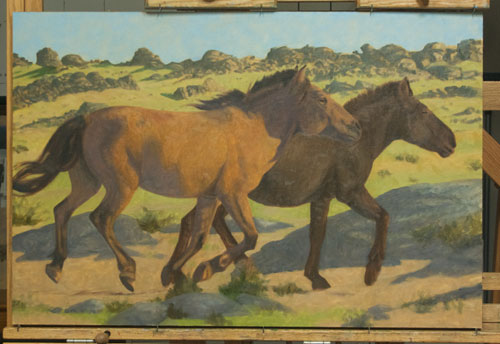
Mongol Horse #5-Evening Run 24x36" oil (price on request)

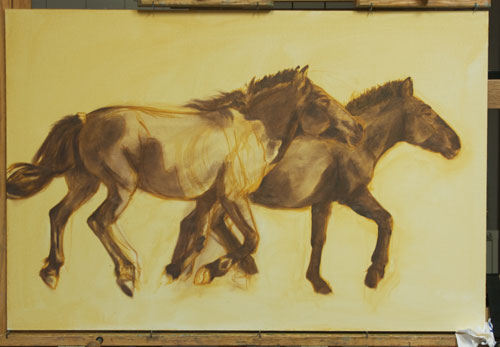
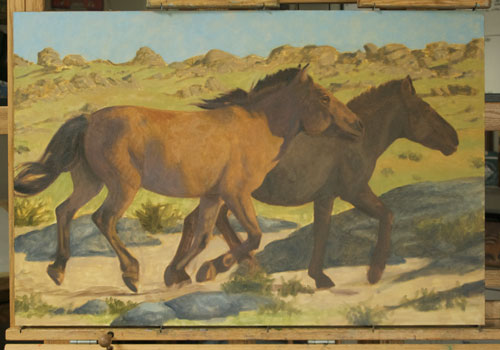
I was at Ikh Nartiin  Chuluu Nature Reserve in Sept. of 2008. While sitting outside my ger, a small herd of local horses came wandering by. It was early evening and some of them were feeling frisky, like this stallion. I loved the quality of light on his reddish coat. The background shows some of the fantastic rock formations at Ikh Nart, which provide habitat for argali sheep and Siberian ibex.

Here’s the step and step creation of this painting:

The brush drawing start
Laying the shapes of the shadows
First indication of the background
Shadow shapes for background elements
First pass of color for sky and ground
Progress on the horses
Light and dark sides established for rocks
Approaching the finish
The finished painting

Mongolia Monday- A Day of Remembrance

In the United States today, it is Memorial Day, when we honor those who have died defending our country. There will be ceremonies, services and gatherings all over America in commemoration.

I read recently that the Mongolian army has, for a number of years, held military exercises and served as UN Peacekeepers alongside American soldiers. I hope that the relationship has been beneficial for both. One article, with some great photos, described how the Mongolian contingent in one country invited the Americans to celebrate Naadam with them. It was pretty obvious that a good time was had by all.

So I would like to extend my thoughts not only to the Americans soldiers that we remember today, but also the Mongolians who have given their lives for their country, with wishes for peace and strong friendship between our countries for many years to come.

Mongolia Monday: Boroo (Rain)

Mongolia gets very little rain and most of what does fall comes in the summer. After the brutal winter zud (a drought year followed by an extremely cold winter with heavy snowfall) that hammered the country these past months, a year of good rainfall would be a blessing, indeed.

Being a herding culture, the Mongols have always depended on rain to grow the grass they need for their animals. The rainy season is short, so I suspect that as wonderful as a Mongolian summer is, it’s also a time for some anxiety.

In 2008, rain came late, at the end of August. My husband and I were at Ikh Nartiin Chuluu Nature Reserve. We arrived on a beautiful evening. It started to rain at around 3am and didn’t stop for 18 hours (we counted). But we had perfect weather for the rest of the trip.

In 2009, on my Artists for Conservation Flag Expedition, it was definitely the rainy season, even though there wasn’t enough to break the drought.

Here’s a few of my favorite “boroo” photos. (Note: “Boroo” is pronounced more like “baurau”, with a rolled “r”.)

Naadam opening ceremonies, July 2009; the colorful show goes on for everyone, including the Mongolian State National Grand Orchestra
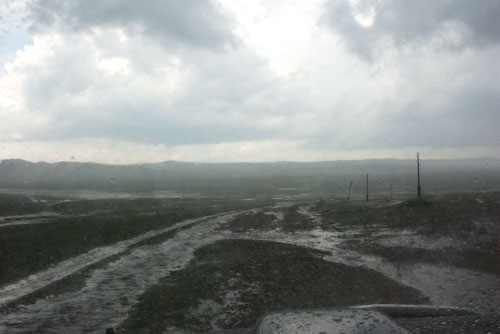
Heavy rain/hail en route from Ulaanbaatar to Arburd Sands ger camp, July 2009
One of the hailstones; roof of vehicle was dented
On-coming rainstorm at Ikh Nartiin Chuluu Nature Reserve, July 2009; it rained hard for an hour and a half so I just stayed in the cozy ger; the white rectangle in the background is one of the toilet enclosures. Yes, it was a bit of a walk.

Rain has, so to speak, seeped into the culture to the point where it’s a leitmotif in many of the music videos I’ve watched and clearly has romantic connotations. Sometimes it seems like there has been an informal competition between groups and singers to see who can work the most rain into their video.

Here is one from Javhlan. Imagine this singer with an absolutely glorious voice, standing in the woods singing as the crew poured “rain” onto him. I’ll bet he only needed one take.

And, taking it even further, is A Capella’s “Boroo”. Hope it was a warm evening.

Finally, instead of a set-piece like the previous two, Guys 666, who normally seem to be hard rappers, did this video, also called “Boroo”, that tells a story, albeit not an entirely happy one.

Mongolia Monday: Teaching Myself Mongolian

Today I thought I would share how I’m studying to learn Mongolian. I had two years of German in high school and before that, had had some private lessons in Japanese before a trip that my mom and I took with two other couples to Japan in 1968 when I was fourteen. That’s pretty much the extent of my foreign language experience. (Trying to teach myself Welsh was a non-starter and I don’t know that learning to read the Canterbury Tales in the original Middle English counts)

Before my second trip to Mongolia in 2006, I decided that I both wanted and needed to learn at least a little of the language since I was going to be traveling on my own for over three weeks with only Mongolian guides and drivers. The guides, at least, speak decent English, but I was going to be finding my way around Ulaanbaatar on my own part of the time.

The first sign I could read; the ubiquitious "KHAN BANK"; Hovd,Sept. 2006

I advertised in our local news/art/culture weekly for a Mongolian tutor (in rural Humboldt County, California?) and, guess what, I got a phone call within two days. Seems a woman from Mongolia, who had met and married an American guy who was there serving in the Peace Corps, was at a party with her husband and a number of people asked them if they had seen the ad.

It turns out that she had only been in this country for a couple of months, so her English was still very uncertain. He called me and we set up a meeting between her and I. It went well and we were able to get together about a half dozen times before I left. Even better, we’ve stayed in touch and become friends with them.

She drilled me in basic pronunciation, got me going with some basic vocabulary and taught me necessary phrases like “hello”, “thank you” and “I’m from California”. Her husband contributed a word to use if someone hassled me- “Yasambay!” (sic), which means “What are you doing?”, the idea being that the person would be so shocked at hearing Mongolian from a non-Mongol that he/she would immediately stop whatever they were doing. As it happens, I’ve had no occasion to say it so far.

That tutoring, plus a copy of the Lonely Planet phrase guide for Mongolian is what I had until last year.

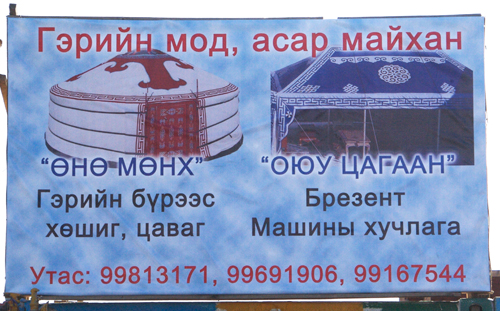
Banner for tent sales, Narantuul Market; Ulaanbaatar, May 2005- top line: "GERIIN MOD, ASAR MAIKHAN" - Geriin is, I believe, the possessive of ger, the felt "tents". Maikhan are the summer tents; "ONO MONKH", followed by "GERIIN BUREES KHOSHOG, TSAVAG"; OYUU TSAGAAN", followed by "BREZENT MASHIN KHUCHLAGA"; last line "UTAS", "Call:"

After sitting mute, and depending on a translator, during my three days of meetings with the herder women in July of 2009, I decided that it was time to get serious. While I was in Ulaanbaatar I bought Mongolian-English and English-Mongolian dictionaries.

When I got home I started to comb the web for a language program and found one from Transparent Language. (None of the other major foreign language companies offer Mongolian as far as I can tell). It is based on word lists that are viewed on “cards”. Each word is in Mongolian Cyrillic and and a transliteration into the Latin alphabet. One can also listen to a male native Mongolian speaker and repeat back each word. It even lets you slow down the speaker so you can hear the word better. There are a variety of other activities like typing out the words and some simple games.

I had also bought a small stack of music CDs and rapidly realized that I could use them, too. The perfect two-fer, listen to cool pop and rock music and study Mongolian at the same time.

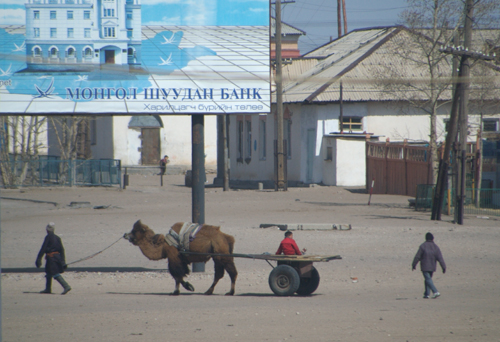
Billlboard; taken from train on the way to Ikh Nartiin Chuluu, April 2005 (I may have started to fall in love with Mongolia at this point, seeing the bactrian camel cart)- "MONGOL SHUUDAN BANK"

But I was still struggling to get anywhere. As it turns out, my husband had to learn Russian when he joined the Air Force (and if I say any more, I’ll have to kill you). He told me the first thing he and his classmates had to do was memorize the Russian alphabet overnight. He suggested that I back up and learn the Mongolian cyrillic alphabet. I managed that in a few evenings and suddenly it got a little easier.

I’d started to “collect” words, writing them on a pad of paper. That reached its limit of practicality pretty quickly. I bought a copy of Bento, the consumer-level database program for the Mac and created my own word list, which is divided into categories like English, Mongolian, part of speech and subject (animal, food, furniture, etc.). I can sort my list by any of them, which is very useful and why I bought a database. It will be on my laptop, which travels with me, but I’m also going to print it out in each category to have handy in the car or when I’m walking around.

Recently, a commenter on another post told me about Anki, a downloadable program that generates “cards” with whatever content one wants like, say, Mongolian words. This is the same model the Transparent Language package, Byki Deluxe, uses, but those are pre-set. I’ve downloaded Anki, which is free, but haven’t had time to mess with it.

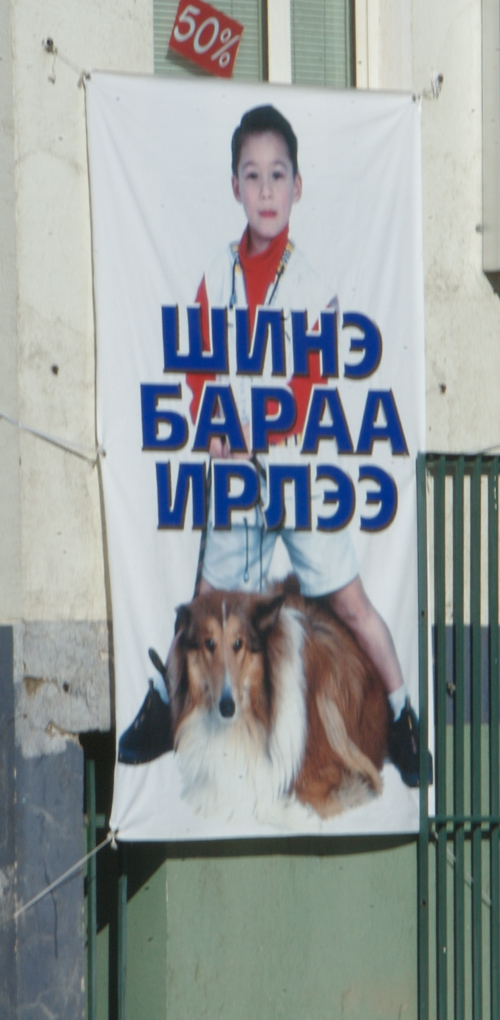
Well, that banner was a surprise. Are there actually any collies in Mongolia? I have no idea. Ulaanbaatar, Sept. 2006- "SHINE (new) BARAA (merchandise) IRLEE ("has arrived", I think it means)"

Then a French Facebook friend (say that fast three times) told me about PowerWord, which includes Mongolian as one of their offerings. So, for $8.99, I now have a Mongolian language program on my iPhone, too. It is also based on word lists, like Byki, but so far I think I like the way it’s organized better. It also has a spoken component, this time with a female voice.

Of course, the best and fastest way to learn will be immersion in the language once I get to Mongolia. But I hope I’ve “primed the pump” for rapid progress with the study that I’m doing before departure.

Chinggis is everywhere; Ulaanbaatar, Sept. 2006- "ENERJI"; the lines above and below the main word are in a script that I can't quite figure out for every letter. The block lettering is easy by comparison.

Comments and corrections welcome!

Mongolia Monday- 6 Things I Haven’t Seen Or Done In Mongolia. Yet.

It’s the last installment of my six part series. This week it’s going to be what I haven’t done yet. Of course, it’s an endless list, even for one country, because there’s always something new crossing one’s radar. But I wrote down the first six thoughts that came to mind and found that I do have a good list of things that I really do want to do or see and that are reasonably achievable.

Not having done them yet, I don’t have images. But I’ll share some which I took on previous trips that are related and also have inspired my list.

1. Gallop on a horse across the countryside– I am not a rider, but I’ve always wanted to do this (maybe it was all the western movies I watched as a kid). I looked into it once and the riding teacher I spoke with said six weeks of lessons at least to get to that point. Needless to say that didn’t happen. But in Mongolia…..I trust the horses and the horsemen, so maybe it’s possible. We’ll see.

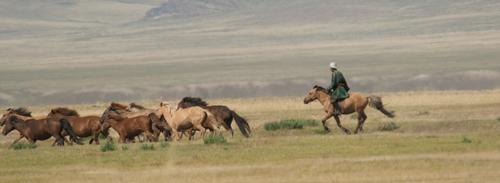
Herder with horses near Hustai National Park, Sept. 2008

2. Attend the Yak Festival– Now really, who could resist that? Not me, that’s for sure. My current understanding is that it was started by a dairy company and is held around the first weekend in August, which means I can probably go this year! According to the Wikipedia entry for “Yak Racing” the activities include “…yak racing and showing, wild stallion and yak rodeo riding, milking contests and other traditional Naadam events of horse racing, wrestling and archery.”

"Ride me? The heck you say." Yaks at Gun-Galuut Nature Reserve, July 2009

3. See Burkhan Khaldun– This is the sacred mountain where Chinggis Khan dedicated himself to Tenger, the Sky, went to pray and, on a few occasions, hide from enemies. It is still an important place in Mongol culture. I don’t know if non-Mongols are allowed or welcome onto the mountain, but I would like to see it.

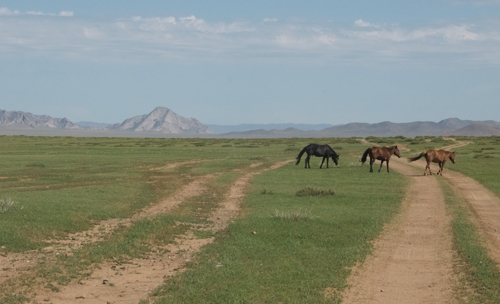
Tahilgat Hairhan in the distance; en route between Baga Gazriin Chuluu Nature Reserve and Ulaanbaatar, July 2009

4. Take a lesson in writing the ancient Mongol vertical script– Back in the 1970s and 1980s, I worked as a sign painter, graphic designer and calligrapher. I’ve always loved lettering and type. I spent a lot of time learning to letter with a sign painting quill (brush), along with pen and ink. “Oriental” brush lettering never particularly attracted me, however. Then I went to Mongolia and saw the vertical script, which Chinggis Khan adopted from the Uighar people because he realized that he couldn’t run his empire without a writing system. As you can see  below, it’s still in use today, 800 years later. And it’s stunningly beautiful.

One of the first times I saw the Mongol script; large banner on building across from my hotel, Ulaanbaatar, Oct. 2006

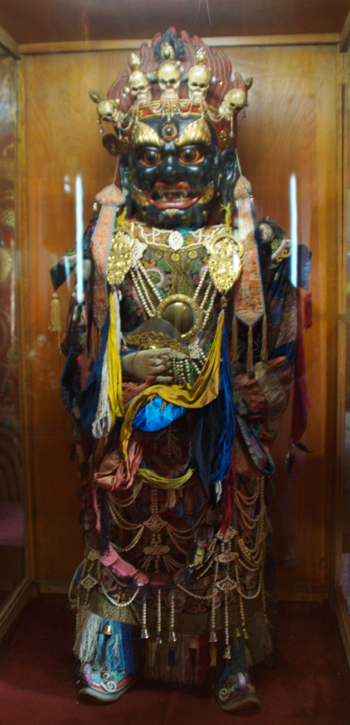
5. See Tsam Dancing– Today it’s a Buddhist ritual of relatively recent (late 18th century) origin, but it has it’s roots in ancient shamanistic beliefs. Basically an exorcism ritual, it has a set “cast of characters”. The fantastic costumes and masks must be seen to be believed. Fortunately, many of them are on display at the Chojin Lama Museum in Ulaanbaatar. When I saw them the first time, I was captivated without having a clue about what they were for. To see them in use would be wonderful.  For a fuller explanation, go here.

Tsam dance costume, Chojin Lama Museum, Ulaanbaatar, Sept. 2006

6. Hike in snow leopard habitat-Which is a lot more realistic than saying “see a wild snow leopard”.  There are between 500 and 1000 snow leopards in Mongolia, according to the Snow Leopard Trust. Their habitat covers over 100,000 sq. km, so obviously the odds of seeing one are really slim to none. But one can get out into the mountains where they live.

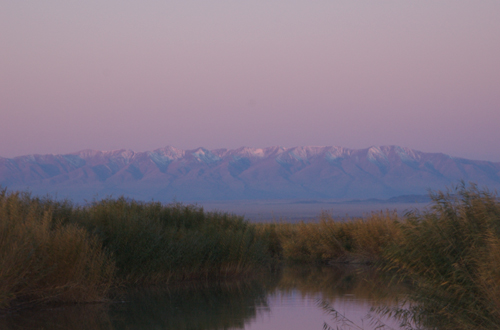
Jargalant mountain, a far eastern spur of the Altai Mountains, Sept. 2006

Major Juried Show News! Accepted Into Art And The Animal!

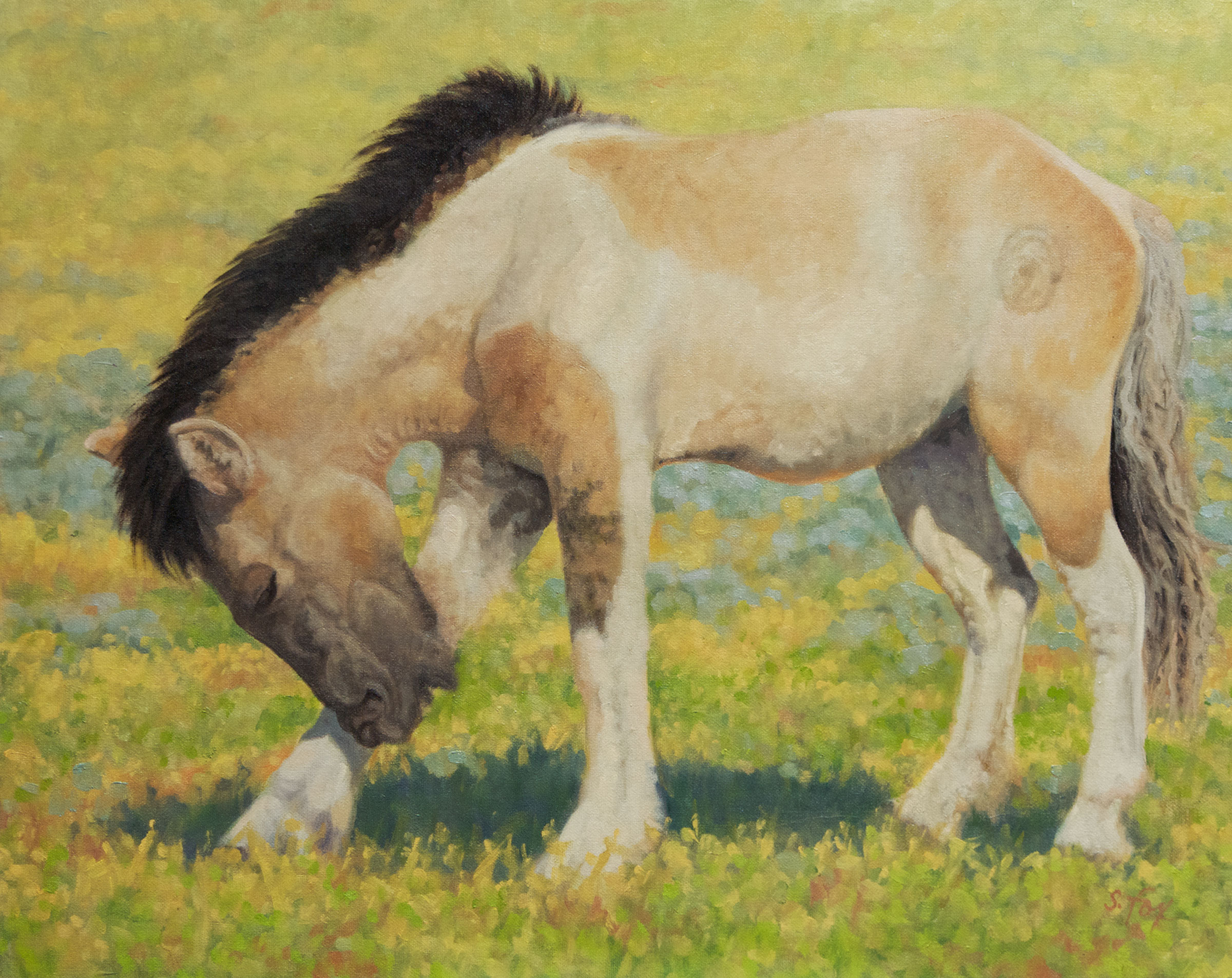
I received word this afternoon that my painting “Mongol Horse #3-Young Stallion” has been accepted into Art and the Animal, the prestigious 50th Annual Exhibition of the Society of Animal Artists. This is the second year in a row I have had work in the show. Last year it was bactrian camels, the detail of which is currently on my masthead.

I’ll be at the opening weekend of the show, which will debut at the San Diego Natural History Museum the first weekend in September. More later….

Mongol Horse #3-Young Stallion 16x20" oil on canvasboard

New Painting! After the Race; Scraping Sweat

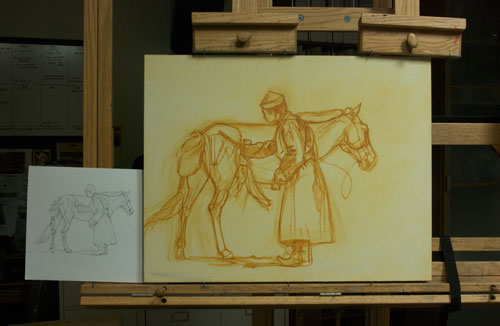
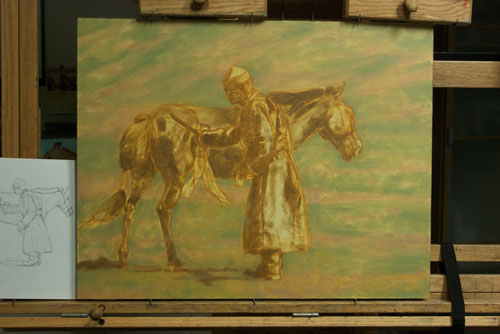
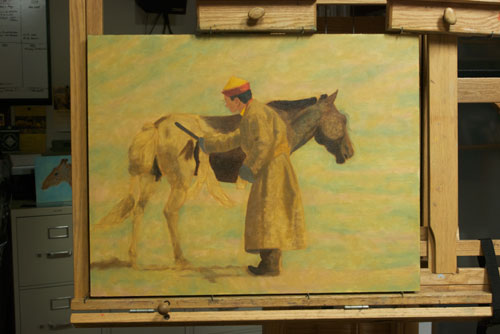
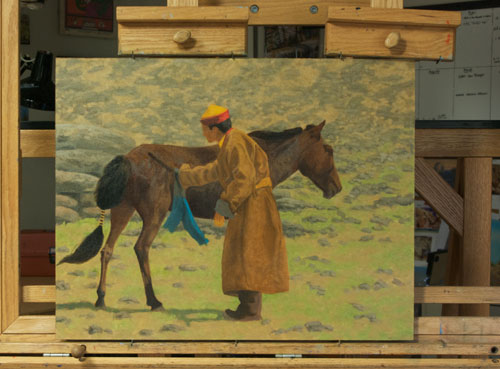
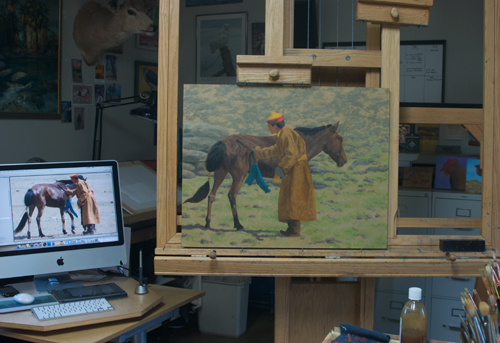
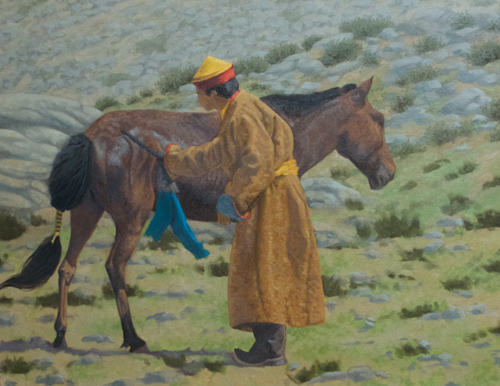
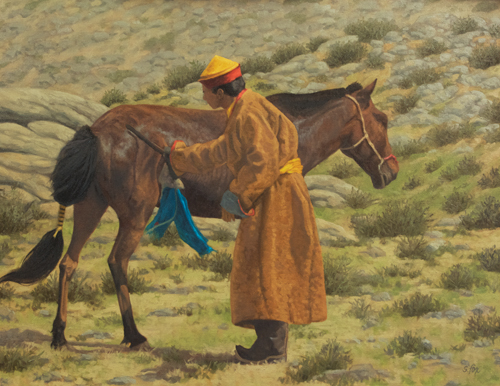
When traveling in Mongolia, one often sees the herders out taking care of their animals. Often they’re wearing western clothes, but a lot of them wear del, the traditional long garment. It’s very practical and makes them look very dashing. What isn’t quite so dashing are the ubiquitous baseball caps, however inexpensive and practical they are. So when I was at a mountain blessing ceremony at Bag Gazriin Chuluu and was walking around after the horse race, this gentleman really stood out with his red and yellow hat. I have no idea who he was, but he was scraping sweat off one of the horses with a special blunt, flat blade. I believe the sweat from a winning horse is considered to have the strength of that horse in it and so is very auspicious. The blue scarf is a khadak, which is used for offerings.

Here’s the step-by-step for “After the Race; Scraping Sweat:

Brush drawing with pencil preliminary
First pass of all-over color, plus shadow shapes; notice background goes in opposite direction of horse
Next color pass; starting to define the drapery of the del
Needed another element in background, so I added the rocks in mid-ground on the left to anchor horse and man
One of the two main pieces of reference on the iMac; I like his gesture in this one but needed another for the horse's head; there was a third reference shot for the background
All elements in place; everything is staged for the final push; spent yesterday finishing the background and making lots of tweaks and corrections to the horse; notice that the background has now been divided into two planes for more visual interest
After the Race; Scraping Sweat 22x28" oil on canvasboard