Continuing with a look at some interesting Mongolian postage stamps, this week is a set of what the text at the top of them says (in English, which is convenient) are “The Chinggis Khan’s Militant Soldiers”.
The original art, as credited on the stamps, is by T. Otgonbayar and the date of issue seems to be 1997.
One of the things I like about these as a reference source is that the images were created by a Mongol artist, not a westerner working from whatever sources, probably secondary/tertiary, that they could find.
First is a set of single stamps, three with swordsmen, three with horsemen and two with archers.
The piece d’ resistance is a triptych of the Mongol army in full panoply. What a sight they must have been! It is estimated that at the time the Mongols were conquering city after city, the total number of them was maybe one million. The army probably had 100,000 soldiers. Total. Each one had about five horses. So a half million horses to find graze for. And there was no supply line, no logistics challenges like modern armies face. Being a nomadic people, many soldiers had their gers and families with them, but instead of moving to new pastures, they just kept heading west. No one was longing for home and loved ones, because home was with them wherever they went.
Swordsmen; the one on the left carries a horsehair standardHorsemen; notice the two cheetahs on the far right stamp; that's something I want to find out more aboutArchers; only English longbowmen could approach the ability of the Mongol archersThe Mongol Horde; "horde" is the only Mongolian word that has come unchanged into English; notice, once again, the two cheetahs on the right; and also the black and white horsehair standards; white ones are still used today as important symbols of the Great Mongolian State
There’s a certain rhythm to creating paintings. I usually have a number of them underway at various stages of completion. Of course, most of them are hanging around unfinished. Then I get to the final sitting on one of them and pretty soon, Ta Da!, it’s done!
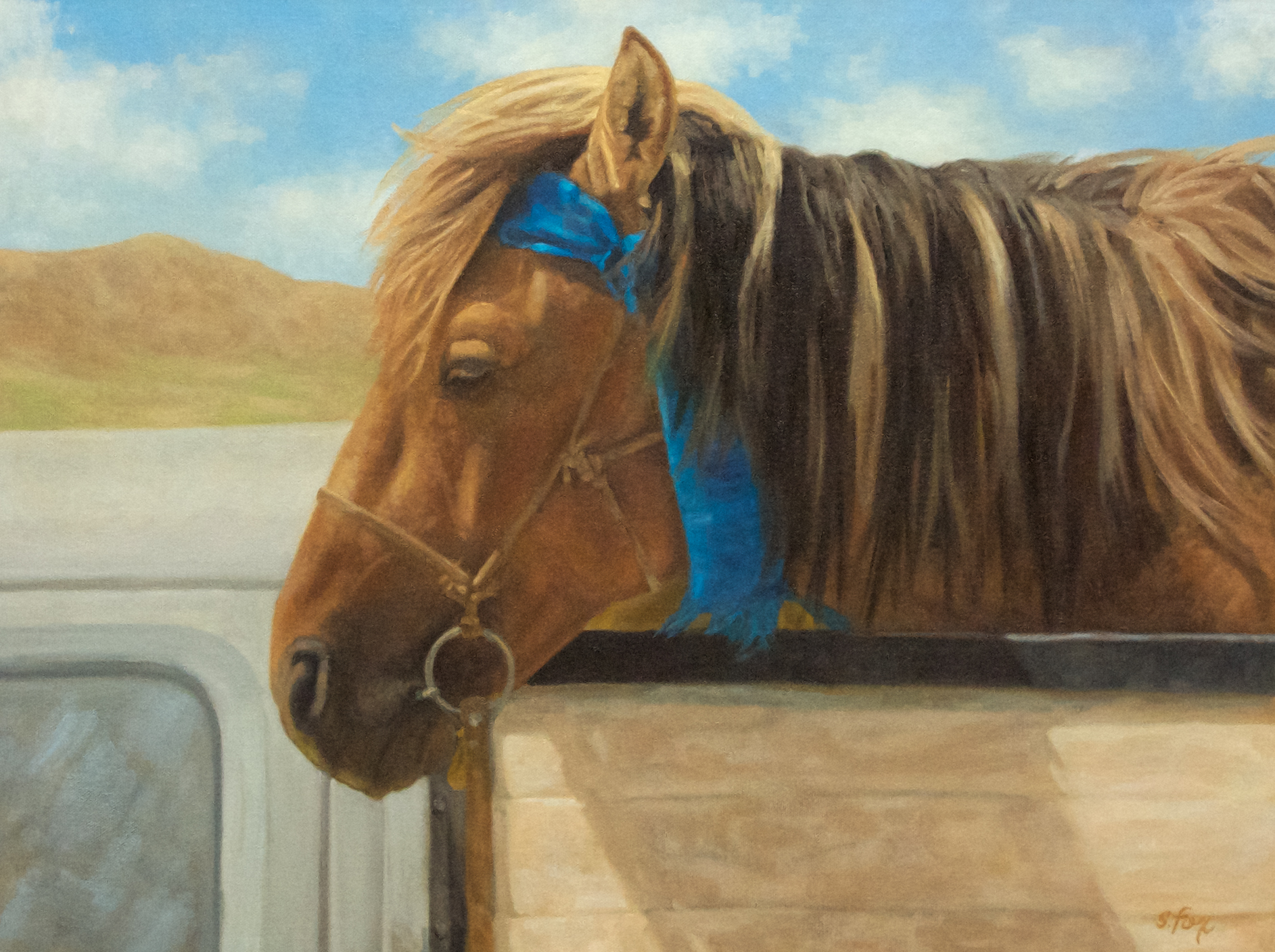
I finished one yesterday and one this morning. First, my latest Mongol Horse series painting:
Mongol Horse #6, Race Winner 18x24" oil on canvasboard price on request
I shot the reference for this one on my camping trip in Mongolia this last July. We had pulled into a soum center, which is the American equivalent of a county seat. My guide went over to some trucks filled with horses and chatted with the men, who were taking a break in the shade since it was a warm day at the northern edge of the Gobi. I stayed in the car, but got some good photos. My goal in this piece was to capture the wonderful quality of light that is one of the things I love about Mongolia.
This is a typical Mongol horse who is being taken on a “Naadam (festival) tour” for the horse race events. He’s a winner since he’s wearing a blue scarf called a khadak. He’s not spiffy looking compared to a thoroughbred, but he can also run 20 miles or more without stopping. I also always like seeing the bi-colored manes, which adds a bit of flash.
Minii Govi (My Gobi) 16x12" oil on canvasboard
I grew up with the redwood forests of northern California and have never been a “desert person”. But I love the Gobi (which means “desert” in Mongolian). This scene was also from my 2010 camping trip. The air was incredibly clear, almost crystalline. And it was obvious why Mongols call their country “The Land of Blue Skies”. This is a small piece that I’ve done for myself to start to understand how to paint an amazing part of the world.
A week or so ago, I was poking around the listings on EBay that come up when you search “Mongolia” and ended up browsing through the postage stamps. Mongolia is one of those countries that, in the past, released an endless supply of stamps aimed at collectors. It brought in some income to the government during the socialist era and when times were very hard back in the early to mid-1990s during the transition to democracy.
Along with the obligatory Princess Diana commemoratives, it turns out that there is a wealth of stamps with imagery from Mongolia’s history and culture. Some of the stamps showing traditional clothing are so detailed that they to all intents and purposes qualify as primary reference material.
I had purchased some stamps on previous trips just because I liked the images and they are a well-known souvenir choice. I had also been a stamp collector many years ago as a kid. I don’t know that I would take up actual collecting again, but if I did, I would specialize in the historical and cultural subjects, along with animals (no surprise there, I imagine).
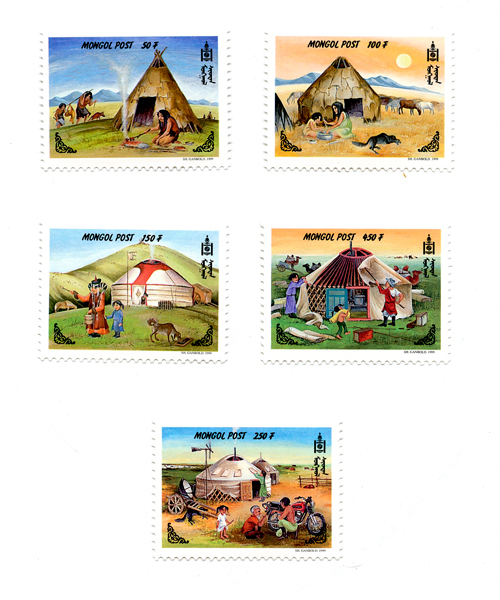
This week I’ll share the costume, history and ger-themed stamps I have. Next week will be Mongol warriors and the third part will be some with plants and animals.
Comments, information from my Mongol friends and fellow Mongolphiles welcome, as always.
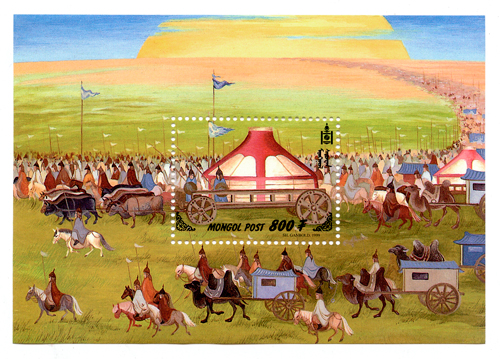
Traditional dress; the top middle is what a married Kalkh Mongol woman woreHistorical/legendary images, I believeThis set appears to be gers (which is simply Mongolian for "home") through Mongol history; ending with one that combines the old and proven with the new and modern; love the aruul drying on the roofThe Khan's ger on the move, literally a "mobile" homeTraditional life in a ger; lightweight metal stoves instead of the open brazier and people tend to wear modern clothes (but not always), but otherwise this is what they are like to this day. Notice the kids on the left playing anklebone games; the floor coverings are sheep's wool felt embroidered with handspun camel wool thread in an traditional design
This poem is from a book that I found in the Art Shop at the Museum of the Chojin Lama. It is called “Modern Mongolian Poetry (1921-1986)” and was published in 1989, just before the non-violent revolution in which Mongolia made the transition from communism to democracy. It was my first introduction to Mongol poetry.
Poets and other creative people who objected to the communist government had to be very careful in what they said, wrote and painted. There are many poems in the book extolling the wonderfulness of the socialist system, heroic workers and battle victories. But, carefully couched in metaphor, are other points of view. I’ll be posting some of both in the future, but today’s poem is about a subject that I suspect all Mongols of the time could agree on…HORSES!
Mongol horses, Baga Gazriin Chuluu, July 2010
MONGOLIAN HORSE
Crowning our glorious motherland
With victory after victory.
Raising the victorious banner,
We always went on horseback.
As a Mongolian’s courage
Is measureless,
So the Mongolian horse’s strength
Is boundless.
When the good Mongolian people
With their history of victory
Did their good deeds
Their good horses played their part.
As a Mongolian’s courage
Is measureless,
So the Mongolian horse’s strength
Is boundless.
In doing work
For our happiness
Our spirited Mongolian horses
Will work with us ceaselessly.
As a Mongolian’s courage
Is measureless
So the Mongolian horse’s strength
Is boundless.
I’ve had my iPad for about three weeks and am already wondering how I got along without it.
It’s easy for me to read on it and I’ve downloaded my first book, Isaac Asimov’s Memoirs, if you must know.
I’ve played to the end of Graffiti Ball. I’ve got Solitaire, Cro-Mag Race and Paper Toss. David and I have found that we like playing Scrabble with it.
I’ve downloaded the iPad version of the Monglian language app that I have on the iPhone and also found a English-Mongolian dictionary.
Google Earth looks really good.
I plan to use Keynote for a virtual portfolio of my work and a presentation about the women’s crafts collective that I work with in Mongolia.
The battery life is terrific. The glossy screen is lovely. The keyboard, well, it’s functional, but will take some getting used to. I wouldn’t write the Great American Novel with it, but would certainly do short blog posts or longish emails.
But, I wondered, having bought Autodesk’s Sketchbook for the iPhone, could I use the iPad as a real, functional, I just need to get some work done, sketchbook? I bought Sketchbook Pro first thing. With some caveats, which I will cover at the end, the answer is a resounding “YES!!!” I had to force myself to stop drawing and get this post done.
The iPad should be viewed as simply another way to create images. A different media, if you will. And one that takes the same kind of futzing around, experimenting and practice that would be required to get the hang of any new way of working. Except that it’s a whole bunch of ways in one app that can be endlessly combined.
I’ve barely scratched the surface as this point, but thought that I would share some of what I’ve drawn and “painted” over the last week or so.
I first had to decide what tool to draw with and what color. I decided to see if I could replicate David Rankin’s fast sketching technique because, if I could, then the iPad would be all I would need for field sketching at zoos and such. Here’s some experiments, the ones I considered reasonably successful. The others have gone to the big wastebasket in teh interwebs.
Gobi Monastery gate, from July 2010 trip to Mongolia; this was the first keeperHerder's dog; started to see how to add color
These next ones are all done really fast. Maybe a minute or so.
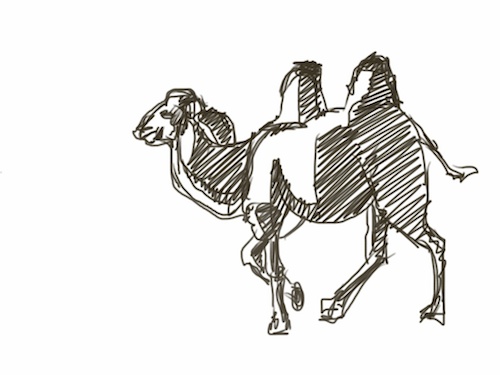
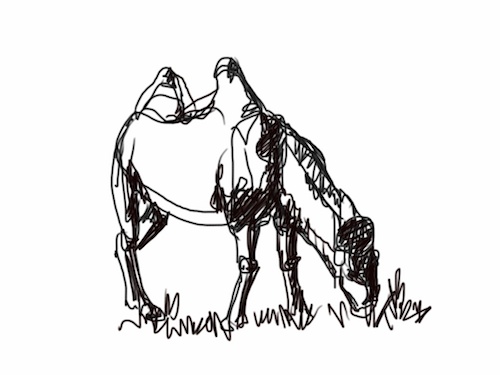
Bactrian camel; trying different tool and valueAnother experimentI like this one. Used a chisel point for thick and thin lines.My thought here was to see if I could do a prelimary quick sketch for a painting. Two guys riding a yak.
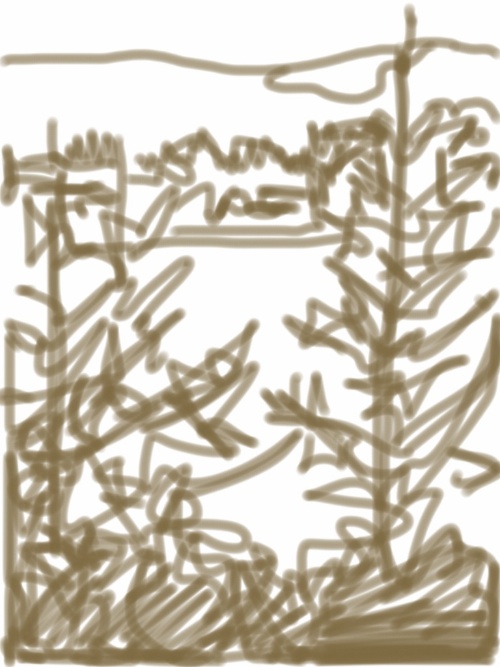
Then we went to the Humboldt Bay National Wildlife Refuge and I took the iPad with me. I realized that I didn’t know it well enough to do much, but I did do this one sketch that turned out ok. It’s from up on Table Bluff looking east across the bay.
First location sketch
When we got home I decided to try something finished in full color from a photo I’d taken that day. I beat this thing to death adding layer after layer and, you know what, it didn’t matter. I could just keep going as long as I wanted to.
Trees at the refuge
So I had a scribbling good time on that one. But how about a “real” drawing of an animal. A couple of false starts, I did the lemur and realized that this app was for real. It probably took me somewhat over an hour because of picking my way through all the choices of tool and colors. At this point, I also started to really use the “Radius” setting, which is the diameter of the tool and “Opacity” which is how solid the color is. And that function is what really makes this go for me more than anything else, I think.
Lemur, Bronx Zoo
I started an argali drawing, got it almost done, leaned forward, accidentally pushed the button at the bottom of the iPad, which closed the app, unfortunately having not saved about an hour’s worth of work. All gone. Oops. Lesson learned. But here’s the starting drawing, which is pretty much the same as what I do with a brush or pencil.
Start of argali drawing; and the end, as it turned out.
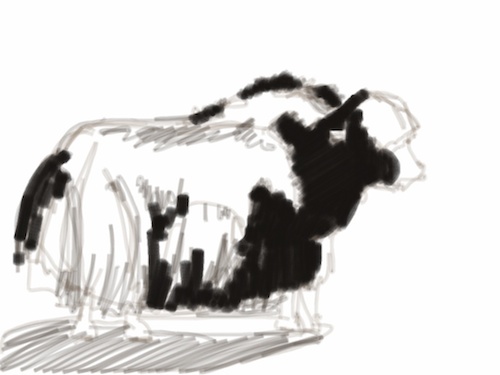
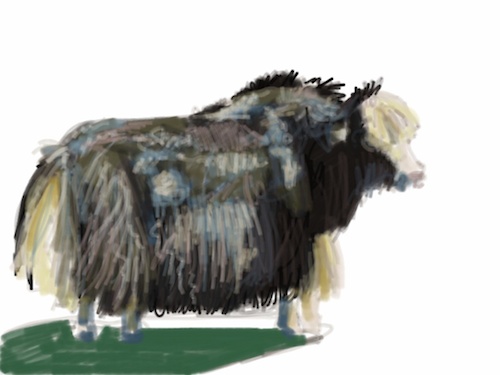
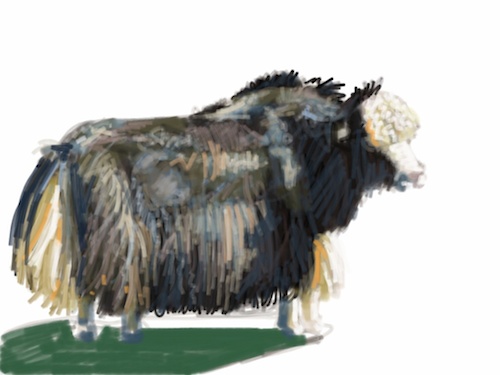
This morning I did the following drawing of a yak, wanting to have something more finished to go with the lemur. I did my saves this time, so I can show you the whole sequence from start to finish. It took about an hour and a half. I used the same procedure as usual.
DrawingShapes of shadowsLaying in the darkest darksPutting in a layer of color all overThe process of refining shape, values, drawing beginsMore layers of colorThought I was done and, anyway, it was lunchtime.But came back and realized that the highlights on the hide were too bright.
I could keep going on this guy, smoothing the transitions between areas and doing more with the ground, but I’ve gotten all I need from this one, so time to move on. It was fun though, especially adding the squiggles on the head.
Now, the caveats:
The first eight drawings, up to the lemur, were done with my finger. I was surprised at what a decent result I got, but I needed something with finer control and which was a wee bit thinner because said finger blocked my view of what I was working on. We went by the local Apple affiliate store and I bought a Ten One Design Pogo Sketch because….it was the only stylus they had. As it turned out, it works pretty well. But I would still like something with a smaller tip. There doesn’t seem to be anything out there at the moment. The stylus tips have to be a special kind of foam that will conduct electricity, which is how the touch screens work. There is some DIY info. on the web that shows you how to make your own and I’m thinking I might try that.
Moving the foam tip around on the screen doesn’t have a great tactile quality. It’s kind of smooshy and draggy. And I wonder how long the foam will hold up with the kind of use I intend to give it. I still need to put a removable clear film on the screen, so maybe I can find something that is slicker. Someone needs to make a special clear film for artists that has the right amount of friction.
Overall the functionality of Sketchbook Pro is really good and pretty intuitive. I’ve read the documentation and don’t recall seeing any of these addressed: I would like to have a side bar, like in Photoshop, that let’s me keep the tools and color selector in view. Having to toggle back and forth can get a little old. But it does give one the maximum real estate for drawing. I’d like an auto-save option (imagine that) that can be set to a choice of intervals. I want an eraser. Right now, I have to change colors and select white to erase.
I’d like to be able to directly import all or a selection of drawings into Aperture without having to export them to Photos on the iPad first. But the whole process was easy and worked well, except for the part where every image was re-named “Susan on the camel.jpg” (a previous project) when I exported them to my blog folder instead of the names I took the time to give each drawing in Sketchbook. Aperture also insisted on creating a new Project for the images instead of letting me import them into the album I had created for them. The two apps need to learn to communicate better.
I’d like the images to be in a format other than jpg so that I can process them in Photoshop if I want to without losing image quality.
I would like to be able to access the user manual in one click.
In conclusion:
The combination of the iPad and Sketchbook Pro is very close to being a serious product for serious working fine artists. I absolutely recommend it.
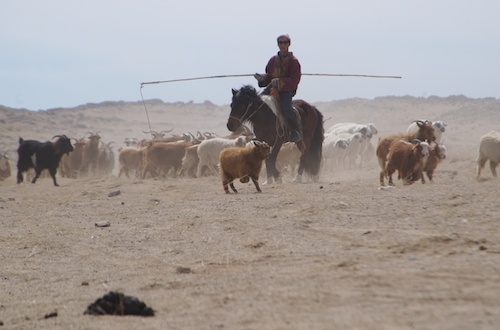
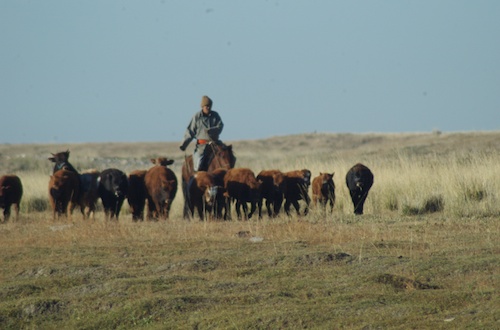
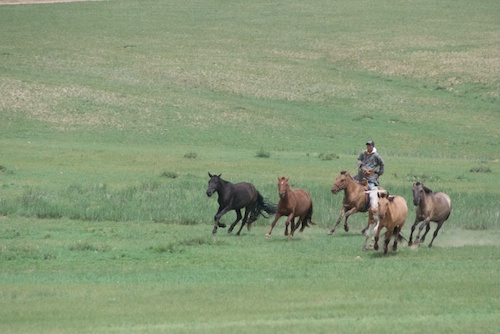
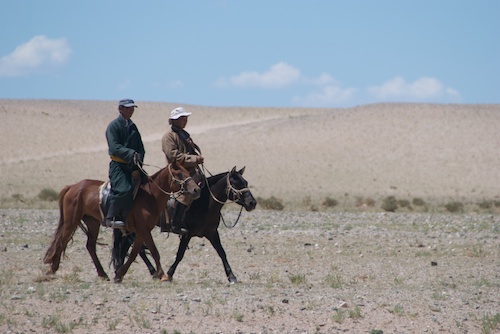
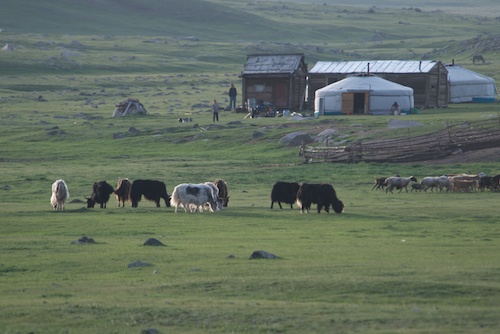
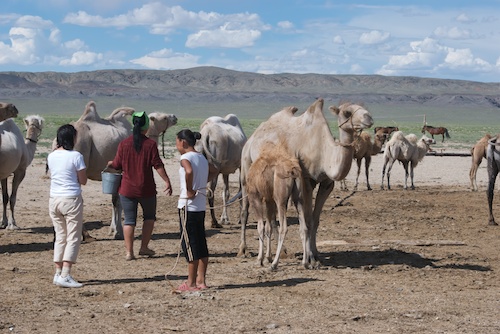
Going to let the pictures tell the story today. Here’s a collection of some of the photos I’ve taken of Mongol herders. Included are all of the Five Snouts, plus camels. Now I’m sitting here missing tsagaan idee (white food): airag (fermented mare’s milk), aruul (dried yogurt), byaslag (cheese), orom (sliced dried cream) and tsotsgii (cream, just cream, eaten using aruul as a base to put it on; heavenly). Bi ter bukh dortei! (I like it all!). Mongol friends-correct my sentence if it is wrong.
Herder with urga, Ikh Nartiin Chuluu, April 2005 (my first trip to Mongolia)Camel herder, Gobi near Bayanzag, Sept. 2006 (these are racing camels)Herding cattle near Tuul Gol (River), Sept. 2006Herding sheep and cashmere goats near Hustai National Park. Sept. 2008Rounding up horses, Gun-Galuut, July 2009Local herders coming to check out flooded river crossing, The Gobi, July 2010En route shot from car, July 2010Herder, Hangai Mountains, July 2010Time for a morning chat, Hangai Mountains, July 2010Yak herder's ger, Naiman Nuur, Hangai Mountains, July 2010Rounding up yaks, Orkhon Falls, July 2010Camel's milk airag coming up soon, the Gobi, near Orog Nuur, July 2010
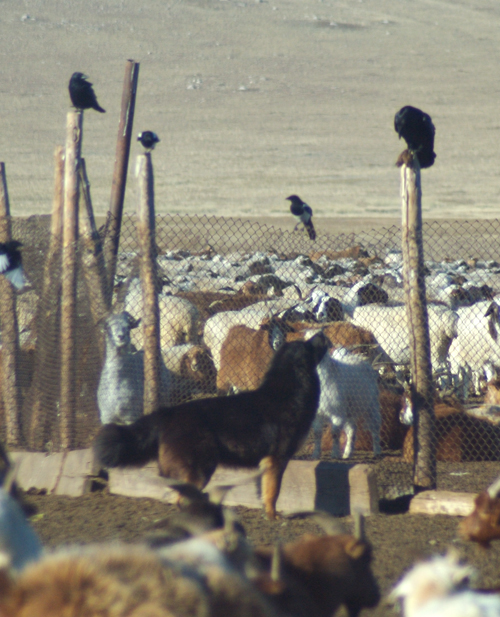
It's a draw. A herder's Tibetan mastiff dog "trees" a raven. Near Hustai National Park, Sept. 2006
I just finished Henning Haslund’s marvelous book “Tents In Mongolia”. As mentioned in a previous post, he was a keen observer who was fascinated by everything about the Mongols and their culture. He also seemed to be able to put aside his cultural biases much better than many of his contemporaries and describe what he saw with no moralizing and a minimum of judgment and off-the-cuff interpretation. For example (his spelling of Mongol words was clearly his best guess and was not consistent, which is why the word for “raven” is spelled two different ways):
“A pair of screaming ravens sailed over our heads towards the valley in the south, and this had an encouraging effect on Batar (his Mongol traveling companion), since the black khiltai shobo , “talking birds”, as the Mongols call them, conducted themselves in a manner which satisfied him.
“The ravens play for the Mongols a like important role as they did in the ancient north of Odin. The black widely-traveled birds are equipped with keen intelligence and are able to understand human speech. It is vouchsafed to certain favoured human beings to understand the ravens’ language, for ravens have a language, and these favoured human beings can acquire unbelievable wisdom and learning by listening to the communications of the sagacious birds.”
There are also a few pages of interesting notes in the back of the book:
Kiltai shobo, “the talking bird”, as the Mongols call the raven, may bring the traveller good or ill omen. Some of the auguries attributed to the bird are:
If a raven crosses you in its flight from left to right, the omen is good; if from right to left, it is evil.
If a raven croaks behind you when you are on your way, the omen is good.
If it flaps its wings and croaks, you are approaching great danger.
If it pecks at its feathers with its beak and croaks, it signifies death.
If it pecks food and croaks at the same time, you will find food for yourself and your horse on the journey.
If many ravens gather at sunrise, it signifies difficulties on the journey.
If a raven croaks at sunrise it foretells a fortunate journey during the day and that you are about to reach your goal.
I’m currently about 60 pages into what is already one of the best travel books on Mongolia that I’ve read. Henning Haslund went to Mongolia with a number of fellow Danes in the early 1920s to establish a farming and mining colony in the north not far from Khosvol Nuur. “Tents In Mongolia” is his account of that journey. It was re-printed by Adventures Unlimited Press in 1995 and retitled “Secret Mongolia”.
Henning has already demonstrated a flair for observation, so I thought that I would share this wonderful description of his and the party’s first personal contact with a Mongol in Mongolia. I really wish I had been there.
“Suddenly the caravan dogs gave tongue….Down a long slope to the eastward, a billowing cloud of dust was rolling towards us…..One, two, three, four, five riders galloped out of the dust and- we were completely disarmed.
“A sunburnt girl with a smile as fresh as a steppe morning reined in her fiery steed before our shamefacedly lowered rifle barrels. Her teeth were pearly white, her eyes as clear as day, her smile disarming, her grip on the reins strong and her movements in the saddle full of grace. She was a daughter of Mongolia, she was herself the free, wild, captivating steppe.
“She was dressed in bright-colored silks, and when she moved there was a ringing of silver and a rattling of precious stones. She shone with the joy of living, and her demeanor bore witness to pride and noble birth. Over her forehead she wore a wide, massive silver band in which were set five large pale red corals. From this diadem half a dozen small chains of coral hung down to the boldly curved and sharply drawn black eyebrows that marked her race. From the sides of the diadem and from her ears hung chains of silver ornaments and strings of corals, pearls and turquoises which fell jingling over her small strong shoulders. Her hair was kept in check by a coral-studded black veil, fastened behind by a jewelled sliver diadem.
Coral necklace, Museum of National History, Ulaanbaatar, Mongolia
“Her long robe was of pale blue silk, and over it she wore a short, sleeveless waistcoat of crimson brocade in which were interwoven dim symbols of fortune and long life. The waistcoat was fastened in front with golden laces attached to buttons of chased silver.
“Her cloak reached to her knees where it met her long black velvet riding boots. Her small, neat feet were shod in boots whose elegance was enhanced by the sharply unturned toes. Her hands were strong, but small and shapely. Her fingers were studded with coral ornaments and heavy silver rings, and thick bracelets clashed upon her wrists.”




















 Susan Fox, American Artist