It was the second morning out on my one-week camping trip last August.We had stayed the previous night at the ger of my driver and his family, who lavished on me piles of white foods…aruul, airag, urum (dried yogurt, fermented mare’s milk, clotted cream) and more.
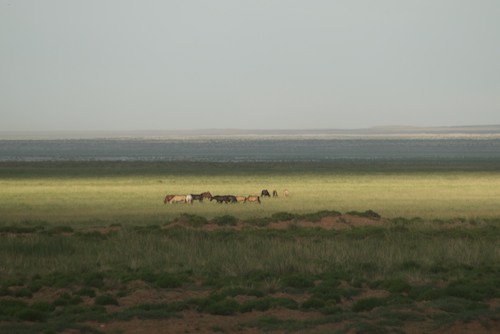
As we were heading west towards what I had been told was a beautiful lake, I spotted a large herd of yaks not too far from the road. Puugii, who turned out to be a great driver, pulled over and stopped. I got out to take pictures and almost immediately saw three herders coming our way at a gallop. They pulled up, all dressed in del and boots, looking very dashing, and stopped. What a photo op! I asked Puugii to ask them if I could take some pictures. There was a little hesitation, but then they nodded and I got to work, knowing already that I would be getting multiple paintings from this encounter.
I didn’t realize until I got home and took a closer look that this mal chin (herder) was checking me out with a look of calm appraisal.
You can see the other two paintings I’ve done so far here (the portrait at the bottom) and here.
The legendary Gobi….what images it conjures up, some true and some not, as it turns out. A land of contradictions. A desert, but mostly without sand. A byword for dryness and lack of water, but rivers flow through it, there are lakes and it’s known as the source of the sweetest and best vegetables grown in the country.
I grew up in Redwood Country….forests. I’ve always loved forests. My mom loved the desert. Me. Not so much. Until I met this desert.
A view I love…a Mongolian earth road stretching out ahead as far as one can see, Juiy 2010Time to milk the camels at the only herder’s ger for many miles. Got my first taste of camel’s milk airag, July 2010It does rain in the Gobi and everything can turn green in a matter of hours, July 2010My tent on Orog Nuur, a remote Gobi lake, just myself, my guide, the cook, hundreds of birds and gazillions of mosquitos. When camping in Mongolia, you can stop and pitch your tent pretty much wherever you want to, July 2010Last glow of evening light on The Flaming Cliffs, made famous by Roy Chapman Andrews’ Central Asiatic Expeditions of the 1920s, Sept. 2006
I spent a great morning at the American Museum of Natural History during my recent quick visit to New York to attend the Society of Animal Artists board meeting and show jury.
This time I wanted to sketch and once again see the fossils that Roy Chapman Andrews’ Central Asiatic Expeditions brought back from Mongolia. I got to chatting with one of the volunteer docents and found that she knew the location of some Mongolia items that I hadn’t found on my previous visit in 2009.
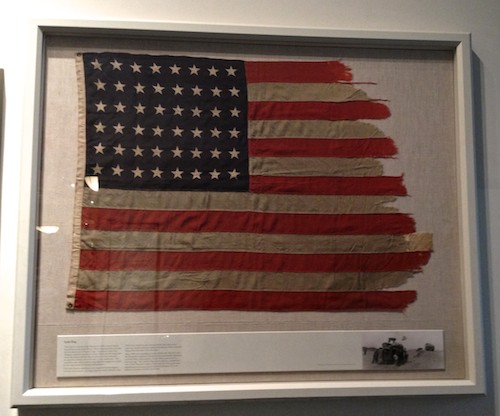
The jackpot was an American flag that flew from one of the expedition vehicles. It was in a glass case that had been mounted on the wall in one of the stairwells, not exactly a prominent, easy to find location, so I appreciated the docent’s help a lot!
Here’s a “album” of photos from the museum, filled out with a couple from my previous trip, ending with a couple of iPad sketches I did.
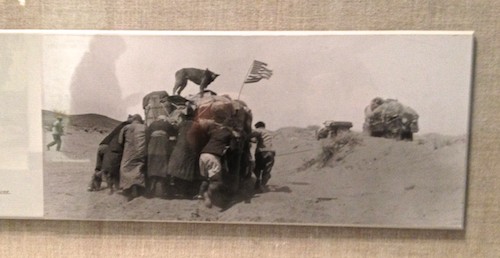
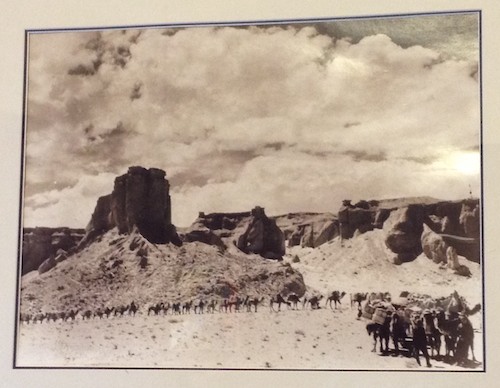
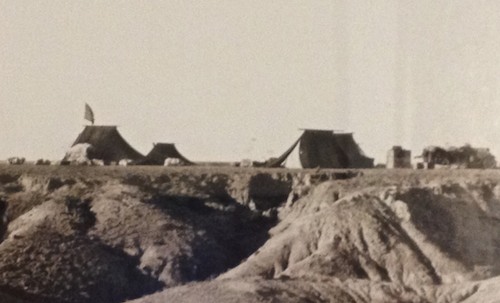
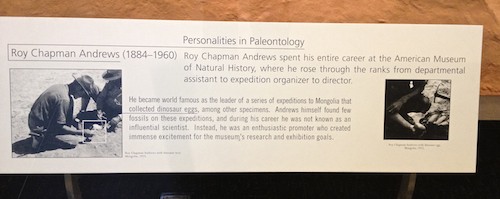
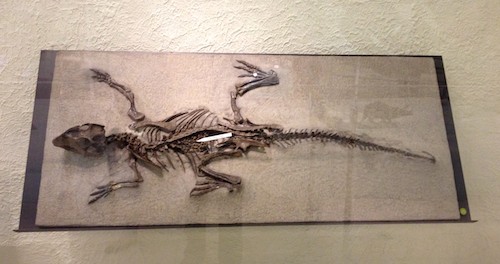
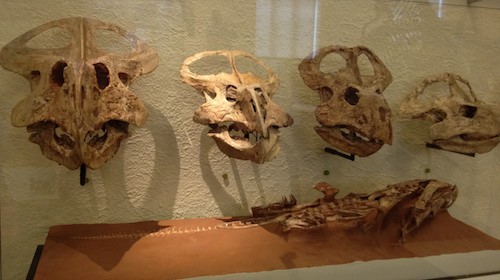
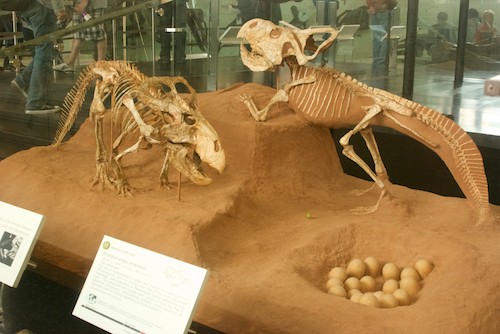
American flag carried to the Gobi of Mongolia by one of Roy Chapman Andrews’ Central Asiatic Expeditions.Closeup of the photo. I’ve helped push a vehicle or two on my trips, but without a dog to supervise.The walls in the cafe closest to the Paleontology section are lined with photos of the Central Asiatic Expeditions to Mongolia. This one is of what Andrews dubbed “The Flaming Cliffs” which are located in an area the Mongols call Bayanzag (Place of the saxaul trees). I’m pretty sure I watched the sun go down along the lengthy of this butt in September of 2006. He used large caravans of camels to transport supplies and get them into position before the rest of the expedition arrived in motor cars.Another photo from the cafe, this one showing the Expedition’s camp. The tents are “maikhan” or summer tents, which are lighter and even more portable than the better known felt gers.Short profile of Roy Chapman Andrews. It has been speculated that he was one of the inspirations for Indiana Jones. And if you’ve read his biography, that’s not hard to believe, although there is no proof.One of the fossils from Mongolia, a Psittacosaurus mongoliensisInformational sign about the above fossilProtoceratops fossil skulls of varying sizes; the expedition’s scientists found far more of these than any other speciesA pair of protoceratops (image from 2009)Although the Expeditions failed in their original goal, which was to find evidence that “man” had originated in Asia, not Africa, the find that electrified America was the discovery of the first known fossil dinosaur eggs. Andrews’ decision to sell one created a firestorm of controversy. (image from 2009)Besides the flag, this was the other item from Mongolia that I’d missed on my previous trip, an amazing fossil of a female dinosaur which contains a egg with a recognizable embryo, something never before seen or found.
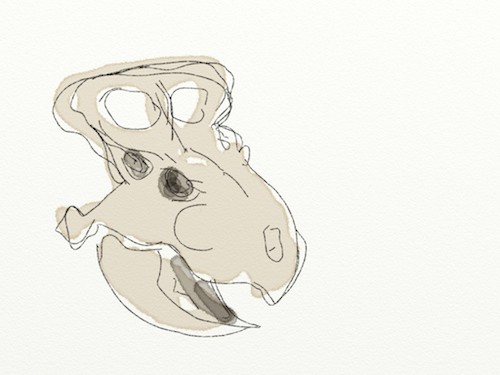
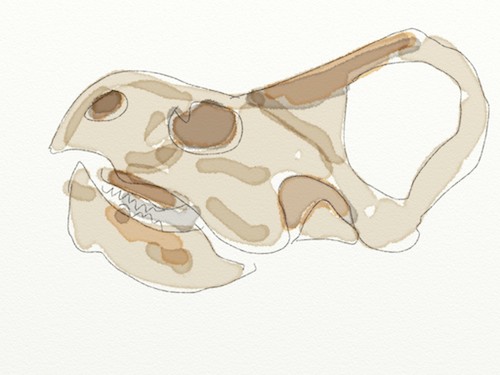
Finally, here are a couple of quick sketches I did of protoceratops skulls using ArtRage on my iPad.
I’m now in Denver, staying at the home of the President of the Society of Animal Artists, Diane Mason. She and her husband drove me up into Rocky Mountains National Park yesterday. On the way, in the adjoining National Forest, we saw a good-sized group of bighorn sheep, including a ram, right by the road and, in the park, hundreds of elk and a lot of mule deer.
Once I’m home I’ll post some side by side photos of argali and bighorns and rocky mountain elk and marel/ red deer. The latter look almost alike and are in the same genus, Cervus, but are different species.
We’ll go back into the park this afternoon and I’m hoping to get some video of the sheep. Got some of the elk yesterday.
I visited two very different parts of Mongolia in 2010 on my two week camping trip: the Gobi and, directly to the north, the Hangai Mountains. Today I’d like to share five of my favorite photos from the mountains, which I hope very much to explore more in the future. I think you’ll see why…
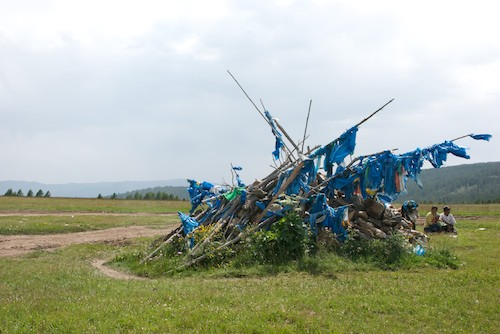
Gachen Lama Khiid, Erdensogt Soum- this has to be one of the great undiscovered places in Mongolia, an old monastery located north of Bayanhongor in Bayanhongor Aimag. I could spend days sketching and painting this beautiful temple and the stupas overlooking the river valley. There are more photos and the story of our visit here.We had spent the night camped out on a hillside with a lovely view. The next morning I crawled out of my tent to the sight of local herders moving their yaks out to graze. Being in plain view, we soon had visitors, including this older gentleman. He perfectly sums up the dignity and presence of the Mongol country people. He also knew I was taking pictures of him...We had to come down out of the mountains proper to circle around to get back in to our next destination. There was a small temple just outside a small soum center. I peeked inside and was treated to this riot of color, all kinds of candy and other food left as offerings. I don't know the story of the statue, but wish I did. More on the day I took this photo and the one above here.Our destination that day was Khuisiin Naiman Nuur National Park, a series of nine ("naim" in Mongolian) mountain lakes, only accessible by car by driving up the length of this incredibly beautiful valley, which is where we camped for one night. I could have stayed there two weeks. More photos here.We wended our way higher into the mountains reaching a pass where we found this fantastic ovoo made of wood and festooned with dozens of blue khadag (offering scarves). The tradition is to walk three times around it clockwise and leave some kind of offering or token, even if it's only a stone that one has picked up from the ground. Ovoos are always on high places and passes. The creation of them dates back far beyond the arrival of Buddhism to the ancient beliefs of Tengerism (or what westerners call "Shamanism"). More photos of the beautiful, wildflower-filled mountains here.
Mongol warriors escorting Chinggis Khan's mother, Hoelun: National Naadam opening ceremonies, Ulaanbaatar, July 2009
Mongolia has always been considered an incredibly remote and exotic destination by most westerners. The shorthand expression for the farthest a person could be from any place has been to say that they’ve gone all the way to “Outer Mongolia”.
The reality today is that it is quite simple to get there from the United States and Europe. I fly to San Francisco (one hour) to Seoul, South Korea (11+hours) to Ulaanbaatar, the capital of Mongolia (three hours). There are non-stop flights to Ulaanbaatar from Berlin and Moscow. But before air travel, before trains, before the country was essentially closed to foreigners by the communist government from 1921 to 1990 (other than the Russians who were stationed there), Mongolia was a challenging place to get to and travel in.
This will be an occasional series about westerners who have traveled to Mongolia in times past and left written accounts of their experience.
Epic. Journey.
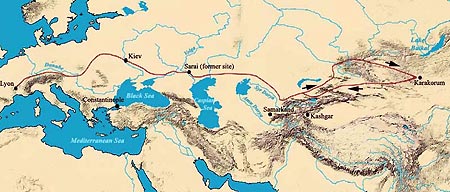
First up is a man known in English as John of Plano Carpini, sent to Mongolia by Pope Innocent IV in April of 1245 to find out all he could about the “Tartars” who had beaten every army of European knights sent against them, but had then mysteriously vanished as quickly as they had appeared.
He and his party were stopped for a time in Russia at the camp of Batu, one of the most important Mongol princes, who finally ordered them to travel on to the court of Guyuk, who was the grandson of Chinggis Khan through his father, Ogedei Khan. 106 days and 3,000 miles later, in July of 1246, they arrived at the Mongol imperial capital of Kharkhorin. Carpini was in time to witness the Great Khural during which Guyuk was elected Great Khan.
Guyuk declined their invitation to become a Christian, although there had been Nestorian Christians present and living in the empire for some time. He did, however, give Carpini a letter to take back to the Pope demanding that he travel to Kharkhorin and submit to Mongol authority.
One page of the letter from Guyuk to the Pope
Guyuk allowed them to begin their journey home in November. They re-traced their route across the length of the Central Asian steppes through the winter and on into spring, then summer, finally arriving at Kiev in June of 1247. Traveling on, they delivered the Khan’s letter to the Pope in Lyon, France, who was not inclined to obey.
This epic journey was really a spy mission. The Mongols had withdrawn from Europe, it turned out, due to the death of Ogedei Khan (the cause is presumed to have been acute alcoholism) and the requirement to return to Mongolia to choose his successor, but the westerners, not knowing any of this, had no choice but to assume that they might return at any time and pick up where they left off, on the verge of entering central Europe. Carpini’s mission, which he courageously carried out, was to gather all the information he could, not only about the Mongols themselves, about whom nothing was known, but everything he could find out about their military: numbers of men, armor, weapons, tactics. Of course, if this had become known to the Mongols, it would have been a one-way trip for all of them.
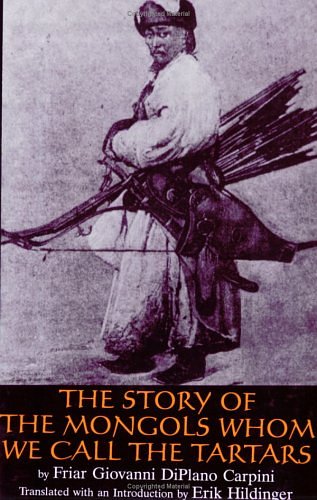
The edition I have.
Once home, he wrote it all down in a report for the Pope, which has become the book, “The Story of the Mongols Whom We Call The Tartars”, the first account of the Mongols by a westerner. It has been translated into English and is a fascinating read for anyone interested in history, Central Asia, the military, travel and the Mongols themselves. You can get a hardcopy translation by Erik Hildinger at Amazon or read a free online version, translated by Richard Hakluyt here, which also has various download options.
1. Who demonstrated the strength in working together using arrows?- Hoelun, the mother of Chinggis Khan
2. What form does the tea used for milk tea traditionally come in?- Bricks or blocks
3. What side of a Mongol horse does one always mount from?- Left
4. Mongolia became independent in the early 20th century from what other country?- China
5. What two animals do the Mongols claim descent from?- Wolf and deer
6. What was the real name of the “mad monk of the Gobi”- who wrote the famous poem “Perfect Qualities”?- Danzanravjaa
7. What is the traditional greeting when approaching a herder’s ger?- Hold the dogs!
8. From what people did the Mongols get their classical vertical script?- Uighers
9. Why did the Mongol army leave Europe and return to Mongolia?- To elect a new Khan
10. Who created and bestowed the title “Dalai Lama”? For bonus points, what does the world “Dalai” mean?- Altan Khan; “ocean”
Large ovoo along main road south out of Ulaanbaatar
Part 2:
1. What is a “morin khuur”?- Horse-head fiddle
2. From what people did the Mongols get their classical vertical script?- Uighers (my apologies for missing that I’d used this one in the first 10)
3. What are each of the four sides of a sheep’s anklebone called?- Sheep, goat, horse, camel
4. Name the Five Snouts.- Horse, cattle, sheep, goat, camel
5. Which ikh khan founded Kharkhorin?- Ogedei
6. Which direction do gers always face?- South
7. Who is the lead singer of Hurd? For bonus points, what does his name mean?- Chono: wolf
8. What is the name of the mountain where Temujin took refuge?- Burkhan Khaldun
9. What are The Three Manly Sports?- horse racing, wrestling, archery
10. Name the two main political parties in Mongolia.- Democratic party and Mongolian People’s Party (I was a little flexible on this one since there have been fairly recent name changes. The MPRP changed its name last year. The other party is referred to in the media as the Democrats. But I knew what you meant)
And the winner is…..Carole Hollrigel! But it was close. Only two points separated her from the next closest entrant.
Today’s post is a poem about the Gobi and a “sandalwood brown camel”, but I also want to remind you that the deadline for the Mongolphile Quiz is this Friday at 5pm, Pacific time. Twenty questions here and here.
“From the Top of a Camel the Sun Seems so Near” by Zhanchyvn Shagdar
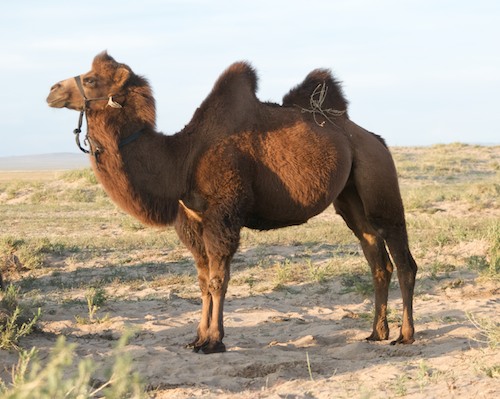
Bactrian camel, Arburd Sands, Sept. 2008
Gobi of exquisite mirage
Has the seven colors of the rainbow.
And my brown camel with graceful legs
Can travel for a month without rest.
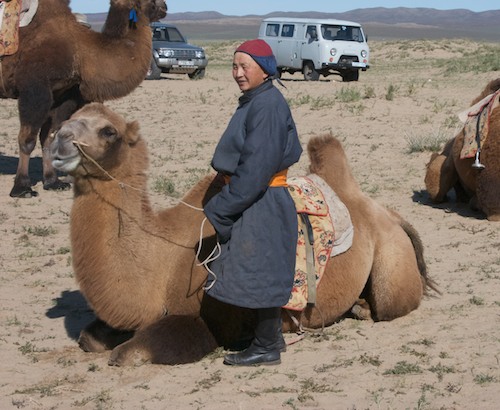
Gobi bactrian camels, July 2010
When I ride my sure-footed brown camel
The sun in the sky seems so near,
Oh, I’m on my way, my sweetheart,
And I’ll be with you at sunset.
Saxaul forest with the Flaming Cliffs in the distance, Sept. 2006
Gobi, with its bushes of saksaul,
You are renowned in this wide world,
And my sandalwood brown camel
Can jog faster the longer the road.
Arburd Sands, Sept. 2008
When I ride my sandalwood brown camel
The moon in the sky seems so near,
Oh, my love, linked to me by fate,
I’ll be meeting you when the moon rises at night.
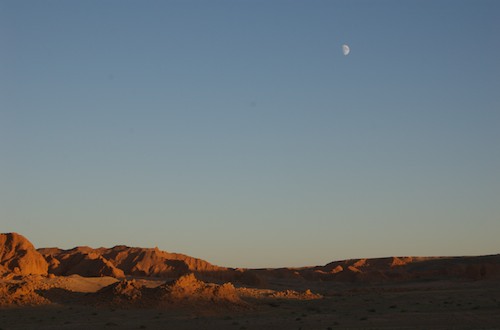
Moonrise over the Flaming Cliffs, Sept. 2006
Gobi in the radiance of pure gold
Is beautiful like a new family tent,
And the jogging of my straight humped brown camel
Can reach the distant horizon.
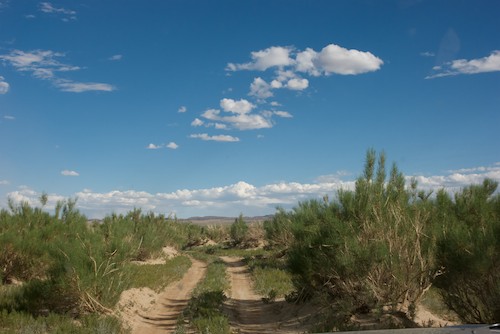
Saxaul forest near Orog Nuur, July 2010
My Gobi with its bushes of saxaul,
You are renowned in this wide world,
And my sandalwood brown camel
Can jog faster the longer the road.















 Susan Fox, American Artist