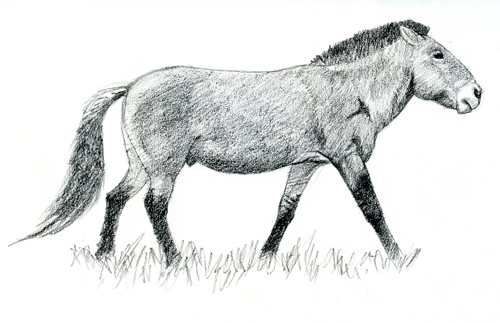
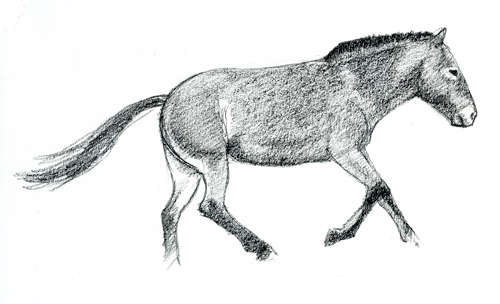
I’m in the middle of a rather large painting (no, not the argali one; a subject for another post; short, short version: got stuck, needed to let it sit for awhile), so I thought I would post a few drawings that I’ve done recently and then get back to the easel. It’s juried show painting season, so I’m trying out different reference images to see if I think they’ll make a painting. These were all done with Wolff’s carbon pencils on Canson Universal Recycled Sketch paper, which turns out to be quite a nice combination.
Ibex billy; from Baga Gazriin Chuluu, July 2009Bactrian camel, Arburd Sands, Sept. 2008Bactrian camel, Arburd Sands, Sept. 2009Takhi stallion "Temujin", Hustai National Park, Sept. 2008Takhi mare, Hustai National Park, Sept. 2008Takhi foal, Hustai National Park, Sept. 2008
When I went to Mongolia last July on my AFC Flag Expedition, I knew that arrangements had been made to meet with some unknown number of women at the Ikh Nartiin Chuluu Nature Reserve research camp to talk about helping them set up a felt crafts cooperative. I sorted through all my sewing stuff and came up with a pretty good-sized bag of needles, thread, notions and one extra pair of very good sewing scissors to donate to the cause. You can read about the meeting and see photos of the four intense days I spent with the women here.
The scissors, I found out late on the third day, were very, very, did I say very, popular. I was asked during a last meeting of everyone, if I could get more scissors. Sure, I said, how many pair? One for everyone, so 20 pair. I knew I could figure out some way to do this, so I said yes.
Then a burly man in a del, clearly one of the herders who had spent most of his life out of doors and who had quietly come in and was sitting by the door, raised his hand. Through my translator, he shyly asked if it would be possible to get 21 pair. His wife hadn’t been able to come to the meeting, but he would like to give a pair to her because it would make her happy. Yes, of course. I still choke up a little when I remember him sitting there in a ger full of women (Mongol women can be formidable), summoning up the courage to ask a total stranger for something for his wife.
My gift scissors being used to cut out the fabric for a del for my husband. The women made two, one for each of us, in three days. Notice that there is no paper pattern. The skill to make these traditional Mongol garments is either passed down or there are classes where it is taught.
Then, during a series of “competitions” that celebrated the end of the meetings, everyone divided up into teams to do skits. One team did theirs on where the scissors were because everyone was wanting to use them.
I think what is being said is something like "I need to cut this. Where are the scissors?"
Fast forward and I’m back at home. My husband generously offered to donate the money to purchase the scissors through his company. I got on the internet and in touch with one of the staff people at the Denver Zoo Foundation. It turned out that a fabric store chain had 8″ Gingher sewing scissors on sale at a very good price. Sewers know that Ginghers are about the best you can get and that’s what I wanted the ladies to have. So they were ordered and delivered to my contact person at the Zoo.
Next was how to get them to Mongolia. We’d hoped to send them over with someone, but no one was going in the near future, the scissors weighed a fair amount and, with security being what it is, we felt like it was a lot to ask for someone to take them on a plane, even in checked luggage.
The Director of the Conservation Biology Department, which is who I work through, said that the only reliable way to make sure they got to where they needed to go was via FedEx, so that’s what we did. That cost over $400. My husband had included $100 for shipping in his original donation and the Zoo picked up the rest. So far so good.
The scissors arrived at the airport and then it got complicated with customs paperwork that none of us knew had to be done ahead of time. More fees, which my husband covered. But the scissors were in UB and in the possession of the right person, who would make sure they got to where they needed to go.
All along I’d had this vision of the scissors arriving in the winter when the women didn’t have as much work to do, so would have time to make felt items to sell this summer. And it would be cold and things would be difficult, but maybe this would be a nice mid-winter surprise. And I would be announcing that this endeavor of my Art Partnerships for Mongolian Conservation had been successfully concluded.
Unfortunately, this winter has turned out to be what the Mongols call a “Zud”, heavy snow and extreme cold, as in below -40F, which is a “normal” winter low. Haiti has the world’s attention, deservedly, but for those of us who care about Mongolia, there is a crisis happening there, too. I wrote to the scientist who goes to Ikh Nart every month and who is going to deliver the scissors, asking how my friends are. His reply was that he hasn’t been able to contact anyone, but will let me know when he does. I suspect that he can’t even get to the area right now. Conditions may not improve until April. I know that the Mongols are resourceful people and they’ll help each other through this, but I am concerned. I’ll be very glad when I hear that everyone is ok.
I’ll post as soon as I have news. In the meantime, I’m making my plane reservations for the next trip in July/August.
There’s this saying about combat flying- hours of boredom interspersed with moments of stark terror. At a far less dramatic level, painting seems to have a similar rhythm sometimes. We spend days or weeks working on paintings and, suddenly, some get finished, signatures go on, photos are taken and, ta da. we’re ready to move on. I finished this painting a couple of days after the one I posted last Friday.
This piece is a scene from the mountain blessing ceremony that I had the good fortune to attend at Baga Gazriin Chuluu. There had already been an anklebone shooting competition, but the horse race was the event that everyone dropped what they were doing for. The Buddhist monks who had been sitting in a tent, chanting, came out and joined their families and friends. For at least a hour before the race, the kids had been warming up the horses by walking them in a big circle, sometimes singing as they rode round and round.
The horses were two-year olds, all stallions. As it turns out the Mongol word for horse, “mor” includes the fact that the horse in an ungelded male. That’s the default. Then there are geldings and mares. Being young colts, the race was a short distance- 7km. (The main national Naadam race for fully adult horses is 56km.) As with all Mongol horse races, after warm-ups the jockeys rode their mounts out to the starting line at a walk or trot, followed by a few vehicles which I assume included the starter and some of the trainers.
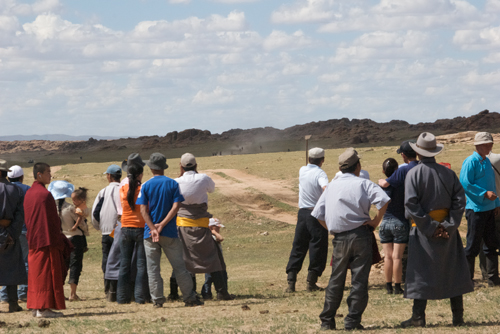
Everyone went out of sight behind a large rock formation. We all waited at the finish line, a small pile of rocks which held up a pole that had a colorful red scarf flying from it like a flag.
Horse race with spectators, Baga Gazriin Chuluu, July 2009
Pretty soon the crowd stirred and, looking out, we could see the dust from the horses. In just another minute or two they started to reach the finish line. I got as many pictures as I could.
The trainers checked the horses over and some scrapped the sweat off them, although none were lathered up or even looked particularly tired. Then the jockeys spent most of the next hour circling the wrestling competition, cooling down their mounts. That’s when I got the image I used in this painting.
I’ve also included the reference photos since I think too many animal artists just use whatever setting the animal is in when the picture was taken and don’t consider other options. In this case, the background was pretty boring. But, a short distance away were these really great rock formations.
The young rider:
The background:Put them together and….
After The Race, Baga Gazriin Chuluu 16x20" oil on canvasboard
The rocks were deliberately placed so that the boy would be against the large shadow area. I kept things on a diagonal so that the background would be at a different angle from the main subject and keep the composition from being too static. After going 14km, the rider was still having to pull firmly to keep his mount at a walk. I wanted all the elements of the painting to support that pent-up energy.
One of the interesting and, to a lot of Westerners, amazing things about traveling in Mongolia is that the thousand-plus year old traditions of hospitality out in the countryside are still practiced. It feels very odd to walk up to someone’s ger (assuming there are no dogs in sight), open the door and walk right in without knocking. After four trips, I still get a twinge doing it.
I found myself very intimidated the first time. There are no windows in a ger and the door is solid wood so, even with a guide, you are walking into someone’s home without any idea of what to expect. Fortunately, the Mongols are patient and understanding, like my first time, when I turned to the right instead of the left and circumnavigated the ger to get to the stool that I was to sit on.
At least I remembered not to step on the threshold or walk between the upright supports.
The older gentleman approved of the fact that I was wearing Mongol boots. He said to me, through my guide “I see Mongol boots and I look up and see… a western face”. It was spring, which means really cold and windy, and they were the warmest footwear I had with me, having purchased them at the State Department Store in UB. They worked, of course. I asked if he would be willing to have his picture taken with a westerner wearing Mongol boots and he immediately sat up, buttoned his del and made room for me to sit beside him on the bed.
First-ever ger visit; ok, I'm hooked; near Hustai National Park, May 2005
Those thermoses keep water hot, hot, hot for over 24 hours. I want one. I just have to figure out how to carry it home.
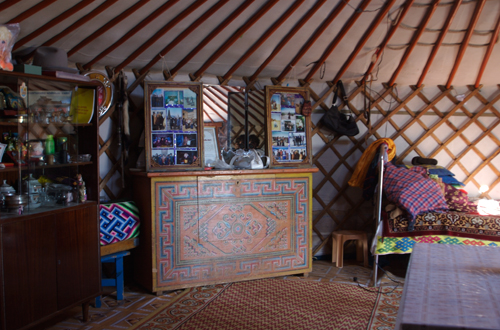
Ger interior; the Gobi near Bayanzag, Sept. 2006
Now ger visits are one of the things I MOST look forward to when I go to Mongolia. A ger, maybe because of the quality of space that the round shape creates, is one of the most pleasant and peaceful places that I’ve ever been in. I just happily sit sipping milk tea or airag and nibbling aruul as conversations that I don’t understand a word of go back and forth between my guide and our hosts.
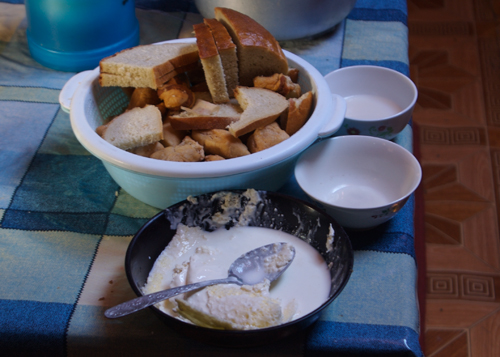
Mutton almost ready; my driver really tucked in; I passed; western Mongolia, Sept. 2006Boortz soup; Yum!! Mutton I can believe in (and eat safely); Baga Gazriin Chuluu, July 2009;Aruul; an acquired taste that I had acquired after about three (careful, 'cause it was rock hard) bites; western Mongolia, Sept. 2006Mongol-style clotted cream; to die for- near Hustai National Park, Sept. 2006
Gilmour seems to have relished ger visits also and provided a good description of the customs:
“As for entering tents on the plain, there need be no bashfullness. Any traveler is at perfect liberty to alight at any village he may wish and demand admittance; and any Mongol who refuses admittance, or gives a cold welcome even, is at once stigmatised not a man but a dog. Any host who did not offer tea, without money and without price, would soon earn the same reputation, the reason being, I suppose, that Mongolia has no inn, and all travelers are dependent on private houses for shelter and refreshment. At first sight it seems rather exacting to leap off your horse at the door of a perfect stranger, and expect to find tea prepared and offered to you free; but probably the master of the tent where you refresh yourself is at the same time sitting likewise refreshing himself in some other man’s tent some hundred miles away; and thus the thing balances itself. The hospitality received by Mongols in travelling compensates for the hospitality shown to travelers.”
Young hostess; near Hustai National Park, Sept. 2009 (the ger with the CREAM)
Sort of an odds and ends Friday as the year winds down. The deep freeze is over here in coastal Humboldt County and it’s back to nice normal rainy weather with nighttime lows in the 40s. I’ve been getting in some good easel time of the past few weeks. Here’s a new argali painting from reference that I shot in July at Gun-Galuut Nature Reserve. I watched this group of rams work their way across the rocky slope for almost an hour. “Uul” is Mongolian for “mountain”.
On The Slopes of Baits Uul, Gun-Galuut 18x24" oil on canvasboard (price on request)
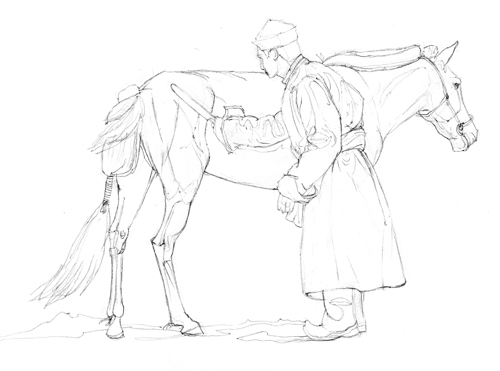
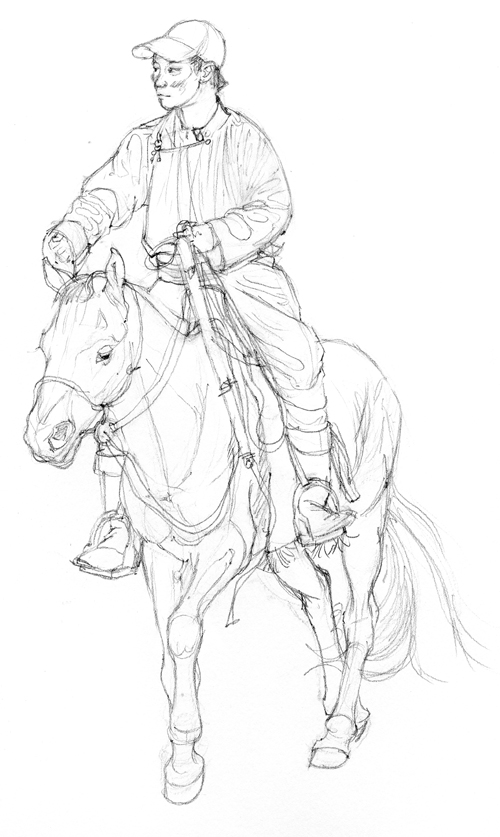
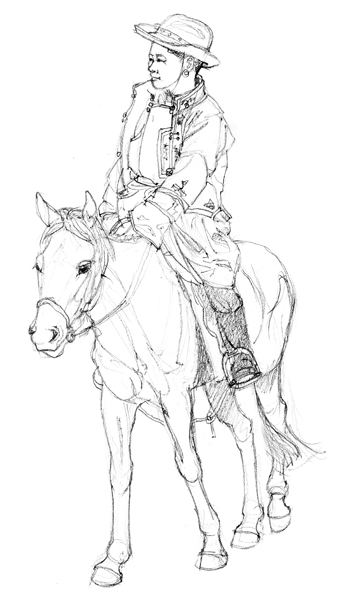
I’ve also decided that I want to paint not just the domestic Mongol horses, but the people who ride them. Which brings me back to wrestling with human figures, as described in an earlier post. I get a better result if I can scan the drawings rather than photograph them and also wanted to really hone in on accuracy, so these are smaller and done with a Sanford Draughting pencil, but on the same vellum bristol (which erases very nicely). The heads ended up being only 3/4″ high, which is pretty small, but it reminded me of a story from art school that I thought I might pass along.
One of my teachers was Randy Berrett, a very good illustrator who chose to work in oils. This was kind of masochistic, in a way, because it added a layer of complexity when he had to ship out a wet painting to meet a deadline. In any case, he was showing some examples of his work in class and one was a really large painting of the signers of the either the Declaration of Independence or the Constitution, I can’t remember which. Someone asked why he painted it so large. Randy’s answer really struck me at the time and has stayed with me. It’s something worth remembering when planning a painting. He said that he wanted the heads to be at least an inch high and that requirement controlled the final size of the painting. I’ve sized more than one painting on the basis of that criteria since then.
The first drawing combined two pieces of reference. One of the horse and one of the man. In the latter, he was in front of the horse’s head. In the former, I didn’t like the pose of the horse. Moving the man back works much better. The sweat from a winning horse is considered to be good luck. There are special scrapers made to remove it.
Scraping the sweat after the race, Baga Gazriin ChuluuLocal herder, Erdene NaadamBoy on horse, Erdene Naadam
Part of the reason I did the previous two was to see if the images “drew well” and to work on horses coming forward at a 3/4 angle. The final two are head studies, in which the heads are 1 1/2″ from forehead to chin.
Local herder, Erdene Naadam
Finally, the folks at Eureka Books in Old Town, Eureka have decided to hold a special art show. Here’s the Call for Entries.
Spent pretty much all of my easel time on the argali painting this week. I think I’ve got it on track now. I need to do some detail drawings of the horns of all three to make sure I understand their structure and perspective before I begin the final stage on them.
I tried painting the big ram light all over, like my reference of him, yesterday, along with defining his neck and shoulder muscles. Came in this morning and realized that I needed to go back to the original color rough because I’d lost the value contrast I needed and the interesting color variation that the younger rams have on their heads and bodies. So I ended up going in dark over light, which worked just fine.
end of day 10-21-09
I also added a couple more layers of color to the sky- a light warm and a light cool, knocked back the right side background with a pale glaze and the left shadow side with an ultramarine blue glaze to cool it down.
This morning I started on the young ram on the left and pretty much have him where I want him. Then I went back to the main ram and repainted him from head to tail.
end of day 10-22-09
I’m starting to get the light quality I’m after. Next, I believe, will be the left side and foreground rocks to “catch them up” with the rest.
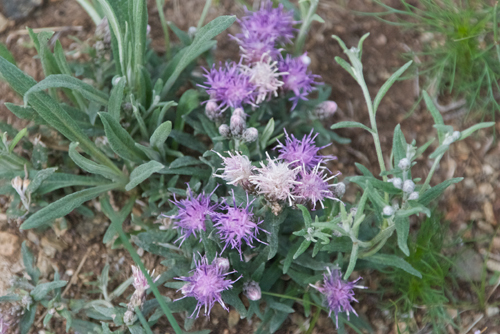
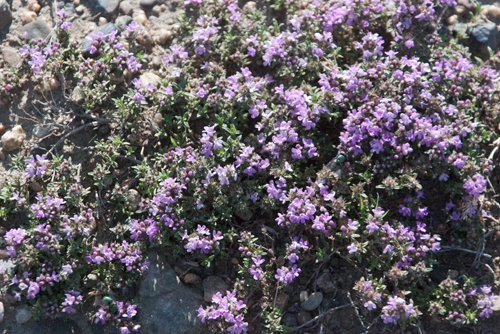
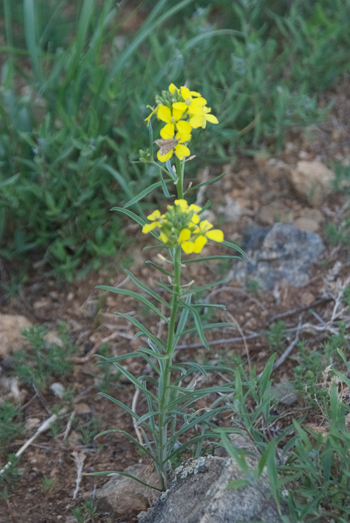
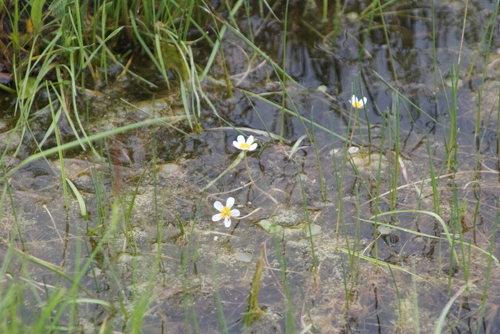
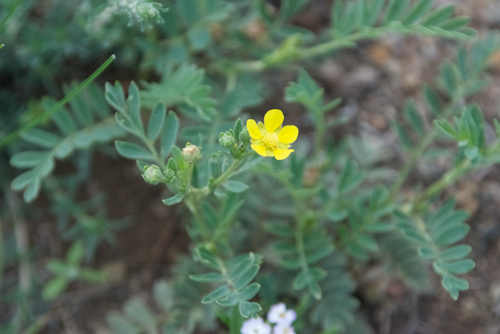
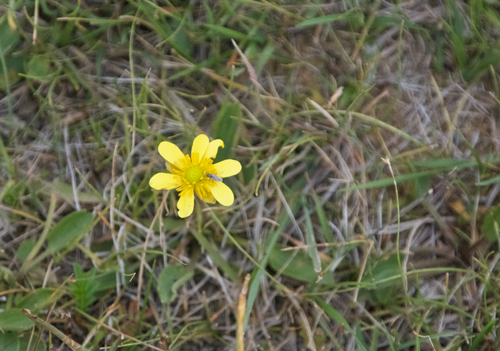
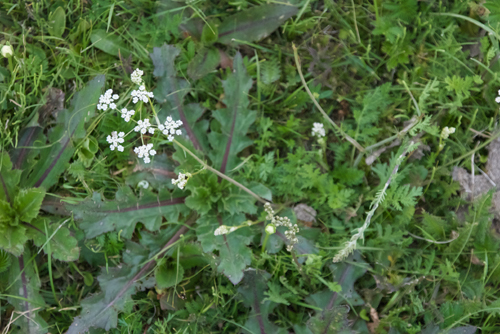
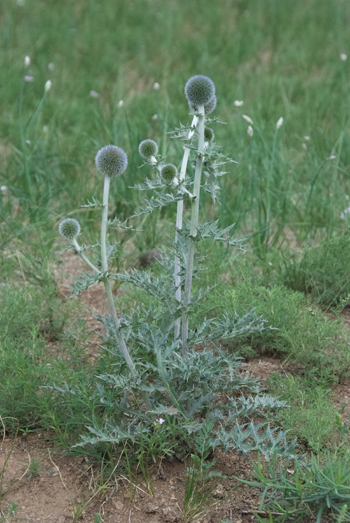
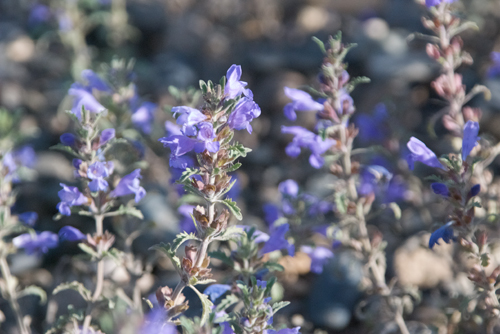
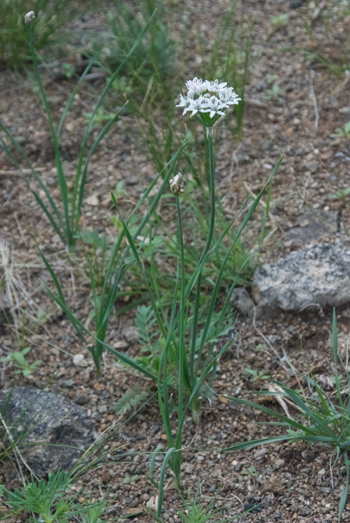
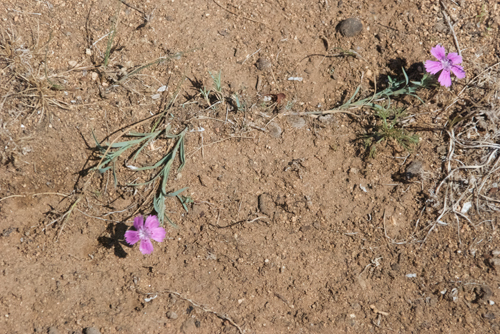
This is the final installment of images that I took of wildflowers during my AFC Flag Expedition to Mongolia this past July. As before corrections and identifications of flowers I couldn’t find in the guidebook I used, “Flowers of Hustai National Park”woulo be greatly appreciated.
Sawwort, Saussurea amaraSnow-in-Summer, Cerasttium arvenseThistle speciesThyme, Thymus globicusUnknown; guide said it was not a pasque flower since bloom season for that is earlierGoniolimon, Goniolimon speciosumWallflower, Erysimum flavumUnknown aquatic flowerUnknown white flowerUnknown white flowerUnknown yellow flowerUnknown yellow flower
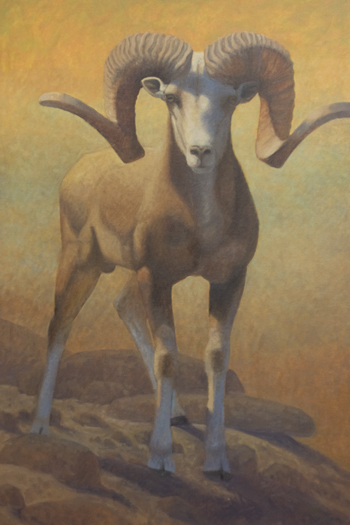
Writers of fiction say that they will have a story all plotted out, but sometimes the characters take control and things go off in unexpected directions. That’s more or less what I feel happened with the painting below. I wanted to do a big argali, because, well, I just needed to do it. About halfway through, though, I could see it starting to diverge from where I thought it was going. By the time I had the background mostly done and had started on the rocks and ground, it had become clear that the painting was going to be what it wanted to be and I was along for the ride. Interesting sensation. Without further ado, “Gun-Galuut Argali”:
Gun-Galuut Argali 36x24" oil on canvasboard (price on request)
I’ve gotten in a couple more good sessions on the big argali painting. The right side background still needed something, so I went back to my reference and found some rocky slope images that I liked. So far this one is behaving itself, but you never know.
This one shows how I start to block in the light side and some of the dark areas. The drawing is still kind of lost, but I’m not worried about that at the moment. I’m working on shapes and value/temperature relationships.
head detail
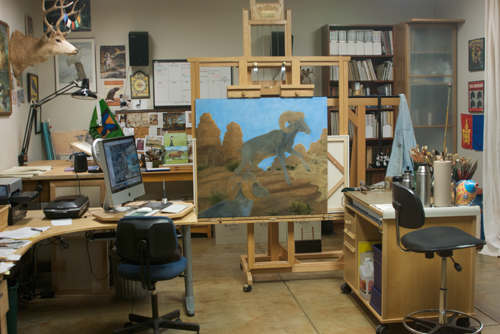
Here’s the studio set-up with my iMac on the left. And, yes, I love my Hughes easel, especially when I’m working on a larger painting since I work my way over most of it during a session.





























 Susan Fox, American Artist