Mongolia Monday- Tsagaan Sar=great food

We hosted our Mongolian friend, her husband and two other couples for a Tsagaan Sar party this past Saturday night. Tsagaan Sar is the Mongolian New Year and the name means “White Moon”. In Mongolia, it’s about three days of visiting, gift-giving and lots of food and drink. As I was thinking about what to post today, I realized that I haven’t written about the food and, when I poked around my photos, found that I’ve ended up with quite a few images (I take pictures of everything). So, here’s an “album” of Mongolian food, with commentary. My apologies in advance for any homesickness this may cause my Mongolian readers.

Salt deposit, western Mongolia

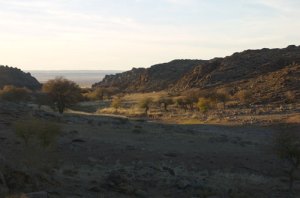
One of our stops when I was in western Mongolia in 2006 was this huge salt deposit. And, yes, we drove right out over that “bridge”. If you’ve ever played the game “Civilization”, then you can understand how this resonated with me. For how many thousands of years have people been coming here to get salt?

Harvesting salt, western Mongolia

There happened to be two men doing exactly that. Some of our party had to give it a try. At the end of the handle is a scoop with holes in it to let the liquid run out. It seemed to be trickier to do than it looked, so the local guys were pretty amused.
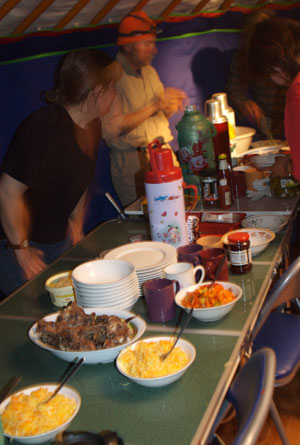
Mongolian BBQ during the Earthwatch project, 2005

The brown meat in the bowl is goat. The “Mongolian BBQ” that we get in the US is a Chinese invention and has nothing to do with how real Mongols eat. Their diet has traditionally been meat and dairy, diary and meat. Sheep and goats are slaughtered by cutting a slit in the stomach area, inserting a finger, hooking and pulling a vein (Thank you, Narantsogt, for the correction from what I had previously written. He has more info in the comments section) . Pretty humane and it keeps blood from going all over in a country where there isn’t extra water for cleanup.
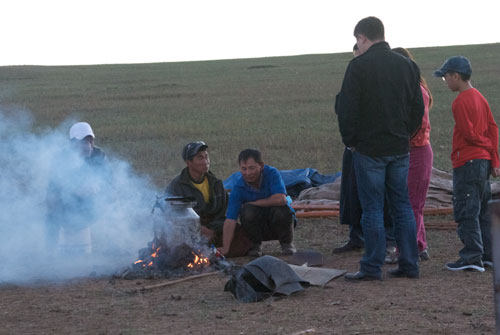
Real Mongolian BBQ, Arburd Sands

Here’s the meat in the pot after the foal branding at Arburd Sands. We were invited, but it was getting dark and it looked like the guys were settling in for a very convivial evening that was going to run very late.

Goat meat, Khomiin Tal

Sometimes the goat is simply butchered and hung up in the ger for use. I was told that this much goat meat would feed 3-4 Mongols for about two weeks. The humidity in Mongolia hovers around 10% max., so meat will keep in the dry air. On the other hand, the Mongols have been eating this way for centuries and have defenses against whatever might get into the meat. Westerners don’t, so we have to be careful what we eat. The head will be on the menu too. Nothing is wasted.

Meat for sale
Meat for sale

We stopped in a soum center (county seat) in western Mongolia for lunch. While we were waiting for our food, I saw these three ladies with meat to sell. They saw me take the picture and I went over and managed to tell them that I was from California. More smiles. Hope they sold out.

Buuz
Buuz

Maybe the most beloved item of Mongolian cuisine. Families make thousands of them for Tsaagan Sar. Generally the filling is mutton. I asked if I could take pictures and, from their expressions, their reaction was along the lines of, “Well, if you want to photograph something sooo ordinary, be our guest….What will those visitors think of next?” I guess the equivalent here would be taking pictures of a McDonald’s. I ate four. I practically had mutton fat running down my arm. They were one of the best things I’ve ever had when traveling. I can’t possibly miss them as much of the Mongols, but I’m really looking forward to my next trip.

There’s a recipe for buuz here. We’ve done them now with lamb and on Saturday we used ground beef. We are going to try to find mutton later this year.

On to dairy:

Aruul
Aruul

Aruul is essentially dried milk. Mare’s milk is heated up on the ger stove and separated. The solids (which Narantsogt says he remembers as cheese and yogurt) are mixed with water and flour and formed into a variety of shapes and put out in the sun to dry, usually on the top of the ger. It tastes kind of like an slightly acidic yogurt and is an acquired taste, I would think, for most westerners. It took me about three bites. Careful bites, with my molars, because this stuff is hard. But it’s the perfect snack food in the field. Pure protein.

Mongolian "clotted cream"

We were visiting a ger adjacent to Hustai National Park and, instead of aruul, I was offered this: pure cream to spread on the bread. Oh my goodness. I really had to get a grip on my manners, because I could easily have eaten all of it. But one has to remember that the Mongols will give you the last of what they have and do without in order to meet their obligations as hosts and many live pretty close to the edge.

Then they handed me a glass, which I assumed at first was the usual milk tea. After a few sips it dawned on me that it had to be the legendary airag (or kumiss, fermented mare’s milk). This was in September, so it was very late in the airag season. It can be “problematical” for western digestive systems and the feedback loop is very, very short. I decided to throw caution to the winds and drank about 4-5 oz. No problem. Whew.

Airag, vodka, cheese, Arburd Sands

Last year, at Arburd Sands, we were hosted by a local horse trainer and his family, who have 300+ horses. So there was LOTS of airag. This vessel was full to the brim. Fortunately, we weren’t expected to drink the entire contents of those rather large bowls. I think the idea was more for the host to be able to demonstrate the household’s generosity by offering brimming cups. The vodka was Chinggis Khan Gold, I think, which was excellent. The little cubes behind it were a soft cheese. Also delicious.

Finally, a menu item that I have not had the opportunity to try yet, but which is probably as near and dear to as many Mongol’s hearts as buuz. That would be….marmot.

Siberian marmot, Hustai National Park

The Mongols who like marmot, REALLY like marmot. When speaking of it, they get this kind of far away look as if remembering every bite they’ve ever had and are savoring it all over again. I’ll leave the hunting details to another time. If any Mongols reading this want to send me an accurate description and/or account, I’ll gladly post it. The traditional preparation involves gutting the animal and removing the fur with a, wait for it, blowtorch. Then it’s cooked over a  fire. On a cultural note, it turns out marmots living in Mongolia are the original disease vector for the bubonic plague (Black Death) that hit Europe in the late 1340s.

When you’ve come in from the countryside, there are lots of good restaurants in UB, including…a Chinese-style Mongolian BBQ, which has proved to be very popular with the actual Mongolians.

BD's Mongolian BBQ, Ulaanbaatar
BD's Mongolian Barbeque, Ulaanbaatar

If you are going to Mongolia, get the Lonely Planet guide.

For more on Tsagaan Sar and things Mongolian, I HIGHLY recommend the Asian Gypsy blog.

Gallimauphry

Rainbow from last week's storm

A great old French word that I picked up many years ago when I was active in the Society for Creative Anachronism. It means “a jumble or hodgepodge”. Which is kind of what today’s post is.

SOFTWARE THAT I USE to keep things moving and, with luck organized. FWIW.
I switched to Apple at the end of 2008 and have never looked back. I tease my husband, who still uses a PC, about when he’s going to come over from The Dark Side. He might, at some point, if his business requirements allow. In the meantime, other than house network stuff, which is still his balliwick, I can now handle my system with a minimum of whining at him for technical support.

1. MobileMe– keeps a bunch of data like my address book, email, notes, etc. in an online Apple “cloud”, which lets me effortlessly keep my iMac, MacBook and iPhone synced.

2. Quicken– checkbook balancing trauma is a thing of the past. At last. I also record my credit card transactions.

3. Flick!– just started to enter the records of my paintings. I used to have Working Artist, which I absolutely hated, but everything else available for the PC was worse. Flick! has a clean, attractive interface and responsive tech support. It’s built on Filemaker, the Mac-based database standard.

4. Aperture– Apple’s image management software; handles my closing in on 30,000 images effortlessly. Lets you open images in Photoshop with one click. Set up whatever categories (which it calls Projects and Albums) work best. The RAW files are resident on the iMac for speed, but are backed up to an external Time Machine hard drive,  so every image exists in duplicate. We hope to eventually keep an additional set on a Buffalo Terrastation that will be kept in the garage, which is a separate building. Am I paranoid? After experiencing a real, physical back up hard drive crash a couple of years ago with a machine that was supposedly designed to recover from something like that and having the vendor essentially shrug and say “Too bad”, and in which I lost forever a bunch of images of older work, you betcha. CDs are not archival. None of them. A high quality external hard drive is the only way to store images for the long haul.

5. Photoshop CS4– can’t imagine how I’d function without it. The relevant difference between it and Elements is that Elements doesn’t let you do CMYK conversions and other tasks necessary to prepare images for commercial reproduction. I use Photoshop for just about everything image-related.

6. iTunes– last year we converted over 700 CDs to digital. No more getting up to change discs and no more discs taking up valuable shelf space. All my music is right on my desk. Hey, it’s a big deal when you grew up with a record player and a stack of 45s and LPs.

SPEAKING OF MUSIC

Unless I’m writing, talking on the phone or doing concept work (thinking up ideas for paintings), the music’s on. I lived in the San Francisco Bay Area for most of the 1980s and there were still quite a few musicians from the 1960s around and working in various bands. Guitarist John Cippolina was one of them. He was best known as the lead guitarist for Quicksilver Messenger Service. I saw him in the mid-1980s in a band called Terry and the Pirates. It turns out there’s a two album set of recordings by the Pirates and, if you want to spend 99 cents on one of the hottest, driving SF-style rock songs out there, buy “Something to Lose”. Cippolina on the guitar and Nicky Hopkins, who was also in Quicksilver for while, on the piano. Crank. It. Up.

Species tulips, hellebores, flamingos
Species tulips, hellebore, flamingos

GARDEN REPORT

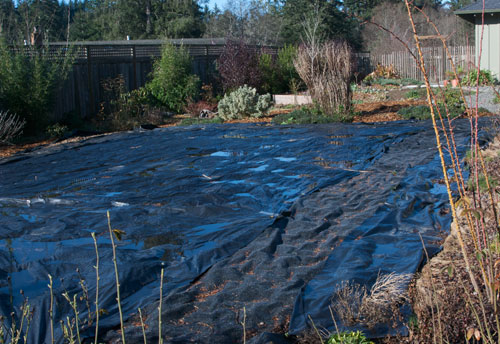
Frogs are at it around the clock now, crocus and early daffodils are blooming, tulips are up. Primroses going strong. In the neighborhood, the willows and Indian plum are starting to leaf out already. We’ve covered the front “lawn” (34’x19′) with black plastic and are going to turn it into a vegetable garden.

Soon-to-be-vegies!
Soon-to-be-vegies!
Pansies, Pickwick crocus, tulips

BOOK REPORT (and also PLANET SAVER TIP OF THE DAY)

I’ve become increasingly concerned about what’s happening/happened to the food supply in this country. The pet food recall in 2007 definitely got my attention. Oh, and then there’s the Peanut Thing. Now I’m (finally) reading The Omnivore’s Dilemma by Michael Pollan and it is really crystalizing my thinking. One of the basic points is that industrial scale food production, in and of itself, is a major problem, both in the animal suffering it causes and the loss of nutrition and taste in fruits and vegetables. Plus the environmental cost of moving all that stuff an average of 1500 miles. And who would have thought that corn and the excessive amount of it grown is literally the root of the problem.

It’s time to, as Pollan says, “opt out” of the industrial food chain. His book is an exploration of how that food chain works, what the consequences are and how new alternative food chains are being formed. Anyone who wants to make conscious, sound and informed decisions about what they eat needs to read this book.

For us, we’re becoming much better label readers (citric acid is from corn!?). We’re going to concentrate even more on sourcing our food locally. We already do not eat factory-farmed animals or animal products. Period. I’ve mentioned the vegetable garden. We also plan to get chickens later this year to provide eggs.

The great thing is that the information and alternatives are out there, especially for those of us who are fortunate enough to live in California. Obama mentioned in his State of the Union address that subsidies would be cut for “agribusiness”, which is long, long overdue. In the meantime, what we can do is vote with our pocketbooks.

EBay Auctions- 2-23-09 both SOLD 3-2-09

peacock

PEACOCK  oil on canvasboard 8×6

I photographed this handsome guy at the Denver Zoo last year. He was one of eight who were showing off for each other. Spring had sprung!. Click here to bid

morning-near-goose-lake1MORNING NEAR GOOSE LAKE  oil on canvasboard 8×6
Goose Lake is in the far northeastern corner of California and extends over the Oregon border. There is a state park with a very nice campground. This scene is from the surrounding area. It was a beautiful fall morning!

Click here to bid

Mongolia Monday- Excerpt from My 2006 Trip Journal- Ikh Nartiin Chuluu Nature Reserve

Travelers get attached to a particular place for a variety of reasons. Maybe it was stunningly beautiful or irresistibly peculiar. Maybe it was somewhere they’d wanted to go to since childhood, finally made it and it was everything they’d dreamed of and more. Maybe something special happened while they were there. Maybe they went for one reason and discovered something unanticipated but compelling. The latter probably most applies to why Ikh Nartiin Chuluu Nature Reserve has become one of my most favorite places on the planet.

This seems unlikely to me since I’ve never been a “desert” person. That would have been my mom, who found the area around Hemet, California (the landscape, not the trashy sprawl) quite to her taste. I like my landscapes green. With trees. Preferably redwoods. Like these at Prairie Creek Redwoods State Park, about 30 minutes from our house. I spent my childhood getting to camp out at places like this. Pretty darn lucky, I’d say.

prairie-creek

But Mongolia got to me. Except for the northern part of the country, which is the southern edge of the boreal forest, trees are not what Mongolia is about. It’s the ultimate wide-open-spaces destination. I went to Ikh Nartiin Chuluu for an Earthwatch project and found a place so special that I plan to go back until I can’t travel anymore. I returned in 2006 for a short visit, just a couple of days. Here’s what happened the first day.


October 6, 2006

Woke up and 6:30, out the door in less than 10 minutes to walk down the valley. Too early for good light, but saw a couple of argali dash up the hill from the stream over 100 yds. away so no photos.

ikh-nartiin-chuluu-valley

Valley where research camp is located

ikh-nartiin-chuluu-sunrise-rocks

First sun on the rocks

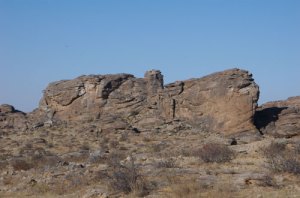
Came back for 7:30 am breakfast. Baaska (my guide), driver and master’s student still asleep, so headed out on my own about 8:30 am. Found my favorite huge rock! Windy but not cold. No argali or ibex. Stopped to rest and have a snack and realized that not only was the wind getting much stronger, but that the distant rocks were getting hazy with dust, just like when I was out with Rich (Dr. Richard Reading, the Earthwatch project’s Principal Investigator, and I walked back to camp in an on-coming dust storm in 2005 after the team had walked a 4km argali survey). Decided it was time to go directly back to camp since no one knew where I was, just that I would be back at 1pm for lunch. Got out the GPS, punched “Go To” POI #1 (camp) and got back just fine.

ikh-nartiin-chuluu-fav-rock

This rock turned out, from another angle, to be three formations that were overlapping, but I still like it! It’s about the size of an aircraft carrier.

ikh-nartiin-chuluu-nestCinereous vulture nest

Since I’ve never been here at this time of year and there really isn’t anyone to ask until Amgaa gets here or maybe Jed (two of the other scientists), it seemed sensible to play it safe. Maybe after lunch will be a good time to go out in the van and check out the Tibetan writings and see if we can spot any argali. The Mongolians, Baaska, student, driver, ranger are all yakking away in the kitchen ger. I’ve never known people who could sit down together, never having met before and just roll along talking like the Mongolians. It feels from the outside like the continuation of an ageless oral culture which hasn’t been undermined by tv. Yet.

ikh-nartiin-chuluu-skull2Argali skull

I hope this wind dies down. Being out in Ikh Nart again, just me and the rocks was really great.

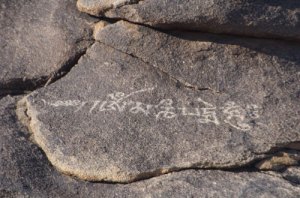
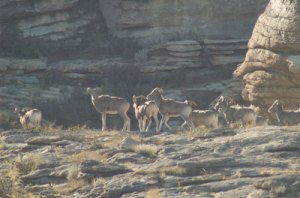
5:15 pm- Went out in our van with the ranger at 1:30. He needed to do some telemetry and was willing to find inscriptions. We found five, but no luck at all finding the one Rich took me to last time. Saw and photographed a large herd of  ewes with, it looked like, one ram and a smaller group a few minutes later. It has really stayed windy and cold. I’m in the ger with the stove going.

ikh-nartiin-chuluu-inscription

Tibetan inscription

ikh-nartiin-chuluu-argali

Herd of argali sheep

I’m Now A Member of Lost Coast Daily Painters!

As some of you may remember, I blogged a for a few weeks on marketing and  two items I discussed were “spend as little money to market your work as possible” and “strength in numbers”.

Today I’m proud to announce that Lost Coast Daily Painters is up and running and listing paintings on eBay. Here’s the press release that went out yesterday:

HUMBOLDT PAINTERS GET CREATIVE ABOUT SELLING ART BEYOND THE REDWOOD CURTAIN

If the economic slowdown has a bright side for artists, it is this: the opportunity to explore new ways to create and sell art. “My paintings range in size from quite large to very small, and for a long time I’ve wanted to find a format for showing and selling my small pieces.” said Eureka oil painter Kathy O’Leary. “This is a good time to take some chances and try something new.”

A group of five Humboldt County artists have joined together to take part in a growing international trend called daily painting. Painters complete one small work every day, post it on their blog, and sell it on eBay. The top-selling daily painters have cultivated large audiences and built a steady income selling paintings online.

Eureka author Amy Stewart is a student of oil painter Linda Mitchell. Last summer she went to Santa Fe to take a workshop from one of the most successful daily painters, Carol Marine. “Painting is really just a pastime for me,” Stewart said, “but I’m very interested in seeing what artists can do with technology and social networking. I’ve been blogging for years, and I was intrigued by the idea of selling paintings online and building an audience that way.” At the workshop she learned techniques for composing and finishing small, quick paintings, as well as eBay selling tips.

Now Stewart, Mitchell, and O’Leary have joined together with Dow’s Prairie artist Susan Fox and Eureka oil painter Rachel Schlueter to sell their paintings online through a group blog, Lost Coast Daily Painters. New paintings will go online every day, with bidding starting as low as $25 on eBay. A “Buy It Now” page lists paintings that are available for a fixed price directly from the artist.

Like most professional artists who participate in daily painting blogs, Mitchell plans to continue showing her work in galleries. “I’ll sell small paintings online, and work that I’ve shown before,” she said. “My larger paintings will continue to go to galleries. Most people want to see a larger piece in person before they buy it, and galleries are the place to go for that.”

Schlueter looks forward to the challenge of posting smaller works every week. “The idea is to do something fresh and spontaneous and put it out there, and then just move on to the next painting,” she said. “And it’s nice to be part of a group blog. That makes it easier to have something new up every day.”

Connecting with artists and art lovers around the world is another attraction, according to Fox. “I’ve been selling small paintings on eBay as an individual,” she said, “but I’m really looking forward to marketing my work with four of my colleagues and friends. Daily paintings are a great way to buy a single special piece or start a collection very affordably.”

Visit lostcoastdailypainters.blogspot.com for new work by each artist and links to other daily painting sites around the world.

—————–

I still have two paintings listed, but time is running short. Scroll down to find them and click to bid.

Here’s a preview of one of two paintings that I’ll be listing on Monday. There are five of us and we each took one weekday, so there are new listings Monday through Friday. We’ve already had sales before the official publicity kick-off, which is very encouraging. I have multiple bids in on “Pismo Beach Sunrise” and “Wyoming Cottonwoods” is being watched.

Without further ado, here is “Morning Near Goose Lake”-

Morning Near Goose Lake  oil  8"x6"
Morning Near Goose Lake oil 8"x6"

Paintings that don’t sell will move to our “Buy It Now” page and will be available for a set price.

UPDATE 3-4-10: Life brings change and I am no longer a member of Lost Coast Daily Painters. My career is taking a different path since last year and I find that I must concentrate on that. Three new artists have now joined the group and I encourage you to click on over and take a look at their work.

Re: Facebook TOS- VICTORY!

It took about 48 hours, but a pretty satisfactory response has come from Zuckerberg and company. This was posted on one of the Groups that formed to fight the change. The Facebook-formed Group mentioned below has almost 30,000 members as of 7am PST.

I do believe they’ve got it:

OFFICIAL RESPONSE FROM FB SPOKESPERSON BARRY SCHNITT:

Hi everyone,

First, I want to apologize for the delay in response. It’s been a long day with lots of interesting and constructive discussions. Second, I want to thank you for your questions and concerns. As Mark expressed in his blog post on Monday, it was never our intention to confuse people or make them uneasy about sharing on Facebook. I also want to be very clear that Facebook does not, nor have we ever, claimed ownership over people’s content. Your content belongs to you.

We do need certain licenses in order to facilitate the sharing of your content through our service. That’s where the Terms of Use come in. The fact that you’ve raised the questions you have is proof that we haven’t done a good job explaining these licenses in the actual language of the document. In fact, as we were working to answer your questions, we realized the new version of the Terms might technically permit some of the hypothetical situations people have offered. I can assure you, however, that these hypotheticals aren’t ones we had in mind when writing the Terms, and that selling user information for profit or using it to advertise Facebook in some way was never part of our original intent. Assurances aren’t enough, though, and we plan to codify this in our revised Terms through simple language that defines Facebook’s rights much more specifically.

In the meantime, we’ve decided to revert to the old Terms as we work to address this. Mark has explained this in more detail in another blog post (http://blog.facebook.com), and we’ve created a group where people can provide input (http://www.facebook.com/group.php?gid=69048030774). We hope you’ll join this group and post comments. We promise to use these comments to help construct a new Terms of Use that reflects the principles around how people share and control their information, and that’s written clearly in language everyone can understand.

I hope you don’t think your participation in this discussion was a waste of time. Honestly, your questions were very helpful to us in arriving at what we believe is the right decision. Also, I think your questions will continue to be useful as we’re crafting a new Terms.

Again, thanks for the fruitful discussion and a special thanks to Anne Katherine and Julius for setting up this feedback forum. We hope you’ll all join our “Facebook Bill of Rights and Responsibilities” ( http://www.facebook.com/group.php?gid=69048030774 ) group and continue discussing these issues there.

Any Artist Or Creative Person With A Facebook Page Needs to Read This

Facebook recently changed its Terms of Service (TOS) in a way which explicitly gives them unlimited, forever rights to whatever content you post there. Three Groups have formed so far to fight this.

Read more about it here

Regardless of the fact that we all might as well accept that anything we put up on the Internet is there forever and can’t really be controlled, that does not give someone like Facebook the right to appropriate their user community’s intellectual and copyrighted property for their own possible future profit. That’s not sharing, it’s theft.

EBay Listings 2-16-09-both SOLD 2-23-09

Wyoming Cottonwoods, oil 8"x6'

Click to bid here

Pismo Beach Sunrise oil 8"x6"

Click to bid here

Mongolia Monday- Excerpt From My 2006 Trip Journal; Takhi Watching at Hustai National Park

On my first trip to Mongolia in spring of 2005, I managed to get a couple days at Hustai National Park, enough to know that I wanted to go back when the daytime high was more than 32F with howling wind (ah, early May in Mongolia!). Hustai is the most accessible place to see reintroduced takhi, or Przewalski’s horse. For 2006, I arranged to have the use of a car, driver and guide so that I wasn’t dependent on driving around with other, non-artist visitors.

I needed to be in the park at dawn and at the end of the day in order to get what I’d missed before because of cloud cover- takhi in great light. This excerpt is from my first day.

9-27 10:15 am Wed.

Just got back from the morning “game drive”. Left a little after 7:30 am and got to the valley just in time to catch the light about 8 am. Hit the jackpot, Two takhi just on the shadow side and then coming into the sun.

Takhi Mare and Stallion at sunrise, Hustai National Park

Went back up to (the) pass, seeing more takhi and the 2 eco-volunteers from France who I sat with last night. Missed a great shot of a bull marel (a species of elk) because the driver didn’t stop in time. Continued over and down around the backside of what my guide says is called “God Mountain” because all the spire-like piles of rock look like flames of fire. There were takhi at the base of a particularly picturesque part of it and the guide asked me to take her picture. She pointed out another mountain where she said lynx live.

Guide with takhi in front of "God Mountain", Hustai National Park

We continued on into what she says is called “Happy Valley” and it sure was for me. Came upon 2 groups of takhi, one waterhole. I think the issues were who got to drink first and can I steal some of the other guy’s mares. (There are 3 largish songbirds pitty-pattying around on the top of the ger as I write this entry)

Takhi harems at waterhole, Hustai National Park

We entered a part of the valley with trees along one side and it turns out they are saxaul, which I didn’t expect to see until I went south (and it turns out that I hadn’t. Something must have gotten lost in translation, because I found out this last trip that they for sure weren’t saxaul trees). There were also some domestic horses, which the driver got out to shoo away. We circled around out on the grasslands and saw 2 small and 1 large group of gazelle. Final stop was the research center, which was looking pretty sad and almost derelict last time. It’s humming now. Offices for the ec-volunteers, the managers, biologists, ecologists and a kitchen. There’s even curtains on the windows.

So, I’ve gotten my evening light and early morning light. Now it’s just seeing what kind of behavior I can record.

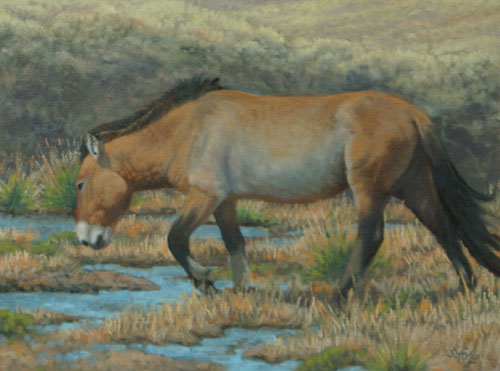
I liked the waterhole setting and plan to eventually do a big painting with both harems that tries to show what I saw that morning. In the meantime, I had this reference from elsewhere in the park of a mare with a beautiful gesture.

Morning Drink oil  12"x16"
Morning Drink oil 12"x16" (price on request)