This has been a fun, and instructive, series for me and I’ll definitely be doing more of this kind of thing for my own study work.
Most of the drawings I’ve done for the previous posts were done fairly quickly, generally 30 minutes or less. For today, I’ve done more finished drawings, once again using the Wolff Carbon pencil on vellum bristol.
The idea for these was to use all the features of the subject, including gesture for the full body drawings, to capture its character and essence.
 For a Bactrian camel head study, I looked for reference with a 3/4 view, but most of what I have didn’t seem like it would draw well because the position of the features is so odd. Time was limited, so I stayed with a classic profile that shows his calm, unexcitable nature. My husband and I got to sit with a large group of camels at Arburd Sands when we were in Mongolia and I could practically feel my blood pressure drop as I sat and sketched them.
 The body of this spotted hyena got too big, so I cropped her at the shoulders, which gives a different look than the camel above, in which the drawing trails off in value, number of lines and amount of detail. I find hyenas interesting and compelling on a number of levels. They live in a matriarchal clan structure, will go to war with lions and move a lot faster than you think they can with their gallumping, awkward gait. The African night wouldn’t be the same without their crazy whooping and insane giggling.
 I love the flow of the pose I captured at Yellowstone as this coyote ran parallel to the road in nice morning light. The head demonstrates that you can get a lot of character without a lot of detail if you make your marks carefully, see the shapes correctly and don’t get hung up in drawing individual hairs.
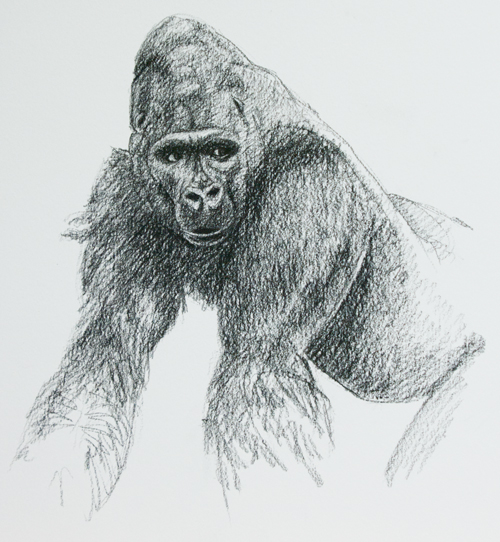 This drawing and the next one ended up too big to scan, so they were photographed and then processed in Photoshop. They were done on white paper, but I kind of like the toned effect. In any case, I’ve rarely done primates, but I got some incredible reference of the gorillas the last time I was at the San Francisco zoo and have been looking forward to seeing what I could do with it. The big silverback male was on morning patrol and he didn’t miss a thing.
 Sometimes a subject serves itself up on a silver platter and is so compelling that the artist’s job is to simply not mess it up. I found warthogs to be, pound for pound, THE most entertaining animal I saw in Kenya. This one was at Lewa Downs, grazing near the lodge we stayed at. He’s got it all: great ears, that remarkable face and the solid body carried by relatively delicate-looking legs and feet.


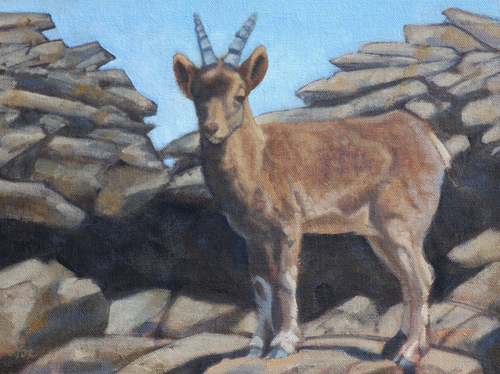

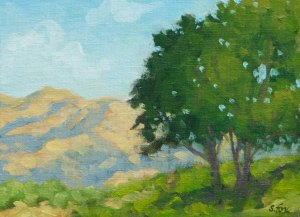

 A Holsteiner stallion, who I did a portrait commission of year before last.
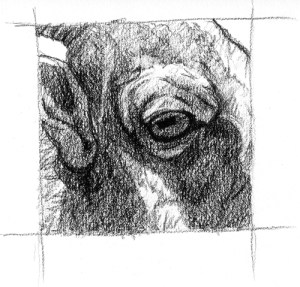 A bighorn sheep ewe from the Denver Zoo.
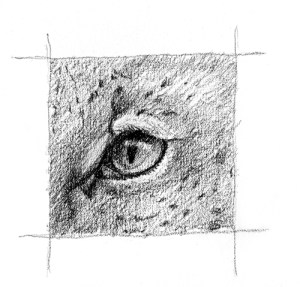 A serval, also from the Denver Zoo.
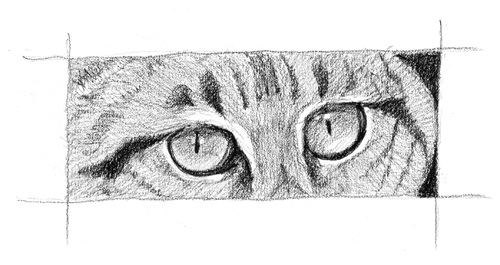 And our own dear tabby girl, Persephone, aka The Princess.
 I’m going to start posting drawings of various subjects since, after all, I am an artist, not a photographer or book reviewer. Today’s drawing is of two young takhi stallions that I photographed at Khomiin Tal, the third takhi reintroduction site after Gobi B and Hustai Nuruu. It is located in the Zavkhan province or aimag, which is in western Mongolia. I read on one of the Mongolian news websites that the herders out there lost 250,000 livestock over the winter. I haven’t found any info on the takhi, but I know that people stay out at the research camp and feed them if necessary. Twenty-two horses were initially shipped to Khomiin Tal from a semi-reserve in France which is located at high altitude in the French Alps. I would think that there would be over two dozen horses by now.

 This is the mouth and muzzle of a Coke’s hartebeest, a large antelope, which I saw in the Masai Mara, Kenya. It has a very long head. When I enlarged the image to see the mouth better, I was struck by how its shape and the shape of the nose flowed together in an almost art nouveau manner. Just the kind of thing I look for.
 Also from the Mara, this is the mouth of a spotted hyena. Their jaws are trememdously strong and can break large bones apart. And, as you can see, are filled with teeth. Studies have proved that they hunt at least as much as they scavenge. They live in female-centric “clans” in a defined territory that they defend against anything, even lions. I really enjoyed watching them and hearing them “whoop” at night.
 This is the muzzle of a young lion I saw in the Mara. No scars yet and it has an almost soft quality that will change as he gets older.

 Susan Fox, American Artist