Having A Lovely Time

But first….this is post number 300! Thank you to everyone who has visited, left comments and has otherwise been supportive. I really appreciate it!

Hard to believe that my trip back east is almost over. Wednesday was the Society of Animal Artists board meeting, which was very productive and worthwhile. There were fifty applicants for membership. Eleven were accepted.

The next day, my host, Guy Combes, needed to get some work done, so I got to see one of his paintings in progress and just kick back. Around lunch time he took me over to the headquarters of Greenwich Workshops, who publishes Guy’s giclees and also handles his originals. They’re located in a lovely old brick building in the small town of Seymour. But once you’re inside in the production rooms, it’s state-of-the-art.

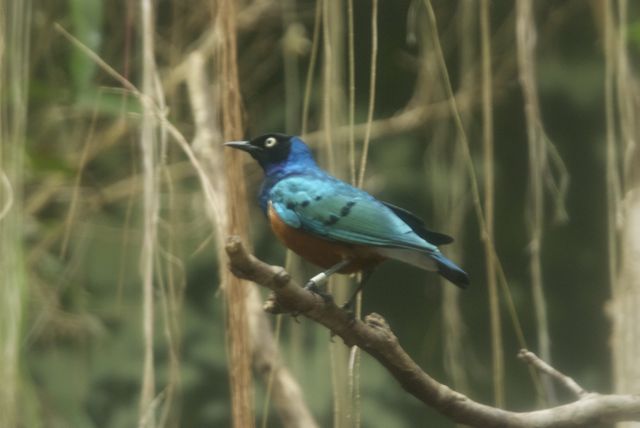
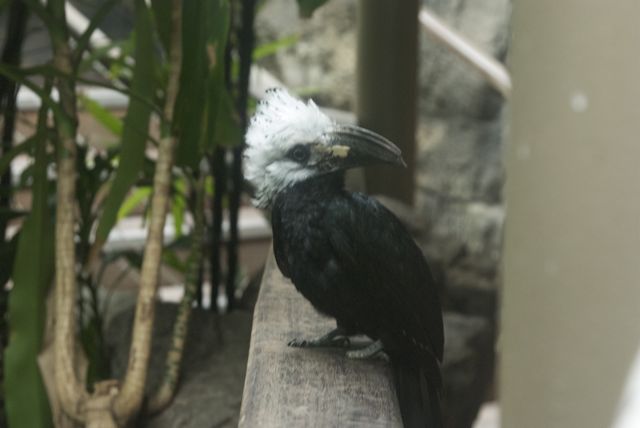
The following morning, we drove down to the home of Alison Nicholls, a fellow Flag Expedition grant recipient. Her trip was to study African wild dogs. The three of us starting talking art and animal shop immediately, continuing on into the next day as we took the train into New York to go to the Central Park Zoo. It’s a small facility, owned and operated by the Wildlife Conservation Society, but it plays an important role in introducing city children to wildlife and conservation. The highlight was the tropical bird aviary. Here’s a few images:

Superb Starling (East Africa)
Long-tailed hornbill (East Africa, but not Kenya)
Victoria crowned pigeon (Indonesia and New Guinea)

Back at Allison’s, we went out for a great seafood dinner, still talking shop. It’s been a real treat for me since Allison and Guy have been to many interesting places that are different from where I’ve been.

Today we’re going to drive up to New Haven to hit a couple of museums, probably the British Collection and the Peabody, both based at Yale University.

Mongolia Monday- A Short Intermission

I leave on a trip to New York tomorrow to attend my first meeting as a member of the Board of Directors of the Society of Animal Artists, then I get to hang out for a few days with a couple of other artist friends. Don’t know what my internet connection situation will be, but I’ll post on Friday if I can. Otherwise, I’ll be back next Monday for the next installment of the current series.

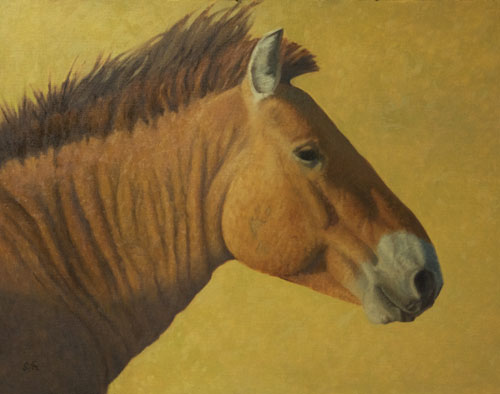
New Painting Debut! “Hustai Takhi Stallion”

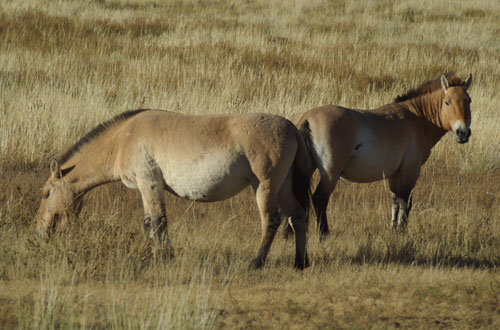
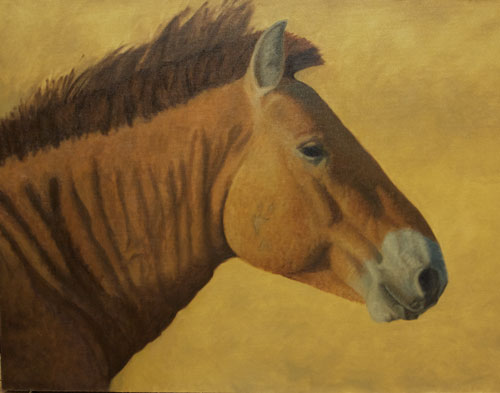
I’m currently working on a large painting that is the most complex one I’ve done yet. I’ll post it when it’s finished. But, in the meantime, I’ve kind of taken a break from it on and off to do something simpler and more straightforward, a head study of a takhi stallion I saw at Hustai National Park in 2006. I had a reference shot that I liked because of the shadow pattern, but as you’ll see there were adjustments that had to be made for it to work as a painting. I hope this step-by-step illustrates how important it is to not, as they told us in art school, get “married to your reference”.

My subject is on the right. A stallion keeping an eye on his mares on a sunny fall day.
The reference photo. It's a little out of focus, but, hey, I'm an artist. 🙂
When it's a simple subject like a head study, I dive right in with a brush drawing. Notice that I'm looking for basic shapes, not detail.
First pass with color, laying in shadow areas.
All-over basic color lay-in. Composition, drawing, value pattern set.
About mid-way through. The stage is set for the fun part. Head is almost done and it's time to do the neck, ear and mane. I worked those folds for most of yesterday afternoon. They had to read correctly, but not stand out too much. Notice that by this point I've ditched the hard cast shadow because it was too visually distracting. I want viewers to look at his head, not his neck. I worked the boundary of the shadow until I got what I wanted, keeping the edge soft.
The horse is done. Now I've started to put in a second color on the background. Not sure where I was going to go with it, but ended up liking it enough that I made it the final color. I liked the complementary color relationship between the reddish horse and the greenish background.
Hustai Takhi Stallion 22x28" oil on canvasboard

Mongolia Monday- 6 Cool Souvenirs To Bring Back From Mongolia

Mongolia is probably terra incognita for what comes from there that would be of interest to western visitors. The Lonely Planet guide has a section on souvenirs, but until you’ve walked through the 5th floor of the State Department Store in Ulaanbaatar, you can’t appreciate the possibilities or the variety. Plus, in general, the good stuff is still inexpensive and eminently packable. Here’s my list of six favorite momentos of Mongolia.

1. Cashmere


The good news- the world’s finest cashmere comes from the cashmere goats of Mongolia. The bad news- goats are really hard on the land because they pull plants out by the roots when they graze, unlike sheep, cattle and horses. But…cashmere is currently the best source of income for many, if not most, of the herder families. (Land sustainability issues in Mongolia is a subject for a future post.) Unfortunately, most of the cashmere they, or rather their goats, produce, goes to China which is where it is turned into finished products.

However, you can get cashmere products that are produced in Mongolia. There are a number of factories, Gobi Cashmere being the best known. The point is to make sure that you are buying Mongolian-made cashmere. Our Earthwatch team got to visit the factory store of Gobi Cashmere in 2005. At the time, a lot of the clothing had kind of a dated look and the colors were, let’s just say bright and cheerful. That’s all changed and the downtown stores stock very stylish fashions. I came home with a long scarf (see above) woven in three natural colors. It’s fabulous.

2. Clothes
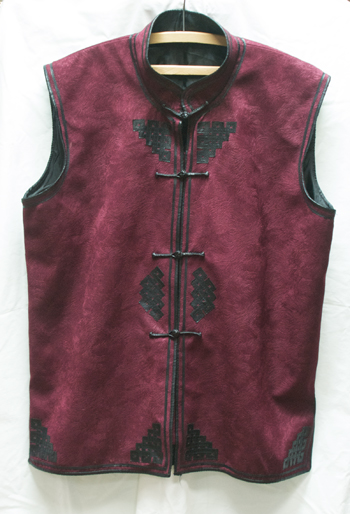

Not everyone is into ethnic clothing, but I’ve loved the look since the 1960s. Mongolia is a dream come true for me. There are vests (see above) and jackets to choose from in different colors, both in wool and cotton. What I’ve really fallen in love with are del, the national garment. I wear one in the morning as a robe and always have one with me when I travel. They’re perfect for staying in ger camps when you need to get to and from the toilet and the shower. They’re practical and packable. I wear my vests all the time; out to dinner and to art openings. A cotton jacket is perfect for wearing into town.

3. Felt
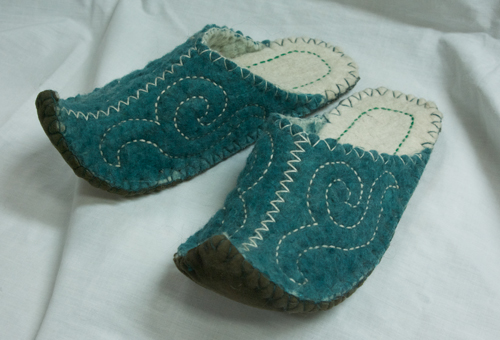

There’s been an explosion in the production of felt products, especially, it seems, slippers. The trick here is to learn the difference between the items that are factory-made with machine-made felt and the ones that are hand-crafted out of hand-made felt. As you can imagine, cost is one giveaway, plus the former are almost too perfect and lack that quality of being made by a human hand. These are hand-made. Not sure what was used for the color. It turns out that footwear with upturned toes originates in the traditional Mongol land ethic, which is to not damage the land that supports you, even if it’s just scuffing it with the front of a regular boot.  As regular readers of this blog know, I’m involved in supporting a women’s felt crafts cooperative “Ikh Nart Is Our Future”. More felt craft pics here.

4. Art
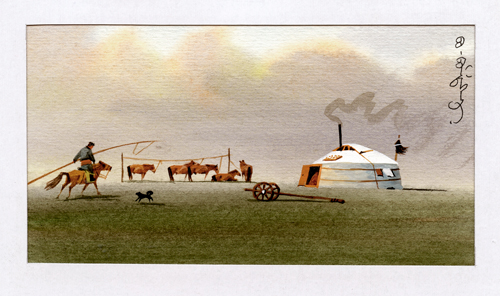

For me, one of the greatest discoveries about Mongolia has been how artistic the culture is. Bali gets a lot, if not most, of the attention, but Mongolia deserves a spot in the sun, too. A BIG spot.

The lively art scene is still unknown to most of the world. On any nice day at Sukhbaatar Square in Ulaanbaatar, one is likely to encounter art students carrying around portfolios of their work for sale. And, in one case, I bought two pieces from a woman who was selling work by her husband. When I go to Mongolia now, I try to find one new artist per trip. That hasn’t been hard as I usually find at least two. The above small painting is from my last trip. It’s a 3×6″ original watercolor and it cost all of about $3.00 USD. I try to find two or three by the same person so I can hang them as a group. It is very typical of what you find in the souvenir stores; charming little “slice of life” scenes with all the traditional elements. One of the others by this artist had camels, too.

The second painting is watercolor on canvas and is one of six my husband and I bought when we were in Mongolia in 2008. It’s 13.5×18″ and was about $35 USD. I don’t know who he is (Can anyone translate the signature, which is in the old Mongol classical script?), but he’s phenomenal!

Both of these pieces came from the State Department Store, which has, by far, the best selection of art for sale.

5. Music

Besides art, another aspect of Mongol culture that deserves to be better known is the contemporary music scene. If you went by what was on Amazon, you’d think that Mongols still only do traditional forms like khoomii (throat singing), long song and play the morin khuur, but you would be wrong. Once again, regular readers know how much I like current Mongol music. The CDs are impossible to buy over here, but there are a lot of videos on YouTube. I posted some of my favorites here, here and here. The Hi-Fi shop on Seoul St. in Ulaanbaatar has a good selection and is where I’ve gotten the ones I’ve brought home.

6. Poetry Books

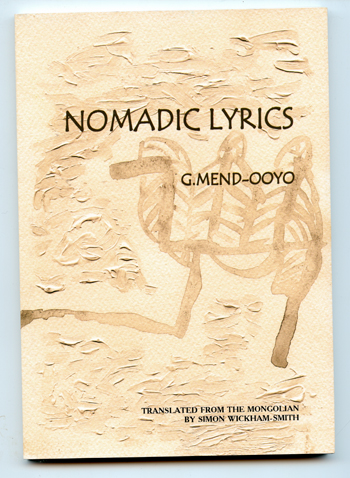
Finally, the literature of Mongolia is also not well-known in the West. Only recently has any amount of it been translated into English. I came across an old book of poetry at the Chojin Lama Museum, then found the one above and some others in the gift shop at the Bayangol Hotel. The translator, Simon Wickham-Smith, is working with the Mongolian Ministry of Poetry and Culture (Wouldn’t it be nice if the USA valued those things enough to have a government agency devoted to them?) to bring Mongol poetry and literature to the world. Simon was nice enough to contribute two guests posts to this blog here and here.

I’ve come to believe that a non-Mongol really needs to read some of the poetry to start to understand the Mongol’s relationship with the land, the seasons and, of course, their horses.
Five Reasons To Do Small Paintings

Over time, I think most painters end up with preferences for size, ranging from true miniatures that may only be an inch by an inch to, well, big, really big. Like ten feet high.

I’ve tended to stay in a middle range, which happens to be what has NOT been selling during the recession. But before the meltdown, I had decided to start doing art festivals and I needed a large body of work. Most of the paintings are 12×16″ to 18×24″.

Then I joined the Lost Coast Daily Painters and found myself needing to have a small (5×7″ to 8×10″) painting to post every week. It was hard at first to work that small, but I got used to it and started to see some definite advantages:

One, they are more affordable for people.

Two, many buyers and collectors don’t have room anymore for work that is much bigger and it encourages them to take a chance on a new artist. That would be me.

Three, small works seem to be considered appropriate for gift-giving, so that expands the market a little.

Four, for me as an artist, I’ve found that it’s a good way to study various painting problems, like capturing light effects, without investing time and materials in a larger piece that might not pan out.

Five, they force me to focus on one idea and to keep it simple.

Here are three recent small works:

Arcata Bottoms Stormlight oil on canvasboard 8x8"

I wanted to capture the light effect of dark clouds and sunny areas. Working in a square format was fun, too.

Black Bear, Grand Tetons oil on canvasboard 16x8"

I’ve struggled with how to paint this kind of light effect- foreground shade and background sun. It’s a push and pull process. I think this works pretty well.

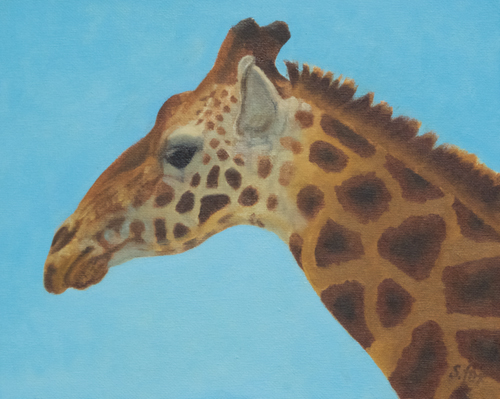
Reticulated Giraffe, Samburu oil on canvasboard 8x10"

Once again, I’m studying how to do a light effect- the high key shadows and reflected light on the head of the giraffe. I also ended up with a postive/negative shape relationship that I like. The color of the giraffe and the sky form a complementary color relationship, too.

What has evolved over the past year is an interesting split that is working well for me. I’m doing a lot of smaller pieces like the ones above (I plan to have 30 or so available at the Marin Art Festival). And then I’m painting larger, major pieces that can require a lot of preliminary work. With luck, you’ll see the latest one next week.


Mongolia Monday- Juried Show News!

We interrupt our regularly scheduled series on cool things to see and do in Mongolia because I got a packet in the mail yesterday informing me that my painting “Choidog and Black” has been accepted into a special exhibition of the American Academy of Equine Art, “The Horse in Fine Art, a Salute to the World Equestrian Games 2010”, which are being held in the United States for the first time ever.

Submission was by invitation only, so that was gratifying all by itself, but to have a painting accepted is a thrill! Especially when the invitation encouraged artists to submit images that reflected the events to be held at the Games, such as dressage, show jumping, reining and endurance, none of which I have ever seen in person. The only work of mine that the Academy has seen was the Mongol horse piece which was in their fall juried show, so I figured they knew that that was what I do and what they would get.

I submitted three paintings, two of horse racing with the boy jockeys ( here and here) and one of Choidog, the horsetrainer. They chose what I would consider the “purest” Mongol one, because he is wearing traditional clothing, not the modern clothes the kids have on. I hope they post the show on their website so I can see the other paintings!

Choidog and Black 18x24" oil on canvasboard

So I am in the happy position of having one of my Mongol subject paintings in a show that will be viewed by horsey people from all over the world. Nice way to start the week.

Next Monday, I’ll return to my six part series with my personal choices for the six best souvenirs to bring home from Mongolia.

Rewarding Day At Point Reyes National Seashore

As promised, here’s a look at Point Reyes National Seashore on a fabulously beautiful day.

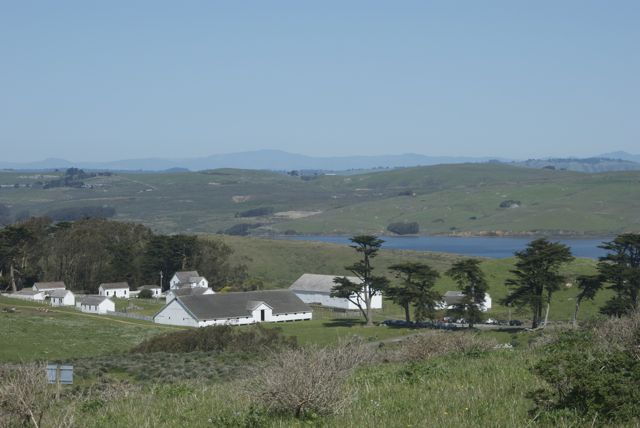
Pierce Ranch buildings at the northern tip of the park

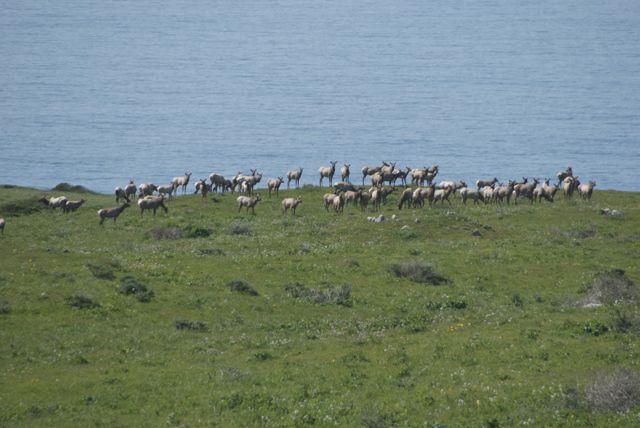
Unlike most national parks, people still live and work within its boundaries. There are over a dozen dairy and cattle ranches dating back to 1852 still in operation, plus an oyster farm. Back in the mid-20th century, developers wanted to turn the whole area into a new city. After a long battle, that was defeated and now this incredible part of west Marin County is preserved for everyone to enjoy. Including around 450 tule elk, which is what brought us to the park yesterday. They had been extirpated from the area by 1860. Nearly a century later, they were re-introduced. They are smaller than the better-known Roosevelt elk, whose southern-most range stops about 300 miles north in Humboldt County.
tule elk grazing
Tule elk; what a backdrop! The Pacific Ocean
Tule elk; part of a herd of about sixty

When it comes to wildlife, one never knows what to expect. We had great luck and saw four different herds, all from the road. I didn’t have my long lens, so these images were taken with the 28-300. You can see that the elk weren’t very far away. Below are more images of other parts of the park.

Looking north; elk are to the left
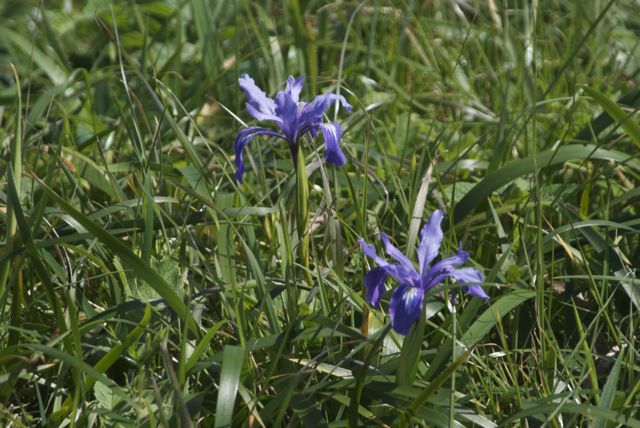
Native Douglas iris; it was blooming in big clumps all through the park
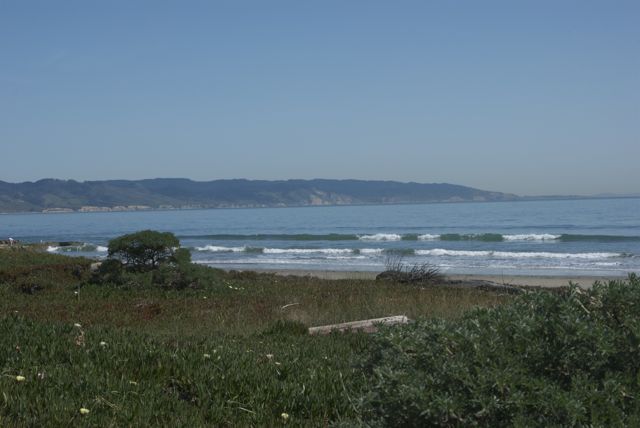
Near the lighthouse at the southern-most point, looking north along beach
Drake's Bay, to the east of previous image, looking south towards San Francisco

Yes, THAT Drake. Sir Francis Drake made a landfall here in 1579. He stayed here about five weeks, hauling the Golden Hinde onto the beach to careen her, which means pulling her out of the water and leaning her on her side to clean the hull of barnacles and seaweed. He and his crew encountered local Miwok indians who supplied them with boiled fish and meal ground from wild roots.

Another of the old ranches; on our way out of the park

Point Reyes, as you can imagine, is a magnet for local and visiting plein air painters. Now that I’ve been able to reconnoiter, we’ll plan a future trip so we can stay in the area and have time for me to paint, too. There are a lot of small resort motels, a private campground in Olema and vintage hotels, B&Bs and good restaurants in Point Reyes Station. We had lunch at the Pine Diner. Cobb Salad to die for.

More on Point Reyes on the official site here

Friday Follies

We’re on a weekend trip to the San Francisco Bay Area. Taking care of some business in Santa Rosa this morning, getting a second key made for the VW Eurovan (long story) and then it’s fun time.

The next stop will be Point Reyes National Seashore, which is on the north side of the Golden Gate in Marin County. At the northern end is a tule elk reserve, which is the main reason we’re going to the park. With luck I’ll be able to post photos late this afternoon or tomorrow morning, along with information on this species of elk that is smaller than the better-known Roosevelt elk.

I’m also hoping to get good reference for small paintings that I’m going to do for the Marin Art Festival in June. Perfect work/play day.

The weather is spectacular. It was 72F in Santa Rosa at 8pm last night. Crazy for March, but very pleasant. Clear as a bell and sunny this morning, so it should be beautiful over on the coast and even warm.

Mongolia Monday- The 6 Ecosystems

Continuing on with our series, I’ve always thought it would be fun to do a trip that would start either in the north or south and travel through all six major ecosystems in Mongolia, which run roughly parallel to each other in bands going from east to west.

Here is a map that shows them very well. It’s from a booklet, “Mongolia’s Wild Heritage: Biological diversity, protected areas and conservation in the land of Chingis Khan”, that was published in 1999. It was a cooperative effort between the Ministry of Nature and Environment, the Mongolian Academy of Sciences, the Mongolian Biodiversity Project and the Worldwide Fund for Nature. I don’t know if it’s still available, but if you are interested, drop me a note and I’ll see what I can do.

Starting in the north:

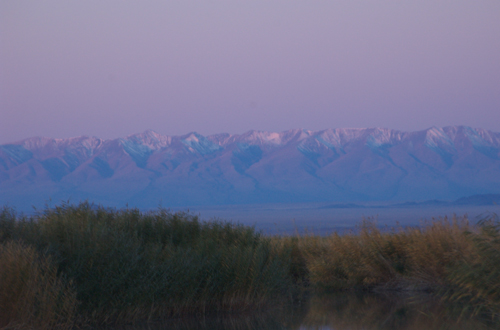
1. High Mountain– I haven’t been up into the mountains yet, but I did get the above photo of Jargalant Hairhan, which is part of the western Altai Mountains. The high mountains make up about 5% of Mongolia’s land. The climate is extreme. There are still some glaciers in the Altai Mountains. Animals that can be found there include argali, snow leopard, ibex, Altai snowcock and two species of ptarmigan. The photo was taken during my 2006 trip to Khomiin Tal on our way back to Hovd.

2. Taiga– the southermost part of the vast world-circling boreal forest, or taiga, extends into northern Mongolia.  It covers about 5% of Mongolia’s land area. The weather is also extreme with more rain and lower temperatures than most of the country. The most common species of tree is Siberian larch. Animal species include reindeer, wolves, wolverine, lynx, Eurasian river otters, stone capercaillie and three species of owl. This is the famous Turtle Rock, which I photographed in Gorki-Terelj National Park in May of 2005. It was snowing.


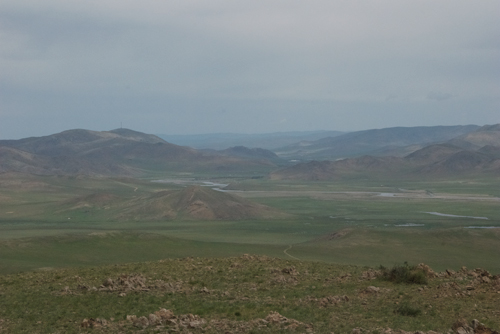
3. Mountain Forest Steppe- As the name indicates, this is a transition zone between the mountain forests and the grasslands of the steppes. It accounts for about 25% of the country’s land area. The mountains are of a lower elevation and include wide river valleys. Most of the population of Mongolia lives in this zone. Animal species include roe deer, elk (marel), wolf, red fox, Eurasian badger, Pallas’ cat, wild boar, great bustard, black kite and darian partridge. The image above was taken from Mt. Baits in Gun-Galuut Nature Reserve in July of 2009, looking north into the Kherlen River valley and on to the mountains.

4. Steppe– This is the landscape that most foreigners envision when they think of Mongolia. The famous grasslands cover about 20% of the country. The largest remaining area in Central Asia of this ecosystem is in eastern Mongolia. The climate runs from hot in the summer to cold in the winter, but not as extreme as the zones to the north and south. It provides much of the main grazing land for the herders’ livestock. Animal species include Mongolian gazelle, wolf, corsac fox, Siberian marmot, tolai hare, demoiselle crane, steppe eagle and saker falcon. The photo was taken en route between Ulaanbaatar and a ger camp at Arburd Sands in July of 2009.

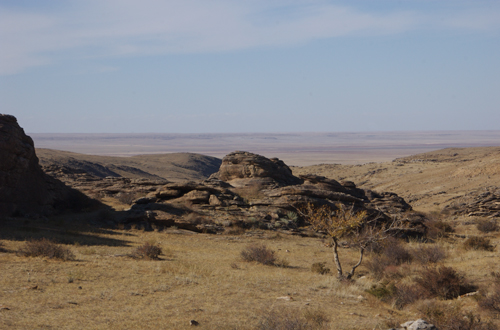
5. Desert Steppe- This is the transition zone between the grasslands and the Gobi (which means “desert” in Mongolian). It accounts for over 20% of the land area. Drought is frequent, along with strong winds and dust storms. Many herders live in this ecosystem, however. Animal species include takhi (Przewalski’s horse-reintroduced), khulan or wild ass, saiga antelope, marbled polecat, Mongolian hamster, houbara bustard, lammergeier and cinereous vulture. The image was taken at Ikh Nartiin Chuluu Nature Reserve in September of 2008.

6. Desert- The Gobi is one of the most famous deserts in the world, but, contrary to common belief, very little of it is sand. It’s mostly gravel and small rock and as you can see, there is vegetation. It accounts for around 25% of the land area. Where there are springs, families have truck gardens and it is well-known that the best and sweetest vegetables in the country come from the Gobi. The weather is, once again, extreme, climbing to well over 100F in summer and dropping to -40F in the winter. Animal species include wild bactrian camel (very endangered), Gobi bear (critically endangered; maybe 30 left), khulan, saiga antelope, argali, Pallas’ sandgrouse, saxaul sparrow and desert warbler. I took this picture in September of 2006. The red rock formations in the distance are the Flaming Cliffs, where the first fossil dinosaur eggs were found.

All this, in a country that is about twice the size of Texas!