Mongolia Monday: The Best Camping Trip Ever, Part 4 – Crossing A Flooded River, Visiting A Camel Herder’s Ger, Arriving At A Remote Lake In The Gobi

I think that in order to communicate with some immediacy one single day that had enough incident for three, I’m going to simply quote my journal entry for July 15, adding images as needed.

“What an amazing day. Went south-west with Orog Nuur as our goal. Khatnaa knew there was the Taatsin Gol to cross, so stopped at a petrol station to ask about it. Also there were two van loads of Mongols from Togrog who were heading west to mine for gold. Usual Mongol socializing and information exchange ensued.

A third van showed up and all headed towards the river, which was flooded due to rains in the Hangai Mountains.

Assessing the situation

We got across one stream, but were stopped by a broad ribbon of streams and mud. The main channel was moving fast and pulsing with even more water.

Went back up to the bluff overlooking the river and had lunch, watching the three van loads of Mongols look for a way across and mess around in the water.
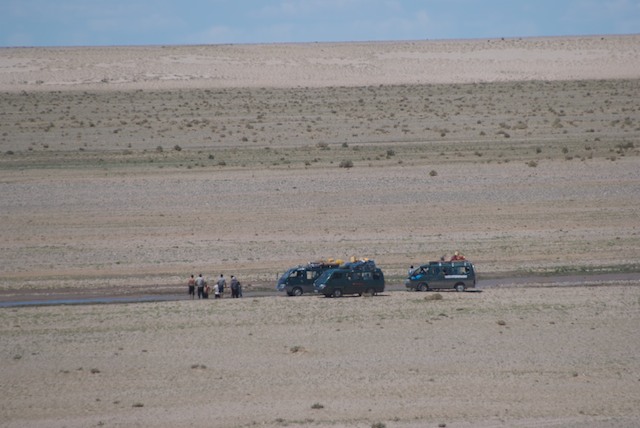
Lunchtime for us

Went back down to the river. Khatnaa walked a long way to see if he could find a crossing point, but came back and told us that the last stream of water was the worst of all. So we were faced with going north 100 km to the closest bridge. Such is travel in Mongolia.

Suddenly, there was action with one of the vans. A bunch of guys had formed a line across one point of the main channel and the van charged into the water, started to stall, but the guys all got behind it and pushed it on through!
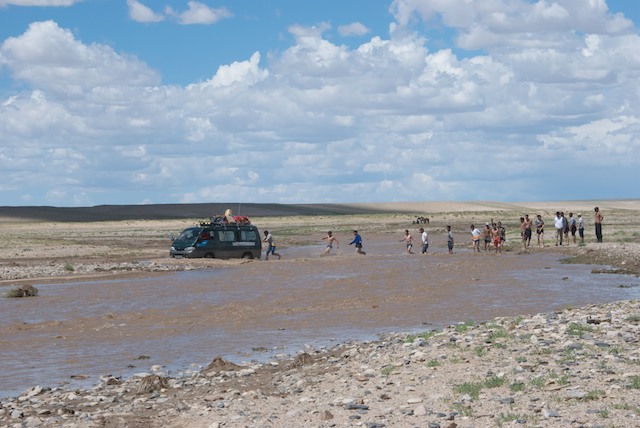
First van crosses the river

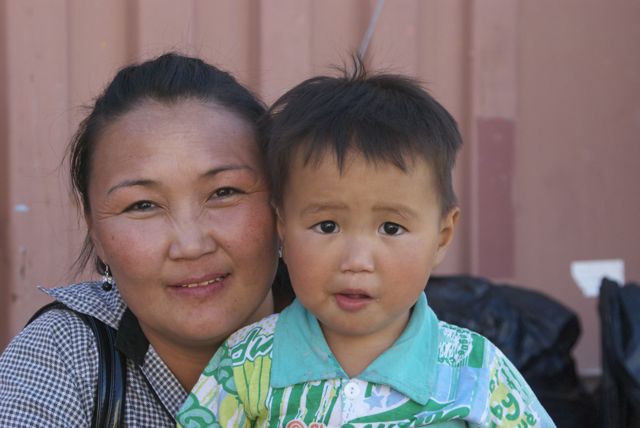
Well, if a van could make it, our big Land Cruiser certainly could and did, without even needing a push. We did end up with an extra passenger, a little eej (mother) who wasn’t about to miss her chance to ride in our big car.
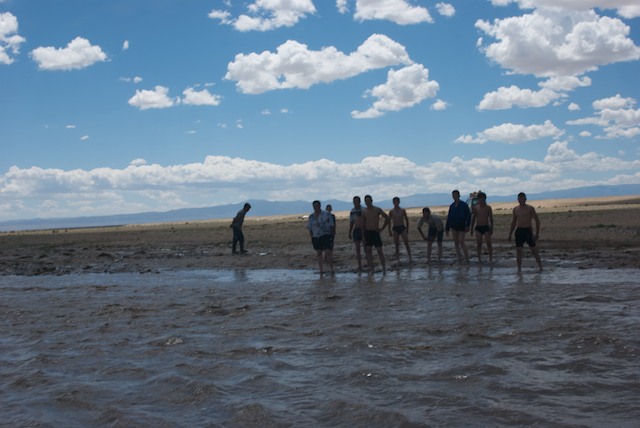
Our turn. Halfway across.

We got out on the other side and I photographed the other two vans making the crossing. Then said our good-byes.

Third van goes into the river.

We followed one van up a soft sand slope. It promptly got stuck so we rolled back down and went around it and on up the hill.

The entire “adventure” of the river crossing was a perfect example of Mongol practicality, improvisational skills and good humor. No one at any point got angry, showed frustration or swore. When it looked like things had stalled out, the guys took a break and goofed around in the water. Or so it seemed. They were clearly having fun but they were, in retrospect, also searching for a crossing point.

The spot they found was one where the channel wasn’t too wide or deep and where they felt the bottom was solid enough for a vehicle to get across with a minimal chance of getting stuck.

Without winches, cables or even rope, they simply used the same solution they always do – push.”

——

Once across, we were really able to roll for awhile on good earth roads.

At this point we knew that the lake, Orog Nuur, was 2/3 full and that the river flowing into it was impassible due to run-off from the mountains. But we had also been told that there was a road on the opposite side of the lake.

Khatnaa spotted a ger and drove over to it. I usually just stay in the car while he asks directions, but his time he gestured me to get out and said “Let’s visit.”

We ended up spending around two hours with Batsuuri and his family.

When we entered their large, comfortable ger, the first thing I noticed was two boys sitting on the floor watching Star Wars:The Phantom Menace on a small flat screen tv. Batsuuri was sitting on the floor, a couple of older girls were going in and out and Javhlan, his wife, was just starting, I found out later, to make suutai tsai (milk tea). I’ve drunk a fair amount of it by this time, but had never seen it made before.

A bowl of small squares of fried bread and sugar cubes was placed in front of us. The movie ended and the two boys, both Mongol but one had blond hair, started playing with a bunch of nails they had pulled out of a bag. I watched them happily amuse themselves for over half an hour, arranging the nails in various patterns and finally using a closely lined up row of them as a little hammered dulcimer.

At one point a wrestling competition came on the tv and I knew that we were going to be staying for awhile because Khatnaa is a BIG wrestling fan.

Javhlan asked if we would like to try camel milk airag. We all said yes. It was delicious, of course.

As we sat, and Khatnaa and Soyoloo chatted with our hosts (Besides camels, they have about 300 other animals. They lost 10-15 in the zud, nothing, really.), Javhlan made a meal of rice with meat in it and we ended up having dinner with the family.

Then it was time for her to milk the camels. They have 40 camels, seven of which had babies. So I found myself with another amazing photo opportunity.

Javhlan milking one of the camels

I was wearing one of (local Humboldt County artist) Bekki Scotto’s hand-dyed rayon t-shirts and had Khatnaa take some pictures of me standing in front of the camels. I think Bekki will like that.

Soyoloo, our great cook, and I

Once the milking was over it was time to leave, but it turned out that there is more than one road around the lake. Batsuuri offered to take us part of the way on his motorbike. Khatnaa provided petrol from a jerry can he had in the car. They had almost finished syphoning when who should pull up but one of the three vans! They had taken the main road to the river, found it flooded and had come back to the only ger for miles to find out if there was an alternate route, so Batsuuri showed them the way also. Once he’d gotten us to the correct road, we waved goodbye and drove on into a large saxaul forest, much of which was in light, almost white, sand. Many stops for pictures. And berries!
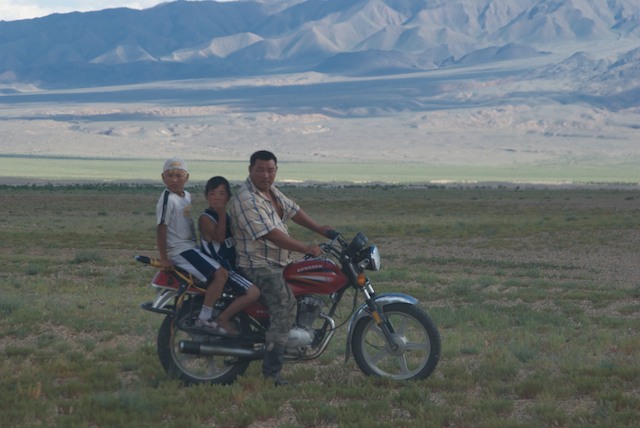
Batsuuri shows us the way around the lake
The saxaul forest
Edible berries in the Gobi

Finally we could see the lake, Orog Nuur, in the distance. The passing clouds were creating gorgeous spotlite areas on the mountain range to our left.

Ikh Bogd Uul
Ruddy shelducks, Orog Nuur

We made one more quick stop at a herder’s ger and then found a track down to the lake. We parked, got out, walked down to the shore and Khatnaa announced that we had arrived at “bird heaven”. Indeed.  The shoreline had birds from one end to the other. The lake edge had even more mosquitos. I observed that it looked like we had also arrived at “mosquito heaven”, which Khatnaa thought was pretty funny.

But we sure weren’t going to be able to camp there. So we moved away far enough to be out of the worst of it, put on insect repellent that Soyoloo had handy and set up camp.
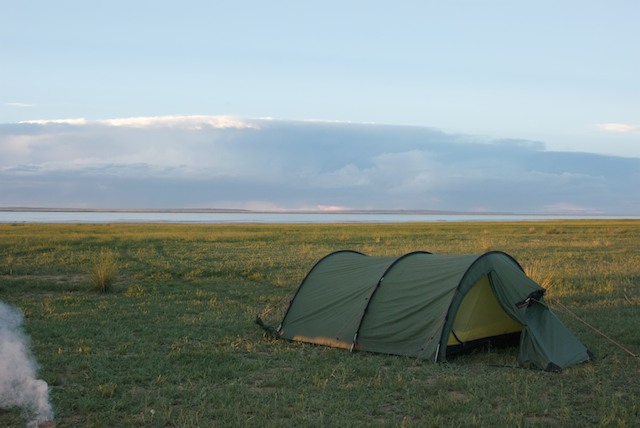
My tent with Orog Nuur in the background

It ended up being cook’s night off since we were all pretty full from the meal at Batsuuri’s. Lunch had been a delicious white fish from Khovsgol Nuur. We all had some leftover fish with rice and a few cookies and we were fine.

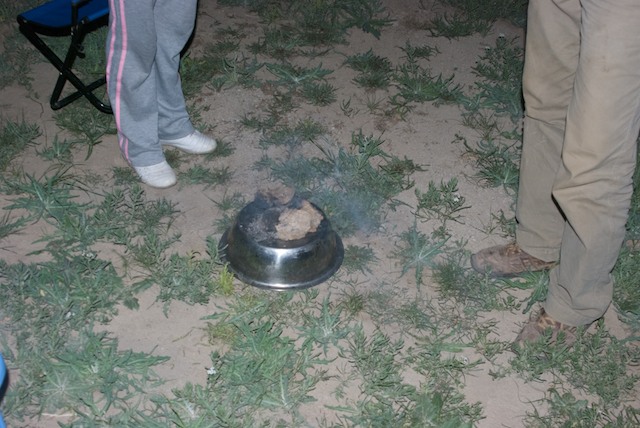
In the meantime, the mosquitos were getting pretty annoying. We had no netting, so , once again, Mongol ingenuity rode to the rescue. Khatnaa went out and gathered a small bag of animal dung which he piled up and set smoking with a small blowtorch. We put our chairs in its path. Problem solved. Until the breeze kept changing direction. Soyoloo came up with a brilliant solution. She turned a metal flat-bottomed bowl upside down and had Khatnaa got a small dung fire burning on it, which meant that instead of moving our chairs to stay in the smoke, we simply moved the smoke. We dubbed it our “nomadic dung fire”.
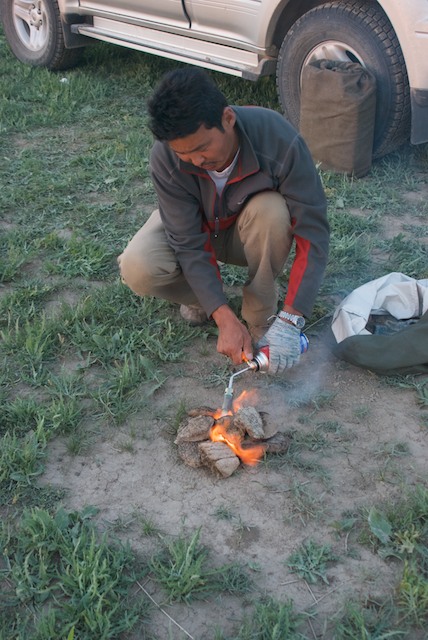
Setting the dung smoking
The Nomadic Dung Fire

We sat until dark, watching a lightning storm across the lake from us, a spectacular sunset to the north and listening to the Javhlan CD I’d brought from UB, finishing off the last of the bottle of Chinggis Gold vodka and chatting about all kinds of things. A perfect ending to a perfect day.”

Sunset at Orog Nuur, the Gobi

It’s Been A Busy Trip

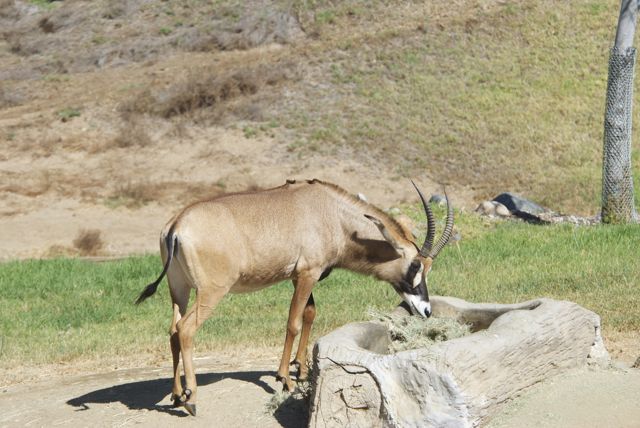
Roan antelope, San Diego Zoo Wild Animal Park

It was a jam-packed four days of activities at the Society of Animal Artists 50th Anniversary celebration. Along with whale-watching, we spent a day at the San Diego Wild Animal Park and the San Diego Zoo.

On the last day, we went over to the San Diego Natural History Museum for the official opening of “Art and the Animal”. Our work is beautifully displayed on three levels of the central atrium. Along with the artists and their guests, many members of the public were also in attendance. The show will be in San Diego until October 31.

Hippopotamus, San Diego Zoo

That evening, it was time for the annual banquet, which included the presentation of the Society’s first Lifetime Achievement Award to Robert Bateman, which he richly deserves for both his distinguished career as an artist and his commitment to conservation and environmental issues.

Our campsite at Anza-Borrego State Park; I slept on the cot under the stars

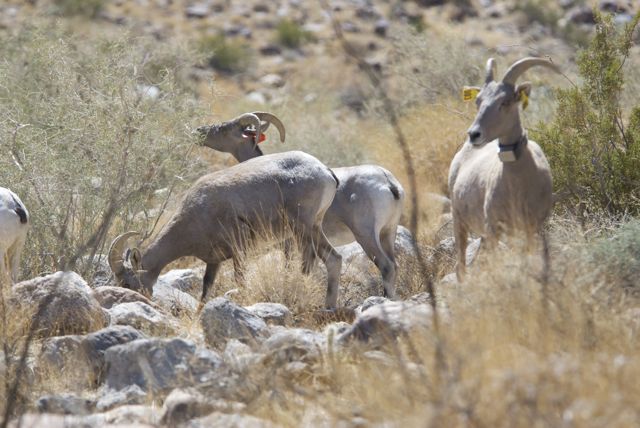
The next morning I and fellow artists and SAA members Guy Combes and Andrew Denman departed for Anza-Borrego State Park in hopes of seeing and photographing desert bighorn sheep. As you can see below, we succeeded, toughing out unseasonably hot daytime temperatures which reached 112F.

Desert bighorn ewes, Anza-Borrego State Park

Our next stop was the cooler clime of the Sierra Nevada foothills, home to the Sierra Endangered Cat Haven. As many of you know, I refuse to patronize for-profit game ranches. It has been a pleasure to discover Cat Haven, a non-profit operation which not only has the fittest and healthiest captive genetically wild cats that I have ever seen, but is heavily involved in a variety of conservation efforts on an on-going basis. I would encourage my fellow animal artists to consider a visit here to support an organization which puts the welfare of the animals first instead of using them for personal gain.

Tango the cheetah

Yesterday we took an afternoon trip up into Kings Canyon National Park, which I had never been to. We were awed by the jaw-dropping magnificence of the canyon and took a LOT of photos.

Kings Canyon

I’ll be home soon from my travels and am looking forward to getting back to my easel!

Update From The Society Of Animal Artists 50th Anniversary Celebration

I’ve been so busy the last couple of days that there hasn’t been time to do any posts. Day before yesterday was spent at the San Diego Zoo Wild Animal Park and yesterday at the San Diego Zoo. Terrific animal photos ops, lots of walking. And we’re all having a great time together sharing our love of art and animals.

Today are the main events: the annual member’s meeting, a very special presentation about his work by Robert Bateman, who will be receiving a lifetime achievement award, finally getting an opportunity to see the show itself at the San Diego Natural History Museum and, this evening, the banquet, during which Mr. Bateman will be honored and the show juror’s will announce the winners of the Society’s Awards of Excellence for this year.

Tomorrow Guy Coombes, Andrew Denman and I head out to Anza-Borrego State Park in search of desert bighorn sheep. My contact there has emailed me that the rams are already gathering and butting heads. There are sightings near one of the trailheads and even one of the parking lots! It’s also hot, hot, hot. As in 113F hot. Not sure if we’ll be able to camp in the park under those conditions, so we may have to seek out somewhere at higher altitude. But it’s all part of the fun and privilege of being animal artists on the road.

As I am able to access the internet I’ll try to post a few images from the rest of the trip, which currently also includes stops at two wildlife sanctuaries.

I’m At The 50th Anniversary Celebration of the Society Of Animal Artists

I left Humboldt County this past Sunday morning, picked up fellow artist and colleague Andrew Denman at his home in the San Francisco Bay Area and we journeyed south to San Diego, California, camping out a couple of nights at our wonderful state parks along the way.

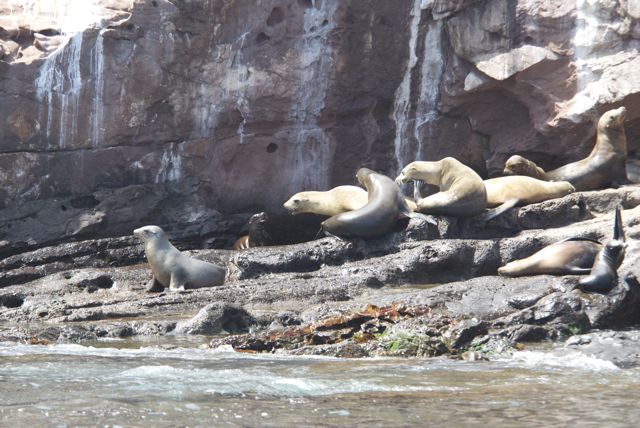
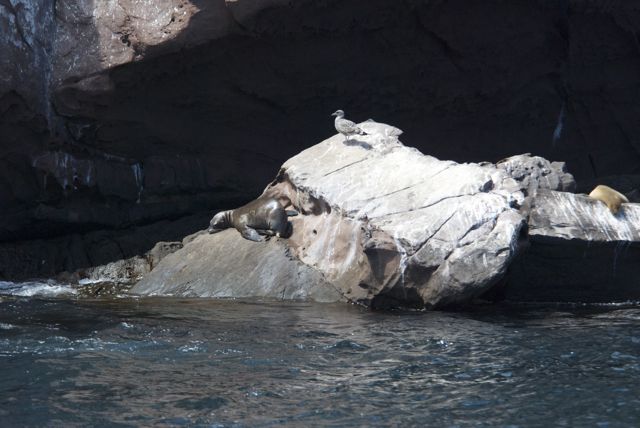
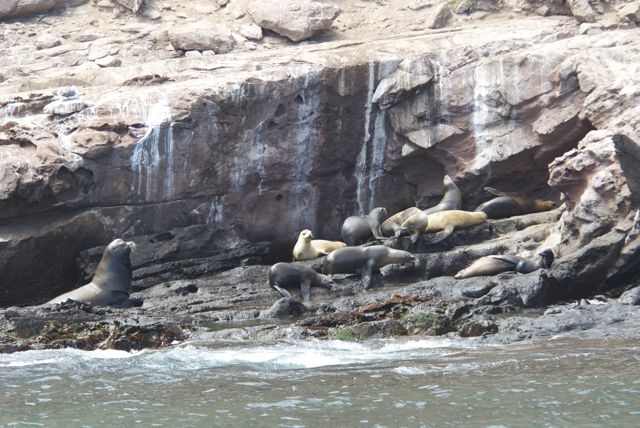
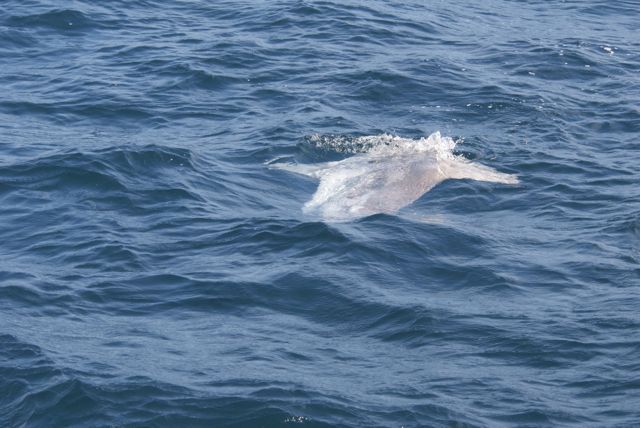
The event activities started the next day with an all-day whale watching trip. We didn’t see any whales, but there was lots else to get photos of for possible future paintings – bottlenosed dolphins, California sea lions, harbor seals, gulls and terns, phalaropes, brown pelicans, blue-footed boobies (yes, that’s a real bird and it does have light blue feet), brown boobies, cormorants, a couple of jellyfish and, the really rare sight of the day, a sunfish. Here’s a few images:

California sea lions on a floating dock
Sea lions
Sea lions
Sea lions
Brown pelicans
Cormorants
Cormorants
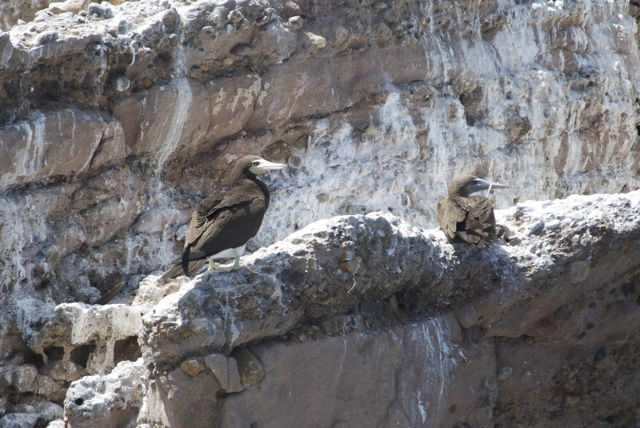
Brown boobies
Sunfish
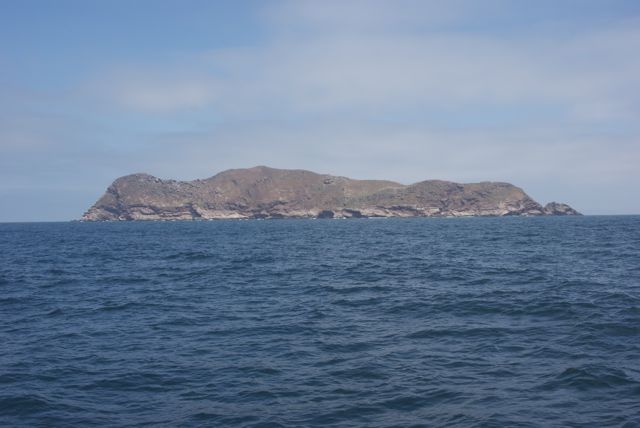
North Island, one of two that we approached on the boat for wildlife watching

Coming up next – The San Diego Zoo Wild Animal Park

Location Sketching In Ulaanbaatar, Mongolia

This time I finally did something I’ve been wanting to do in Ulaanbaatar for my last couple of trips to Mongolia – sketch on location.

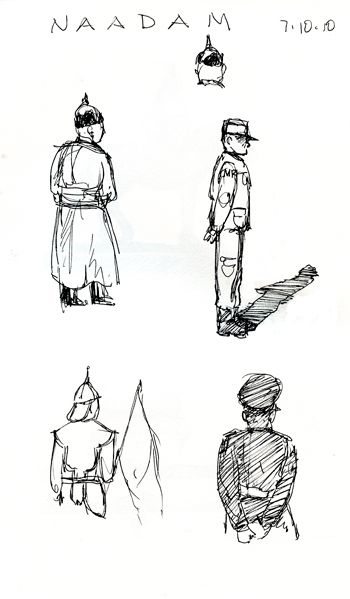
I got started right away since I had a couple of hours before I left for the countryside on July 10, having arrived on July 8. The Naadam celebrations had begun at Sukhbaatar Square, so I walked over from my hotel and did this page of quick studies.

Naadam 2010, Sukhbaatar Square

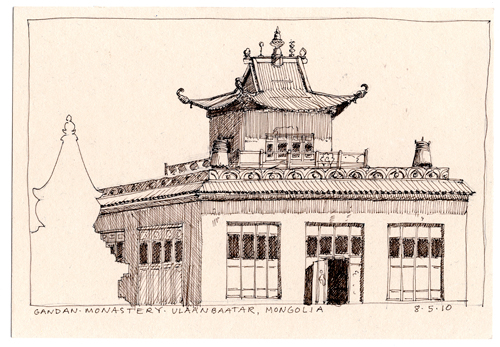
Back in UB after the camping trip, I met up with a new Mongol friend I had originally connected with on Facebook and we spent part of a morning at Gandan Monastery. It was fun to have a sketching buddy. He hadn’t drawn since high school, but must have still remembered something, because he immediately turned out some nice work.

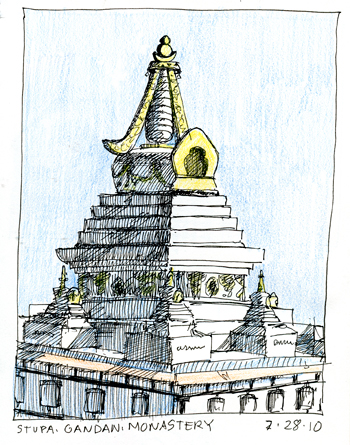
I got an interesting comment on the stupa drawing. An older man came by, looked at what I was doing and told me, through my friend, that there HAD to be nine smaller stupa shapes below the main one. I couldn’t really explain that I simply couldn’t see them from the angle at which I was sitting, so just had to let him walk off in a minor huff.

Stupa, Gandan Monastery

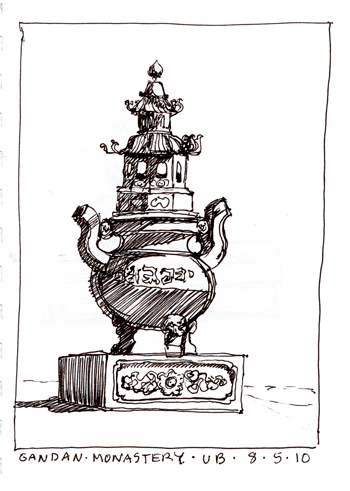
There are a number of these big (close to 8′ high) incense burners around the Monastery grounds. Visitors circle them while trailing a hand along the surface.

Large bronze incense vessel, Gandan Monastery

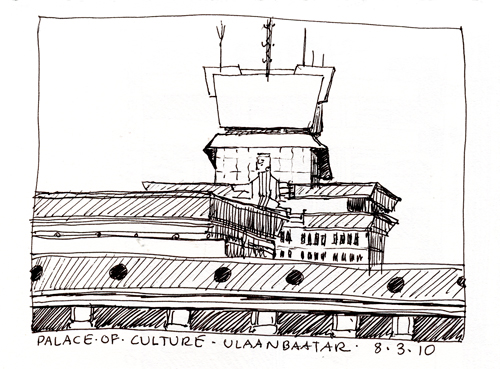
After I returned from the countryside, I went back to Sukhbaatar Square and sketched some of the buildings. The Palace of Culture is one of my favorites. The top of the tower is metallic gold and sparkles beautifully in the sunshine.

The Palace of Culture
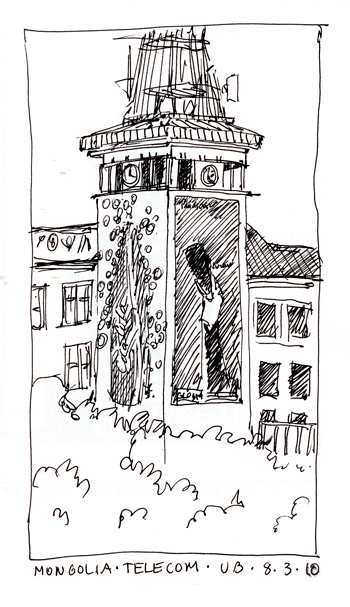
Mongolia Telecom

I started to draw some attention at this point, particularly from a nice young man who wanted to practice his English, and had to give it up. Yes, that’s a giant Coke bottle on the left hand side of the building.

I also went back to Gandan Monastery for another morning of sketching. This time I tried adding some color with my water-soluble colored pencils.

Gandan Monastery

The preceeding sketches were all done in a small Strathmore premium recycled sketchbook. But I also wanted to experiment with working on location on toned paper. These were done during the second stint at Gandan Monastery and also at the Museum of the Chojin Lama. I never do architecture, really, so it was a challenge to try to keep things in reasonably decent perspective. On the other hand, unlike animals, the buildings, at least, don’t move.

Gandan Monastery temple
Museum of the Chojin Lama temple gate

Next Friday, I’ll post more drawings, this time from the journal that I kept during the trip. Dogs, dinosaurs, the desert and…..

Mongolia Monday: The Best Camping Trip Ever, Part 3- The Gobi, Gempilarjaalin and Onglyn Monasteries

Leaving Baga Gazriin Chuluu meant that I was now traveling south into a part of Mongolia that I had never been to and really knew very little about. Perfect.

Our first stop was in the soum center of Erdenedalay, home of the Gempildarjaalin Monastery, which was built in 1910. The main temple survived the destruction of the late 1930s and there are now ten monks in residence.

Gempildarjaalin Monastery
Gempildarjaalin Monastery interior

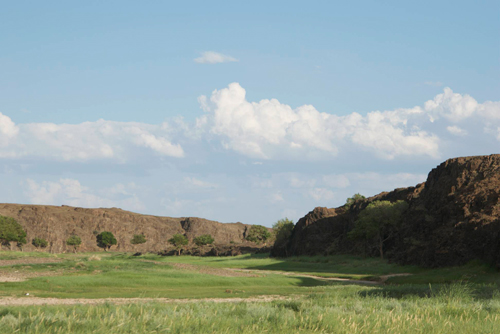
Our road then continued out across the Gobi. The landscape was rolling and surprisingly green. We could see a storm front with rain off to our right.

Earth road in the Gobi

Our final destination for the day was the river valley of the Onglyn Nuur (River), which is also home to the ruins of Onglyn Monastery.

Onglyn Nuur valley

Khatnaa and I went for a birding walk in the early evening and saw some hoopoes, one of the most elusive birds to get close-up photos of.

Hoopoe

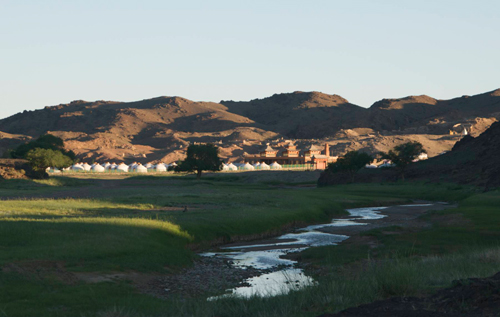
The next morning we walked the short distance to the monastery ruins, which were actually two separate establishments, one founded by a prominent lama in the 1760 and the other by one of his students in 1800.

Tourist ger camp with ruins behind it on the hillside

They were two of the largest monasteries in Mongolia, capable of housing up to 1000 monks. All the buildings were destroyed in 1937. Two hundred monks were killed. Many were put to work for the communist government. Some escaped by becoming farmers.

Ruins with sacred spring

A new, small temple has been built and there are now some monks in residence at the site again. There are also ambitious plans to re-build a major temple.

Small temple interior
The main altar

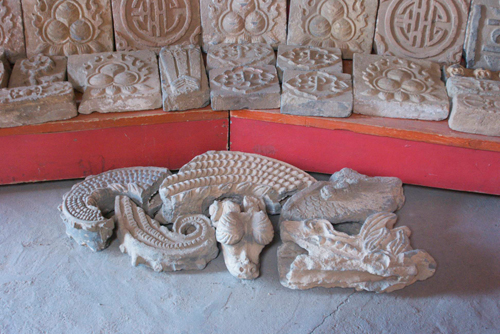
Not far from the temple is a ger which houses a small museum of artifacts that have been recovered from the ruins. I found it very poignant. So much beauty, wantonly destroyed.

Decorative stone work recovered from ruins
Wood beam with raised decoration
Khatnaa speaking with the museum host

On a happier note, we stopped in at the Secret of Onglyn ger camp and Khatnaa arranged for us to take real showers! It being the morning and the water being heated via a solar system, they were going to be cool, not hot, but it really felt good to remove a few layers and get my hair washed.

Back on the road, the green had disappeared and become the almost bare, gravelly ground that the Gobi is known for. We also drove up and over rock formations that reminded me a little of those at Ikh Nartiin Chuluu.

Rocky upland area

In the late afternoon, we stopped at a town called Guichin Us to re-fill our water containers from the well. This became a regular feature of the trip, stopping at a local well for water, which Soyoloo then boiled so that we could use it for drinking.

Water refill from a town well

We drove a few kilometers out of town, onto the open plain and stopped for the night. One of the remarkable things to me was the spots that Khatnaa often chose for campsites. He almost never sought out a sheltered spot of any kind. What seemed to matter was having a slight slope so that if it rained, the water wouldn’t gather under the tents. So here’s my tent out in the “middle of the Gobi”, complete with my drying laundry. It was really, really quiet and we sat after dinner watching a distant thunderstorm, hoping that it was dropping badly needed rain on the land beneath.

My tent (with clean socks)

Next up:  crossing a flooded Gobi river, bactrian camels and “mosquito heaven”.


Mongolia Monday- “Ikh Nart Is Our Future” Update

I’ll get back to The Camping Trip, but I really want to share the news on the women’s felt crafts collective. Notice the change from “cooperative”. There are a number of words used in Mongolia for legally constituted groups, each of which has different requirements. I need final confirmation from him, but my scientist friend Amgaa, who has been instrumental in helping me help the ladies, believes that this is the correct term, which is almost surely a holdover from socialist times.

Stuffed toy camel in progress

I spent a fun and productive week at Ikh Nartiin Chuluu Nature Reserve. There will be more about my argali and ibex sightings in a future post, but for the moment I’ll just say that I finally, after five trips there, got the reference photos I’ve really wanted – both species in great light and close enough for me to really capture details like head structure. Paintings to follow.

I’ve been so anxious to see Boloroo, the collective director, the other women and to find out how things are going for them.

Boloroo and Tuvshin

I’ll quote from my journal:

Tuesday, August 10-
Great reunion with Boloroo and some of the other ladies. Learned that what started last year with 14 ladies from one Bag (the smallest administrative unit in Mongolia; “bag” means “small” in Mongolian) has now expanded to 30 members in four of the five bags in the soum (the equivalent of a county). Some of the new members came along and it was fun to meet them.

Tuvshin (Boloroo’s son, my little buddy from last year) is now a sturdy almost 2 year old. One lady who was pregnant last year came with her baby and husband, who brought a nice little ibex carving to sell. (I’ve got a probable donor for good quality steel carving knife blanks. I’d like to encourage the men, too.)

Two folding tables were set up and covered with lots of merchandise. The collective has expanded beyond felt crafts, too. One lady now has a knitting machine and brought a variety of tops and sweaters to sell.

Crafts

Selenge (the research camp manager and my translator) had me explain it all to the Earthwatch volunteers. By close of business, close to half of what had been brought had been sold.

A wonderful follow-up in every way to last year’s launch.

And customers

I was also able to have a private meeting with Boloroo, Selenge translating, about ideas for the kinds of things I think would sell in the US and some possibilities I’m working on for sales outlets. Many of the women will be perfectly happy to make slippers, stuffed toys and small, simple items to sell to visitors who come to Ikh Nart. But I’ve seen a level of talent and creativity in some of the women that I want to encourage. They can take their work, with practice, to a very high level of fine craft and therefore command much higher prices.

I watched Boloroo switch from visiting mode to business mode and am really impressed by how thorough and professional she is. I am so very fortunate to have gotten involved with a group that has her as the leader.

One of the new members and her family

I had also brought over a stack of sketchbooks, plus pens and pencils, so that young local artists would have the materials they need to create designs for things like purses. I believe this is better  than having a westerner like me do them, although I’ll be happy to help if asked.

Office interior

The following afternoon, I visited the soum center, Dalanjarglan, for the first time. Boloroo was there and we got to spend three hours together. She showed us the collective “headquarters”, a small free-standing building which used to be a gas station. It turns out that she bought the building herself. Amgaa had a banner sign made and donated some large informational posters from a past presentation about Ikh Nart. These have been hung on the interior walls. I saw the felt presses and they are clearly getting used regularly.

The felt presses

I had also paid for training earlier in the year in UB for Boloroo and one other lady, Lhagvadelger, the Bag Governor’s wife. Boloroo is now doing training herself. I also learned that there are four more levels of training available, so I will be looking for funding to cover that in the future.

Boloroo and I in front of the "Ikh Nart Is Our Future" office building

In UB a couple of weeks ago, I paid a visit to Tsagaan Alt, a store run by the Mongolian NGO from whom we got the felt presses and training. Everything they offer is of very high, consistent quality. Eventually, the collective will be able to sell their work there.

Selenge is going to try to keep up with what is going on with the collective and send me occasional reports.  Stay tuned. The ladies are clearly just getting started.

Mongolia Monday: The Best Camping Trip Ever, Part 2 – Baga Gazriin Chuluu Nature Reserve, Delgeriin Choiriin Khid

Even though I only spent two days there last year, Baga Gazriin Chuluu was a place that I really looked forward to visiting again.

A harem of local horses near our camp

One of the best experiences was visiting the ger of Yanjmaa, who had made boortz soup from scratch for us and served me a bowl of the best yogurt I’d ever had. Would she still be around? Although she had relocated her ger, the answer was “yes” and we had another lovely visit, but also learned something disturbing about the wildlife of the reserve.

There was a zud in Mongolia this past winter, which is a combination of a dry summer and a very severe winter. It was a national disaster that was occurring the same time as the quake in Haiti, so there was very little media coverage until early in 2010. The last estimate I read said that around 10 million head of livestock died.

Yanjmaa told us that no argali or ibex had been seen in Baga Gazriin Chuluu since February.  Before then, she had gone out one morning, and to her surprise, found a large ibex billy in with her domestic goats. He was very weak, so she managed to get him into her ger and onto her bed, hobbling him when he started to thrash around.

Having been a vet before she retired, she tried to treat him by offering him cold water and a medicinal plant, shavag, which contains lots of vitamins. Finally, she moved him back out to the goat enclosure, where he died.

Our first thought was that the argali and ibex had all died, like the ibex, but later on that day, it occurred to me that wild animals sense what is going on in their world and that it was more likely they had all simply left as the weather became extremely severe. In some parts of Mongolia, the temperatures dropped to -50F.

Talking with the reserve ranger, Batsaikhan, the next day, we confirmed that the ibex and argali were gone, around 160 animals total. Khatnaa had told me that he had seen 10+ argali about 20 km east of Arburd Sands, which is about a four hour drive north of Baga Gazriin Chuluu, on July 5, a week earlier. This was outside their normal, known range and preferred habitat.

That evening, Batsaikhan came by our camp to give us really good news. A group of visitors had reported seeing a group of argali just within the reserve! Perhaps they and the ibex will all, or mostly, come back to Baga Gazriin Chuluu now that the weather is good. I hope so.

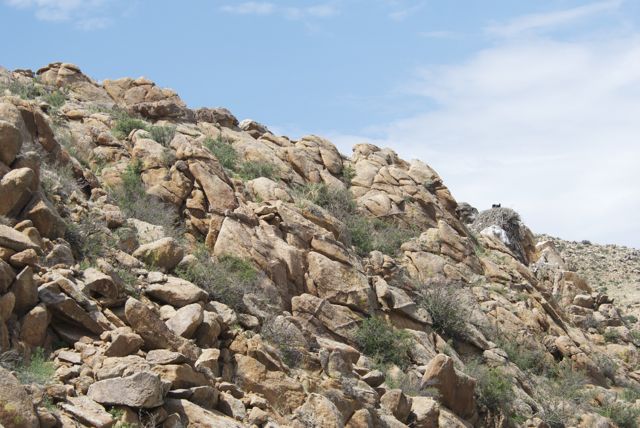
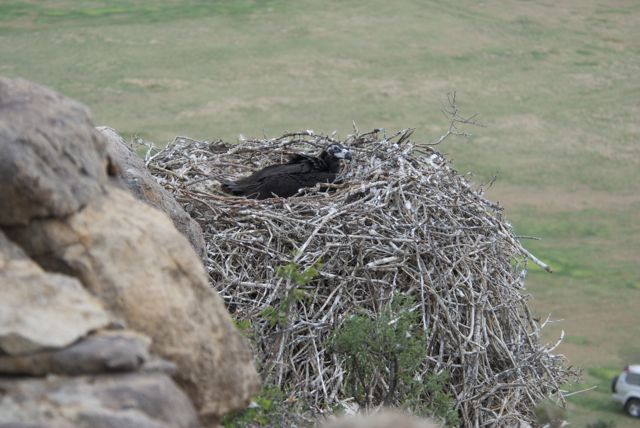
On our way to find Yanjmaa, we had passed through an area that had a number of vulture nests, one of which was on a cliff near the road with a fledgling cinereous vulture in it. I got some good photos from down below, but Khatnaa climbed up behind the nest and came back with some amazing images. We went back the next day and this time I climbed up with him and found myself just slightly above the nest, about 8 meters away. What a photo op!

Cinereous vulture nest from below

He/she knew we were there, but never showed any stress. The adult had taken off as soon as we got out of the car, so I felt comfortable staying for awhile and taking almost 100 photos.

The young occupant

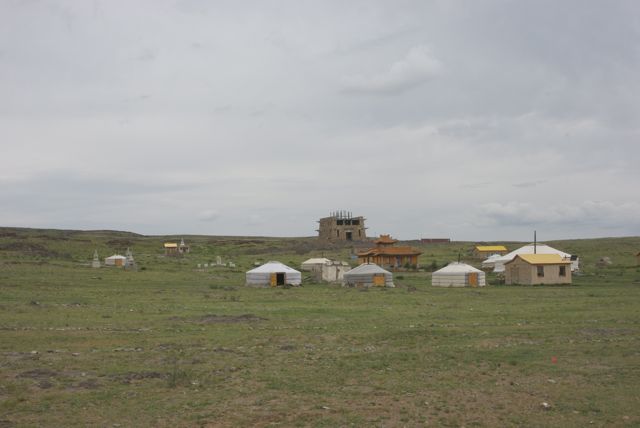
Later that afternoon, we took a side trip out of the reserve to visit a local monastery, Delgeriin Choiriin Khiid. It was one of the many, many monasteries destroyed in the late 1930s, but is now being rebuilt. There are 15 lamas in residence. I was allowed to take photos in the interior of one temple, which is in a large ger.

Monastery grounds
Interior of ger temple

The next morning we departed for the fabled Gobi.

Mongolia, Uh, Wednesday: The Best Camping Trip Ever, Part 1- Baga Gazriin Chuluu Nature Reserve

I got back from the Mongolian countryside around 5pm this last Sunday. It’s taken a few days to catch up on things and to let the trip settle in my mind and think about how to describe one of the best experiences of my life.

This will obviously take more than one post. Probably a dozen or more. I shot over 3000 images in 14 days. Fortunately, I also kept a journal. I’ll post some of the sketches from it after I get home and can scan them.

Where to begin? First, this was to be my very own “Nomadic Journey”. Instead of my previous trips where I was really focussed on seeing wildlife and had set itineraries, this time I wanted to get out into the deep countryside and see what Mongolia had to show me. My particular interest this trip was, as mentioned in previous posts, to learn more about the Mongol horses and the herders who breed, ride and race them. I also hoped to find a couple of local naadams to attend.

I had the same excellent guide/driver, Khatnaa, who I traveled with for the first nine days of my AFC Flag Expedition last year. But nstead of the Mitsubishi SUV that survived the hail storm we’d gotten caught in, he had acquired a new Toyota Land Cruiser Prado just a month ago, so we’d really be traveling in style.

In addition, since this was a tent camping trip, Soyoloo joined us as the cook. She proved to be a superb professional and a lot of fun as well. Watching her taught me quite a bit about what it takes to keep people well and safely fed in remote locations. Not to mention keeping track of the water supply.

What all this means is that we had the freedom to travel where we wished and camp where we wanted. I’m totally spoiled now. Mongolia really is the greatest camping destination.

The ger camps require advance reservations since they only keep food on hand for the guests they expect to have and it’s not possible for anyone to “run to the store” to get more food for unexpected guests since the closest shop could be over 40km away.

I spent some time chatting with Jan Wigsten from Nomadic Journeys the day before departure. He observed that people come to Mongolia with a list of places they want to see, often based on a guidebook driving tour, and that by doing so completely miss the point of one of the things that makes traveling in Mongolia so special. This country isn’t really about places, as spectacular as the landscapes are, it’s about people and their connections. The places end up being kind of a bonus.

I mentally filed that away and ended up with a number of compelling reasons to recall it over the next two weeks.

We left Ulaanbaatar around 10am the morning of July 10, the first day of the national Naadam holiday, heading south towards Baga Gazriin Chuluu Nature Reserve. We spent our first night camped near a bend in the Tuul Gol, a little southwest of Hustai National Park.

Pick a spot, any spot

The next day, we stopped for lunch at Zorgol Uul, a sacred mountain. On the backside, away from the road, was a sheltered area with trees festooned with khadags, the blue ceremonial scarves. A pretty special place for a meal, to be sure.

Zorgol Uul

While we were eating, two steppe squirrels suddenly appeared, rearing up on their hind legs and pushing at each other with their front paws and then tumbling around on the ground. Naadam squirrel wrestling!

A short time later I spotted two chasing each other. Naadam squirrel racing! We didn’t miss Naadam after all.

Steppe squirrel

Arriving at Baga Gazriin Chuluu, Khatnaa drove up and back down a small canyon looking for a camping spot. Here’s what he found…

It'll do, I think

We spent three nights in the reserve.

Next post: Where’d the argali and ibex go? Could we find Yanjmaa again, who made the wonderful boortz soup for us last year? And an amazing encounter with the world’s largest vulture.

In the meantime, I’m off to Hustai National Park the day after tomorrow for two nights to see the takhi in the summertime.