A week or so ago, I was poking around the listings on EBay that come up when you search “Mongolia” and ended up browsing through the postage stamps. Mongolia is one of those countries that, in the past, released an endless supply of stamps aimed at collectors. It brought in some income to the government during the socialist era and when times were very hard back in the early to mid-1990s during the transition to democracy.
Along with the obligatory Princess Diana commemoratives, it turns out that there is a wealth of stamps with imagery from Mongolia’s history and culture. Some of the stamps showing traditional clothing are so detailed that they to all intents and purposes qualify as primary reference material.
I had purchased some stamps on previous trips just because I liked the images and they are a well-known souvenir choice. I had also been a stamp collector many years ago as a kid. I don’t know that I would take up actual collecting again, but if I did, I would specialize in the historical and cultural subjects, along with animals (no surprise there, I imagine).
This week I’ll share the costume, history and ger-themed stamps I have. Next week will be Mongol warriors and the third part will be some with plants and animals.
Comments, information from my Mongol friends and fellow Mongolphiles welcome, as always.
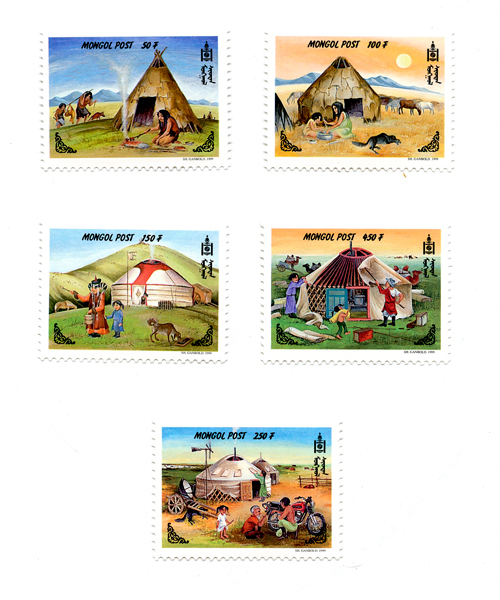
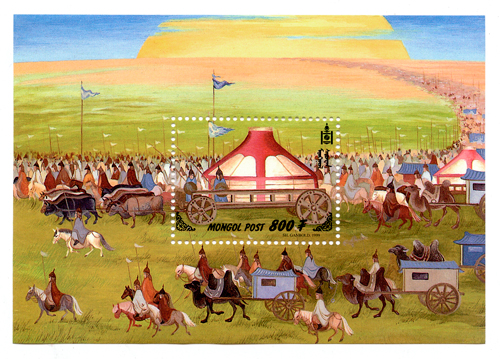
Traditional dress; the top middle is what a married Kalkh Mongol woman woreHistorical/legendary images, I believeThis set appears to be gers (which is simply Mongolian for "home") through Mongol history; ending with one that combines the old and proven with the new and modern; love the aruul drying on the roofThe Khan's ger on the move, literally a "mobile" homeTraditional life in a ger; lightweight metal stoves instead of the open brazier and people tend to wear modern clothes (but not always), but otherwise this is what they are like to this day. Notice the kids on the left playing anklebone games; the floor coverings are sheep's wool felt embroidered with handspun camel wool thread in an traditional design
Safari camp on Paradise Plain, Masai Mara, Kenya, 2004
As those who get my newsletter and read this blog know, I was invited to go on what sounded like one of those trips of a lifetime that many artists dream of….traveling to India to see wild tigers. I had been scheduled to leave this past Tuesday (Jan. 17), but I canceled the trip. Why? Well, the reasons why and what you can learn from my experience are the topic of today’s post. I’ve illustrated it with images of journeys past.
I’m going to keep the identity of who invited me and was sponsoring the event private, since at no time did I feel that there was any malice or ill-intent involved. But, as I think you’ll see, it doesn’t take either to decide not go on, or actually cancel out of, what seems to be a great trip.
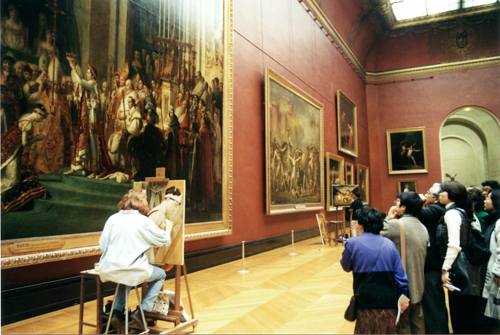
Artists copying masterworks at The Louvre, Paris, France, 1996
To make a longish saga as short as possible: an artist friend asked if I would like to see if he could get me invited to an artist’s event in India. We would be hosted at a fancy lodge adjacent to a national park which is home to tigers and other wildlife. I said “Yes!”. And, after a short time, an invitation was emailed to me by the organizer. I accepted. It seemed like a smart career move, based on what I knew at the time, with the opportunity to have my work seen by an international audience.
Plans were plotted and plane reservations were made. Then all the artists involved (from quite a few countries) got an email from the organizer with an update for the event. And that’s when it started to look iffy. As in, OMG.
What had been represented to me as an Artist’s Week that would result in a donated work being exhibited on a tour in Europe and then auctioned off to support tiger conservation had morphed into an event in India which was to include a fashion show, rock concert and some kind of children’s activities. There were no specifics about international exhibition venues and the auction was now going to be handled by a “company like Christie’s”, whatever THAT was supposed to mean. And, to top it off, the organizer said that a new sponsor had signed on and wanted our paintings at the end of February, that is, one month after our week there had ended. Red flags, flashing red lights, danger, danger, danger.
I was going to travel, literally, half way around the world for….this? I don’t think so.
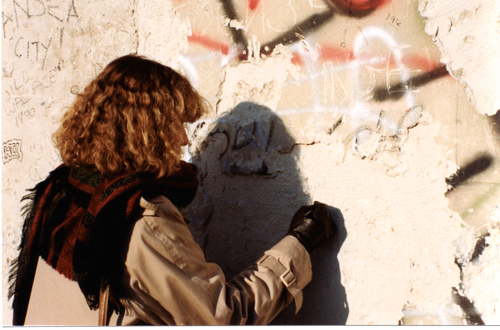
Leaving our names on a remaining section of the Berlin Wall, Germany, 1990
While there were serious problems with the changes themselves, the fact that things had changed so much so close to the event was even more worrisome. It suggested an inexperienced event organizer who was winging it and didn’t really know what they were doing. Things that should have been settled long before the artists were even invited (and remember, I got on the dance card late in the day) still seemed to be in flux. Not to mention the completely unrealistic surprise deadline and, oh by the way, can you all increase the percentage of your contribution because it’s (all together now) For The Tigers.
I (apparently along with a number of the other artists, including the friend who got me into this) replied saying, more or less, you’ve got to be kidding. I wrote to the organizer that, unfortunately, I was going to have to bow out. My previous commitments and my working methods made it impossible to meet the deadline. (I wasn’t going to get into all the other stuff.)
My friend also dropped out.
In the meantime, I had bought plane tickets to Nairobi and back and he had bought our tickets from Nairobi to Mumbai and back (I was going to hang around in Kenya for a couple of weeks after the return from India). I had, the day before, sent via FedEx my visa application to a company that handles such things.
Now I had to unwind it all. I stopped the visa application process before it had started and had them FedEx my passport back to me (total cost: around $50). I canceled my itinerary and banked the tickets (change fee when I re-book: $250. Ouch). Friend canceled the tickets he had booked (cancellation fee: $218. More ouch). So, around $500 to get out of it. Not great, but it was the right thing to do, believe me.
So, what can be learned from all of this? Remember, there are no bad guys. Everyone had good intentions.
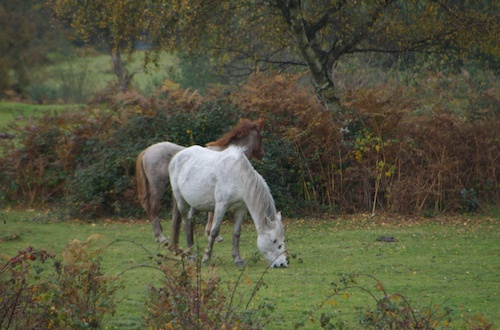
New Forest ponies, Hampshire, England, 2004
Here’s 10 tips, based on the above and other personal experiences:
1. You’ve seen an ad for a workshop or a tour in a place you’ve always dreamed of going to. Ask yourself: Is this the right trip for you or are you going because it’s there? How well does the trip fit your artistic goals?
2. Can you check out the organizer through references from previous “customers”? Make sure that their criteria for a successful or failed trip are in line with yours.
3. Before you sign up, have an exit strategy. This may mean paying more for refundable tickets (which I had not). It may mean having to leave the workshop or group. I ended up moving into a small hotel in town when I was in Portugal in 1996 because the group I was with at an old farmhouse was the very definition of “disfunctional” and I couldn’t even get a reasonable night’s sleep. Make sure you have enough money or at least a high enough limit on your credit card so you aren’t stuck in a bad situation for lack of funds.
Roman temple ruins, Evora, Portugal, 1996
4. I don’t travel with miscellaneous groups of total strangers anymore. See item 3. What’s your tolerance for rude, inconsiderate behavior? What is your tolerance for physical discomfort? Know thyself and do not try to fool yourself or talk yourself into a trip. If you need your own room, suck it up and pay the single supplement.
5. Which brings us to….Don’t force it. Trust your gut. I had to force myself to punch the “Buy” button for the India trip plane tickets. There is a book called “The Gift of Fear”, which I recommend for anyone who is planning to travel to unknown or exotic locations because it explains very clearly WHY you should trust your gut/instincts/intuition. The punch line is that the data you need is there, but, for whatever reason, only your subconscious mind is perceiving it. In hindsight, it’s often quite obvious why it was really dumb to (fill in the blank with the “What was I thinking?” of your choice).
6. Once you’ve signed on for a trip, monitor the responsiveness and helpfulness of the organizer(s). Do they communicate with the participants in a timely and professional fashion? Do they answer emails, voice messages in a timely fashion? No news is bad news and was one of the red flags for the India trip. And, by the way, two days before the event, the schedule for the week was sent out (I’m still on the mailing list, I guess). There will be only one “game drive” a day and the rest of the time will be filled with…other stuff. I would be a seriously unhappy camper at this point.
Outdoor cafe, Milan, Italy, 2000
7. If you start to wonder what’s going on, don’t make excuses for the organizers. For most of us, once we commit to something, it’s natural to want it to all be ok. See item 5.
8. Yes, it’s your dream trip, but don’t get carried away. Be hard-headed. You’re the one writing the checks. The only leverage you have is your willingness to walk away. Do not let yourself be cornered into thinking that you MUST go if it starts to feel wrong. It wasn’t easy to get to the bail-out point on the India trip, especially after announcing it in my newsletter, on my blog, on Facebook….but it was the right thing to do.
9. If you are traveling with a buddy, once again, have an exit strategy. Travel can have a strange effect on some people, who will possibly do things that they would never do at home. You are responsible for your own care and safety. If someone you’re with wants to do something you think is stupid or risky, walk away. I repeat, walk away. You’re a long way from home, may not speak the language and might not have a cell phone that works where you are. Carry the contact information for your embassy with you and register with them before you go. They can’t help you if they don’t know you’re in the country.
10. But if it all feels right and good, GO, GO, GO!!! There’s nothing like getting out there into the world and learning what a big, wonderful, fascinating place it is.
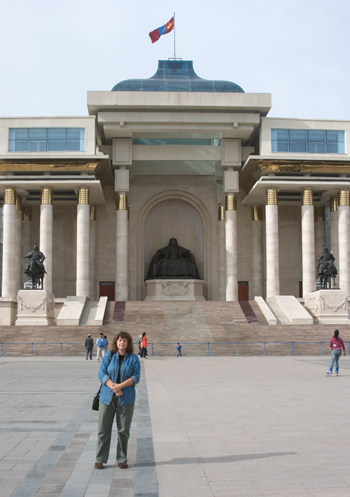
The Parliament Building with statue of Chinggis Khan, Ulaanbaatar, Mongolia, 2008
This poem is from a book that I found in the Art Shop at the Museum of the Chojin Lama. It is called “Modern Mongolian Poetry (1921-1986)” and was published in 1989, just before the non-violent revolution in which Mongolia made the transition from communism to democracy. It was my first introduction to Mongol poetry.
Poets and other creative people who objected to the communist government had to be very careful in what they said, wrote and painted. There are many poems in the book extolling the wonderfulness of the socialist system, heroic workers and battle victories. But, carefully couched in metaphor, are other points of view. I’ll be posting some of both in the future, but today’s poem is about a subject that I suspect all Mongols of the time could agree on…HORSES!
Mongol horses, Baga Gazriin Chuluu, July 2010
MONGOLIAN HORSE
Crowning our glorious motherland
With victory after victory.
Raising the victorious banner,
We always went on horseback.
As a Mongolian’s courage
Is measureless,
So the Mongolian horse’s strength
Is boundless.
When the good Mongolian people
With their history of victory
Did their good deeds
Their good horses played their part.
As a Mongolian’s courage
Is measureless,
So the Mongolian horse’s strength
Is boundless.
In doing work
For our happiness
Our spirited Mongolian horses
Will work with us ceaselessly.
As a Mongolian’s courage
Is measureless
So the Mongolian horse’s strength
Is boundless.
I’ve had my iPad for about three weeks and am already wondering how I got along without it.
It’s easy for me to read on it and I’ve downloaded my first book, Isaac Asimov’s Memoirs, if you must know.
I’ve played to the end of Graffiti Ball. I’ve got Solitaire, Cro-Mag Race and Paper Toss. David and I have found that we like playing Scrabble with it.
I’ve downloaded the iPad version of the Monglian language app that I have on the iPhone and also found a English-Mongolian dictionary.
Google Earth looks really good.
I plan to use Keynote for a virtual portfolio of my work and a presentation about the women’s crafts collective that I work with in Mongolia.
The battery life is terrific. The glossy screen is lovely. The keyboard, well, it’s functional, but will take some getting used to. I wouldn’t write the Great American Novel with it, but would certainly do short blog posts or longish emails.
But, I wondered, having bought Autodesk’s Sketchbook for the iPhone, could I use the iPad as a real, functional, I just need to get some work done, sketchbook? I bought Sketchbook Pro first thing. With some caveats, which I will cover at the end, the answer is a resounding “YES!!!” I had to force myself to stop drawing and get this post done.
The iPad should be viewed as simply another way to create images. A different media, if you will. And one that takes the same kind of futzing around, experimenting and practice that would be required to get the hang of any new way of working. Except that it’s a whole bunch of ways in one app that can be endlessly combined.
I’ve barely scratched the surface as this point, but thought that I would share some of what I’ve drawn and “painted” over the last week or so.
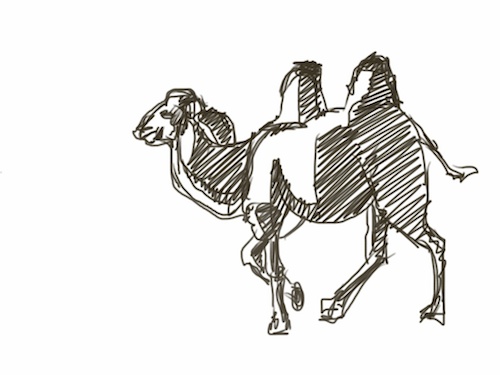
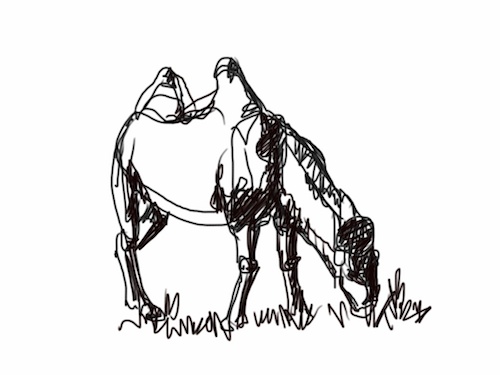
I first had to decide what tool to draw with and what color. I decided to see if I could replicate David Rankin’s fast sketching technique because, if I could, then the iPad would be all I would need for field sketching at zoos and such. Here’s some experiments, the ones I considered reasonably successful. The others have gone to the big wastebasket in teh interwebs.
Gobi Monastery gate, from July 2010 trip to Mongolia; this was the first keeperHerder's dog; started to see how to add color
These next ones are all done really fast. Maybe a minute or so.
Bactrian camel; trying different tool and valueAnother experimentI like this one. Used a chisel point for thick and thin lines.My thought here was to see if I could do a prelimary quick sketch for a painting. Two guys riding a yak.
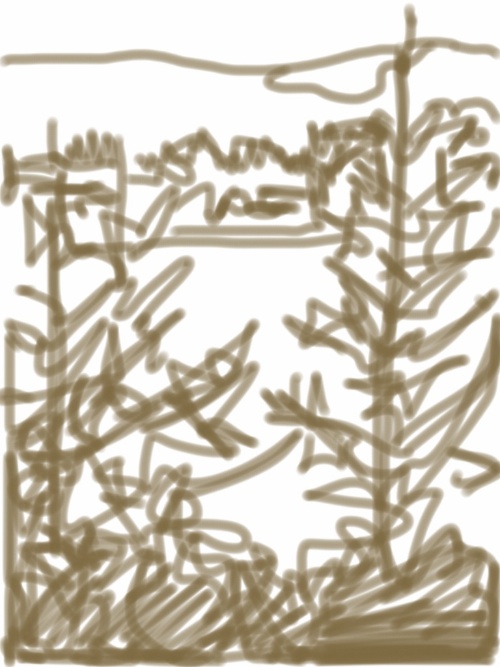
Then we went to the Humboldt Bay National Wildlife Refuge and I took the iPad with me. I realized that I didn’t know it well enough to do much, but I did do this one sketch that turned out ok. It’s from up on Table Bluff looking east across the bay.
First location sketch
When we got home I decided to try something finished in full color from a photo I’d taken that day. I beat this thing to death adding layer after layer and, you know what, it didn’t matter. I could just keep going as long as I wanted to.
Trees at the refuge
So I had a scribbling good time on that one. But how about a “real” drawing of an animal. A couple of false starts, I did the lemur and realized that this app was for real. It probably took me somewhat over an hour because of picking my way through all the choices of tool and colors. At this point, I also started to really use the “Radius” setting, which is the diameter of the tool and “Opacity” which is how solid the color is. And that function is what really makes this go for me more than anything else, I think.
Lemur, Bronx Zoo
I started an argali drawing, got it almost done, leaned forward, accidentally pushed the button at the bottom of the iPad, which closed the app, unfortunately having not saved about an hour’s worth of work. All gone. Oops. Lesson learned. But here’s the starting drawing, which is pretty much the same as what I do with a brush or pencil.
Start of argali drawing; and the end, as it turned out.
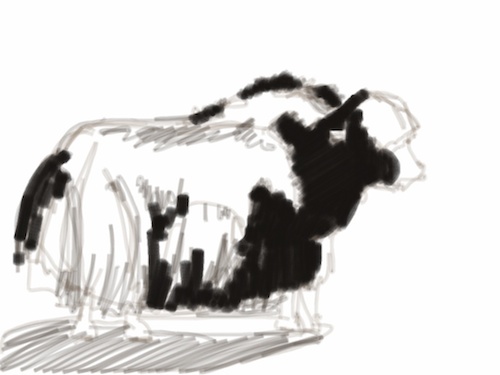
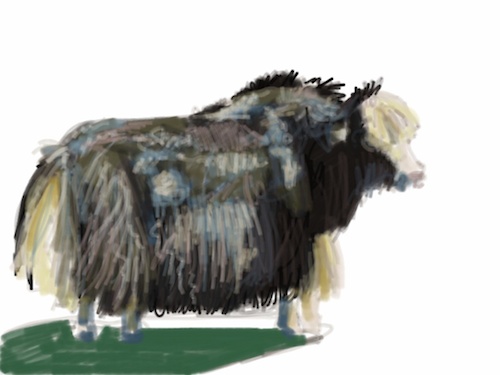
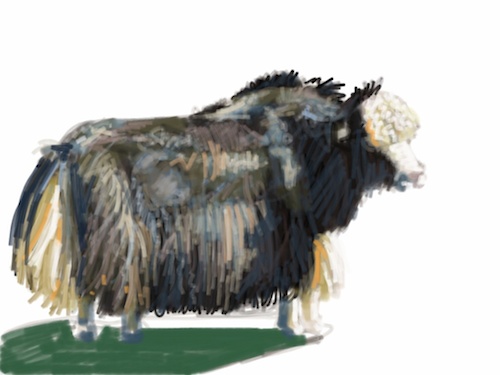
This morning I did the following drawing of a yak, wanting to have something more finished to go with the lemur. I did my saves this time, so I can show you the whole sequence from start to finish. It took about an hour and a half. I used the same procedure as usual.
DrawingShapes of shadowsLaying in the darkest darksPutting in a layer of color all overThe process of refining shape, values, drawing beginsMore layers of colorThought I was done and, anyway, it was lunchtime.But came back and realized that the highlights on the hide were too bright.
I could keep going on this guy, smoothing the transitions between areas and doing more with the ground, but I’ve gotten all I need from this one, so time to move on. It was fun though, especially adding the squiggles on the head.
Now, the caveats:
The first eight drawings, up to the lemur, were done with my finger. I was surprised at what a decent result I got, but I needed something with finer control and which was a wee bit thinner because said finger blocked my view of what I was working on. We went by the local Apple affiliate store and I bought a Ten One Design Pogo Sketch because….it was the only stylus they had. As it turned out, it works pretty well. But I would still like something with a smaller tip. There doesn’t seem to be anything out there at the moment. The stylus tips have to be a special kind of foam that will conduct electricity, which is how the touch screens work. There is some DIY info. on the web that shows you how to make your own and I’m thinking I might try that.
Moving the foam tip around on the screen doesn’t have a great tactile quality. It’s kind of smooshy and draggy. And I wonder how long the foam will hold up with the kind of use I intend to give it. I still need to put a removable clear film on the screen, so maybe I can find something that is slicker. Someone needs to make a special clear film for artists that has the right amount of friction.
Overall the functionality of Sketchbook Pro is really good and pretty intuitive. I’ve read the documentation and don’t recall seeing any of these addressed: I would like to have a side bar, like in Photoshop, that let’s me keep the tools and color selector in view. Having to toggle back and forth can get a little old. But it does give one the maximum real estate for drawing. I’d like an auto-save option (imagine that) that can be set to a choice of intervals. I want an eraser. Right now, I have to change colors and select white to erase.
I’d like to be able to directly import all or a selection of drawings into Aperture without having to export them to Photos on the iPad first. But the whole process was easy and worked well, except for the part where every image was re-named “Susan on the camel.jpg” (a previous project) when I exported them to my blog folder instead of the names I took the time to give each drawing in Sketchbook. Aperture also insisted on creating a new Project for the images instead of letting me import them into the album I had created for them. The two apps need to learn to communicate better.
I’d like the images to be in a format other than jpg so that I can process them in Photoshop if I want to without losing image quality.
I would like to be able to access the user manual in one click.
In conclusion:
The combination of the iPad and Sketchbook Pro is very close to being a serious product for serious working fine artists. I absolutely recommend it.
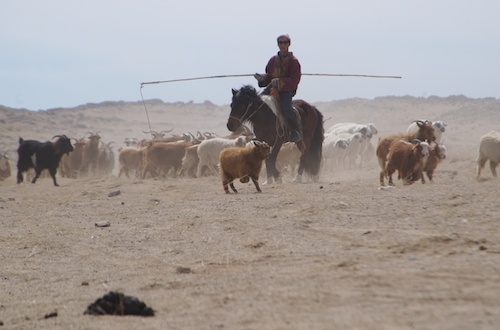
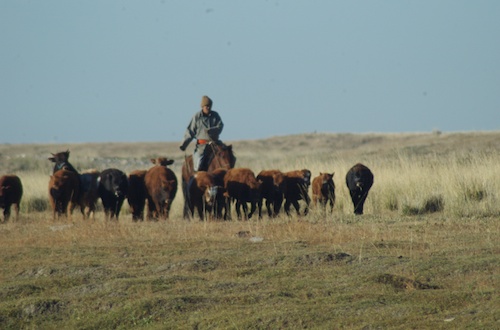
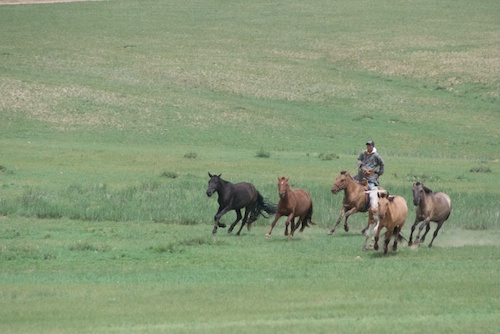
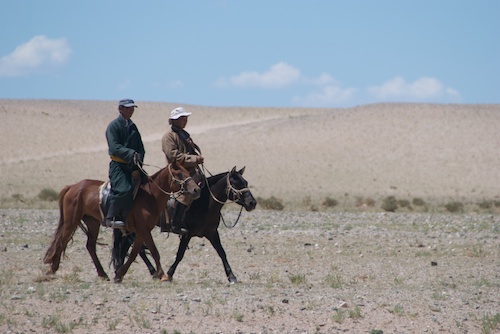
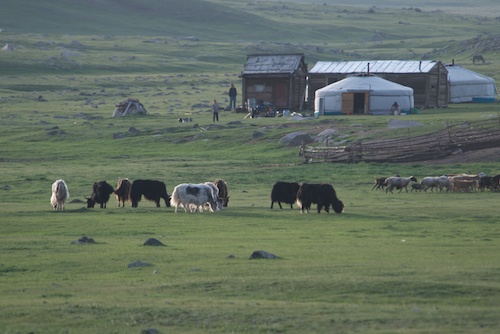
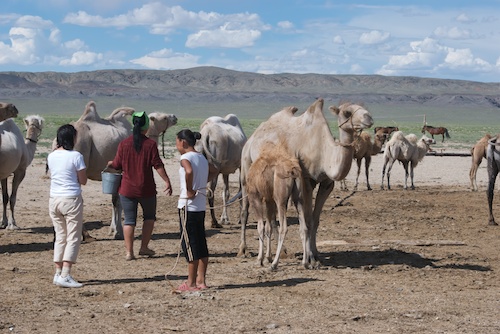
Going to let the pictures tell the story today. Here’s a collection of some of the photos I’ve taken of Mongol herders. Included are all of the Five Snouts, plus camels. Now I’m sitting here missing tsagaan idee (white food): airag (fermented mare’s milk), aruul (dried yogurt), byaslag (cheese), orom (sliced dried cream) and tsotsgii (cream, just cream, eaten using aruul as a base to put it on; heavenly). Bi ter bukh dortei! (I like it all!). Mongol friends-correct my sentence if it is wrong.
Herder with urga, Ikh Nartiin Chuluu, April 2005 (my first trip to Mongolia)Camel herder, Gobi near Bayanzag, Sept. 2006 (these are racing camels)Herding cattle near Tuul Gol (River), Sept. 2006Herding sheep and cashmere goats near Hustai National Park. Sept. 2008Rounding up horses, Gun-Galuut, July 2009Local herders coming to check out flooded river crossing, The Gobi, July 2010En route shot from car, July 2010Herder, Hangai Mountains, July 2010Time for a morning chat, Hangai Mountains, July 2010Yak herder's ger, Naiman Nuur, Hangai Mountains, July 2010Rounding up yaks, Orkhon Falls, July 2010Camel's milk airag coming up soon, the Gobi, near Orog Nuur, July 2010
On offer are original, one of a kind drawings and oil paintings and also affordable prints of my work. I hope you’ll stop by and check it out! I’m at: http://www.etsy.com/shop/foxstudio.
Here’s a sample of what’s currently available:
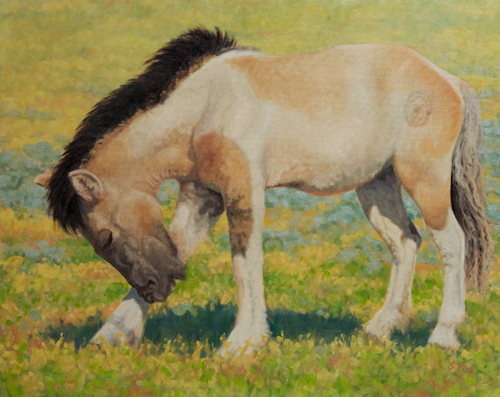
Gorilla 14x11" charcoal on paper $50Morro Bay Gull 6x8" oil on canvasboard $75Mongol Horse #3-Young Stallion 8x10" print on paper $12
I accept credit cards via Paypal and will ship worldwide. For US customers, if you are not satisfied, return the item within 14 days for a full refund. I want you to be happy with your art acquisition!
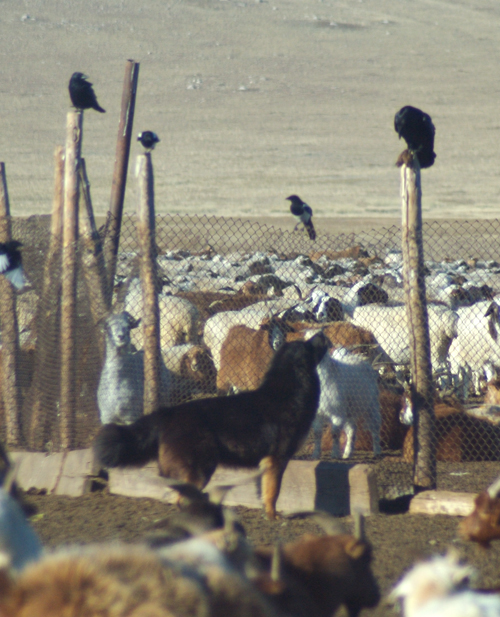
It's a draw. A herder's Tibetan mastiff dog "trees" a raven. Near Hustai National Park, Sept. 2006
I just finished Henning Haslund’s marvelous book “Tents In Mongolia”. As mentioned in a previous post, he was a keen observer who was fascinated by everything about the Mongols and their culture. He also seemed to be able to put aside his cultural biases much better than many of his contemporaries and describe what he saw with no moralizing and a minimum of judgment and off-the-cuff interpretation. For example (his spelling of Mongol words was clearly his best guess and was not consistent, which is why the word for “raven” is spelled two different ways):
“A pair of screaming ravens sailed over our heads towards the valley in the south, and this had an encouraging effect on Batar (his Mongol traveling companion), since the black khiltai shobo , “talking birds”, as the Mongols call them, conducted themselves in a manner which satisfied him.
“The ravens play for the Mongols a like important role as they did in the ancient north of Odin. The black widely-traveled birds are equipped with keen intelligence and are able to understand human speech. It is vouchsafed to certain favoured human beings to understand the ravens’ language, for ravens have a language, and these favoured human beings can acquire unbelievable wisdom and learning by listening to the communications of the sagacious birds.”
There are also a few pages of interesting notes in the back of the book:
Kiltai shobo, “the talking bird”, as the Mongols call the raven, may bring the traveller good or ill omen. Some of the auguries attributed to the bird are:
If a raven crosses you in its flight from left to right, the omen is good; if from right to left, it is evil.
If a raven croaks behind you when you are on your way, the omen is good.
If it flaps its wings and croaks, you are approaching great danger.
If it pecks at its feathers with its beak and croaks, it signifies death.
If it pecks food and croaks at the same time, you will find food for yourself and your horse on the journey.
If many ravens gather at sunrise, it signifies difficulties on the journey.
If a raven croaks at sunrise it foretells a fortunate journey during the day and that you are about to reach your goal.






















 Susan Fox, American Artist