Comments About Art And Artists From William Robinson Leigh

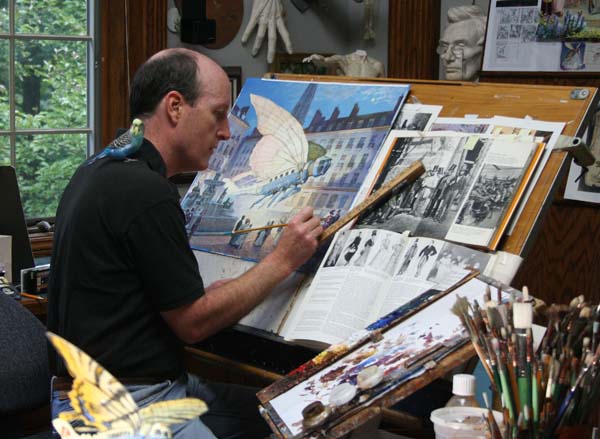
Leigh in his studio

Although his name is not familiar to most people anymore,in his day Leigh was ranked with Remington and Russell for his depictions of the American West, mostly southwestern Native Americans.

He grew up in a southern family that struggled to maintain an acceptable level of gentility without much money. Through the kindness of family members and friends, Leigh studied art at the Munich Academy for 12 years, even though he’d really wanted to go to Paris (too expensive).

He ended up traveling to the West and found his subject matter among the Navajo, Hopi and Zuni people, gaining the fame and fortune he had always sought late in his career.

The Pottery Maker

I recently read Leigh’s biography by D. Duane Cummins, having gotten interested in the artist after stumbling across four of his original pen and ink drawings for his book “Frontiers of Enchantment” at an art gallery in New York, which unfortunately were way beyond my price range. The book is about his adventures in Africa with Carl Akeley.

He was apparently quite an unpleasant person to be around and didn’t marry until late adulthood.

The book quotes from Leigh’s writings and he seems to have had plenty to say both about the creation of art and the art scene of his time, of which he was not, shall we say, a fan.

Struggle for Existence- Leigh also did a fair number of wildlife paintings

Here are a few of my favorites:

On drawing:
From a letter from Leigh to his mother, who wanted him to “skip ahead” from drawing to painting at the Munich Academy so he would be done sooner with his stay in Europe, money to pay for it being difficult to come by:

“You ask if I do not think that it would be my better plan to go into the painting school. Well I will tell you just how it is. You probably think that after having studied drawing for the length of time which I have studied it, (three winters in Baltimore, and two winters here, five in all) that I ought to be a pretty good draftsman by this time, at least good enough to go into the painting school. And it is very natural of you to think so; having not a minute knowledge of what an artist has to know. but you only have to reflect what an enormous undertaking it is to become an artist. When a person begins to paint, think what he has to struggle with. The bare outline of the head, the modeling of each individual part, the color, and the manipulation of the paint. When one begins to paint before he can draw well, he finds the difficulties so increased that he is crushed and is at a loss to know how to advance. The only thing is to go back to the drawing school and draw, until drawing becomes easy to him so that when he begins to paint the color and handling of the paint are the only things he has trouble with…Art is not a thing that can be understood at a glance, or studied out by rule like long division sums, nor can it be pushed along by force or learned within a measured space of time. It is not simply the skill of long practice, it is mental creative process.”

And, one week later:
“Do not think that all I have to do is to go into the Antique for one year, Nature one year, Paint one year, and Composition school one year, and then come home an artist. I might as well, tell you now, that it will take much, much longer than you think….I have begun the study of art now and there is no turning back.

Study for "The Best of the Bunch"

On Post-Impressionism (this from someone who had wanted very badly to study art in Paris):
“A whole generation is being mentally indoctrinated with sophistical garbage and the philosophy of Paris sewer-psychology.” He also referred to French paintings as barbaric, vulgar imbecilities, brazen effronteries, hideous travesties, sadistic, psychological bamboozle, technical flub dub, and insults to the common intelligence.”

“Sodom and Gomorrah would have been contaminated by them.”

After viewing the Armory Show in 1913:
“When our country was first invaded by the excretions of the French absinth fiends & and soul-debased moral prostitutes at the armoury exhibition in 1913, few including myself, could have been brought to believe possible, the aberrations of which our land is capable.”, also referring to it as an “intellectual pigsty” and “a lunatic’s hangout”.

At that point in time art like that in the show was outselling the style of art he was doing, both in price and quantity.

A finally, quite a takedown of Whistler:
“Whistler never understood that the human message in a picture was weightier than his tonal effects. He was devoid of story telling qualities: human joys and sorrows, the tragedies and poetries of life, the problems of the world, the sublimity of the ocean, the clouds, the stars did not stur his imagination. Cold and cynical, he took no interest in anything outside himself and the technical; the milk of human kindness, if he had any of it, was in the form of a lump of ice. Never before had the mediocre and the ignorant such a champion.”

I know, William, but what do you really think?
Mongolia Monday: 6 Great Mongolian Art Sites

One of the best-kept secrets about Mongolia is how important art is to Mongol culture. It reminds me of what I’ve heard about Bali, where it seems that everyone does something creative. I’ve found that as soon as someone in Mongolia finds out that I’m an artist, I come into focus and more or less jump to the head of the cultural line.

Artistic expression in Mongolia ranges far and wide, from traditional painting and sculpture to singing, music, dance, calligraphy, leatherwork, feltwork, embroidery and more.

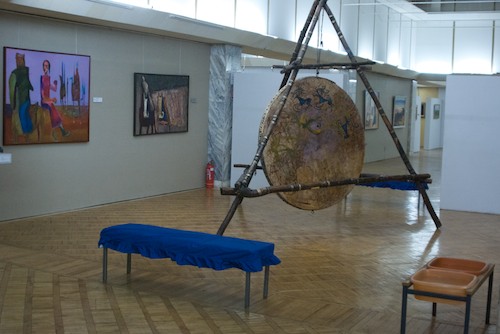
One of the gallery areas in the Modern Art Gallery, with a large shaman's drum

Mongol painters have been able, for the past seventy or so years, to travel to art schools in Eastern Europe, including Russia, where they have learned classical academic methods at a time when that instruction was impossible to find in the United States. The results can be seen today, especially in the Mongolian Modern Art Gallery. which is really a museum with a permanent collection.

Horses Hooves by P. Tsegmid, Modern Art Gallery; a personal favorite

There is also a national organization, the Arts Council of Mongolia, which runs a variety of programs to support young and emerging artists. I spent an hour with the director of the Council this past trip and came away very impressed by the quality of the programs and the staff.

Political commentary from an artist who was part of a group show at the Union of Mongolian Artists' gallery last year

There are also at least a couple of artist-run organizations. One of them, the Union of Mongolian Artists, has excellent light-filled exhibition space in a building just south of Sukhbaatar Square. I go there every time I’m in UB and the current offering is always interesting and of good quality.

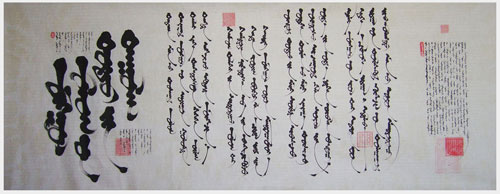
Mongol calligraphy by Sukhbaatar Lkhagvadorj

Some of the artists have their own websites. Here’s one from an incredible Mongol calligrapher, Sukhbaatar, who I have gotten to know on Facebook. He and his fellow calligraphic artists use the ancient Mongol vertical script which Chinggis Khan got from the Uigher people since the Mongols had no writing at the time he established the empire. The script also exists in type fonts and is taught in the schools.

Tsagaandarium Art Gallery and Museum

There are also a few commercial art galleries where you can see a very wide range of contemporary Mongolian painting, sculpture and other media. I’ve been to the Valiant Art Gallery a number of times. It  has two locations: one in the same building as the famous expat restaurant, Millie’s, which is right across the street from the Museum of the Chojin Lama and the second near the State Department Store. Last, but certainly not least, is the Tsagaandarium Art Gallery and Museum, which is located on a corner in Zaisan, across the river from the main part of Ulaanbaatar. They not only have great art, but offer all kinds of community events and art classes.

Best Juried Show Rejection Letter EVER!

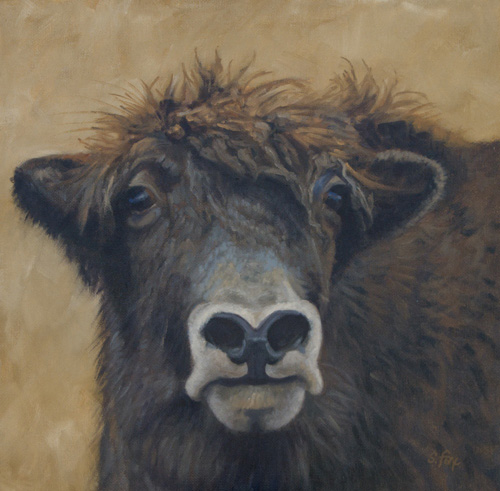
Checking You Out 12x12" - Now, really. How could they resist this face?

Rejection hurts, no doubt about it. You slave away and do the best piece of art you can and, clunk, it doesn’t get in. I’ve certainly gotten my share of rejection letters since I first started to enter juried shows in 2002. There are two shows that I’ve entered at least six or seven times each and still have not gotten in.

But I don’t make excuses. I don’t blame the judges. I don’t tell myself “It’s all subjective”. And I don’t scream and throw things (although that might be kind of fun). Until recently I assumed that my work simply wasn’t good enough yet. That still may be true, but I work hard to view my paintings objectively and at this point I feel that I know when I’ve nailed it. Only so many pieces will be accepted and only so many in a given genre, media and size. Sometimes your piece is just the odd one out.

So, if I don’t get in, it means that….I didn’t get in.

Which brings us to my latest rejection. I entered Salon International, the top-notch Greenhouse Gallery of Fine Art show, for the first time last year and had two of my three entries accepted! What a rush! And they were animal subjects (against which there can be definite bias in the mainstream art world) and both Mongolia subjects. So I got in on my terms with my subject matter of choice.

Guess what? I won’t have anything in the show this year. Bummer. But wait, here’s relevant excerpts from the rejection letter that went out to all of us. I was so impressed by it that I wrote to the gallery owner thanking him and asking if I could use it for a blog post, for which he graciously gave permission.

This is a perfect primer for any artist who wants to enter the juried show arena. Notice that it’s not about you personally, it’s the merit of your work only that is being judged. Read carefully how they define “artistic excellence”. There’s your checklist.

Dear Artist,

We congratulate you for having the courage to “throw your hat in the ring” of competition and for submitting one or more entries to Salon International 2012!

Salon International 2012 will be a spectacular exhibit of 434 paintings selected from 1,112 entries representing 44 states plus DC in the USA and 18 additional countries. As this event is open to all oil painters of traditional representational subject matter worldwide, the entries represent an extremely wide range of artistic skill and ability. In selecting paintings for the exhibit the jury was looking for over-all artistic excellence. In determining the presence of artistic excellence the following components were considered heavily: composition / design, focal point, use of color, paint manipulation, unification, originality, creativity, feeling, and choice of subject matter. When a painting is not selected for exhibit it does not necessarily mean that the jury does not like or respect it. As with any competition, a line has to be drawn. Where that line falls is always, at least partially, determined by space limitations.

The 1,112 total entries this year reflect a 9 1/2% decrease from last year. The over-all strength of the entries was greatly increased, resulting in more paintings being included in the exhibit than ever before, with a grand total of 434. Obviously, we can’t continue to increase the size of the exhibit every year. This means that we will have to become even more selective in the jury process. It means that wonderful paintings will be competing with other wonderful paintings. What does this mean for you? It means that each year the bar of artistic excellence is raised higher, the competition among artists becomes even greater, the awards are more meaningful and Salon International becomes more prestigious and more respected!

The major goal of Salon International is to both encourage and challenge artists worldwide to continuously strive for artistic excellence. If your entry was not accepted for this exhibit it should not be taken as a defeat but should be considered simply as a challenge to continue that constant stretch for a higher level of artistic skill and excellence. We encourage each one of you to continue to accept the challenges along the path which leads to the rewards of excellence and to continue to “throw your hat in the ring” of competition. Competitions are a healthy component of the growth process, creating opportunities to set and achieve goals, setting forth examples to follow, and rewarding excellence.

A list of accepted artist names and images for the Salon International 2012 exhibit can be viewed online at http://si.greenhousegallery.com. The entire Salon International 2012 exhibit can be viewed on line at http://www.greenhousegallery.com beginning on or possibly before April 14th. The awards will also be posted on this web site beginning April 14th .

We appreciate your participation in Salon International 2012 and your part in helping to make it a success. We have every intention to continue to build this event into one of the most prestigious and highly respected juried exhibits in the world. We welcome you to continue to participate in this exciting journey!

Very sincerely,

Will I enter again next year? Does paint dry?

Mongolia Monday- Wildlife Profiles: Takhi

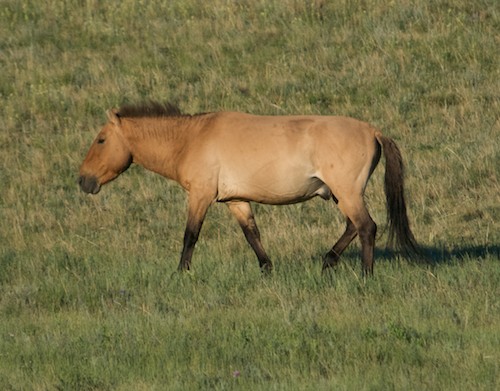
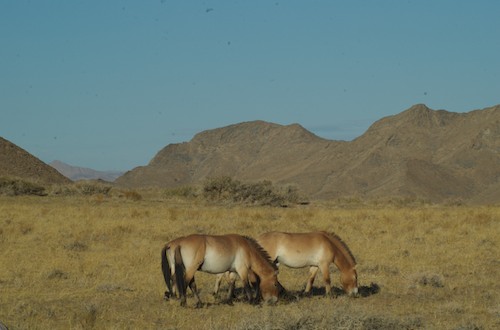
Takhi stallion, Hustai National Park, 2010

Species: Takhi or Przewalski’s horse (Equus ferus przewalskii)

Takhi, Khomiin Tal, 2006

Weight, height: approximately 300 kg or 660 lbs.; 13 hands (52 inches, 132 cm)

Takhi, Hustai National Park. 2005

Conservation Status: Endangered (IUCN Red List)

Takhi, Hustai National Park, 2011

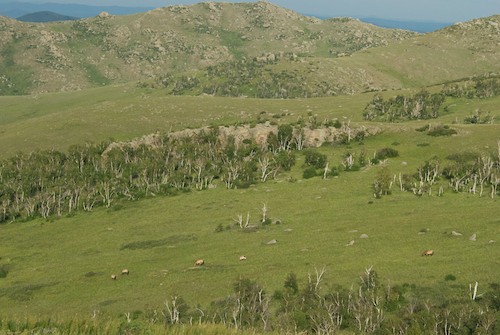
Habitat Preference: Steppe, semi-desert; now also mountain steppe (Hustai)

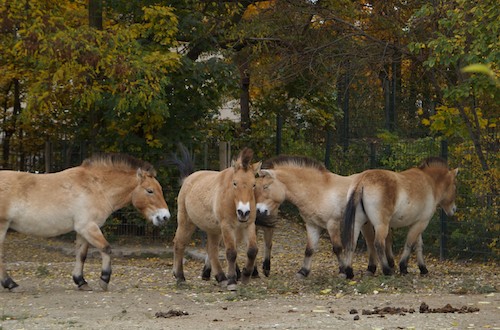
Takhi group, Berlin Zoo, 2004 (first time I ever saw the species)

Best places to see takhi: In the wild: Hustai National Park, Mongolia. Captive animals: Many zoos and some reserves, including: San Diego Zoo, Denver Zoo, the National Zoo, the Berlin Zoo, the Wilds (near Cincinnati, Ohio)

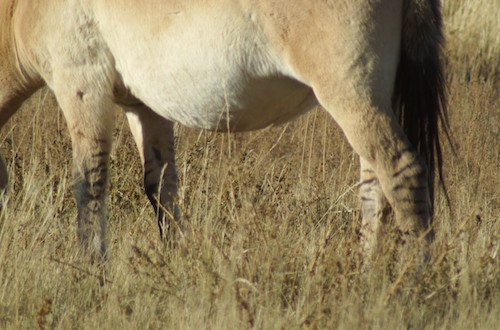
Takhi leg stripes, Hustai National Park, 2005
Domestic Mongol horse with leg stripes, 2011

Interesting facts:

-Takhi are the only surviving species of true wild horse. What are called “wild horses” in the USA are feral domestic horses.

-The last wild takhi, a lone stallion, was spotted at a waterhole in the Dzungarian Gobi in 1969, and not long after the species was declared extinct in the wild. After WWII, only 55 survived in captivity, all descended from 13 founder animals. Today there are approximately 2000 takhi of which, as of 2011, 360 were at three release sites in Mongolia.

-Their range originally included, along with Mongolia: Belarus, China, Germany, Kazakhstan, Lithuania, Poland, Russian Federation, Ukraine.

– Takhi have 66 chromosomes. Domestic horses have 64. They can mate and produce fertile offspring. It is estimated that they diverged around 500,000 years ago, so the speciation process is not complete. Domestic Mongol horses with takhi characteristics like carpal and tarpal leg stripes are fairly common, indicating a cross at some point in the past. Modern horses are not descendents of takhi.

-Other than a few instances of intensively hand-raised foals who would tolerate a rider while young, no one has ever “tamed” a takhi.

-They became known in the west when Col. Nikolai Przewalski brought a skull and skin, which had been presented to him at a border crossing between far western China and Mongolia, back to Russia. The official description was published in 1881.

3 Great Art Blogs

Here are the links to three art blogs I really like. There are a lot of them out there, but unfortunately too many artists don’t post regularly or don’t do much other than occasionally post images of their work.

These three stand out for quality of content and regular postings.

1. Gurney Journey is one of the top-rated art blogs. James Gurney is the author of the Dinotopia books, has written two books about art technique and craft and posts to his blog every day on everything from how the human eye tracks through a painting to short profiles of famous artists to how he creates his own marvelous works.

2. COLOR AND LIGHT is the blog of nationally known artist Adele Earnshaw. She started as a watercolorist, but switched to oils a few years ago and the story of why and how she did that makes very interesting reading. Recently she’s been doing what she calls 75 For 75. A painting a day for 75 days that she offered for sale as she finished them for $75. I managed to snag one a few months ago, but I had to be quick because most sell within minutes.

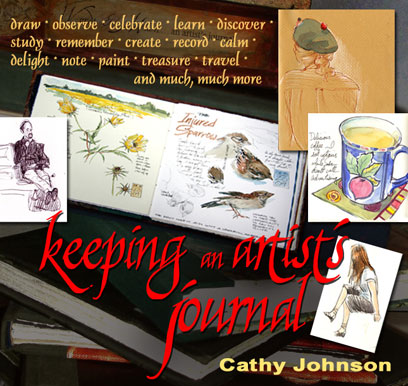
3. Cathy Johnson Fine Art Galleries is where you can find all kinds of great art instruction materials, along with images of Cathy’s art. I remember reading her column in Artist’s magazine many years ago and was tickled to find her on Facebook and see that she is still at it and then some. She offers CD courses, mini-classes and also information about various art media like her favorite drawing pen. Her instruction is real, not that rote “Here is how you paint a tree with my special brush and paint” stuff.

Mongolia Monday- Proverbs About Being A Mongol

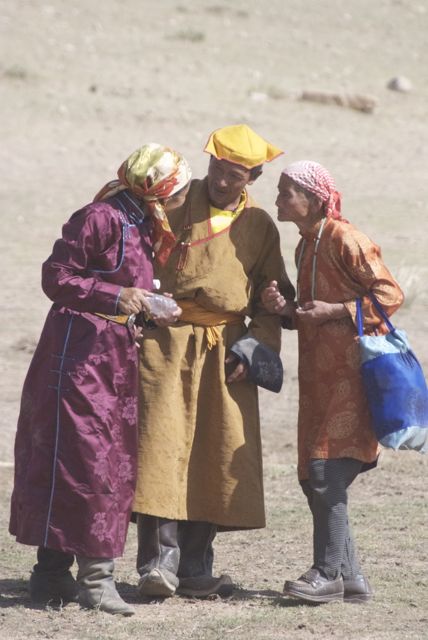
Buddhist priest chats with two women, Baga Gazriin Chuluu mountain blessing naadam, July 2009

There are many proverbs in Mongolia concerning good and bad character traits. Many are meant to teach children how they are expected to act. Others are intended as reminders about how to get along in life.

A good character and name is very important and is shown (or not shown) in one’s actions:

Take care of your deel when it is new
Take care of your name when it is clean

Person who has bad character loses his name
Person who works hard will tell his name

Being humble is considered a very good character trait:

A large sea is calm
A knowledgeable person is humble

Many proverbs encourage people to work hard and finish what they start:

If you are bold, work will be finished
If you are persistent, happiness will come

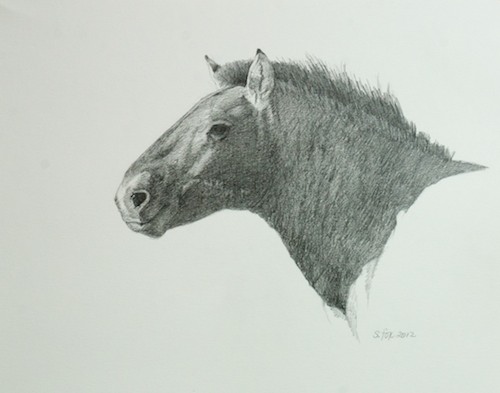
New Drawings of Takhi

It’s been awhile since I’ve done some finished graphite drawings and that’s what I’ve been doing this week. I’ve always loved to draw, so it was fun to just sit with a pencil (a General’s Draughting Pencil) and paper (Strathmore 300 vellum bristol) and work from some of the takhi photos I’ve shot during my trips to Mongolia.

Tahki Stallion
Takhi foal
Takhi Stallion Head Study
Takhi Stallion "Snaking"

A French equid researcher I know told me that this body position is  known as “snaking”. It’s purpose is to get the stallion’s harem moving quickly. His low body position is suggestive of a stalking predator and triggers the response he wants from his mares. I’ll probably be doing a painting of the whole scene at some point, so this is a useful study.

All of these horses were photographed at Hustai National Park, which is an easy two-hour drive west of Ulaanbaatar.

Mongolia Monday- Ethnic Folk Group Altain Orgil

Mongol ethnic folk group Altain Orgil is essentially the house band at the City Nomads restaurant in Ulaanbaatar. I had never heard of them until I bought one of the CDs on a whim at the HiFi shop on Seoul St. Wow. I will be at City Nomads at 7:30pm sharp next time I’m in UB.

There are a number of these groups around, young people who are not only preserving traditional singing forms and instruments like khoomii, long song and morin khuur, but adding their own individual vibes and twists. What makes Altain Orgil interesting to me, besides loving their music, is that they often wear authentic-looking Mongol shamanic clothing when they perform. Unfortunately, I could only find a couple images of the group, but there are a number of videos on YouTube and I’ve posted a few of them below.

Have You Heard Of Pinterest?

Pinterest is the newest social media service hit and one that has the potential to be very useful to visual artists. It’s currently available by invitation only, but you can request one at their homepage, or this article on Mashable offers a few other suggestions.

They’ve gone from 1.2 million users in August to over 4 million at this point. And that’s without being open to the public.

It’s a virtual “pin board” to which images are posted. You can create “boards” on any topic you wish, such as “Susan Fox’s Paintings” or “Outrageous Desserts” or whatever. Other members can comment on your pins and (and this is part of what makes it intriguing as an art marketing option) “re-pin” your image to one of their own boards, from which their followers can re-pin it and…..

It’s totally visual. It’s easy and non-technical to use, at least I think so. You can post prices, so it has potential as a selling site for art. (How to do so is included in a bonus feature that is part of the Mashable article linked to above). It could almost be a substitute for a website if all an artist wanted was a place to display lots of their work.

The interface is clean and attractive and shows off art nicely. Pins can also be re-posted on Twitter and Facebook. There’s a line of icons under your profile information that includes links to your website, Twitter, Facebook and an RSS feed.

It’s easy to pin to with a “Pin It” bookmarklet that sits in your browser Toolbar. It’s easy to upload images from one’s computer. It’s easy for people to “re-pin” or share what you’ve posted. My Mongolian bactrian camel painting was re-pinned within minutes after I posted it, so there’s potential for lots of eyeballs and for an image to go viral.

Here’s my “pin” page: http://pinterest.com/foxstudio/pins/ and here are my “boards”: http://pinterest.com/foxstudio/. I’m trying a variety of boards, hoping that if I have interesting images in a number of categories, it will draw people in to check out my art, too, and also become a follower. It was really easy to add new boards, rearrange their order and move images between them.

On the main site, there is already an “Art” category, also “Photography” and “Film, Music and Books” categories. You assign your boards to one of these pre-existing categories, but can easily change which one at any time.

If you want to find out more about how to use Pinterest and to see if it would be useful to you as an artist, Mashable has a handy beginner’s guide.

This is still a really new option and early artist adopters are going to have to feel their way to see how it can best be used. If you’re already on Pinterest, let me know what you think of it!