Rejection (It Sucks)

California Condor  10x8" oil I think this is a great piece and was hoping the small size would turn the trick for a first time acceptance. Uh, nope.
California Condor 10×8″ oil
I think this is a great piece and was hoping the small size would turn the trick for a first time acceptance. Uh, nope.

My colleague and fellow SAA member Sandra Blair has written a great blog post called “Salon des Refuses” taken from the original exhibition that a number of the French Impressionists and other “modern” artists mounted in 1863 when their work was rejected for the Salon of the French Academy, which was a bastion of traditional realistic painting and sculpture.

Sandra’s topic is the artists who were rejected by the jurors of this year’s Birds in Art competition, the most prestigious bird art exhibition in the world. And I’m one of them. For the eighth year in a row. I’ve never gotten in. But as you will see if you click through to Sandra’s post and scroll down, I’m in very good company indeed. And don’t miss the comments. Kathy Foley, the Director of the museum which hosts the exhibition, has posted some thoughtful observations.

Our respective posts are absolutely not intended to take away anything from the artists who have had their work accepted. Many of them are our friends and colleagues and we are thrilled for them. But rejection stings, particularly with social media like Facebook, on which one sees the happy announcements of acceptance while waiting with hope fading that the magic email will arrive in one’s own inbox. And doesn’t. Sigh. Another rejection.
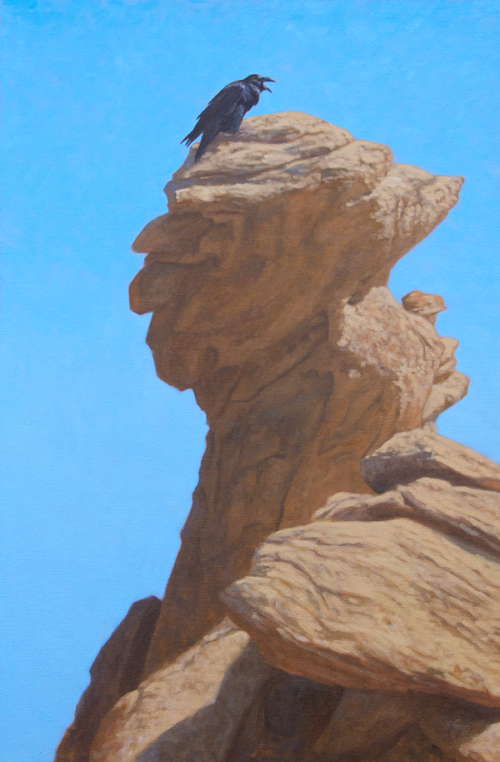
Raven on Big Head Rock, Ikh Nart  oil  30x20" I thought this was a great piece and was hoping that a big "wow" painting would turn the trick for first time acceptance. Uh, nope.
Raven on Big Head Rock, Ikh Nart oil 30×20″
I thought this was a great piece and was hoping that a big “wow” painting would turn the trick for first time acceptance. Uh, nope.

The important thing to remember is that if one doesn’t get into a show it means…..that one didn’t get into the show. Life goes on. There will be more shows. It’s crazy to take an exhibition rejection personally. Don’t do it.

Also…don’t make excuses. I have always taken the rejections as a challenge to get my work to the next level. That seems to be incredibly difficult for many artists to do. But if you can face the fact that maybe the reason you didn’t get in is that your entry wasn’t good enough, it provides the opportunity for growth. Blaming the jurors for being “subjective” or excusing yourself because you don’t have an “in” with the “right people” will not.

So, here’s a plan. Let yourself utterly wallow in self-pity for, oh, say, ten minutes. Let all those thoughts about how unfair it is and how the jurors are blind idiots who wouldn’t know good work if they were smacked along side the head with it bubble up. Cry. Snivel. (Carefully) throw something. And then get back to doing the thing you most love in the world, making art.

New Paintings Debut! “Quiet Moment (Mongol Horses)” and “Goviin Boroo (Gobi Rain)”

"Quiet Moment (Mongol Horses)"   14x18"  oil
“Quiet Moment (Mongol Horses)” 14×18″ oil

These two Mongol horses were part of a large herd that I saw at Gun-Galuut Nature Reserve in August of 2011. The mosquitos were pretty bad, so they were spending the day standing  in a large shallow pond surrounded by a wetland area. Although it is a nature reserve, the local herders are allowed to use the valley as they always have during the times when the ground-nesting cranes aren’t incubating eggs.

Herd of Mongol horses at Gun-Galuut Nature Reserve
Herd of Mongol horses at Gun-Galuut Nature Reserve with the Steppe Nomads eco ger camp in the background. The reserve is only a two-hour drive from Ulaanbaatar

The reference for “Goviin Boroo (Gobi Rain)” was taken in July, 2010 on my amazing two week camping trip. The rains were really good almost everywhere that year and the Gobi, contrary to how most westerners picture it, was green, green, green in many places, including this area near Orog Nuur, a remote Gobi lake where we spent the night.

"Goviin Boroo (Gobi Rain)"  18x24"  oil
“Goviin Boroo (Gobi Rain)”
18×24″ oil

I loved the layers of clouds, the streak of sunlight on the grass and the complimentary colors of green and red and knew I’d do a painting of the scene at some point.

You can read about the camping trip by selecting Mongolia 2010 from the drop-down categories menu.

The WildArt Mongolia Expedition, Introducing The Mongol Artists: Oidoviin Magvandorj

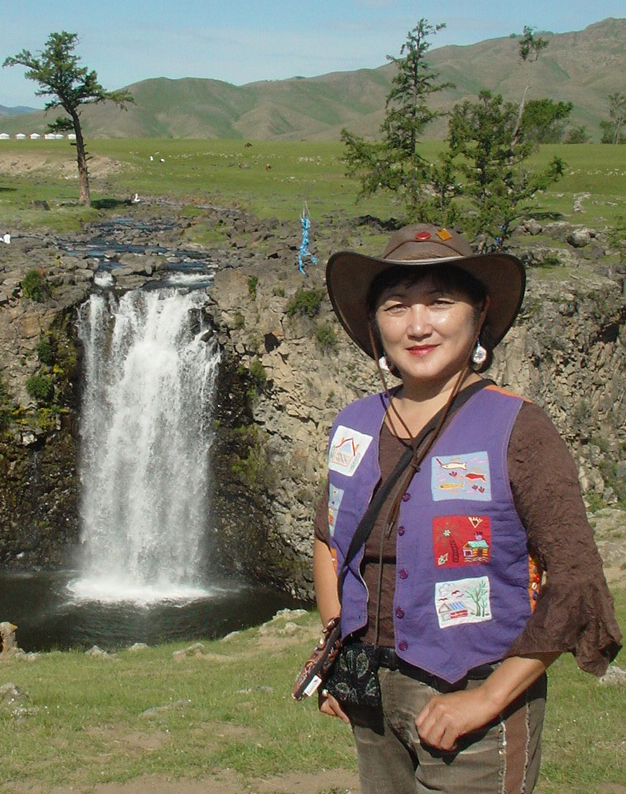
Magvandorj O PhotoOIDOVIIN MAGVANDORJ

Magvandorj was born in 1952 in Tsagaan Khairkhan, Uvs Aimag.

He attended/graduated from the State Pedalogical University in 1980

From 1972 to 1976 he was an member of the Union of Mongolian Artists branch in Uvs Aimag

From 1980 to 1990 he was an artist at the Musical Drama Theater, Uvs Aimag

Since 1990 he has been a freelance artist and a member of the Union of Mongolian Artists in Ulaanbaatar since 2000.

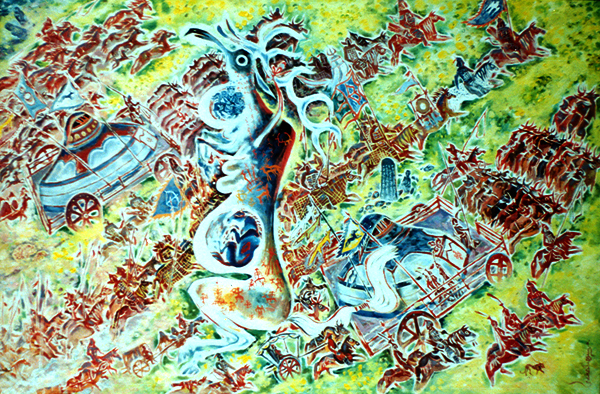
Great Empire of Mongolia

Great Empire of Mongolia

He has exhibited his work since 1977, both in Mongolia and internationally, participating in exhibitions in Paris and Mexico. His work has been in Union of Mongolian Artists exhibitions since 2005.

His awards include:
1987- “Mongolian National Costumes”- First Prize
1987- “Concert of Many Nationalities”- Best Artist
1988- Festival of Raduga- Leading Prize
2008- Leading Cultural Worker, Ministry of Education and Science

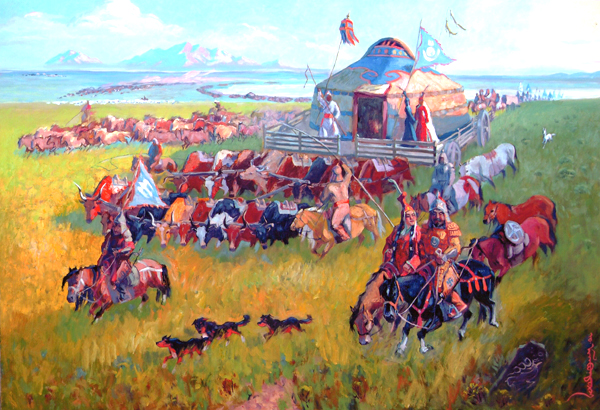
Nomadic

Nomadic

Altan Argamj

Altan Argamj

The WildArt Mongolia Expedition-Introducing the Mongol Artists: Tugsoyun Sodnom

It gives me great, great pleasure to introduce the two Mongol artists who will be going on the WildArt Mongolia Expedition! I met them when I was in Ulaanbaatar last year and am very excited that they have signed on. Them are well-known in Mongolia and deserve to be known in the United States too.

Today, I would like you to meet Tugsoyun Sodnom. Next will be Oidoviin Magvandorj.

S.Tugsoyun-orkhon

Tugsoyun was born in 1955.

She graduated from the Fine Art College, Ulaanbaatar in 1974 and from the Surikov Institute of Fine Art, Moscow, Russia, in 1980.

She has been exhibiting her work since 1974, both in Mongolia and internationally, participating in exhibitions in Bulgaria, Japan, Russia, Japan, India, Germany, Australia, Korea, the United States and London. Since 1974 she has participated in all of the Union of Mongolian Artists’ exhibitions.

Since 1974 she has designed and/or illustrated over 100 books.

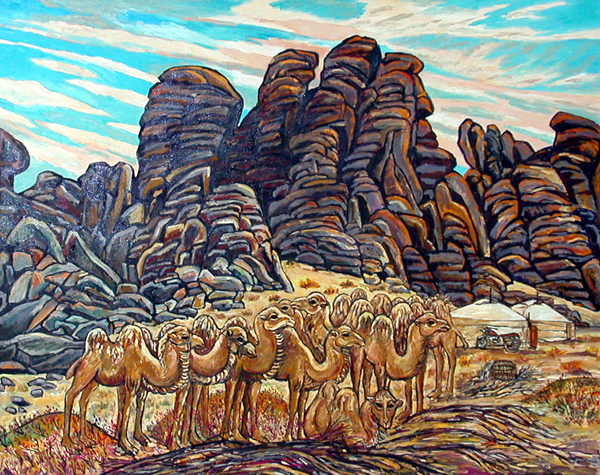
Gobi Camels

Gobi Camels

Her awards include:
1985- Annual Prize of the Union of Mongolian Artists
1988- Honorary Diploma, International Exhibition, Bulgaria
1989- Mongolian Youth Federation’s Award
1993- “Honored Labor” medal, government of Mongolia
2003- “Pole Star” of Mongolia, which is the highest honor that the Mongolian government bestows on artists

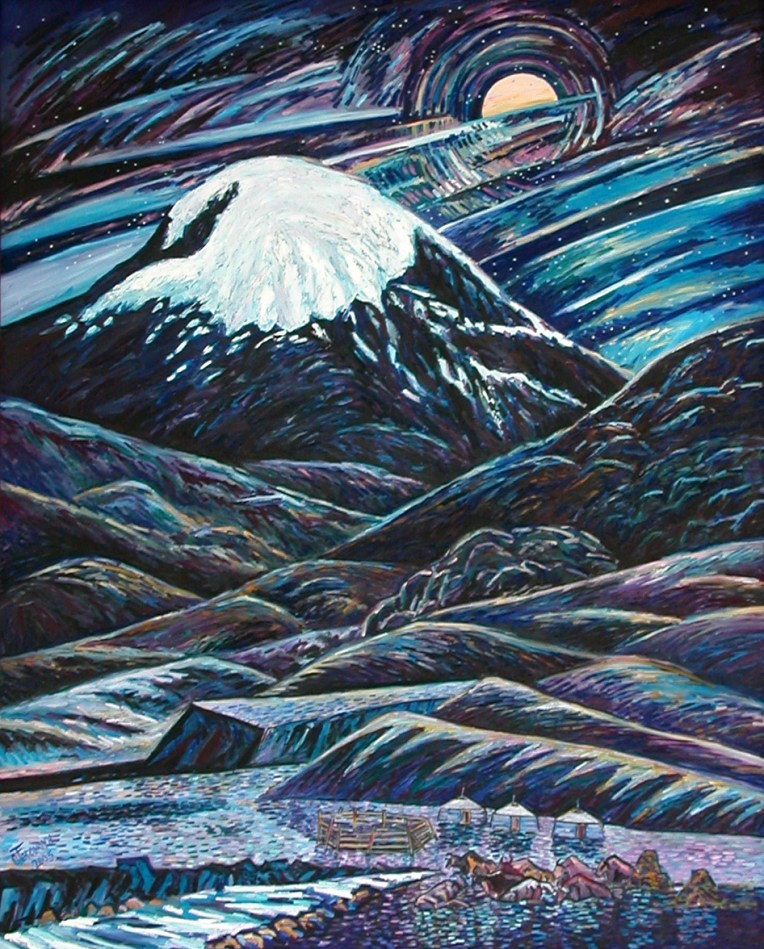
Night of Otgontenger Mountain

Night of Otgontenger Mountain

Her paintings and graphic works are in the collections of:
Fine Art Museum of Mongolia
Mongolian Modern Art Gallery
Fukuoka Art Museum, Japan
Trade and Development Bank, Ulaanbaatar
Agricultural Bank, Ulaanbaatar
Mongolian Chamber of Trade and Industry
Undruul Hotel
Tsetseg Hotel
Soros Foundation, Ulaanbaatar
The Asia Foundation, San Francisco, USA
Private collections in Japan, Germany, United Kingdom, Australia, Canada, Denmark, Korea, China, Russia, USA

Ger District

Ger District; she is particularly known for her series of ger paintings

Horse and Rider

Horse and Rider; one of her book illustrations

3 Ways To Use Your iPad For Your Art

Ikh Nart argali head study
1. Ikh Nart argali head study

An iPad is not a substitute for traditional media. It’s its own media and can let you make images that wouldn’t be possible any other way. But it can also be used for some of the same things as pencils or pens and paper. Here are three ideas on how to do that, all using my current favorite app ArtRage.

1. Color and detail studies- One can do a fairly finished study drawing to learn a subject, its form, structure, proportions and colors. If I do a painting of this argali, I’ll already know it pretty well and can concentrate on my brushwork. I like how easy it is to make corrections, zoom in and out and keep working layer after layer until I get what I’m after.

Mongol horse running

2. Preliminary study sketches- The iPad is great for sketching and finding out if a reference animal draws well. This is a horse I saw last year. I did one sketch of the whole animal,then zoomed in to do a close-up of the head and finally moved down to do the two front legs. Once again, it’s not that this can’t be done with pencil and paper, but the iPad offers other tools like a watercolor brush that would easily let me, for example, add a watercolor wash for the shadow areas. There’s also an eraser tool for making changes or cleaning up lines. It’s also convenient not to have to scan anything. The drawings are already digitized.

Mongol bokh thumbnails

3. Thumbnails- ArtRage works just fine for doing thumbnail sketches for working out composition ideas, like these two bokh, or Mongol elk species, fighting it out during the rut. They were way up on a hillside and as they bugled and sparred, with cows and calves  running past them. It took only a few minutes to do these six ideas, using the pencil tool with a light warm grey color for the marks. That’s another nice feature. You can do drawings like this in any color and easily change the color.

Mongolia Monday- 5 Photos Of Favorite Places: Khar Us Nuur

Sunrise with Jargalant Uul in the background

On my second trip to Mongolia in 2006, which I did on my own through Nomadic Journeys, I wanted to go out to the west to visit Khomiin Tal, the third location where takhi/Przewalski’s horse has been reintroduced. I flew out to Hovd, which is around 1000 miles from Ulaanbaatar, met my guide and driver and headed east about 130 miles, most of it on earth roads. I knew nothing about anything in Mongolia at that point and it was all a brand new and exciting experience.

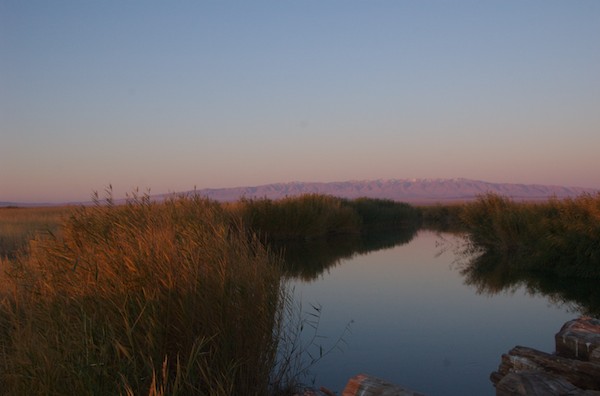
An unexpected sight was Khar Us Nuur National Park, which has been set aside to conserve and protect a complex of three lakes and their connecting channels. It is also one of the great birding hot spots in the world. But it’s difficult to get to the lakeshore in most places due to the thick reed beds. We camped on the shore of one of the channels the last night out in the countryside. Here are some of my favorite photos of a place I’d love to go back to sometime.

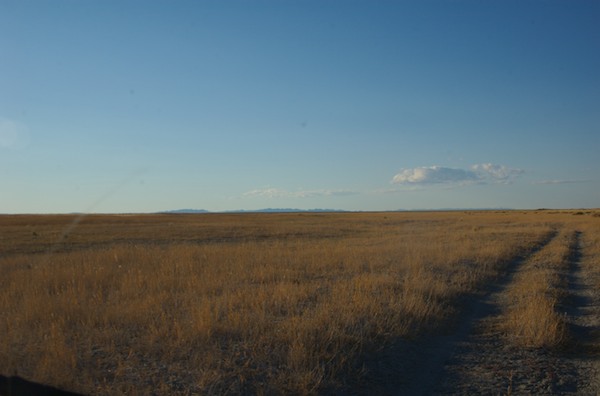
The steppe
The steppe at sunset, looking back to the east with the lakes behind me. This was my first look at the legendary grassland steppes the now exist only as remnants in Mongolia.
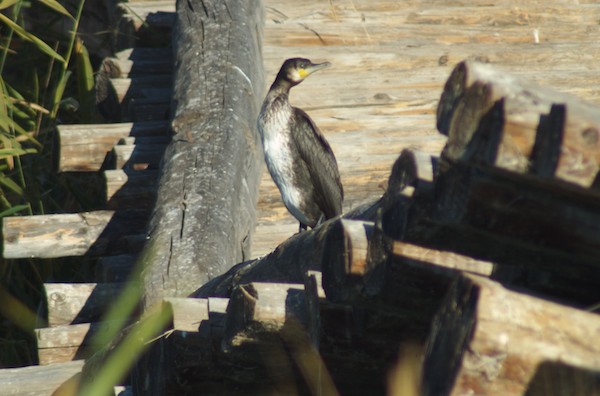
Cormorant
Great cormorant using an old wooden bridge as a fishing perch
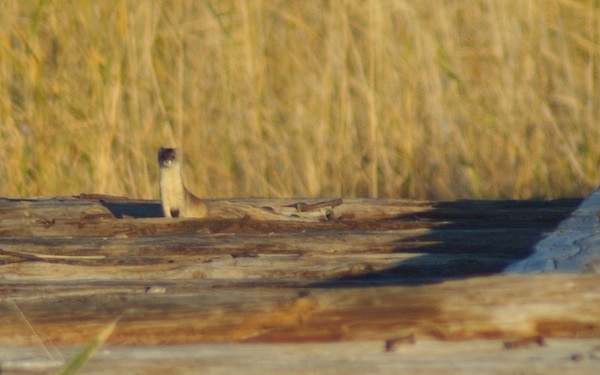
Weasel
Stoat or ermine who popped up on the old wooden bridge right near where we were camping.
Bactrian camels
Bactrian camels near the soum center, Dorgon. This was the first large herd of camels that I’d seen in Mongolia.

There is a previous post about great wildlife watching places in Mongolia that includes Khar Us Nuur. You can read it here.

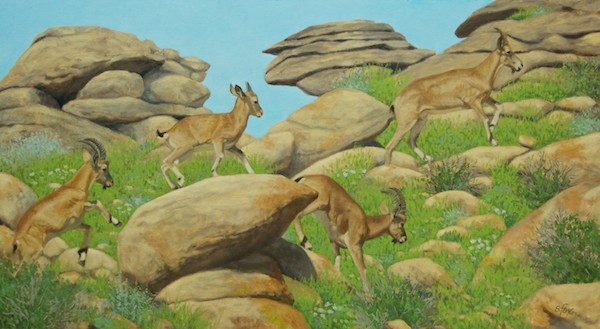
New Painting Debut! “Rock Hoppin’ ” -Siberian Ibex

Rock Hoppin'  20x36"  oil
Rock Hoppin’ 20×36″ oil

I went to Ikh Nartiin Chuluu Nature Reserve last year with a plan to focus on getting good, paintable Siberian ibex reference. Boy, did that ever work out. On three out of four mornings, I shot over 1000 photos and watched ibex for at least five hours. They were a couple of groups of nannies, kids and juvenile billies who were hanging around some of the rock formations at the west end of the valley where the research camp is located, only a 30 minute walk.

I’ve got a lot to chose from, but loved the “rock hopping” that occurred when this group, who I had already been watching for over an hour as they rested, grazed and interacted, got up and started to move off when the big nanny did. So here she is, cautiously and seriously leading her group to wherever she’s decided they will go, while the youngsters goof off and play follow the leader up and down and on and off the rocks.

Here’s a step by step of “Rock Hoppin’ “:

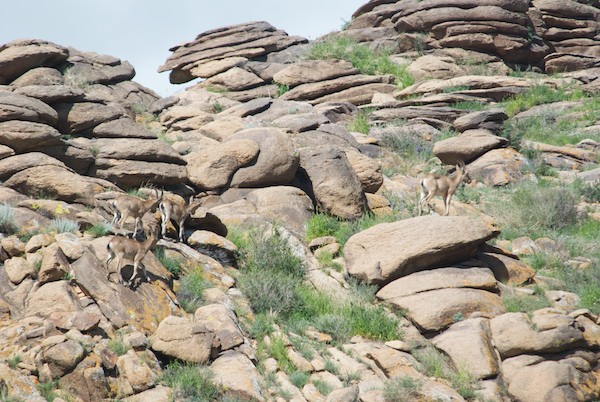
Ibex group at Ikh Nartiin Chuluu
Ibex group at Ikh Nartiin Chuluu; one of the dozens of photos I shot of this group as they moved off from left to right, the nanny leading the way and stopping at times to evaluate what’s ahead. Most of my reference showed only the rocks, but I wanted some sky also, so chose this photo for the upper left hand part of the painting, particularly that unstable formation at the top, which gives a feeling for the habitat the ibex like best.  There had been a lot of rain and the reserve was as green as anyone could remember. Wildflowers were everywhere. The photos one usually sees of this species are from way up above the tree line in mountains where there is very little vegetation. I liked showing them in a different and more colorful habitat.
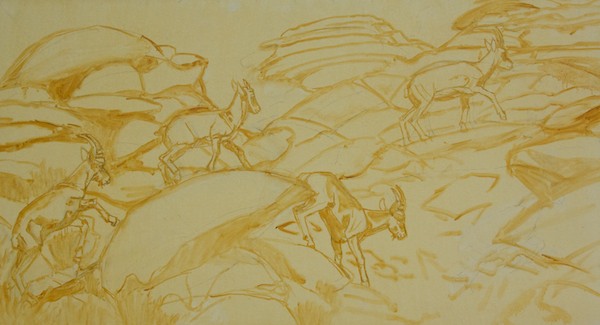
Preliminary graphite study
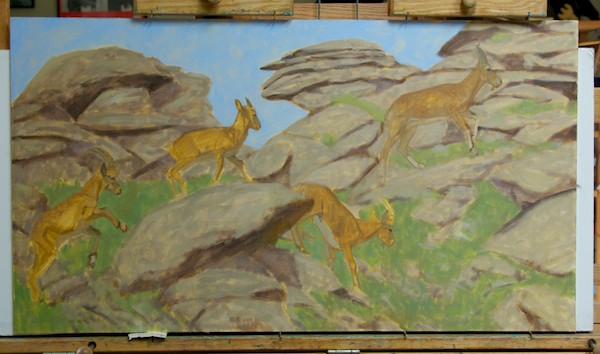
After doing a compositional drawing, I did a graphite transfer to the canvas and then re-stated the drawing with a brush
After doing a compositional drawing at the final size, I did a graphite transfer to the canvas and then re-stated the drawing with a brush. There had been a fifth ibex in the lower right, but something didn’t seem right design-wise and the solution seemed to be to remove that one, which I did. Then there was still something not right. I realized that I needed an adult ibex, the nanny who was leading the group, not a juvenal billy. This not only let me use a larger animal, which was visually more interesting, but made the painting behaviorally accurate, which is very important to me. I’ve developed a painting procedure that lets me make minor to major changes at any time in the process. I never have to put pressure on myself by “guessing right” at the beginning and then finding myself stuck when something isn’t working.
First color pass
First color pass, just laying in major shapes to make sure it all works. I used three pieces of reference for the ibex and at least three for the rocks. I planned the placement of the smallest ibex so that his/her head would be against the sky, which was not the case with the reference photo.
Modeling the ibex and the rocks
Modeling the ibex and the rocks. I’ve defined the shapes of the shadows on the rocks and can now see the pattern those create. I made sure there were large rocks pointing in from the right so that everything wasn’t moving off the canvas.
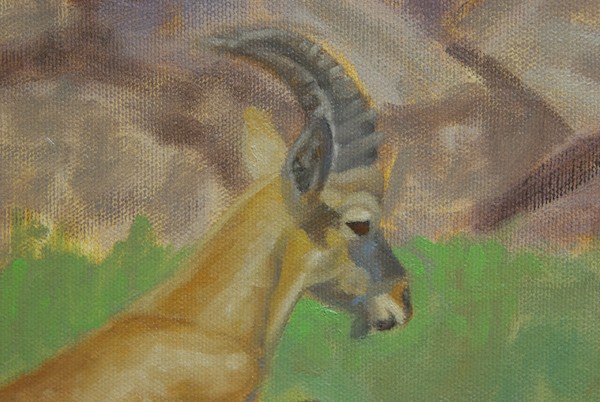
Detail of head in progress
Detail of a head in progress. From the base of the horns to the tip of the nose is 1 3/4″. I kept the shapes simple, but accurate. Detail per se is of no importance to me.
Detail of kid in progress
Detail of kid in progress. It was important to get the great gesture correct and show the muscles working.
Almost done.
Almost done. After this photo was taken, I punched up everything as needed, both ibex and the rocks and finished the grass, which has about six layers of warm/cool, light/dark colors, plus the summer flowers. I also refined the branches of the wild apricot shrubs. I basically did a repaint over the whole thing pulling up the light areas and adding color variations to the rocks, including the lichens, which give a warm touch that picks up the colors of the ibex and ties them to the landscape.
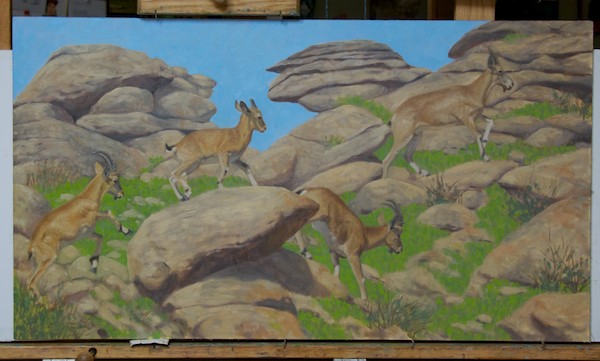
Detail; finished ibex, rocks, grass
Detail; finished ibex, rocks, grass. The grass was an almost acid green since it was so fresh. I knocked it back a little in intensity since it didn’t look quite believable in a painting. I also consciously varied the colors of the ibex and the proportion of light to dark on the bodies.
Rock Hoppin'  20x36"  oil
Rock Hoppin’ 20×36″ oil

New Painting Debut! “Raven on Big Head Rock, Ikh Nart”

Raven on Big Head Rock, Ikh Nart  oil  30x20"
Raven on Big Head Rock, Ikh Nart oil 30×20″

I was watching, sketching and photographing a group of ibex near this instantly recognizable rock formation at the west end of the valley where the research camp is located at Ikh Nartiin Chuluu Nature Reserve. Suddenly a raven landed on top of the rock and stayed for quite bit, occasionally announcing his presence. There were also endangered less kestrels swooping around and some red choughs, so it was quite a busy morning.