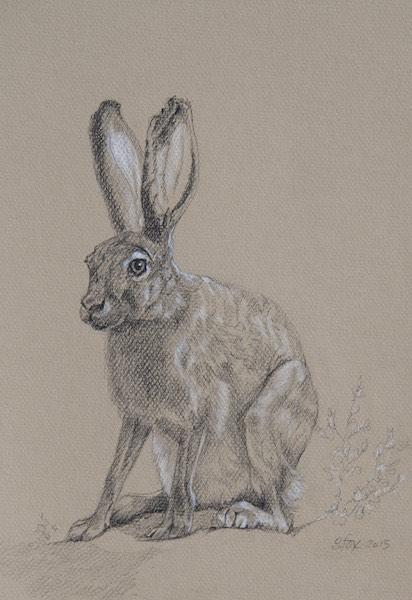
Tolai Hare 12×10″ Wolff’s Carbon Pencil and Prismacolor pencil on Canson paper
Over the past week I’ve finished, photographed and sent in my entries for the two most important animal art juried exhibitions. Whew. It was pretty intense there for a couple of weeks. Now the waiting begins…tick tock tick tock….In the meantime….
I’ve been wanting to do a painting of a tolai hare, the only member of the rabbit family native to Mongolia, for a number of years, but until last year had never gotten good enough reference. They wait either in cover or pressed to the ground, then explode into view, sometimes almost at your feet, and take off. Definitely gets the adrenaline going. I was at Ikh Nartiin Chuluu last year, staying at the research camp, which is at the head of a valley with a spring and stream. A variety of wildlife, both mammals and birds, come to drink there. One evening I was sitting up on the rocks, hoping to catch argali in good light. But what showed up first was this tolai hare! Since I was already in place and not moving, he/she went about their business none the wiser to my presence. And I finally got what I needed. This is a new species for me, so I did this drawing to “learn what they look like”. I enjoy working on toned paper and adding the touches of white.
Eowyn is the senior of our three cats at age 12. She’s mellowed over the years, but could probably have killed a Nazgul in her time. Her nicknames have included My Mean Widdle Cat and Mistress Mayhem. We found each other at the local humane society when she was about four months old, having been picked up as a stray on the street. (I was facing the full-length mirror behind where I sit in front of my easel, so that’s how I ended up in the shot.)
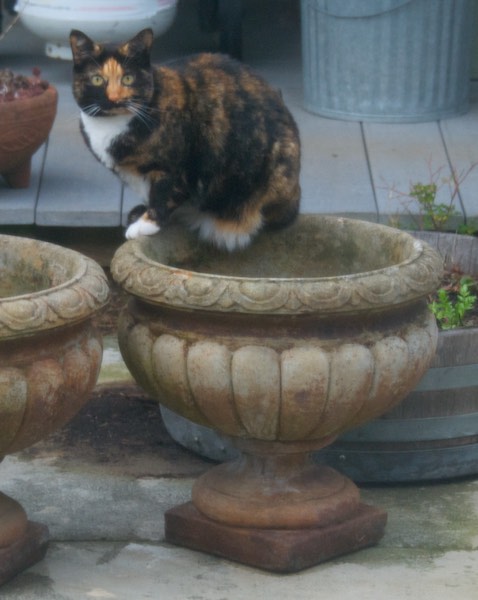
Michiko means “precious” in Japanese. She’s a tamed feral about age ten. We got her from the county shelter, where she was part of a feral litter that had been brought in. It’s been a long road for her to become a house cat and learn to trust. Her behavior was strictly patterned for many years. Recently, and we think it’s because of the calming energy our collie, Hailey, has added to the mix, Michiko has finally started to relax and even have little crazy fits, dashing around the house and batting at a catnip mouse. She’s so pretty I didn’t really care if she ever became a lap cat or wanted to be petted. Just having her around and giving her a safe home was enough. As it happens she sits on my lap and likes pets and skritches now.
This is Alexander A Really Great Cat. He was born at the county shelter and fostered in a home with other cats. He’s the first one we’ve had who actually has social cat skillz. He was a scruffy little thing who needed a bath immediately, which he took without a blink. He’s five now and has grown into this quite handsome guy who weighs around 16 pounds. He goes limp when picked up so our vet figured out that he is part ragdoll. He also has the long body. He’s a big lug of a cuddle bunny who has also killed black rats with a single bite to the spine….
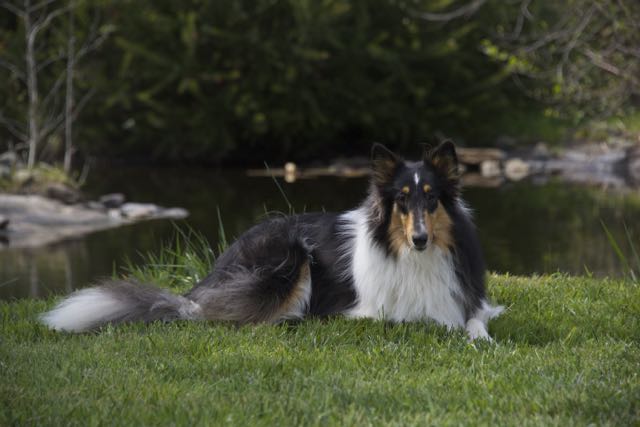
And a BONUS! Here’s our two year old tricolor collie girl, Hailey, looking pretty down by the pond. She watches over everything that goes on on the property, including the kittys, who all trust and like her.
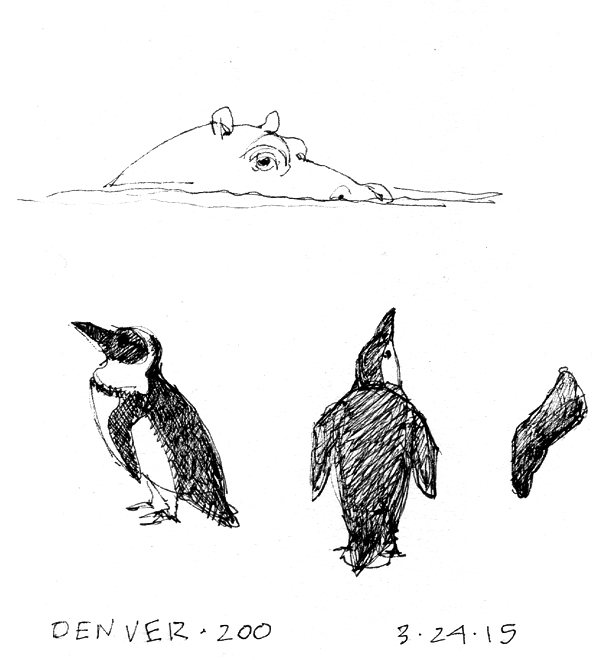
Hippo and penguins. I did the hippo in about 10-15 seconds since he went underwater at that point, so no time to add any tone or detail. The penguins were more cooperative.
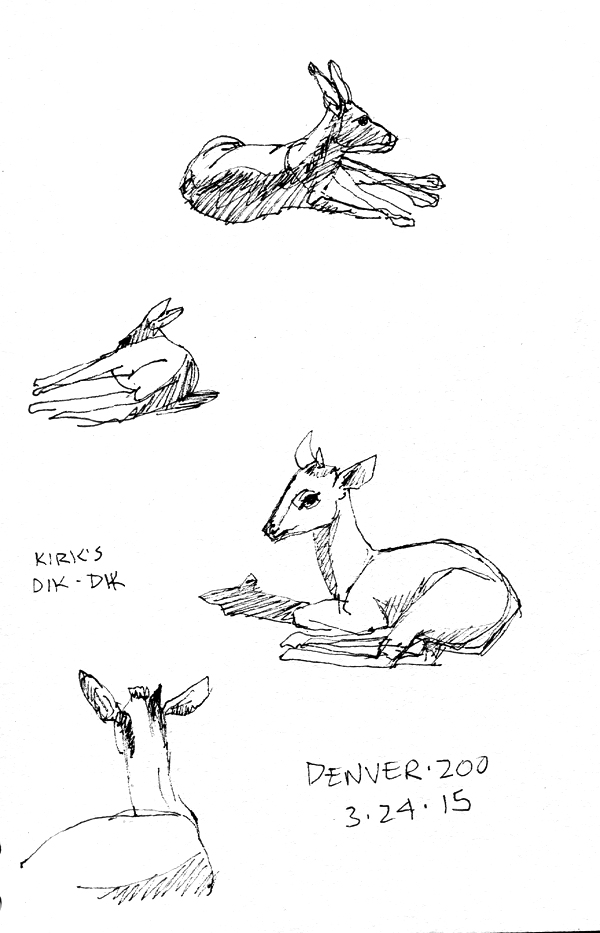
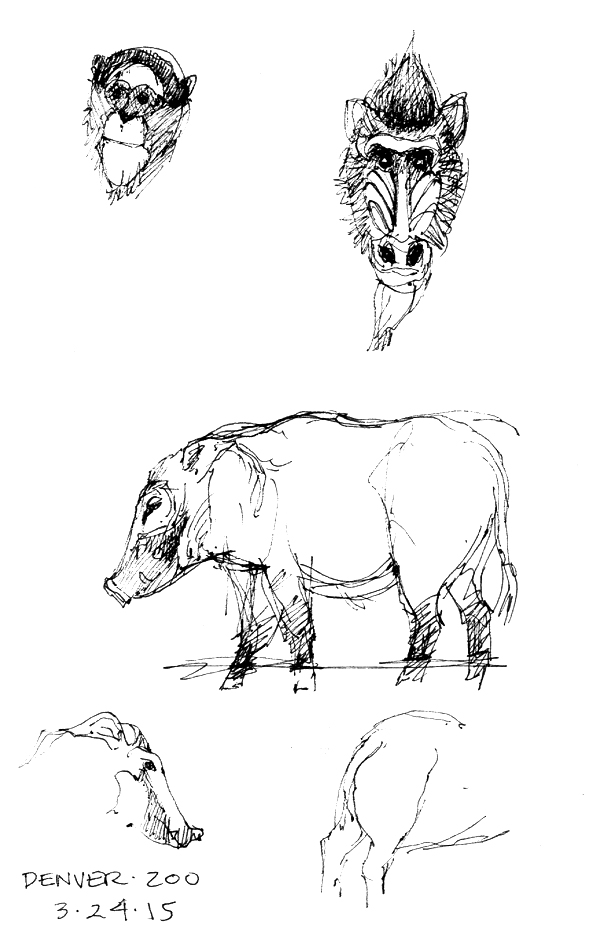
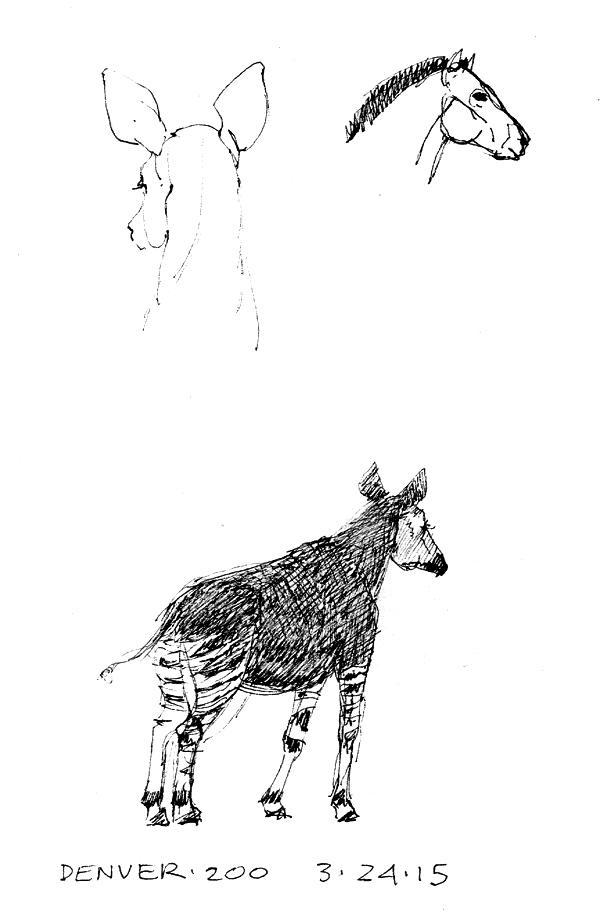
I got to spend a day sketching at the Denver Zoo a week ago. There really is no substitute for drawing from live animals if one is an animal artist. Photos alone just don’t cut it and, even more, photos that you haven’t taken yourself. The kind of sketching I’m showing here is about process and observation, not a polished or finished result. I hadn’t done this for awhile so it felt awkward at first, but got easier as the day went on. I used a 7×5″ Pentalic Nature Sketch sketchbook and a .02 black Sakura Micron pen, both of which I keep in my purse, a roomy Tom Bihn bag which can also hold my iPad. So that’s it….paper and a pen. Anyone can do this and you’ll see animals, whether it’s a pet cat or a tiger, in a new way. Start with animals who are resting or otherwise not moving. What is challenging is exercising one’s visual memory by doing ones that are moving. You will see with zoo animals in particular that their movement often has a pattern. Observe that, pick a gesture or angle and start and stop as needed as the animal comes past again.
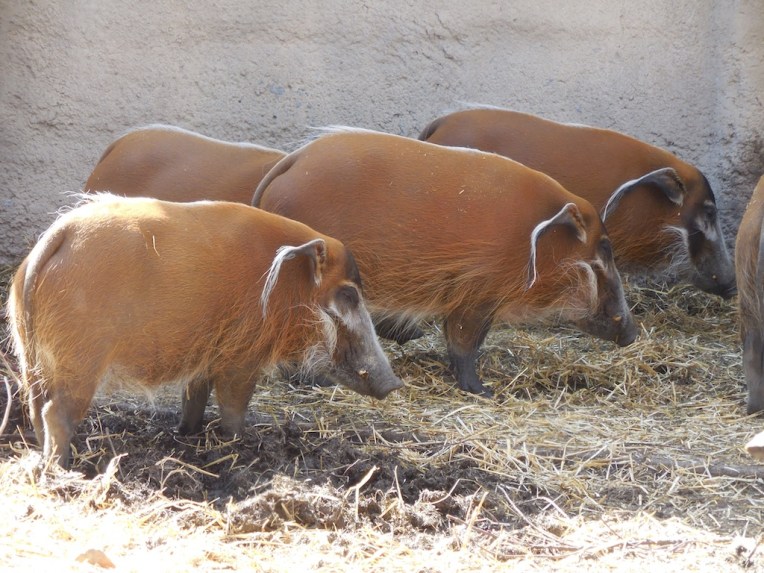
Steller’s sea eagle and cinereous/eurasian black vultures. The eagle held still. The vultures were busy hopping around.Kangaroo and Kirk’s dik-dik. The kangaroos were towards the back of their enclosure. The dik-diks were pretty close.De Brazza’s monkey, mandrill and Red River Hogs. The De Brazza’s monkeys never stopped moving. It took awhile to even get a reasonably accurate head sketch. The mandrill just sat and looked at me. Red River hogs are one of my favorites, but I hadn’t had a chance to draw them much before. So the first one shows me searching for the shapes and proportions. Nothing wrong with doing that.Red River hogs. What’s not to like about drawing these guys?Red River hog, gorilla and giraffe. One of the hogs held still long enough to do a decent head sketch. The big male gorilla was working on a treat stuffed into what looked like a short length of wood. Even though his back was to me, I found the shapes interesting to draw. The giraffe was quite a way away so I couldn’t see the head all that well, but I really like drawing them, so what the heck.The zoo has a small group of takhi/Przewalski’s horses and of course I had to sketch them. They also kept moving around, but this one stayed grazing for just long enough.Takhi/Przewalski’s horse and a bactrian camel laying on its side. I did the camel to study the legs. Note how I used small circles to indicate the location of the joints.Okapi back of head, takhi/Przewalski’s horse, okapi. With those ears, why not draw the back of the head? I think that’s my most successful sketch of the day. The okapi was mostly moving, so I had to pick a position and use my visual memory along with noting the stripe patterns on the legs. This was a species I had never drawn before and it was s little challenging to keep the odd proportions correct. It’s reasonably close.Colobus monkeys, maned wolf. The monkeys were up in their trees, moving around and swinging on the ropes. All I could do is try to capture the basic appearance and the gestures. The black one is from memory. The wolf whose back of the head I did was lying down. The other one was pacing so, as mentioned above, I waited until he/she came past me again to continue the sketch.
It was snowing the next morning, so I went to the Denver Museum of Nature and Art. They have a large, very good collection of taxidermy mounted animals set in nice dioramas. One generally does not rely on mounts since accuracy varies greatly, but for field sketching on a bad weather day, they’re perfect! And they don’t move! As with the zoo animals, I was after a quick impression sketch, not a detailed study, because I had limited time. But one could certainly bring colored pencils, larger paper and do more finished work. One might choose to focus in on, and really work to understand, how the feathers are lifting where the bird is grooming them.
Whooping craneWarthog and great anteater. For both of these I was concentrating on the movement and expression. Also the markings on the anteater. Ran out of room for all of the tail, but didn’t worry about it.
Roy Chapman Andrews’ Flag, which he carried on his Central Asiatic Expeditions to Mongolia in the 1920s
The weekend festivities are over and The Explorers Club Annual Dinner was everything I’d hoped it would be. It was a full schedule, starting with a New Members Reception on Friday afternoon. But first I went to the Club the day before when it wasn’t crowded and explored the building from top to bottom. You can take a virtual tour here. I wanted to find one specific item, shown above- the Flag carried by Roy Chapman Andrews to Mongolia during his Central Asiatic Expeditions in the 1920s.
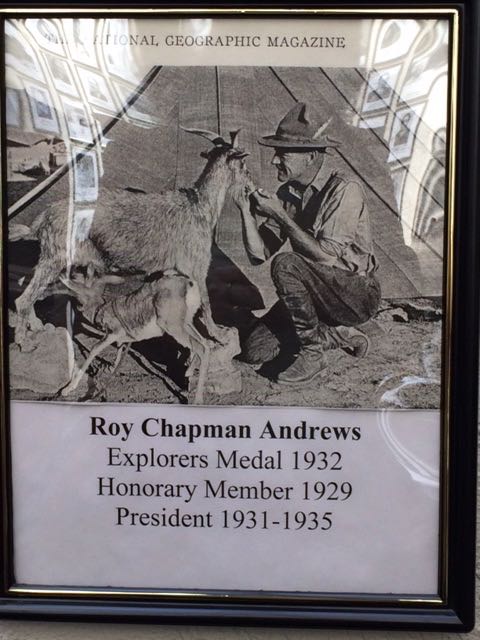
Roy Chapman Andrews’ photo on the wall of those who have served as President of the Explorers Club or received one of the Club’s honors
I also found this photo of him. Almost all the others are studio portraits. I love that his shows him in Mongolia out in the field. The domestic nanny goat is nursing what I think is a baby Mongolian gazelle. The Explorers Medal is the highest honor bestowed by the Club. Other recipients have included Admiral Peary, Jane Goodall, Thor Heyerdahl, the crew of Apollo 8- the first men on the moon, Sir Edmund Hillary, Mary Leakey (for the Leakey family), George Schaller, Michael Fay, Edward O. Wilson, Sylvia Earle and James Cameron.
Club headquarters, particularly the staircases, is filled with art, much of it created during expeditions. Unfortunately almost everything was either under glass or there was glare from the lighting, but here are a couple of examples:
The one above was painted on location in Africa by William Robinson Leigh as a study for a diorama painting. The watercolor below is one of a series done on location in Antarctica (I couldn’t read the name of the artist).
There are many rooms, all filled with art, artifacts and objects brought back from over 100 years worth of expeditions. The “Trophy Room” has been the subject of some controversy over the years, given today’s awareness of endangered species. But at one time expeditions were sent out by major museums like the American Museum of Natural History specifically to collect specimens for display. Hunting was viewed differently in those days. The mounts and skins in the room were donated in good faith and will probably stay where they are.
Here’s a corner in one room with a bucketful of spears and a portrait of Teddy Roosevelt, who was a member of the Club.
The weather took a twist on Friday afternoon with quite a snowstorm. New York City got close to 4″ in a fairly short time. It made getting around pretty interesting for this native coastal Californian.
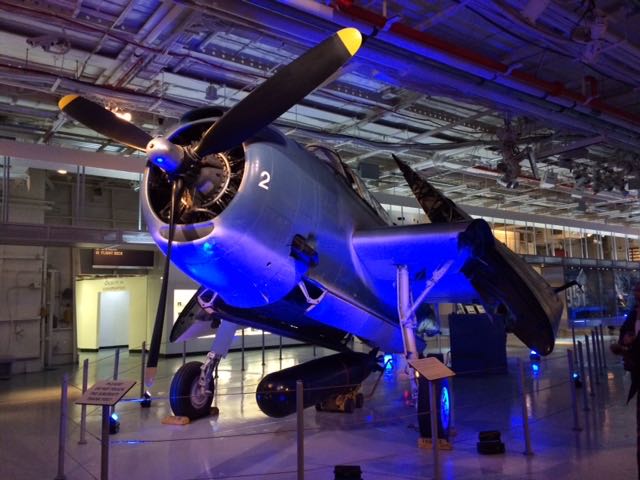
Friday evening the festivities officially kicked off, snow or not, with a cocktail party on the hanger deck of the USS Intrepid, a WWll-era aircraft carrier, which is now a floating museum. I was having too much fun, plus trying to find some people who I knew had been to Mongolia, to take many photos, but here’s one of an Avenger. Its wings fold up so that more would fit on the carrier.
The next day my artist friend and colleague Alison Nicholls and I had time to go visit the Salmagundi Art Club, one of the oldest art clubs in the country, having been founded in 1871. We poked around the Library, checked out the newly and beautifully renovated main gallery space and enjoyed the original art hanging on the walls. There was still plenty of snow on the ground and Central Park was really lovely.
Saturday evening finally arrived and it was time to go to the American Museum of Natural History for the 111st Annual Dinner. It was pretty chilly but we stopped long enough so that Alison could get a photo of me at the museum entrance. I made a dress to go with a vest I brought back from last year’s trip to Mongolia and wore a pair of gold-stamped red leather Buryiat Mongol boots with upturned toes. I also carried a felt purse which was a gift from Ikh Nart Is Our Future, the women’s felt craft collective which I help support. It has an embroidered patch of the Ikh Nartiin Chuluu logo on it.
Inside, an old Explorer Club tradition was being carried on…serving what for westerners is extremely unusual and exotic food. There used to be an entire buffet, but now days it’s one dish. This year it was….tarantula meat in a kind of a casserole. No, I didn’t try it. I didn’t want to wait in line. But I did take a photo.
Also in the entry rotunda were two fossil dinosaur skeletons lit up in glowing purple. Quite a few of the attendees were wearing clothing from other countries, so I fit right in.
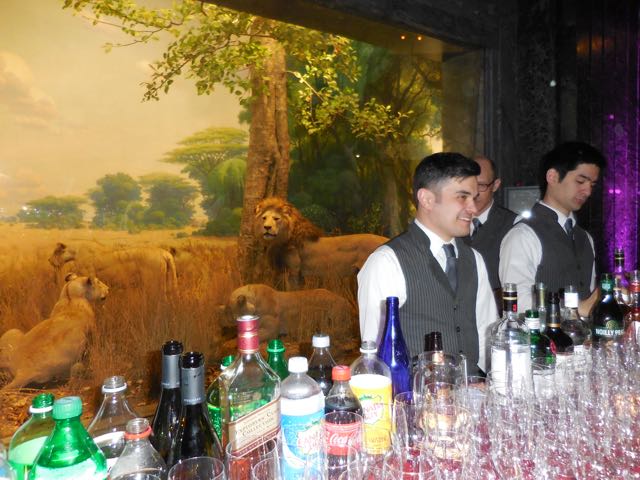
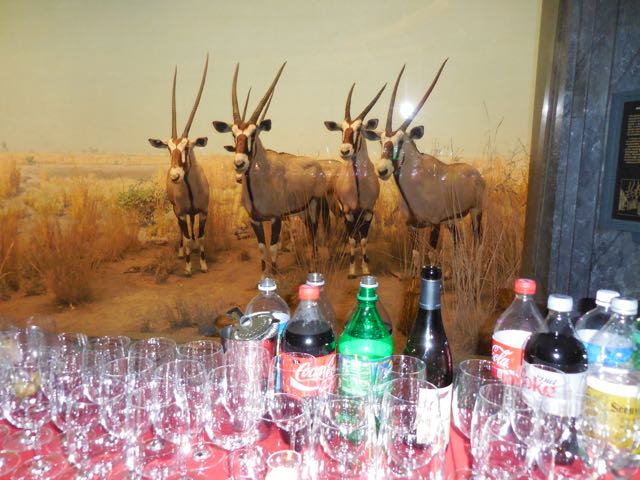
The before dinner gathering was in the famous African Hall. One really had to be there, but these will give you an idea of what it was like to party in one of the world’s great museums:
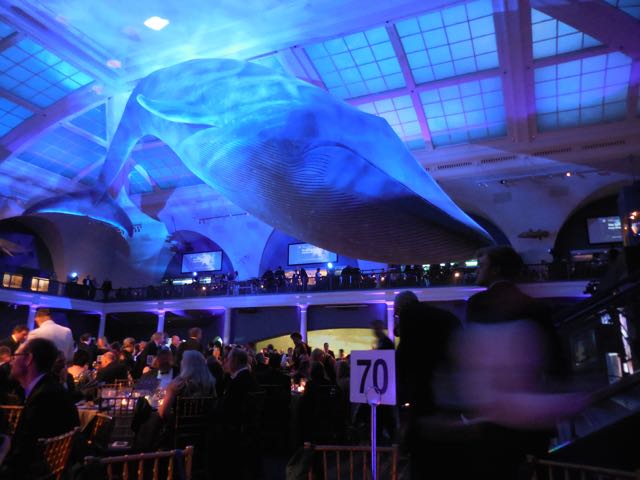
The pre-event announcements had said that we would be “dining under the blue whale” and they weren’t kidding. Here’s the view from our table in the Milstein Hall of Ocean Life. The lighting on the full-size model of the whale was almost unearthly. Appropriate for an ocean creature.
One of the main orders of business for the evening was the giving of awards and honors. Mendip Singh Soin, who is a good friend of Jan Wigsten, one of the partners who owns the tour company I work with, Nomadic Journeys (small world story), received a Citation of Merit. I had chatted with him the previous evening, so it was fun to see someone I’d met on on the podium.
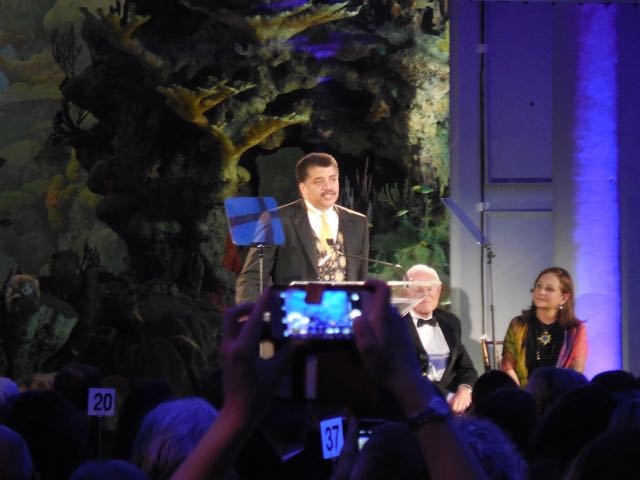
The highest honor that the Explorers Club bestows, as I mentioned above, is the Explorers Medal. You can read the full list of previous recipients here. It is long and it is illustrious. And this year the honoree was *drum roll* Neil deGrasse Tyson.
We were way in the back of the room, but I managed to get a few photos of him giving his acceptance speech. And that concluded the formal program. Everyone, or at least it seemed so, adjourned back to the African hall for more merriment and visiting. We stayed to the very end and made our way out after midnight. And so ended my first-ever Annual Dinner. And I don’t plan for it to be my last!
But first, here’s a photo that I took from the plane as we flew over the Sierra Nevada mountains heading east from San Francisco. There should be nothing but white in this picture from top to bottom. There is no snow pack again this year, which means drought conditions will continue. A third of the state’s water from from winter snowfall in the Sierra Nevadas. There’s more info. here.
I’m now in New York at the Hotel Newton, getting ready to head over to The Explorers Club to poke and around and meet up with my host for the weekend, artist and Society of Animal Artists colleague Alison Nicholls. We’ll be going to the Bruce Museum in Greenwich, Connecticut this afternoon and meeting up with artist and also Society of Animal Artists friend and colleague Sean Murtha, who works at the museum. Check out their websites by clicking on their names. I think you’ll enjoy seeing their work.
And finally, if you’re not familiar with The Explorers Club, of which I became a Fellow last April, you can find out more here. The Saturday night festivities will be live-streamed.
Fall in the mountains of northern Mongolia is spectacular. I was staying at the Nomadic Journeys Jalman Meadows ger camp for a few days in September, 2012 and turned out to have timed my trip perfectly for the fall color display. The camp is up on a bluff overlooking the river valley. I spent quite a bit of time wandering along the banks, sketching the scenery and some local yaks who had come to drink and graze. There were also quite a few local herder’s horses wandering about. It was very peaceful and quiet.
I never get tired of going to Hustai National Park in Mongolia. It’s the best place in the world to see takhi or, as they are known in the west, Przewalski’s horse. I saw this stallion with his harem in August of 2013. It had been a good year for all the animals in Mongolia, both domestic and wild. The takhi looked great!
Takhi harem, Hustai National Park
Here’s part of the harem moving along for their morning graze. A dominant mare leads them and decides where they will go. The harem stallion usually brings up the rear, keeping an eye on everyone. At the time I was there I was told there were around 300 horses divided into 15 harems, plus some bachelor groups. Hustai National Park is only a two-hour drive, mostly on paved road, from Ulaanbaatar. So it should be on the “Must See” list for any animal or horse lover traveling to Mongolia.
Takhi/Przewalski’s horse is the only surviving species of true wild horse. At one point there were only 54 of them in the world. Now there are, I believe, over 2000. They have been reintroduced to three locations in Mongolia, including Hustai. The other locations are very remote and not set up for visitors, so this is the place to see them.
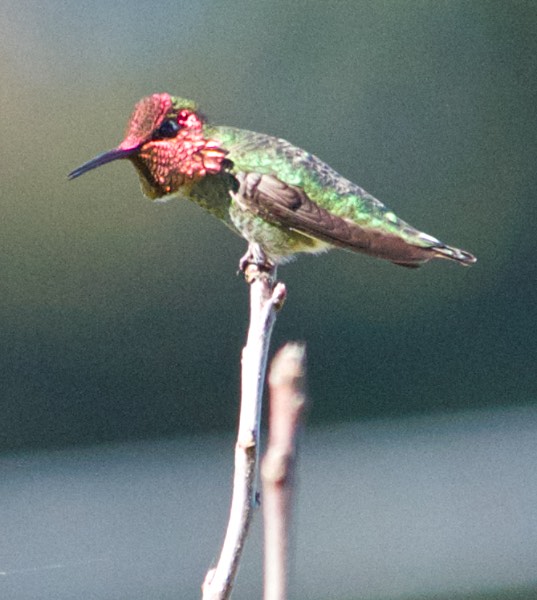
Male Anna’s Hummingbird telling me who owns the place, 1-25-15
Unlike much of the country we’ve turned the seasonal corner out here in northern California. Unfortunately the day after day of nice warm sunny weather means that we’re not getting any rain, so we’re going into a fourth year of drought. At the moment, though, the garden is starting up again with the first bulbs blooming, plus a few other “early risers”. The Anna’s Hummingbird in the photo was in the yard at the end of last month. There’s usually hummers around in the winter and spring, dog-fighting for, well, just about anything it sometimes seems. This guy landed in one of the apple trees. I couldn’t get very close, so even with my long lens (Nikon 80-400mm) he was pretty tiny in the photos. But I thought it would be fun to share one of him in his full “don’t mess with me” display.
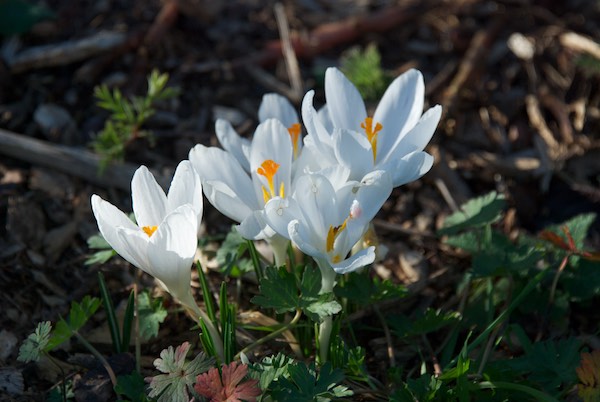
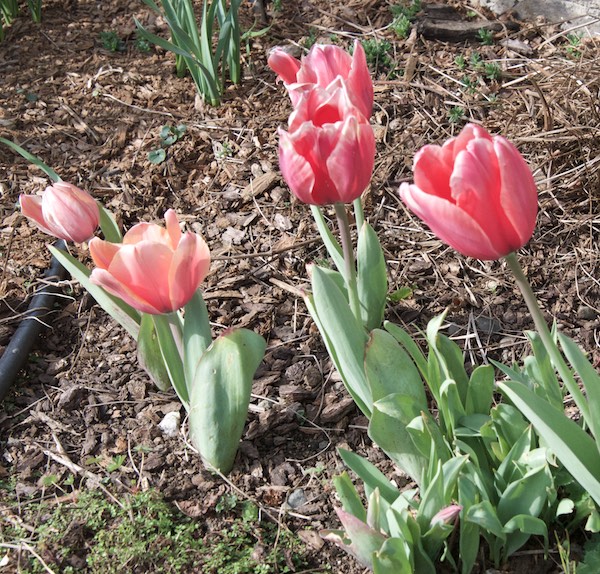
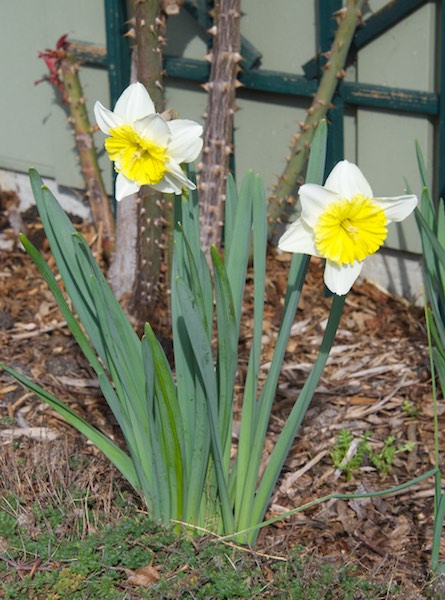
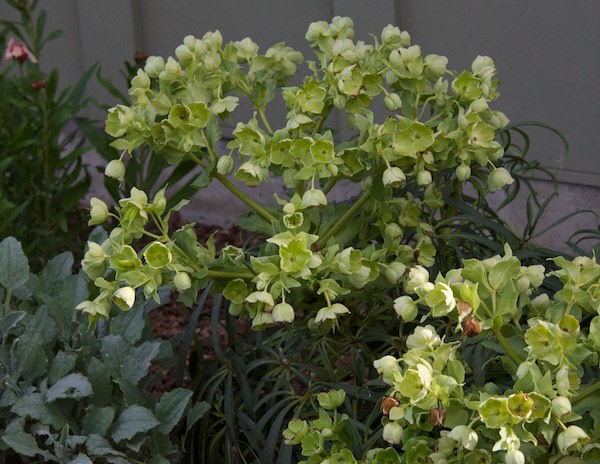
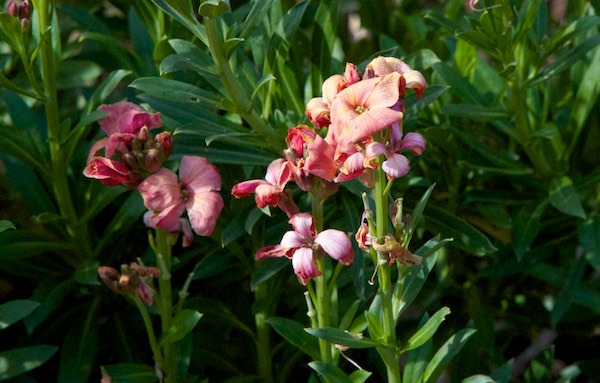
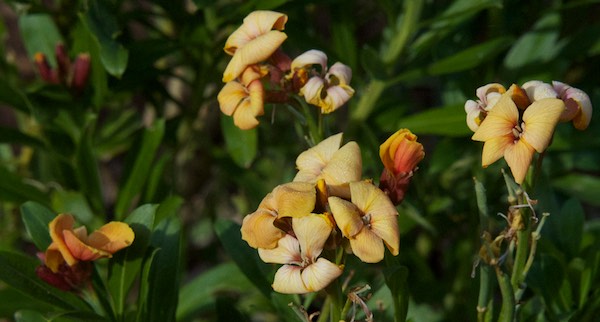
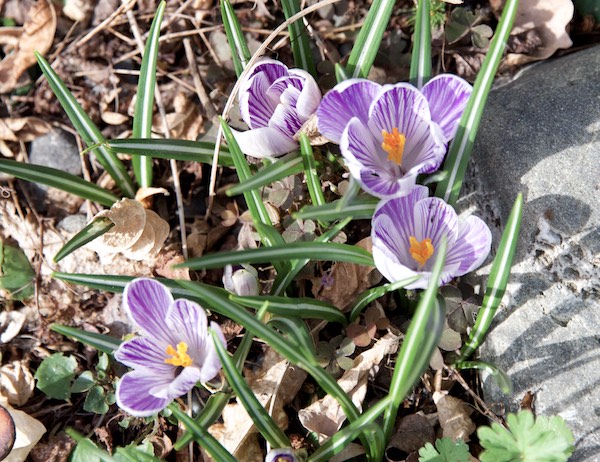
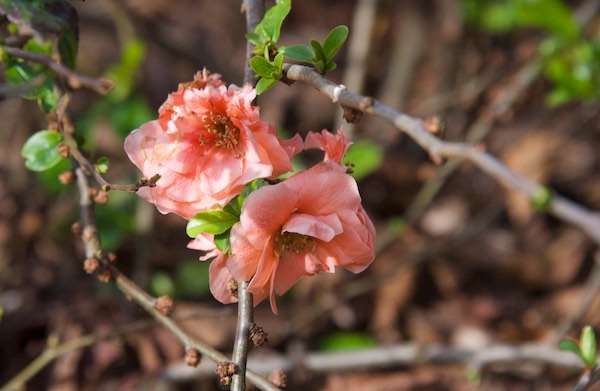
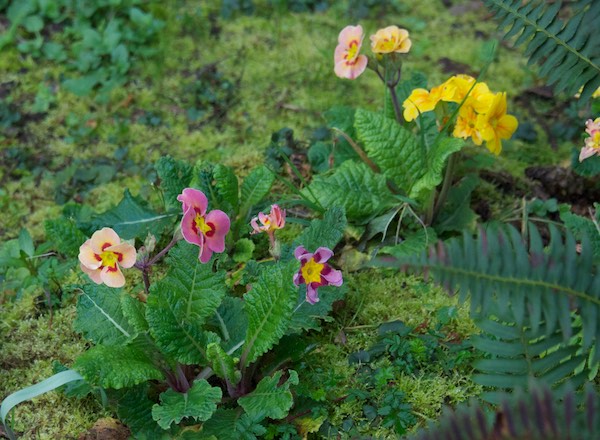
Here are some photos of what’s blooming today (all photos taken with a Nikon D750 and a Nikon 28-300mm lens):
White crocusPink tulipsDaffodilsCorsican helleboreWallflowers I grew from seed brought back from EnglandWallflowers I grew from seed brought back from EnglandCrocus “Pickwick” my favoriteFlowering quincePrimroses
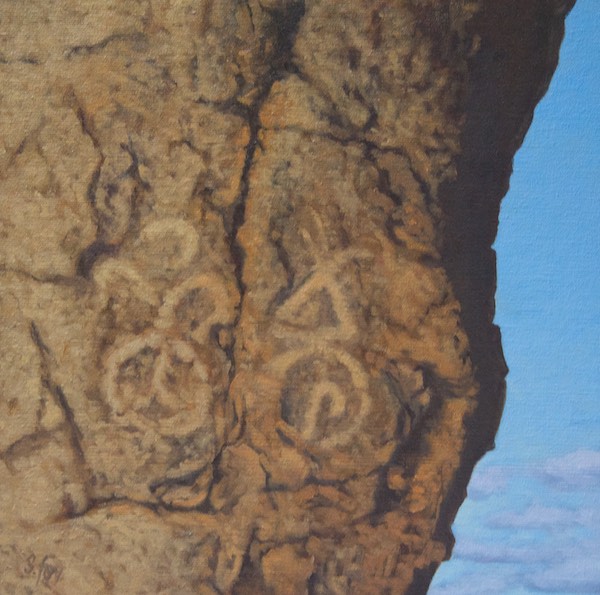
Although Ikh Nartiin Chuluu Nature Reserve is known as a great wildlife destination where it’s pretty easy to see argali sheep and Siberian ibex, it’s also turning out to be a treasure house of archaeological and cultural artifacts and sites. Among them are inscriptions and petroglyphs, including the subjects of my painting, which are part of a variety of images on a large rock near a well. You can see them in the photograph below which I took in 2008.
Rock with petroglyphs, Ikh Nartiin Chuluu
Research into this facet of the reserve only began a few years ago through an Earthwatch-sponsored project “Archaeology of the Mongolian Steppe”. The over 70 sites recorded so far cover 6,000 years of human habitation, including at least one site dating from the time of Chinggis Khan.
“Petroglyphs, Ikh Nartiin Chuluu” will be in the upcoming Redwood Art Association show “Elements: Earth, Water, Fire, Air”, from February 23 to March 20.
















 Susan Fox, American Artist