Personally, I have found that learning from good teachers is a great time-saver. What could take years of trial and error can maybe be addressed in an hour and then you get to move on to the next challenge.
In that spirit of benefiting from those who have gone before, here’s some thoughts about the making of wildlife art that I find worthwhile, illustrated with a few of the reference photos I’ve shot through the years.
KEN CARLSON:
“One of the challenges of painting a number of animals, particularly pronghorns, is to design an interesting grouping. What I try to achieve is an appealing overall shape; an uncontrived, natural look to the grouping…”
National Bison Reserve pronghorns; this has possibilities, but the "grouping" needs a lot of work
BOB KUHN:
“…the need to convey those gestures, poses and attitudes that spell out the character unique to the animal.”
Lake Nakuru cape buffalo; typical "I dare you". The painting I used this reference for will be on my website by the end of November
GUY COHOLEACH:
“You look into the eyes of a leopard in a zoo, and sure, you can get a lot out of them. But look into the eyes of a lion 30 feet away from you, when you’re standing right in front of him with no rifle, and let me tell you, they look a lot different. They do.”
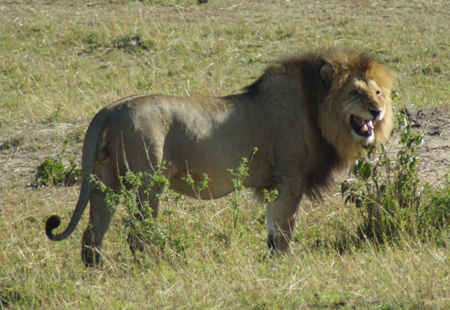
Masai Mara lion; I was in a car, but still...(Actually, he's flamen. There was a more dominant lion nearby who was with a lioness.)
NICHOLAS HAMMOND author of Modern Wildlife Painting:
“The best of modern wildlife painters show us the mystery and death, memory and beauty and what is to be learned, or lamented, loved or wept for.”
One of the most rewarding parts of travel is finding out how many ways there are to address the everyday challenges of life which are perfectly valid, but really, really different from how one does things at home. If the traveler is open to new experiences with an attitude of neutral curiosity, he or she might find that “difference”, in and of itself, is not threatening. Pity the impervious person who spends fair sums of money and time to travel and comes home utterly unaffected and unchanged. What an opportunity for the enrichment of one’s life wasted.
Mongolia is such a great place to get out of one’s own bubble. Customs and practices that haven’t changed in 1000 years exist happily alongside 20th/21st century technology. So, the country family holds its annual foal branding and a city relative records the occasion with her cell phone camera. Perfect.
(I would also like to note here that I have zero tolerance for those who want to deny more traditional cultures modern equipment, technology or goods because it will somehow “spoil” them. Selfish, romantic nonsense. The thought that a people like the Mongols could somehow be “spoiled” by integrating the modern world into their lives is ridiculous, IMHO. Lack of western technology does not equal stupid. Grant people the right to make up their own minds and choose what makes sense to them.)
Which brings us to today’s theme- how to get around, round, round in Mongolia. We will proceed from western high-tech to (for westerners) the picturesque.
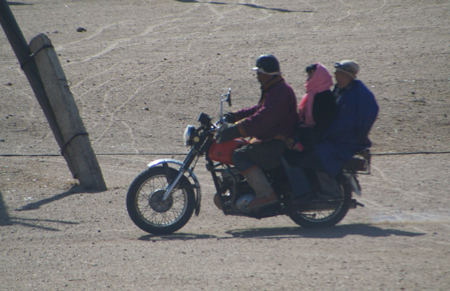
Chinggis Khan International Airport, UlaanbaatarTrain between Ulaanbaatar and ChoirMotorcycle, western Mongolia
Love the seat cover!
A ride home from the train stationTruck with handcrank starter, Hovd, western Mongolia
The Mongolians might be the greatest mechanics in the world. Travel stories by writers who have gone there are filled with accounts of impossible repairs in the middle of nowhere. Lack of money, parts, towing services (Ha!) and the need to find a way has bred an amazing level of ingenuity, which I have personally experienced with awe and respect. But those are stories for future posts.
the fabulous Russian Fergon van
You travel in these to ensure you get there, not because they’re comfortable. Four gear shift levers and counting.
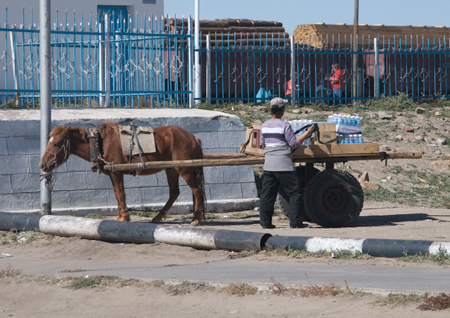
Tractor with hay, Hovd Horse cart with bottled water, Choir Donkey carts, HovdCamel cart, between Ulaanbaatar and ChoirRubber boat, Khar Us Nuur National Park, western Mongolia
My guide had talked about “the boat” (!?) when we were leaving Hovd for Khomiin Tal. Our last night out I found out what he was talking about. He’d purchased this inflatable boat when he was in Germany and this was his first chance to try it out.
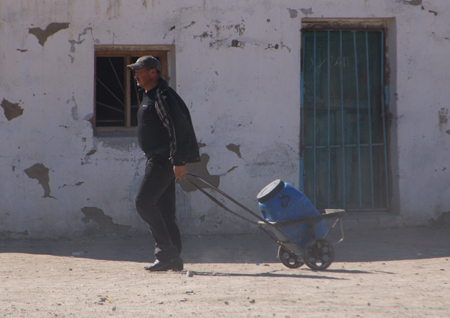
Hauling water in Hovd
There doesn’t seem to be much in the way of running water in the towns I’ve been in, so one sees it being hauled in these carts. It makes you think about your use of water and be more mindful of what it took to provide it.
Moving bricks to the kiln, western MongoliaHome from shopping, Hovd
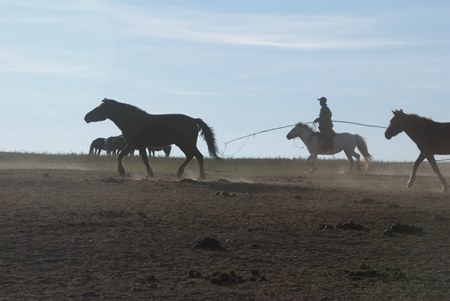
Lots of people have to walk to where they need to go, but, of course, the quintessential way to get around in Mongolia has always been on horseback.
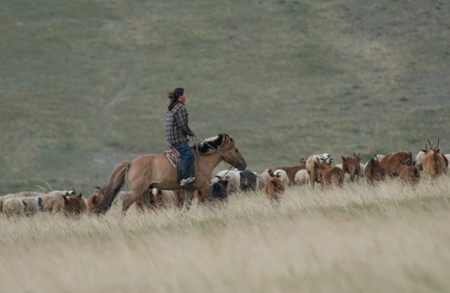
Herding goats near Hustai National Park
I like this picture because you can really see how she is riding standing up in the saddle. The stirrups are tied together under the belly of the horse to keep them in place. Ah, THAT’S the secret.
Choidog at the foal branding, Arburd SandsTimeless
1. I just finished balancing my checkbooks. Ugh. But life has gotten better since I’ve started using Quicken. I highly recommend it to anyone who battles the balancing of the checkbook every month and sometimes loses. Since I have three accounts (plus the credit card)- business, personal and “not-my-money” (for stashing sales tax, etc.), I have found an infinite number of ways to procrastinate. I was one of those math-challenged girls who was passed along in school. Even today, the mention of those “word problems” will start my stomach churning.
My husband has been a trooper through the years bailing me out and getting things balanced when they’re so tangled up I’m ready to scream. But supposedly, at least most of the time, I am an Adult, who really ought to be able to deal with this, right? Well, once I finally forced myself to sit down with him and Just Do It, and now that I’ve gotten the hang of it, it really is nifty and easy.
(Why is math such a problem for me? It took years, but I finally figured it out. It turns out that I always did great in subjects where I could literally “see it”, as in create a visual image. So, English, history, biology, no problemo. Math? Couldn’t process the information visually, so I was sunk. Same problem with inorganic chemistry. Knowing that now, it’s how I memorize numbers. I really do see the actual numbers in my mind’s eye. The anxiety with regard to the word problems came from my attempts to “make pictures” and run them like a little movie and when I couldn’t, the stress took over. )
So, yo, artists who want to make a living- you’ve got to get a handle on the money part somehow. Quicken is how. The reconciliation part is like MAGIC.
2. Sometimes I take photos that just holler “PAINT ME!” Usually it’s wild animals, but not always. We were at a state park when I spotted this chocolate lab laying by the lake. I loved his expression and the light on his coat, so I thought I’d see what I could do.
Where's the Ball? oil on canvas board 12"x9"
And, I just finished this one yesterday. I love working the structure of animals that don’t have long fur. I shot this Jack Russell terrier at a riding stable in southern California.
What's Next? oil on canvas board 12"x9"
As you can see, I had fun with the background color. There will probably be more of that in the future. Prices available on request.
ART THOUGHT FOR THE DAY
“Your time is limited, so don’t waste it living someone else’s life. Don’t be trapped by dogma- which is living with the results of other people’s thinking. Don’t let the noise of other’s opinions drown out your own inner voice. And most important, have the courage to follow your heart and intuition. They somehow already know what you truly want to become. Everything else is secondary.”
Steve Jobs
ON A LIGHTER NOTE
“Outside of a dog, a book is man’s best friend. Inside of a dog, it’s too dark to read”.
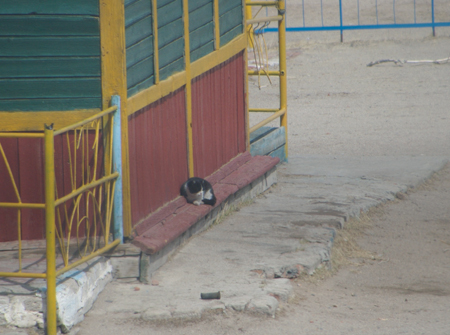
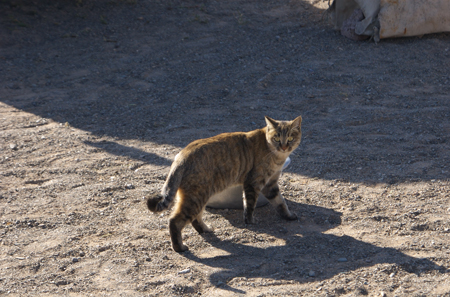
In three trips to Mongolia I’ve seen exactly….three cats, literally one per trip. In general it appears that Mongolians don’t much like cats. There are a number of beliefs about them, none particularly positive. I was told that the appearance of a cat meant that there would be a death. Two women that I’ve spoken with both said that they didn’t even like the idea of touching a cat, but one allowed as how her attitude was probably based on things older people had said when she was much younger.
On the other hand, when we stopped at a ger in the Gobi, I watched a woman shoo this cat into the ger while the dogs were clearly meant to stay outside. I remember thinking “It figures.”
Cat at ger near Bayanzag in the Gobi
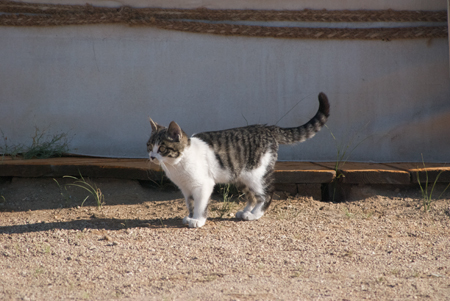
They do seem to be kept around by some families for the age-old purpose of rodent control. This little cat was at the ger camp at Ikh Nart. She was fussed over by the cook, who I was told loves animals. She was very friendly, so David and I were able to get an unexpected “cat fix”. It was apparently impossible to keep her out of the staff ger because she would climb up to the top and come in through the center opening. One night she dropped down onto our guide’s bed, one of the women who was adamant about not liking cats, and proceeded to try to snuggle up near her head. I remember thinking “It figures.”
Young cat at Red Rock Ger Camp, Ikh Nartiin Chuluu Nature Reserve
DOGS
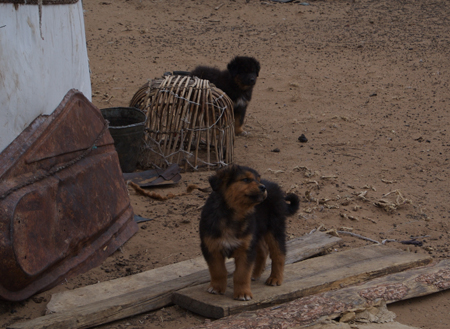
I suspect that Mongols have had dogs for as long as they have had horses and the other “Snouts”. The traditional greeting upon approaching a herder ger is “Hold the dogs!” and they aren’t kidding. The traditional herder’s dog is a Tibetan mastiff, which can take its guard duties very seriously. I was told on this last trip, however, that many herders do keep a dog as a “pet” along with the ones for guarding. I hope to learn more about all this on the next trip.
Tibetan Mastiff-type dogMastiff puppies near Hustai National Park
One consistant piece of advice that one runs across when looking into travel to Mongolia is do not, DO NOT, pet, pat, scritch, scratch or otherwise touch any dog. They have not been vaccinated for rabies and getting saliva on your skin, much less a bite, means air evacuation to a hospital for the (painful) series of shots. Foreigners who are working in the countryside get the rabies vaccine, but since nothing is 100%, it’s smart for them not to have contact either.
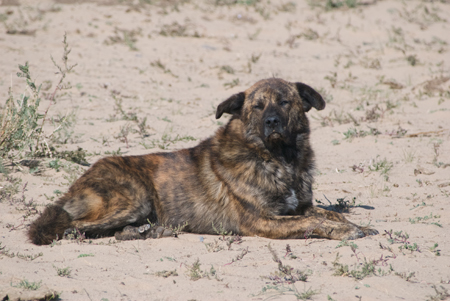
That said, I have found that most of the dogs I’ve seen don’t exhibit vicious behavior and a lot of them seem to be longing for contact with people. I finally relented once at Arburd Sands when this dog approached me while I was sketching and leaned into me. I decided that it was unlikely that the camp owners would have a dog around that was at all likely to bite the guests. I stayed alert while I gently petted his back and didn’t let his mouth near my hand. He seemed to really like it, but it was still a risk.
Friendly dog at Arburd Sands
I hadn’t seen brindle dogs like this before this trip. Not sure where that coloration came from, but he has the mastiff head and body type.
I feel like I’m seeing fewer of the pure mastiffs since my first trip. When the Russians pulled out in 1991, I was told that they left their guard dogs, mostly German Shepherds, behind. And I remember seeing a couple of what looked like purebred Shepherds between the airport and UB in 2006. There has obviously been a lot of uncontrolled interbreeding. It looks to me like the dogs are gradually reverting to the basic dog form that travellers see all over the world in the streets, the countryside, at dumps, etc.
Dog seen by side of the road near Gorkhi-Terelj
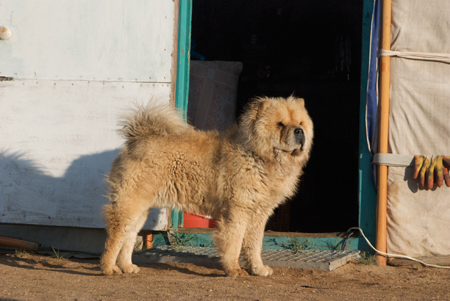
And, for something completely different, at Red Rock Ger Camp, there was this chow chow, the only one I’ve seen in Mongolia. Never found out who he belongs to, but a fairly wide area around the camp seemed to belong to him, judging by his thorough and conscientious marking routine.
Chow chow at Red Rock Ger Camp
RANDOM NOTES
From The Global Village Dept.- twice when I’ve been in the State Department Store, I’ve seen young girls with tiny “fashion accessory” dogs tucked in their arms, a la Paris Hilton. Sigh.
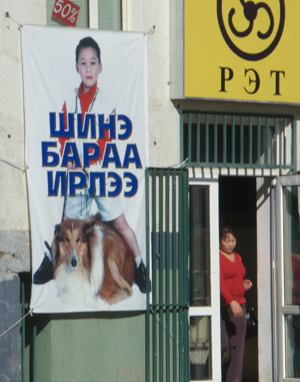
And finally, many of you know that I have a rough collie, named Niki, the same breed as Lassie. Imagine my surprise when I happened upon this banner in Ulaanbaatar:
I’m just finishing a second productive week in the studio after my return and, boy, does it feel good. As did getting out yesterday afternoon and planting some new roses and spring bulbs.
HEAVY LIES THE HEAD
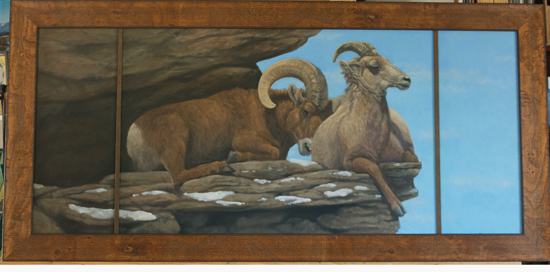
I’ve got a number of pieces in progress, but wanted to share this one that was completed before I left. It was in the Wild Visions 2 show and I hadn’t had a chance to photograph it until a couple of days ago. I’ve never done a three-panel piece and I’m thrilled with the framing. Unfortunately, the framer has gone out of business and there isn’t anyone else around here who can do this kind of custom work. Drat.
Heavy Lies the Head oil 20"x 46"
The animals, bighorn sheep, were photographed at the Denver Zoo. It was a warm morning and the ram couldn’t keep his eyes open. His head kept, drooping, drooping, until it sank onto the back of the ewe, who never even blinked. The pose was irresistible, but I did check with Laney, a nationally known artist who specializes in bighorns, to ensure that this behavior could have happened in the wild.
Of course they needed a more interesting setting, so I found some nice rock formations that I had shot up on Logan Pass in Glacier National Park, where bighorn sheep are often seen. Laney suggested adding the bits of snow so that the presence of the ram and ewe together would be consistent with the season.
Besides the great pose, I wanted to try to capture the feeling of the environment bighorns live in and how casual they are about heights that would make a lot of people faint with vertigo.
CHEETAH HEAD STUDY
Some animal’s heads are more challenging than others. There are subtleties to the forms that, if they are missed, leave the viewer who knows better feeling that the painting was “close, but no banana”. Cheetahs seem to be one of the difficult ones. I think I’ve seen more badly drawn and painted heads of cheetahs than maybe any other animal, so I’ll hang it out there and offer for your perusal this new head study.
Cheetah Head Study oil 9"x 12"
EQUIPMENT REVIEWS
All in all, everything worked as it was supposed to.
My husband was very happy with his LL Bean Katahdin 20F sleeping bag. He liked the larger size and the fact that it was rectangular. The Climashield fill kept him comfortable. The only down side was that it didn’t pack down as small as my down bag.
My Katahdin 20F down bag was great, as usual. One of the nice things about the rectangle is that it can double as a comforter. This is handy in a ger, which has regular beds with sheets and blankets. It can get cold at night though, but unzipping the bag and throwing it over the bed worked well. And if the mattress was too hard, as is sometimes the case, I used the bedding as a “pad” and just slept on top of it in the bag.
The LL Bean ripstop cotton pants were absolute winners. We wore ours day after day and they seemed to shed dirt and never felt icky. My husband likes them so much, he now wears them for his everyday pants.
Loved having the New Balance walking shoes for around town and camp as a change from the hiking boots. Hadn’t made space for that before. The LL Bean Cresta Hikers were, once again, comfortable and functional. David bought a pair of Keen hiking boots, which he really likes for their comfort and breathability. What we found, however, during the deluge at Ikh Nart, when we had to walk around 40 yards to the toilet, was that his boots wetted through pretty quickly. Now, he hadn’t waterproofed them, because we hadn’t anticipated such hard, out-of-season rain, but my boots kept my feet dry throughout. They are leather, which I probably wouldn’t buy now unless I could source them to humanely raised cattle, but they really performed.
The Smartwool socks rocked! The Thorlos tended to get sweaty. Next trip I’ll take more Smartwool for the field and a few Thorlo light hikers for around town.
Loved the Patagonia fleece for comfort, but will probably replace it to reduce bulk. It took up a lot of space in my duffle. The Travelsmith jacket was great. Too bad they don’t make it anymore. The only problem was that the patch pocket got caught on something and ripped loose.
I love, love, love my Icebreaker 100% merino wool thermals! The top and bottom together take up less space than one piece of the other brand. I didn’t need them very much, but found them very comfortable when I did wear them.
It’s interesting how things are going full-circle for some outdoor gear. All there used to be was cotton and wool. Then the new, improved synthetics came along and, overall, they were an improvement in weight, performance, etc. But I’m finding that the new cotton and wool products work as well, if not better, and are not made with petroleum by-products.
The MetroSafe 2000 purse was good, as usual. Very functional, practical and unobtrusive.
My old standby neck scarf and hat did the job, also as usual.
Camel ride at Arburd Sands
The luggage came through fine. It was nice to have the lower rigid-side compartment on the bottom of the big one for odd, ends, extras and art purchases. It’s a rolling Sportsman’s gear bag from LL Bean. The small one, which Bean doesn’t make anymore, holds the camera equipment, toiletries bag and the minimum needed to survive a day or two without the big bag.
ART THOUGHT FOR THE DAY
“There is a common foundation from which all the arts rise, and that is the need for self-expression on the part of the artist,-expression of his own personal experience, whether it be by words, as with literature; by sound, as with music; by pigment or with plastic shape, as with the graphic arts. But there is a further condition attendant upon this expression of which we do not always take account, namely, that the artist’s personal experience must be emphasized by strong feelings, by enthusiasm, by emotion, or the result is not art.”
Notes on the Art of Picture-Making by C.J. Holmes, Slade Professor of Fine Art, Oxford University, 1909
I started some fun paintings from my new Mongolian reference last week and thought I’d share a couple of them in progress. I’m experimenting with a new way of starting, based on something I learned from John Seerey-Lester. Up till now I’ve begun by drawing directly with the brush, using line. It’s a default from being a “drawer” as a child. One of the major things I learned in art school was to see shape instead of, or in addition to, line.
Since I don’t use a projector, I draw directly from images on my monitor or a preliminary drawing. I sometimes get in trouble and spend a lot of time correcting. What to do?
Something must have been purcolating while I was away from the easel, because it suddenly occurred to me to do a light lay-in of the shapes with a big brush for size, proportion and location, wipe it out so that it is a ghost shape and then start the “real” drawing. It’s already made a difference.
So, here’s two in progress:
A Mongolian stallion 24″x36″
Mongol Horse stallion
And a bactrian camel 20″x28″
Bactrian camel
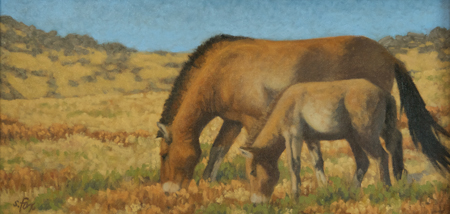
Also, here’s one of the paintings that was accepted and will be available for purchase at the Society of Animal Artists show “Small Works, Big Impressions” at The Wildlife Experience near Denver, Colorado.
It’s called “Breakfast for Two” and is a takhi mare and foal that I saw at Hustai National Park.
I recently received an email from an art student in Northern Ireland (wonders of the internet!), who is doing a paper about an artist whose work she likes for her “A Levels”. That artist would appear to be me. I liked her questions since they got me thinking some more about what I do, why and how. So I thought I would share it with you:
1.Why did you choose animal art?
As I think about it, it might be more appropriate to say that it chose me. I drew animals more than anything else as a child by far. When I was back in art school at age 35, I tended to think of using animals for my assignments. When I moved to “easel painting”, I started doing animals early on and when I learned about the field of wildlife art, that pretty much sealed the deal. I do enjoy other subjects, but it has always been my animals that have drawn the strongest response from people.
2.How would you gather information for your topic (ie do you study the body movements of animals, go to the zoo etc)
I do fieldwork trips every year to see animals in their own habitats and also visit zoos whenever possible. I have a large reference library that includes a number of books on animal anatomy. I sketch from live animals when I can and take a lot of photos. My digital image library has over 10,000 animal pictures alone, taken since 2004. Plus hundreds of prints from before I went digital.
3.Have you ever been influenced by a person or place?
Yes, I seem to be the kind of artist who is inspired more by what I see in the natural world, as opposed to a more purely internal vision. Taking a master class from John Seerey-Lester in 1997 was probably the greatest single reason I’ve become an animal artist because of his encouraging words about my paintings, which made me believe that I could succeed if I was willing to work hard.
The four places that I find most inspiring are Mongolia, Kenya, the Yellowstone/Wyoming/Montana area and my own home ground of northern California.
4.Is there a particular artist whose work has inspired you?
If I had to name one, it would be Bob Kuhn, a legendary illustrator who became one of the two or three top wildlife artists of the 20th century. I’m inspired by the quality of his draftsmanship, design/composition, his painterly technique, his knowledge of his subjects and his uncompromising willingness to do what it took to get reference he needed. He’s my role model for everything a wildlife/nature artist should be. He passed away last year.
5.What media do you prefer working in and why? Is there a medium you are not comfortable with?
I work in oil. The original impetus was having wanted to paint in oil since I was a child, but now it’s because it’s the medium that most lets me express my vision of a subject. I love everything about it except the fumes, so I pay attention to proper ventilation.
I’m probably least comfortable with something like pastels, for the very pedestrian reason that I don’t like having my hands messy while I work and I don’t want to wear gloves.
6.My favourite piece of your work is ‘Double check’, how did you come up with the idea and how did you gather photographs etc to help you?
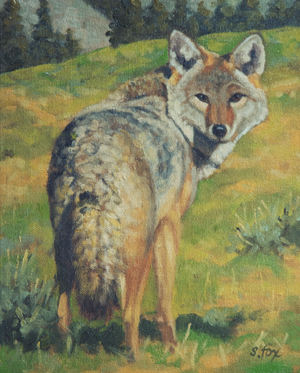
Ah, I just delivered that painting to the buyer. It’s one of my favorites ,too. I hadn’t done a coyote for a long time and I have some great reference of them that I shot over a couple of trips to Yellowstone and the Grand Tetons. I was looking for an image that would work at a small size and had interesting light. I also look for an aspect that represents something authentic about the animal and what they are like, both as a species and as an individual. The painting used two pieces of reference, one of the coyote and one for the background. So I already had the reference for that one.
Double Check oil 10″x8″
7. When did you realise your talent for art and why in your opinion is animal art so effective?
I can’t remember a time when I didn’t draw. I don’t know how much talent I have, but I’ve been willing to work hard for a long time. I’ve been told that my animals have “life” in their eyes and I agree, but that seems to happen without conscious volition on my part, so maybe that’s my “talent”.
Human affinity for animal images goes back to the Stone Age, as can be seen by cave paintings and pictographs. We have literally shared our lives with them for over 10,000 years (in the case of dogs). We share our world with them. Every culture has some relationship to animals, mostly positive, sometimes negative, but a connection nonetheless. We see ourselves reflected in them. We project ourselves and our emotions, ideas about good and bad, and our needs onto them. Images of animals and our liking of them are one facet of that long history.
8. Do you have any future plans for your art?
To continue to grow as an artist and get better. To always look for new ways to more accurately express my vision. To use my art to promote conservation and environmental issues, while making a decent living.
9. What do you think is unique about your art?
My vision and point of view and how I express that stylistically. Which really is, or should be, true for any other artist, no matter what their subject matter or medium.
10. Where do you paint and do you find the environment you work in important?
I have a 450 sq. ft. studio at my home. I have worked in a variety of environments, including a garage, and would have to say, that, yes, it’s important. I need an organized, properly lit space. I need the work space to not get in the way of doing the work.
11. When it comes to doing the fur on the animals, what do you find to be the fastest but most effective way for this?
I don’t personally think that speed, per se, is the goal. First comes the decision about what your vision is and then, what is the most technically appropriate way to accomplish that? Having said that, however, I have no interest in detail for it’s own sake. I would find painting every hair boring to do and usually find it boring to look at. What challenges me is seeing how much I can simplify and leave out and still communicate something like “fur”. So, I don’t literally think “fur” when I’m painting. I’m thinking shape, value, color, color temperature, visual texture, etc., which is a more abstract level. If all those come together then that area will say “fur” even though it’s really just blobs or spots or strokes of paint.
12. Is the background as important as the animal itself?
I would answer that somewhat indirectly by saying that the idea of the painting is the most important and every element present must support that idea, whether it’s the animal or the background. It all has to come together as a coherent whole.
13. What scale would your art normally be and how long would it take you to complete?
The smallest paintings I do are 6″x8″ and, so far, the largest is around 36″x48″, plus a variety of sizes in between. I decide on the subject first and then choose the size and proportion that will best suit the idea I have.
I can finish a small painting to be used as a study in a couple of hours. “How long does it take?” is a question artists get all the time and the answer is usually some variation on “It depends.” It depends on how complex the composition is, how much preliminary work was necessary, how many changes were required along the way, whether one got stuck and had to let the thing sit for a week, a month, a year.
14. Were you hoping to strike any emotions from your audience? if so what?
I think that part of what defines something as “art” is whether or not it elicits an emotional response in the viewer. So, yes, I guess I always hope for that. But I’m really more concerned with recording my emotional response to my subject than trying to project or control that of the viewer.
15. Which is you favourite piece of your own work and why?
Whatever the latest one is that came out the way I’d envisioned it. Currently it’s the Cape Buffalo Head Study. It may be the best painting I’ve done so far and I did it as demo over the course of about six hours at an art festival with constant interruptions. Interesting, in view of my earlier comment about my preferred working environment and that I hadn’t envisioned anything in particular about it except to have something going to draw people into my booth.
16. Is there anything that motivates you whilst painting?
The thought that somewhere, sometime, someone viewing my work might be inspired to become actively involved in working to save our planet. It needs all the help it can get.
May all our interviews be so merry and bright.
NEW COMMISSION
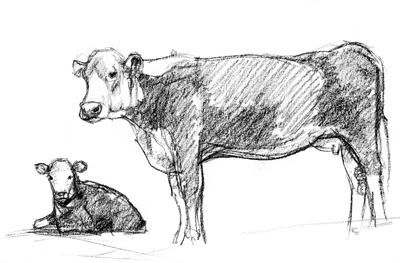
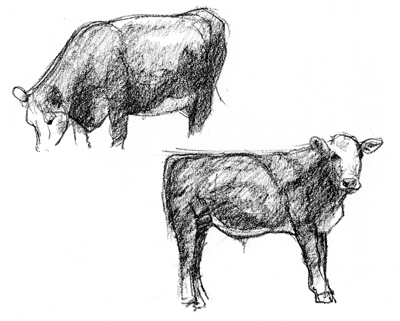
My most faithful collector and I have had a list of paintings that she would like me to do. Since she grew up on a cattle ranch in Southern California, she wants a painting of an oak tree with polled Hereford cattle, plus a few other elements. So this is where my illustration training kicks in. I find this kind of thing fun if, once the content is decided on, I am left to solve the problem and paint it as I see fit. I have now started the sketches. I haven’t drawn cattle much, so that was the first step. Here’s a few that are promising-
Hereford cow and calfYoung Herefords
ART QUOTE OF THE DAY
“You do not have to go very far to find suitable subjects. The cat lounging on your sofa, the horse down the road, yours or your neighbor’s dog; all are proper subjects and all will give knowledge which can later be broadened by trips to the nearest zoo or museum. My old friend and counselor, Paul Bransom, was the man who first urged me to go to the zoo, and to draw, draw, draw, Even the best reference sources don not take the place of real knowledge of animal structure. That can only be gained by putting your time in with the animals.”
I don’t know about other artists, but after a long trip it takes a little internal shove for me to get going again. I need to shake the rust off, get in the groove, just….start…..working.
I also spent some time thinking about my work procedures. I love to paint and tend to dive in, flail around and pull it together, or not. I’ve got some ideas about what I want my work to look like and have come to conclusion that I need to spend more time on the preliminaries, especially for larger works. That means drawing, drawing, drawing. Plus value and color studies as needed.
Winter is when I try to push my work to the next level and experiment and, since the first winter storm of the year arrived yesterday, I guess it’s time.
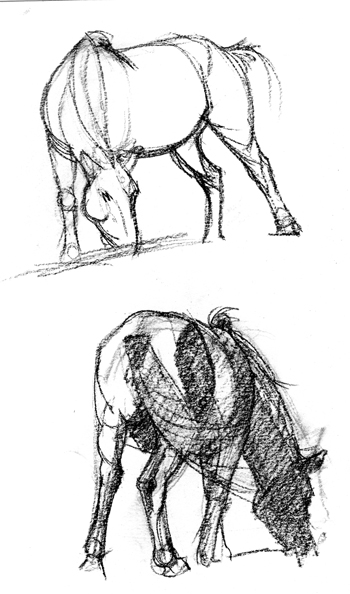
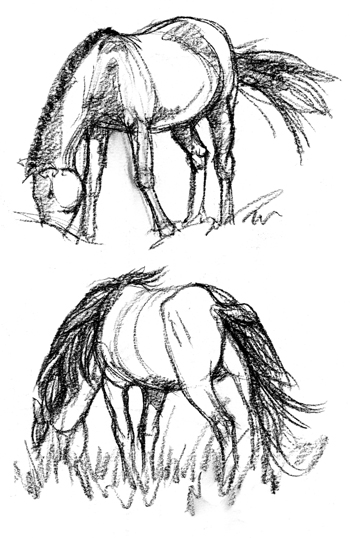
This week I’ve done a pile of charcoal drawings of the Mongolian horses, which I got fantastic reference photos of. I’ve always struggled for some reason with poses where the horses have their heads down, grazing, so I decided to get a handle on that once and for all. What worked was doing the body first and then adding the head. I’d been doing it the other way around, to my eternal frustration.
Here’s a selection of some I feel came out ok. They are done with a 6B extra soft General Charcoal pencil on 2 ply Strathmore Vellum Bristol and are unretouched. I’m always looking for what will add to the illusion of three dimensional structure and a body in space and what will help me get a handle on the anatomy.
These took 15-20 minutes each.
I also want to get some action into my work, so here’s a couple of running horses.
No idea if any of these will find their way into paintings, but I enjoyed doing them.
ART THOUGHT FOR THE DAY
“Artistic growth is, more than anything else, a refining of the sense of truthfulness. The stupid believe that to be truthful is easy: only the great artist knows how difficult it is.”




















 Susan Fox, American Artist