
For more information or to bid, click here
For more information or to bid, click here
Sometimes having another, educated eye can really help. Since this is a big painting which will require a big time commitment, I decided to consult with another wildlife artist who I have taken a workshop with and whose judgment I trust. She knows me and knows what my goals are for my work. I sent this image to her on Friday and got her response this morning.
For reference, the first version from the previous post:

The next version. I also decided to make the sheep on the right a juvenile to provide variety for the horns, along with adding some of the body and changing the head position.

Here’s the critique:
“These guys remind of me of desert bighorn – horns and heads large for lightly built bodies (though desert bighorn have much thinner horns). The mouth on the rear youngster is a little uncertain (what’s he doing?). I’d like to see more suggestion of muscle in the body – particularly hindquarters – of the main ram. His front left leg feels a little stiff – I like the movement in his overall gesture, but the knee and pastern don’t flow as well. He seems a little over at the knee on his right front. I know sheep aren’t built like horses, but sometimes (to borrow from Bob Kuhn) the artist has to make changes that look better, even if they’re not as accurate.
The front partial ram head/horns ought to be larger to indicate perspective; his body seems larger, as it should, but head/horns don’t seem as large relative to his body as the main ram’s.
Painting all those rocks will be great fun! I love rock and snow – so graphic. Everything in the composition leads us to the right and the main ram’s head – should be striking. You might consider turning his head towards us a little to keep the viewer from zipping out to the right – but it should still work as it is too.”
This are exactly the kind of technical notes that I was hoping for from someone who only knows what I’ve showed them, not what I think I’m trying to do.
This afternoon I did the re-drawing, erasing where needed. The muzzle of the ram on the left head got a little too big. I’ll fix that tomorrow, but otherwise it’s all working. As far as the first observation of the critique- in fact, the argali are very solidly built compared to desert bighorns. The big argali rams also weigh twice as much, 200 lbs. vs. 400 lbs. But both have very slender legs in relation to the bodies.
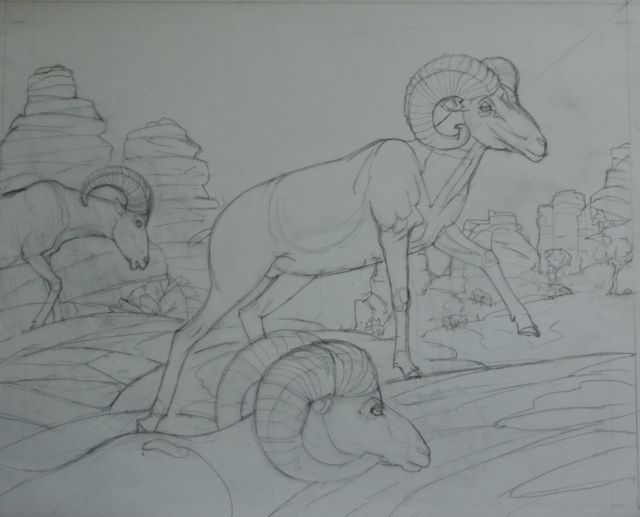
Now I have some good visual variety. The three argali are all different sizes and angles. I have the directional flow that I want, but I need to make sure that the viewer’s eye doesn’t “flow” off the right hand side. The stacked rocks will be the “stopper”. I’ve minimized the horizontal planes and added some shrubs and more small trees, aspens that I saw at Baga Gazriin Chuluu.
The next step is the value study. Value is light and dark relationships, separate from color. I already know that the area of highest contrast will be the main ram’s head against the sky.
UPDATE 8-25-09:
The re-drawing is done. I ended up changing the whole head and neck of the ram on the left side and straightening the foreleg of the main ram a little more. One of the lessons I learned when I worked in the sign shop doing hand-drawn lettering was the difference that, literally, the width of a #2 pencil point was between right and wrong. When I saw it for the first time, it was like a big, bright light came on. It was so obvious. And it’s true when drawing animals or anything else. I will always be grateful to the owner of the shop for giving me the opportunity to train my eye to discern differences that fine. The acceptable tolerance was 1/64 of an inch when drawing letters a few inches high.
I still see little things in the drawing that bug me, but I’ll deal with them when I do the brush drawing on the canvas. Being bugged about something is one of the ways that I know a painting isn’t done yet. And when nothing bugs me anymore, I’m done, which really means that I’ve solved all the problems. The itch to fix what I can see isn’t right is one of the things that drives me on a painting. I Just Can’t Stand It.
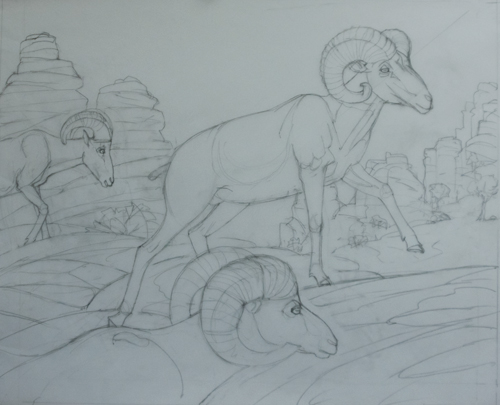
I also lightly drew some more rock towers on the right for my “stopper”. They will be simple shapes in aerial perspective.
UPDATE 6pm:
I lied. I did one more overlay this afternoon with a mechanical pencil (HB lead) to really refine the drawing and get it ready for the value study. Every version allows me to be more decisive about tricky shapes like the horns. Plus, I wanted to more thoroughly work out the background and foreground. And I still wasn’t happy with the ram on the left, so he got re-drawn. Again.
I’m using Canson tracing paper for the first time and, wow, is it nice. I used to use whatever was cheapest, but no more. All but the last drawing, which I’ll post tomorrow, was done with a Sanford Draughting Pencil. They were Eagle Draughting Pencils when I first started buying them many years ago and appear to have been owned by at least two other companies between then and now. Fortunately, they’ve never been “improved”, so they’re as good as ever.
One of the advantages of my illustration training is the process that we were taught for putting a picture together. I don’t do all the steps all the time, but now that I’m about to start one of the largest paintings I’ve done so far, I need the control that the process gives me.
My first sighting of argali at Baga Gazriin Chuluu Nature Reserve, thanks to Onroo the local camp staffer who knows the place and where the animals tend to hang out, was a group of rams in wonderful morning light. Mostly they were grazing and resting. For this painting, however, I wanted action. The essential image popped into my head and then it was a matter of getting it down on paper, which is one reason why the thumbnail process is so valuable.
Here’s some of the reference that I’m using:
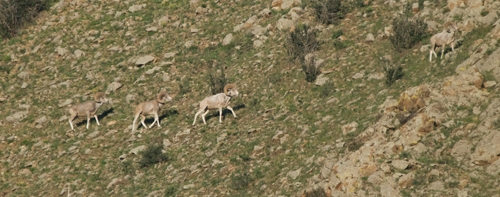
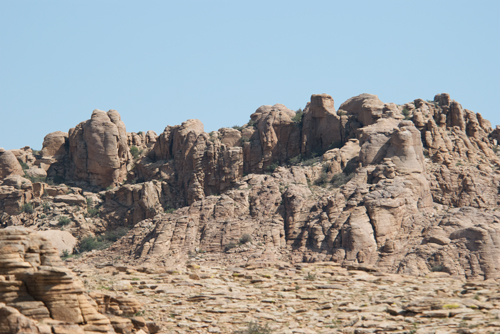
I liked the pose of the big ram who is third from the left. This photo was taken at Gun-Galuut Nature Reserve. I dumped the image into Photoshop and did a horizontal reverse to get him going the direction I wanted. And then zoomed in as much as possible. The next three are from Baga Gazriin Chuluu. Talk about reference eye candy.


I did a couple of drawings of the main sheep to try out position and gesture.

In this one I added the a background to see how that worked.
 My idea is to channel a little Edgar Degas and have the animals coming in from the frame, not have all of them within the frame. This is too static, but it gives me something to bounce off of. Gotta start somewhere.
Here’s the thumbnail sheet. I’m trying to figure out where the three masses of sheep will be in relation to each other. Then I did another, larger sketch.
 This is more what I had in mind. Almost everything is on a diagonal, which gets rid of the too-static quality of the previous sketch. As I draw and re-draw the animals, I’m able to get to “know” them better and can refine and push the poses.
I spent a good chunk of yesterday doing a finished scale drawing that will be transferred to the canvas via the ancient and honorable grid system. I ended up with three layers of tracing paper. The bottom one had the lines for the edge. The second one had the drawing of the sheep. The third was the landscape. I did one and it’s really nice, but not right for this painting. Replaced it with a new sheet and re-did it. When I was satisfied that I had more or less what I wanted, I re-drew the argali, once again refining and tweaking the drawing.
At this point, I have solved the design/composition problem and the drawing problem. Both may be re-visited at any time as needed if I see something that needs fixing, but the next step is a value study, that is, the pattern of lights and darks. We were told in art school that if we get the values in a picture correct, then we can do anything we want with color, which I have found to be true. One of the tasks that needs doing to take the Gun-Galuut argali and the image of the sunny rocks and make them work with the Baga Gazriin Chuluu morning light. For that I’ll do a color study.
I hunted through my reference once again for the sheep images that I thought would work best. And here is, so far, finished drawing. Still not sure about the argali on the left. I’ll see how it looks to me on Monday. I also think I need a little more “air” on the right side and maybe the top. Not much, maybe a half-inch.

Finally, a favorite photo from the local Naadam at Erdene. Waiting for the race results.

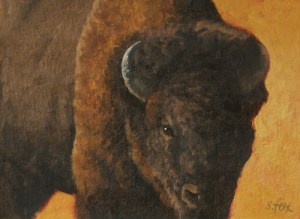
Click to bid here
Since, judging from the stats, the subject seemed to be very popular, I thought I would continue today with more on the takhi, specifically how I take the reference I shoot and turn it into a painting. More and more I start with drawings to become familiar with a new species or figure out things about one I’ve painted before.
Here are three drawings from last year, the first two of which were published in the Society of Animal Artists newsletter.
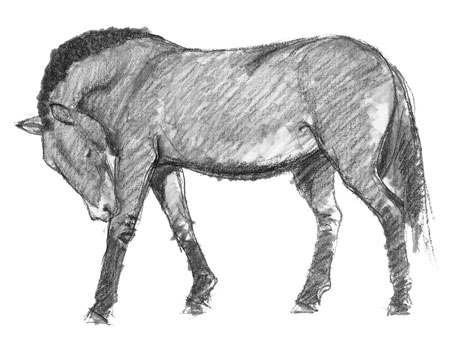

Now I’ll show you how I take an animal from one time and place and put her in a setting from another time and place, a challenge that every wildlife artist needs to meet successfully. Here’s the setting:

What a treat! We came around the bend in the dirt track early in the morning and there, right in front of us were two harems at the same time, sorting out who gets to go first.

I always try for a variety of shots; close-ups and the “big picture” for context. I used to come home with great close shots of something like a tree and found that I’d completely forgotten to get the surroundings, which really cut down on my options. Notice that the above photo is kinda fuzzy. But it’s still useable for reference.
Now here is the horse reference. Different part of the park, different year, different season. I’ve included two as an example of what to look for when evaluating images. These are similar, but the second, to me, is clearly superior. I love the rhythm of her gesture.


So next I did a drawing to capture that.

And, putting them together, here is the finished painting, completed in 2007. What I hope is that you can’t tell that I “stitched” together the reference from two sources.

I also wanted to let you know that two of my takhi images are available as limited edition giclees, framed or unframed. The full information is on my website. Click on “Limited edition giclees” under Fox Studio in the column on the right and it will take you directly to my giclee page.

I saw this foal on the same trip as the mare in the painting above. He or she was quite a character.
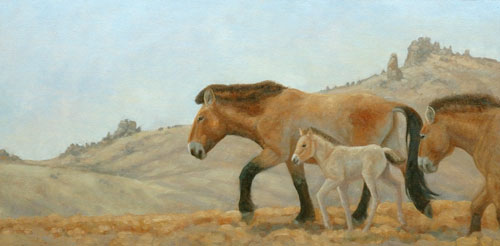
I posted this last week, as the original painting is still available, but have also published it as a giclee. It’s another example of how I took the mare and foal, who were against a grassy hillside and moved them to a ridge that has Hustai’s famous mountain as the background. The third horse was added as a design element.
All my giclees are available for holiday delivery.
ART THOUGHT FOR THE DAY
Let this be plain to all: design, or as it is called by another name, drawing, constitutes the fountain-head and substance of painting and sculpture and architecture and every other kind of painting, and is the root of all sciences. Let him who has attained the possession of this be assured that he possesses a great treasure…:
Michaelangelo (who ought to know)
Personally, I have found that learning from good teachers is a great time-saver. What could take years of trial and error can maybe be addressed in an hour and then you get to move on to the next challenge.
In that spirit of benefiting from those who have gone before, here’s some thoughts about the making of wildlife art that I find worthwhile, illustrated with a few of the reference photos I’ve shot through the years.
KEN CARLSON:
“One of the challenges of painting a number of animals, particularly pronghorns, is to design an interesting grouping. What I try to achieve is an appealing overall shape; an uncontrived, natural look to the grouping…”

BOB KUHN:
“…the need to convey those gestures, poses and attitudes that spell out the character unique to the animal.”

GUY COHOLEACH:
“You look into the eyes of a leopard in a zoo, and sure, you can get a lot out of them. But look into the eyes of a lion 30 feet away from you, when you’re standing right in front of him with no rifle, and let me tell you, they look a lot different. They do.”
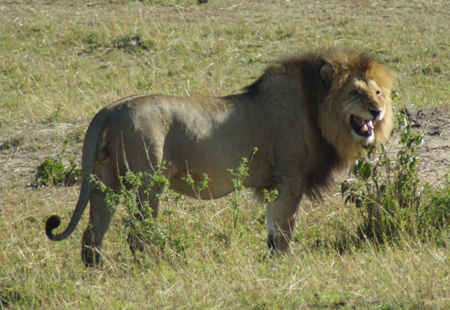
NICHOLAS HAMMOND author of Modern Wildlife Painting:
“The best of modern wildlife painters show us the mystery and death, memory and beauty and what is to be learned, or lamented, loved or wept for.”

Happy Hallowe’en!
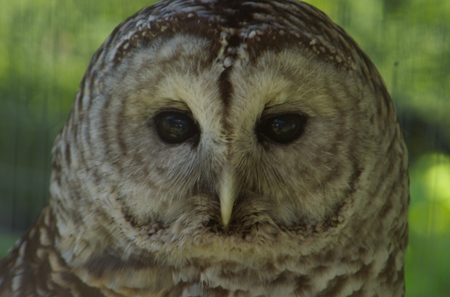
Hope everyone has a fun and safe holiday weekend!
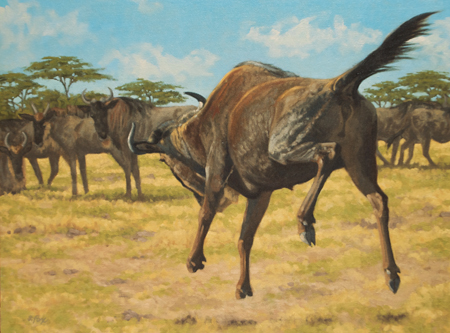
“Wildebeest Whoop-de-doo” oil 18″x24″
from reference shot in the Masai Mara, October 2004
ART THOUGHT FOR THE DAY
To paraphrase a famous advertising guy- Creating art is the most fun you can have with your clothes on.
 Susan Fox, American Artist