And now we come to the last leg of a wonderful two-week tour and a look at one last ecosytem, the mountain forest, which is the southermost extension of the boreal forest that circles the northern part of the Earth.
The Jalman Meadows ger camp, run on a seasonal basis by Nomadic Journeys, was set up high on a bluff overlooking the Tuul Gol.
While there is wildlife around, it’s the activities one can do here that are the main attraction and we took advantage of all of them!
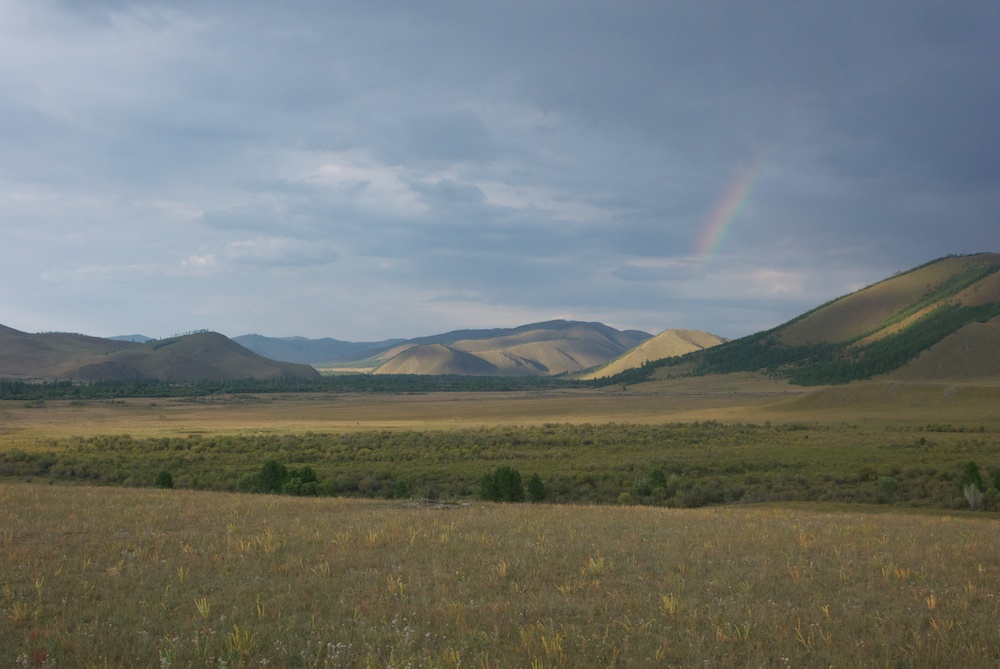
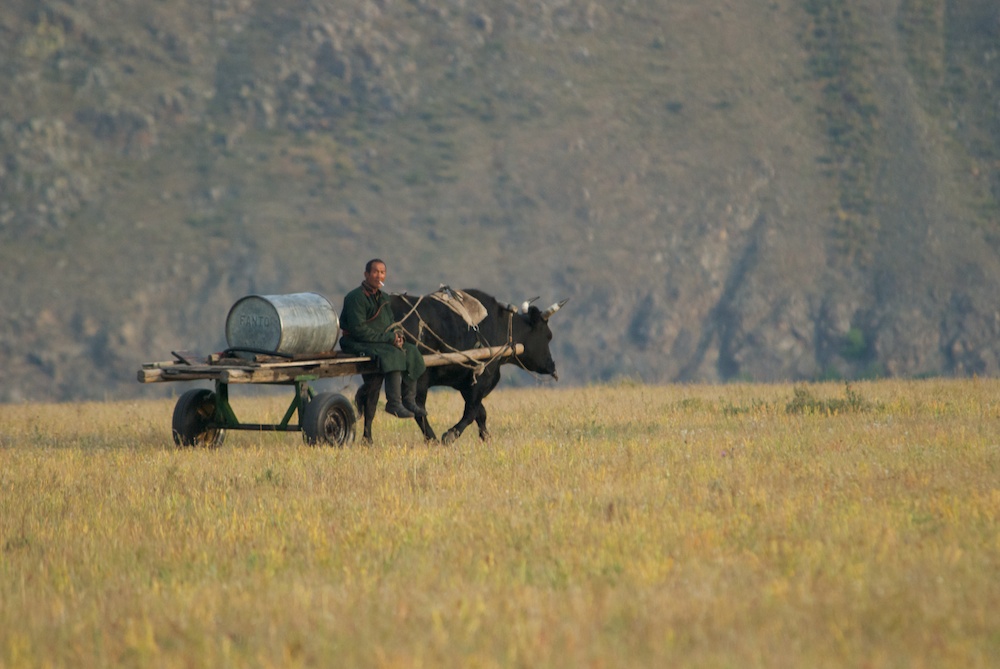
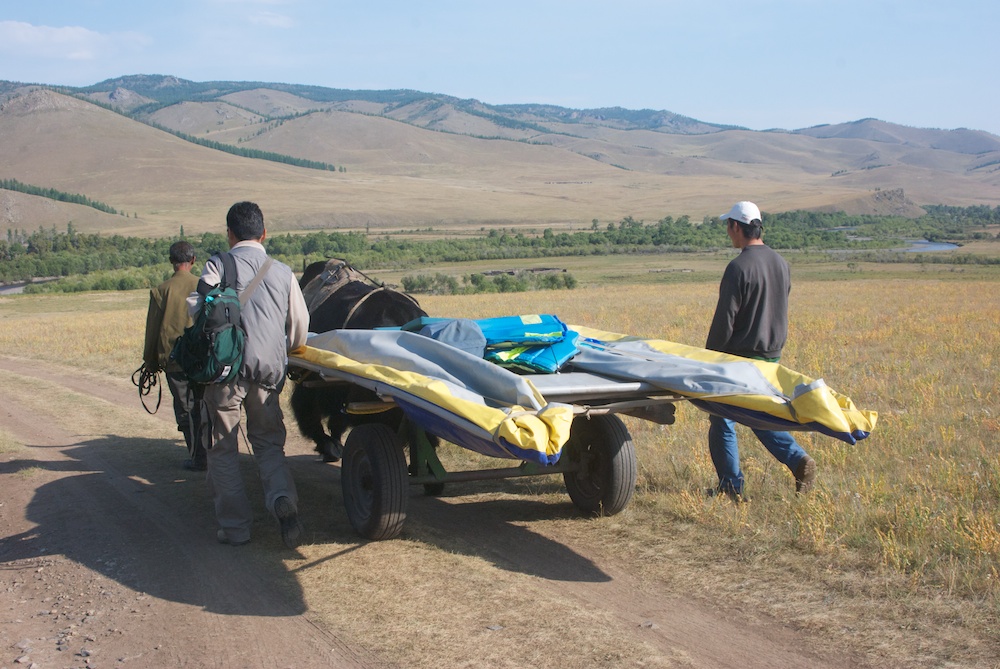
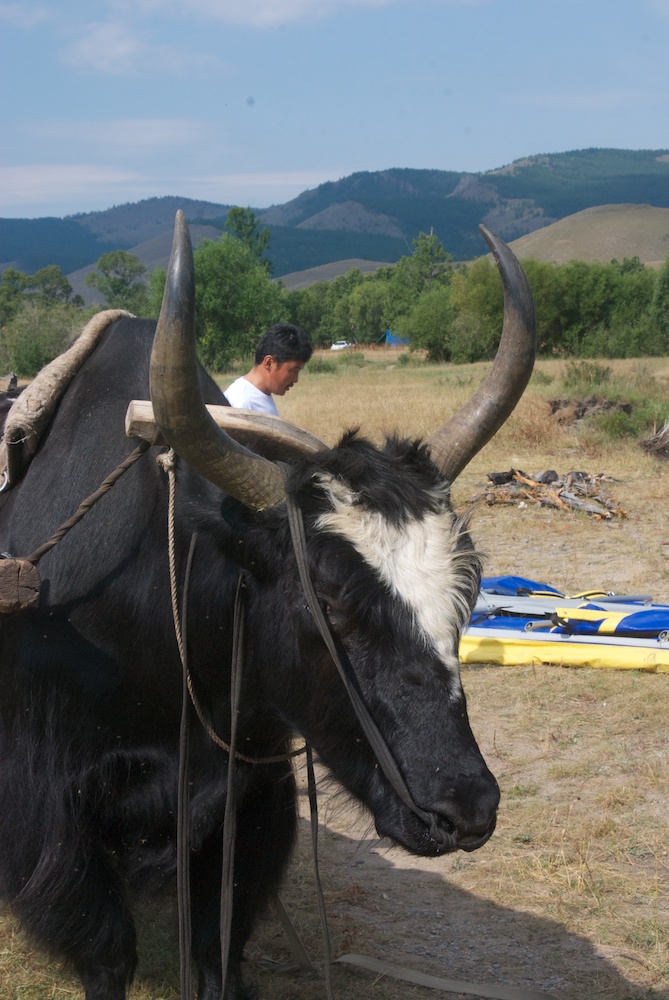
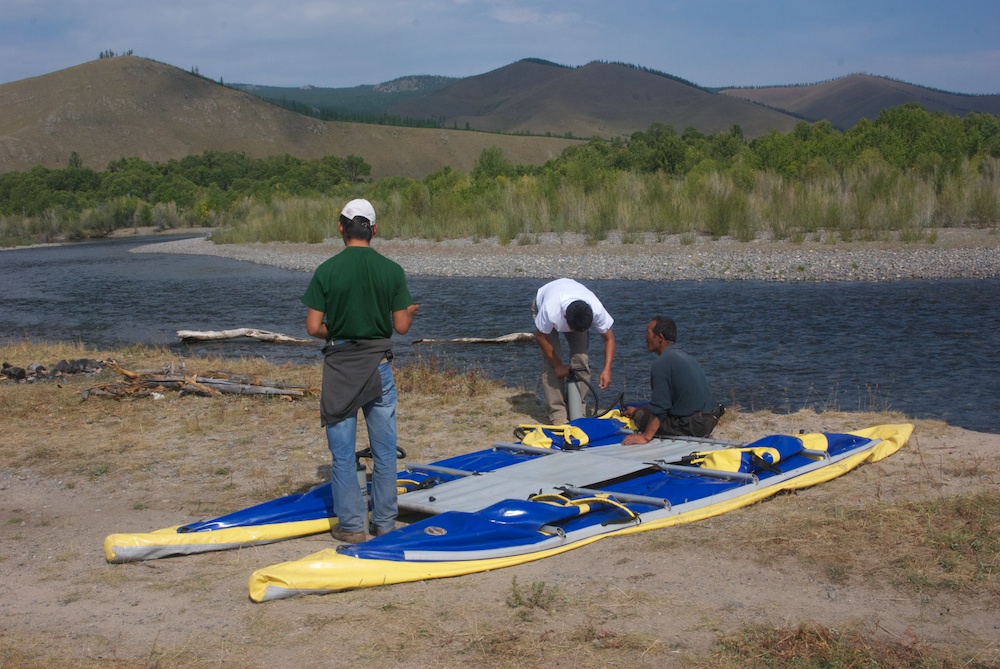
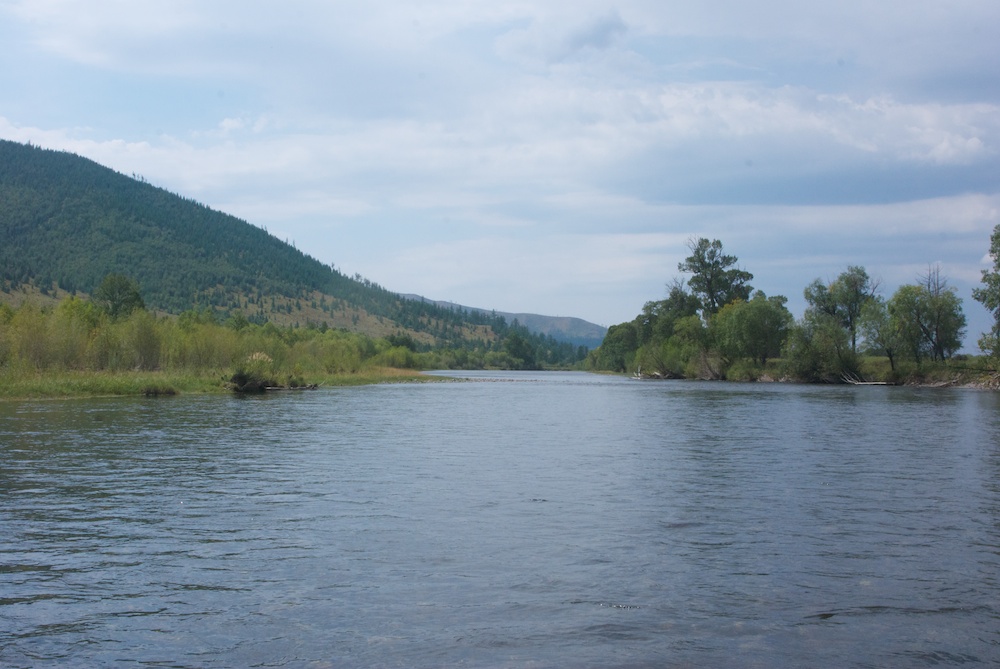
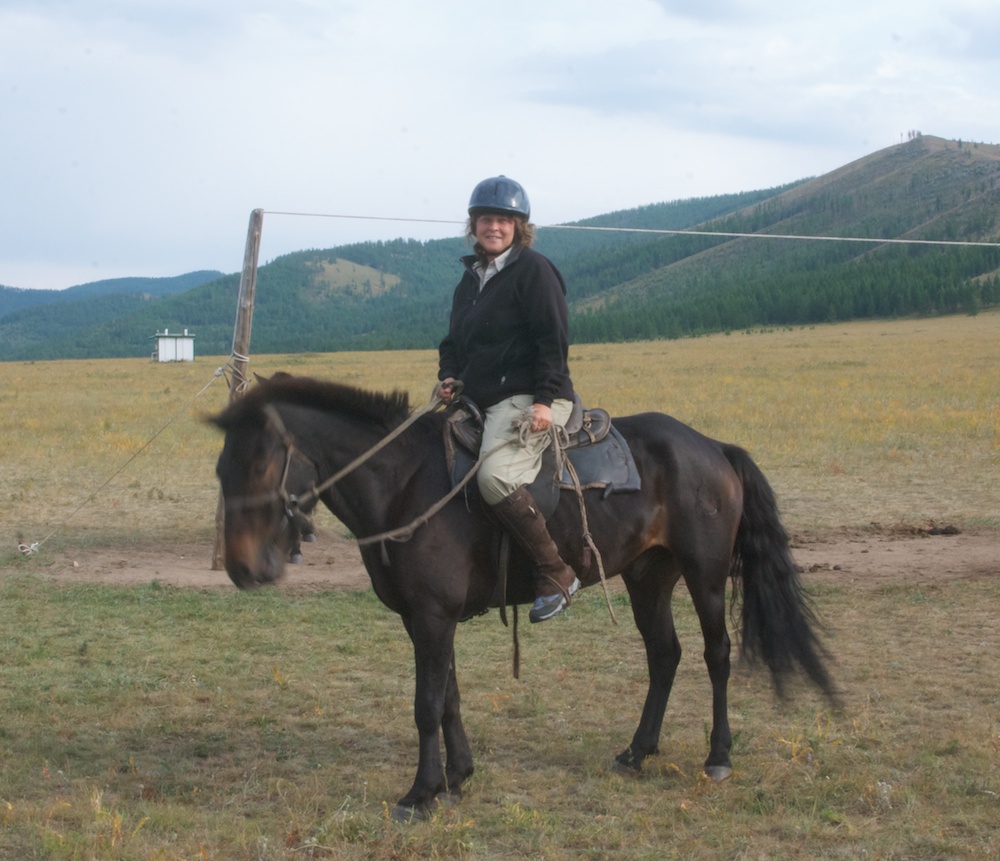
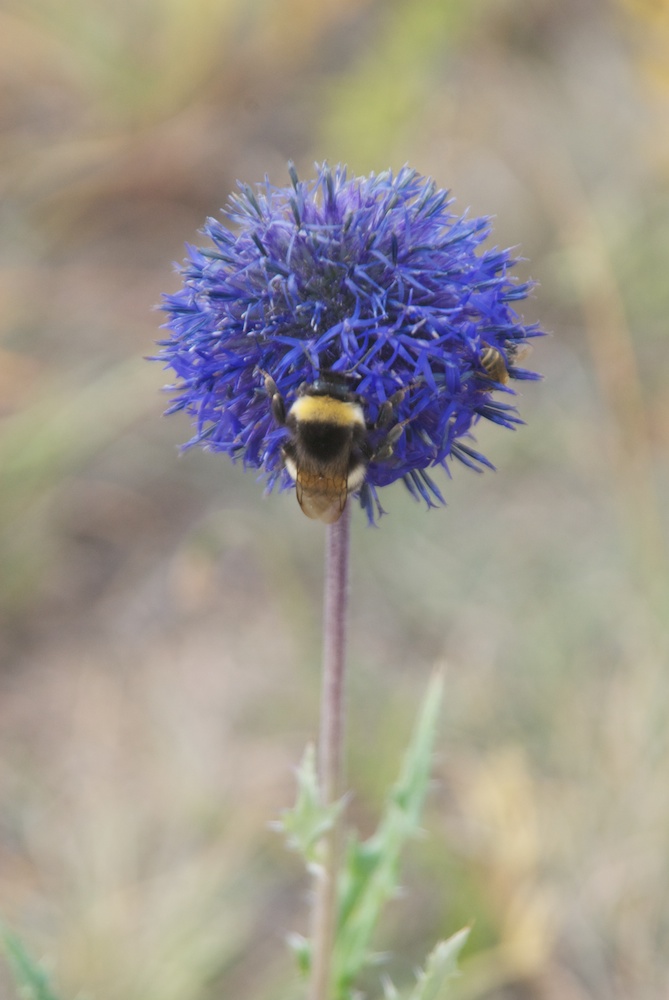
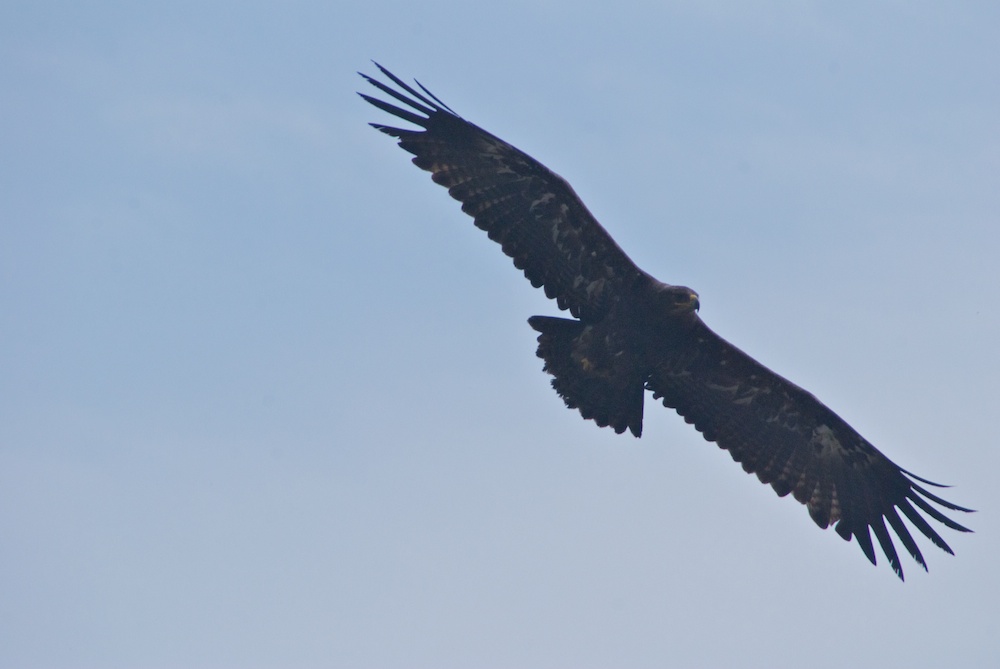
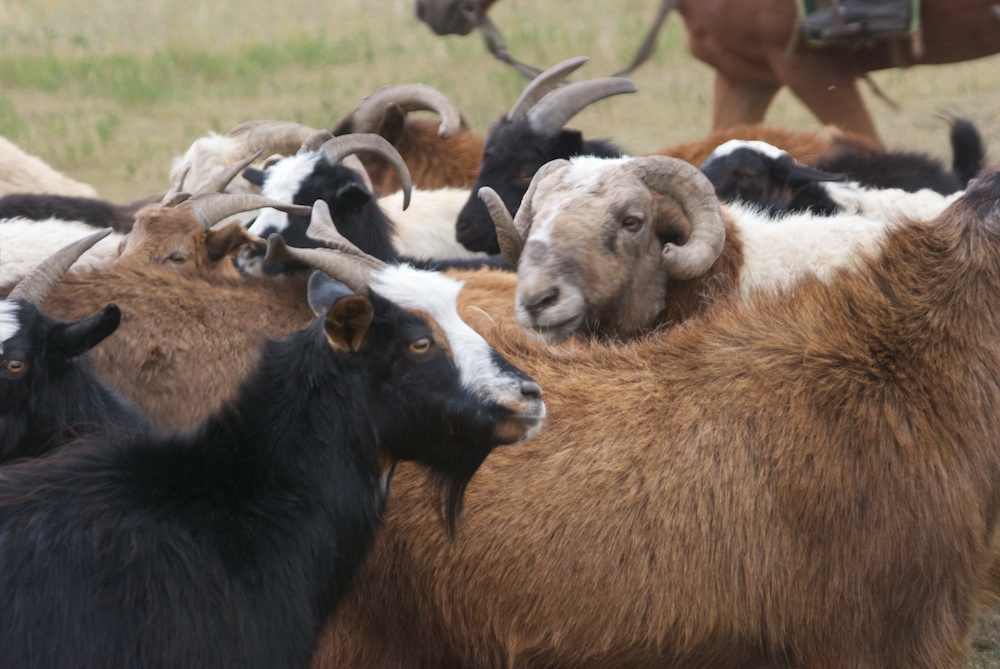
As I came out of our ger after getting settled in, this memorable scene met my eye.Jalman Meadows ger camp with the Tuul Gol in the background.A local herder with his ox-drawn cart fetched water for the camp every day from the river.He also provided the means by which the inflatable boat on which we would take a river trip was transported. We walked about six kilometers to the launch site.This time our "helper" was a yak/cattle hybrid called a hainag.Inflating the boat.And then we were floating down this beautful river.The scenery wasn't flashy, but had a calm peacefulness.We saw a number of birds, including this grey wagtail.There were quite a few riffles to paddle through, which added a little excitement.Finally, the ger camp came into view and our half-day river trip was over.In the afternoon, it was time to go riding.There is nothing like riding through the Mongolian countryside on a Mongol horse.The next morning there was time for a hike up onto one of the hills near the camp. We walked up through the larch trees until we got to this view.The mountain wildflowers were still blooming. The white flowers are edelweiss.And the bees were still busy.We were packing to leave after lunch when Khatnaa stuck his head inside our ger and told us to come quickly, there was an eagle close by. We got some great photos of this big steppe eagle.He finally took off and circled once over our heads.It had started to rain on and off and we needed to get down out of the mountains, but when we saw this big herd of billy goats and rams, it was photo op time.They were all sizes, shapes, colors and horn designs. The young herder walked them back and forth past the car a couple of times, so we got lots of great pictures.Another herder we saw, tending his animals, rain or shine. It was raining.At last we approached the tarmac road, passing the spectacular statue of Chinggis Khan, facing east towards the Mongol homeland.One more wildlife sighting...golden eagles belonging to local a local Kazakh. They go up into the mountains and capture the young birds, using them to hunt with for a couple years and then releasing them.And then it was back into the wilds of Ulaanbaatar, now a city with over a million people. The noise was a shock after the quiet of the countryside.
I’ll be leaving on my 2011 trip to Mongolia two weeks from tomorrow. Things are pretty simple this time, no new gear to buy for a change. Duffles are out and I’m starting to collect various things I’m taking and staging it all in the guest room.
I’ll be staying with a family in Ulaanbaatar for the first week, seeing friends, getting a couple of new del made and doing some sketching. I’ll also be checking out how much things have changed since last year, when there was a lot of sidewalk repair and general clean-up going on in the central part of the city.
Contrast
It will also be interesting to see if any of the traffic calming measures are working. At this point, the biggest adrenaline rush I get in Mongolia is crossing the street in UB. On my first few trips, I literally waited at a corner until an elderly Mongol or a young mother with small children came along and then I crossed with them, figuring they would get at least some consideration.
The last trip, I finally (mostly) figured out the pattern and started to cross on my own. The drivers cut it really close, but aren’t actually trying to hit anyone (mostly), so the safest course of action is to do what they expect. This does, however, often leave my lizard brain screaming at me that “You’re gonna die!”
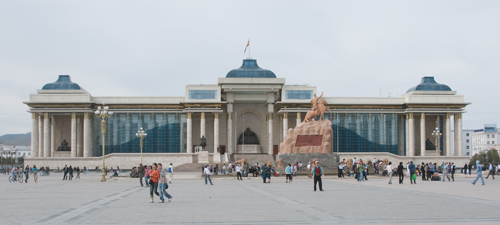
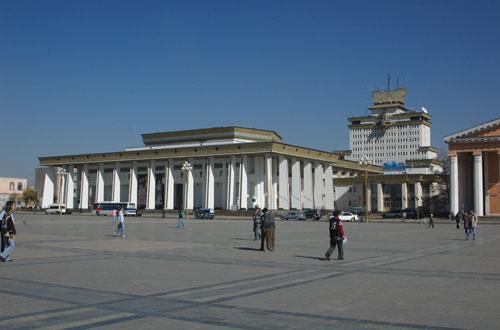
Buildings lining Sukhbaatar Square: the reddish one on the left is now the stock exchange
But I still like the crazy city, which has great energy and vibrance, along with some really cool architecture and good restaurants. And it’s such a contrast to the countryside, with its earth roads, incredible scenery, wildlife, herders and quiet.
This time I finally did something I’ve been wanting to do in Ulaanbaatar for my last couple of trips to Mongolia – sketch on location.
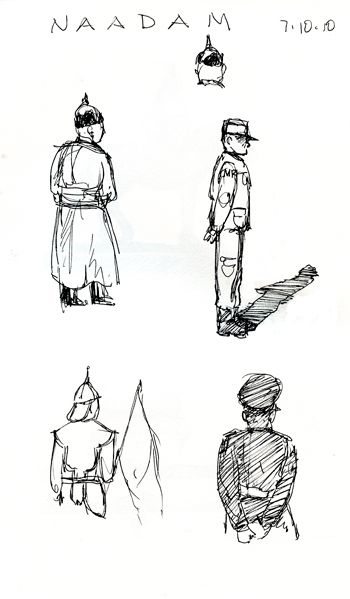
I got started right away since I had a couple of hours before I left for the countryside on July 10, having arrived on July 8. The Naadam celebrations had begun at Sukhbaatar Square, so I walked over from my hotel and did this page of quick studies.
Naadam 2010, Sukhbaatar Square
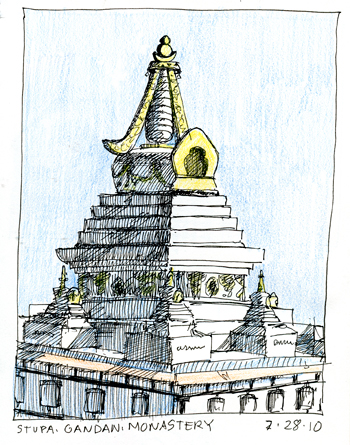
Back in UB after the camping trip, I met up with a new Mongol friend I had originally connected with on Facebook and we spent part of a morning at Gandan Monastery. It was fun to have a sketching buddy. He hadn’t drawn since high school, but must have still remembered something, because he immediately turned out some nice work.
I got an interesting comment on the stupa drawing. An older man came by, looked at what I was doing and told me, through my friend, that there HAD to be nine smaller stupa shapes below the main one. I couldn’t really explain that I simply couldn’t see them from the angle at which I was sitting, so just had to let him walk off in a minor huff.
Stupa, Gandan Monastery
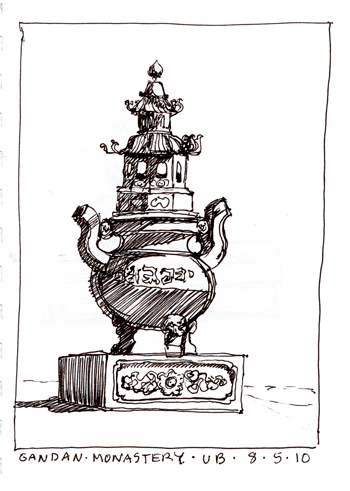
There are a number of these big (close to 8′ high) incense burners around the Monastery grounds. Visitors circle them while trailing a hand along the surface.
Large bronze incense vessel, Gandan Monastery
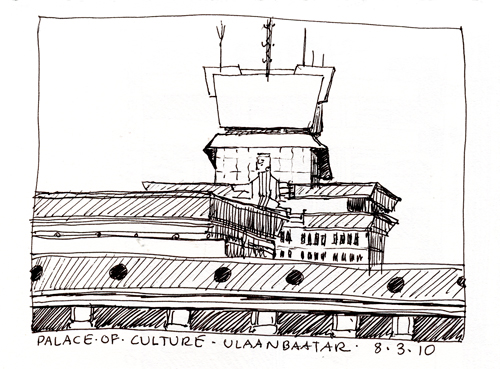
After I returned from the countryside, I went back to Sukhbaatar Square and sketched some of the buildings. The Palace of Culture is one of my favorites. The top of the tower is metallic gold and sparkles beautifully in the sunshine.
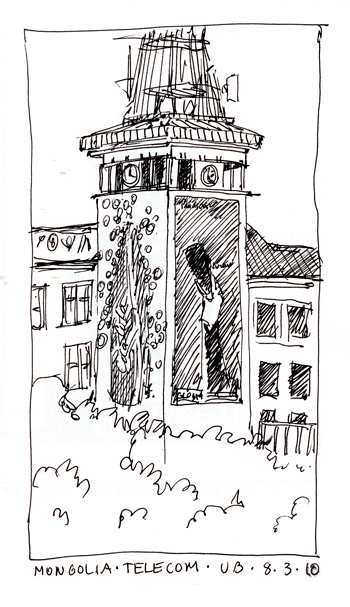
The Palace of CultureMongolia Telecom
I started to draw some attention at this point, particularly from a nice young man who wanted to practice his English, and had to give it up. Yes, that’s a giant Coke bottle on the left hand side of the building.
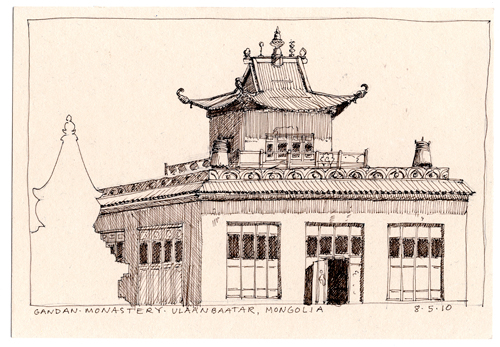
I also went back to Gandan Monastery for another morning of sketching. This time I tried adding some color with my water-soluble colored pencils.
Gandan Monastery
The preceeding sketches were all done in a small Strathmore premium recycled sketchbook. But I also wanted to experiment with working on location on toned paper. These were done during the second stint at Gandan Monastery and also at the Museum of the Chojin Lama. I never do architecture, really, so it was a challenge to try to keep things in reasonably decent perspective. On the other hand, unlike animals, the buildings, at least, don’t move.
Gandan Monastery templeMuseum of the Chojin Lama temple gate
Next Friday, I’ll post more drawings, this time from the journal that I kept during the trip. Dogs, dinosaurs, the desert and…..
The only thing many people know about Mongolia is that it is the place from which Chinggis Khan and the Mongol Horde rode forth to conquer the largest land empire in history. The Mongols’ view of him is very different than the one westerners grew up with. Far from being a bloodthirsty “barbarian”, he is considered more as Americans do George Washington, as the father of their country. He united the Mongol tribes in 1206. The last vestiges of his empire lasted until the 18th century, although it had split into many separate parts long before. He was their lawgiver and his pronouncements carry weight and provide some guidance in the country to this day.
Mongolia became the world’s second communist country in 1921. Not long after, the memory and public acknowledgment of Chinggis Khan was, except for a very few brief periods, actively suppressed. This changed, it appears, almost instantly, when Mongolia became a democracy in 1990. He is THE major cultural icon of Mongolia today. In fact, I just realized that I’m writing this wearing my Chinggis Khan t-shirt that I bought when I was there in 2006. There is also Chinggis Khan beer and vodka. Large wall-hangings with his portrait are very popular. You see him on billboards. He and his warriors ride into the National Naadam stadium during the opening ceremonies. There is a pop singer named Chinggis Khan. And, as you will see below, one can put together quite an interesting tour of the country visiting statues, monuments and a variety of locations associated with him.
I’ve been to three of the ones listed here and hope to visit the others at some point. Who knows, maybe this summer!
Government House, Sukhbaatar Square, UlaanbaatarChinggis statue
1. Sukhbaatar Square- When I first saw the Government Building in 2005, it was a socialist era plain brown rectangle. The next time, in 2006, it was covered with scaffolding and it looked like a major change in the facade was under way. By the time I saw it again in 2008, the transformation was complete as you can see in the first image. It’s now one of my favorite government buildings ever. And the centerpiece is an enormous statue of Chinggis Khan.
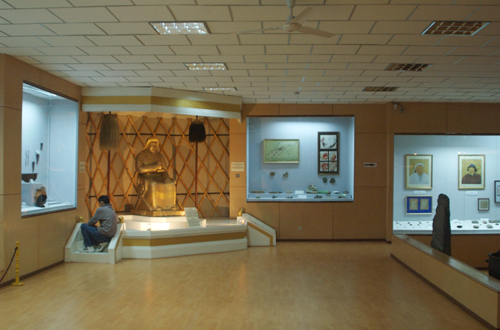
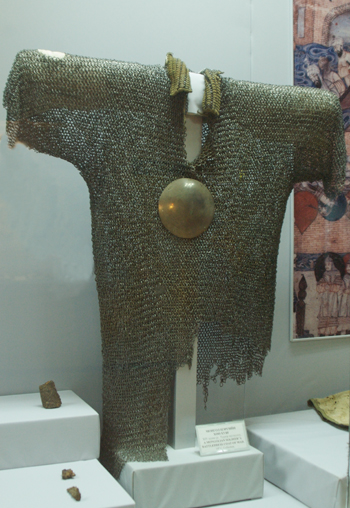
Chinggis Khan room at the National Museum of Mongolian HistoryMongol chain mail hauberk-13th-14th c.
2. National Museum of Mongolian History- There’s a rather large room devoted to Chinggis Khan and the Mongol Empire on the 3rd floor. Lots of interesting artifacts, including the chain mail hauberk show above. There are supposed portraits of Chinggis, Kublai and other Mongol khans, but I believe they are Chinese in origin and created after the lifetimes of the subjects. One unexpected display has an actual letter between one of the later Khans, Guyuk, and the Pope. There was a surprising amount of communication between the Mongols and western Europeans from the 13th century on, although usually at cross-purposes. The Europeans wanted the Mongols to help them beat the Saracens and the Mongols wanted the Europeans to submit to them and become part of the Empire. Needless to say, neither party got what they wanted.
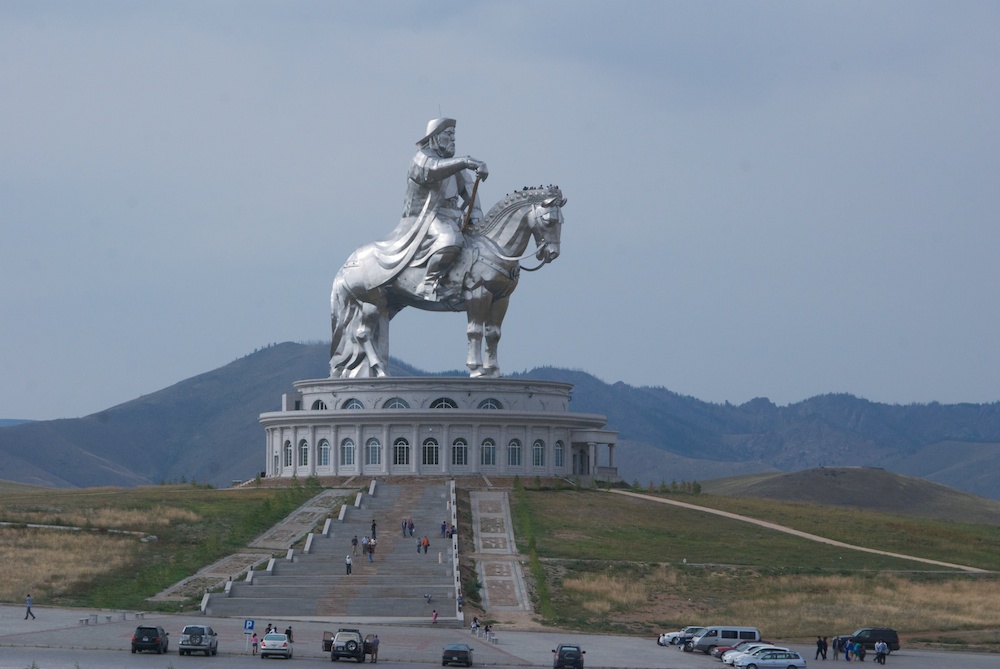
The world's largest equestrian statueThe view looking east as Chinggis would see it
3. The Chinggis Khan Equestrian Statue- It’s 40 meters high and on a 10 meter high base and is covered in aluminum. If you look at the horse’s mane, you can see the people who had taken the elevator up into the horse’s body. There’s a restaurant, gift shop and other facilities in the base. The second image shows what the statue “sees”. Out beyond those mountains is the origin point of the Khalkha Mongol people, who westerners think of as “Mongols”, although there are quite a few other ethnic Mongol groups.
These next three are the places that I haven’t been to yet, so there’s no images.
4. The Onon River– In the mountains near this river’s junction with another, Balj Gols, is where Chinggis Khan is believed to have been born. Although westerners think of the Mongols as a steppe people, they originated in a mountainous area that is part of the southernmost extension of the taiga or boreal forest. This is where the first monument to Chinggis Khan was erected during the socialist era. The people responsible ended up being purged. There is also a stone marker near the village of Dadal, placed in 1990 to commemorate the 750th anniversary of the writing of the Secret History of the Mongols, almost the only primary reference material available about the Mongols during the time of Chinggis Khan, although it survived only as a Chinese transliteration.
5. Avarga- This site on the Kherlen River is supposed to be the location of Chinggis Khan’s “capital”. It is believed to have served as his base from 1197 until the end of his life. I’ve been told that there are two noisy ger camps in the immediate vicinity, so it looks like a day trip or camping out will be the preferred options.
6. Burkhan Khaldun- This mountain, where Chinggis Khan took refuge from enemies before he became Khan of all the Mongols and journeyed at various times in his life to pray to Tenger (the Sky), is located within the Khan Khentii Strictly Protected Area, which the Lonely Planet guide describes as “Chinggis Khan territory”. There is an ovoo on the mountaintop that is visited by the Mongols. I don’t know if it’s ok for non-Mongols to go onto the mountain, but I would at least like to see it.
While Ulaanbaatar may not be a well-known destination city, it has plenty of interest to offer visitors, especially if they are interested in Buddhism, history, nature or art. Here’s my list of the places I’ve found so rewarding that I’ve been back to most of them twice so far and will probably visit them again.
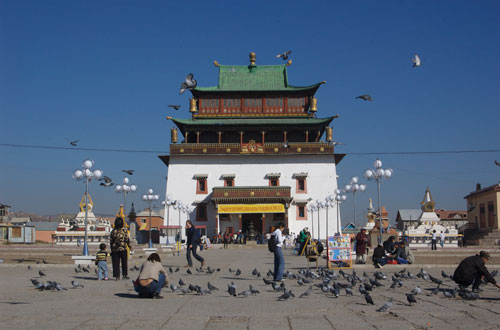
1. Gandantegchinlen Khiid– the full name translates as “the great place of complete joy”. More commonly known as Gandan Monastery, it was built starting in 1838. Ninety-nine years later, it was one of the very few monasteries to survive the Stalin-style purges that led to the destruction of hundreds of temples and the deaths of an estimated 17,000 monks. These days, with the revival of Buddhism in Mongolia, Gandan is a busy place. There are a number of temples. Visitors are only allowed into the main one, as seen below, Migjjid Janraisig Sum. Within it is an enormous statue of Buddha, well worth the modest price of admission.
Migjid Janraisig Sum, the main templeSpinning the prayer wheels at Gandan
2. Chojin Lama Temple Museum– Smaller than Gandan, but with an intimate, decorative charm, this old temple is tucked away down a side street and is surrounded on three sides by modern buildings. But once inside the walls, it’s a place of beauty and peace. Construction started in 1904 and took four years. It was saved from destruction for use as an example of past “feudal” ways. Although it is considered a museum and there don’t seem to be any monks in attendance, every time I’ve been there, people have been in the temples praying and leaving offerings. There is also a concrete ger “Art Shop” shop on the grounds that can be accessed without paying admission. I think it’s the best place in UB for souvenirs, although it doesn’t have the wide selection you can find at the State Department Store. What it does have is the feeling of a treasure hunt in a curiosity shop.
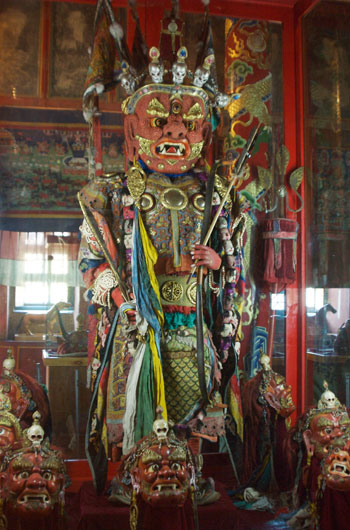
Interior gate at the Chojin Lama Temple MuseumOne of the incredible Tsam dance costumes on display; the mask is covered with coral beads; Tsam dances are a pre-Buddhist survival that are now part of Buddhist practice in Mongolia
3. The Natural History Museum– Speaking of curiosity shops, the Natural History Museum is like a survivor from another time. It needs and deserves to be modernized, but something charming and fun will be lost when that happens. It is home to a very good collection of dinosaur fossils that have been found in Mongolia over the years, including eggs and a huge Tarbosaurus. The most spectacular fossil on display is the famous “fighting dinosaurs”, a protoceratops and a velociraptor locked in mortal combat as they were possibly trapped in a mud slide. Another personal favorite, which I hope will be preserved in any modernization, is the “camel room”, see below.
The fighting dinosaursThe Camel Room
4. The National Museum of Mongolian History– Only a block away from the Natural History Museum, the history museum has been renovated to an international standard. There are three floors of exhibits, starting with the superb section of stone and bronze age items on the first floor, an amazing display of ethnic Mongol historic costume and jewelry on the second floor, the can’t-be-missed third floor collection of artifacts from the time of the Mongol Empire and on through to the changeover twenty years ago from socialism to democracy.
Khalkh Mongol woman's costume (should look very familiar to Star Wars fans)The Real Deal; Mongol metal scale armor from the 13th-14th century
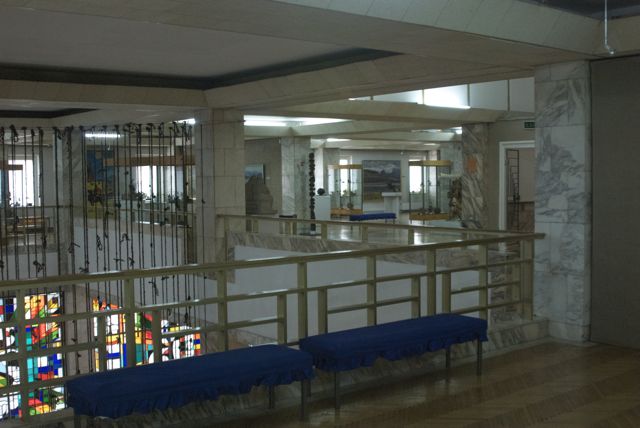
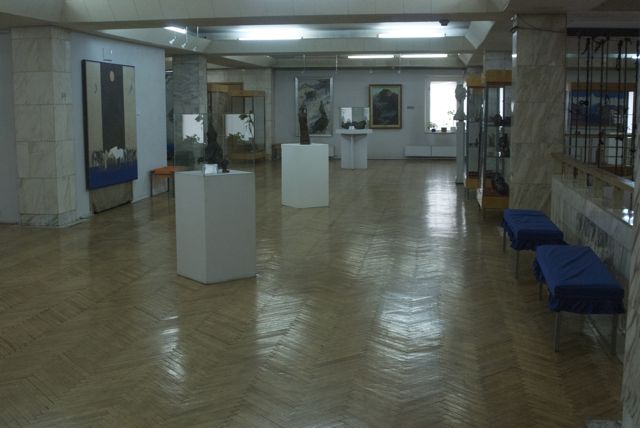
5. Mongolian National Modern Art Gallery– Housed in one of my favorite buildings, the Palace of Culture, anyone who is interested in excellent representational or abstract art will find a couple of hours here very rewarding. For a more thorough tour from my visit there during my 2009 Artists for Conservation Flag Expedition, click here. It’s clear that many of the artists have had classical training, either in Russia or other Eastern European art schools. But, as seems to be the case with most of the art forms practiced in the country, what is on display has a unique Mongol sensibility.
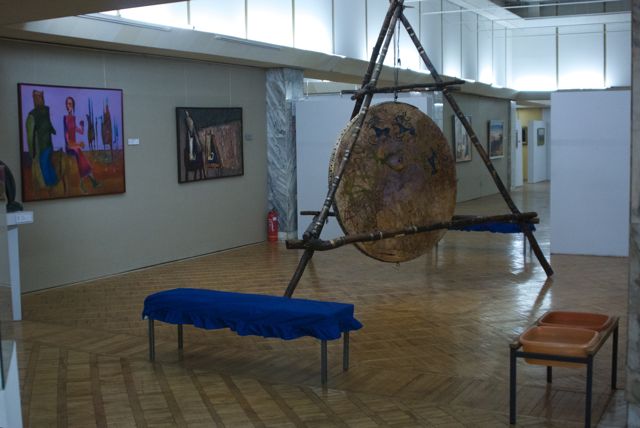
The Palace of Culture, UlaanbaatarOne of the galleries, with a large shaman's drum
6. Zanabazar Museum of Fine Arts– Zanabazar was one of the greatest artists to have lived and worked in Mongolia. He is best known for his exquisite bronze sculptures of Buddhist manifestations such as Tara. The best images that I was able to get, however, due to low light or glare on glass, were of some of the appliqued and embroidered thangkas, or devotional works. The Red Ger Gallery on the first floor has an excellent collection of work by contemporary Mongol artists available for purchase.
Travel home from my trip back east got, shall we say, interesting. Suffice to say that the good news is that I got home. The bad news was that it was at 2:30 in the morning. So I slept in a little.
I did get in some studio time since I have to have five small works for the Godwit Days waterfowl festival this weekend. I’ll pick up the “Six Things” series next week, but, in the meantime, here’s an image of the Chinggis Khan statue that is in the front of the Parliament Building in Ulaanbaatar. As you can see, it’s quite large.
Went to BD’s Mongolian BBQ for dinner night before last. It’s quite popular with the Mongols even though there’s nothing authentically Mongolian about it. Apparently it’s a Chinese invention. BD’s does the same kind of stir fry on a big hot surface that you see in the USA. Mongols don’t do stir fry.
Real Mongolian BBQ involves killing a goat, slitting the body cavity open, cleaning it out, stuffing it full of hot rocks, putting the whole thing in a metal container and setting that on hot coals to cook. When it’s done, the meat is pulled out, along with the rocks, which are then passed around, hand to hand, for good health. And yes, I’ve had it, hot rocks and all, and it was good.
I don’t envision a real Mongolian BBQ place coming to your neighborhood anytime soon.
I’ll probably go back there again since for 6900 tugrigs I can get a heaping bowl of veggies, noodles and meat with Mongolian ginger sauce. A small Chinggis Khan beer is 2100 tugrigs. 9000 tugrigs at the moment is less than $8.
Plus the cooks show off by doing things like lining up four or five pieces of broccoli on the long sword-like turner and then flipping them all up into the air and catching them all on the plate. So it’s dinner and a show.
———-
This morning I had breakfast in the hotel, which is included in the price of the room. They’ve gone from a menu to a breakfast buffet with an egg cook, like you see at many hotels now in the states. It’s really sped up getting breakfast and one can skip the slices of mystery meat that I think they put out for the Germans.
The weather was nice and cool when I left the hotel around 9 am. I walked about twenty minutes to the Mongolian Modern Art Gallery, which is actually a museum since nothing there is for sale. There was a show that I had read about on one of the Mongolian news sites and today was the last day.
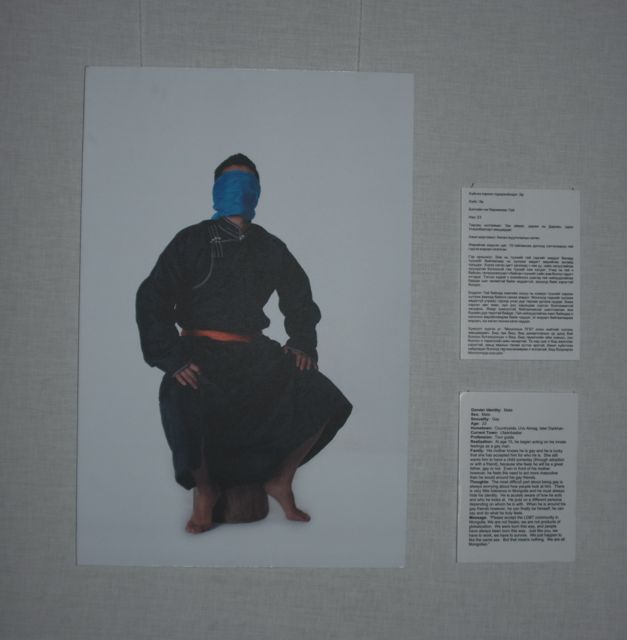
With all the Prop. 8 stuff in California and the civil rights issues concerning LGBT citizens that remain to be addressed, I wanted very much to see “Beyond the Blue Sky”, a “multi-media art exhibit for, and in collaboration with, Mongolia’s lesbian, gay, bisexual and transgendered community.
The people in the photographs have their faces covered by khadags, blue scarves, which are given as gifts, but are also used to cover the faces of the dead. It symbolizes the position LGBT people find themselves in in Mongolia since currently they cannot live their lives fully, but must conceal their gender identity or otherwise be vulnerable to prejudice, discrimination and violence.
It was a very powerful show.
Here’s the image that really struck me the most:
Image of man in del, face covered by khadag, “Beyond the Blue Sky”
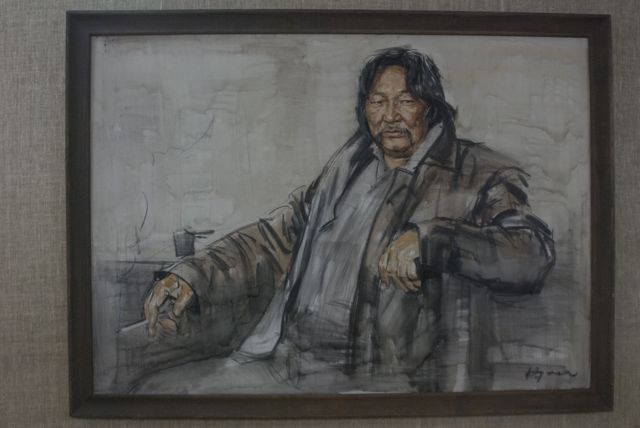
I then went upstairs to see the main galleries, which house original Mongolian paintings, sculpture and fine craft dating from the early/mid-20th century. As a socialist state with close ties to the Soviet Union, aspiring Mongol artists often studied art in Moscow. This gave them a grounding in classical realism that allowed them to create paintings of great quality. And they’ve built on it ever since, adding their own unique interpretations of the world they live in.
Here are some examples:
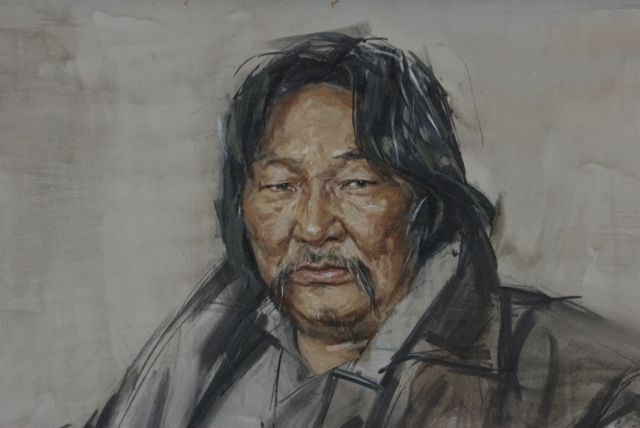
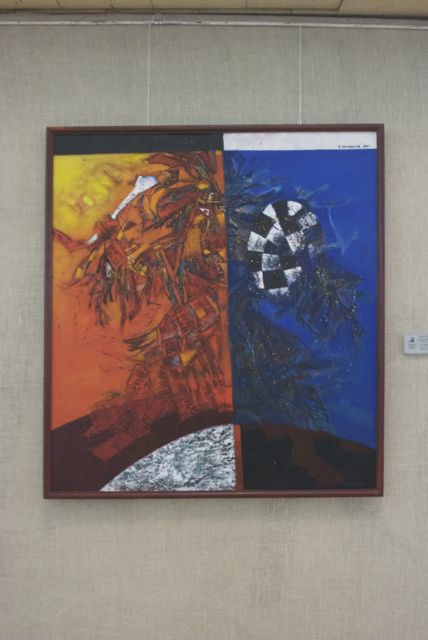
Portrait- Orkhon, N. 2006 oilPortrait, detailThe Red Portrait- Nasantsengal Bayanjargal 2001 oilThe Own Portrait- Ulziikhutag, Yondon 1991 oilLord of Great Land- Ichinnorov, Choij 1981 oilIn Art Studio- Bold, Dolgorjav 1981 oilHorses Hoof- Tsegmid, P. 1986 oilPost Man- Tsembeldorj, Myatov 1997 oilThe Bullet of the Sky- Tumurbaatar, Badarch 2004 oilThe Guardian Spirits- Advabazar, Nyam 2001 oilThe Light of the Steppe- Sanchir, N. 2002 oil
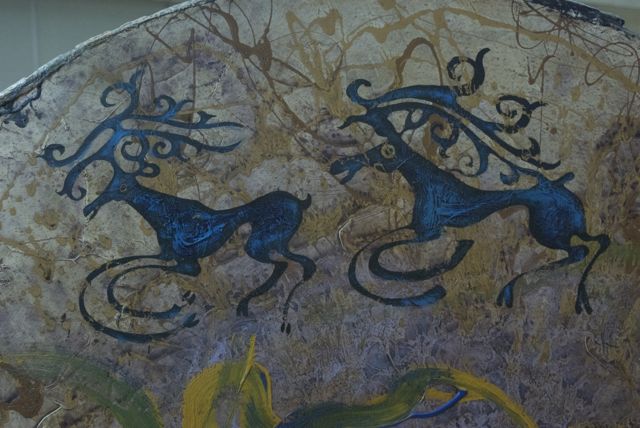
There was also this wonderful ceremonial drum with deer painted on it..
“Deer Drum” leather on wood frame“Deer Drum”, detail
Finally, here are some views of the gallery spaces:
I had lunch at Millie’s, which serves good solid American food like burgers and sandwiches and is popular with the expat community of consultants and aid workers, along with visitors like me.
The next stop was the Hi Fi store, to see if I could get some of the music CDs for groups I’ve found on YouTube and Imeem. And I had some success. By the time I left, it was getting seriously hot, so I hiked it back, about 30 minutes, to the hotel to hide out until it cools down.
———
An addendum to my comments about all the livestock I saw when I was coming into town. Looks like it’s not as charming and picturesque to the authorities as it was to me. This is from a Mongol news website, http://www.en.news.mn:
“Herders asked to move livestock away from Ulaanbaatar
Tue, 7 Jul 2009 17:07:49
The Metropolitan Professional Monitoring Agency has reminded herders that there is a ban on livestock entering Ulaanbaatar green areas, and another on trading of any form in certain areas. With demand for sheep rising in Ulaanbaatar just before and during Naadam, some herders come to the city with their livestock at this time and the reminders are aimed at stopping the move.
Some 200 herder families have brought 30,000 animals into prohibited areas. The law calls for confiscation of all income earned from trading in such restricted areas. Further violation of the law can lead to imprisonment.”
I came downstairs to check out after the previous post. I walk up to the counter. The nice woman says that she is to call the manager, who wishes to speak with me. In the meantime, I finish settling my bill. He comes out and asks if breakfast was ok. I say fine and then tell him that everyone makes mistakes, but it’s how they respond that counts and that he and the hotel had out-done themselves and I was very pleased. He smiled and made a little bow. I then asked where to go to wait for the shuttle bus. And he says……we have a special shuttle for you, a car. And darned if there wasn’t a spiffy black sedan waiting at the curb for me. Can you believe that?
I walk out to the car and get in while they load my luggage. Just before we pull away, I look to my right and there is the manager and one other man, in attendance is the only way to put it. I smiled and waved and they smiled and bowed. And then the fairy princess was wisked away to her MIAT flight to Ulaanbaatar, where she is now ensconced in a tenth floor room with a view of Peace Ave. at the Narantuul Hotel and happily connected to the internet, a great relief.
——-
On the way in from the airport, besides the gers and gas stations, buildings and billboards, there were sheep. And goats. And cattle. Lots of them. And Mongol guys riding around on horseback. I must have seen 20 small to largish herds of animals. Their owners were hanging out in whatever shade they could find. The billboards seemed particularly handy. One family group had set up a low table with a white cloth on it and appeared to be about to have tea.
I’ve never seen this between the airport and town before, but then I realized – Nadaam. The herders have come in from all over and they can’t leave their animals, so everybody is here. I also think I saw some townspeople “shopping” for that perfect main course for their holiday dinner. On the hoof at the moment.
I had no idea and the cameras were buried in the suitcase, so no photos at the moment. But it was a great sight. And is exactly the kind of thing I love about Mongolia.
———
If Chinggis Khan had had a car it probably would have been a huge black Hummer trimmed out in lots of chrome, like the one I saw coming into town. Over here those stupid things almost make sense.
Which is Mongolian for “Hi!” or “Greetings”. It’s pronounced, roughly, “sain” as in sandwich, “ban” as in bandaid, “uu” as in oval.
I’ve just downloaded what looks to be a very useful Mongolian language program from Transparent Language. The next trip is coming up in July and I want to be able to communicate better. Before my 2006 trip, I was able to find a local Mongolian woman who tutored me in basic pronunciation and vocabulary, along with some simple sentences. It’s amazing how far you can get with: please, thank you, excuse me, yes, no, hello, goodbye, I like….., and knowing the numbers from one to ten. But it didn’t help when I heard a cool song on the driver’s MP3 player and had no way of asking who the artist was. I have a Lonely Planet Phrasebook and a “cheat sheet” from my tutor, but that’s not enough.
I have some familiarity with learning a new language. Spanish (see below), some basic Japanese (I can still count to ten!) when I was 14, two years of German in high school (wish I’d taken one year of German and one of French) and some Middle English and Anglo-Saxon in college. At one point I’d decided to teach myself Welsh. It was a short point.
Like many languages, Mongolian has sounds that don’t exist in English, so that’s a challenge. One travel writer describes spoken Mongolian as sounding like two cats fighting, but I’ve found that to be somewhat of an exaggeration. The guys seem to play up the gutteral sounds more than the women, especially in the countryside. There are rolled “r”s, which means that after 40 years, my stupid junior high Spanish class has finally turned out to be good for something. And there is a sound that is similar to the double “L” in Welsh. Vowels that are “doubled”, like in the sign below or in “Ulaanbaatar”, are audibly extended, as in Khan vs. Khaaan. One of the sounds that I have found most challenging so far is “g”. It seems to be something like “uudo”, with a slightly rolled “d”, but I’m sure I’m mangling it into something hilarious. The Mongols are blessedly tolerant of anyone who takes a swing at their language and seem to appreciate the attempt.
Their alphabet is a close adaptation of Russian Cyrillic and I’ll be learning that, too. It will be nice to be able to read at least some of the signs in Ulaanbaatar. Like these (I used to be a sign painter and still can’t resist taking pictures of signs that catch my eye). There’s just enough overlap with the Roman alphabet to be slightly maddening. You feel like you can almost read it, but no.
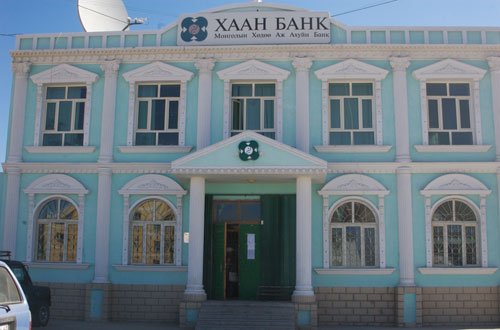
Khan Bank, Hovd, western Mongolia
Although, in this case, it was more the beautiful building that I wanted a picture of. But good to know that this is a bank, if one is running low of cash. One of the first signs I was able to read.
Gers and tents for sale at the Narantuul Market, UB
I took this photo partly because I had no time to inquire about details like prices and didn’t want to lose track of them since I would really like to get a tent like the one on the right.
Pet shop sign, Ulaanbaatar
Since my dog is a tri-color rough collie, the same breed as the dog on the sign, I had to get a picture. I’ve wondered since then if there are actually any collies in Mongolia. They certainly have a coat that would be handy in the cold weather. Lassie Forever!
Street sign, central Ulaanbaatar
Now, how could anyone resist a drink that will give them the energy of the Mongol Horde?




























 Susan Fox, American Artist