I’m now one month from departure for my next trip to Mongolia. I don’t have a specific itinerary yet, and probably won’t until I arrive, but here’s some of the things I hope to do and see this time around:
A nice little serving of buuz
-I’m one of the administrators for a Facebook fan page called “Buuz”, which are dearly beloved steamed meat dumplings. Mongols make and eat zillions of them for Tsagaan Sar, the Mongol New Year. When you ask a Mongol living in another country what they miss most, “buuz” is often the answer. We have over 700 fans now! And it turns out that the person who started the page, an Italian guy who is married to a Mongol woman, is going to be in Mongolia the same time as me. So we’ve announced a get-together for “Buuz People” in Ulaanbaatar on July 13 at the (no fooling) Grand Khan Irish Pub. Who knows who will show up, but it should be fun.
Yaks, Gun-Galuut July 2009
-It appears that the first weekend of August that there will be a Yak Festival somewhere in the Khangai Mountains west of Ulaanbaatar. Now, how could I miss that?
Horse race finish, National Naadam July 2009
-I would like to get to a number of Naadam horse races, both the national one and at least one or two local ones to get more painting reference. I also want to get a lot more photos of the herders and their horses.
Closeup of Chinngis Khan statue east of Ulaanbaatar July 2009
-There’s not much left of the ancient Mongol capital of Kharkhorin. It was sacked by a Ming Dynasty army and then most of the remaining stone was used to construct Erdene Zuu Monastery. I would like to visit both.
Tahki mare with two foals, Hustai National Park Sept. 2008
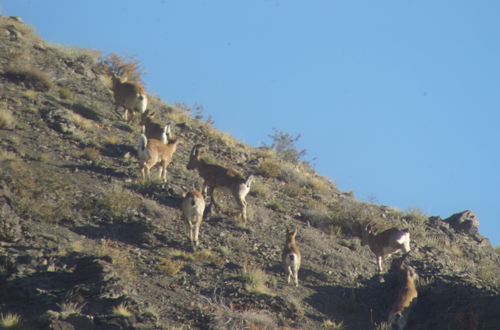
-For wildlife watching this trip, I want to go back to Hustai National Park and see the takhi in the summertime. I didn’t have time to go there last year. And I plan to return to Baga Gazriin Chuluu Nature Reserve and Ikh Nartiin Chuluu Nature Reserve for argali, ibex and whatever else comes within camera range.
I’m tweaking my equipment for this trip and will cover that in future posts. At the moment, I’ve gotten a new wind and moisture proof fleece jacket from REI that I really like so far and a new Kata daypack for carrying my camera equipment in the field. More on both next week.
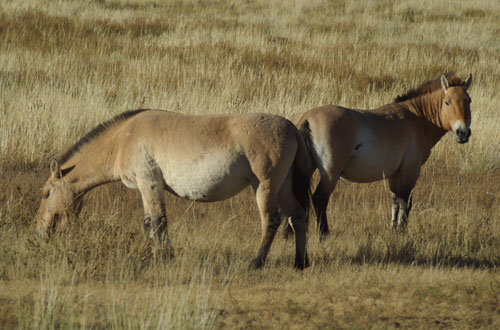
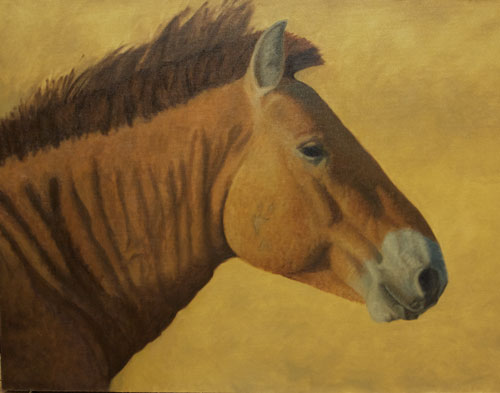
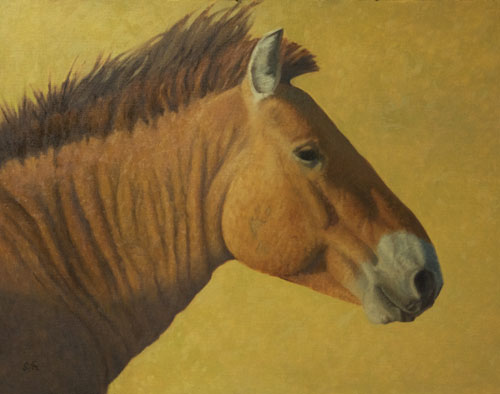
I’m currently working on a large painting that is the most complex one I’ve done yet. I’ll post it when it’s finished. But, in the meantime, I’ve kind of taken a break from it on and off to do something simpler and more straightforward, a head study of a takhi stallion I saw at Hustai National Park in 2006. I had a reference shot that I liked because of the shadow pattern, but as you’ll see there were adjustments that had to be made for it to work as a painting. I hope this step-by-step illustrates how important it is to not, as they told us in art school, get “married to your reference”.
My subject is on the right. A stallion keeping an eye on his mares on a sunny fall day.The reference photo. It's a little out of focus, but, hey, I'm an artist. 🙂When it's a simple subject like a head study, I dive right in with a brush drawing. Notice that I'm looking for basic shapes, not detail.First pass with color, laying in shadow areas.All-over basic color lay-in. Composition, drawing, value pattern set.About mid-way through. The stage is set for the fun part. Head is almost done and it's time to do the neck, ear and mane. I worked those folds for most of yesterday afternoon. They had to read correctly, but not stand out too much. Notice that by this point I've ditched the hard cast shadow because it was too visually distracting. I want viewers to look at his head, not his neck. I worked the boundary of the shadow until I got what I wanted, keeping the edge soft.The horse is done. Now I've started to put in a second color on the background. Not sure where I was going to go with it, but ended up liking it enough that I made it the final color. I liked the complementary color relationship between the reddish horse and the greenish background.Hustai Takhi Stallion 22x28" oil on canvasboard
The travel season is almost upon us. I’ve got my plane tickets for my July departure to Mongolia. For anyone else thinking about or planning to go there, I thought I’d offer one list a week for six weeks, of six “themes” for things to see, with six suggestions. I’ll start with the one that’s probably nearest and dearest to my heart – wildlife viewing destinations. I’ve been to all of them at least once.
Takhi grazing, Hustai National Park
1. For horse-lovers, Hustai National Park is a must if you are going to Mongolia. It is one of three places where tahki (Przewalski’s horse) have been reintroduced and is only about two hours west of Ulaanbaatar, mostly on tarmac road. You may also see marel (a species of elk), Mongolian gazelle, marmots and a variety of birds, such as demoiselle cranes, golden eagles, saker falcon, and black storks. There is a permanent ger camp that is open year around. The main building has a pleasant dining hall. There are three large concrete “gers”. One houses a gift shop, one has displays about the park and another is where presentations about the park are given by staff scientists. You can explore the park by vehicle, on foot or horseback. When I was last there in the fall of 2008, there were 15 harems of over 200 horses.
Reedbeds, Khar Us Nuur National Park
2.Bird-watchers should consider traveling out to western Mongolia to go to Khar Us Nuur (Black Water Lake) National Park. Khar Us Nuur is the second largest freshwater lake (15,800 sq km) in Mongolia . The Khovd river flows into it, creating a large marsh/wetland that is home to the largest remaining reed beds in Central Asia. The lake provides habitat for wild ducks, cormorants, egrets, geese, wood grouse, partridges, the rare relict gull and also the herring gull. May and late August are the best birding times. Another freshwater lake, Khar Nuur (Black Lake), which is connected to Khar Us Nuur via a short river called Chono Kharaikh, hosts the migratory and globally threatened dalamatian pelican. Direct access to the lakeshore is limited due to the reedbeds, but there is open shoreline near the soum center (county seat) on the north shore and an observation tower on the east side. As far as lodging, I can’t make any recommendations since I was rough camping when I was there, but I’m sure there’s something in or near Hovd, the main town. From Ulaanbaatar, flying to Hovd is the only practical way to get there since it’s about a thousand miles west of the capital.
Siberian ibex, Gobi Gurvansaikhan National Park
3. The legendary Gobi is home to Gobi Gurvansaikhan National Park, created partly as a refuge for an endangered population of wild bactrian camels. They are in a remote and inaccessible (except for researchers) part of the park, however. There are also snow leopards and argali, which visitors should not expect to spot. What there is a good chance of seeing are Siberian ibex, pika, two species of gazelle, steppe eagles, golden eagles, lammergier or bearded vultures, black vultures and a variety of smaller birds. I stayed at Nomadic Journeys’ Dungenee eco-ger camp, which is taken down at the end of each season, leaving almost no trace. The kitchen and dining “room” are in connected gers. The setting is terrific, on an upland that has the park’s mountains in one direction and the Gobi stretching out in the other. To get there from Ulaanbaatar one either drives south on the main road, which is an earth road and takes, I think, two days, or flies into Dalanzadgad, which takes about two hours.
View of Steppe Nomads Ger Camp overlooking Kherlen River; the wetland is off to the right with the base of Mt. Baits behind it, Gun-Galuut Nature Reserve
4.A relatively new park, Gun-Galuut Nature Reserve is only a couple of hours east of Ulaanbaatar, mostly on tarmac road. There are two main wildlife attractions here: around 100 argali mountain sheep, which live on Mt. Baits and a wetland area with endangered white-napped cranes, along with a variety of other birds like cinereous vultures, demoiselle cranes, black storks, whooper swans, ducks and terns. The permanent ger camp has a lodge which houses a dining hall and bathroom facilities. There are many activities to choose from besides wildlife watching, including boating, archery, yak cart and horse riding, hiking and homestays with herder families, all of which provide employment for local people. This was the first stop on my Artists for Conservation Flag Expedition in July of 2009.
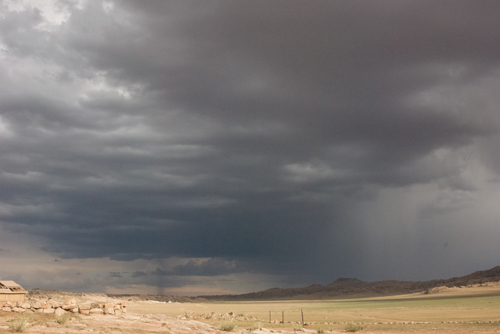
View from my ger, with passing summer rain storm, Baga Gazriin Chuluu Nature Reserve
5. I knew nothing about Baga Gazriin Chuluu Nature Reserve when I arranged to go there as part of my July 2009 Artists for Conservation Flag Expedition other than it had argali. I was only there for two days, but they were two of the most memorable days I’ve had in four trips to Mongolia. The reserve is home to about 60 argali, which are more tolerant of people and vehicles than the ones I’ve seen elsewhere, along with Siberian ibex, cinereous vultures, columbia rock doves and other birds. The rocky uplands cover a smaller area than Ikh Nart (no.6 below), and are easy to get around in on foot or by vehicle. There is a ger camp tucked up against one of the rock formations with an amazing view down the valley. A concrete “ger” serves as the dining hall and has a covered patio area. There is a toilet/shower block, for which the water is heated by solar power. Baga Gazriin Chuluu is about a six hour drive on an earth road southwest of Ulaanbaatar.
Argali ewe with two lambs; one with radio collar, Ikh Nartiin Chuluu Nature Reserve
6. And last, but certainly not least, Ikh Nartiin Chuluu Nature Reserve, my destination when I first went to Mongolia on an Earthwatch project in spring of 2005. Ikh Nart may be the best all-around place to see wildlife in the country. There are argali mountain sheep, Siberian ibex, corsac fox, red fox, tolai hare, cinereous vultures, golden eagles, black kites, kestrels and many other birds. Nomadic Journeys also has an eco-ger camp here, Red Rocks, and offers guided and unguided trips. It is a great place to hike. There are fabulous rock formations, some of which have Tibetan inscriptions carved on them. You will need a GPS since, while there are some dirt tracks, there are no marked trails. This was the third stop on my Artists for Conservation Flag Expedition in July of 2009. Ikh Nart is a seven hour train ride or a five to six hour drive south and slightly east, mostly on tarmac, from Ulaanbaatar.
There are more photos in other posts on this blog. Look under “Mongolia” on the blog roll at the right or do a name search.
If you’re watching the Olympics you know that it sometimes seems more like ads interspersed with some sporting events than the other way around. I’ve also realized that I don’t know how argali sheep are put together as well as I need to, especially the legs, and I’ve got a major takhi painting coming up
Put the two together and I’m getting some good sketching time in. I’ve got all my images from my last two trips to Mongolia on my MacBook Pro, sitting in iPhoto, which happens to have a great enlargement function. I’ve set the laptop on a small folding table (are they still called “tv trays”?) and am using a 9×12″ sketchbook.
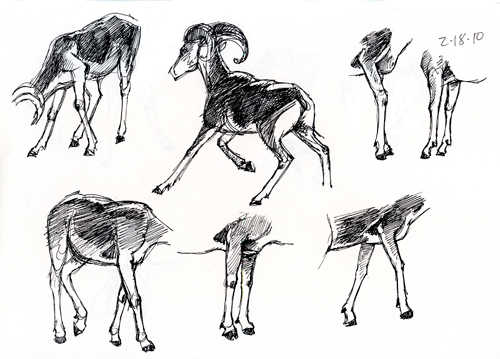
These are drawn with a fine felt tip pen with no preliminary pencil work. I either get it or I don’t. None take more than about five minutes, so there isn’t a lot of time invested. The purpose is to hone in on areas that I don’t understand as well as I should. Purely process, not result. Plus, I keep in mind that photos flatten objects, so I need to compensate for that when drawing three dimensional animals.
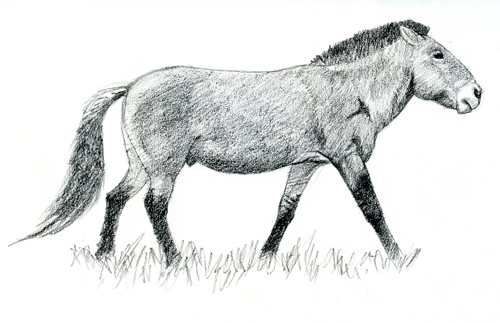
I started with a page of takhi, plus a cow I saw at Hustai.
Then I moved on to argali. One of the challenges is to keep the legs and body in proper proportion since the legs are really skinny and long. There isn’t a lot of muscle definition to play with, like with horses, so one has to nail the overall shape.
I’m struggling with the horns, too. They move back and around in space and I’m suspicious of how the camera might distort them. What I really need is to draw from the live animals. But there are none in zoos that I know of and in the wild you’re lucky to watch them from 600 meters (over 600 yds.)
Ideally, I’d have my Leica Televid spotting scope, which would solve the problem, except that it is entirely impractical to haul it around in the terrain where the argali are, at least for me. So it’s photographs and a pair of domestic ram’s horns that I brought back from England some years ago. I don’t have access to taxidermy mounted argali, but the problems there would whether or not the horns are typical, how good the quality of the mount is and is it a Mongolian argali. Notice that I started on the left with only basic shapes and didn’t worry about modeling or “color”.
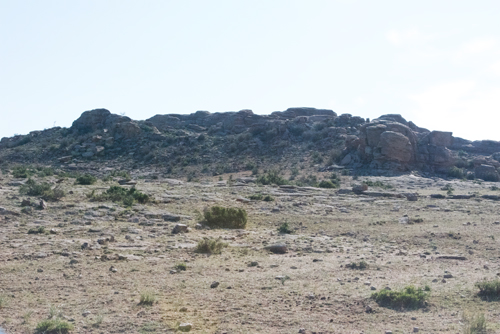
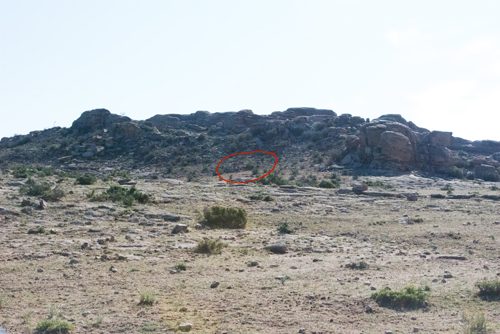
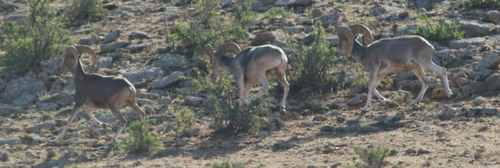
The best images I have of argali so far are a group of six rams at Baga Gazriin Chuluu Nature Reserve. They were considerate enough to have parked themselves in the open within sight of the main road through the reserve in great morning light. I would have been lucky to have spotted them, but the local man living in the reserve who my guide hired to go out with us both mornings that I was there saw them right away. Here’s a long shot from where we stopped. They’re right back against the rocks, in the middle.
I’ve circled them in red.
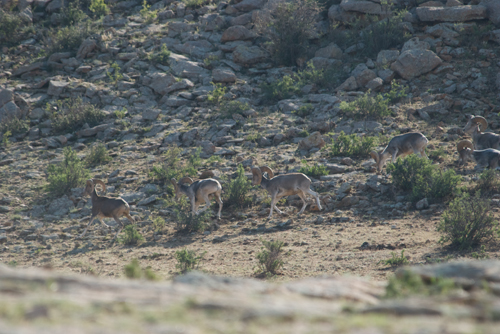
Piece of cake, right? Here’s what I got when I zoomed in with my Nikon Nikkor VR 80-400 lens. These are 10mg files, so they can take quite a bit of enlargement and stay sharp. I’ve got about 84 images total to work with. There’s something useful in all of them. Love these guys.
Here’s a close-up of the three rams in front. A perfect Exhibit A of the subject of a previous post about why you have to get out there and do the fieldwork. There’s no other way to get this kind of reference (Buying it from someone else doesn’t count). Game ranch animals won’t do it either. They’re out of context and, unless you’ve observed the species in the wild, you have no idea whether or not any behavior that you see is “real”.
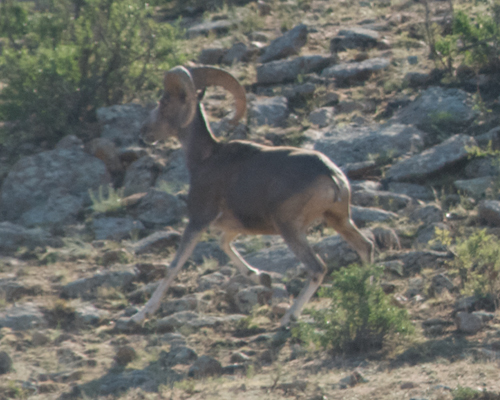
And closer yet of one I drew last night. Everyone was fat and sassy and in great condition. Notice that the younger ram is much browner than the older ones. His behavior was different, too. He was a little more skittish, kept more space between himself and the others than they did between each other and was last in line when they all finally moved up into the rocks.
Great stuff! Action, a terrific pose, rim light. Here’s the page of sketches that include this ram.
Give it a try! It’s a great way to keep training your eye.
I’m in the middle of a rather large painting (no, not the argali one; a subject for another post; short, short version: got stuck, needed to let it sit for awhile), so I thought I would post a few drawings that I’ve done recently and then get back to the easel. It’s juried show painting season, so I’m trying out different reference images to see if I think they’ll make a painting. These were all done with Wolff’s carbon pencils on Canson Universal Recycled Sketch paper, which turns out to be quite a nice combination.
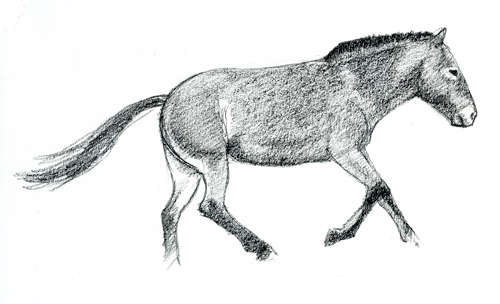
Ibex billy; from Baga Gazriin Chuluu, July 2009Bactrian camel, Arburd Sands, Sept. 2008Bactrian camel, Arburd Sands, Sept. 2009Takhi stallion "Temujin", Hustai National Park, Sept. 2008Takhi mare, Hustai National Park, Sept. 2008Takhi foal, Hustai National Park, Sept. 2008
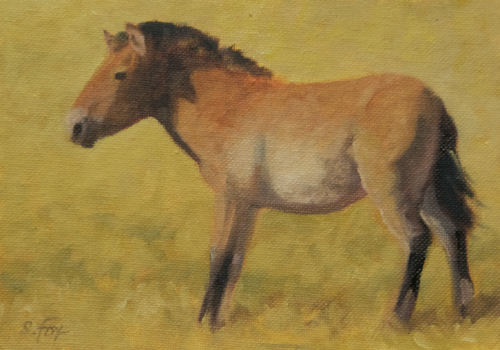
“Takhi Yearling” is a painting of a takhi that I saw at Hustai National Park in Mongolia in Sept. 2006. Takhi are the only surviving species of true wild horse. It’s a thrill and a privilege to see them in their native habitat. I’ve now visited two of the three places in Mongolia where they have been reintroduced after going extinct in the wild in the late 1960s. Click to bid here
I thought I’d get a two-fer this week and combine my eBay listing with Mongolia Monday since the painting up for auction is a 8×6″ oil of a takhi (Przewalski’s horse). It’s from a photo that I took at Khomiin Tal, the westernmost of the three takhi reintroduction sites in Mongolia. I visited there in September of 2006. What an adventure that was for me! I flew out to Hovd, met my guide and then went by Russian Fergon van (those of you who have been to Mongolia know what that means…) east over 100 miles on what the Mongols call “earth roads” to the river valley where the horses were. I got to see them in late afternoon and morning light and got a lot of good reference. Here’s a photo of some of the horses grazing-
Takhi grazing at Khomiin Tal, western Mongolia
And here the painting that is currently available at auction here
Here are four more new paintings to go with the two I posted last week. I had a problem with the background in the last one and thought I’d show how it was and how I changed it.
Heading Down For Breakfast 8x10" oil on canvasboard (price on request)
Here is one of the takhi (Przewalski’s horse) that I saw when I was at the Khomiin Tal reintroduction site in western Mongolia in September of 2006. It was first light a group of horses were coming down out of the hills to graze.
Mongol Horse #4; Afternoon Graze 9x12" oil on canvasboard (price on request)
This was a harem stallion that I saw at Ikh Nartiin Chuluu last fall. He was also the model for Mongol Horse #2. It amazes me that, given the extreme environment that they are exposed to year in and year out, that these tough small horses grow such long manes and tails. But they do.
Top O' The Morning 10x8" oil on canvasboard (price on request)
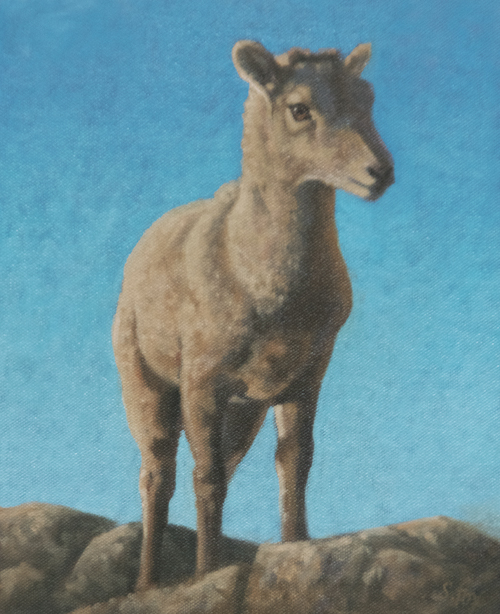
I saw this Rocky Mountain bighorn lamb with his mother near Tower Campground in Yellowstone National Park a couple of years ago. They were by the side of the road, which lacked interest as a setting, to say the least. So I moved him.
Catching the Morning Light 9x12" oil on canvasboard (price on request)
This argali ram, along with five others, gave me an eyeful on my first morning at Baga Gazriin Chuluu Nature Reserve in Mongolia in July. I wanted to work on capturing the quality of light without worrying about painting too many animals, so decided to start with a small painting. I had one idea for the rocks as you’ll see below but, on further review, something wasn’t working. Time to get out the scraper. What do you think was wrong? Answer below the second image.
First versionDetail of scraped out area
There were a couple of problems. One, in getting into the grooviness of painting the rocks, I completely lost track of my light source. The rocks are in full light, but are on the same plane as the ram. Buzzz. Second, I tried to use what I knew to design the rocks more or less from memory, which resulted in a boring, distracting (what an awful combination!) set of shapes. I went back to the rocks that were in the original photos and saw that they were much less rounded, which provided a needed contrast with the curves of the ram.
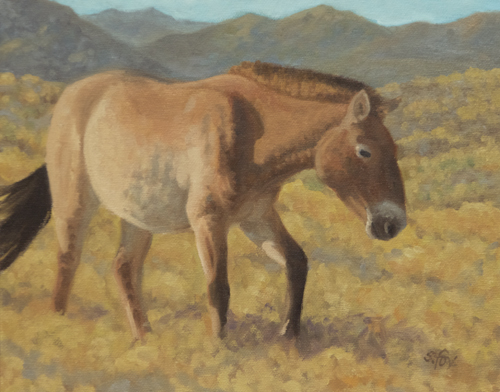
Takhi Mare, Hustai National Park, Mongolia 8x10 oil on canvasboard
I’m running a little behind, so I’ll cover the art stuff that’s going to Mongolia with me next week. In the meantime, I think I’ve solved the hot-water-in-the-ger-problem with a nifty little “stove” that uses solid fuel cubes and is specifically ok for use in tents. More later once it gets here.
I thought that I would share a few images of the creation of this study.
Initial drawing and shadow shapesAdding the medium tones and basic huesPutting in a background toneModeling the form and refining the drawingCorrecting the shapes and working on the backgroundAnd...the finished study!
As usual, there was a cat working hard, right near by:


















 Susan Fox, American Artist