Mongolia gets very little rain and most of what does fall comes in the summer. After the brutal winter zud (a drought year followed by an extremely cold winter with heavy snowfall) that hammered the country these past months, a year of good rainfall would be a blessing, indeed.
Being a herding culture, the Mongols have always depended on rain to grow the grass they need for their animals. The rainy season is short, so I suspect that as wonderful as a Mongolian summer is, it’s also a time for some anxiety.
In 2008, rain came late, at the end of August. My husband and I were at Ikh Nartiin Chuluu Nature Reserve. We arrived on a beautiful evening. It started to rain at around 3am and didn’t stop for 18 hours (we counted). But we had perfect weather for the rest of the trip.
In 2009, on my Artists for Conservation Flag Expedition, it was definitely the rainy season, even though there wasn’t enough to break the drought.
Here’s a few of my favorite “boroo” photos. (Note: “Boroo” is pronounced more like “baurau”, with a rolled “r”.)
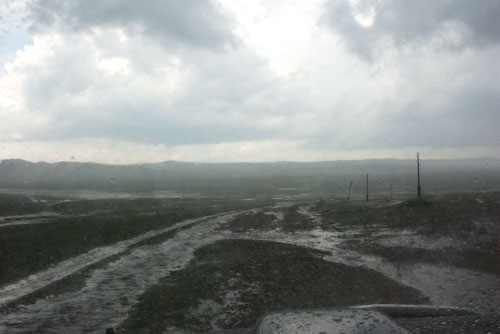
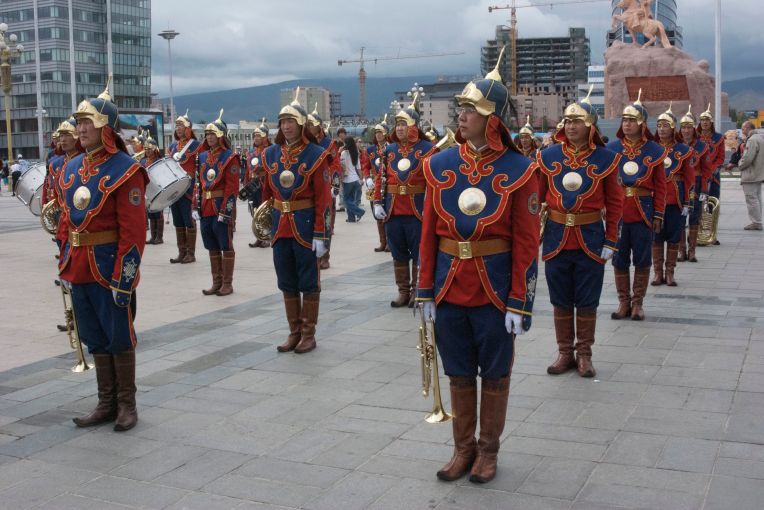
Naadam opening ceremonies, July 2009; the colorful show goes on for everyone, including the Mongolian State National Grand OrchestraHeavy rain/hail en route from Ulaanbaatar to Arburd Sands ger camp, July 2009One of the hailstones; roof of vehicle was dentedOn-coming rainstorm at Ikh Nartiin Chuluu Nature Reserve, July 2009; it rained hard for an hour and a half so I just stayed in the cozy ger; the white rectangle in the background is one of the toilet enclosures. Yes, it was a bit of a walk.
Rain has, so to speak, seeped into the culture to the point where it’s a leitmotif in many of the music videos I’ve watched and clearly has romantic connotations. Sometimes it seems like there has been an informal competition between groups and singers to see who can work the most rain into their video.
Here is one from Javhlan. Imagine this singer with an absolutely glorious voice, standing in the woods singing as the crew poured “rain” onto him. I’ll bet he only needed one take.
And, taking it even further, is A Capella’s “Boroo”. Hope it was a warm evening.
Finally, instead of a set-piece like the previous two, Guys 666, who normally seem to be hard rappers, did this video, also called “Boroo”, that tells a story, albeit not an entirely happy one.
Sort of an odds and ends Friday as the year winds down. The deep freeze is over here in coastal Humboldt County and it’s back to nice normal rainy weather with nighttime lows in the 40s. I’ve been getting in some good easel time of the past few weeks. Here’s a new argali painting from reference that I shot in July at Gun-Galuut Nature Reserve. I watched this group of rams work their way across the rocky slope for almost an hour. “Uul” is Mongolian for “mountain”.
On The Slopes of Baits Uul, Gun-Galuut 18x24" oil on canvasboard (price on request)
I’ve also decided that I want to paint not just the domestic Mongol horses, but the people who ride them. Which brings me back to wrestling with human figures, as described in an earlier post. I get a better result if I can scan the drawings rather than photograph them and also wanted to really hone in on accuracy, so these are smaller and done with a Sanford Draughting pencil, but on the same vellum bristol (which erases very nicely). The heads ended up being only 3/4″ high, which is pretty small, but it reminded me of a story from art school that I thought I might pass along.
One of my teachers was Randy Berrett, a very good illustrator who chose to work in oils. This was kind of masochistic, in a way, because it added a layer of complexity when he had to ship out a wet painting to meet a deadline. In any case, he was showing some examples of his work in class and one was a really large painting of the signers of the either the Declaration of Independence or the Constitution, I can’t remember which. Someone asked why he painted it so large. Randy’s answer really struck me at the time and has stayed with me. It’s something worth remembering when planning a painting. He said that he wanted the heads to be at least an inch high and that requirement controlled the final size of the painting. I’ve sized more than one painting on the basis of that criteria since then.
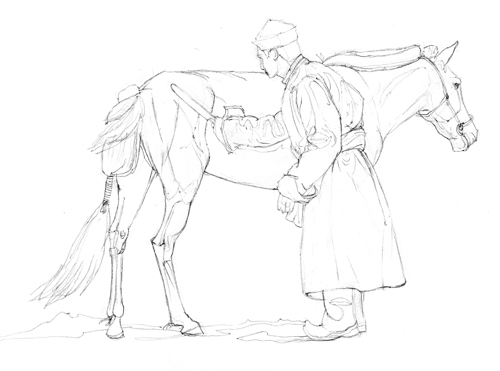
The first drawing combined two pieces of reference. One of the horse and one of the man. In the latter, he was in front of the horse’s head. In the former, I didn’t like the pose of the horse. Moving the man back works much better. The sweat from a winning horse is considered to be good luck. There are special scrapers made to remove it.
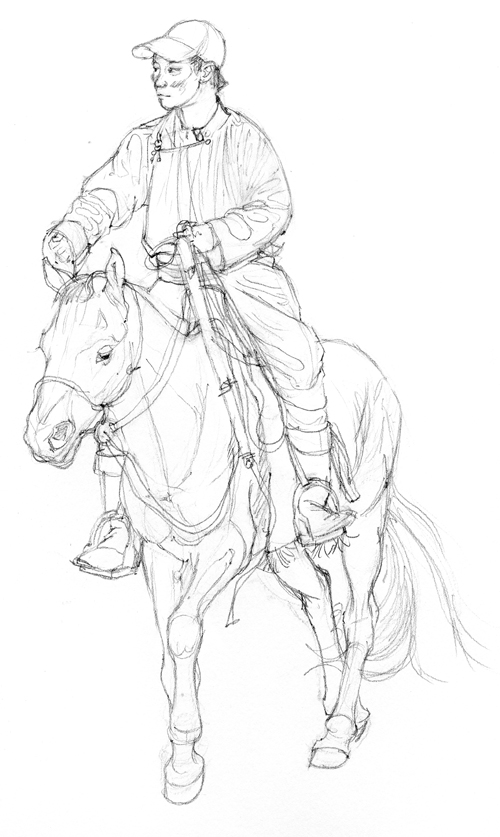
Scraping the sweat after the race, Baga Gazriin ChuluuLocal herder, Erdene NaadamBoy on horse, Erdene Naadam
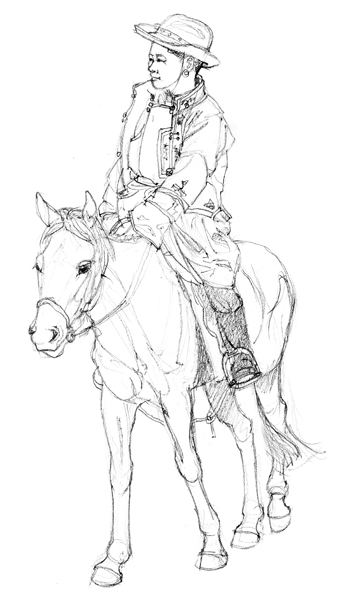
Part of the reason I did the previous two was to see if the images “drew well” and to work on horses coming forward at a 3/4 angle. The final two are head studies, in which the heads are 1 1/2″ from forehead to chin.
Local herder, Erdene Naadam
Finally, the folks at Eureka Books in Old Town, Eureka have decided to hold a special art show. Here’s the Call for Entries.
I started to write a reply to the (partially quoted) comment below and realized that the topic was worthy of its own post since, as you will see, I have strong opinions about the subject (Who, me?).
“I found your process very interesting…especially because I tend to ‘jump right in ass-first’ and not do any studies to figure out composition etc. I have no idea why I hate doing that…perhaps I am just impatient to get to the fun. of course this does cause problems!!…..Does Photoshop help you a lot in planning paintings? I have never once used it, I must admit…..You can re-position items in your photo using Photoshop? Man, Maybe I need to get a Photoshop For Dummies book!”
My response, which is intended to address the general issue, and not in any way the individual commenter who I quote above, is as follows:
I never use Photoshop for planning paintings in the way you describe. IMHO, it’s a pernicious trend that’s been used by way too many artists as an excuse to avoid the hard work of actually learning to DRAW.
It’s also very obvious a lot of the time when that’s how a picture has been put together. It looks like a bunch of bits with no cohesion. Animals that look pasted onto the background. Animals the wrong scale. Animals in a position that is impossible given the perspective of the setting. Light sources that don’t match. Uncorrected distortion from shooting the subject with a wide angle lens in which you end up with a back end view of something like an elk with a tiny butt that has an overly large head sticking out of it. Slavish adherence to the reference. Lack of variety of edges,with every edge same from front to back. No emotional punch or a point of view that’s unique. No exercise of the craft of painting. Just tedious rendering of Every Single Thing In The Photograph.
I’ve been in workshops watching artists beaver away at moving an animal around in a landscape on their computer and then transferring it directly to their canvas. Kind of pathetic, really. There’s a power and a mastery that comes from entering your subject directly into your brain by drawing it over and over. It’s how you learn what something looks like. Photoshopping short-circuits that. Look at who the top wildlife artists are and have been. They can all draw like crazy. Some stay with highly detailed work, like Carl Brenders, or push the limit of looseness, like Julie Chapman, but being able to draw lets them make the choice.
Copying a Photoshopped composition without having solid drawing skills cheats the artist out of all that is most important in the creative process, i.e. the creativity.
A painting is really just a series of judgments and choices. The better an artist gets at those, the better the paintings. Photoshopping images into a montage short-circuits this part of the painting process, too.
I realize that the struggle is a drag, but there isn’t any easy way to do good work that I’m aware of. The best work comes out of the struggle. I long ago lost count of the times I hit the wall on a painting, slid down to the floor, picked myself up and soldiered on until I broke through. It doesn’t happen as often now, but I know it could happen at any time.
What I do is go through a lot of paper. What you see in my posts are just a small sample. Since one of the reasons I’m an artist to begin with is that I always loved to draw from the time I was a little kid, it would defeat a main purpose of the exercise for me to eliminate that step. I also use a mirror to check my drawing for accuracy. It’s almost magical how errors jump out at you. Can’t use Photoshopped photographs for that.
I’ll just flatly say it- If you want to be any good, much less excel, as a painter of animals (or any other representational subject, for that matter), learn to draw. And draw live animals whenever possible. Period. No excuses.
Mongolia Photo of the Week
Start of national Naadam ceremony at Sukhbaatar Square, Ulaanbaatar; The band
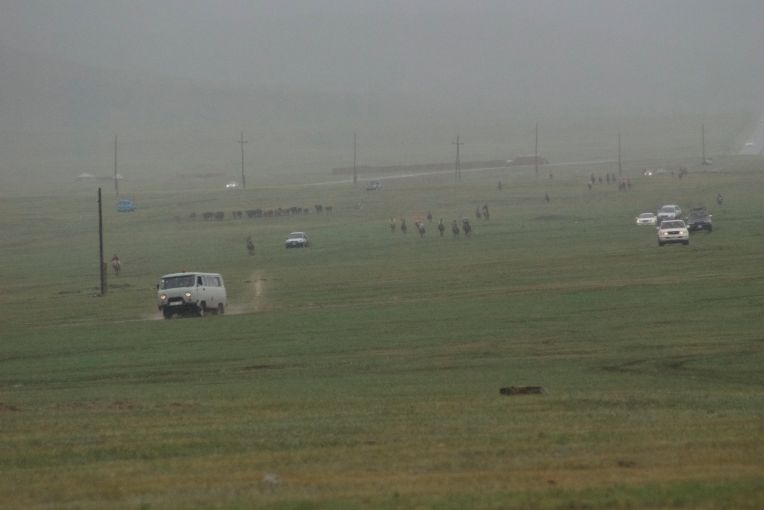
The day was cloudy and cool, really rather nice. It could have been 90F in the shade. We left for the horse race site and spent two hours in traffic that was almost indescribable. A cross between Mr. Toad’s Wild Ride, bumper cars without anyone actually making contact and a free-for-all race to get to the valley. Over here we would describe it as “a solid line of cars”, but the word “line” doesn’t remotely apply. The road had been blocked so that both lanes ran in one direction, but people were on the shoulder and off on parallel dirt tracks, all weaving in and out to gain advantage. It was kind of like….a wacked-out horse race.
Our guide, Osoo, estimated that around one third of the population (2.7 million) of the country was present at the race. There were literally thousands of cars on a two lane road all trying to get to the same place.
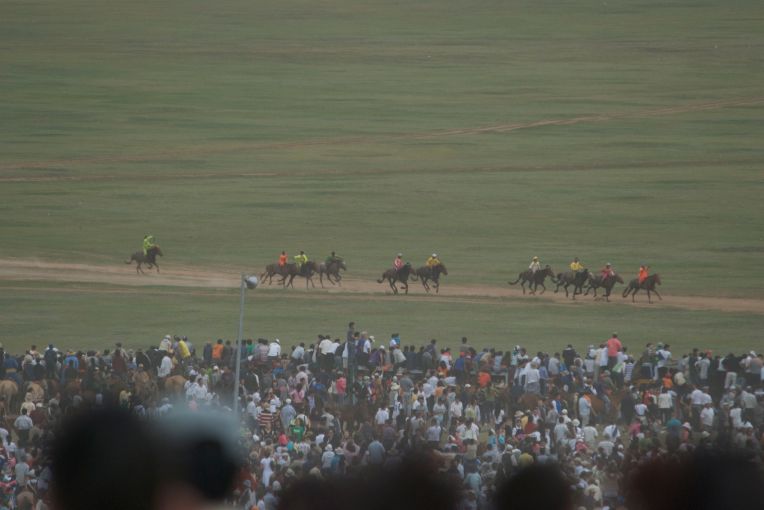
We arrived and some of us took up station on the top of the hill. Others braved the packed flat area adjacent to the track. With the long lens, I got some pretty good pictures. It was a festive day and the vibe was great. It was like a convival country fair with about 900,000 fairgoers spread out over a large valley.
This was the second to the last race. It was for five year stallions, 25 km. The jockeys ranged in age from 5-12. The horses had already trotted or cantered the 25km to the starting line before the race and then they galloped the whole 25km back to the finish line. There were a lot of support vehicles, including an ambulance. There were also vets ready if needed.
Without further ado:
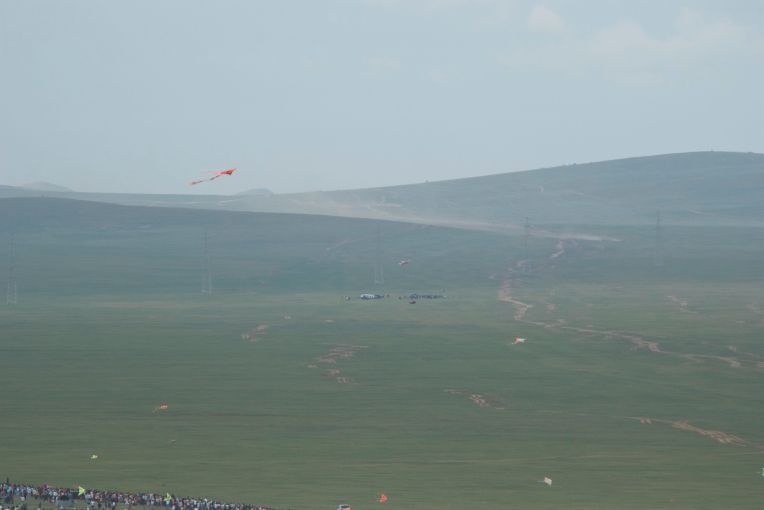
Crazy trafficHorse race crowdThe dust cloud shows the horses almost to the valleyThe lead horses approach the finishRunning for the finishOrange passes white and red near the finish lineSecond large group coming in
We never found out who won, but it was an exciting finish and the crowd was roaring. The fastest horses finished in 30-40 minutes, the slowest took about an hour.
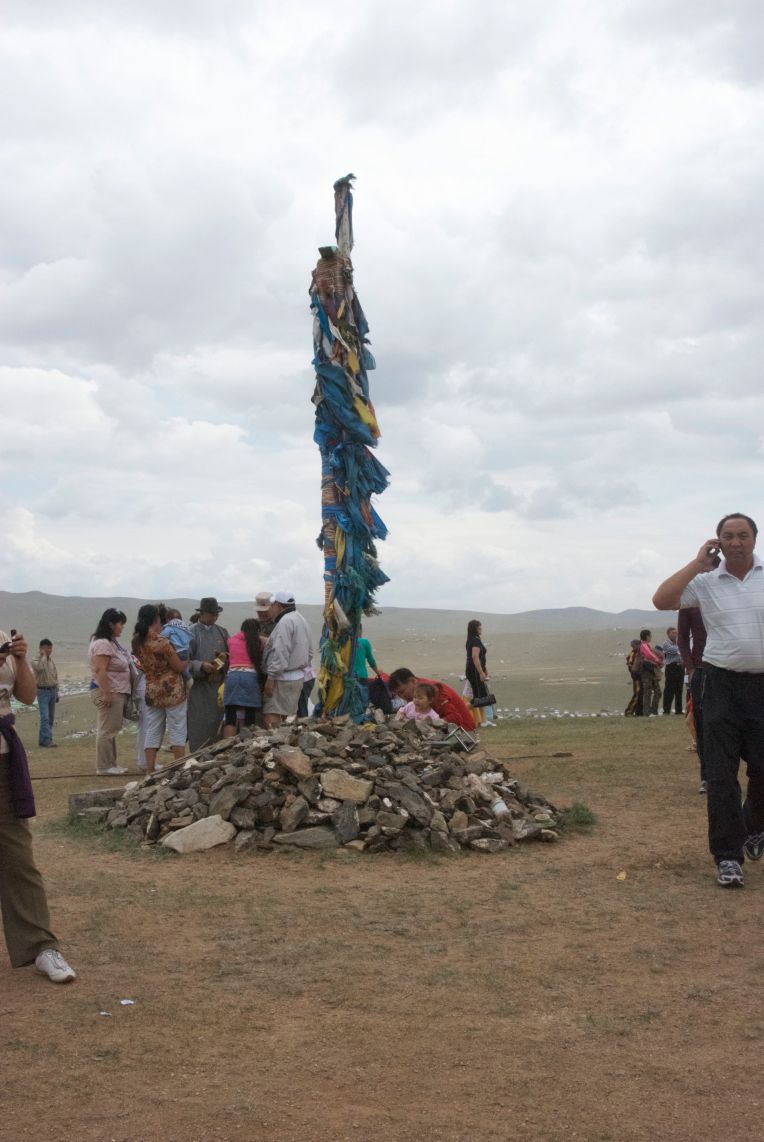
Horse race crowd with racers gers in backgroundOvoo; on highest point; a old animistic custom
Time to go back. Traffic not quite as frantic, but still pretty wild. Lots of herders with their animals along side the road.
Sheep and dust
We had picnic lunch in the van and then went back to the stadium. Unfortunately, the archery and ankebone competitions were over. But a couple of the archers were still at the archery field, including the winner.
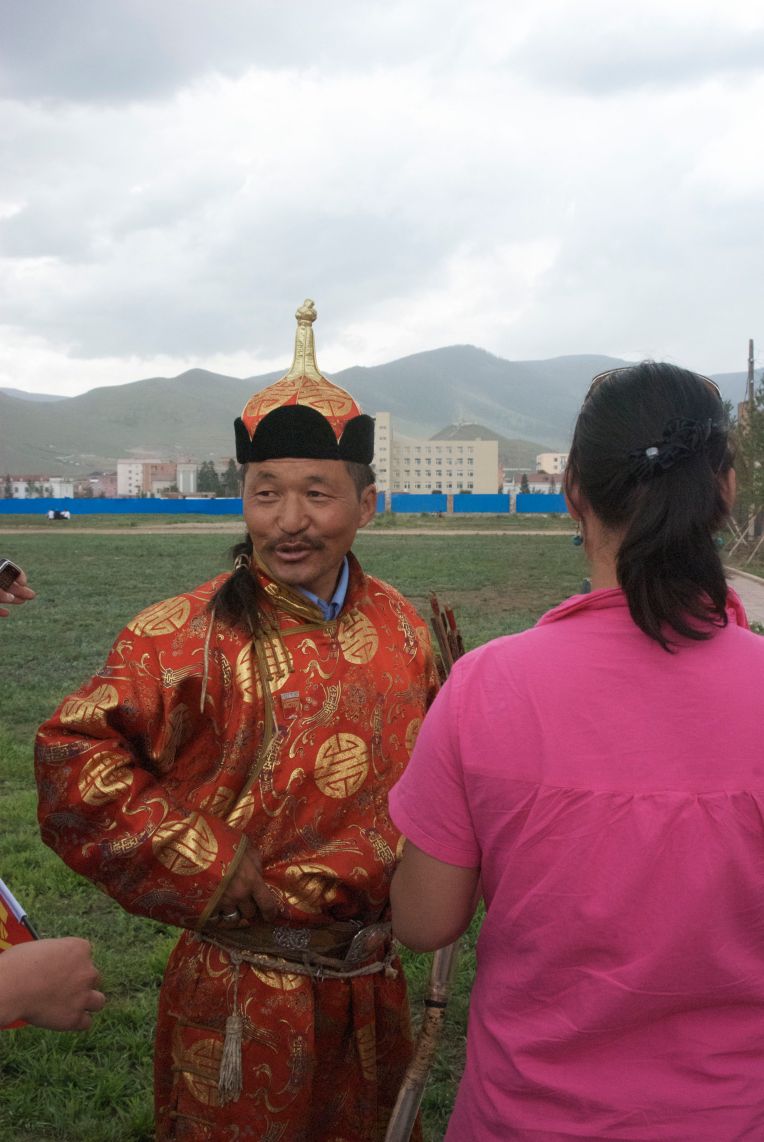
Winning archer, his wife and a fan
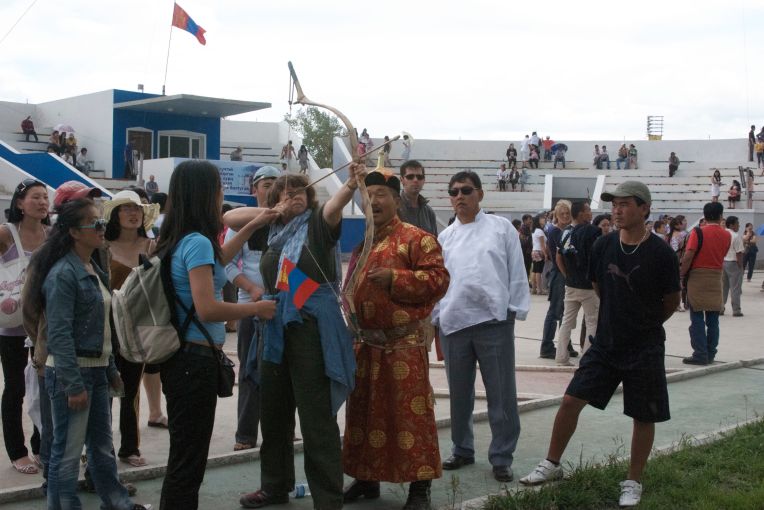
Another archer was giving a demonstration and, for 1000 tugrik, about 80 cents, you could shoot an arrow. Couldn’t resist the chance to try that, of course.
Archer doing demonstrationI got to shoot the bow and arrow; about 40lb. pull
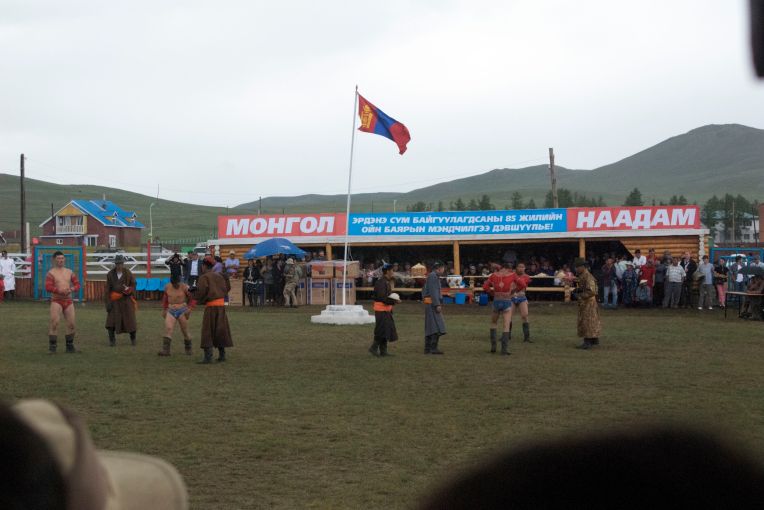
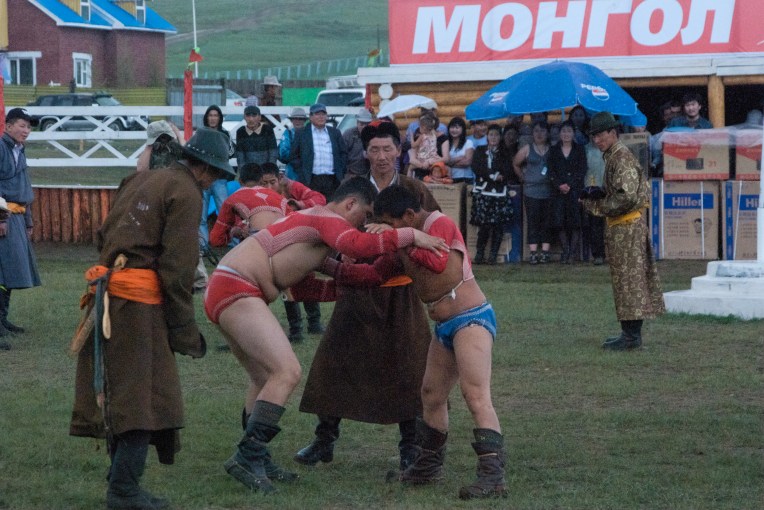
Then it was back to the wrestling in the national stadium. It was packed and then it started to rain. Hard. For over an hour. So there were rain delays and still eight wrestlers competing when we had to go.
Wrestling; the average height of a Mongolian may be 5'2", but there are plenty of big guys, tooWrestlingWrestling
On our way out, we passed someone who was allowing people to pose on his horse for pictures.
They really do start them young in Mongolia
It was back to the hotel to rest for an hour or so, then dinner at …..BD’s Mongolian BBQ, which suited me just fine. Then off to the Naadam concert, performed by the Mongolian State Grand National Orchestra. And grand it was. They are definitely ready for their first world tour. There are 65 members, playing mostly Mongolian instruments like the morin khur, or horse-headed fiddle, but also some western instruments like trumpets. Almost all the music was by Mongolian composers, but they also did an enthusiastic version of “The Barber of Seville” and, for the encore…..”We Are The Champions” by Queen!
Off to Gun Galuut. Need to pack and get breakfast. Next post will be the 21st or 22nd. Bayartai!
Breakfast at 7:30am. Everyone met in the lobby at 8:30 and then it was off to Sukhbaatar Square for the beginning of the day’s Naadam activities.
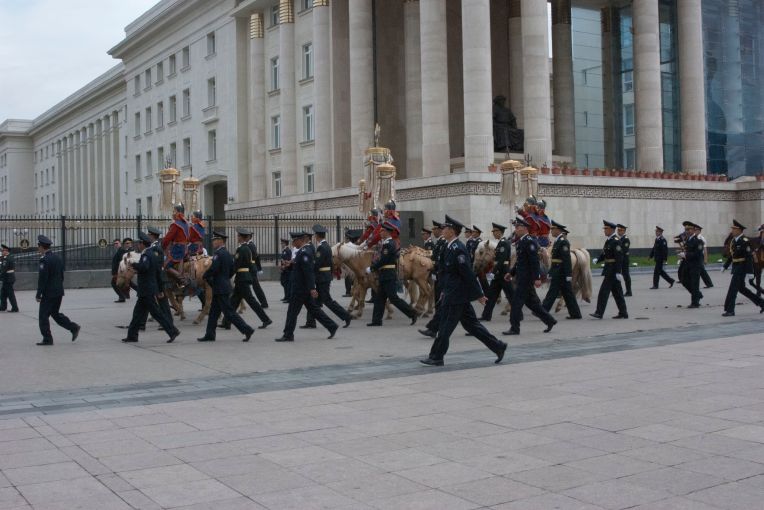
Costumed horsemen escorted the horse tail banners around the Parliament building and then on to the National Stadium, as did we.
Got there early enough to pick and choose our seats.
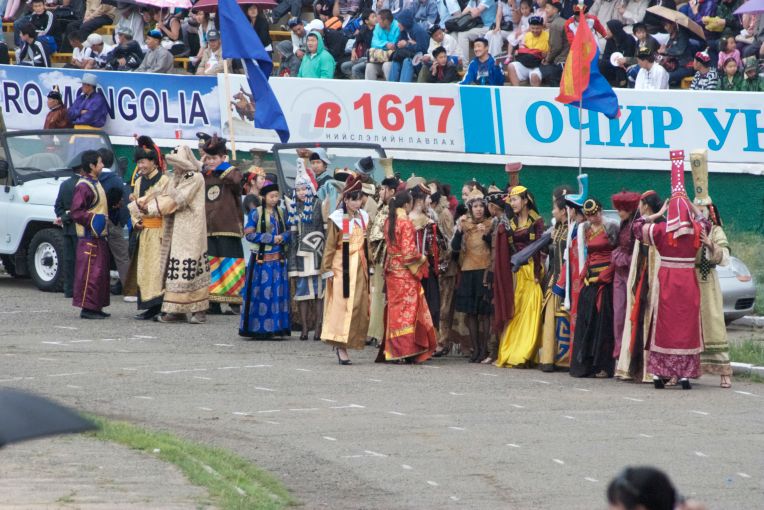
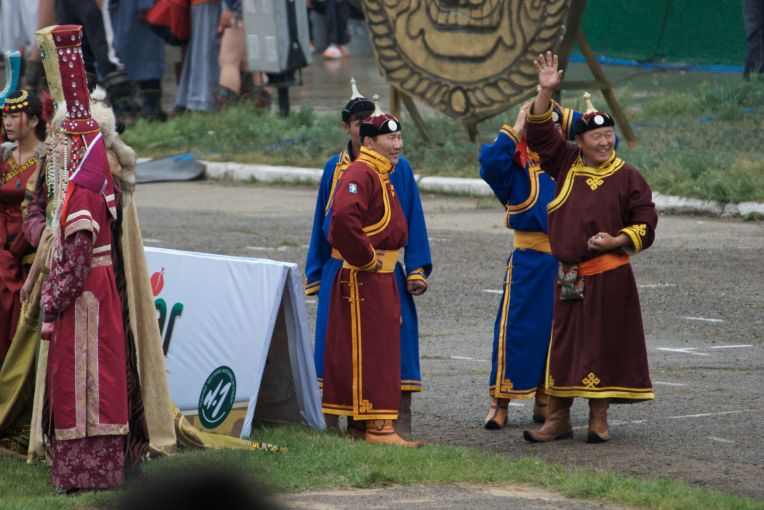
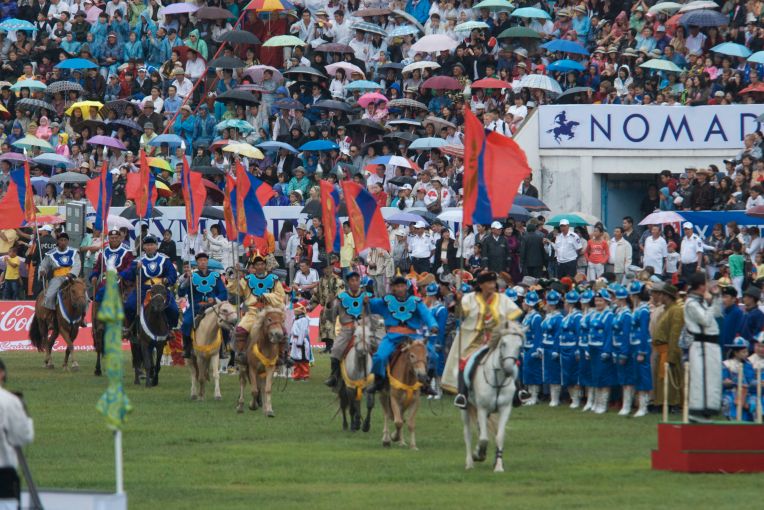
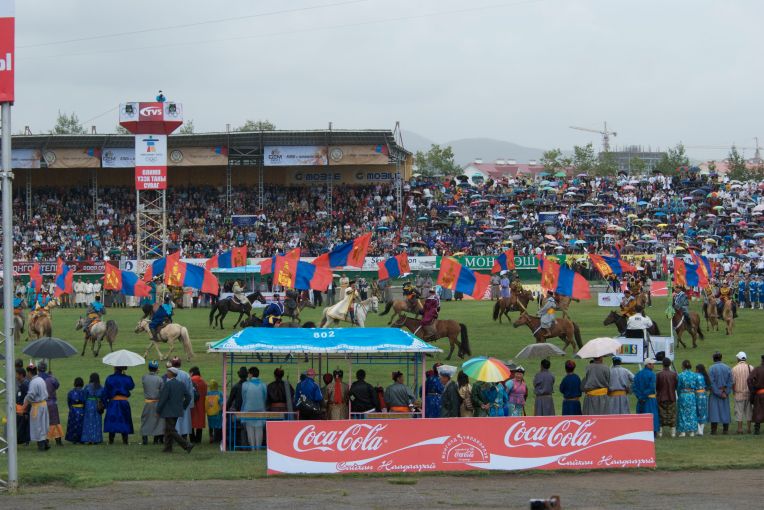
Opening ceremonies got underway at 11am. The whole stadium was a riot of color, both because of the costumes of the participants and also the umbrellas of the spectators since it decided to rain for a short while.
The horsemen came in with the horse tail banners and placed them in a stand. The President of Mongolia gave a short address. Then there were displays of horsemanship, children doing a ribbon dance and wonderful music by the orchestra.
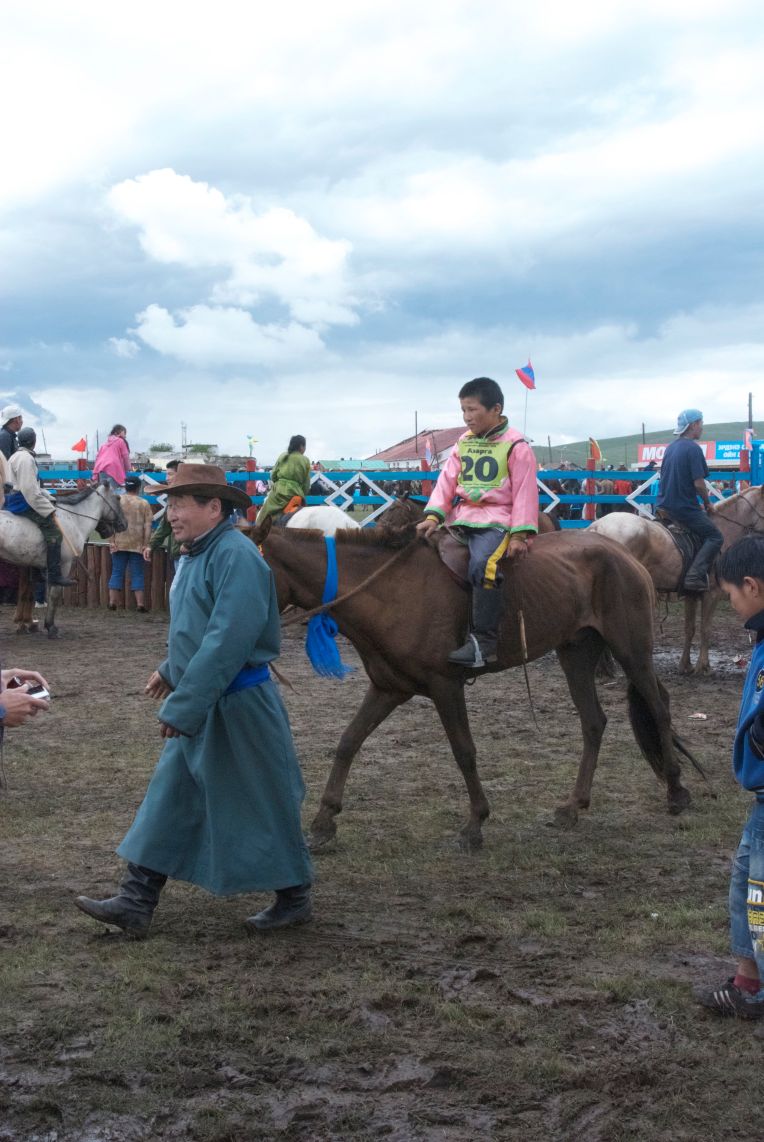
When it was over we piled back into our bright yellow Nomadic Journeys van and drove about 90 minutes east to experience a local Naadam. It was raining pretty good when we got there, but stopped just as the horses came into view. We had gotten there in time to see the end of the horse race. Had some airag and watched the wrestling finals. Took many photos of horses and their riders. The jockeys are boys and girls under ten. The horses in this race were two year olds. Prizes go the the first five to finish and the last.
We went to a ger in the village and were treated to airag, vodka, aruul, cheese and khuusuur, fried mutton turnovers.
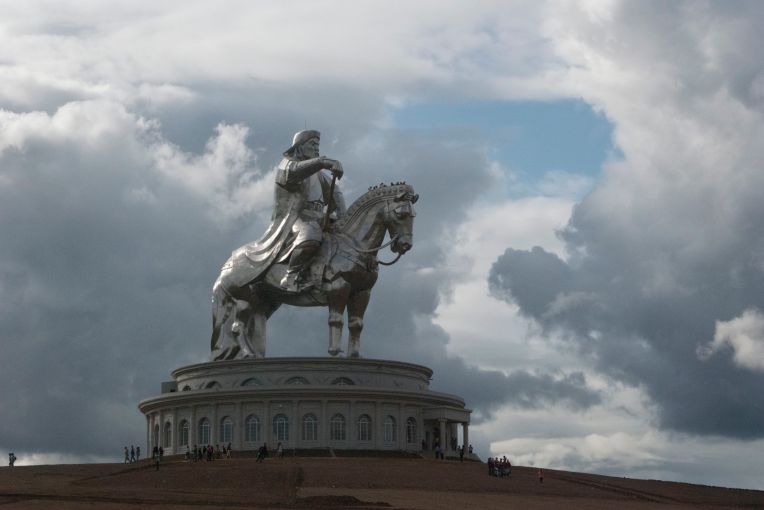
Stopped at the new giant statue of Chinggis Khan on the way back.
Got back to the hotel at ten till eight. A long, but interesting and worthwhile day.
And here are pictures of it all:
Note- due to time limitations, these are as I took them, no cropping or adjustments except for a couple which were on the dark side.
First, the national Naadam-
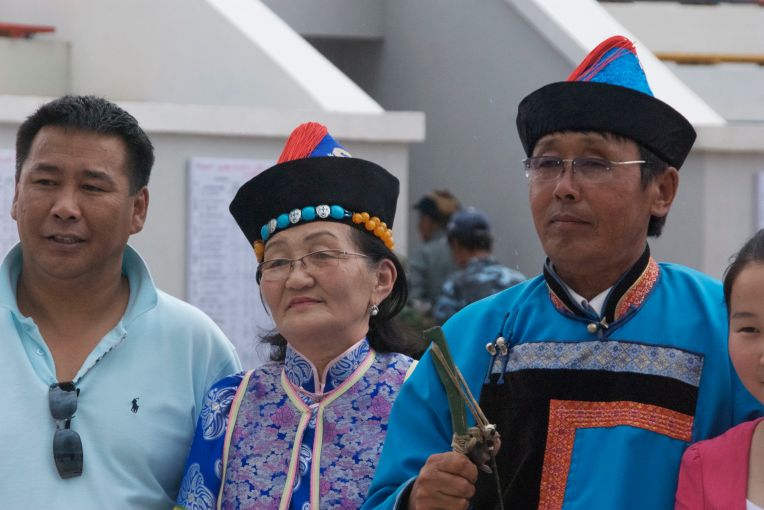
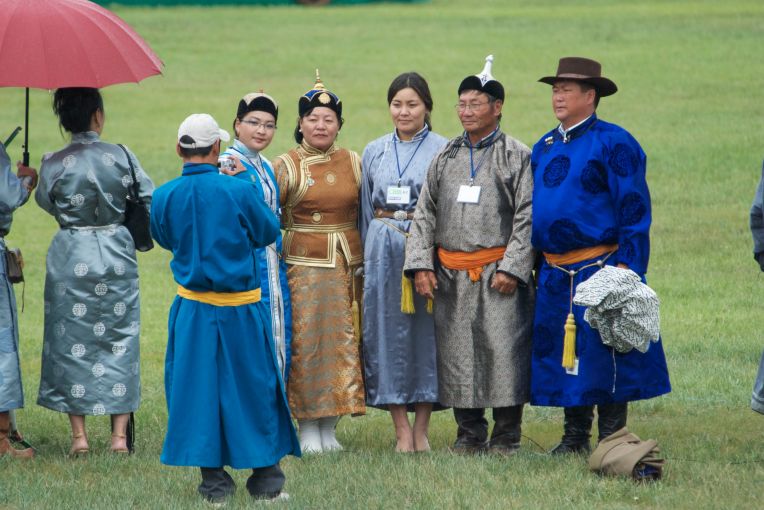
Horse tail standards being brought out of Parliament buildingHorse tail standards proceeding around Suhkbaatar SquareTwo ladies wearing del at Suhkbaatar SquareNational Stadium before the crowds arriveHorse tail standards entering stadiumFabulous costumesNaadam officialsOrchestra and conductorPresident of Mongolia addresses crowd; had to take photo through a supportListening to the PresidentRibbon danceHorsemanshipProcession of Mongolian national flagsDisplay of Mongolian flagsMaking Naadam memoriesBalloons for sale outside National StadiumMongol man kneeling outside of National Stadium
Then it was on to the 90 minute drive to the local Naadam-
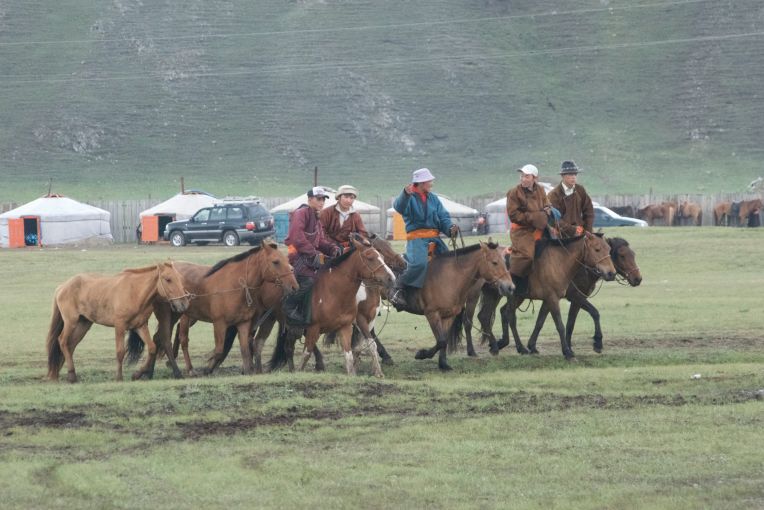
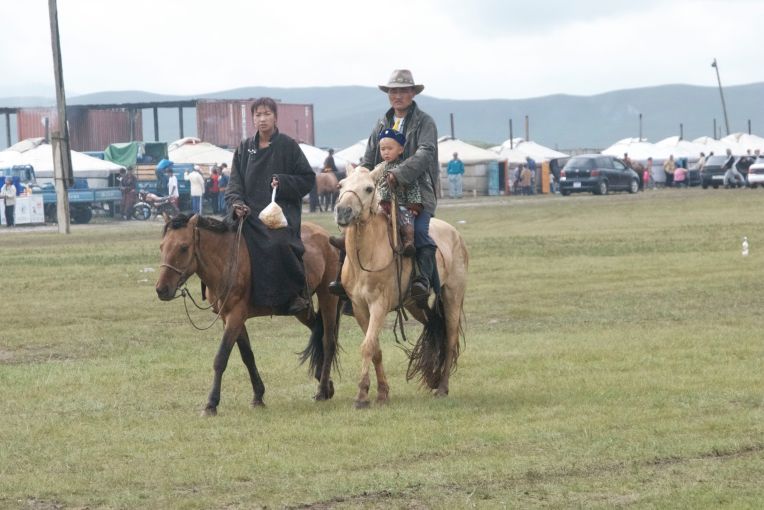
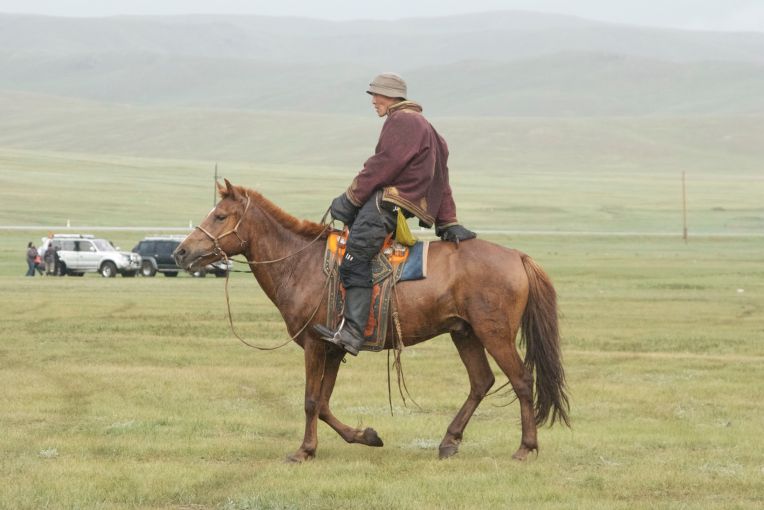
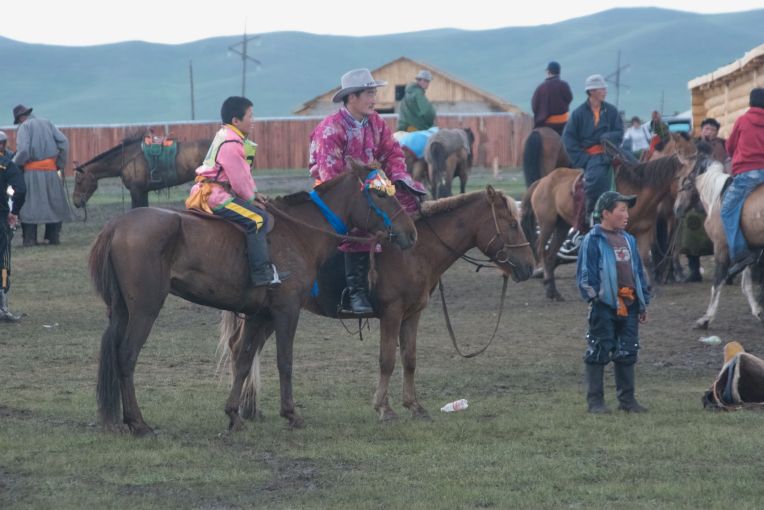
Racers coming in; rain stopped shortly after I took this pictureAlmost to the finishGirls race right along with the boysA group coming to the finishHeading for the finish, but then it was time for wrestling....Local Naadam stadium with wrestlingMongol wrestlingEagle dance after wrestlingGroup of riders; took a lot of horse and rider pics while waiting for race resultsLocal familyLocal riderWaiting for the horse race results; then the winners started to appearA race winnerJockey won a rug for momOne of the racersThe winner of the raceLocal Naadam horses going homeTour group in ger for "snacks"Mongol snacks: mutton with fat; aruul stacked on bread
We stopped at this incredible statue on the way back to Ulaanbaatar-
Giant Chinggis Khan statue facing towards his birthplace to the eastChinggis statue detailChinggis' view





























 Susan Fox, American Artist