Back from the Marin Art Festival

Although sales weren’t what I’d hoped for, things were about as I’d expected given gas prices, the real estate implosion and the upcoming election. Made back gas and food money. I sold a lot of cards and a small original. But I got a lot more out of this event than sales. My fellow neighbor artists were equally talented and welcoming. And I feel like I laid a good groundwork for next year.

The people who came by my booth in a steady stream both days were interested and interesting, as one might expect in Marin County. There was the petite older woman who, it turns out, is an doctor of internal medicine who got her medical degree from Stanford in the 1940’s. Her father supported her, but her mother didn’t, saying that she would never go to a female doctor. Oh, well, with luck we’ve largely moved on from that sort of thing.

As always, got some great stories about other people’s world travels to places like Botswana and inner travels by a woman who does shaman work. Did I say I was in Marin County?

Many people were interested in my paintings of the takhi and most of them have seen the movie “The Story of the Weeping Camel”.

Out of around 300 artists at the festival, I was just around the corner from Jeff Morales (www.jmceramics.com), a fantastic ceramic artist who lives less than 15 minutes from me on the south end of McKinleyville. Small world #253.

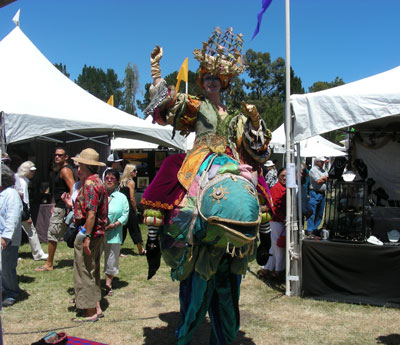
One of the great things about the festival were the stilt walkers in absolutely amazing costumes. They really took the event to another level and drew a crowd wherever they went. Here’s two of them:

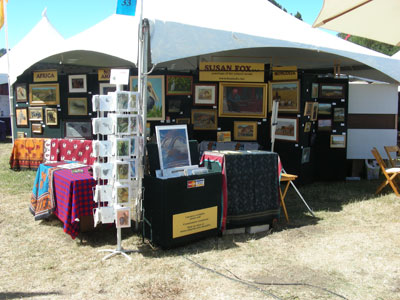
And, of course, being a wildlife artist, the universe conspired to allow me to do a little fieldwork in the comfort of my booth. Here’s the booth:

And here’s the little pocket gopher who came up for breakfast around 9am right next to the base of my easel in the middle of my space. Wildlife watching doesn’t get any easier.

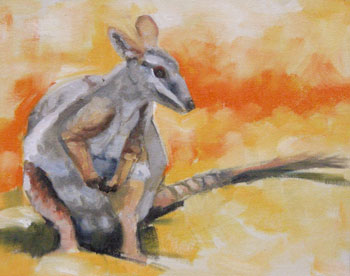
I had fun doing painting demos during the weekend. Here’s the one I did on Saturday in about two hours, counting interruptions. It’s a kangaroo I saw in a zoo. Don’t know the species:

And this is the one I did on Sunday, on and off for most of the day. Considering the working conditions, I’m pretty darned please. It’s the best cape buffalo I’ve done yet. And I’m keeping him.

Award at Palos Verdes Art Center Show!

I just found out that “Takhi Stallion and Mare” as seen at the top of my masthead, has been awarded third place in the show “The Spirit of the Horse”, which is currently on view at the Palos Verdes Art Center in southern California. My newest takhi painting “That’s The Spot!” was also accepted into the show. You can see it by scrolling down a few entries.

This is my second award. Last year, I won a Juror’s Choice Award from the California Art Club for “Made In The Shade”, soon (as of tomorrow) to be available as a limited edition giclee.

And here’s a favorite takhi photo from Khomiin Tal. Plans are starting to gel for the September trip. David and I leave on August 24. I’ll start a countdown on August 1st. I’m hoping to blog from Mongolia.

The Party’s Over (for this year, at least)

What a great two days I’ve had here at the OPA event. Everyone made this first-timer feel very welcome. I met so many artists who not only do great work, but are terrific people too.

One of the nicest things about the morning demos, besides seeing “how it’s done” was that we, the artists, mostly had the whole gallery to ourselves. It was so packed last night that it was hard to really appreciate a lot of the work. This morning we could all wander around to our heart’s content inspecting paintings, talking shop and watching the other artists work.

This afternoon I attended` back-to-back sessions presented by Alyson Stanfield who runs artBizcoach.com. She’s written a book called “I’d Rather Be In the Studio: The Artist’s No-Excuse Guide to Self-Promotion”. The morning session was “Getting Comfortable Promoting Your Art” and the afternoon was “How to Use Email, Websites and Blogs to Amplify Your Online Presence.” I’ll review the book after I read it (it only seems fair), but I can safely say that her presentations were packed with useful information.

For any other artists reading this blog who want to make a living making art, let’s face it, we’ve got to deal with the marketing part. Alyson takes the intimidation factor out of it and makes a very convincing case that not only should we being doing proper self-promotion, but that we absolutely can do it effectively and still get in our easel time.

Tomorrow I’ll get to spend time with the Mongolian scientist I met on the Earthwatch project I did there. We have kept in touch, but haven’t seen each other since then. I’m hoping to learn more about conservation work in Mongolia and how my art can support that, along with just getting to learn more about a country that I’ve come to like very much.

The Elk, part two

ANIMAL STUFF

Went over to the shelter for my usual Wednesday afternoon gig yesterday. Almost didn’t go because I was feeling kind of tired. But working with the animals and getting out on my feet usually energizes me, so off I went.

And was dragooned by a kennel attendant about 10 seconds after I walked in to “help with an animal”. Dog or cat, I asked. Neither, she said. Hummm, I thought. We entered a small outdoor enclosure and there lying on the floor covered up with towels was a jersey bull calf, who had been brought in two hours earlier. He was a newborn, so new that his umbilical cord was still wet when he arrived. He was also pretty scrapped up. They don’t know yet if he was dumped (being a male of a dairy cow breed means you are of very limited use) or fell off a truck, but they needed to get some food in him immediately. So Kathy held the calf, I held the bottle of colostrum and with some sweet talk and stroking, I got him to start sucking at the nipple. Now, mind you, the only reason I ever wanted to go to the fair as a kid was to see the animals, but I’ve hardly ever even petted a cow and here I was getting to help save this (not-so-little) guy’s life. Deep satisfaction doesn’t begin to describe how I felt.

One of the animal control officers has extensive experience with cattle, both dairy and beef and also lives near the shelter, so he has volunteered to take care of him and make sure he eats. The calf also made the front page of the local newspaper this morning. I’ll post updates as I find out more and a photo if I can get one.

ART TALK

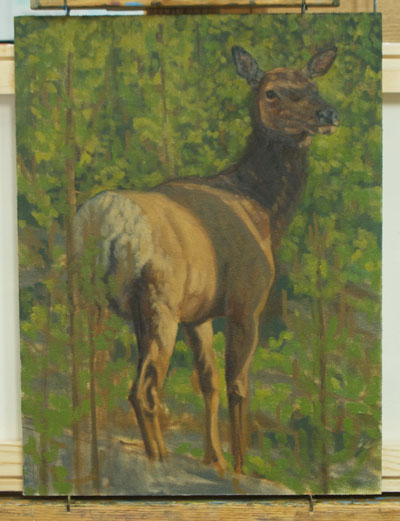
So, back to the *#@*!^ elk. Upon further review, something was seriously not right and I spent most of Tuesday and part of Wednesday fixing it. The drawing of the head was out a mile and the neck was too short, plus a few minor, quickly fixed problems with the hind end. I’ve now repainted the head, oh, I don’t know, six or so times. One of the challenges when faced with something like this is to do what needs to be done and still end up with something that doesn’t look labored.

Over at Julie Chapman’s blog, there is a comment thread discussing a common phenomena in art in which the artists who are competent professionals agonize and tear their hair out and artists who aren’t very good always seem to be pleased with what they’ve done, oblivious to the problems in their work and impervious to any criticism. I’m definitely in the “agonize” column. Just ask my husband.

One theory I have is that, as according to Buddhism, people don’t like to be uncomfortable. They move toward pleasurable things and cling to them and away from unpleasant or uncomfortable things. It’s hard to just be with whatever is going on without getting caught up in it one way or another. Really seriously creating art that is good, whatever the media, means living with frustration, mental exhaustion and doubt, none of which is particularly comfortable. Any dedicated artist reading this knows what it feels like when you’ve busted your butt all day and finally your mind just hits the wall and slides down to the floor. Then you know it’s quittin’ time.

But all that can be avoided if one takes the position that everything is fine, just fine. And, if you don’t get into juried shows or organizations, hey, it’s all subjective and they don’t know what they are talking about anyway. Letting go of that means that you have to take responsibility for your art and its shortcomings and, to improve, you have to be willing to do what it takes. And that’s one big thing that separates the amateurs from the professionals. You do what it takes to get it right. No excuses or rationalizations.

I remember when I made the conscious decision to pursue oil painting (and drop illustration, graphic design, etc.) and see just how good I could get. I realized that I had to face the possibility that I would give it everything I had and that, in the end, through an inability to exercise correct choices or judgement, that I would only ever be a mediocre painter. That thought made me sick inside. But I couldn’t turn away, so I accepted the challenge. None of this has ever come easily to me, so one thing I know how to do is hang in there and struggle through. Which brings us back to that bloody elk, part two-
cow-elk2.jpg

There’s still LOTS to do. The modeling of the head needs work to describe the structure. I’ll probably do a pencil drawing to work it out better, so I can lay the paint in with confidence.

And, here’s one of my newest finished paintings, called “Mutual Curiosity”. When I was at Ikh Nartiin Chuluu, I spent two days out in the reserve walking around alone with a GPS, looking for argali so I could do behavioral observations. The trick was that I had to find them, without them seeing me, in order to do the observations. It wasn’t easy. This big old ram spotted me pretty quickly, but he let me follow him around for about twenty minutes. He was very thin, but had a huge, heavy horns. I filled him out a little. It was spring, so he had made it through the winter of 2005. I wondered as I did the painting if he made to 2007.

mutual-curiousity.jpg

I also wanted to show the amazing environment that the argali of Ikh Nart live in. I compressed the scene a little from the photograph, but all those weird formations are within yards of each other.
Aperture and a Few Favorite Photos

In between trying to get a number of paintings done, I’ve spent one full day of each of the last two weekends importing my images into Aperture, the digital photo manager that I had pre-installed on the iMac. I think I’m almost halfway there. All of Kenya 2004, Mongolia 2005 and 2006, two trips to Wyoming and one to Montana are in, plus some personal stuff and photos of paintings. The two trips to Mongolia come to 5,792 total. Kenya 2004, the art workshop safari with Simon Combes and nine other artists, totals 5,116. Wyoming, which includes Yellowstone, the Grand Tetons, the areas around Jackson and Dubois totals 3,824. Can you imagine how much paper and ink it would have needed if those had been prints? Or plastic, paper and ink if they were slides? And how much shelf space I’d need. So far, it’s all on the iMac’s hard drive, which will be backed up to our Buffalo Terastations.

Digital is by far the most environmentally friendly way to acquire and store images and music. I’m ready for movie downloads to our tv anytime now.

elephant-and-vehicle.jpg Samburu 2004

Aperture’s image organization system is based on projects, albums and folders. Half the battle was understanding how I would want to find things well enough to set up the essential system before I started importing. I finally went with projects based on location. Images can only be in one project, but can be in multiple albums. So, I’ve done the initial imports into country projects that have specific location albums in them. Therefore, the Mongolia project has albums for Hustai National Park 2005, Hustai National Park, 2006, Khomiin Tal 2006 and so on. I had realized when I was still working with IMatch on the PC that I needed to be able to not only go to a specific location, but also when I’d been there, so this time every location name also includes the year. The next step will be to copy all the animals into specific species albums, along with various landscape features like rocks and trees, time of day like sunsets, and weather features like clouds. Everything will be batch keyworded and have appropriate metadata added. Maybe by the end of baseball season.

nmwa-marmot.jpg

Marmot at National Museum of Wildlife Art (He’s real.)

I bought an after-market book on Aperture with a DVD tutorial that I’m working my way through. I got a handle on importing and dove in because my images look so completely stunning on the glossy 24″ iMac monitor that I needed to start working from it immediately. I’ve been cruising through a bunch of my photos this afternoon, especially all my argali reference from Mongolia, and I can honestly say that for the first time I can really see what my 6mb Nikon D70’s can do. Wow.

me-and-tshuu.jpg

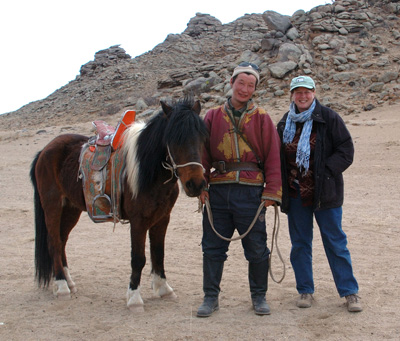
Local herder and I at Ikh Nartiin Chuluu Nature Reserve, Mongolia

My paintings are going to take a big step forward. John Banovich, who I was fortunate enough to have a workshop with, told us that “you are only as good as your reference”. That is so, so true. I can’t even believe that I ever thought that 4×6 or even 5×7 prints would give me a good result. I now have the equivalent of huge transparencies that I can work from in daylight.

Hope to post some new paintings by late next week. Heading down to San Francisco for the weekend and taking along a blue heeler from the shelter who needs to go to rescue. Next entry I’ll tell the story of my first transport two weeks ago. Super short version-four dogs, ten hours driving.

The Big Conversion (Gulp)

Well, I’m finally doing it. After using IBM-based PCs for almost 15 years, I got a spiffy new iMac with the 24″ monitor a couple of weeks ago. It was a no-brainer once I decided that there was nothing to do but suck it up and re-catalog my 8,000+ images. All my music CDs are done- over 400 of those. Eight football games and a few week night hours of The Weather Channel and Animal Planet later.

I’d been toying with the thought of doing this for awhile, but the clincher was when my husband, who has over 40 years experience with computers, stated that he was “scared” of working with my PC-based image management software, IMatch. That got my attention. It turns out that while the program does what I need quite nicely, it’s a nightmare under the hood for a variety of reasons I won’t bore you with since I have a tenuous grasp on the technical problems myself.

First impressions? I feel like I just traded in a Model T Ford for a 2008 Ferrari. Microsoft should be afraid, very afraid.

I’ll be re-cataloging my images using the Apple product Aperture. I had it pre-installed and, after the machine had arrived, learned of the existence of Lightroom, the Adobe product. Aperture seems to put more emphasis on organizing images anyway, which is what I really need it for. I can use Photoshop (upgrade time) for tweaking.

Needless to say, I can hardly wait to start painting and drawing from the phenomenal glossy iMac monitor. It’s as much more luminous than the Planar flat screen I’ve been using as the Planar is from the prints I used to use.

In the interests of simplicity and consistency, I was planning to replace my beloved IBM X31 with a MacBook Pro. But wait, Steve Jobs just announced the Air ultra thin notebook. Whew, that was close. Glad I didn’t have the money right away. Clearly, in the Apple world, it’s crazy to buy anything significant after about October in any given year.

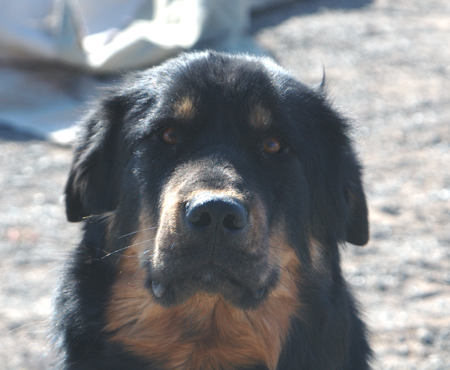
In other news, I got an email a few weeks ago from someone in Germany who had been on my website and saw the photos of Mongolian herder’s dogs I have there. Berit Kaier is a member of a non-profit dedicated to the preservation of these dogs, called Tibetan mastiffs, and is putting together a brochure about the dogs. She was hoping that I would give them permission to use some of my images. Of course I said “yes”. Here is what I sent her-
mongol-dog-along-rail-line.jpg

Photographed from train, spring 2005

mongol-dog-west.jpg

Western Mongolia, fall 2006


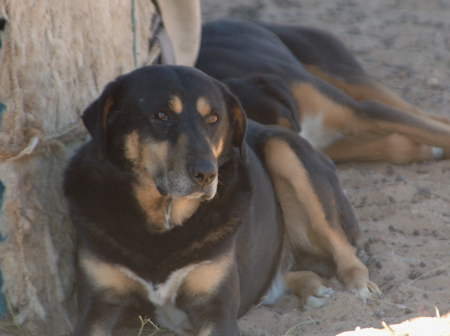
Mongol Dog Gobi

Gobi Desert, fall 2006


mongol-puppies-hustai.jpg

Near Hustai National Park, spring 2005; the basket is for gathering dung to use as fuel

The dogs have a reputation for being “protective”. In fact, the traditional greeting when approaching a ger (Mongolian for “yurt”) is “Hold the dogs!”. The only aggressive one I’ve encountered so far was the mother of the puppies, above, and the woman did have to hold her while we went into the ger. Otherwise, they’ve kept an eye on us or even seemed friendly. Since I hadn’t had a rabies vaccine, I had to resist any temptation to pet them, just in case.

The purebred version is threatened by inbreeding with other types of dogs that have been introduced into Mongolia, like the German Shepherds the Russians abandoned when they left Mongolia in 1991. I saw what looked like purebred shepherds living the feral life around Ulaanbaatar and I have seen quite a few dogs that obviously have shepherd in them- prick ears and the black saddle.

The herder’s dogs stay near the ger and, I have the impression, get scraps when an animal is slaughtered or they fend for themselves. In the reserve where I did the Mongolian Argali Earthwatch project, the researchers were surprised and somewhat dismayed to find that one of the major causes of argali mortality was predation by the mastiff dogs.The next trip to Mongolia is planned for September of this year. Along with everything else I want to see, I hope to find out more about the dogs and get a lot more photos of them. I think that they would make interesting subjects.

Happy New Year!

Back in the saddle again for 2008. Lots to look forward to.

All the kittens I fostered have found new homes. I thought that I would start to introduce that permanent animal members of the household. First up- Niki, our four year old tricolor rough collie, self-appointed guardian of all creatures large and small. Here’s picture of him with Tucker and Katie. Niki had laid down by the crate and the two kittens came over and got as close as they could. All of them quickly became fearless of my 75 lb. dog.

niki-tucker-katie.jpg

We finally had our first ducky visitors to our pond, three hooded mergansers. One male, two females. I thought, uh oh, there go the goldfish, since mergansers are diving ducks and, sure enough, while we watched, they caught and ate two big ones. But we have since seen at least eight or nine in their usual hangout, so we didn’t do too badly. Michiko spotted them and instantly became a fan. More about her in the next week or so.

michiko-merganser.jpg

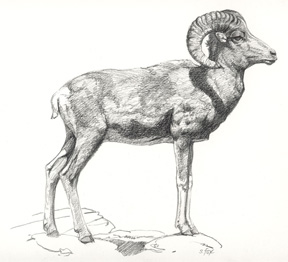
In art news, the latest issue of the newsletter of the Society of Animal Artists features drawings that I have done of Mongolian wildlife. Here’s three of them, an argali ram, an ibex billy and a takhi mare and foal (Przewalski’s Horse). They were done on 2 ply bristol with a Wolff’s carbon pencil.

argali-ram-standing-blog.jpg

ibex-billy.jpg

takhi-mare-and-foal-heads-blog.jpg

Ok, Time For Some Art

I love to paint. I love to travel. I love animals. Put it all together with supportive husband who used to stack up the frequent flyer miles, and you get a nature artist who has been lucky enough to go to Kenya twice, Mongolia twice and North American wildlife ground zeros like Yellowstone, the Grand Tetons and Glacier to sketch, observe and photograph a mouthwatering variety of wildlife and their habitats.

Ikh Nartiin Chuluu Argali

The painting above is “Ikh Nartiin Chuluu Argali”, a 15″x30″ oil on canvas. The name translates as “Great Sun Rocks Sheep”. My first trip to Mongolia was in April of 2005 to participate in an Earthwatch Institute project “Mongolian Argali”, which are the world’s largest mountain sheep. A ram can weigh over 400 lbs. and have a horn curl of 65″. In this painting I felt that I was introducing a species that not many people have seen, so I wanted to show them in their environment in the reserve, which is a large area of rocky outcroppings rising up above the steppe, which you can see in the background. “Ikh Nart” is about a five to six hour drive southwest of Ulaanbaatar on a road that largely parallels the railway line to Beijing.

They blend in very well with the rocks and so I designed my composition with the idea that the viewer would see the lead ram first since its head is in high contrast against the background and the second ram, well, second.

For more on my travels, visit my website. For more on the reserve, visit the website listed to the right.