I had found out that a third takhi reintroduction was taking place in western Mongolia and, somewhat blithly as it turned out, decided that I HAD to go there. Jan at Nomadic Journeys set it up and on the morning of September 21, I flew 1,000 miles west to the town of Hovd. My guide, Octyabr, met me at the airport and after paying 67,500 tugrigs for overweight bags (around $70), off we went. That evening, I caught up on the day:
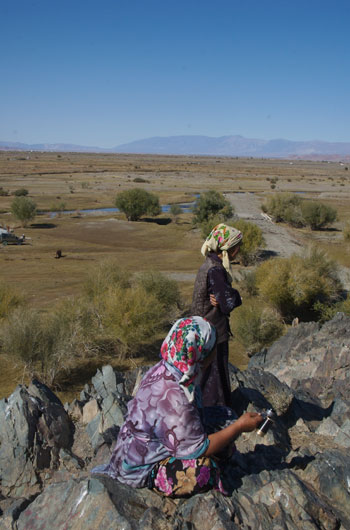
September 21, 7:30 pm- Stopped for the night by the (a) river. What a day. didn’t get out of town until 2:50. Two German students, October (English spelling), driver, cook (who actually turned out to be a local guy who knew the route to the place: the German students did the cooking to “pay” their way) and me, in the end. Typical Mongolian expedition. Students needed 20 min., so went to October’s home for tea and bread. Then it was: hire a driver, go to the bank, top off the tank, stop at store, drop off father, let driver pick up gear. There may have been more, but I forget. (There was- lunch at a local cafe) Then I find out that it’s 300km to Khomiin Tal and we won’t get there today. Stopped to climb a rock overlook. Fabulous view of river valley with Kazak (sic) gers. Next stop was a brick factory. Oh, I forgot they packed an inflatable raft and fishing gear. But sailing down the road through spectacular scenery with the Mongols singing away was terrific!
Which is Mongolian for “Hi!” or “Greetings”. It’s pronounced, roughly, “sain” as in sandwich, “ban” as in bandaid, “uu” as in oval.
I’ve just downloaded what looks to be a very useful Mongolian language program from Transparent Language. The next trip is coming up in July and I want to be able to communicate better. Before my 2006 trip, I was able to find a local Mongolian woman who tutored me in basic pronunciation and vocabulary, along with some simple sentences. It’s amazing how far you can get with: please, thank you, excuse me, yes, no, hello, goodbye, I like….., and knowing the numbers from one to ten. But it didn’t help when I heard a cool song on the driver’s MP3 player and had no way of asking who the artist was. I have a Lonely Planet Phrasebook and a “cheat sheet” from my tutor, but that’s not enough.
I have some familiarity with learning a new language. Spanish (see below), some basic Japanese (I can still count to ten!) when I was 14, two years of German in high school (wish I’d taken one year of German and one of French) and some Middle English and Anglo-Saxon in college. At one point I’d decided to teach myself Welsh. It was a short point.
Like many languages, Mongolian has sounds that don’t exist in English, so that’s a challenge. One travel writer describes spoken Mongolian as sounding like two cats fighting, but I’ve found that to be somewhat of an exaggeration. The guys seem to play up the gutteral sounds more than the women, especially in the countryside. There are rolled “r”s, which means that after 40 years, my stupid junior high Spanish class has finally turned out to be good for something. And there is a sound that is similar to the double “L” in Welsh. Vowels that are “doubled”, like in the sign below or in “Ulaanbaatar”, are audibly extended, as in Khan vs. Khaaan. One of the sounds that I have found most challenging so far is “g”. It seems to be something like “uudo”, with a slightly rolled “d”, but I’m sure I’m mangling it into something hilarious. The Mongols are blessedly tolerant of anyone who takes a swing at their language and seem to appreciate the attempt.
Their alphabet is a close adaptation of Russian Cyrillic and I’ll be learning that, too. It will be nice to be able to read at least some of the signs in Ulaanbaatar. Like these (I used to be a sign painter and still can’t resist taking pictures of signs that catch my eye). There’s just enough overlap with the Roman alphabet to be slightly maddening. You feel like you can almost read it, but no.
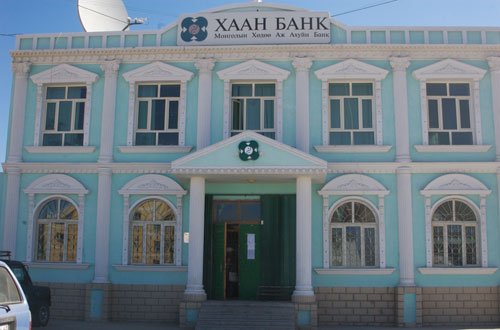
Khan Bank, Hovd, western Mongolia
Although, in this case, it was more the beautiful building that I wanted a picture of. But good to know that this is a bank, if one is running low of cash. One of the first signs I was able to read.
Gers and tents for sale at the Narantuul Market, UB
I took this photo partly because I had no time to inquire about details like prices and didn’t want to lose track of them since I would really like to get a tent like the one on the right.
Pet shop sign, Ulaanbaatar
Since my dog is a tri-color rough collie, the same breed as the dog on the sign, I had to get a picture. I’ve wondered since then if there are actually any collies in Mongolia. They certainly have a coat that would be handy in the cold weather. Lassie Forever!
Street sign, central Ulaanbaatar
Now, how could anyone resist a drink that will give them the energy of the Mongol Horde?
Here’s a few bactrian camel drawings I did in about an hour this morning. They were done on vellum bristol with a Wolff’s carbon pencil. The head drawing is a little more finished. The full body study was really just to capture the pose and lay in the shadow areas. You can see how I corrected one of the hind legs. The small hind leg study was to learn more about the structure. So, one subject, three different goals. As usual, do try this at home.
I’m not sure that this photo, taken by Roy Chapman Andrews, is from Gandan Monastery, but the prayer wheel is certainly close in size and design to the one I saw there.
Large prayer wheel
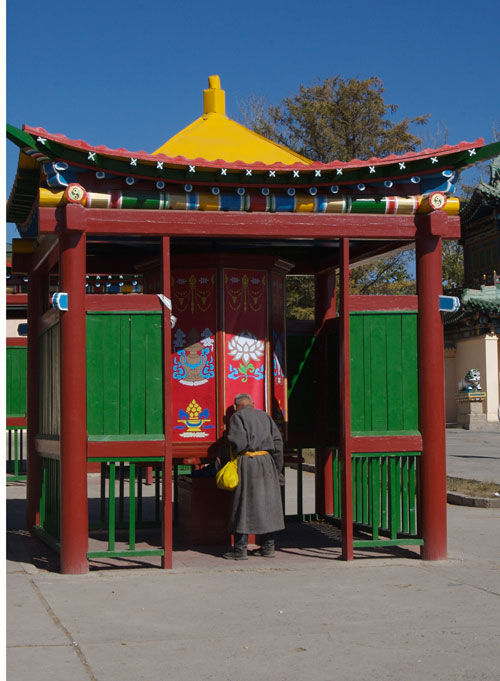
Here is the one I saw.
Large prayer wheel at Gandan Monastery, Sept. 2006
People had written on it with a variety of pens, probably prayers.
I keep a journal on all my “interesting” trips, along with a sketchbook, and thought that I would occasionally share some entries. In 2006, I read The Great Railway Bazaar by Paul Theroux on the first part of the trip and was inspired to try my hand at recording something more descriptive, rather than just short “Today I was in western Mongolia, the van broke down and I got food poisoning.” diary-type entries. Here’s what it was like to get clean at a ger camp in the Gobi:
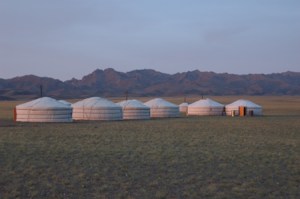
Dungeree Ger Camp, Gobi, 2006 (Gurvansaikhan mountains in background)
October 2, 2006 1:15pm:
Ah, the joys of clean hair and body. Once it was ready, I went to the shower ger. There was a stone path leading to a wood slat platform. A big metal bowl of hot water was sitting on top of the stove, in which there was a roaring fire. A small stand held one pair each lg. and small plastic sandals. There was a hook for ones clothes. The shower was provided by a pump sprayer just like what one would buy at the garden shop or hardware store with a spray head attached. One fills it (although it was already ready for me) with a combination of hot water from the stove and cold water from a can by the wall. Pump up the pressure and voila! a perfectly acceptable hot shower in the middle of the Gobi. It was still a little chilly, so I had a fire ready to go back at my get, so I am now (more or less) clean, dry and warm, a lovely combination much appreciated on this kind of trip.
I thought I’d start off the New Year with the subject that’s most near and dear to Mongolians’ hearts – horses.
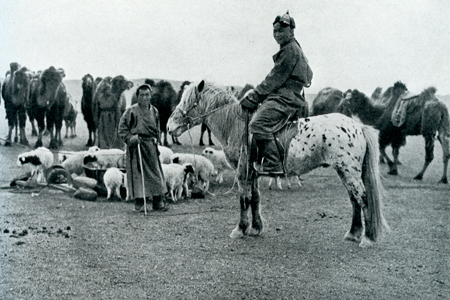
Here’s an old photo from the late 1920’s, taken on one of Roy Chapman Andrews’ Central Asiatic Expeditions:
Mongolian herder, late 1920's
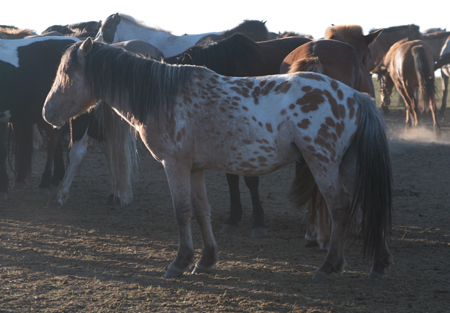
Here’s a horse I saw this past September:
Mongolian horse, Arburd Sands
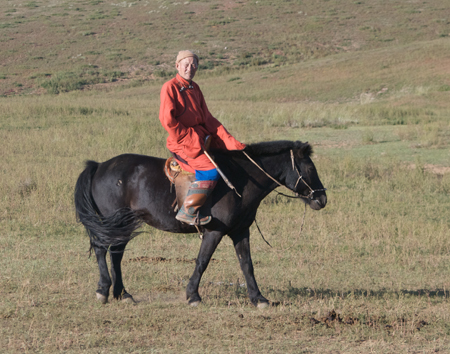
And here’s the herder who owns the horse. Other than the head gear, not much has changed. The long robe or “del” is the perfect garment for the climate and environment. And while I have seen herders wearing the traditional pointed hat, they tend to be mostly the young men. Baseball caps are what one usually sees. The older men often wear snappy-looking fedoras.
Choidog, Arburd Sands
On Friday I’ll be debuting my latest Mongolian horse painting!
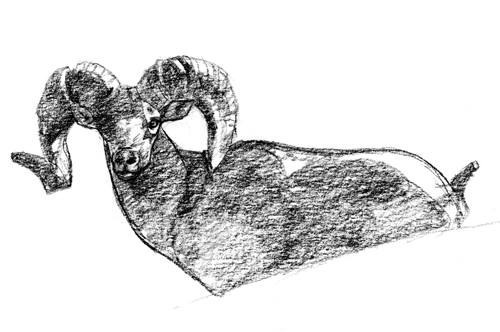
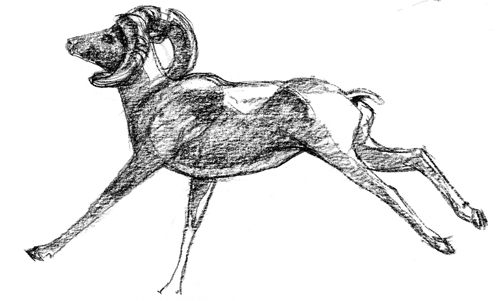
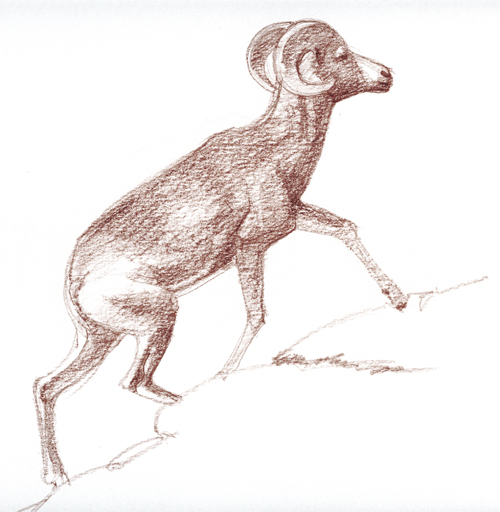
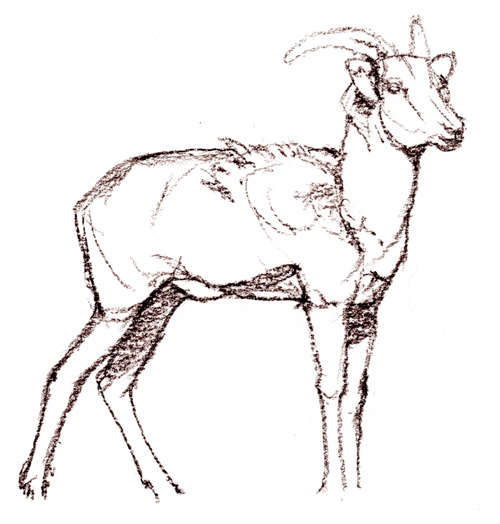
With the New Year come new painting projects. We try to take time off between Solstice and New Year’s Day because that’s when things slow down for my husband, who is the executive director of an information technology consortium, but I can’t stay out of the studio completely. I have a bunch of ideas for paintings with Mongolia subjects and this morning I thought I’d do a few drawings of argali and try different drawing media. All of these are done on 2-ply vellum bristol. None of the four took more than 15-20 minutes. The idea was to limber up after a break without worrying about doing a pretty, finished drawing. I wanted to catch the character of the animal and the rhythm of their body and movement. Please DO try this at home.
Argali Ram, Ikh Nartiin Chuluu, Sept. 2008
This is a try-out to see how he “draws” since I have a painting idea in mind. He’s a big, old ram with battered horns that will be an interesting challenge to paint. I also like the shadow pattern on his head. Drawn with a 6B Wolff’s Carbon pencil.
The gold standard in fieldwork for wildlife artists is the animal Doing Something. Prey animals like argali tend to be running away, so lots of butt shots. But this one took off from stage right to stage left, giving me a perfect chance to record a variety of leg positions. Also drawn with a 6B Wolff’s Carbon pencil.
Young Argali Ram Climbing, Ikh Nartiin Chuluu, Sept. 2008
Another jackpot. He’s going up the rocks parallel to me. Drawn with a Cumberland Derwent Drawing pencil, Venetian Red. These have a fair amount of wax in them, so are more like a fancy crayon. They feel soft on the paper. I don’t think I got very interesting line quality, but did feel that I caught the tension in the hindquarters as he is about to push off.
Argali Ewe Standing, Ikh Nartiin Chuluu, April 2005
This one is from pictures I shot on my first trip to Mongolia in April/May of 2005. The animals still had their winter coats. This ewe was part of a small herd which had come down to a stream for water one morning. I find 3/4 head views challenging, partly because I know that I have to compensate for the flattening effect of the photograph. Drawn with a 2454 Conte crayon. I hadn’t used these in awhile and found I liked the line quality and the way the Conte felt on the paper. This sketch took maybe ten minutes.
So you can see that what you draw with can really change the appearance of your drawing. The only way to know what will work best for you is to experiment with different combinations.
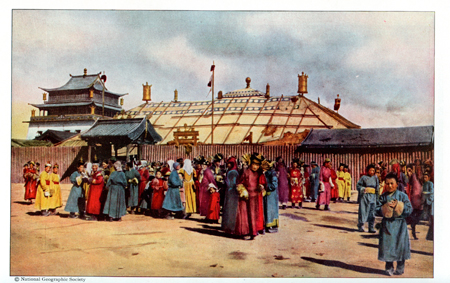
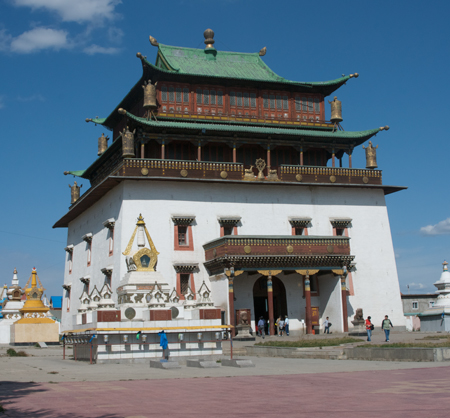
Looking through some of my books about Mongolia and magazines with articles about the country, I had that “I’ve been there” feeling a number of times, partly because not much has changed in some respects from when westerners first visited. So, I thought it would be fun to occasionally juxtapose my photos with the old ones, starting with Gandan Monastery.
Gandan Monastery- photo by Roy Chapman Andrews, late 1920'sGandan Monastery, photo by Roy Chapman Andrews, early 1920'sGandan Monastery, photo by Susan Fox, 2008
Purely coincidental that I took my photo from almost the same position as Andrews.
Then, I was hoping someone could help me here. I really, really, really would like to get one of these tents and have had no luck so far. Can anyone get me a price and supplier? I could probably sell a half dozen or so here in the States. I might be able to pick them up in UB in July, but am open to suggestion.







 Susan Fox, American Artist