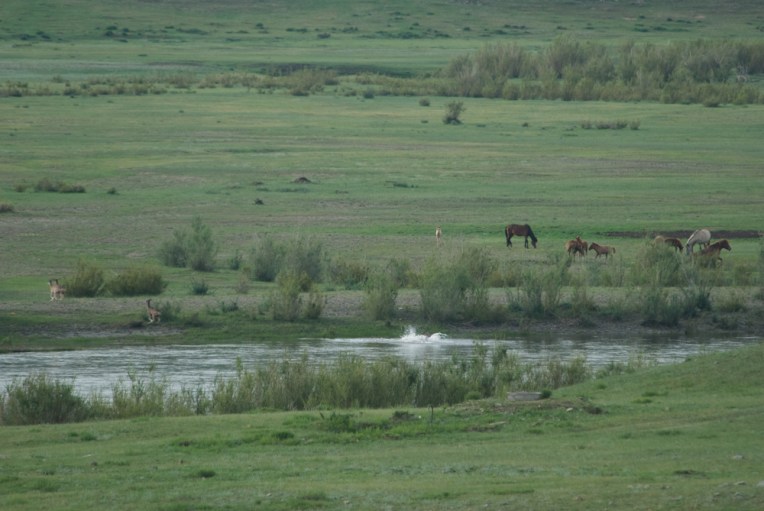
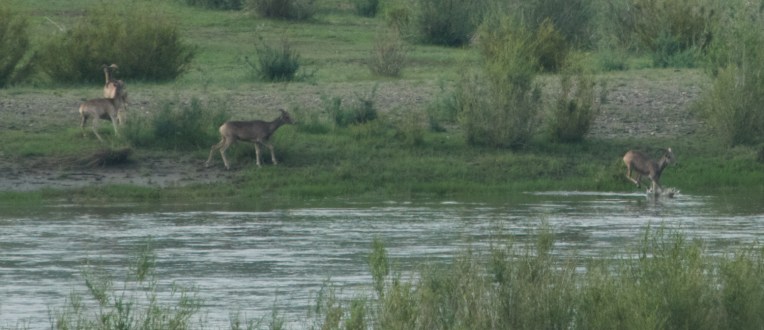
I have just received confirmation that I have taken the only known photographs of a Mongolian argali sheep crossing a river. This occurred at the Gun-Galuut Nature Reserve during my Flag Expedition on the very first morning of observations. In fact, he (Dr. Reading believes it was a yearling ram) was one of four of the first argali I saw on the trip.
Dr. Reading also noted in his reply to my query that “Well, I don’t think anyone ever doubted that argali cross these relatively shallow, relatively slow rivers (at least I never did). All ungulates (and most mammals) swim pretty well and you need something a LOT more substantial that the Kherlen River to stop them.”
The main reason, I believe, that no one has gotten photographs is that the only place where argali have been studied in any depth is at the Ikh Nartiin Chuluu Nature Reserve, which has a few small streams, but no rivers. Research has begun at Gun-Galuut and, in fact, an Earthwatch team is scheduled to be there for part of their time in September, but the emphasis has been on capturing and putting radio collars on the argali, not behavioral observations.
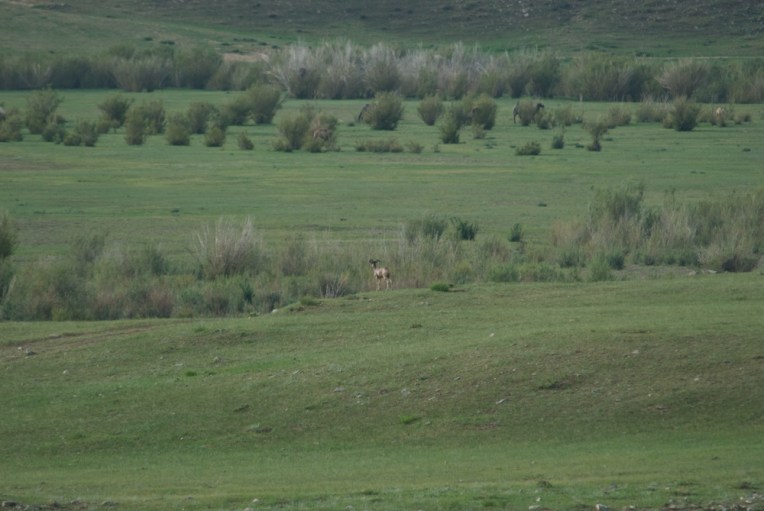
The four sheep that I watched were on the opposite side of the river from their home range, Mt. Baits. Their behavior appeared anxious and finally one bolted back across the river. He climbed up on a high point and looked back. The young ram finally turned and ran back up onto the mountain. The other three argali seemed indecisive and ultimately did not cross, but moved up onto a smaller mountain where I finally lost sight of them.
The group of argali down at the Kherlen RiverSuddenly one jumped inAnd made quite a splashAnd then swam directly towards usWhere's everyone else?
Here are detail shots of the main three photos:
Detail: jumping in the riverDetail: the splashDetail: swimming across the Kherlen River
I’ve been back a week now. Something special happened on this, my fourth trip. A lot of things came together for me and I was able to experience Mongolia and connect in ways that I hadn’t on previous trips, even though something kept driving me to return.
Some of it was simply gaining a familiarity that made this trip by turns exhilarating, relaxing and just plain fun, instead of low-level stressful. A lot of it was the two people I traveled with, Khatnaa, my guide for the first nine days, and Gana,with whom I traveled to Ikh Nart, who answered my questions with consideration and honesty, and helped me start to understand what it is to be a Mongol. But, mostly, I felt like the land itself let me in and then offered up treasure after treasure.
I’ll share some of those treasures over the next few posts. Today, it will be images of where Mongolia really starts – the land.
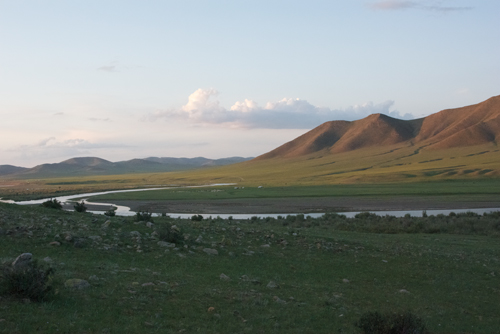
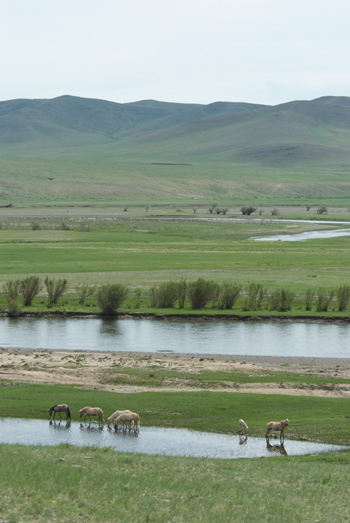
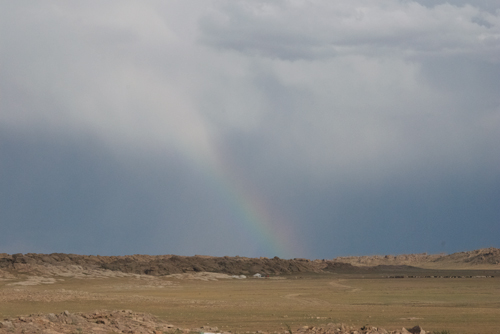
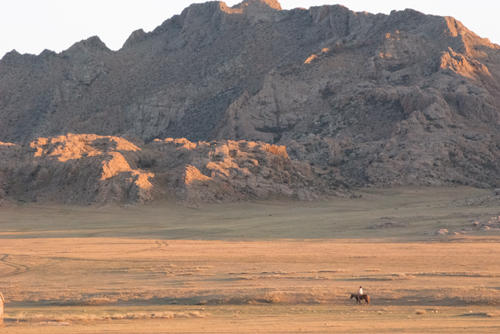
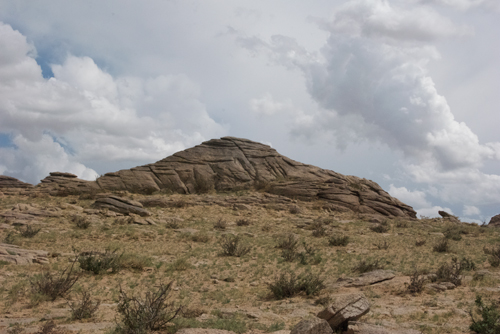
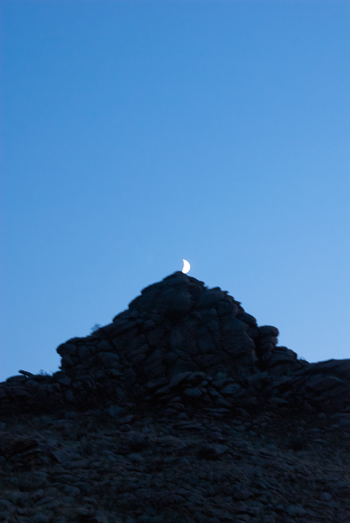
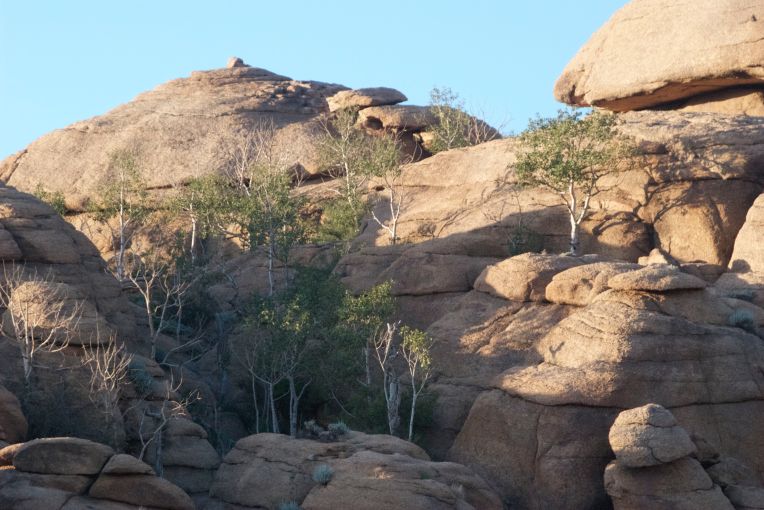
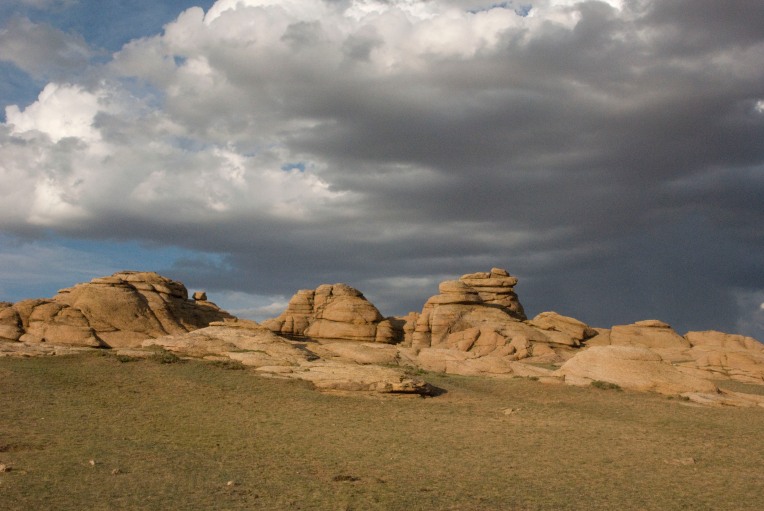
I love and grew up in forests, but traveling across the steppe on the earth roads is one of the things I most miss already.Small lake with demoiselle cranes in lower leftTahilgat HairhanLightning storm, Arburd Sands ger campKherlen Gul valley, morning light, Gun-Galuut Nature ReserveKherlen Gul and east slope of Baits Uul, morning light, Gun-Galuut Nature ReserveKherlen Gul valley, summer day, Gun-Galuut Nature ReserveRainbow over ger, Baga Gazriin Chuluu Nature ReserveStorm light, Baga Gazriin Chuluu Nature ReserveHorse and rider, early evening, Baga Gazriin Chuluu Nature ReserveAspens amid the rocks, early evening, Baga Gazriin Chuluu Nature ReserveOncoming storm, Red Rocks ger camp, Ikh Nartiin Chuluu Nature ReserveRock formation, Ikh Nartiin Chuluu Nature ReserveMoonrise, Ikh Nartiin Chuluu Nature Reserve
I had a pleasantly uneventful trip home from Mongolia. Glad to be home, but already plotting the trip next year. I was able to get to the Hi Fi music shop in UB and buy a few CDs of contemporary Mongol music, so I’ll have fun painting to that until it’s time to go again.
Yesterday afternoon, I had a final get-together with Gana Wingard and Sukhin Amgalanbaatar. We brought Amgaa up to speed on what had happened during the meetings with the women at Ikh Nart and talked about what the next steps should be.
I showed him some of the pictures I took of argali. It looks like I may have the first and only documented evidence of an argali crossing a river, which I saw on the first morning out at Gun-Galuut Nature Reserve. Up until last year, the only argali research in the world was being done at Ikh Nart, which has no rivers, streams, lakes or creeks. Apparently one scientist has maintained that they won’t cross water. I guess no one told the Gun-Galuut argali since at least four of them had before we got there and we watched one come back across. I’ll be working to confirm the significance of what I saw and what it means in terms of what is known about argali.
Today is “My mind is in California, but my body is still in Mongolia”, so I’m going to take it easy, unpack, do laundry, hang out with my husband, pet the cats and dog, maybe putter in the garden if the sun comes out and think about the past three weeks spent in a country that is starting to feel like a second home.
My trip to Ikh Nart was amazingly successful. It seemed like all the stars aligned for my three days of meetings with the women who want to start a crafts cooperative.
It’s going to take a bit to sort it all out and write it down coherently, but the punchline is that they got the word out, fourteen women took a five day felt workshop a month or so ago, and, when they showed up at the research camp (a half hour early), their new Director, Boloroo, handed me a fourteen page proposal and the ladies spread almost two dozen felt craft items out on the tables we’d set up.
To say that we were off and running would be a major understatement. The ladies even had a name for their group- “Ikh Nart Is Our Future”- ready for my approval. I approved. Immediately.
I had purchased four meters of felt in UB to give them and, in three days, all of that was turned into slippers, purses, a large rug and a variety of other things.
I also brought the fabric for them to make del for my husband and I. They finished both of them, fully lined and all the fastenings made by hand, sewn on manual sewing machines and ironed with old irons heated on a propane stove, in three days.
The next step will be to work out the details of the $800 loan that they have requested to buy a felt press, since their intention is to make the felt themselves, not buy factory-made.
Gana Wingard, the biologist who made the trip with me as translator and liaison, was as blown away as I was at how much effort they had put into this. We were going to go out early and late to look for argali and ibex, but never had the time. The schedule and pace was set by the women and it was non-stop. I did see and photograph some argali on the way into the reserve and on the way out.
To Jeff Whiting and everyone at AFC- I can absolutely guarantee you that you have gotten your money’s worth and then some for awarding me this grant. There are single mothers and poor families who will be benefiting for years to come because you made it possible for me to go to Ikh Nart.
Here’s a few photos:
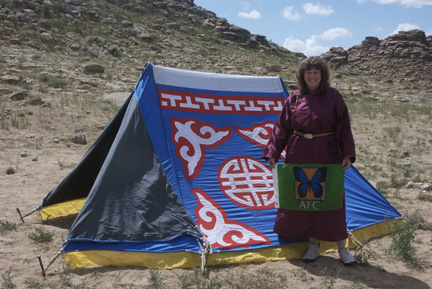
Argali ewe on rockThe ladies arrive at the research campLaying out Mongol felt rug designLadies working on felt projectsMe with new friendSewing my delA felt purse with Ikh Nart patch which was given to me as a giftReady for customers; eleven Aussies, as it turned outA "maikhan" or summer tent; me in my new del with the AFC FlagGroup shot, including Aussie tour group membersFour argali that we saw as we left the reserve this morning
But first, when we got back to UB, I needed to go by the Nomadic Journeys office and pay for the trip. Jan Wigsten, who I worked with to plan my itinerary, was in and he spent about a half hour with Hatnaa and I chatting and kind of de-briefing us about how the trip had gone. It was pretty windy when we went back to the car and by the time we were halfway down Peace Ave. on the way to the hotel, it had started to rain. By the time we pulled into the Narantuul’s parking lot it was……hailing. Hard. The water level in the parking lot was already rising, so, once again, Hatnaa positioned the car so that the back end faced the storm and we sat for about 20 minutes right by the entrance ramp to the hotel door, waiting for it to stop or at least just go back to rain.
We finally got me and my stuff inside and I got my long hot shower. I called one of the Mongolian scientists that I’m working with, Amgaa, and he was free for dinner. He came over to the hotel and we walked a short way down the street to a restaurant that serves Mongolian food. At that point, neither of us knew whether or not Gana Wingard was going to make it in.
But she called the next morning and said the flight from Seoul went with no problems. The storm had cleared out. She came over to the hotel with her nephew, who is in his third year of studying biology at the University. We all went to lunch and then braved the notorious Black Market, now called the Narantuul Market. Nothing illegal goes on there except pick-pocketing. The drill is to take nothing in with you except your money, which you hold in your hand. The market was busy, but not crowded and we had no problem at all. The best way to see it is to go in with no money and just walk around. Needless to say, I don’t have any photos.
It’s a huge covered area with stalls selling everything. Our mission was to buy three or four meters of felt for the herder women to experiment with since we think that they can do well making traditional Mongolian felt carpets to sell. I also bought all the fabric needed for them to make del for myself and my husband.
———-
The driver picks me up at 9am this morning. We then pick up Gana and head south to Ikh Nart. I will be back in UB sometime in the afternoon of the 28th. Gana has been told that it is very, very hot at the reserve. We will do our argali watching in the early morning and in the evening and have our meetings with the herder women during the day. Fortunately, I have found that the same felt covering that keeps a ger warm in cold weather, also keeps them reasonably cool when it’s hot. And the nights can be quite cool. I might even need my down sleeping bag.
I hope to post again at least once before I come home on the 30th.
In the evening after the mountain ceremony, we went for one last drive and ended up poking around the ruins of an old monastery that is tucked up into a narrow canyon. The entry point and the site itself has many aspen trees growing in and around it, some with blue scarves (khadak) tied around them. It was a very peaceful place. After all the normal, but sometimes noisy activity that had been going on around the ger camp, we chose to just sit up on some flat rocks in the quiet, watching the sun go down. It was a very nice way to end my stay at Baga Gazriin Chuluu, knowing that the next day was a long road trip ending up back in very noisy UB.
Left side of canyon entranceRight side of canyon entranceInterior of monastery building with aspen trees
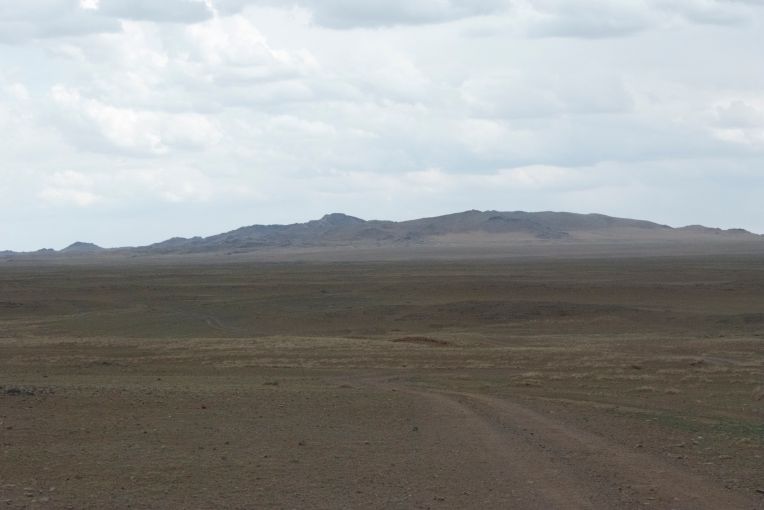
We left for UB around 9am the next morning. Back across the steppe.
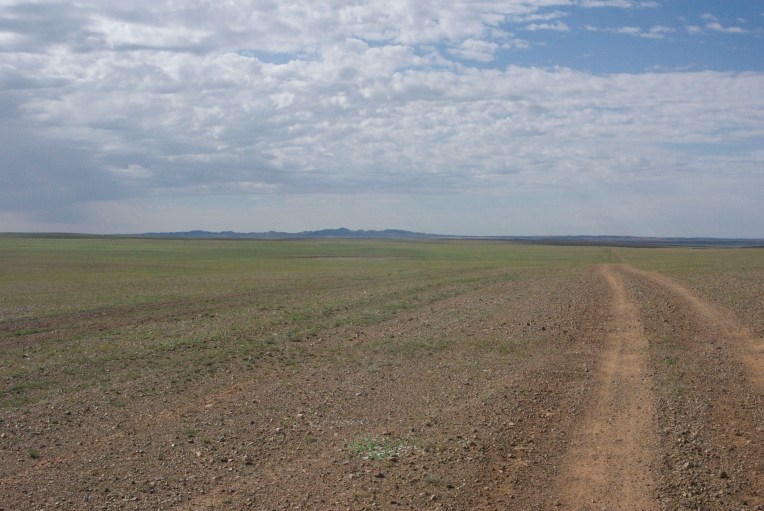
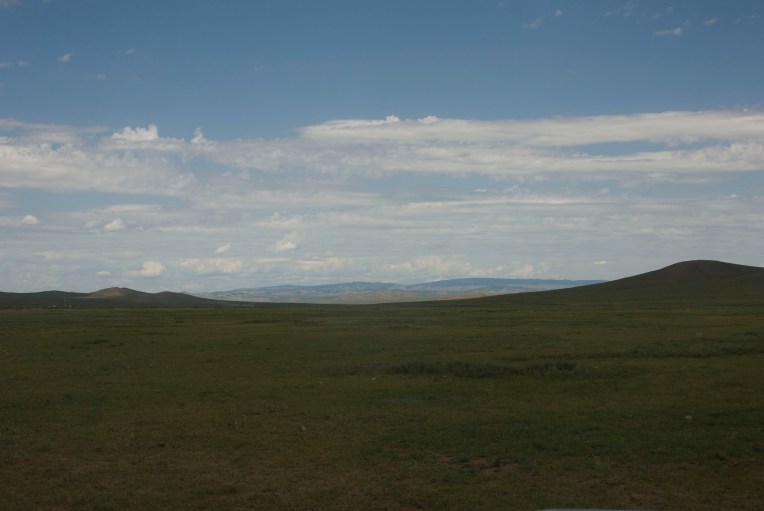
Earth road on the steppe looking south towards Baga Gazriin ChuluuTahilgat Hairhan, the mountain we saw on the way south
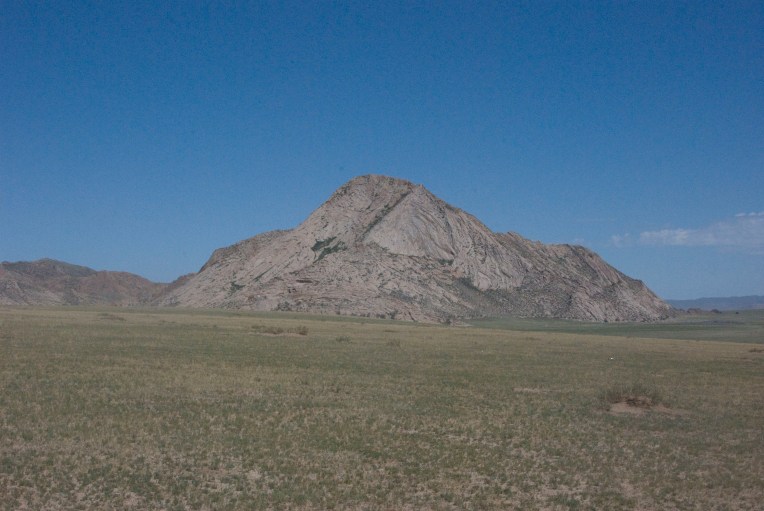
Among the many things I learned from Hatnaa about Mongol culture is that, out of respect for the spirits who dwell there and the fact that the top of a mountain is the closest one can get to Tenger, the sky, you never say the name of a mountain while you are within sight of it. One refers to it as “Hairhan”, which is a term of formal respect. So I asked him what the guides say to the tourists who inevitably ask what the name of this or that is. They parse the issue by saying that the mountain’s name is Hairhan. Which is absolutely true, in a sense, but allows them to honor an important custom. Near the mountain there were a couple of people herding their animals.
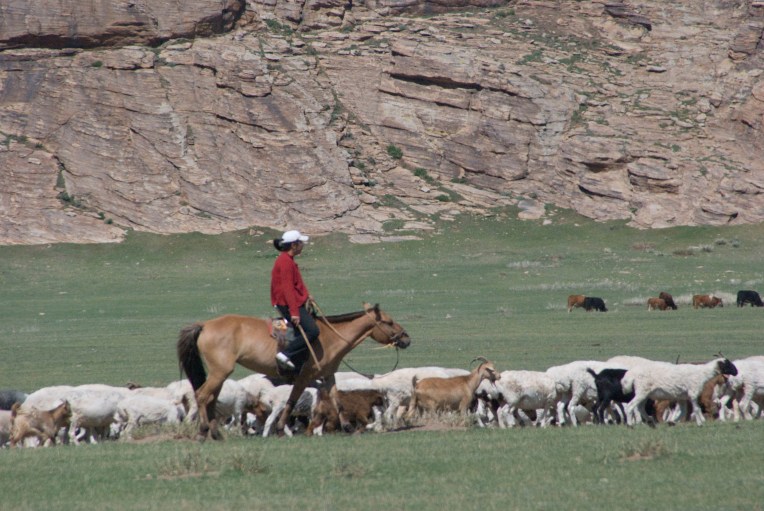
Traditional herding of goats and sheepA somewhat more contemporary method of herding camels
Finally, we came in sight of Bogd Khan, the sacred mountain which lies to the north of Ulaanbaatar and is also the world’s first nature reserve, having been set aside in 1778. Still on my list of places to visit. On the other side was the end of this wonderful road trip and a long, hot shower.
My guide/driver, Khatnaa, picked me up at the hotel at 9am and off to the countryside we went. I’m just going to hit the highlights here due to time constraints. I’ll cover each location more in separate posts after I get home.
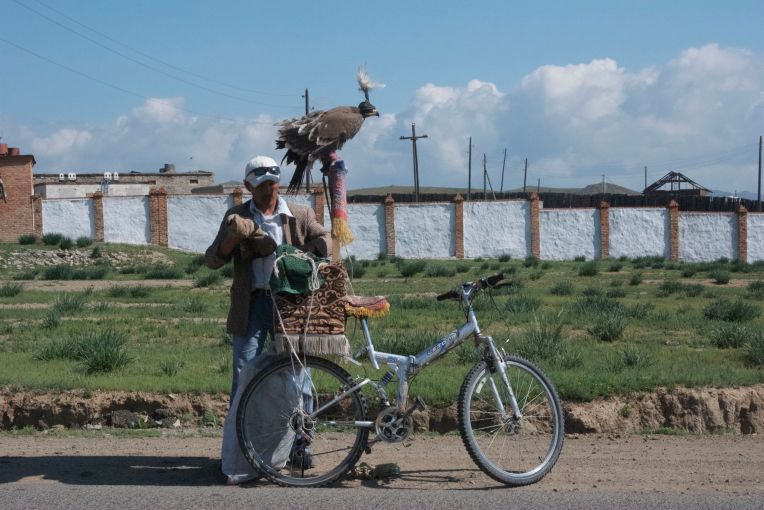
We were about 40 minutes out of UB when we came upon a Kazakh man on a bicycle with his two year old golden eagle perched on the top of stack of parcels. What a way to start the trip!
Kazakh Man and his eagle
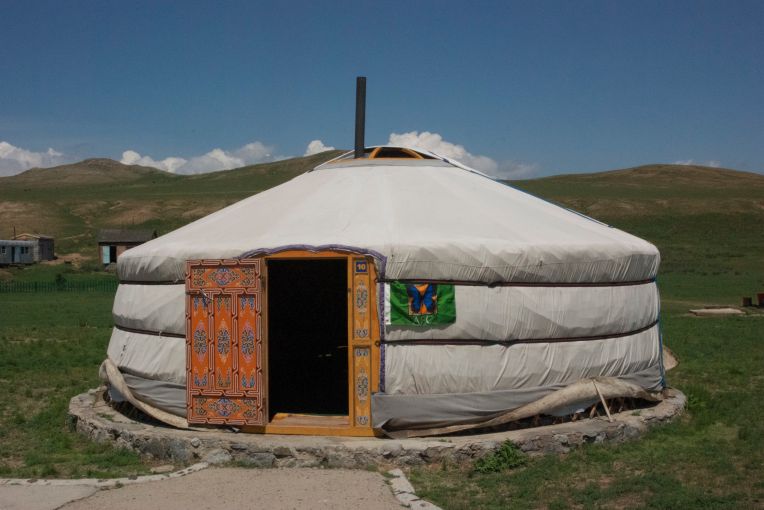
We arrived at the Gun-Galuut (pronounced “goon-galote”) after a pleasant two-hour drive. Lovely tourist ger camp overlooking the valley of the Kherlen River. Here’s my ger-
My ger at Gun-Galuut with AFC flag
We got settled in. I walked down to the river and sat by it for awhile, caught up on the Journal and got organized for the upcoming fieldwork.
View from my ger
The next four days took on a basic pattern of getting up at 6am, out the door by 6:30, game drive until about 9, back for breakfast, do what needed doing, back out after early dinner by 6:30, drive until light gone between 8:30 and 9. Fall over. Repeat.
The first morning, while Khatnaa was scanning the hills, I took a look along the river and, halfway through the first sweep from left to right spotted four young argali rams on the other side of the river. We were off to a good start. Here’s a selection of other images. I’m saving all the best stuff for the paintings, but these will give you an idea of what I saw.
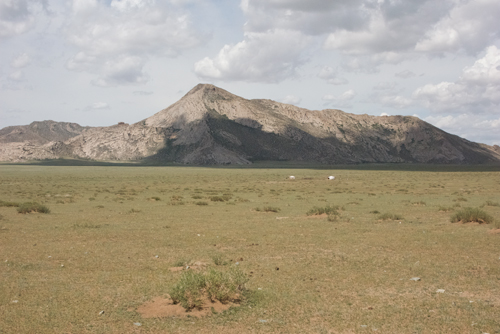
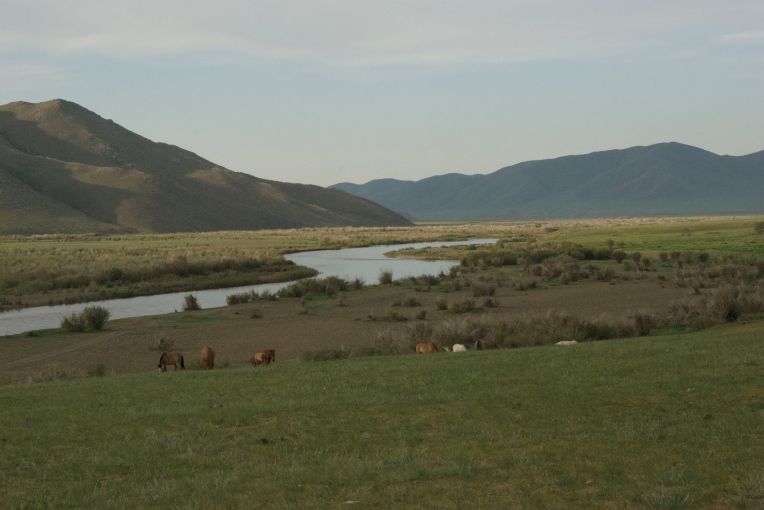
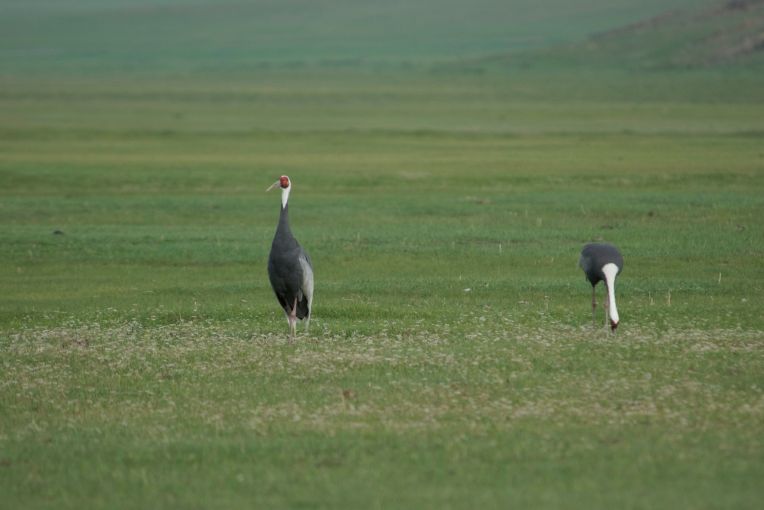
Kherlen Gul valleyEndangered white-napped cranes; one of three pair in the reserve White-napped crane and domestic yaks
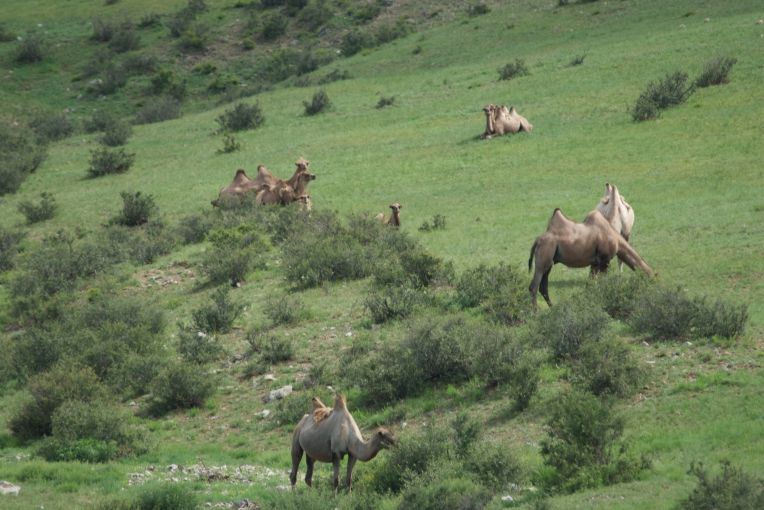
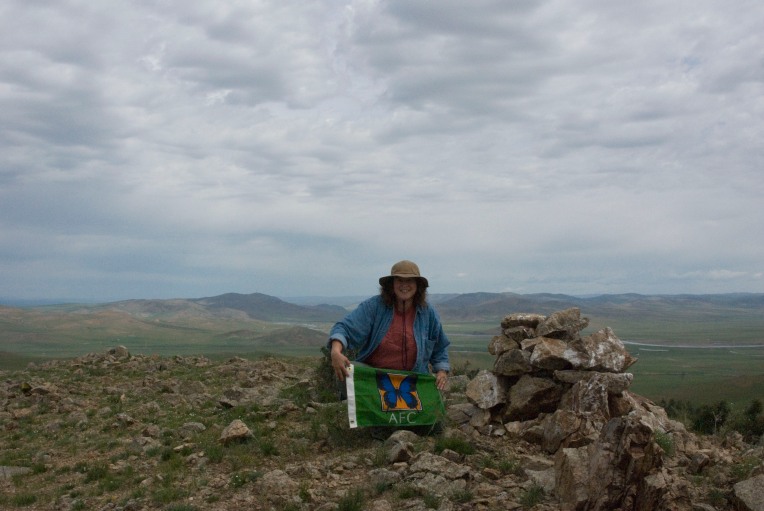
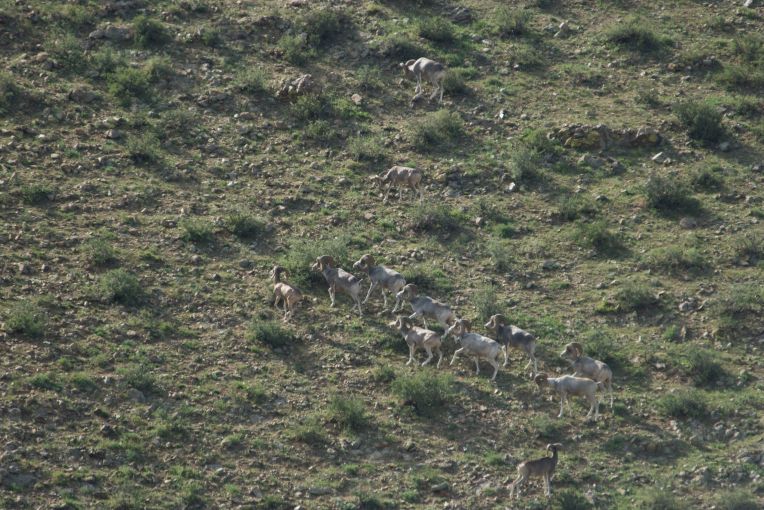
Domestic bactrian camelsPosing with the flagArgali; the big group of 14 we saw
After four fabulous days at Gun-Galuut, we drove back through UB, where I picked up a copy of a bird guide and we ran a couple of other errands. Then it was south to Baga Gazriin Chuluu, with a one night stay at Arburd Sands. It was windy and there were dark clouds around. We stopped for lunch and could hear thunder in the distance. Then it got interesting.
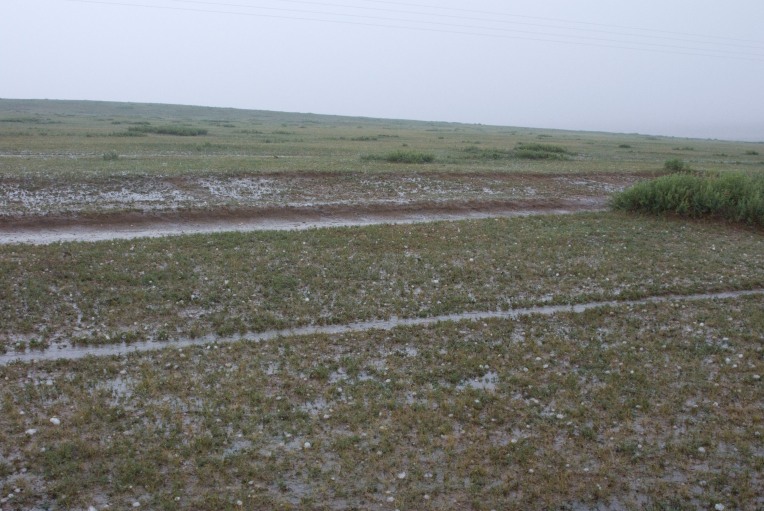
Hail; looking out car window
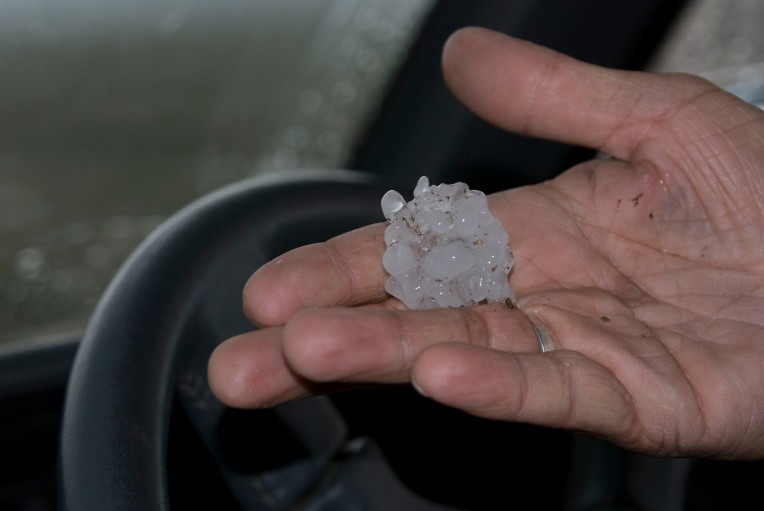
We found ourselves out in the open on the steppe in a violent rain and then hail storm. It was so bad that Khatnaa turned the car so that the back was to the wind to protect the windshield. The sound of the hail hitting the top of the car was really loud and left dents. All we could do was sit tight and wait it out.
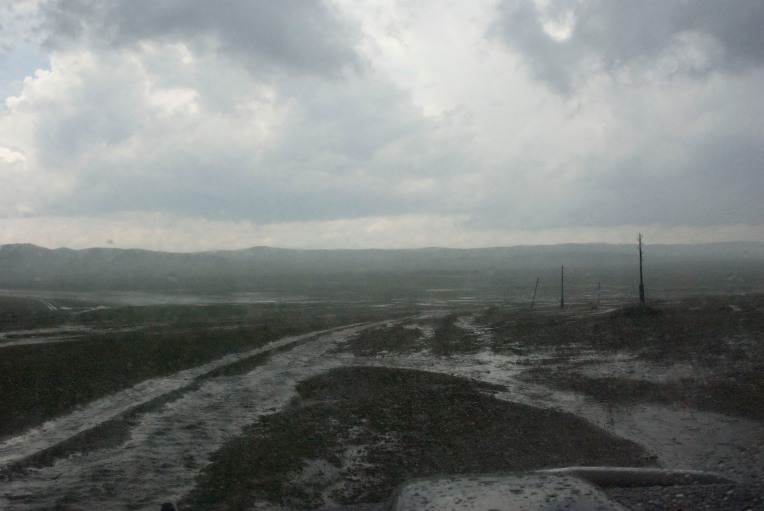
Hailstone that Khatnaa picked up off the groundRoad after hailstorm; the direction we were heading
All the dirt track, or as Khatnaa called them, earth roads had become rushing rivers of water. Amazingly, he was able to pick our way across this safely and without getting stuck in his Mitsubishi Pajaro diesel SUV.
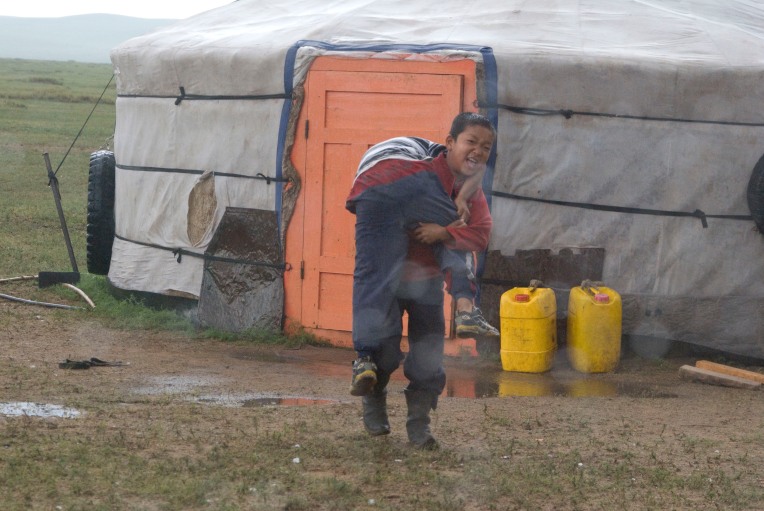
Kids wrestling in the rain
Finally, the hail stopped and we were able to go on. Khatnaa had only been to Arburd Sands once a number of years ago and when he became unsure of the route, he stopped a couple of times and asked for directions. These kids put on a wrestling demo for me while I waited in the car. They were really showing off their moves.
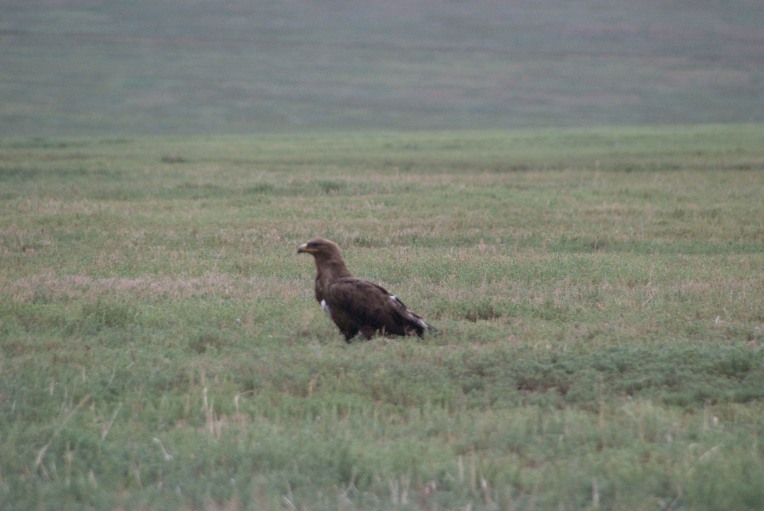
Young golden eagle by side of road
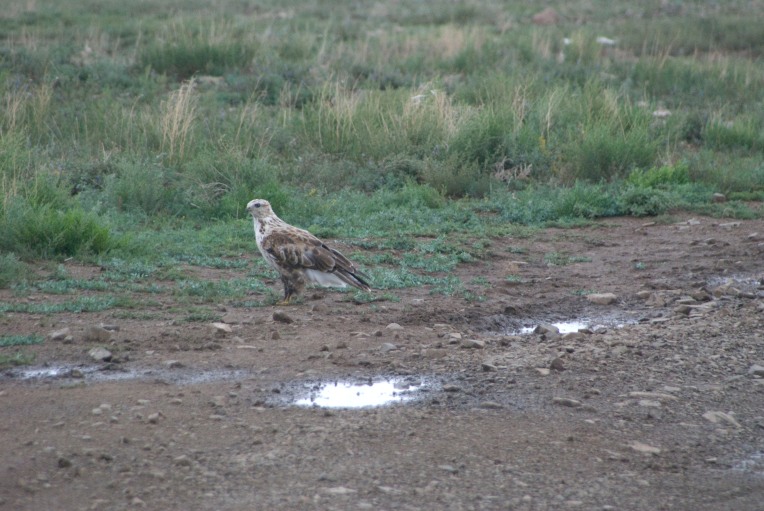
We started to see raptors by the side of the road once we got out past the storm front.
Upland buzzard
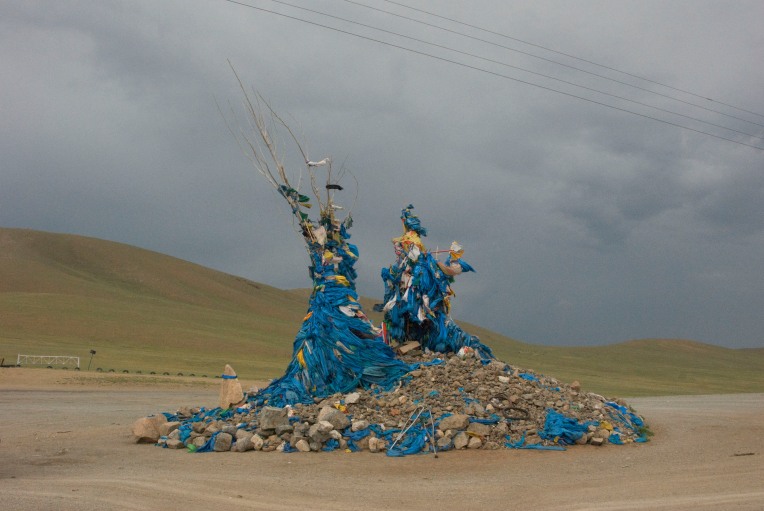
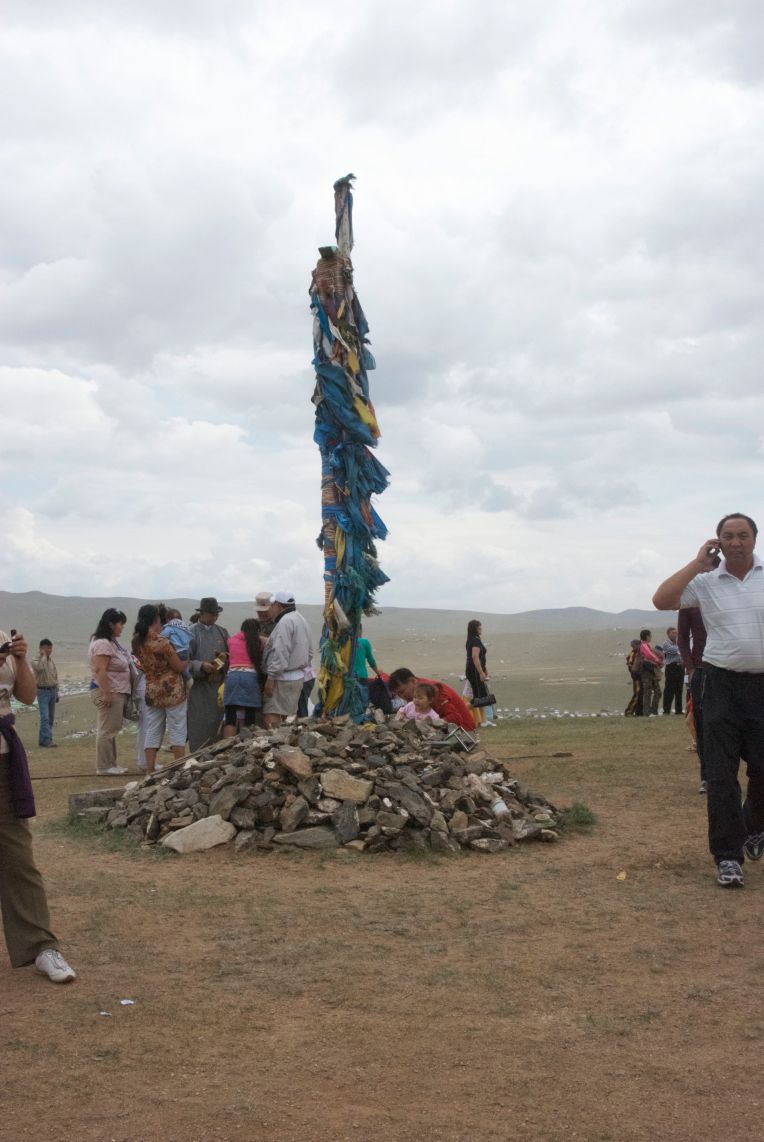
We also passed a number of ovoo. If it was a major one, we stopped, got out and circled it, adding a stone or small tugrik bills. Khatnaa honked at smaller ones as we went by them. More on ovoos in a future post.
Large ovoo
We arrived at Arburd Sands and found out that the storm we had sat through had hit UB, causing the worst flooding in many years. At least 21 people died. If we had not gotten out of UB when we did, we might not have made it out of town at all.
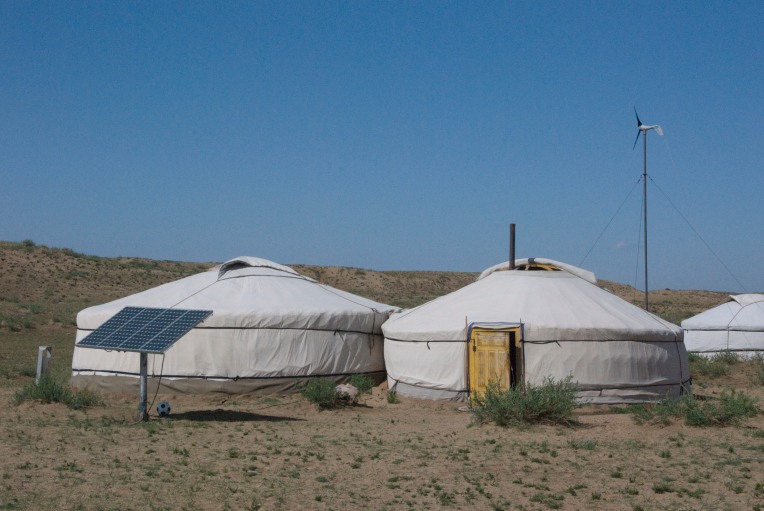
Arburd Sands ger camp is a seasonable sustainable operation which is planned so that it leaves as little a mark on the land as possible. They use solar and wind for power.
Sustainable energy at Arburd Sands
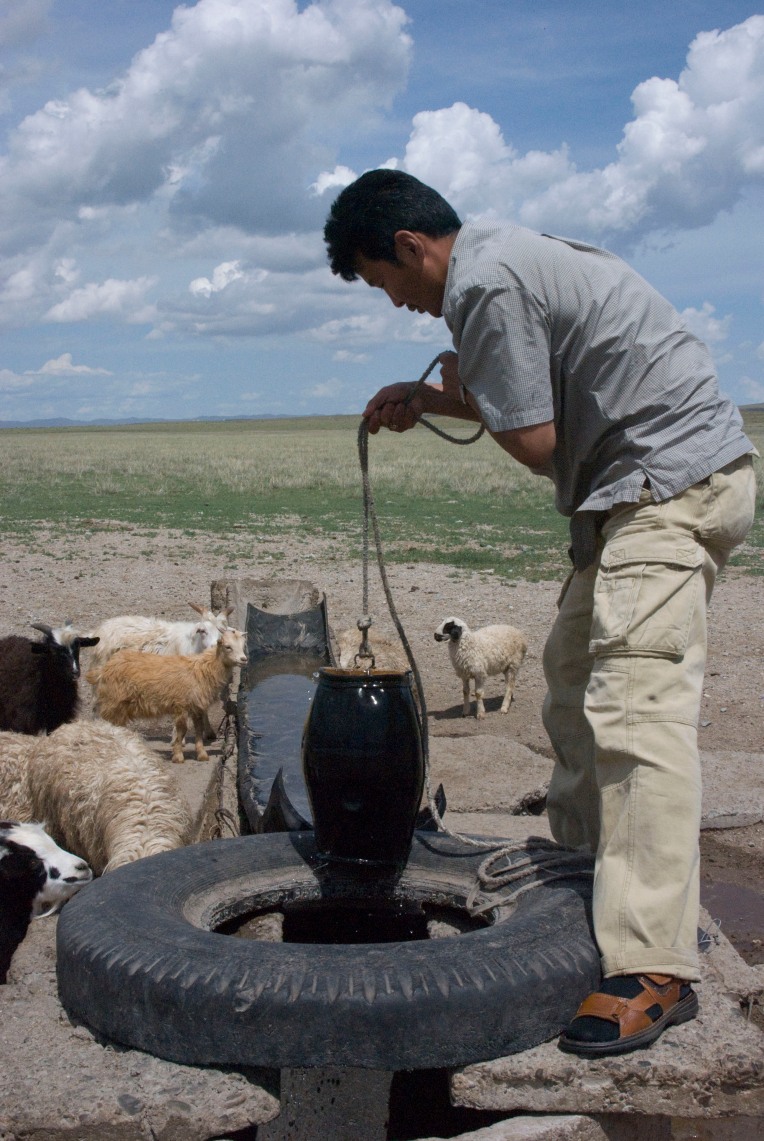
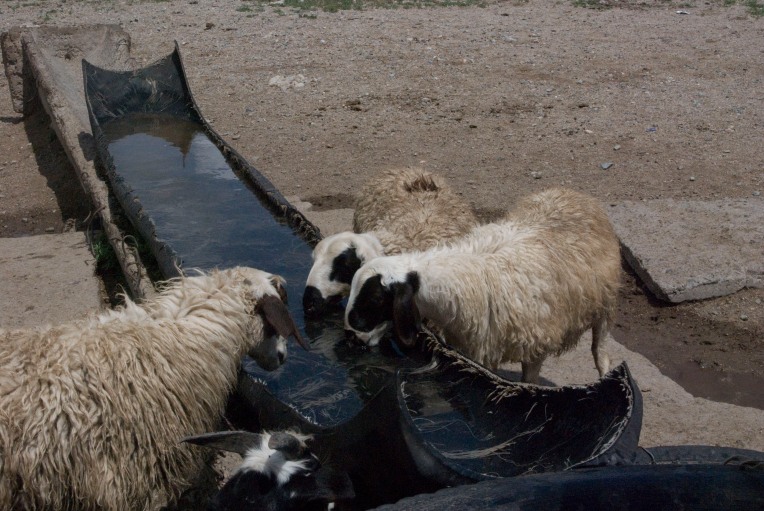
There was an amazing display of thunder and lightning that evening, stretching from east to west. But it only rained during the night. No hail. The next morning we continued on to Baga Gazriin Chuluu Nature Reserve. But, as I am coming to realize is routine when one travels in Mongolia, there were interesting things along the way. Like when Khatnaa stopped at this well and, following the ancient Mongol tradition, drew a couple of buckets of cool water for the animals.
Khatnaa pulls water from the wellSheep drinking the cool well water
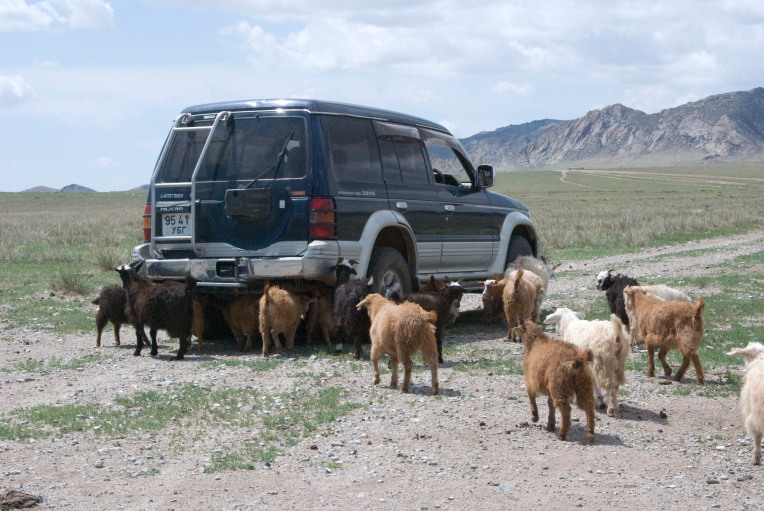
Meanwhile, the goats were seizing another, albeit temporary, opportunity to take advantage of the shade under the car.
Goats going for the shade
We traveled across the rolling steppe, passing an enormous and impressive mountain, a small lake and many country people and their flocks of animals. Finally, in the distance, we could see our destination, Baga Gazriin Chuluu.
Baga Gazriin Chuluu rises out of the steppe
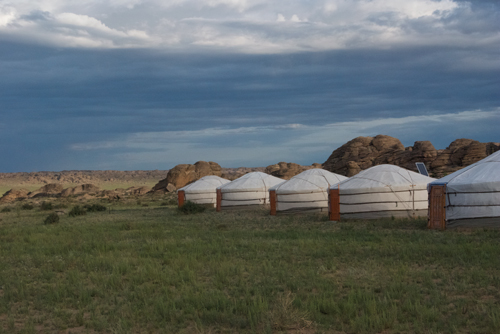
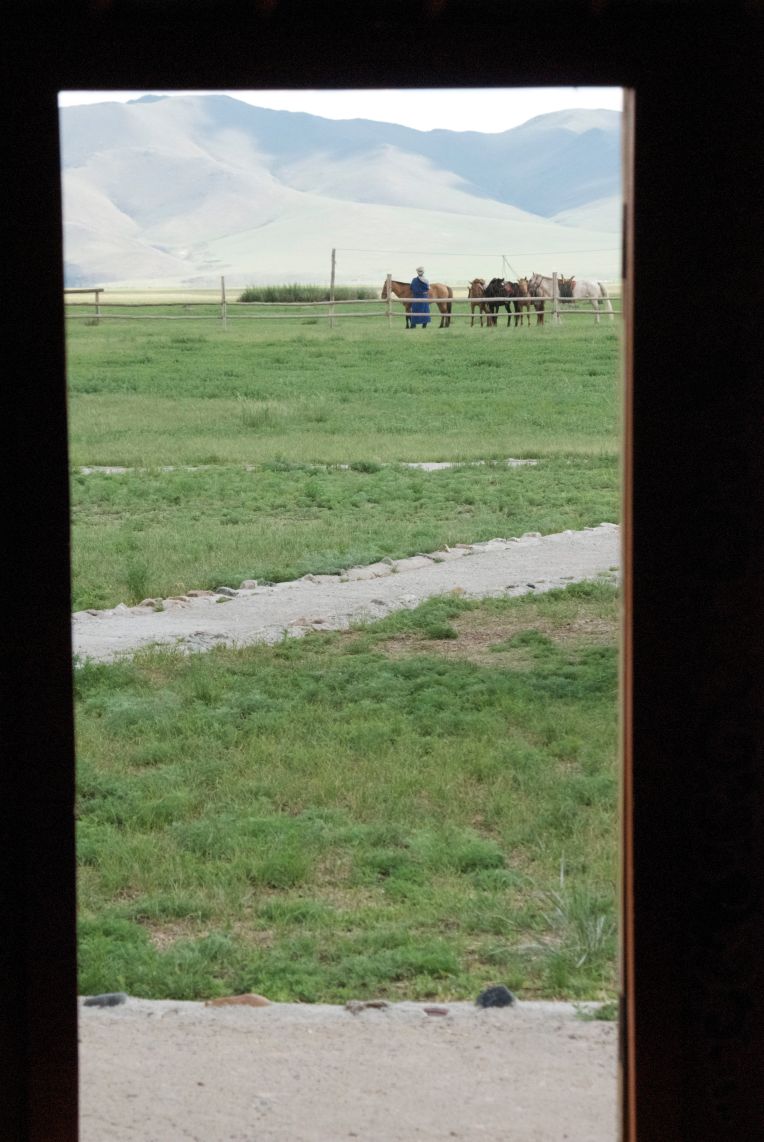
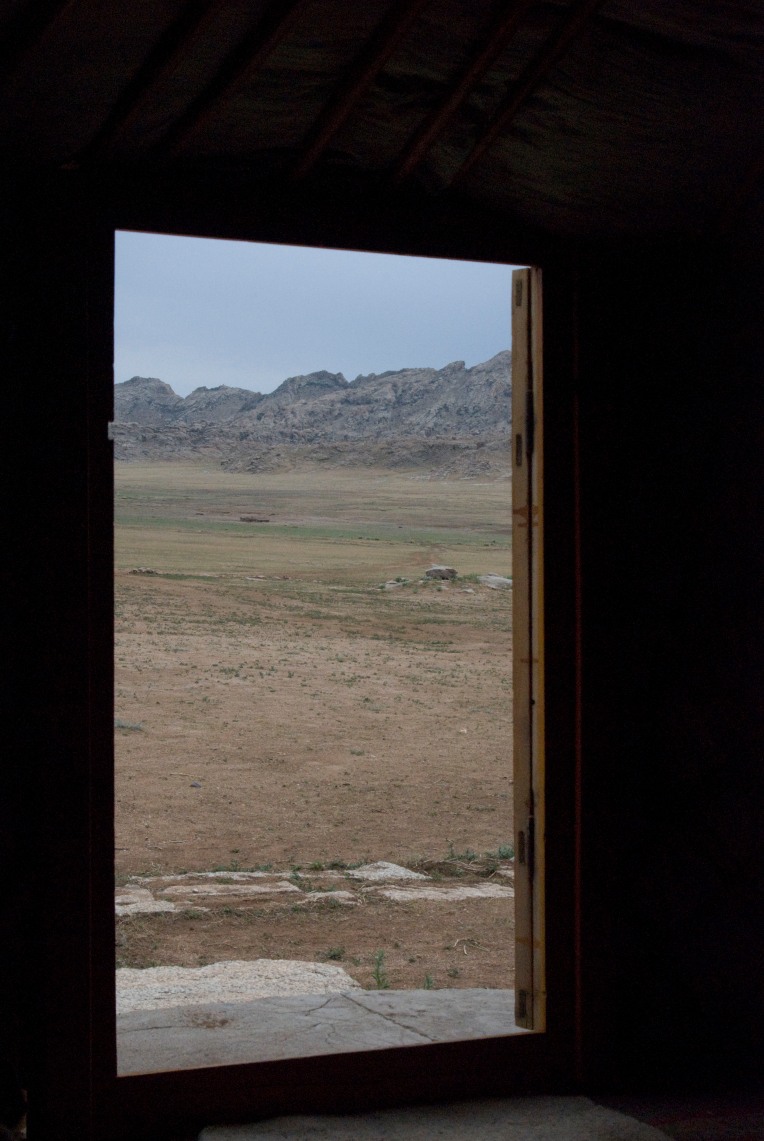
We arrived at the ger camp and went through the usual routine of settling in. Here’s my view through the door of my small, but comfortable ger.
View through the door of my ger
Khatnaa, as the guides usually do, started to chat up the camp staff. He found that one man, Onroo, had lived full-time at the reserve for three years and had a pretty good idea of where the animals were to be found. He went with us both mornings and proved to be indispensable.
The setting
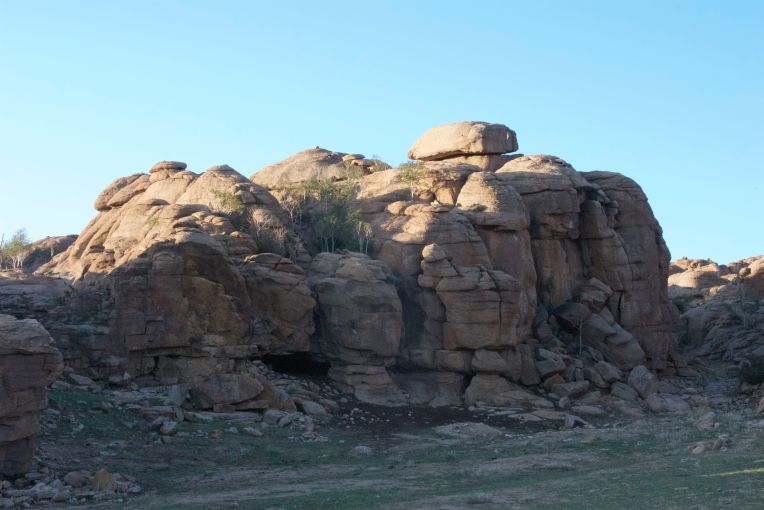
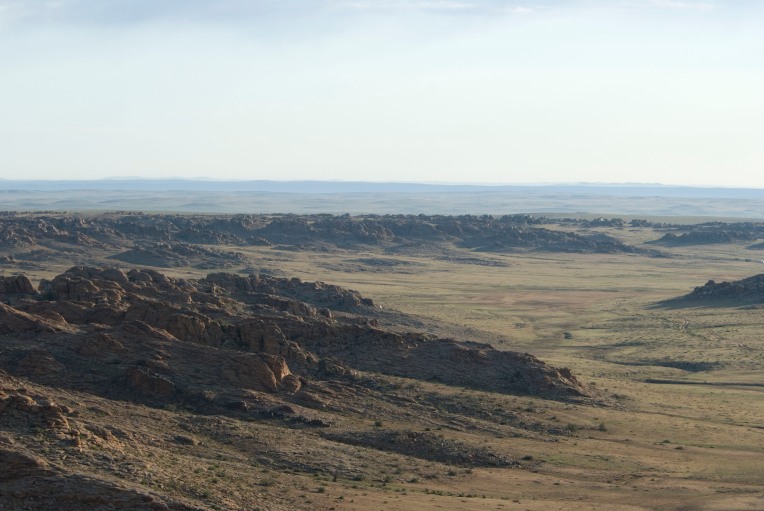
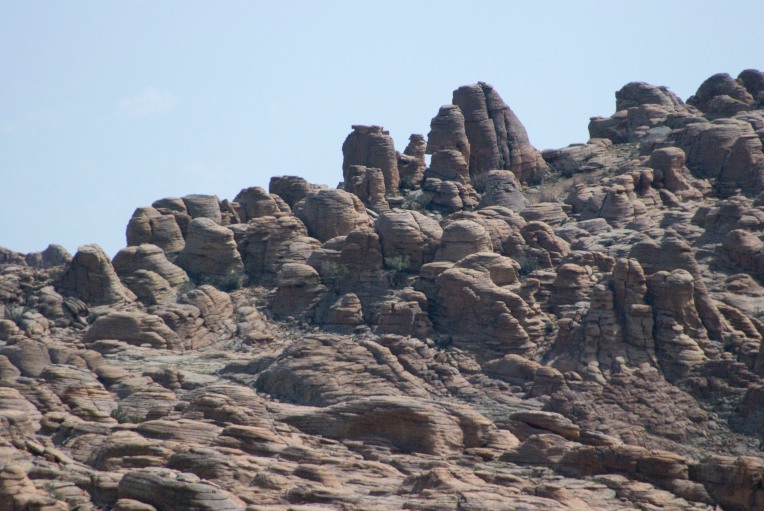
Some of the fantastic rock formations.
Rock formationsRocks, late afternoon
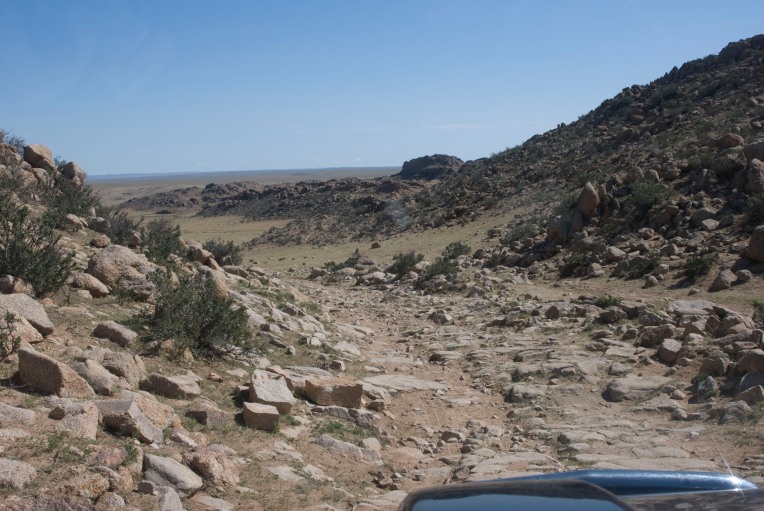
Sometimes the going got interesting as we worked our way around the reserve.
Rocky road
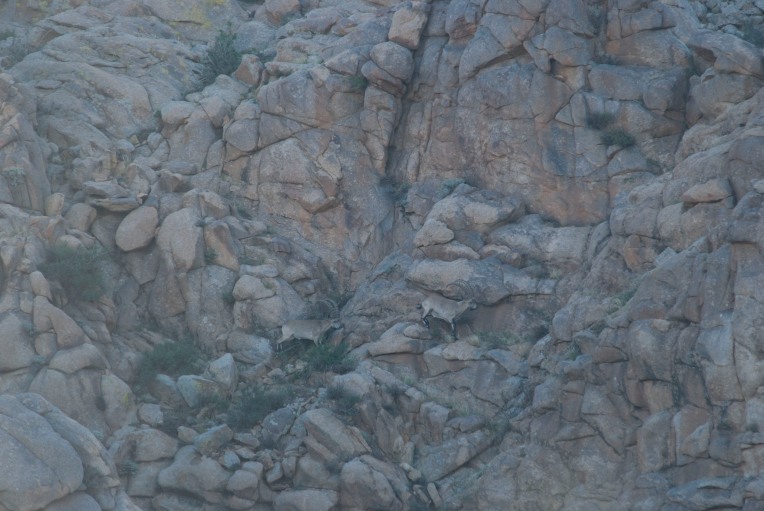
The main species of interest here are argali, ibex and the cinereous vultures.
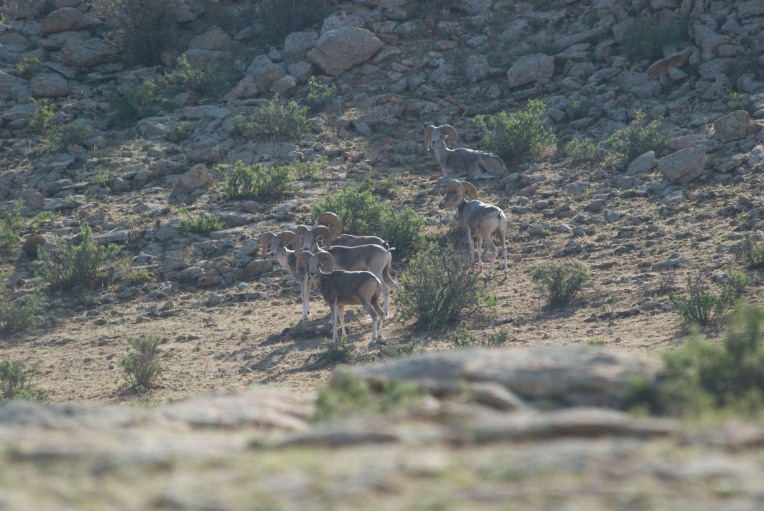
Six argali
These animals were so tolerant of our presence that we were able to get out of the car and take pictures of each other with the sheep in the (somewhat distant, about 800 meters) background.
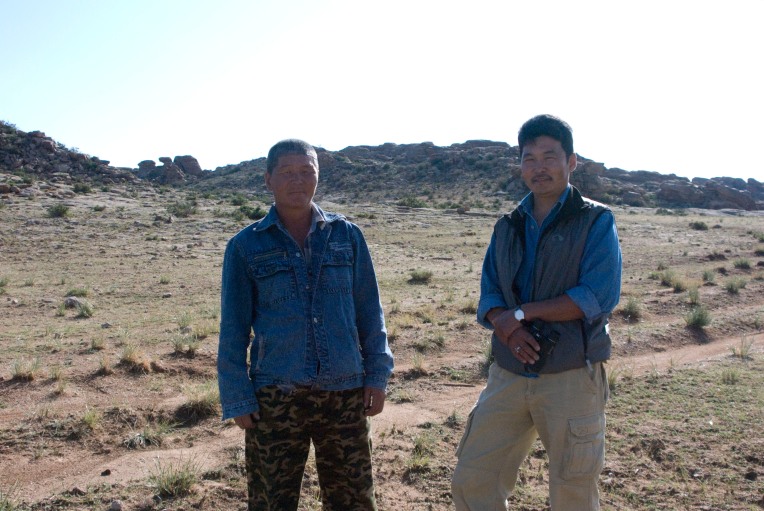
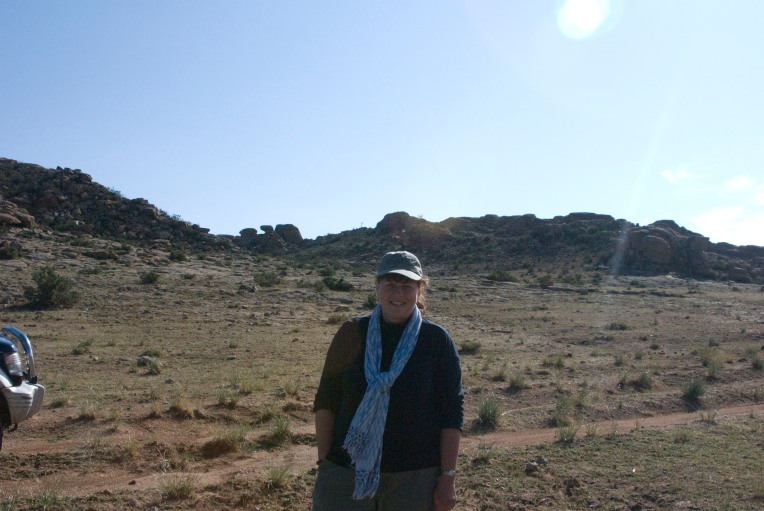
Onroo and Khatnaa in front of argaliMe in front of argali
They’re at the base of the rocky hill to my right on a line with my cap.
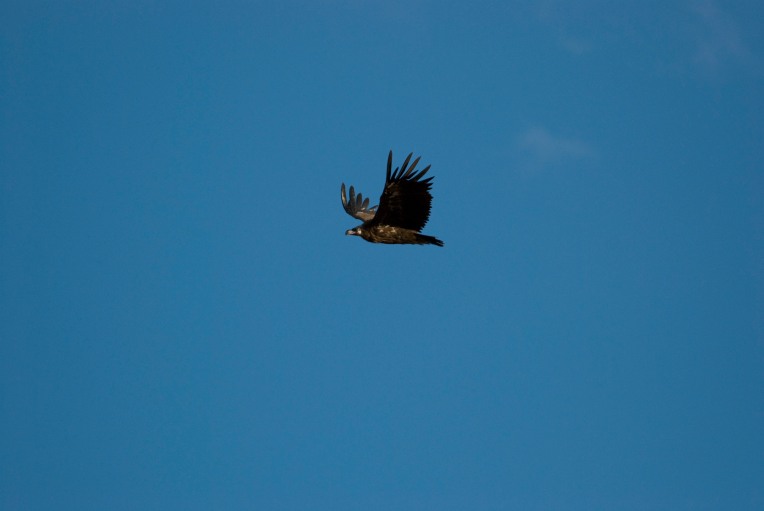
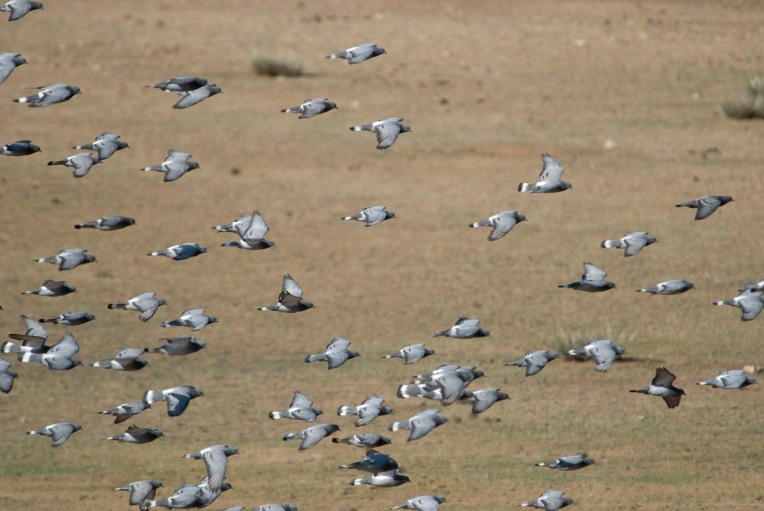
Ibex; two large billies of a group of fiveCinereous vultureHill pigeons (Columba rupestris); a relative of our "beloved"urban rock pigeon
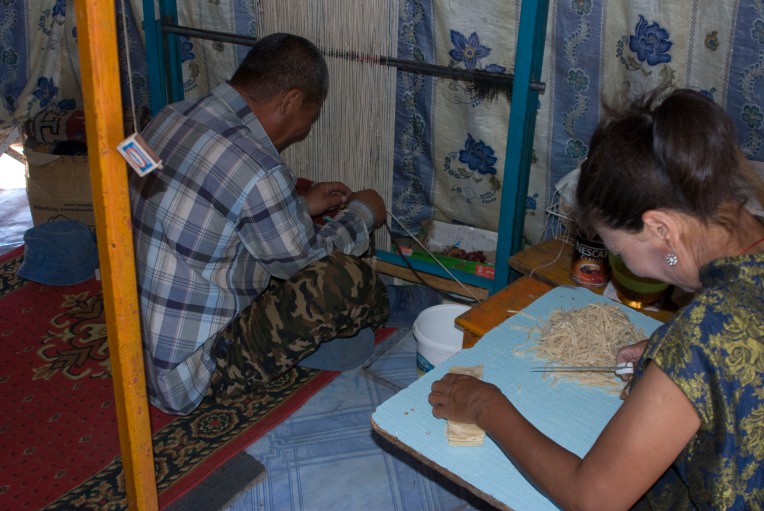
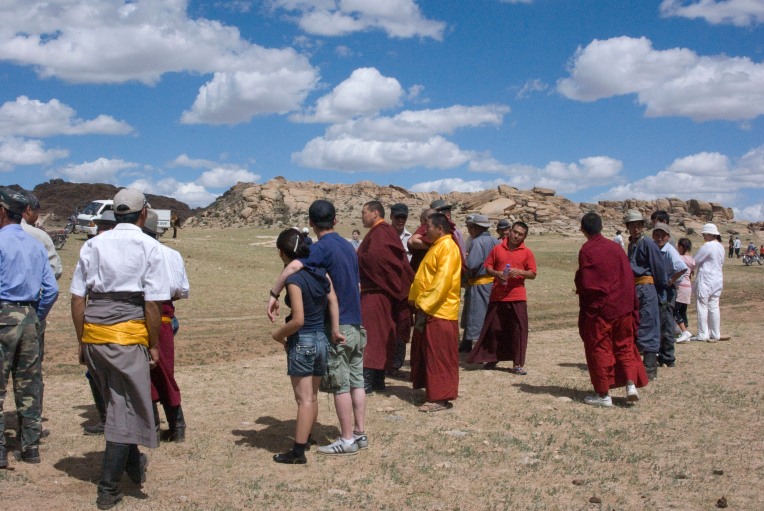
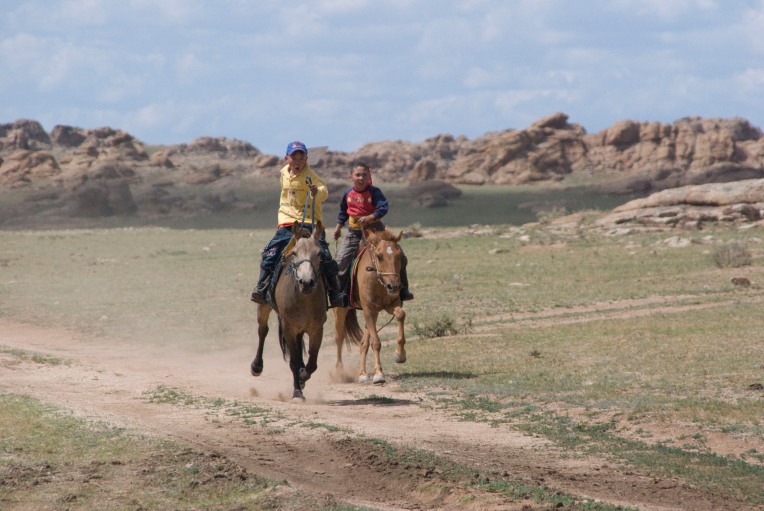
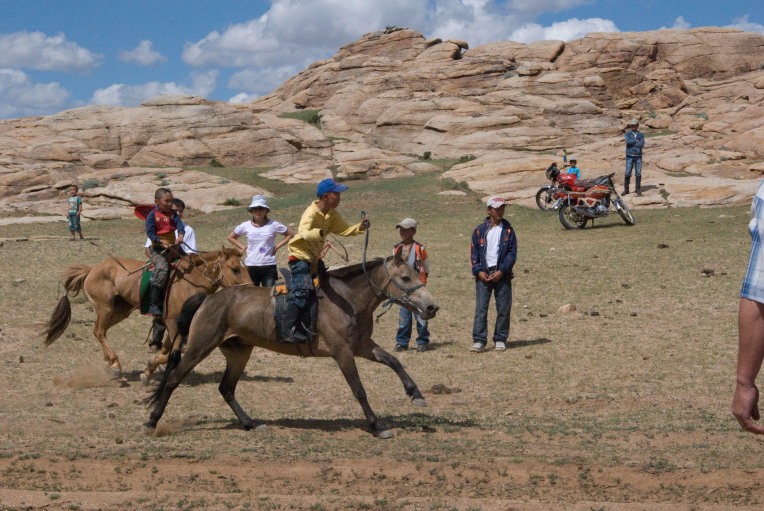
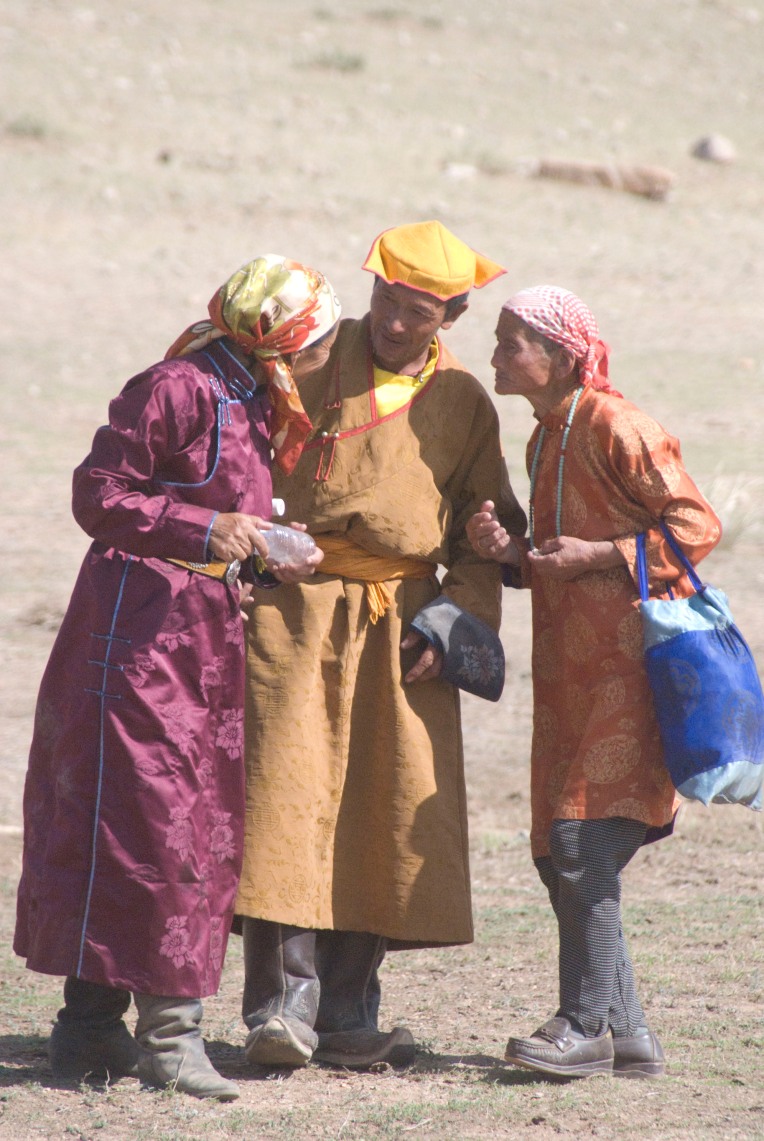
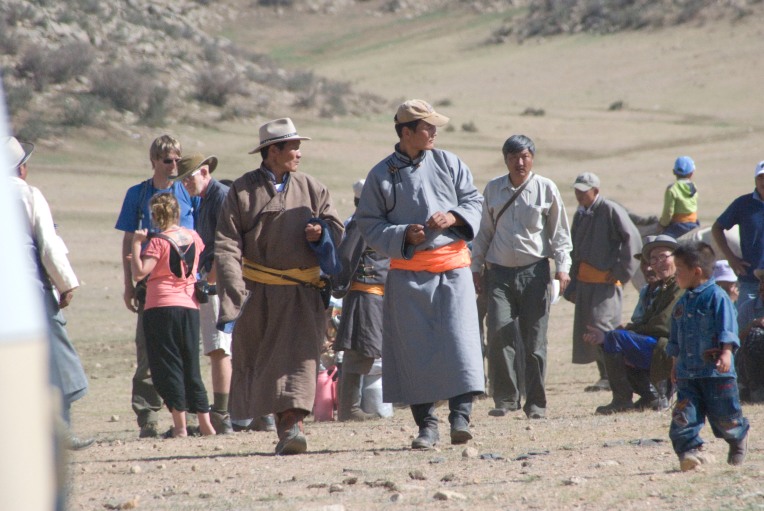
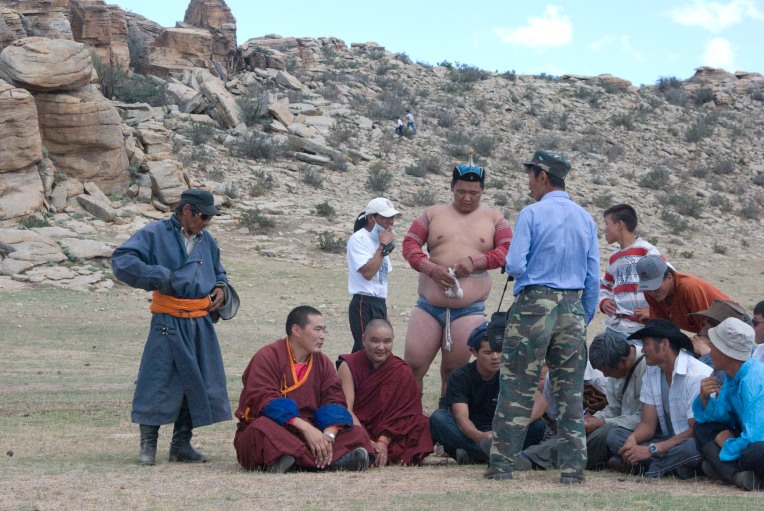
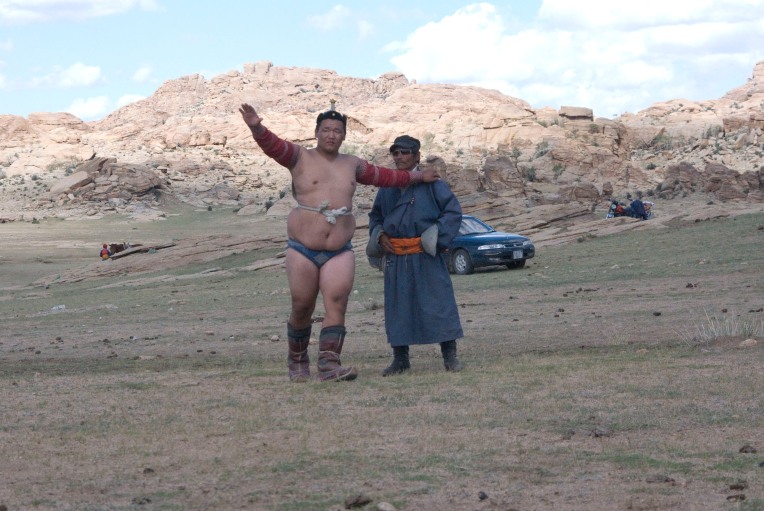
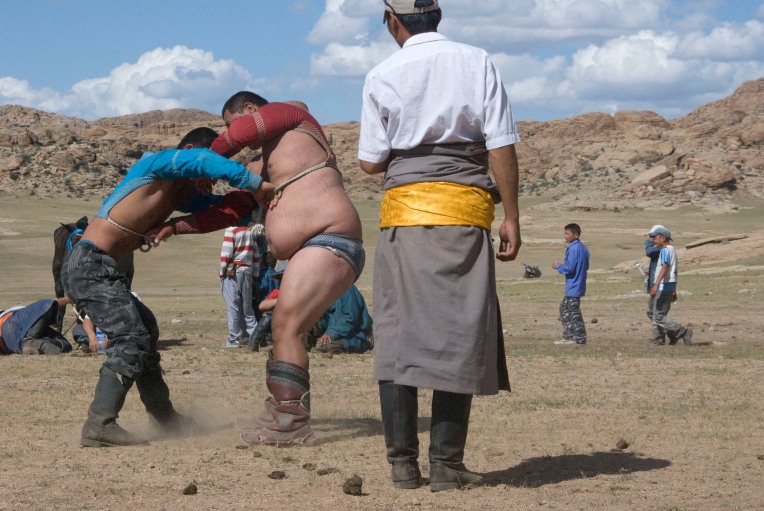
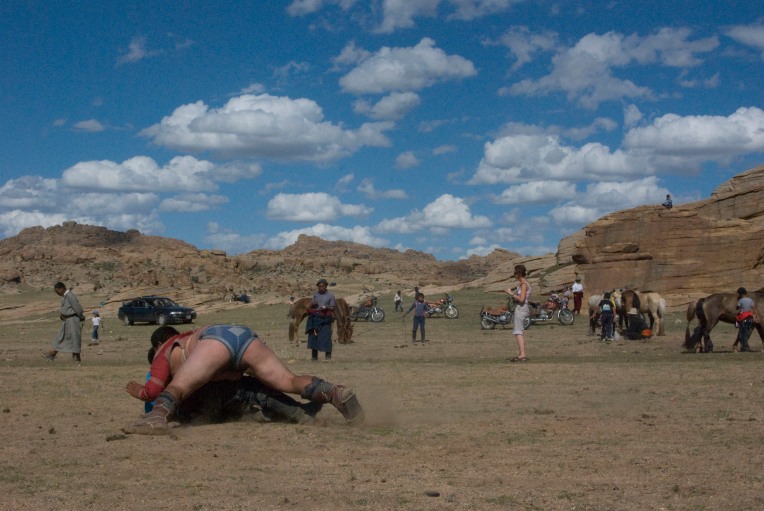
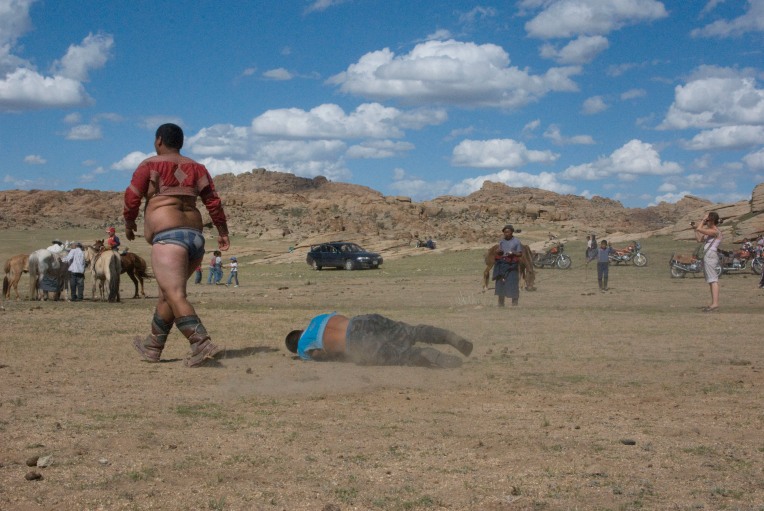
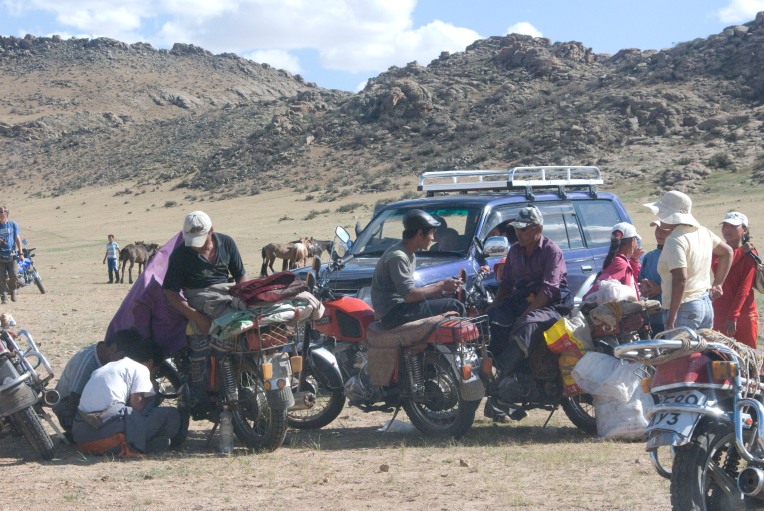
I ended up having a couple of wonderful cultural experiences also, which included a ger visit where I got to watch soup made with boortz, dried meat, and where we were served that and cream, aruul, yogurt and milk tea and also getting to attend a “mountain washing” ceremony that included chanting Buddhist monks, a horse race, wrestling and anklebone shooting.
In Yanjmaa's ger; she's making noodles for soup and Onroo is doing some weaving on her loomHorse race spectatorsHorse raceHorse raceMountain ceremony attendeesMen in del and sashes; they look good and they know itWrestling; almost ready to start The Falcon of the Aimag doing the traditional Eagle Dance before a boutGrappling for advantageHe fell on every opponent like this The guy on the ground was up in a moment and ok; the Falcon won the competitionEnd of the event; last chance to chat
I got back to UB a few hours ago. It was the road trip of a lifetime, wildlife wise. At both Gun-Galuut and Baga Gazriin Chuluu, I saw and photographed argali almost every time we went out on a “game drive”.
Some sightings yielded over 100 images in 20 or so minutes. I got argali in morning light, argali in evening light, argali at dusk, argali in shadow but doing interesting things.
There were large groups of rams, small groups of rams, nursery groups of ewes and lambs and mixed groups of both sexes.
I photographed one group of rams at Baga Gazriin Chuluu that was out in the open at the base of a rocky hill about 800 meters from the road. They were a little nervous, but didn’t run away. In fact, they ended up being so tolerant of our presence that we were able to get out of the car and take turns taking pictures of each other with them in the background.
A lion’s share of the credit for this has to go to one of the Best Guides Ever, Khatnaa, who seemed to have an uncanny feel for where the animals might be, even though he hadn’t really done this kind of thing before. He runs his own tour company, but took me on via Nomadic Journeys. His English is very good, so I learned a lot about Mongol history and culture and he helped me on my pronunciation since I am determined to learn at least conversational Mongolian.
Besides argali, I’ve photographed ibex, cinereous vultures, golden eagles, upland buzzards, black kites, demoiselle cranes, endangered Siberian white-napped cranes and even a lady bug. Plus Mongol horses and bactrian camels.
I’ve also been able to visit gers, eat Mongolian summer “white food” like aruul, cheese, yogurt, cream and airag and yesterday went to a local “mountain washing” ceremony, complete with chanting Buddhist monks, tons of mutton and gallons of airag, plus a 7km horse race, anklebone shooting contest and a wrestling competition.
I’m in UB tomorrow and then off to Ikh Nart, I hope. The weather has been, shall we say, unusual. About two hours out of UB last week, we got clobbered by a hail storm so serious that Khatnaa turned the car around to protect the windshield. Some of the hailstones were an inch across. He has dents in the roof of his Mitsubishi SUV. That fast-moving front caused serious flooding in UB in which 21 people died.
As we approached the hotel this afternoon, it started to rain here in UB. By the time Khatnaa had pulled into the parking lot, it had started to hail. We sat in the car for almost 20 minutes until it was just raining hard. Once again he turned the car so that its back was to the storm. He commented that he could never remember two storms like this in one month.
The scientist who I am to travel to Ikh Nart with is due in at 10:40 tonight. Whether the flight will come in is anybody’s guess with this weather. Stay tuned.
And photos to come as soon as I do the jpeg conversions.
The day was cloudy and cool, really rather nice. It could have been 90F in the shade. We left for the horse race site and spent two hours in traffic that was almost indescribable. A cross between Mr. Toad’s Wild Ride, bumper cars without anyone actually making contact and a free-for-all race to get to the valley. Over here we would describe it as “a solid line of cars”, but the word “line” doesn’t remotely apply. The road had been blocked so that both lanes ran in one direction, but people were on the shoulder and off on parallel dirt tracks, all weaving in and out to gain advantage. It was kind of like….a wacked-out horse race.
Our guide, Osoo, estimated that around one third of the population (2.7 million) of the country was present at the race. There were literally thousands of cars on a two lane road all trying to get to the same place.
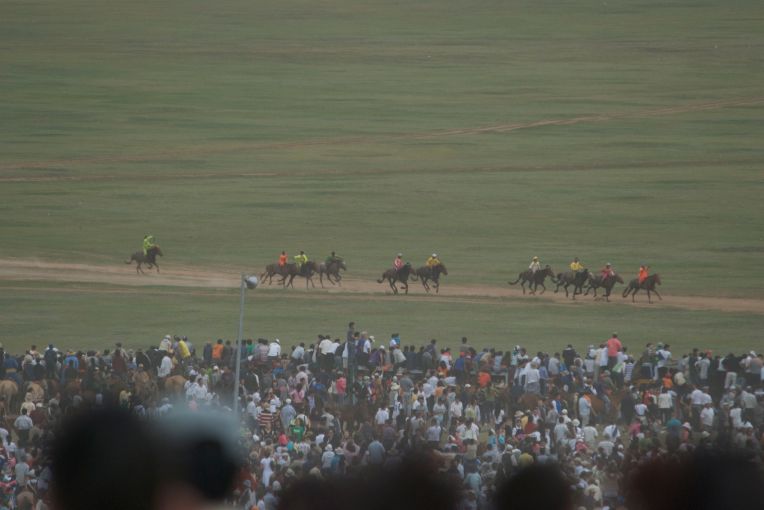
We arrived and some of us took up station on the top of the hill. Others braved the packed flat area adjacent to the track. With the long lens, I got some pretty good pictures. It was a festive day and the vibe was great. It was like a convival country fair with about 900,000 fairgoers spread out over a large valley.
This was the second to the last race. It was for five year stallions, 25 km. The jockeys ranged in age from 5-12. The horses had already trotted or cantered the 25km to the starting line before the race and then they galloped the whole 25km back to the finish line. There were a lot of support vehicles, including an ambulance. There were also vets ready if needed.
Without further ado:
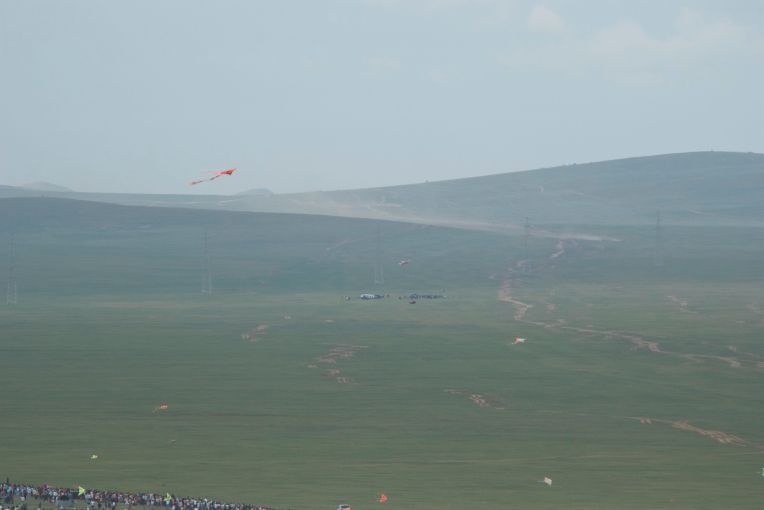
Crazy trafficHorse race crowdThe dust cloud shows the horses almost to the valleyThe lead horses approach the finishRunning for the finishOrange passes white and red near the finish lineSecond large group coming in
We never found out who won, but it was an exciting finish and the crowd was roaring. The fastest horses finished in 30-40 minutes, the slowest took about an hour.
Horse race crowd with racers gers in backgroundOvoo; on highest point; a old animistic custom
Time to go back. Traffic not quite as frantic, but still pretty wild. Lots of herders with their animals along side the road.
Sheep and dust
We had picnic lunch in the van and then went back to the stadium. Unfortunately, the archery and ankebone competitions were over. But a couple of the archers were still at the archery field, including the winner.
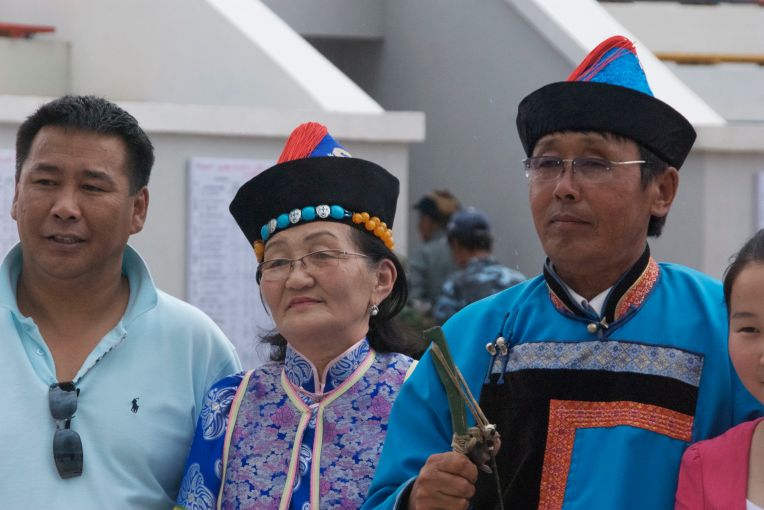
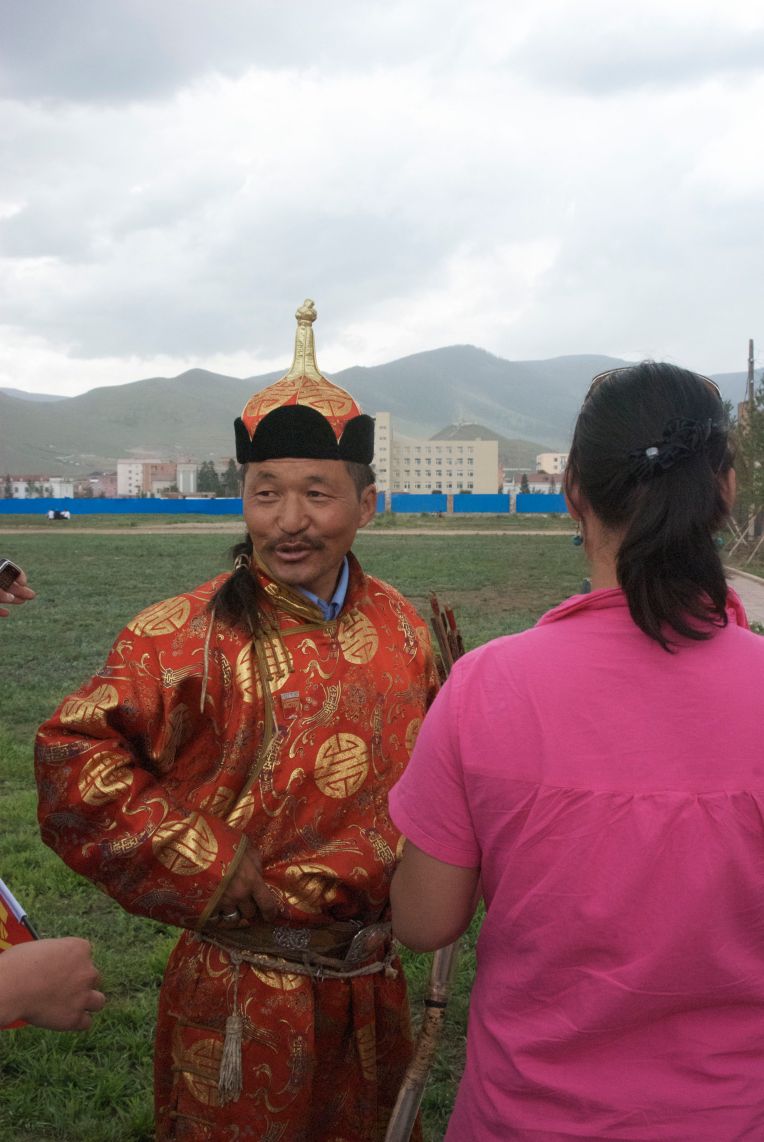
Winning archer, his wife and a fan
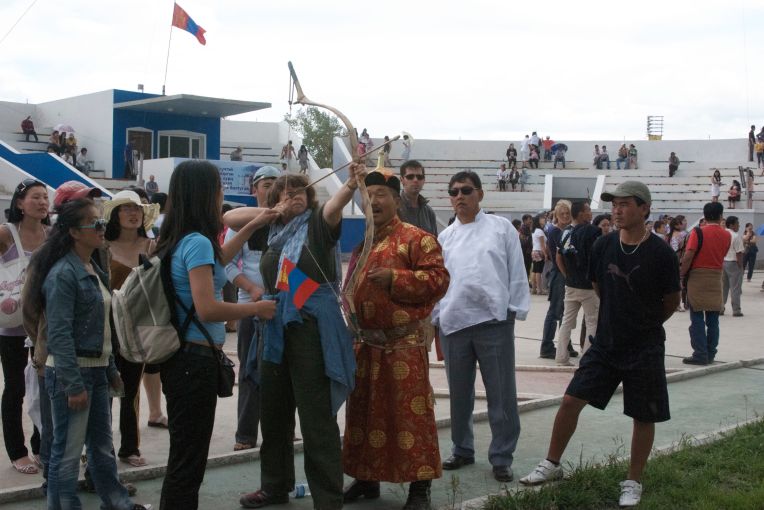
Another archer was giving a demonstration and, for 1000 tugrik, about 80 cents, you could shoot an arrow. Couldn’t resist the chance to try that, of course.
Archer doing demonstrationI got to shoot the bow and arrow; about 40lb. pull
Then it was back to the wrestling in the national stadium. It was packed and then it started to rain. Hard. For over an hour. So there were rain delays and still eight wrestlers competing when we had to go.
Wrestling; the average height of a Mongolian may be 5'2", but there are plenty of big guys, tooWrestlingWrestling
On our way out, we passed someone who was allowing people to pose on his horse for pictures.
They really do start them young in Mongolia
It was back to the hotel to rest for an hour or so, then dinner at …..BD’s Mongolian BBQ, which suited me just fine. Then off to the Naadam concert, performed by the Mongolian State Grand National Orchestra. And grand it was. They are definitely ready for their first world tour. There are 65 members, playing mostly Mongolian instruments like the morin khur, or horse-headed fiddle, but also some western instruments like trumpets. Almost all the music was by Mongolian composers, but they also did an enthusiastic version of “The Barber of Seville” and, for the encore…..”We Are The Champions” by Queen!
Off to Gun Galuut. Need to pack and get breakfast. Next post will be the 21st or 22nd. Bayartai!















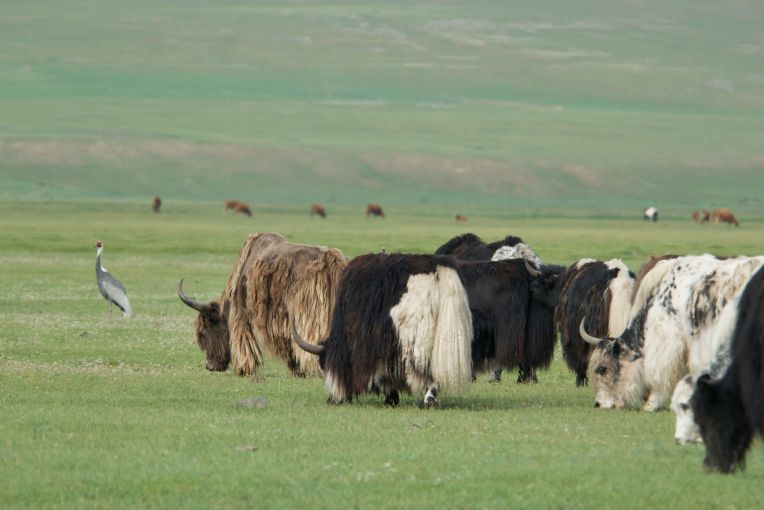 White-napped crane and domestic yaks








 Susan Fox, American Artist