Mongolia Monday (More from “Among the Mongols”)- Hospitality

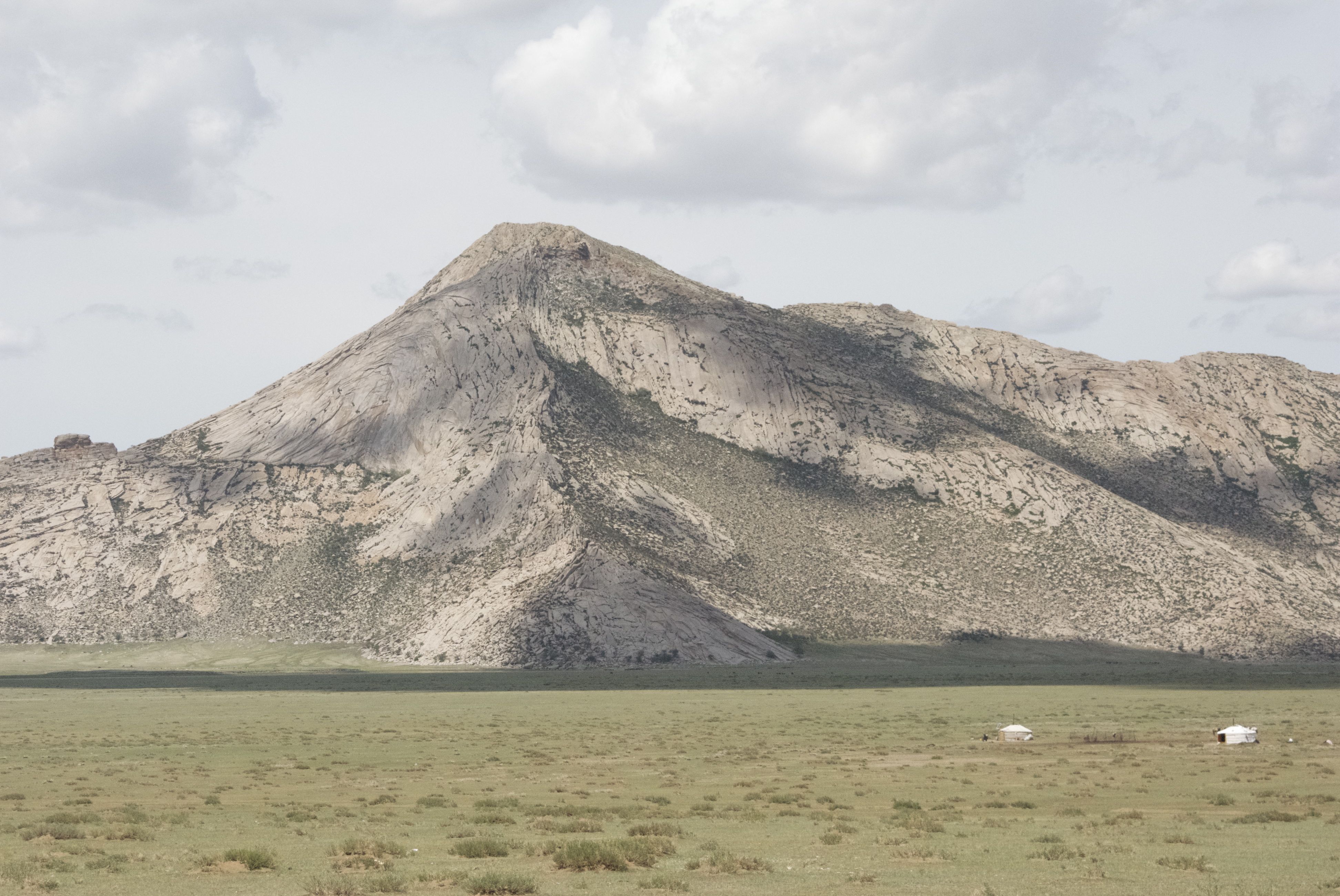
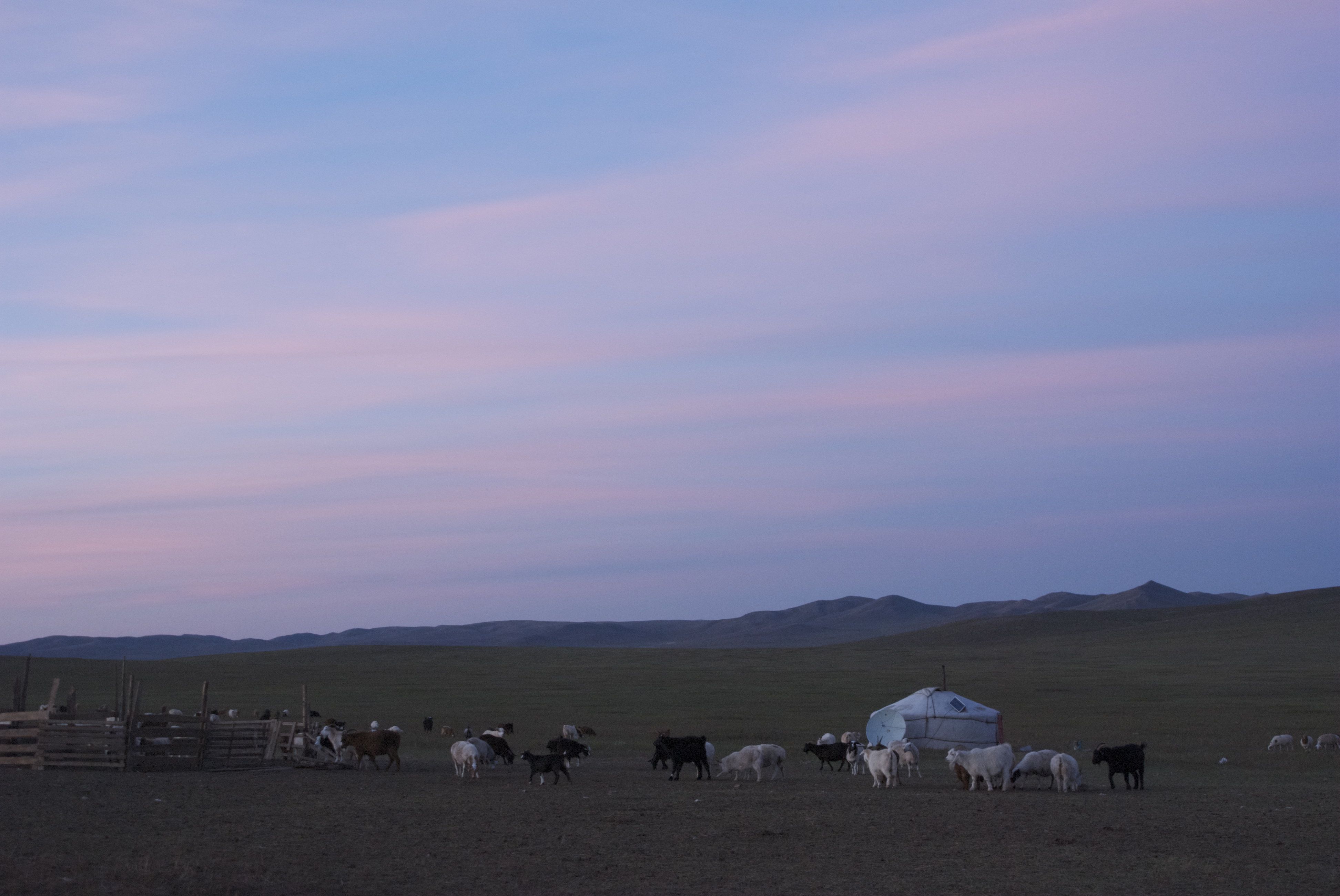
Ger near Arburd Sands, Sept. 2008

One of the interesting and, to a lot of Westerners, amazing things about traveling in Mongolia is that the thousand-plus year old traditions of hospitality out in the countryside are still practiced. It feels very odd to walk up to someone’s ger (assuming there are no dogs in sight), open the door and walk right in without knocking. After four trips, I still get a twinge doing it.

I found myself very intimidated the first time. There are no windows in a ger and the door is solid wood so, even with a guide, you are walking into someone’s home without any idea of what to expect. Fortunately, the Mongols are patient and understanding, like my first time, when I turned to the right instead of the left and circumnavigated the ger to get to the stool that I was to sit on.

At least I remembered not to step on the threshold or walk between the upright supports.

The older gentleman approved of the fact that I was wearing Mongol boots. He said to me, through my guide “I see Mongol boots and I look up and see… a western face”. It was spring, which means really cold and windy, and they were the warmest footwear I had with me, having purchased them at the State Department Store in UB. They worked, of course. I asked if he would be willing to have his picture taken with a westerner wearing Mongol boots and he immediately sat up, buttoned his del and made room for me to sit beside him on the bed.

First-ever ger visit; ok, I'm hooked; near Hustai National Park, May 2005

Those thermoses keep water hot, hot, hot for over 24 hours. I want one. I just have to figure out how to carry it home.
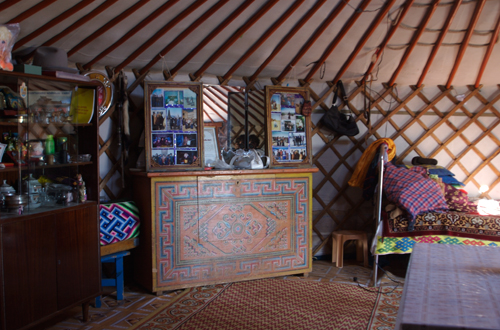
Ger interior; the Gobi near Bayanzag, Sept. 2006

Now ger visits are one of the things I MOST look forward to when I go to Mongolia. A ger, maybe because of the quality of space that the round shape creates, is one of the most pleasant and peaceful places that I’ve ever been in. I just happily sit sipping milk tea or airag and nibbling aruul as conversations that I don’t understand a word of go back and forth between my guide and our hosts.

Mutton almost ready; my driver really tucked in; I passed; western Mongolia, Sept. 2006
Boortz soup; Yum!! Mutton I can believe in (and eat safely); Baga Gazriin Chuluu, July 2009;
Aruul; an acquired taste that I had acquired after about three (careful, 'cause it was rock hard) bites; western Mongolia, Sept. 2006
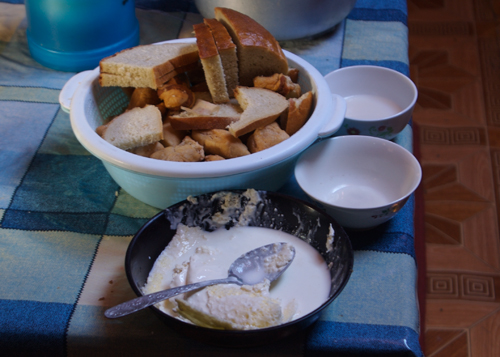
Mongol-style clotted cream; to die for- near Hustai National Park, Sept. 2006

Gilmour seems to have relished ger visits also and provided a good description of the customs:

“As for entering tents on the plain, there need be no bashfullness. Any traveler is at perfect liberty to alight at any village he may wish and demand admittance; and any Mongol who refuses admittance, or gives a cold welcome even, is at once stigmatised not a man but a dog. Any host who did not offer tea, without money and without price, would soon earn the same reputation, the reason being, I suppose, that Mongolia has no inn, and all travelers are dependent on private houses for shelter and refreshment. At first sight it seems rather exacting to leap off your horse at the door of a perfect stranger, and expect to find tea prepared and offered to you free; but probably the master of the tent where you refresh yourself is at the same time sitting likewise refreshing himself in some other man’s tent some hundred miles away; and thus the thing balances itself. The hospitality received by Mongols in travelling compensates for the hospitality shown to travelers.”

Young hostess; near Hustai National Park, Sept. 2009 (the ger with the CREAM)

Mongolia Monday- This Week’s EBay Listing 1-4-10; A Takhi From Khomiin Tal SOLD

I thought I’d get a two-fer this week and combine my eBay listing with Mongolia Monday since the painting up for auction is a 8×6″ oil of a takhi (Przewalski’s horse). It’s from a photo that I took at Khomiin Tal, the westernmost of the three takhi reintroduction sites in Mongolia. I visited there in September of 2006. What an adventure that was for me! I flew out to Hovd, met my guide and then went by Russian Fergon van (those of you who have been to Mongolia know what that means…) east over 100 miles on what the Mongols call “earth roads” to the river valley where the horses were. I got to see them in late afternoon and morning light and got a lot of good reference. Here’s a photo of some of the horses grazing-

Takhi grazing at Khomiin Tal, western Mongolia

And here the painting that is currently available at auction here

Takhi 8x6" oil on canvasboard

Mongolia Monday-More From “Among The Mongols”; Traveling By Horse

While I’ve done my traveling in Mongolia by vehicle, the following, for me, really evokes what it’s like to journey through the countryside. I’ve included a few images from my trips.

“Traveling in Mongolia has many pleasures, but ordinary traveling is so slow that the tedium threatens to swamp them all. Horseback traveling does away with the tedium as far as possible, and presents the greatest number of new scenes and circumstances in rapid succession. Night and day you hurry on; sunrise and sunset have their glories much like those seen at sea; the stars and the moon have a charm on the lovely plain.

Ever and anon you come upon tents, indicated at night by the barking of the dogs, — in the daytime seen gleaming from afar, vague and indistinct through the glowing mirage. As you sweep round the base of a hill, you come upon a herd of startled deer and give chase, to show their powers of running; then a temple with its red walls and gilt ornamented roofs looms up and glides past.

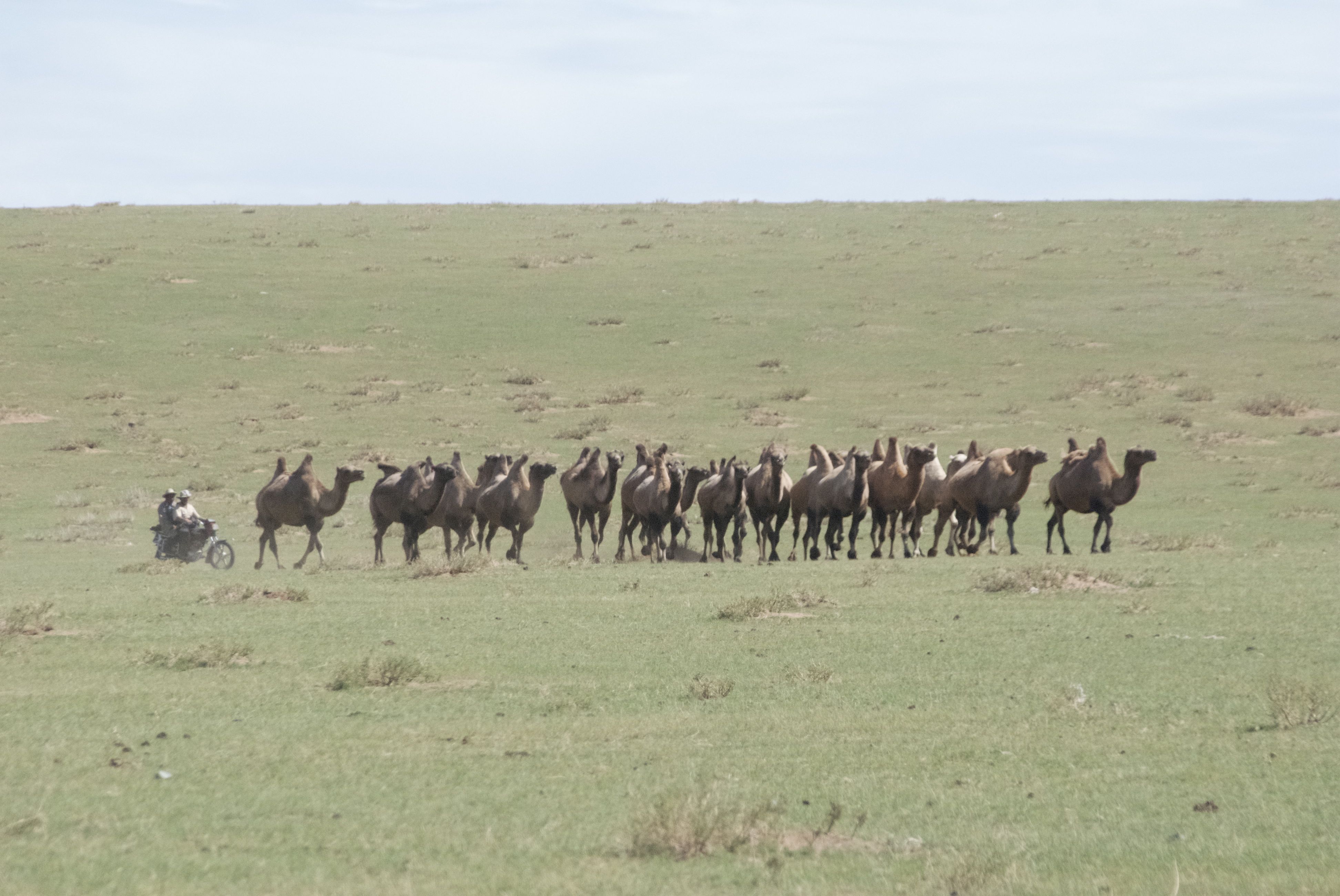
Hill-sides here and there are patched with sheep; in the plains below mounted Mongols are dashing right and left through a large drove of horses, pursuing those they wish to catch, with a noosed pole that looks like a fishing rod. On some lovely stretch of road you come upon an encampment of ox carts, the oxen grazing and the drivers mending the wooden wheels, or meet a long train of tea-laden silent camels.

When the time for a meal approaches and a tent heaves in sight, you leave the road and make for it. However tired the horses may be, they will freshen up at this. They know what is coming and hurry on to rest.”

The previous post is here.

Mongolia Monday- “Among the Mongols” Book Review

I have built up a decent collection of books about Mongolia from a number of sources and now have most of what is readily available, some of which have been reviewed in past posts here, here and here. This one was a major find, however. It fits into what is really a sub-genre of travel literature: books written by western missionaries who have gone to “exotic” faraway places to seek converts to Christianity, something I will say up front that I have no sympathy with whatsoever.

“Among the Mongols” (The Religious Tract Society, 1888) is, however, a delight from beginning to end. The Rev. James Gilmour may have originally gone to Mongolia to save souls, but seems instead to have had a romping good time spending 21 years traveling from ger to ger across the countryside learning as much as he could about the Mongols and their culture, including the language, providing free medical treatment and talking about the Bible when opportunity permitted. About halfway through the book he allows as how he never gained a single convert and then writes two entire chapters explaining why converting the Mongols is almost impossible and maybe even not such a good idea. The second chapter is called “The Mongols’ Difficulties About Christianity”. And then it’s back to important business- how the Mongols celebrate Tsagaan Sar, their New Year. Here’s a quote from that chapter on how Mongols eat that demonstrates his good-humored enthusiasm and eye for the telling detail:

As soon as the banch (small meat turnovers) was finished, every man pulled out his knife and set to work on the meat (a large platter of mutton). It is a little alarming to see a Mongol eat. He takes a piece of meat in his left hand, seizes it with his teeth, then cuts it off close to his lips. The knife flashes past so quickly and so close to the face, that a spectator, seeing it for the first time, has his doubts about the safety of the operator’s nose. Practice makes them expert, and their hand is sure, and I have never heard of any one, even when drunk, meeting with an accident in this way. The configuration, too, of the Mongol face makes this method of eating much safer for them than for us. A Mongol’s nose is not that prominent, sometimes hardly projecting beyond the level of the cheeks, and the foreigner’s nose lays him under a considerable disadvantage in dining after the Mongol fashion. “

Needless to say, Highly Recommended! More excerpts to come.

You can purchase your own copy here and here. Don’t pay over $30 for a decent copy. There is the London edition, which is the one pictured above, a US edition (cited by Michael Kohn in Dateline:Mongolia as recommended reading) and a new paperback reprint.

New Painting, New Drawings And An Interesting Call For Entries

Sort of an odds and ends Friday as the year winds down. The deep freeze is over here in coastal Humboldt County and it’s back to nice normal rainy weather with nighttime lows in the 40s. I’ve been getting in some good easel time of the past few weeks. Here’s a new argali painting from reference that I shot in July at Gun-Galuut Nature Reserve. I watched this group of rams work their way across the rocky slope for almost an hour. “Uul” is Mongolian for “mountain”.

On The Slopes of Baits Uul, Gun-Galuut 18x24" oil on canvasboard (price on request)

I’ve also decided that I want to paint not just the domestic Mongol horses, but the people who ride them. Which brings me back to wrestling with human figures, as described in an earlier post. I get a better result if I can scan the drawings rather than photograph them and also wanted to really hone in on accuracy, so these are smaller and done with a Sanford Draughting pencil, but on the same vellum bristol (which erases very nicely). The heads ended up being only 3/4″ high, which is pretty small, but it reminded me of a story from art school that I thought I might pass along.

One of my teachers was Randy Berrett, a very good illustrator who chose to work in oils. This was kind of masochistic, in a way, because it added a layer of complexity when he had to ship out a wet painting to meet a deadline. In any case, he was showing some examples of his work in class and one was a really large painting of the signers of the either the Declaration of Independence or the Constitution, I can’t remember which. Someone asked why he painted it so large. Randy’s answer really struck me at the time and has stayed with me. It’s something worth remembering when planning a painting. He said that he wanted the heads to be at least an inch high and that requirement controlled the final size of the painting. I’ve sized more than one painting on the basis of that criteria since then.

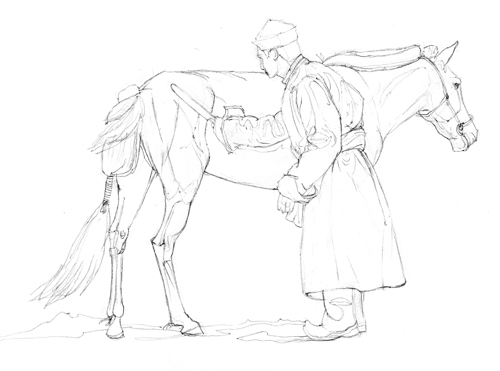
The first drawing combined two pieces of reference. One of the horse and one of the man. In the latter, he was in front of the horse’s head. In the former, I didn’t like the pose of the horse. Moving the man back works much better. The sweat from a winning horse is considered to be good luck. There are special scrapers made to remove it.

Scraping the sweat after the race, Baga Gazriin Chuluu
Local herder, Erdene Naadam
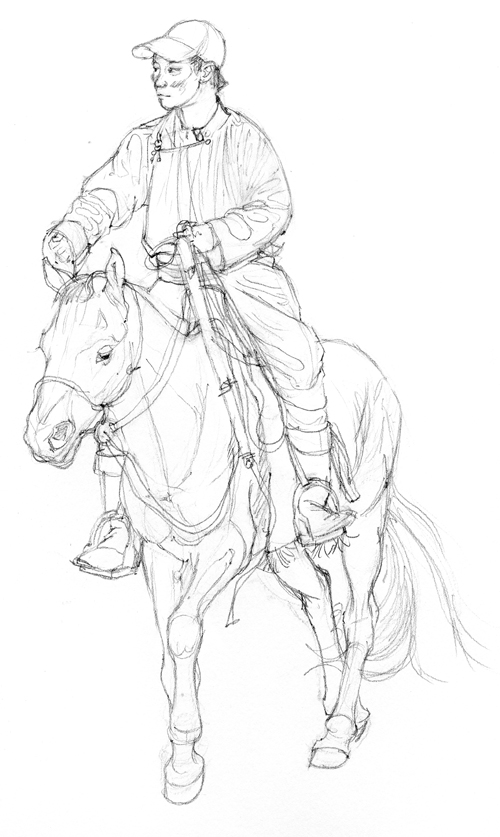
Boy on horse, Erdene Naadam

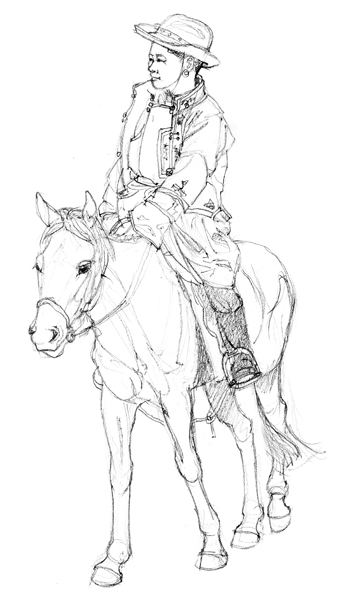
Part of the reason I did the previous two was to see if the images “drew well” and to work on horses coming forward at a 3/4 angle. The final two are head studies, in which the heads are 1 1/2″ from forehead to chin.

Local herder, Erdene Naadam

Local herder, Erdene Naadam

Finally, the folks at Eureka Books in Old Town, Eureka have decided to hold a special art show. Here’s the Call for Entries.

Mongolia Monday- Contemporary Music, Part 1

This is the first in an on-going series about one of the many delightful and unexpected discoveries that I’ve made since I’ve started going to Mongolia-

I was channel-surfing one evening when I was staying at the Narantuul Hotel in Ulaanbaatar during my 2006 trip and came across a music video channel. That’s where my introduction to the music scene in Mongolia began. Most of what is available for sale through outlets like Amazon are traditional “folk” music CDs, particularly performances of khoomi (throat-singing) and long song (in which female singers greatly elongate the notes). One could be left with the impression that Mongolian music consists only of these “indigenous” forms. One couldn’t be more wrong.

Great cultural synthesizers that they are, the Mongols seem to have picked up a number of western popular music idioms within five years of the changeover from socialism to parliamentary democracy and capitalism. In rapid succession that evening and on subsequent trips, I watched boy bands, rap groups, rock groups, neo-folk groups and a variety of male and female soloists. I found myself trying to scribble down names in Mongolian cyrillic. The first group that really grabbed me, and it will come as no surprise to anyone who knows the music scene there, was Nomin Talst. This last trip I “discovered” The Lemons, A Sound, A Capella and Pilots. Poking around on YouTube, which has hundreds of Mongol music videos, unearthed superb soloists like Ganaa (who was, and I guess still is, with one of the first successful boy bands, Camerton) and a woman who has an extraordinary voice, Maraljingoo. Here they are in a duet. I’ve  never been able to figure out the plot in this one. (Any Mongols reading this want to help me out?)

Here’s a solo video by Maraljingoo:

And one from Ganaa:

Unfortunately, I haven’t been able to find a way to buy any of this music via downloads. I purchased a few CDs when I was in UB in July and a Mongol friend brought back a stack last month from a list that I gave her. Otherwise, I have a 100 song playlist on YouTube and listen to a Mongol Facebook friend’s internet radio station here. His 32,000 song selection really runs the gamut from old-style vocalists to hard rock and everything in between.

I really enjoy listening to Mongol pop music while I work on paintings and drawings with Mongol subject matter!

Three Drawings of Mongol Horses and Riders

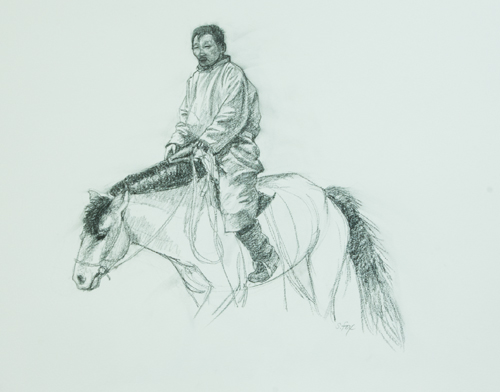
Drawing and painting animals has always come more easily to me than humans. No idea why, that’s just been how it is. But now, I’ve gotten really interested in the Mongol horses and the lives of the herders who breed, train, ride and race them. And I want to paint all of that, so now I really do have to get up to speed with people. These drawings are part of that process. They each took a few hours and I enjoyed doing them a lot.

Erdene-naadam-rider
Horse and Rider at Erdene Naadam, 2009; compressed charcoal on vellum bristol
BGC-boy-on-horse
Horse and jockey, mountain blessing day horse race at Baga Gazriin Chuluu, 2009; charcoal pencil on vellum bristol
Choi's-father
Herder and horse, Ikh Nartiin Chuluu, 2005; charcoal pencil on vellum bristol

Mongolia Monday: Two Poems

I haven’t posted any poetry for awhile, so here are two that I rather like. They are from “Modern Mongolian Poetry”, which was published by The State Publishing House in 1986. This was before the “changeover” from socialism, which started in 1990. So there will be 20th anniversary celebrations in Mongolia next year. Both photos were taken by me on my July trip to Mongolia.

Steppe

AUTUMN ON THE STEPPE

The boundless and spacious wasteland

Spreads yellow; and full-grown grasses sway

Grasshoppers, the world is completely silent,

Only the cranes soar the sky.

From the brown-yellow surface of the golden world

A scent rises, pleasant but strange,

And on the stone-mans’ forehead

Hoar-frost melts like beads of sweat.

B. Rinchen

Three

IT’S AN HONOUR TO BE HUMAN

“I am a human being.” These simple words

Have a ring of dignity and pride.

That’s why

I think that it is the highest honour

To be a human being

In body and soul.

I do not like it, I hate

To be flame in the heat,

Ice in the cold.

But to warm the one freezing to death,

To cool the one gasping in the heat-wave,

Not to flatter the powerful,

Not to insult the weak,

To lend a helping hand to those who stumble,

To encourage those who suffer-

That is how to be a human being.

If you’ve carried dignity and worth

As a banner of struggle,

If you’ve never compromised with cunning and baseness,

If you haven’t feared death.

In the cause of truth and freedom,

Be proud of yourself and say:

“I’ve been a human being!”

L. Khuushaan

Mongolia Monday- My Other Mongol Joke

Buuz is one of the most popular foods in Mongolia. They are a small, round steamed “dumpling” with a mutton or beef filling. Mongols make (and eat) zillions of them for their holidays. Just for fun we had a “buuz party” a couple of weeks ago. One of the guests, and the chief buuz maker, was a young Mongol woman, Ganaa, who I met when I advertised for a Mongolian language tutor before my 2006 trip. Her husband is an American who she met when he was teaching English over there in the Peace Corps a few years ago.

I told everyone at the party the Mongol joke that I posted here last week as we scarfed down many buuz and some delicious salads. Ganaa then told us a story about how a family is all sitting around a table eating buuz. There is only one left on the platter when, suddenly, the lights go out. After a short time, the lights come back on and the solitary buuz is gone. Everyone looks at everyone else. Who took the last buuz?

This has apparently been a running joke in Mongolia for many years.

Here’s a photo of the first buuz I ever saw.

buuz1

I was in western Mongolia, on my way back from the Khomiin Tal tahki reintroduction site. We stopped in a soum center (county seat equivalent) for lunch at this little buuz stand. The ladies made them to order and they were delicious! They were also somewhat bemused by my desire to take a picture of something so utterly ordinary (to them, of course). This was the first real Mongolian food I had ever had.