Mongolia Monday- “Ikh Nart Is Our Future” Update

I’ll get back to The Camping Trip, but I really want to share the news on the women’s felt crafts collective. Notice the change from “cooperative”. There are a number of words used in Mongolia for legally constituted groups, each of which has different requirements. I need final confirmation from him, but my scientist friend Amgaa, who has been instrumental in helping me help the ladies, believes that this is the correct term, which is almost surely a holdover from socialist times.

Stuffed toy camel in progress

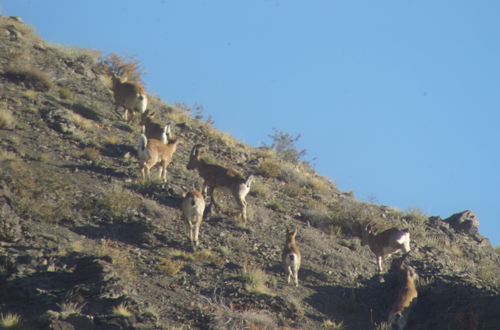
I spent a fun and productive week at Ikh Nartiin Chuluu Nature Reserve. There will be more about my argali and ibex sightings in a future post, but for the moment I’ll just say that I finally, after five trips there, got the reference photos I’ve really wanted – both species in great light and close enough for me to really capture details like head structure. Paintings to follow.

I’ve been so anxious to see Boloroo, the collective director, the other women and to find out how things are going for them.
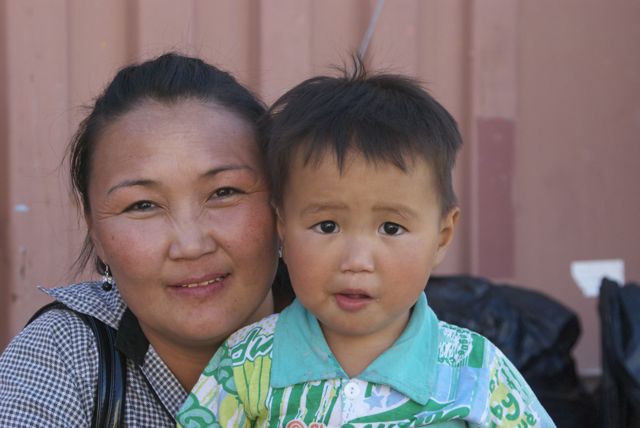
Boloroo and Tuvshin

I’ll quote from my journal:

Tuesday, August 10-
Great reunion with Boloroo and some of the other ladies. Learned that what started last year with 14 ladies from one Bag (the smallest administrative unit in Mongolia; “bag” means “small” in Mongolian) has now expanded to 30 members in four of the five bags in the soum (the equivalent of a county). Some of the new members came along and it was fun to meet them.

Tuvshin (Boloroo’s son, my little buddy from last year) is now a sturdy almost 2 year old. One lady who was pregnant last year came with her baby and husband, who brought a nice little ibex carving to sell. (I’ve got a probable donor for good quality steel carving knife blanks. I’d like to encourage the men, too.)

Two folding tables were set up and covered with lots of merchandise. The collective has expanded beyond felt crafts, too. One lady now has a knitting machine and brought a variety of tops and sweaters to sell.

Crafts

Selenge (the research camp manager and my translator) had me explain it all to the Earthwatch volunteers. By close of business, close to half of what had been brought had been sold.

A wonderful follow-up in every way to last year’s launch.

And customers

I was also able to have a private meeting with Boloroo, Selenge translating, about ideas for the kinds of things I think would sell in the US and some possibilities I’m working on for sales outlets. Many of the women will be perfectly happy to make slippers, stuffed toys and small, simple items to sell to visitors who come to Ikh Nart. But I’ve seen a level of talent and creativity in some of the women that I want to encourage. They can take their work, with practice, to a very high level of fine craft and therefore command much higher prices.

I watched Boloroo switch from visiting mode to business mode and am really impressed by how thorough and professional she is. I am so very fortunate to have gotten involved with a group that has her as the leader.

One of the new members and her family

I had also brought over a stack of sketchbooks, plus pens and pencils, so that young local artists would have the materials they need to create designs for things like purses. I believe this is better  than having a westerner like me do them, although I’ll be happy to help if asked.

Office interior

The following afternoon, I visited the soum center, Dalanjarglan, for the first time. Boloroo was there and we got to spend three hours together. She showed us the collective “headquarters”, a small free-standing building which used to be a gas station. It turns out that she bought the building herself. Amgaa had a banner sign made and donated some large informational posters from a past presentation about Ikh Nart. These have been hung on the interior walls. I saw the felt presses and they are clearly getting used regularly.

The felt presses

I had also paid for training earlier in the year in UB for Boloroo and one other lady, Lhagvadelger, the Bag Governor’s wife. Boloroo is now doing training herself. I also learned that there are four more levels of training available, so I will be looking for funding to cover that in the future.

Boloroo and I in front of the "Ikh Nart Is Our Future" office building

In UB a couple of weeks ago, I paid a visit to Tsagaan Alt, a store run by the Mongolian NGO from whom we got the felt presses and training. Everything they offer is of very high, consistent quality. Eventually, the collective will be able to sell their work there.

Selenge is going to try to keep up with what is going on with the collective and send me occasional reports.  Stay tuned. The ladies are clearly just getting started.

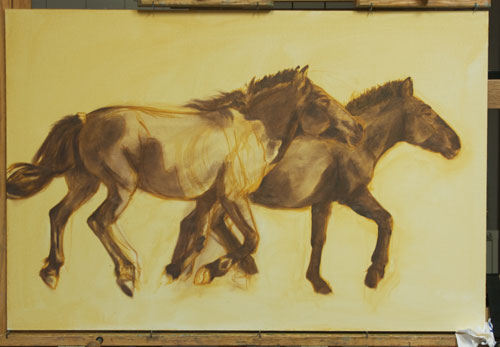
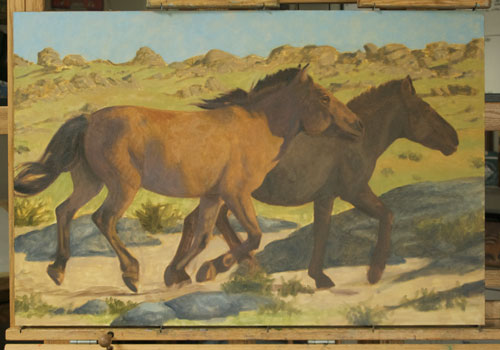
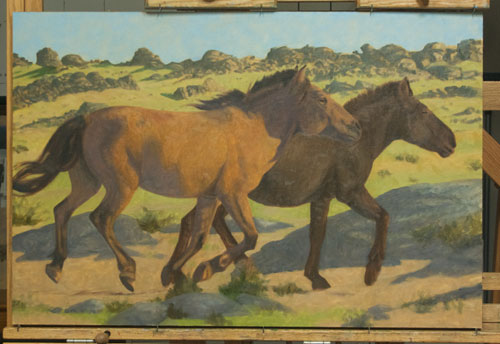
New Painting! “Mongol Horse #5-Evening Run” (Step By Step)

Mongol Horse #5-Evening Run 24x36" oil (price on request)

I was at Ikh Nartiin  Chuluu Nature Reserve in Sept. of 2008. While sitting outside my ger, a small herd of local horses came wandering by. It was early evening and some of them were feeling frisky, like this stallion. I loved the quality of light on his reddish coat. The background shows some of the fantastic rock formations at Ikh Nart, which provide habitat for argali sheep and Siberian ibex.

Here’s the step and step creation of this painting:

The brush drawing start
Laying the shapes of the shadows
First indication of the background
Shadow shapes for background elements
First pass of color for sky and ground
Progress on the horses
Light and dark sides established for rocks
Approaching the finish
The finished painting

Mongolia Monday: Boroo (Rain)

Mongolia gets very little rain and most of what does fall comes in the summer. After the brutal winter zud (a drought year followed by an extremely cold winter with heavy snowfall) that hammered the country these past months, a year of good rainfall would be a blessing, indeed.

Being a herding culture, the Mongols have always depended on rain to grow the grass they need for their animals. The rainy season is short, so I suspect that as wonderful as a Mongolian summer is, it’s also a time for some anxiety.

In 2008, rain came late, at the end of August. My husband and I were at Ikh Nartiin Chuluu Nature Reserve. We arrived on a beautiful evening. It started to rain at around 3am and didn’t stop for 18 hours (we counted). But we had perfect weather for the rest of the trip.

In 2009, on my Artists for Conservation Flag Expedition, it was definitely the rainy season, even though there wasn’t enough to break the drought.

Here’s a few of my favorite “boroo” photos. (Note: “Boroo” is pronounced more like “baurau”, with a rolled “r”.)

Naadam opening ceremonies, July 2009; the colorful show goes on for everyone, including the Mongolian State National Grand Orchestra
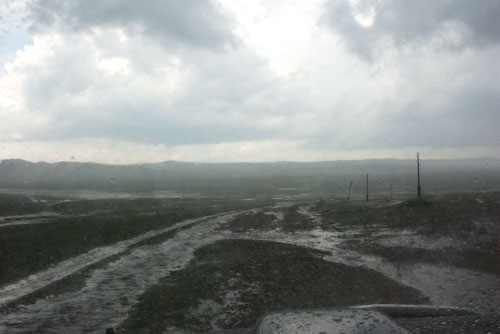
Heavy rain/hail en route from Ulaanbaatar to Arburd Sands ger camp, July 2009
One of the hailstones; roof of vehicle was dented
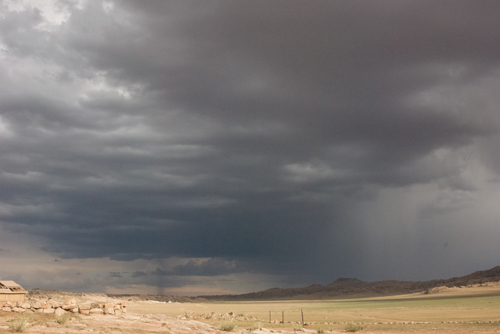
On-coming rainstorm at Ikh Nartiin Chuluu Nature Reserve, July 2009; it rained hard for an hour and a half so I just stayed in the cozy ger; the white rectangle in the background is one of the toilet enclosures. Yes, it was a bit of a walk.

Rain has, so to speak, seeped into the culture to the point where it’s a leitmotif in many of the music videos I’ve watched and clearly has romantic connotations. Sometimes it seems like there has been an informal competition between groups and singers to see who can work the most rain into their video.

Here is one from Javhlan. Imagine this singer with an absolutely glorious voice, standing in the woods singing as the crew poured “rain” onto him. I’ll bet he only needed one take.

And, taking it even further, is A Capella’s “Boroo”. Hope it was a warm evening.

Finally, instead of a set-piece like the previous two, Guys 666, who normally seem to be hard rappers, did this video, also called “Boroo”, that tells a story, albeit not an entirely happy one.

Mongolia Monday- The 6 Ecosystems

Continuing on with our series, I’ve always thought it would be fun to do a trip that would start either in the north or south and travel through all six major ecosystems in Mongolia, which run roughly parallel to each other in bands going from east to west.

Here is a map that shows them very well. It’s from a booklet, “Mongolia’s Wild Heritage: Biological diversity, protected areas and conservation in the land of Chingis Khan”, that was published in 1999. It was a cooperative effort between the Ministry of Nature and Environment, the Mongolian Academy of Sciences, the Mongolian Biodiversity Project and the Worldwide Fund for Nature. I don’t know if it’s still available, but if you are interested, drop me a note and I’ll see what I can do.

Starting in the north:

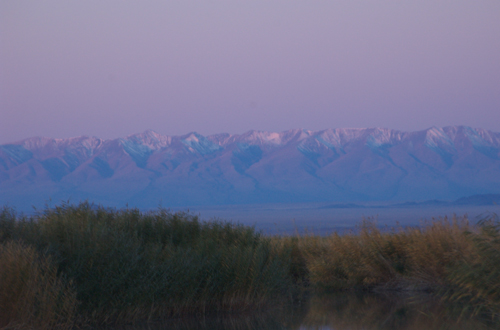
1. High Mountain– I haven’t been up into the mountains yet, but I did get the above photo of Jargalant Hairhan, which is part of the western Altai Mountains. The high mountains make up about 5% of Mongolia’s land. The climate is extreme. There are still some glaciers in the Altai Mountains. Animals that can be found there include argali, snow leopard, ibex, Altai snowcock and two species of ptarmigan. The photo was taken during my 2006 trip to Khomiin Tal on our way back to Hovd.

2. Taiga– the southermost part of the vast world-circling boreal forest, or taiga, extends into northern Mongolia.  It covers about 5% of Mongolia’s land area. The weather is also extreme with more rain and lower temperatures than most of the country. The most common species of tree is Siberian larch. Animal species include reindeer, wolves, wolverine, lynx, Eurasian river otters, stone capercaillie and three species of owl. This is the famous Turtle Rock, which I photographed in Gorki-Terelj National Park in May of 2005. It was snowing.


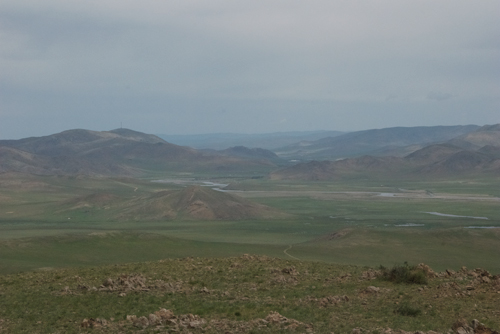
3. Mountain Forest Steppe- As the name indicates, this is a transition zone between the mountain forests and the grasslands of the steppes. It accounts for about 25% of the country’s land area. The mountains are of a lower elevation and include wide river valleys. Most of the population of Mongolia lives in this zone. Animal species include roe deer, elk (marel), wolf, red fox, Eurasian badger, Pallas’ cat, wild boar, great bustard, black kite and darian partridge. The image above was taken from Mt. Baits in Gun-Galuut Nature Reserve in July of 2009, looking north into the Kherlen River valley and on to the mountains.

4. Steppe– This is the landscape that most foreigners envision when they think of Mongolia. The famous grasslands cover about 20% of the country. The largest remaining area in Central Asia of this ecosystem is in eastern Mongolia. The climate runs from hot in the summer to cold in the winter, but not as extreme as the zones to the north and south. It provides much of the main grazing land for the herders’ livestock. Animal species include Mongolian gazelle, wolf, corsac fox, Siberian marmot, tolai hare, demoiselle crane, steppe eagle and saker falcon. The photo was taken en route between Ulaanbaatar and a ger camp at Arburd Sands in July of 2009.

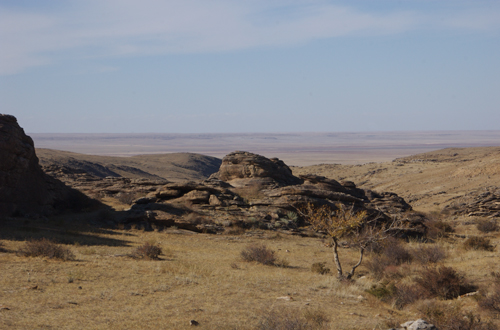
5. Desert Steppe- This is the transition zone between the grasslands and the Gobi (which means “desert” in Mongolian). It accounts for over 20% of the land area. Drought is frequent, along with strong winds and dust storms. Many herders live in this ecosystem, however. Animal species include takhi (Przewalski’s horse-reintroduced), khulan or wild ass, saiga antelope, marbled polecat, Mongolian hamster, houbara bustard, lammergeier and cinereous vulture. The image was taken at Ikh Nartiin Chuluu Nature Reserve in September of 2008.

6. Desert- The Gobi is one of the most famous deserts in the world, but, contrary to common belief, very little of it is sand. It’s mostly gravel and small rock and as you can see, there is vegetation. It accounts for around 25% of the land area. Where there are springs, families have truck gardens and it is well-known that the best and sweetest vegetables in the country come from the Gobi. The weather is, once again, extreme, climbing to well over 100F in summer and dropping to -40F in the winter. Animal species include wild bactrian camel (very endangered), Gobi bear (critically endangered; maybe 30 left), khulan, saiga antelope, argali, Pallas’ sandgrouse, saxaul sparrow and desert warbler. I took this picture in September of 2006. The red rock formations in the distance are the Flaming Cliffs, where the first fossil dinosaur eggs were found.

All this, in a country that is about twice the size of Texas!

Mongolia Monday- 6 Great Places To See Wildlife

The travel season is almost upon us. I’ve got my plane tickets for my July departure to Mongolia. For anyone else thinking about or planning to go there, I thought I’d offer one list a week for six weeks, of six “themes” for things to see, with six suggestions.  I’ll start with the one that’s probably nearest and dearest to my heart – wildlife viewing destinations. I’ve been to all of them at least once.

Takhi grazing, Hustai National Park

1. For horse-lovers, Hustai National Park is a must if you are going to Mongolia. It is one of three places where tahki (Przewalski’s horse) have been reintroduced and is only about two hours west of Ulaanbaatar, mostly on tarmac road. You may also see marel (a species of elk), Mongolian gazelle, marmots and a variety of birds, such as demoiselle cranes, golden eagles, saker falcon, and black storks. There is a permanent ger camp that is open year around. The main building has a pleasant dining hall. There are three large concrete “gers”. One houses a gift shop, one has displays about the park and another is where presentations about the park are given by staff scientists. You can explore the park by vehicle, on foot or horseback. When I was last there in the fall of 2008, there were 15 harems of over 200 horses.

Reedbeds, Khar Us Nuur National Park

2. Bird-watchers should consider traveling out to western Mongolia to go to Khar Us Nuur (Black Water Lake) National Park. Khar Us Nuur is the second largest freshwater lake (15,800 sq km) in Mongolia . The Khovd river flows into it, creating a large marsh/wetland that is home to the largest remaining reed beds in Central Asia. The lake provides habitat for wild ducks, cormorants, egrets, geese, wood grouse, partridges, the rare relict gull and also the herring gull.  May and late August are the best birding times.  Another freshwater lake, Khar Nuur (Black Lake), which is connected to Khar Us Nuur via a short river called Chono Kharaikh, hosts the migratory and globally threatened dalamatian pelican. Direct access to the lakeshore is limited due to the reedbeds, but there is open shoreline near the soum center (county seat) on the north shore and an observation tower on the east side. As far as lodging, I can’t make any recommendations since I was rough camping when I was there, but I’m sure there’s something in or near Hovd, the main town. From Ulaanbaatar, flying to Hovd is the only practical way to get there since it’s about a thousand miles west of the capital.

Siberian ibex, Gobi Gurvansaikhan National Park

3. The legendary Gobi is home to Gobi Gurvansaikhan National Park, created partly as a refuge for an endangered population of wild bactrian camels. They are in a remote and inaccessible (except for researchers) part of the park, however. There are also snow leopards and argali, which visitors should not expect to spot. What there is a good chance of seeing are Siberian ibex, pika, two species of gazelle, steppe eagles, golden eagles, lammergier or bearded vultures, black vultures and a variety of smaller birds. I stayed at Nomadic Journeys’ Dungenee eco-ger camp, which is taken down at the end of each season, leaving almost no trace. The kitchen and dining “room” are in connected gers. The setting is terrific, on an upland that has the park’s mountains in one direction and the Gobi stretching out in the other. To get there from Ulaanbaatar one either drives south on the main road, which is an earth road and takes, I think, two days, or flies into Dalanzadgad, which takes about two hours.

View of Steppe Nomads Ger Camp overlooking Kherlen River; the wetland is off to the right with the base of Mt. Baits behind it, Gun-Galuut Nature Reserve

4. A relatively new park, Gun-Galuut Nature Reserve is only a couple of hours east of Ulaanbaatar, mostly on tarmac road. There are two main wildlife attractions here: around 100 argali mountain sheep, which live on Mt. Baits and a wetland area with endangered white-napped cranes, along with a variety of other birds like cinereous vultures, demoiselle cranes, black storks, whooper swans, ducks and terns. The permanent ger camp has a lodge which houses a dining hall and bathroom facilities. There are many activities to choose from besides wildlife watching, including boating, archery, yak cart and horse riding, hiking and homestays with herder families, all of which provide employment for local people. This was the first stop on my Artists for Conservation Flag Expedition in July of 2009.

View from my ger, with passing summer rain storm, Baga Gazriin Chuluu Nature Reserve

5. I knew nothing about Baga Gazriin Chuluu Nature Reserve when I arranged to go there as part of my July 2009 Artists for Conservation Flag Expedition other than it had argali. I was only there for two days, but they were two of the most memorable days I’ve had in four trips to Mongolia. The reserve is home to about 60 argali, which are more tolerant of people and vehicles than the ones I’ve seen elsewhere, along with Siberian ibex, cinereous vultures, columbia rock doves and other birds.  The rocky uplands cover a smaller area than Ikh Nart (no.6 below), and are easy to get around in on foot or by vehicle. There is a ger camp tucked up against one of the rock formations with an amazing view down the valley. A concrete “ger” serves as the dining hall and has a covered patio area. There is a toilet/shower block, for which the water is heated by solar power. Baga Gazriin Chuluu is about a six hour drive on an earth road southwest of Ulaanbaatar.

Argali ewe with two lambs; one with radio collar, Ikh Nartiin Chuluu Nature Reserve

6. And last, but certainly not least, Ikh Nartiin Chuluu Nature Reserve, my destination when I first went to Mongolia on an Earthwatch project in spring of 2005. Ikh Nart may be the best all-around place to see wildlife in the country. There are argali mountain sheep, Siberian ibex, corsac fox, red fox, tolai hare, cinereous vultures, golden eagles, black kites, kestrels and many other birds. Nomadic Journeys also has an eco-ger camp here, Red Rocks, and offers guided and unguided trips. It is a great place to hike. There are fabulous rock formations, some of which have Tibetan inscriptions carved on them. You will need a GPS since, while there are some dirt tracks, there are no marked trails. This was the third stop on my Artists for Conservation Flag Expedition in July of 2009. Ikh Nart is a seven hour train ride or a five to six hour drive south and slightly east, mostly on tarmac, from Ulaanbaatar.

There are more photos in other posts on this blog. Look under “Mongolia” on the blog roll at the right or do a name search.

Mongolia Monday- The Saga Of The Scissors

When I went to Mongolia last July on my AFC Flag Expedition, I knew that arrangements had been made to meet with some unknown number of women at the Ikh Nartiin Chuluu Nature Reserve research camp to talk about helping them set up a felt crafts cooperative. I sorted through all my sewing stuff and came up with a pretty good-sized bag of needles, thread, notions and one extra pair of very good sewing scissors to donate to the cause. You can read about the meeting and see photos of the four intense days I spent with the women here.

The scissors, I found out late on the third day, were very, very, did I say very, popular. I was asked during a last meeting of everyone, if I could get more scissors. Sure, I said, how many pair? One for everyone, so 20 pair. I knew I could figure out some way to do this, so I said yes.

Then a burly man in a del, clearly one of the herders who had spent most of his life out of doors and who had quietly come in and was sitting by the door, raised his hand. Through my translator, he shyly asked if it would be possible to get 21 pair. His wife hadn’t been able to come to the meeting, but he would like to give a pair to her because it would make her happy. Yes, of course. I still choke up a little when I remember him sitting there in a ger full of women (Mongol women can be formidable), summoning up the courage to ask a total stranger for something for his wife.

My gift scissors being used to cut out the fabric for a del for my husband. The women made two, one for each of us, in three days. Notice that there is no paper pattern. The skill to make these traditional Mongol garments is either passed down or there are classes where it is taught.

Then, during a series of “competitions” that celebrated the end of the meetings, everyone divided up into teams to do skits. One team did theirs on where the scissors were because everyone was wanting to use them.

I think what is being said is something like "I need to cut this. Where are the scissors?"

Fast forward and I’m back at home. My husband generously offered to donate the money to purchase the scissors through his company. I got on the internet and in touch with one of the staff people at the Denver Zoo Foundation. It turned out that a fabric store chain had 8″ Gingher sewing scissors on sale at a very good price. Sewers know that Ginghers are about the best you can get and that’s what I wanted the ladies to have.  So they were ordered and delivered to my contact person at the Zoo.

Next was how to get them to Mongolia. We’d hoped to send them over with someone, but no one was going in the near future, the scissors weighed a fair amount and, with security being what it is, we felt like it was a lot to ask for someone to take them on a plane, even in checked luggage.

The Director of the Conservation Biology Department, which is who I work through, said that the only reliable way to make sure they got to where they needed to go was via FedEx, so that’s what we did. That cost over $400. My husband had included $100 for shipping in his original donation and the Zoo picked up the rest. So far so good.

The scissors arrived at the airport and then it got complicated with customs paperwork that none of us knew had to be done ahead of time. More fees, which my husband covered. But the scissors were in UB and in the possession of the right person, who would make sure they got to where they needed to go.

All along I’d had this vision of the scissors arriving in the winter when the women didn’t have as much work to do, so would have time to make felt items to sell this summer. And it would be cold and things would be difficult, but maybe this would be a nice mid-winter surprise. And I would be announcing that this endeavor of my Art Partnerships for Mongolian Conservation had been successfully concluded.

Unfortunately, this winter has turned out to be what the Mongols call a “Zud”, heavy snow and extreme cold, as in below -40F, which is a “normal” winter low. Haiti has the world’s attention, deservedly, but for those of us who care about Mongolia, there is a crisis happening there, too. I wrote to the scientist who goes to Ikh Nart every month and who is going to deliver the scissors, asking how my friends are. His reply was that he hasn’t been able to contact anyone, but will let me know when he does. I suspect that he can’t even get to the area right now. Conditions may not improve until April. I know that the Mongols are resourceful people and they’ll help each other through this, but I am concerned. I’ll be very glad when I hear that everyone is ok.

I’ll post as soon as I have news. In the meantime, I’m making my plane reservations for the next trip in July/August.

I’ve Returned from Ikh Nartiin Chuluu

My trip to Ikh Nart was amazingly successful. It seemed like all the stars aligned for my three days of meetings with the women who want to start a crafts cooperative.

It’s going to take a bit to sort it all out and write it down coherently, but the punchline is that they got the word out, fourteen women took a five day felt workshop a month or so ago, and, when they showed up at the research camp (a half hour early), their new Director, Boloroo, handed me a fourteen page proposal and the ladies spread almost two dozen felt craft items out on the tables we’d set up.

To say that we were off and running would be a major understatement. The ladies even had a name for their group- “Ikh Nart Is Our Future”- ready for my approval. I approved. Immediately.

I had purchased four meters of felt in UB to give them and, in three days, all of that was turned into slippers, purses, a large rug and a variety of other things.

I also brought the fabric for them to make del for my husband and I. They finished both of them, fully lined and all the fastenings made by hand, sewn on manual sewing machines and ironed with old irons heated on a propane stove, in three days.

The next step will be to work out the details of the $800 loan that they have requested to buy a felt press, since their intention is to make the felt themselves, not buy factory-made.

Gana Wingard, the biologist who made the trip with me as translator and liaison, was as blown away as I was at how much effort they had put into this. We were going to go out early and late to look for argali and ibex, but never had the time. The schedule and pace was set by the women and it was non-stop. I did see and photograph some argali on the way into the reserve and on the way out.

To Jeff Whiting and everyone at AFC- I can absolutely guarantee you that you have gotten your money’s worth and then some for awarding me this grant. There are single mothers and poor families who will be benefiting for years to come because you made it possible for me to go to Ikh Nart.

Here’s a few photos:

Argali ewe on rock
Argali ewe on rock
The ladies arrive at the research camp
Laying Mongol felt rug design
Laying out Mongol felt rug design
Ladies working on felt projects
Me with new friend
Me with new friend
Sewing my del
Sewing my del
A felt purse with Ikh Nart patch which was given to me as a gift
Ready for customers; eleven Aussies, as it turned out
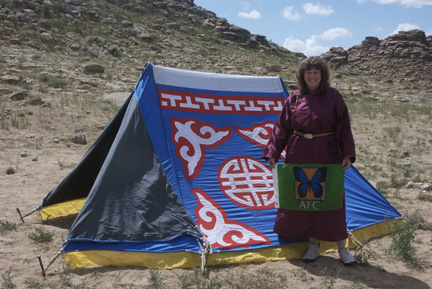
A "maikhant" or summer tent; me in my new del with the AFC Flag
A "maikhan" or summer tent; me in my new del with the AFC Flag
Group shot, including Aussie tour group members
Four argali that we saw as we left the reserve this morning


Plans are Coming Together

Let’s see….my Flag Expedition page should be live soon over at Artists for Conservation. I have confirmed that the weather is likely to be hot, hot, hot. Unless it rains, in which case it could be cold enough that I’ll want my down bag.

I spent three hours on the phone last night with Gana Wingard, the scientist with whom I am working on the women’s craft cooperative. She sent me a great email this morning entitled “The Grand Plan” and then noted that, of course, it’s all subject to change. But we now have hashed out a way forward and know what we need to do, who we need to talk to over there and when and in what order it will probably happen.

It reminds me of one of my favorite exchanges towards the end of one of my all-time favorite movies “The Wind and the Lion”. The Raisuli and his men are on their way to a small village, returning Mrs. Pedicaris and her two children to a contingent of American marines and, after hearing their destination described, along with the myriad dangers likely to be lurking there and the possibility that he could be killed,  The Raisuli says “It is good”. His right hand man says “What is good?’. The Raisuli answers “It is good to know where we are going.”

It turns out that Gana will be bringing radio telemetry equipment because she needs to find all the radio-collared argali or as many as possible before the next Earthwatch team arrives on August 2. There are plans to try a new population survey method since, at this point, it’s not really known how many animals are in the reserve. This is great news for me, since I will now be able to go out looking for sheep with someone who knows the reserve really well and is as motivated as I am to spot the animals.

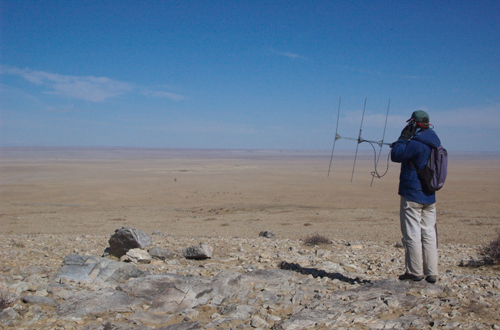
Here are a couple of photos that I took on previous trips of the scientists using radio telemetry equipment. The research project now has some GPS collars, which send in the data via satellite, but those are relatively expensive, so there are still animals that need to be tracked the old fashioned way.

Amgaa doing radio telemetry just below an ovoo, Sept. 2006
Jed Murdoch searching for a collared Pallas Cat; he never got a signal and the cat had vanished, April 2005
Jed Murdoch searching for a Pallas Cat he had captured and collared; he never got a signal and the collar was never found, April 2005
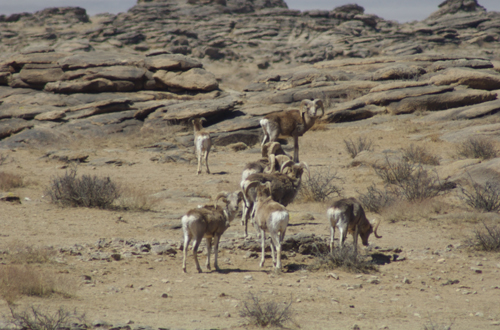
My "grand finale" sighting in 2005; a good-sized group; note the ewe left front wearing a radio collar
My "grand finale" sighting in 2005; a mixed group of eight argali; note the ewe left front wearing a radio collar; one of the handy things about argali is their habit of stopping to look back, which provides an opportunity to get photos of something besides their butts as they run away

Our plan is to “game drive” in the mornings and evenings, when it’s relatively cooler (Gana said that temperatures went over 100F last July. Okaaay.). During the day we will have our meetings with the women, for which the groundwork is being laid by another of the scientists, Amgalanbaatar (which means “peace hero” in Mongolian; see above photo), who we all call “Amgaa”. He is now at the reserve and is passing the word about the meeting and the hoped-for dates. Everything is tentative because summer is when the women have the most work do to, milking animals, making aruul and airag and also felt. We don’t know how many will come, but we know that they are interested. They will need to arrange to have someone watch the children and will want to be home in time to make dinner. Gana expects that they will arrive both on horses and motorbikes.

There are about 100 families living in and around the reserve, depending on their livestock for their living. The women all know how to sew and, in fact, the country women are the repository of the skills needed to make garments like del (the long robes). The younger women who have been brought up in town don’t learn to sew anymore. The material to make a del, outer fabric, liner fabric and trim costs about $30. Some of the women also do embroidery and since that’s something I’ve done on and off for many years, I’m really looking forward to seeing their work.

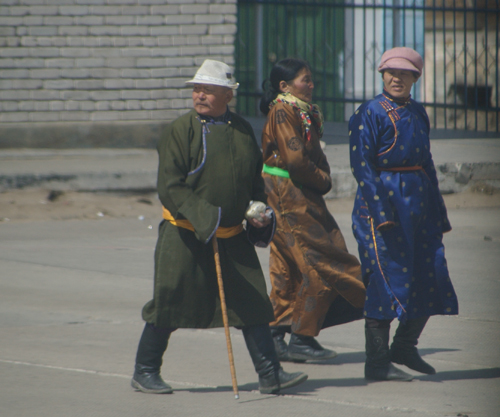
Three Mongols wearing del; train station, April 2005

After talking with Gana, we’ve scheduled a third day for me to get together with any of the kids who are interested in art. I’m taking some sketchpads, pens and pencils. Should be a fun way to pass a hot afternoon.

We plan to go to Ikh Nart on the 23rd and return to UB on the morning of the 28th. That will give me a day and a half to tie up loose ends. Five days and counting………..

Visit the AFC site here

It’s Official! I’m Going Back to Mongolia!

portrait

{Address}

Visit the AFC site here