Mongolia Monday- The Wildlife Of Mongolia Through An Artist’s Eyes: Argali

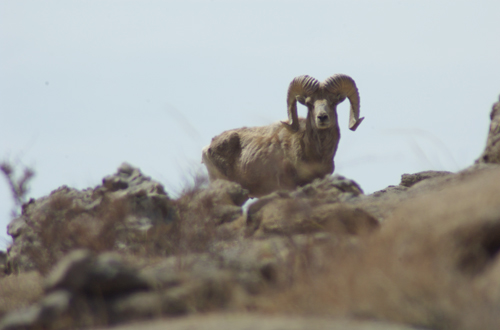
Argali ram, Ikh Nartiin Chuluu, 2005

My plan was to go back to Kenya in 2005 for an Earthwatch Institute-sponsored research project “Lions of Tsavo”. But I was leafing through the new Expedition guide and a project I hadn’t seen before caught my eye, “Mongolian Argali”, whatever those were. Oh. Wild sheep. But….Mongolia. Now there was a place that seemed like it might be interesting to travel to. And who knew how long the project would last. Some went on for a decade or more. Others only for a year or two. I called the Earthwatch office, changed projects and, without realizing it at the time, changed my life.

Argali (Ovis ammon) are the world’s largest mountain sheep. A big ram can weigh close to 400 pounds. The horn curl can reach 65″. Their preferred habitat is rocky uplands, mountains and steppe valleys. They are currently listed on the IUCN Red List as Near Threatened and Appendix II of CITES. Accurate population estimates are hard to come by. The most current one is perhaps as many as 20,000 in Mongolia. It is known that the total continues to drop in the western and central parts of the country, is stable in the south, but seems to be increasing in the east.

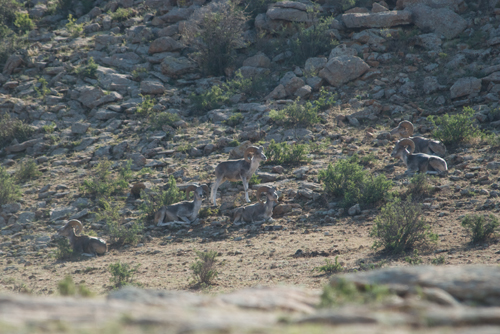
Group of four argali rams, Ikh Nartiin Chuluu, 2005

Threats include poaching, both for subsistence meat and for the horns, which are now in demand in China for use in traditional medicine. It has also been shown that there is a nearly 100% grazing overlap between the wild argali and domestic livestock, which includes horses, sheep, goats and cattle. Predation by the herder’s domestic dogs, particularly on lambs in the spring, is also a problem. Trophy hunting is not currently a large factor, but the license fee income (18,000 USD) ends up going almost entirely to the federal government. Very little trickles down to either the local people or for conservation projects. One response at the local level has been to create reserves where hunting is not allowed.

As you can see below, there is now an Argali Conservation Management Plan. My on-going involvement with the womens’ craft collective comes under item four on the list.

To quote from the Red List entry on argali:

“Additional conservation measures are desperately required in Mongolia. Clark et al. (2006) outlined the following:

• Implement the recommendations outlined in the Argali Conservation Management Plan.
• Improve enforcement of existing legislation that would help conserve argali.
• Enhance conservation management in protected areas where argali are found at high population densities, and increase the capacity of protected areas personnel and other environmental law enforcement officers.
• Work to improve the livelihoods of local communities in areas where argali are protected by local initiatives and re-initiate community-based approaches to argali conservation (Amgalanbaatar et al. 2002a).
• Develop public education programmes to raise awareness of the status of and threats to the species.
• Continue ecological research, monitor population trends, and study the impacts of threats, including work in the Altai and Khangai Mountains to complement research occurring in the Gobi Desert.
• Implement the recommendations from the Mongolian Wildlife Trade Workshop as outlined in Wingard and Zahler (2006).

Argali ewes and lambs, Ikh Nartiin Chuluu, 2005

Until a joint research effort was started by the Mongolian Academy of Sciences and the Denver Zoological Foundation at the Ikh Nartiin Chuluu Nature Reserve in 2001, very little was known about argali ecology, behavior and population status. This was the research that I had signed up to help with as part of the second Earthwatch team ever to go to Mongolia.

It was April of 2005. Spring in Mongolia is a time of cold, wind and dust storms. Daytime temperatures during the team’s two week stay, living in a traditional felt ger, sometimes only reached 32F. I had the time of my life. When they found out I was an artist, one of the scientists asked if I would be willing to go out and do direct behavioral observations. And that’s what I did for the last three days, trekking out alone into the 43,000 hectare reserve with a clipboard, data forms, GPS, cameras, water bottle and snacks, trying to see the sheep before they saw me, otherwise any data I collected was invalid.

I saw this large group at Ikh Nartiin Chuluu in 2008; seventeen animals, I think, and they ran up that vertical cliff like water flowing uphill

Although a lot of the animals were in poor condition coming out of a typical Mongolian winter in which temperatures can plunge to -40F, I saw many groups that included rams, ewes and lambs, gathered some useable data and got some pretty good photographs. It was a perfect two-fer. I was able to contribute to scientific knowledge of a species and at the same time get information that would be invaluable for painting them.
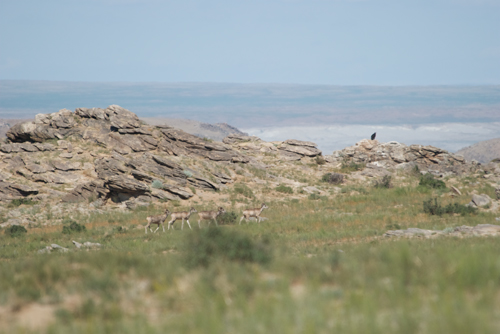
A typical sighting of some ewes and older lambs at Ikh Nart, but with a cinereous vulture, the world's largest, sitting on a rock in the background; in the distance is the desert steppe

I’ve been back to Ikh Nart five times since then and argali have become a particularly favorite subject. I’ve also seen them now at two other locations: Baga Gazriin Chuluu Nature Reserve and Gun-Galuut Nature Reserve.

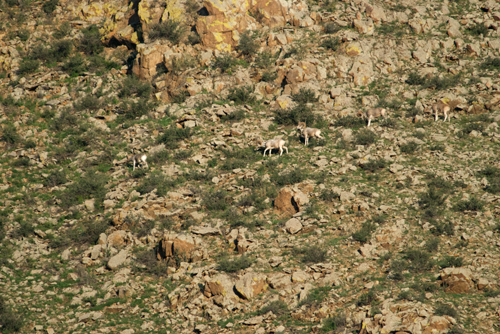
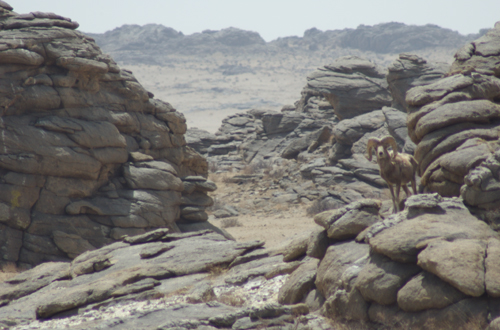
Driving into Ikh Nart in 2008; a grab shot from the car of four rams
Rams on rocky hillside at Gun-Galuut Nature Reserve in 2009; the key to spotting them is to look for movement and those long, thin legs, which don't seem to quite fit the landscape; this was with my 80-400 mm lens (effectively 600mm on a digital body) at maximum zoom
This group of rams, at Baga Gazriin Chuluu Nature Reserve were about 800 meters away within plain view of the road through the park; "lazy" animal watching

I thought that I would share some of the photos I’ve taken and the paintings that have come out of them. It usually takes around three, often quite a few more, reference shots since I move animals around, change backgrounds or whatever it takes to make a composition work. I’m only going to show the main animal reference that I worked from. This fieldwork is critical. When working on a painting, I’m also remembering what it was like to be at that place, how the wind felt, the utter quiet when I stopped for a break, then trudging along, looking up and seeing that the sheep had already spotted and were watching me.
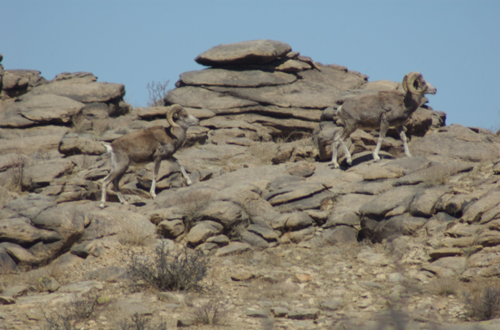
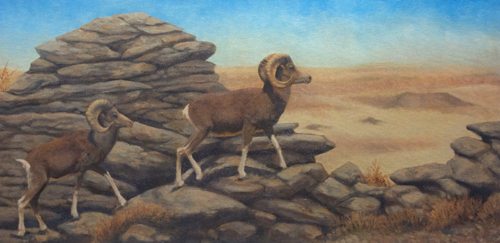
For one of my first argali paintings, I wanted to show them in the fantastic landscape of Ikh Nartiin Chuluu; April 2005
Ikh Nartiin Chuluu Argali 15x30" oil
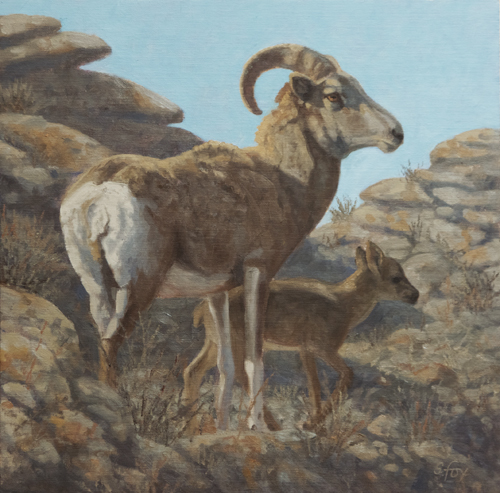
Argali ewe, Ikh Nartiin Chuluu; April 2005; I added a lamb and moved the ewe up so her head would be against the sky for maximum contrast
Argali Ewe and Lamb, Ikh Nartiin Chuluu; 12x12" oil on canvasboard
Old ram, Ikh Nartiin Chuluu; April 2005; He's probably long gone, but we spent a, for me, memorable half hour together as he let tag along behind him after checking me out; that's also him in the first photo at the top of this post
Mutual Curiosity 17x30" oil

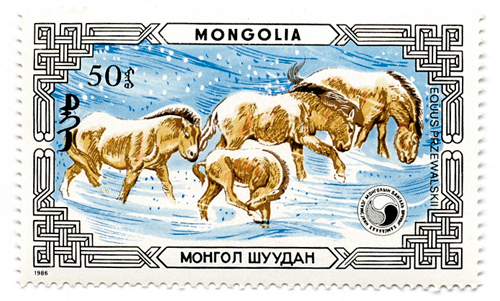
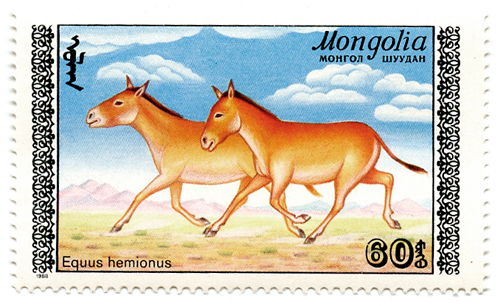
Mongolia Monday- Mongolian Postage Stamps, Part 4; Takhi And Khulan

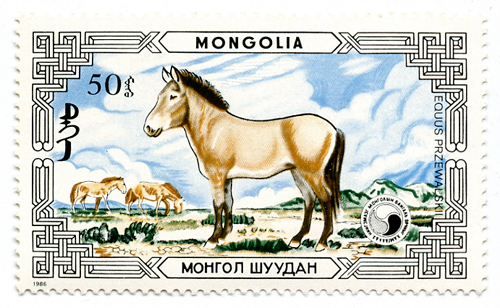
Concluding this series on postage stamps for now, today’s post features the two native equids of Mongolia, the takhi, traditionally known in the West as Przewalski’s horse, and the Khulan, one of a number of species of wild ass.

Takhi are the only remaining species of true wild horse. What Americans call “wild horses” or mustangs are really, simply, feral domestic horses. The two species diverged around 500,000 years ago, so the takhi is not the ancestor of modern horses, nor have any ever been successfully tamed, other than a few instances where a young horse was taught to tolerate humans riding it for a short time. The last wild takhi was a stallion seen in 1969. Captive animals started to be reintroduced to Mongolia in the early 1990s. Being a horse culture, the Mongols are very pleased to have takhi in their country again. And it’s not a surprise that they have been featured on a set of postage stamps.

Khulan are also known as the Mongolian wild ass. Their survival is threatened by habitat reduction and they are also subject to poaching. Not a great deal is known about their behavior or even their total numbers. However, there is an organization, started by a French researcher who is a friend of mine, which carries out the research needed to learn about the ecology of the animals and what their survival requirements are. You can find out more about her project here.

Unlike the takhi, which is a grassland species, the khulan live in the arid environment of the Gobi.

May All Your Wishes Come True. Happy Holidays!

Michiko watches a hooded merganser who visited our pond, Dec. 2005

Hawaiian Birds-A Cautionary Tale

Saffron finches

Unfortunately, most of the birds one will see in Hawaii are not native. It’s a long story, but the introduction of rats, cats and dwarf mongooses, along with habitat loss, have wreaked havoc with the native birds, many of whom are, or were, ground-nesters. Thirty-one species have gone extinct since 1800. The ‘Alala, or Hawaiian crow, went extinct in the wild in 2002. As of July 2010, 78 individuals were in captivity.

Red-billed Leiothrix

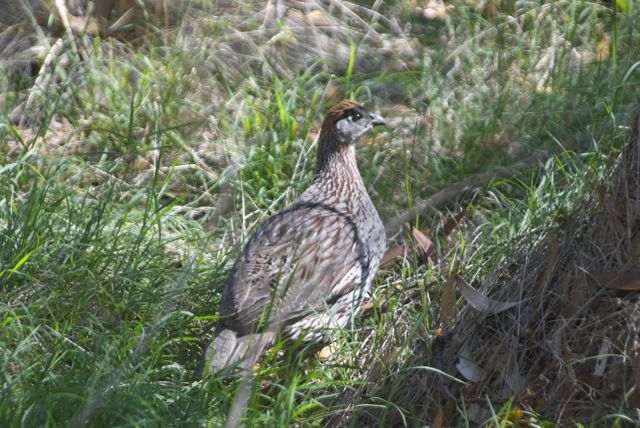
Almost every native Hawaiian bird is endangered, some critically. So it is ironic that one can stay at almost any resort and see lots of birds: saffron finches, common mynas, java sparrows, cardinals, house sparrows and others, but all have been introduced from other continents.

Erckel’s Francolin

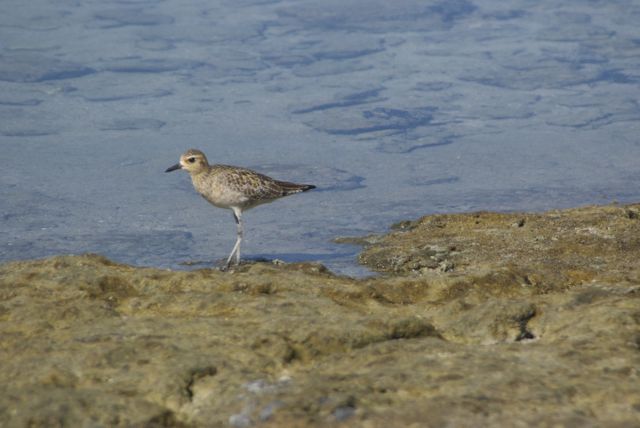
There are also migratory birds that can be easily seen along the coasts and beaches, mostly pelagic and shorebirds. However, they generally nest elsewhere.

Wandering Tattler

If you’d like to learn more, check out this Wikipedia entry.

Pacific Golden Plover

I’m on the Big Island and have been able to do some bird watching. In a week, I have yet to see a native bird. But I have gotten good photos of some of the other species that are here.

Kalij Pheasant

On Vacation In Hawaii!

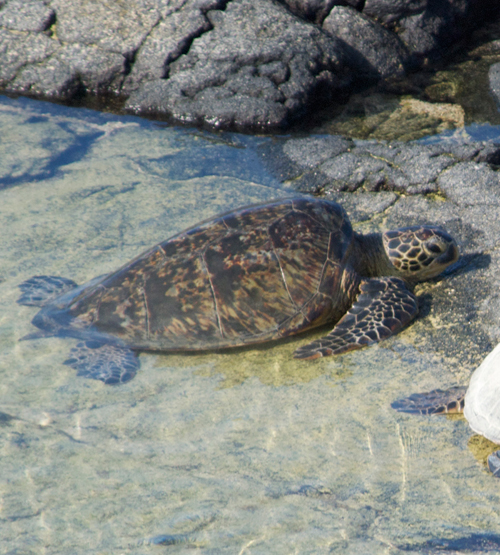
Hawaiian green turtle

I’m on vacation in Hawaii and having a marvelous time. I’ll be posting a few images when I can, so check back and see what I’m up to!

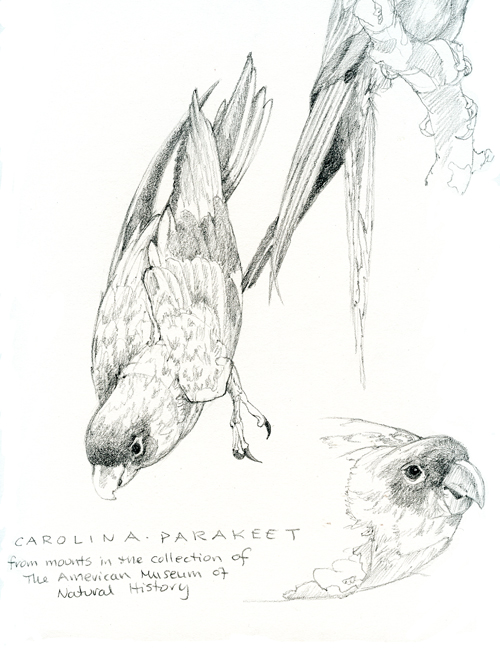
Carolina Parakeet Drawings For A Painting Commission

I spent a day last week at the Ornithology Department of the American Museum of Natural History (AMNH) in New York City, doing research for a painting that I have been asked to do. I’ll write more about this project as it goes along, but this was a necessary first step.

Readers of this blog know how uncompromising I am about seeing my subjects in the wild and how much doing fieldwork feeds into an animal artist’s paintings. In this case, however, no matter how much money I was willing to spend or how far I traveled, I wasn’t going to see this species in its native habitat for the simple fact that it has been extinct for almost 100 years.

The Carolina parakeet was the only member of the parrot family native to North America. Although the passenger pigeon is better known, this very colorful bird also originally was seen in enormous flocks in a range that covered most of the eastern United States from the Atlantic to Florida to Ohio and west to Kansas. They were shot for their feathers, meat and because they were considered a pest, as they liked grain fields and orchards.

And now, except for specimens in museums they’re gone, all gone. Forever.

So my only option was to do my fieldwork at one of those museums. I was going to be in New York for a Society of Animal Artists board meeting and was able to secure access to the rare and extinct bird collection at the AMNH. The room is locked and every drawer in it is locked. After all, there won’t be any more specimens collected of any of those species. I spent all day with two drawers of fifty skins, plus a number of mounts, measuring, photographing and sketching them. And marveling at how beautiful they were.

Now back at home, I’ve started to do drawings in graphite to learn what the birds look like. I will have to rely on the understanding, accuracy and competence of the taxidermists of the AMNH who prepared, preserved and mounted them. I hope to get permission at some point to post some of my photos, but for the time being what I can share is the art that I’m creating from them.

Carolina parakeet studies from taxidermy mounts

I will be working with a few colleagues who specialize in painting birds to ensure that I get their structure and body positions as correct as possible. I will also be consulting videos of a couple of similar species to see how they move and behave. This is a challenging commission, but one that I know will be very rewarding.

Mongolia Monday: We Interrupt Our Regular Programming For Three Special Announcements

But there is a Mongolia connection with all three.

When It Rains It Pours Department: The first two announcements are somewhat related since they both involve very special invitations to travel to “interesting” locations and work with fellow artists.

Update Jan. 2011: Guy and I both bailed on this one when it became clear that it wasn’t very well organized, but who knows, I may still make it to India sometime.

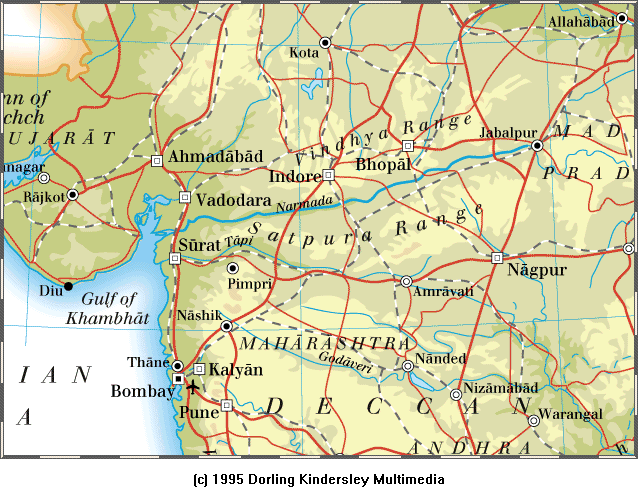
The first invitation has been extended to me thanks to my good friend and colleague, Guy Combes. Even though I’ve bought the plane tickets, I’m still pinching myself about this incredible opportunity. I’ll be departing on January 18, 2011 for Nairobi, from where Guy and I will fly to…..India! We will be part of an international group of artists from the UK, Sri Lanka, Pakistan, India, Nepal, Peru, the USA and Australia who have been invited to the Kanha Tiger Reserve for an Artist’s Week. We will be exploring the park, shooting reference and sketching in order to be able to produce art for a show which will tour internationally and then be auctioned to raise funds for tiger conservation. All expenses except airfare are being covered by our hosts, who own the luxurious lodge where we will be staying.

This is the place that inspired Rudyard Kipling’s Jungle Book stories. It is home to 22 mammal species and over 200 species of birds and is one of the remaining strongholds of the Bengal tiger.

And the Mongolia Connection? Babar, who conquered part of India, was a descendant of Tammerlane, who claimed descent from Chinggis Khan. Maybe or maybe not. But he did come from Central Asia and the part of India that Babar ruled became known as “Mughulistan” or “Land of the Mongols”. We know it as the  Mughal Empire, which lasted from the 1500s until the British took over India in the 1800s. The most famous artifact of the Mughals is the Taj Mahal, built by Mughal Emperor Shah Jahan.

Kanha Tiger Reserve is near Nagpur

After our week in India, we’ll go back to Kenya, where I will stay, visiting and animal watching until I come home on the February 15.

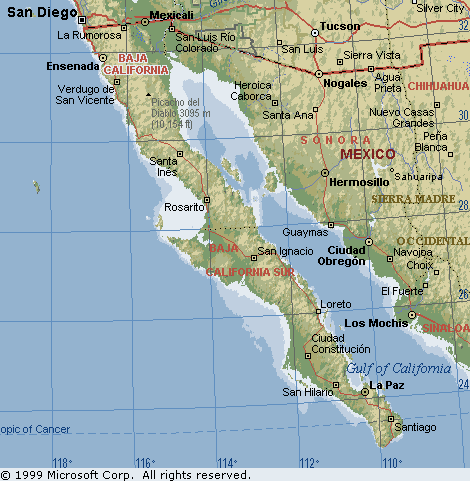
The second invitation came via an email from Dr. David Wagner, who specializes in curating shows of animal art, including the Society of Animal Artists annual exhibtion “Art and the Animal”. He has invited me to join him and a number of my colleagues on the Sea of Cortez at the end of March, 2011. We will be accompanied by a scientist familiar with the Sonoran desert and Sea of Cortez ecosystems. Our mission is to learn about them, shoot reference, sketch and paint, hang out on the beach and eat great Mexican food while talking art shop. The end result will be a show at the Arizona-Sonora Desert Museum in 2013. More details and who else will be going soon.

The Mongolia connection? I will be able to compare the Gobi with the Sonoran Desert ecosystem to see what the similarities and differences are of climate, plant and animal life. I already know that the far-western edge of the Sonoran Desert extends to Anza-Borrego Desert State Park, where there are desert bighorns and that there are argali sheep in mountain areas of the Gobi.

We will be based outside of Guaymas

Last but not least, I am pleased to announce that Plaza Design, with stores in Eureka, Arcata and McKinleyville, is now offering a large selection of my small, original oil paintings! There’s a little bit of everything, including landscapes and American wildlife. They will be offering a selection of my greeting cards, too.

The Mongolia Connection? There are currently a couple of takhi (Przewalski’s horse) paintings available, with more Mongolia subjects to come.

Here’s a look at the display in the Arcata store:

Next week I’ll wrap up The Best Camping Trip Ever.

It’s Been A Busy Trip

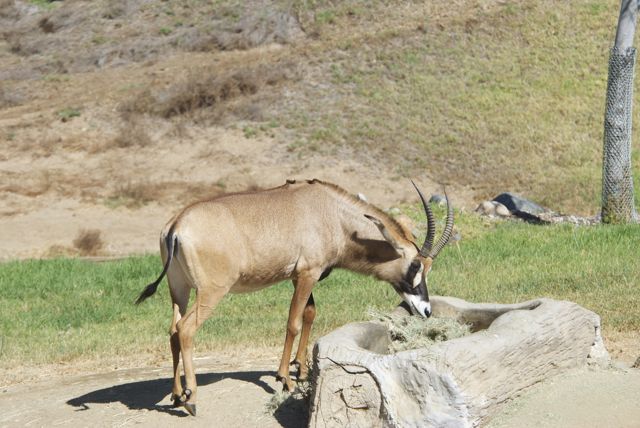
Roan antelope, San Diego Zoo Wild Animal Park

It was a jam-packed four days of activities at the Society of Animal Artists 50th Anniversary celebration. Along with whale-watching, we spent a day at the San Diego Wild Animal Park and the San Diego Zoo.

On the last day, we went over to the San Diego Natural History Museum for the official opening of “Art and the Animal”. Our work is beautifully displayed on three levels of the central atrium. Along with the artists and their guests, many members of the public were also in attendance. The show will be in San Diego until October 31.

Hippopotamus, San Diego Zoo

That evening, it was time for the annual banquet, which included the presentation of the Society’s first Lifetime Achievement Award to Robert Bateman, which he richly deserves for both his distinguished career as an artist and his commitment to conservation and environmental issues.

Our campsite at Anza-Borrego State Park; I slept on the cot under the stars

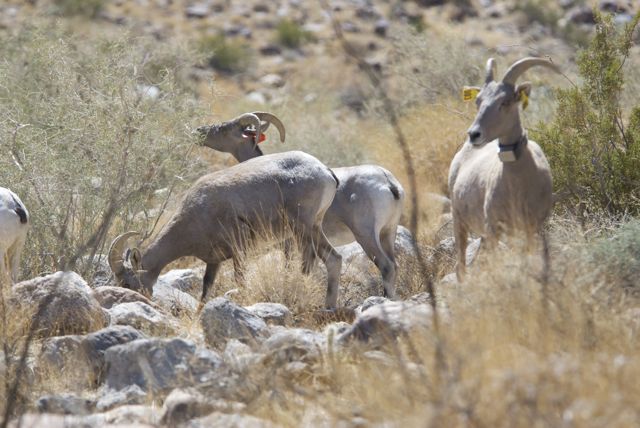
The next morning I and fellow artists and SAA members Guy Combes and Andrew Denman departed for Anza-Borrego State Park in hopes of seeing and photographing desert bighorn sheep. As you can see below, we succeeded, toughing out unseasonably hot daytime temperatures which reached 112F.

Desert bighorn ewes, Anza-Borrego State Park

Our next stop was the cooler clime of the Sierra Nevada foothills, home to the Sierra Endangered Cat Haven. As many of you know, I refuse to patronize for-profit game ranches. It has been a pleasure to discover Cat Haven, a non-profit operation which not only has the fittest and healthiest captive genetically wild cats that I have ever seen, but is heavily involved in a variety of conservation efforts on an on-going basis. I would encourage my fellow animal artists to consider a visit here to support an organization which puts the welfare of the animals first instead of using them for personal gain.

Tango the cheetah

Yesterday we took an afternoon trip up into Kings Canyon National Park, which I had never been to. We were awed by the jaw-dropping magnificence of the canyon and took a LOT of photos.

Kings Canyon

I’ll be home soon from my travels and am looking forward to getting back to my easel!

Update From The Society Of Animal Artists 50th Anniversary Celebration

I’ve been so busy the last couple of days that there hasn’t been time to do any posts. Day before yesterday was spent at the San Diego Zoo Wild Animal Park and yesterday at the San Diego Zoo. Terrific animal photos ops, lots of walking. And we’re all having a great time together sharing our love of art and animals.

Today are the main events: the annual member’s meeting, a very special presentation about his work by Robert Bateman, who will be receiving a lifetime achievement award, finally getting an opportunity to see the show itself at the San Diego Natural History Museum and, this evening, the banquet, during which Mr. Bateman will be honored and the show juror’s will announce the winners of the Society’s Awards of Excellence for this year.

Tomorrow Guy Coombes, Andrew Denman and I head out to Anza-Borrego State Park in search of desert bighorn sheep. My contact there has emailed me that the rams are already gathering and butting heads. There are sightings near one of the trailheads and even one of the parking lots! It’s also hot, hot, hot. As in 113F hot. Not sure if we’ll be able to camp in the park under those conditions, so we may have to seek out somewhere at higher altitude. But it’s all part of the fun and privilege of being animal artists on the road.

As I am able to access the internet I’ll try to post a few images from the rest of the trip, which currently also includes stops at two wildlife sanctuaries.